Have You Ever Wanted to Paint?

by James Wallace Harris, 9/27/23

I spend my days grazing on ideas. I listen to music, watch television or movies, read books, articles, or short stories, look at art books, browse the internet, read history, study popular science, and consume a lot of YouTube videos. All of it is about idea processing.

For breakfast, this morning I read “Painting of Hannah” by Lan Samantha Chang in the September 2023 issue of Harper’s Magazine. Follow the link if you want to read the story too.

“Painting of Hannah” is a short story about a young American, Jacob, studying art in France. Jacob stays at an atelier, apprentice to Thomas Gaugnot, a master painter who is trained in the naturalist technique, a student of Rennes, who was a student of Renoir, with a lineage all the back to Leonardo.

Gaugnot comes across like a Zen master, not saying much but tricking Jacob into seeing. Jacob must sacrifice both his ego and his desire for the beautiful artist’s model, Hannah, who he paints every day. Hannah, a young woman, lives with the older Gaugnot, and is Gaugnot’s muse. Gaugnot tells Jacob:

“They say my technique is obsolete,” Gaugnot said. “That is true. It is secret. It became a secret because no one cared. The attention of the world turned away from this kind of painting, what you call naturalism. You—­” His gaze pushed Jacob back; the chair creaked. “You are here to learn the techniques of this secret.” He smiled a small, triumphant smile. “You think it is romantic.”

We watch as Jacob learns to see. I’ve made a few lame attempts to learn to draw, but I’ve never stuck with it. I’ve even had some classes. I’ve learned with a few hours of work I can show some improvement, but I know becoming an artist takes years. That’s why I gave up, but that was lame of me.

I have several friends who are currently studying various kinds of painting. I admire them for not giving up. You don’t have to compete with John Singer Sargent to enjoy learning to draw and paint. You don’t have to move to France and study with a master for years. Ten thousand hours might make you a master, but thirty hours is enough to produce amazing results. Yet knowing that doesn’t allow me to apply myself at learning to draw. I hate that.

I wish I had that discipline because what I really want is to learn to see like an artist. That’s what the story hints at. That us ordinary folk are blind to most of the visual world. Gaugnot pushes Jacob into seeing what’s in front of the rest of us that we ignore.

The human eye can only see a tiny portion of the visual spectrum or hear a sliver of the audio spectrum. and there are other wavelengths of electromagnetic spectrum that are even beyond our senses. So, it’s a shame we don’t even make the most of what we can perceive.

Evidently, learning to paint means learning to see what we’ve never bothered to look at. I like that. I like that because that’s what I do all day long with my information grazing.

I feel reading and watching helps me discern finer shades of ideas, and learning to write is learning to paint with words. Writing these blogs is learning to see more into the spectrum of language.

But I wonder about Gaugnot and Jacob. They learn to put what they see on a canvas, but do we see what they saw when looking at their paintings? We might see beauty but without understanding the insight. And if I read something written by someone discerning something specific in the reality of ideas, can I discern it too by reading their writing? Or is it only telling me that I need to go look for myself?

There was something in this story, “Painting of Hannah” about Nietzsche that intrigued me. It was the concept of “Eternal return.” It hints at a Groundhog Day existence. That’s the thing about learning to discern all there is from the firehose of information we live with daily; it would take several lifetimes to learn how to perceive everything. Are we Bill Murray living the same life over and over? Are the Hindus right about reincarnation?

I don’t think I’m coming back, so I want to distinguish details as I can before I die, both visually and cognitively. I wonder if I shouldn’t study drawing again. Would the discipline I got from learning about light also apply to studying the perception of ideas?

All my life I’ve wished I had more self-discipline, but if a genie from a magic lamp offered me three wishes, what would be the downside if I asked for more discipline? There’s always a downside in those tales. Maybe I’ve already been granted that wish and I’m living the existence of eternal return.

Tonight, I might snack on “Painting of Hannah” again and reread the story before I go to bed. Reading short stories is like learning to paint, you must keep looking to see everything.

Tomorrow I will wake up and find something else to inspire me for the day. Jacob worked on the same painting daily for months. Is that the key? Maybe I should stay with one concept for months. Maybe the secret is not accumulating more information but studying the same information repeatedly.

JWH
Hitting a Cognitive Barrier

by James W. Harris, 9/24/23

I crashed into a cognitive barrier trying to write my reactions to The Trouble with Harry and To Catch a Thief, two Alfred Hitchcock movies from 1955. After two drafts I realized I wasn’t getting where I wanted to go. I know I don’t want to write movie reviews — the perfect place to find them is Rotten Tomatoes. Nor did I want to describe a film — just go to Wikipedia or IMDB. I wanted to write an essay that captured what I got out of watching those films at age 71.

Time is running out, so I need to make the most of every experience. That involves understanding myself at a deeper cognitive level. One I’m finding harder to reach as I age. On the other hand, aging is giving me more wisdom. The cognitive barrier is being able to express what I’m learning by getting older. But aging is also wearing down my brain. What one hand giveth, another takes away.

Writing is thinking outside of the head. Thoughts are generated inside the head from emotional reactions. Thoughts are fleeting. Thoughts are like cream stirred into coffee, creating little patterns that quickly dissipate. Writing is about capturing that initial pattern and making sense of it by showing how it relates to the memories of millions of past patterns.

Very few people can describe exactly how they feel, and few of those people can explain why they feel the way they do. There are rare individuals that can compose their thoughts inside their heads and eloquently convey the results in speech. Most of us need to think outside our minds via writing and editing.

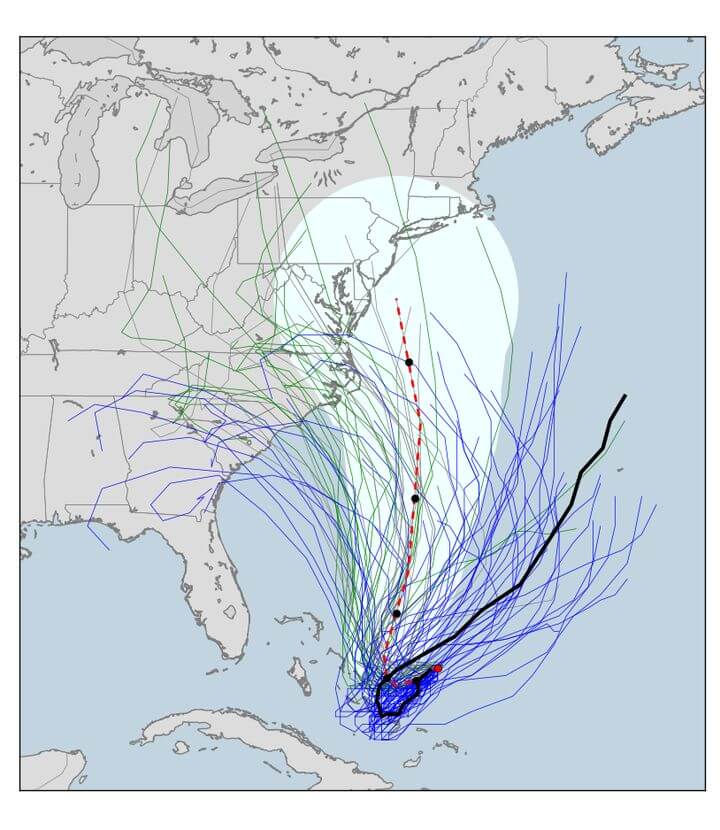
Even when we feel our written words are clear, readers seldom find clarity. Communicating with words is difficult at best and often impossible. What we think we’re expressing can often take a different path to each reader like those spaghetti strings we see in hurricane reports. I might believe I’m writing about Jacksonville, while some readers think I’m writing about Bermuda while others Miami and Charleston.

I enjoyed The Trouble with Harry better than all the other Hitchcock films we’ve watched this month, including Rebecca, Notorious, To Catch a Thief, and Strangers on a Train, films most critics admire a great deal more. However, I thought The Trouble with Harry had many flaws, but then Hitchcock is a flawed filmmaker.

How can I admire a movie that doesn’t measure well against the best movies I’ve seen over a lifetime? This gets into complexity and even multiplexity. I need to relate several reactions that contradict each other. The three films I admired and enjoyed the most this month have been The Trouble with Harry, Twelve O’Clock High, and Mr. Belvedere Rings the Bell. All three were feel-good movies to me, but they each made me feel good in a unique way. Is the word “feel-good” even useful? Many moviegoers might interpret the term “feel-good” so differently that these three movies would not fit their definition.

Should I even use the term? Shouldn’t I just describe exactly what I felt? Will that be clearer?

In my second draft I had a breakthrough. I realized to understand how I react to films I’d need to understand what I expected from them. But my expectations have changed widely over the years. And will my readers have the same expectations? It was then I realized that what I’m expecting from movies at 71 is different from my younger self. Even describing my own emotional experiences is a moving target. But explaining why that’s so hits another cognitive barrier.

I need to think about that.

Putting everything into words precisely is so difficult. Should I even try? I believe most people don’t because all they value is personal experience. Why tell anyone about our perceptions when they have their own?

Do you see why writing that essay became such a black hole?

JWH

Replacing Classic Novels

by James Wallace Harris, 8/12/13

Most bookworms just want to be entertained. They know their tastes are so individualistic that no friend or authority can predict what they will like. However, teachers and literary scholars like to think that certain books should be read, and a tiny fraction of readers are willing to read books because they have a great reputation. We feel reading the classics makes us a better person.

There is no FDA like agency that officially rates books as choice or prime. So, what makes a classic novel? The common assumption is novels that survive the test of time are the real classics. However, you can go on Amazon and order a lot of books from the 19th century that no one considers classics. Some people consider books that are taught in school or college to be the classics. And there is some merit to that, but literary works that get taught are also subject to the whims of pop culture, and English departments.

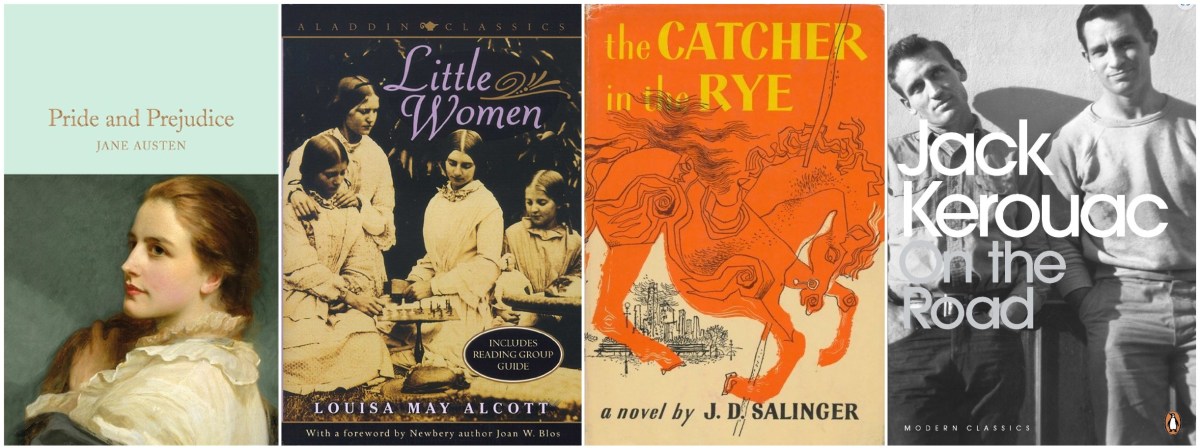
I mention all this, because I read “8 Overrated Literary Classics and 8 Books to Read Instead” by Jeffrey Davies, especially since it throws four of my favorites under the bus: On the Road by Jack Kerouac, Pride and Prejudice by Jane Austen, The Catcher in the Rye by J. D. Salinger, and Little Women by Louisa May Alcott.

Of course, this is clickbait, but I’ve seen this kind of essay before. A couple other examples are “13 Overrated Literary Classics, and What to Read Instead” by J. W. McCormack and “9 Overrated Classics — And What to Read Instead” by Zoraida Córdova.

I understand why young people rebel and want to overthrow the reading lists of the past, especially a past dominated by white male writers. And sure, sometimes these articles are just giving suggestions as to something different to read. But other times, I do feel the writers just hate the classics they are demoting. I often see On the Road and The Catcher in the Rye listed in these literary rebellions. (A hilarious generational attack on The Catcher in the Rye is the novel King Dork by Frank Portman)

What I would like to propose are rules for this game. If you want to oust a literary classic, you need to provide a proper substitute. All too often, these writers offer alternatives that are just their personal favorites, and usually something from recent decades. Classics have specific qualities that any substitute should have too. They include:

  • A snapshot of history – time, place, and subculture
  • Innovation in writing style and techniques
  • A philosophical or psychological insight

In other words, classic novels offer a view of everyday life in the past, even if it’s inaccurate, slanted, or distorted. That’s why I’m against publishers cleaning up aspects of older novels to make them politically correct for modern woke minds. We need to know both the good and bad about how we were. No censoring or whitewashing the past by substituting novels that agree with your moral and ethical sensibilities.

Classic novels supplement history books to build mental models of the past in our heads. Removing any one of them takes pieces of the puzzle away from the collective images we’re building of our cultural heritage and history.

If you’re serious about offering replacements because you feel an existing classic work doesn’t do the job well enough, then suggest a novel that offers a better view of the same time and setting. One that is more insightful.

The trouble is, doing just this is extremely hard. Readers have spent decades and centuries winnowing out the best novels. You might dislike novels for the views they show, but finding good replacements takes a lot of work and reading.

I would suggest, instead of trying to replace specific classic novels, you offer supplements instead that expand or enhance the classics. For example, The Catcher in the Rye (1951) and On the Road (1957) are about alienated youth in America before the youth rebellion of the 1960s. We need more novels about kids growing up in America in the 1940s and 1950s to expand on the views those two famous classics give. I would suggest Horseman, Pass By and The Last Picture Show by Larry McMurtry and The Bell Jar by Sylvia Plath, among others.

The challenge would be to find novels written near the time and setting covered, ones that have been forgotten but are worth resurrecting and remembering. There is something more authentic about novels written by people who lived in the time of the novels as opposed to later novels that are historical fiction.

Few novels are truly contemporary. On the Road was set in the 1940s, but was written in the early 1950s, and published in 1957. It takes a certain number of years to get the perspective and write things down. Breakfast at Tiffany’s was published in 1958, but about 1943. And it’s not the early sixties we see in the film, and neither is the plot or characters. Holly Golightly is a lot closer to Neal Cassidy than most people realize. She is another alienated youth from the 1940s, and another supplement for The Catcher in the Rye.

I understand why young readers dislike older novels. I can understand why they want to promote their favorite stories as classics. But I don’t think it’s an ethical idea to suggest they should replace the older classics, especially with newer novels.

They need to decide which novels from the eras in which they lived paint a worthwhile picture of those times and places, and then promote them as the classics that represent those settings and characters.

If these essay writers need a hook to promote the books they love, please don’t throw the books under the bus that other people love. I’d suggest being straight forward and creating titles like: “The Best Books about Miami in the 1980s.” Or “Novels About People Who Lived Down the Street from Jane Austen.” Or “Characters Who Lived While Jack and Neal Were On the Road.” Or “Novels That Louise May Alcott Read That We Should Read Too.”

JWH

How Addicted Are You To The Internet?

by James Wallace Harris, 7/31/23

Our internet went down Saturday, and a technician won’t come to fix it until Thursday. Living without the internet shows me just how addicted I am to the online world. And we haven’t gone completely cold turkey either, since Susan and I have little lifeboats to the internet with our iPhones. We’re like teenagers, with our faces glued to our phones. While streaming is down, we watch the two nightly shows we watch together, but with our separate iPhones. We both love that routine of watching Call the Midwife and A Place to Call Home every night.

Since we’re both retired, we spend a lot of time watching TV during the day – each with our own TV no less. And since we cut the cord a decade ago, we depend on the internet for streaming TV. I think that’s our biggest withdrawal symptom. So, we’re really addicted to television. But that’s been true since the mid-1950s.

Since the router has died, I realize we have two other addictions that are entirely internet dependent. First, is social media. Second, is information.

We have some friends that we spend time together with physically, but we also have more friends we mostly spend time with on the phone or online. I spend hours every week keeping up with my friends who live out of town, or just don’t get out of the house much. But I also have a new class of friends that I hang out with online. My hobby is science fiction, and I have several friends from around the world that I connect with daily or weekly via the internet. I would miss that connection if it were gone.

I was thinking about these internet friends the other day and comparing them with my science fiction fandom friends back in the 1960s and 1970s. Back then, I corresponded with other science fiction fans by letter, fanzine, and apazine. And I would meet them physically once a year at conventions. That network of friendship was like my current network of science fiction friends on the internet. But the snail mail network was far slower. I was in two quarterly apazines. Replying to people and reading replies would happen every three months. Now, it’s a matter of minutes.

The internet is also my external brain. I’m forgetting more and more words, people, and dates, but my iPhone or computer lets me look things up almost instantly. I’ve become very dependent on referring to Wikipedia, IMDB, ISFDB, Just Watch and other sites to recall words, facts, and events.

Over the past couple of days, I’ve tried to imagine life without the internet. Part of my addiction is habit. I suppose I could learn new habits to replace internet use. But it would mean living in a much smaller world.

Every day I spend an hour or more looking at YouTube videos. What they do is allow me to spy on what other people and animals are doing around the world. And I see amazing things. I have a far greater sense of what’s going on all over this planet than when I just read the newspaper and watched the CBS Evening News.

The internet is like a sixth sense. That’s a third addiction.

I could go back to living without the internet. I could even live without television and the phone. I might even live without books. But, subtracting each from my life would make reality smaller.

I think about the times in the past, where people never ventured further than a few miles from their homes, and they lived without any kind of distant communication at all. That could be a good life, even a better life. But it’s not the one I’ve evolved an adaptation to live in.

If you’re wondering how I created this blog entry, it’s because we went to the AT&T store and up our cellphone plans to include a hotspot feature and unlimited data. This will also make our phones more valuable during power outages too.

JWH

Thinking Outside of Our Heads

by James Wallace Harris

I believe recent developments in artificial intelligence prove that many of the creative processes we thought came from conscious actions come from unconscious mechanisms in our minds. What we are learning is computer techniques used to generate prose or images are like unconscious processes in the human brain.

The older I get, the more I believe that most of my thinking comes from my subconscious. The more I pay attention to both dreams and my waking thoughts, the more I realize that I’m very rarely making conscious decisions.

I might think “I am going to walk across the street and visit Paul,” but I have no idea how to make my body walk anywhere. But then, I’ve always assumed muscle actions were automatic. It was mental actions I believed were conscious actions. I used to believe “I am writing this essay,” but I no longer believe that. This has led me to ask:

Just what activities do we perform with our conscious minds?

Before the advent of writing, we did all our thinking inside our heads. Homer had to memorize the Iliad to recite it. Prehistory was oral. How much of thought then was conscious or unconscious? Have you ever read The Origins of Consciousness in the Breakdown of the Bicameral Mind by Julian Jaynes? I know his theories have lots of problems, but they do imagine what I’m thinking about.

How often have you worried over a problem, say a math problem, or a programming problem, and gave up, but then later, usually after a nap or sleep, the solution came to you? That’s the classic view of unconscious thinking. But even when we’re thinking we’re solving a calculus problem is it really being done at a conscious level? Are you consciously recalling all your math lessons over a lifetime to solve the problem?

How often when working on a Wordle or Crossword does the word magically come to you? But sometimes, we are aware of the steps involved.

In recent years I’ve developed a theory that when we work with pen and paper, or word processor or spreadsheet, or any tool outside our body, we’re closer to thinking consciously. Sure, our unconscious minds are helping us, but making a list is more willful than just trying to remember what we need at the store.

Writing an essay is more willful than woolgathering in the La-Z-Boy. Authoring a book is far more willful still. Engineering a submarine by a vast team of people is an even more conscious effort. Sure, it involves a collective of unconscious activity too, but a vast amount documentation must be worked out consciously.

I’ve written before about this idea. See “Thinking Outside Your Head.” That’s where I reviewed different techniques and applications we use to think outside of our heads.

Many people want to deny the recent successes with AI because they want to believe machines can’t do what we do. That humans are special. If you scroll through the images at Midjourney Showcase, it’s almost impossible to deny that some of the images are stunningly beautiful. Some people will claim they are just stolen from human creativity. I don’t think that’s true.

I think AI developers have found ways to train computer programs to act like the human mind. That these programs have stumbled upon the same tricks that the brain evolved. Many great writers and artists often talk about their Muse. I think that’s just a recognition of their unconscious minds at work. What those creative people have learned is how to work consciously with the unconscious.

What some creative people are doing now is consciously working with two unconscious minds – their own and an AI. There is still a conscious component, the act of working with tools outside of our head. Where the action is, is that vague territory between the unconscious mind and the conscious one.

JWH