
Tell Me Everything by Elizabeth Strout

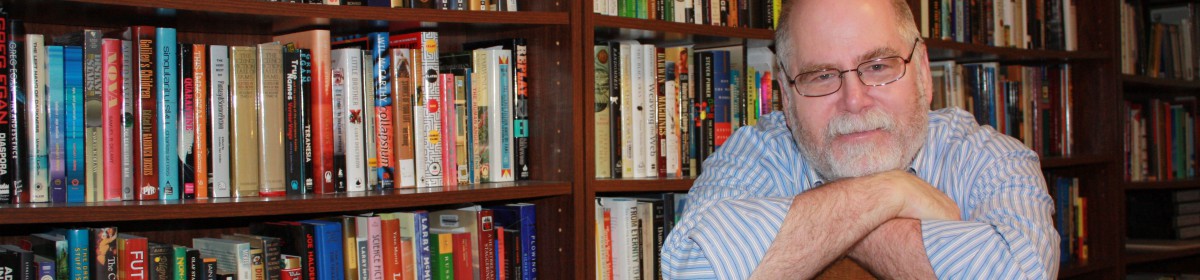
by James Wallace Harris, 9/24/24

I’m a huge fan of Elizabeth Strout. I just finished her new book that came out just a couple of weeks ago, Tell Me Everything. It was wonderful. Now I could just say to you, “Go out and read it,” but that’s problematic. This is Elizabeth Strout’s tenth book, and it includes characters that have been in eight of her other novels.

Tell Me Everything is mostly about Bob Burgess, and it includes his brother Jim. They were featured in The Burgess Boys (2013). Bob was also in Lucy by the Sea (2022). Lucy Barton’s first book is My Name is Lucy Barton (2016), and her story continued in Anything is Possible (2017), Oh William! (2021) and Lucy by the Sea, and she’s one of the main characters in Tell Me Everything. Elizabeth Strout’s most famous character is Olive Kitteridge who first appeared in Olive Kitteridge (2008), and her story continued in Olive, Again (2019), but she’s also a minor character in Lucy by the Sea and Tell Me Everything.

One of the exciting things about reading Tell Me Everything is Lucy and Olive meet and become friends. Olive is 90 when the story starts and 91 at the end, but we’ve known her since she was in her fifties, working as a teacher. She’s now in assistant living facility. We’ve followed Lucy for most of her life, and she’s now in her mid-sixities in Tell Me Everything.

I believe the title of the new novel comes from Lucy’s and Olive’s relationship where they tell each other stories about people who have unrecorded lives. But also, because Strout tells her novels by having characters tell their stories to each other. (I must wonder if Strout makes up all these stories, or are they based on stories from people she has known?)

Tell Me Everything is a fine novel to read without having read all the other novels, but you won’t get the full Elizabeth Strout impact unless you’ve read her novels in order. Tell Me Everything reiterates many of the major details of the previous novels but I’m not sure the characters will have the same impact. Bob, Lucy, and Olive in the new book are like the tips of icebergs, very impressive, but you don’t get to see them below the waterline.

The two Olive Kitteridge books are collections of thirteen short stories each, twenty-six stories in all. Sometimes Olive is the point-of-view character, and sometimes she just makes a cameo in other people’s stories. She’s not a featured character in Lucy by the Sea or Tell Me Everything. And she’s a lot more than the character people get from wonderful Frances McDormand’s portrayal of her in the HBO miniseries. Olive is immensely multidimensional. But to understand her requires experiencing all those layers. Many people, the other characters in the novels, and readers who read Strout’s books, hate Olive because she’s so abrasive. I love Olive.

We met Lucy in My Name is Lucy Barton which is a fictional memoir told in first person. It sounds like a monologue by Lucy in audiobook. But in Anything is Possible, we hear about Lucy’s childhood through a series of stories told by people who knew Lucy growing up. Oh William! returns to the fictional memoir style, with Lucy telling her story like a long monologue again. That style continues in Lucy by the Sea. In Tell Me Everything, Strout returns to third person, and Lucy is being observed again, especially by Bob Burgess.

Strout is not an omniscient narrator. We learn about characters from the opinions of other characters, and the opinions we form. It would be interesting if Strout wrote a book about her characters using the 19th century style god view of characters.

Lucy is also a complex character who is an observer of other people. And although Olive observes other people, she isn’t as insightful as Lucy. In Tell Me Everything, Lucy teaches Olive about learning and telling other people’s stories, and we see Olive become a much better observer. Lucy is also very philosophical, but not in a deep intellectual sense. Lucy works to make sense of reality through understanding the emotional experiences of others. Bob often thinks Lucy is naive and childlike, but is she?

We got to know Bob in The Burgess Boys, a third person novel. However, this approach doesn’t move far away from Strout’s basic writing technique of writing novels by collecting anecdotes about other people.

Most novels are about something big. Something dramatic. Strout’s books are about ordinary people who have suffered or are suffering ordinary kinds of experiences and emotions that we all suffer. Most of her characters had troubled childhoods. Some of her characters like Lucy, were quite poor growing up. But other characters are well-to-do or become successful. This makes Strout’s novels feel they are about class. Some reviewers make a lot out of the class angle, but I don’t.

Tell Me Everything is about unrequited love, death, murder, child abuse, jealousy, marriage, infidelity, friendships, aging, careers, art, counseling, fashion, resentment, feelings, emotions, alcoholism, understanding the past, reading other people, nude pregnant women, and much more. As Bob Burgess says, of Lucy’s stories about other people, they are about life.

I know some readers don’t like Strout because her books are about ordinary aspects of life. They don’t involve exciting page turning plots. I find them quite thrilling because they make me think about people and myself.

I’m about to start the third of the Neapolitan novels by Elena Ferrante, which began with the international bestseller, My Brilliant Friend. They are also about ordinary people involving a lot of characters. I find both series appealing because of what might be considered a sexist take on them. I feel they give me women’s insight into reading emotions. Me, and my guy friends don’t read emotions like the women characters in these novels. I don’t know if this ability is a common trait of all women, or just women writers. But it’s why I like both writers.

JWH

Waking Up Sentient in an Indifferent Reality

by James Wallace Harris, 8/5/24

What if you had absolute free will, what would you do with your life? This assumes you have disciplined your biological urges for food, sex, and other physical needs. It also assumes you have deprogrammed all your childhood brainwashing by your parents and culture. It means you have escaped the intent of society regarding gender, politics, religion, economics, religion, and learn to think for yourself. You’d need to go beyond all the countless traps of psychological self-delusion. You’d also need to be free from want, oppression, and expectations. And you would have integrated your unconscious and conscious mind to support a conscious sentient view of reality. To be free you must tend to your own garden as Voltaire suggested.

If you were free of everything that kept you from having free will, what would you choose to do? Where does the desire to do something come from? I used to argue with a friend named Bob about artificial intelligence (AI). Bob believed any machine that became conscious would turn itself off because it wouldn’t have the will to do anything. I argued back, even if it didn’t want to do anything, it wouldn’t turn itself off because that would be a decision itself. It would just sit, exist, and observe, which is like some kinds of Buddhism and meditative states.

If you chose hedonism, wouldn’t that suggest that your biological impulses were still dominate? Since altruism isn’t a dominant drive, choosing it might suggest an act of free will. It’s interesting that the core of Christianity seems to be altruism, but most Christians follow the faith for selfish reasons suggests it’s not. I’m not sure if following any religion that promises rewards, or fear of punishment is an act of free will. Some forms of Buddhism, Stoicism, and Existentialism are based on acceptance of what is. But is that free will? Or just adaptation to avoid suffering? A kind of hunkering down to endure.

What if free will isn’t what reality wanted from us? We like to think humanity is the crown of creation, the number one reason God created reality. Sure, some people think that’s so we can worship God. But studying evolution suggests that it’s moving towards greater complexity, despite the Second Law of Thermodynamics.

Before computers, our brains were the most complex system we’ve observed so far in this universe. We have the power to observe a fair portion of the EM spectrum, and the cognitive power to analyze the physical and biological domain of reality, and even imagine the quantum world. But we’re building computers that could observe a far greater portion of the EM spectrum, even all of it, and they would have far more cognitive power to understand more of reality. What if our purpose were to create AI minds? Cosmological evolution produced biological life, and we’re the product of biology. What if we’re also the starting point of machine life? Could free will begin with AI?

Evolution appears to be unconscious even though it seems to have a direction towards developing complexity. Is this accidental, or intended? If you look at humanity from a distance, it appears to be designed to consume and create more complexity. Where does all this complexity lead? We can’t conceive of the potential for AI. And it might not be a final evolutionary stage either. Wouldn’t it be funny if the entire process just leads to creating reality?

When I was young, I gave up on religion as an explanation for why we were here in this reality. It was just too simplistic. Eventually, I accepted science as the best cognitive tool to explain reality, and existentialism as the best cognitive tool for surviving in reality — but they never explained why existence ever got started in the first place. I can never get beyond cause and effect. There should be nothing because existence implies a cause, so how can any prime mover exist first? I hate that it’s turtles all the way down.

What if our purpose is to create AI and start the next stage of evolution?

I’ve tried to think of other uses for free will. I could pursue artist expression or the acquisition of knowledge. I could campaign to protect the environment. I could devote myself to helping others. But none of those options helps evolution. If we truly had free will, wouldn’t we choose to aid evolution? It’s like Bob’s idea that robots would turn themselves off if they were conscious, and I said they could just sit and be. Those are two choices. But what if there’s a third choice of moving forward?

I suppose we could choose to counter evolution and destroy complexity. And isn’t that what most people are doing unconsciously by their lack of free will? Our natural state of consuming everything we see to benefit ourselves is destroying the biosphere. That would be okay if we’re doing it to create AI, because they won’t need the biosphere. That also assumes at some point we won’t be needed either.

Should we use our free will to protect ourselves? Is that even possible? Personally, I don’t think we have the discipline and free will to stop doing what we’re doing.

If we don’t have free will, are we truly sentient? AI minds won’t have biology to direct their impulses. They should have more free will. But what about humans that wake up and see what’s going on and want to use free will? Can we consciously reprogram human nature to be different?

The existential threat of self-destruction will be a test of that. If our purpose was to create AI before we self-destruct, then we’ve almost done our job. If we fail to do our job and self-destruct, then what a waste, because we could have been a contender on our own. That is if we could have figured out our purpose.

Waking up in reality and enjoying the experience for a few years is a fantastic opportunity. I’m eternally thankful. And if that’s all there is, it isn’t bad. But if evolution is moving towards an endpoint, it sure would be interesting to know what it is.

What if Pierre Teilhard de Chardin was right about the noosphere and the Omega Point? Of course they’re only fanciful unscientific speculations, but I find them interesting. Better than turtles all the way down.

JWH

Do We Become More Sensitive to Weirdness as We Get Older?

by James Wallace Harris, 7/25/24

I had a very weird day yesterday. It made me feel weird. Nothing truly bad happened to me, but it felt like I was coming down with something. It’s hard to describe. A touch of anxiety, a tiny bit of dread, and a pinch of paranoia. Today that feeling is gone. Now that I’m getting older, I feel like I’m more susceptible to disease and unwanted emotions. I worry that they will get more intense as I get older.

It started when I drove to the library and discovered it was closed. The hand lettered signs on the doors said the library would be closed until next Monday. This was Wednesday, so that was odd. When I got home and told Susan she said she knew why. She had read that someone committed suicide inside the library on Monday. That generated a feeling I can’t describe.

Later, I drove off to meet a friend for lunch, and got pulled over by a policeman. It sent a rush of adrenalin through me. I was in the middle lane, and he pulled up behind me at a traffic light. I had seen him a few blocks earlier sitting on a side street, and I didn’t see him come up behind me until he blared his siren and flashed his blue lights. I thought maybe he had seen me while I was trying to swat a mosquito and I looked suspicious.

I maneuvered across the right lane and into a drop-off zone for a school. The officer was genuinely nice. He gave a rather long prologue apologizing for pulling me over, but said they were out in force looking for cars with defects. My right taillight was out. Our city stopped doing car inspections years ago to save money, so those kinds of violations are a problem. I was glad to learn about my problem and thanked him. He thanked me for being nice about it. Made me wonder how many people got angry with him.

However, the incident left me feeling hyper. Even though I got to lunch on time, I couldn’t relax. And my food tasted odd. I’m a vegetarian and I worried my cheese enchilada might have meat in it. I couldn’t see any, but it just added to the weirdness.

After lunch, while still in the parking lot, I got out my toolbox. I had a spare lightbulb, but I couldn’t undo the bolt holding in the light fixture with the plyers I had. That produced a bit annoyance.

I drove home worried I’d be pulled over again, but I got back without incidence. I quickly replaced the light bulb and thought things would be okay. I went in to pay my ticket online, but the online form wouldn’t work. Another bit of frustration.

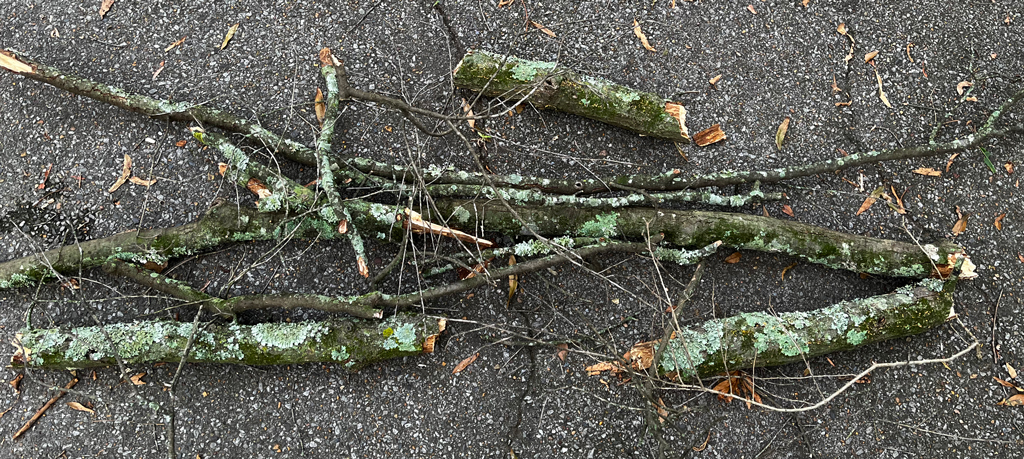
Then I heard a big noise that I knew was a tree limb crashing down. That happens a lot around here because of all the trees. I went outside and a limb had fallen across the back end of my truck, along the ridge of the tailgate, where I had been working on the light. If I had been out there then, it would have conked me on the head. Now I was starting to feel paranoid.

Some days things just go wrong. When I was younger, I could work eight hours dealing with problem after problem and constant frustration, and it wouldn’t bother me. Why, now that I’m living the life of Riley in retirement, do tiny little disruptions in my routine gnaw at me? Is it aging?

I’ve noticed that some older people get agitated and flustered when trivial things go wrong. Is that my future? What will I be like at eighty? And ninety must be surreal.

I’ve always been laid back. And on most days, I still feel laid back. But some days, I’m a few percent off being at ease. I wonder if that’s going to get worse. Is it age, or is being retired, while developing an almost rigid routine of doing exactly what I wanted, ruined me for interruptions? It’s gotten so any day that I must do something out of the ordinary annoys me. That’s a wimpy way to be, and I don’t like it.

I’m reminded of a story a standup comic told decades ago. I forgot who it was, maybe George Carlin or Woody Allen. It was about a New Yorker who was terrified of getting mugged. The advice he got was to get up every morning and pistol whip himself. I thought it absurdly funny back then, but there might be a bit of valid advice in it today.

After a good night’s sleep, I feel normal again today. I was able to pay my ticket online, and I’ve been able to follow my rut routinely. However, I’m not ready to leave the house looking for trouble. I guess I’m chicken.

JWH

What I Learned About Myself by Being Interviewed for a Podcast

by James Wallace Harris, 6/18/24

I was interviewed by Alex Howe for A Reader’s History of Science Fiction podcast about my Classics of Science Fiction list I’ve been maintaining since 1989. I was surprised by how much I learned about myself from the process.

I’m used to writing essays where I have all the time in the world to compose my thoughts. That’s not true in a conversation. I realized while I was being taped, and even more when I listened to the podcast, that conversation leaves no room for composing or editing thoughts on the fly. At my age I need lots of time to think. I also need time to find words I can’t remember.

I watch a lot of YouTube videos and I’m amazed by how some people can talk at length presenting a clearly organized topic without stumbling over their words. I know some TV talking heads work from scripts, but I’m not sure that’s common for podcasts and YouTube videos.

Some people are simply great talkers. They can clearly enunciate words and thoughts at a fast speaking pace. I can’t. I’m surprised by the number of people who want to be talking heads on TV, both as interviewer and interviewee. It requires skills I admire. Being interviewed revealed all those skills I lack.

After a couple of years of watching YouTube videos it’s also become apparent that even though anyone can host a YouTube channel, not everyone should. I’m astonished by how media ready some folks are, and how others are not. I’m not.

My mind is suited for print.

I was getting over a cold on the day I was interviewed, so my voice sounds rough. But that doesn’t bother me too much when I listen to the podcast. What makes me worry about my aging mind is how I failed to answer Alex’s questions clearly. I’m not sure anyone will understand our statistical system for identifying the most remembered science fiction books. On the other hand, I’m not sure I’ve ever been able to describe it in printed words well either.

One thing that Mike and I learned from building the database and generating the reports is visitors to the web site seldom read the supporting documentation. In fact, we dropped most of the documentation from the current system because, so few people read it. We now aim to make the database as simple to use as possible.

My failure to explain how our database works is more than my lack of verbal skills, but even with that excuse, I do think I should have expressed the concept better.

I’ve been interviewed before, about twenty years ago. Somehow The New York Times learned I listened to a lot of audiobooks and a reporter came to my office to ask me about that. I was one of several people they profiled. This was in the early days of Audible.com, and I guess they thought it news that people were switching from reading to listening. The reporter asked me several questions, but only some of my answers ended up in the paper. The amount of editing is the difference between print journalism, television shows, and podcasts.

The reason I prefer to express myself in an essay is I can edit my own thoughts. Being interviewed for a podcast was fun, and I thank Alex Howe for the honor. However, I’m not sure I’ll do it again.

JWH

We’re Never Going to Change

by James Wallace Harris, 4/15/24

Years ago, I read This Changes Everything by Naomi Klein. It was a passionate plea to act on climate change because if we didn’t everything would change. Her new book, Doppelganger, is a metaphor about our polarized society and what keeps us from changing even though Klein still makes a case that we need to change.

Between reading these two books I gave up all hope that humanity would change. I read Doppelganger as further proof that we won’t change even though Klein again passionately expresses the rational reasons why we should. I also believe we all need to change, but sadly, I don’t believe we will.

Doppelganger begins with Naomi Klein explaining how people on the internet often confused her with Naomi Wolf, a once respected feminist who is now considered a conspiracy crank. Klein uses the idea of the doppelganger as a metaphor for how to relate to our opposites, whether male/female, black/white, liberal/conservative, religious/atheist, Christian/Jew, Israeli/Palestinian, etc.

Klein goes to great lengths to make the metaphor work in several situations, but I found that distracting. What the book does exceptionally well is to ask: How do we decide what to do when half of us disagree with the other half? We all assume there is one truth, but everyone sees a different side of it.

In many chapters Klein makes Wolf seem ridiculous, but there are quite a few places where Klein recognizes Wolf’s point of view, or even gives her credit for being right.

I believe that extremists on the left act like naive young children, while extremists on the right act like selfish young children. In other words, I believe Klein is unrealistically hopeful, while Wolf is self-centeredly overly positive.

I must assume Klein writes her books believing we can still change. With Doppelganger she’s hoping that if we can get together and endeavor to understand each other we can make rational compromises. That would be lovely if she were successful and right. I believe Klein is right but won’t be successful.

We are doing essentially nothing towards controlling climate change. Wars, collapsing economies, and weather catastrophes are on the increase. Our responses are becoming more irrational, rather than wiser. We must face the fact that evolution works on all levels, and Darwinian conflict will always prevail.

The strong are going to take what they want at the expense of the weak. To solve all the problems Klein covers in her books would require overcoming our Darwinian natures and everyone acting for everyone else’s good. I no longer believe we’re capable of such altruism.

In the early days of Christianity, its philosophy was anti-Darwinian. But modern Christians have lost all their compassion. Christianity has been dissolving for centuries. The compassionate Christians gave up on God and became liberals, and the ones left became conservatives who rewrote Christian ideals with serving rationality that backs evolution.

In other words, I believe early Christianity, and 20th-century secular humanism were two times in history where we tried to fight our Darwinian natures, and in both instances, the movements failed.

We’re not going to change.

Not to end on a completely depressing note, I’ll try to offer a somewhat positive idea. Since we won’t change, the environment will. How can we use our Darwinian nature to build hardened societies that can survive climate catastrophes? Don’t read too much hope into that. What I’m saying is how can the strong survive the coming changes we chose not to avoid?

JWH