Samsara (2011)–Ron Fricke Shows Us the Diversity of Mankind

It is impossible to express how beautiful Samsara is to see on a big screen.  If you’ve seen Baraka or Chronos at the theater, then you’ll have the best idea of what you are in store for visually.  And this film is all about visuals.  It’s a documentary without narrative.  Beautiful hypnotic music, gorgeous exotic music, lush sacred music adds to the impact of the visuals, but this film is all about seeing.

If a picture is worth a thousand words, your mind will race through an encyclopedia worth of words as you watch Samsara.  It’s a rush.

I can’t emphasize this enough, but to truly experience this film you need to go see it in a theater.  I have Baraka on DVD and watch it on a 56” TV, and I love it.  But it’s not the full experience.  Nothing I can say can convey the full impact of the film.  No photograph or film clip does the film justice.

Now I warn you, this is an intensely intellectual film, even though it has no words.  Many people, will find it boring – if you have a fascination about this reality we live in, then your lifetime of thoughts will make this film great.  Your mind will create a narrative as you watch.  This show is a head trip, and your thoughts will script the film as you watch.  You’ll write it different every time you watch it.  The many scenes from around the world are meant to trigger deep philosophical responses. 

Samsara will probably only play one week in your town, so if its on, go see it while you can.

Be sure and set this clip to the highest resolution and watch it full screen.  Or visit the official site and watch the clip there.

Samsara was filmed in 25 countries with 70mm film, and converted to digital with a 8k scan, creating a 20 terabyte file.  That’s a lot of details to shoot up into your brain in one hour and thirty-nine minutes.  Most Blu-Ray films come in around 20 gigabytes, so Samsara has a 1,000 times more bytes of detail.

samsara_01

Samsara is a spiritual ride around the globe, zooming in on monasteries and prisons, jungles and deserts, slums and hi-rises, the poor and the rich, the beautiful and the grotesque, the living and the dead, a baby in the womb, and people in their coffins.

Samsara and Baraka shows how immensely diverse our world is.  It makes you realize that your view of reality, the one you’re so obsessed with, is really so very small.  Just before Samsara came on tonight they had a preview for The Hobbit.  That preview entices movie goers to come see a fantasy world rich in landscape and full of colorful fantasy beings.  It was a thrilling preview until Samsara came on.  The real world Samsara made the fantasy world of The Hobbit seem pathetic and dull.

samsara_02 

It’s very hard to describe Samsara because it doesn’t stay on any scene for very long.  Each clip is glimpse of a subculture from around the world.  Only a well traveled world traveler will know about most of these sites and people.  There’s even a humorous look of gun owners from around the globe, and beautiful sequences of bullet manufacturing.

samsara_03

Samsara spends quite a lot of time showing exotic locations of religious worship.  This was also true of Baraka.  I believe the filmmakers must be very spiritual people, but I see what they show in a different light.  I see the temples as relics of history, and their worshipers as primitive souls trying to hang onto a dying past in our fast pace world that’s constantly changing.  Our modern world, shown at night, looks like red blood cells coursing through veins.

samsara_04

The Buddhist monks carefully create a mandala with colored sand, but in the end they destroy their creation.  I assume to make it again the next day.  That focus on creating the details in the image is a kind of worship, or prayer.  Filming Samsara is the same kind of worship.

samsara_05

There will be scenes that might shock, disturb or disgust you, but they are all filmed so beautifully that I have to assume that the filmmakers see everything on Earth in a spiritual light.  Many of the scenes are just exotic people that live their lives so much different from ours.  Seeing the film makes me realize how parochial I am.

samsara_06

If Samsara isn’t at a nearby theater, then buy Baraka on Blu-Ray.  You can watch the entire film online, to get some idea of how Ron Fricke sees the world.  Watch it at least long enough to study the faces of the snow monkeys bathing in the warm water.  Think about how they see this world.  Think of the snow monkey watching this film like an alien from outer space seeing our world for the first time.  I’ve watch Baraka many times now, and I want to be the snow monkey.

Samsara and Baraka will not appeal to a lot of people.  I’m sorry that’s so.  People really should spend one evening watching a movie that so much different from their usual multiplex fare.  Take a trip around the real world, it’s more far-out than any CGI world ever created – even Avatar.

JWH – 11/2/12

Prometheus–Intelligent Design Comes to Science Fiction

The Review

As a Saturday afternoon science fiction adventure I’d give Prometheus a generous B.  I enjoyed the film despite all the illogical thinking and action that drives the plot.  The visuals are stunning.  Great android character, and I always love a good artificial being.  Appealing captain character, good hearted, but a bit clichéd.  Not much other characterization, but the film flowed and kept my interest.  Hope I’m not damning it with faint praise, but it’s that kind of flick.  Fun enough, but don’t think about it too much.  It’s pretty weird when the most appealing character is an android.

Prometheus is set in the same universe as Alien (1979) and Aliens (1986) and all the other sequels, yet it’s not exactly a prequel or a reboot, and for the most part it’s not like the other movies.  Prometheus has a new storyline and characters, with much better special effects.  It does mirror some plotting of the original Alien, even down to some very specific outcomes.
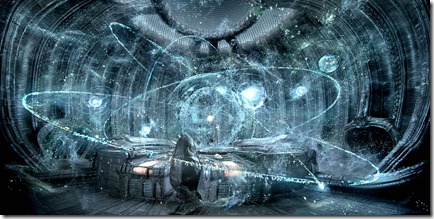
prometheus-movie-image

We don’t get many space adventure movies anymore.  Usually it’s invaders coming to Earth.  I miss movies where we go to alien worlds, so that explains why I enjoyed Prometheus so much, absence makes the heart grow fonder.  Space epics are about as common as westerns, my favorite movie genre.  So if you’re up for a space opera, Prometheus might satisfy you – if you’re not too picky.

Don’t read any further if you haven’t seen the movie, because I am picky, and I’m going to give everything away when I dissect the science fiction in Prometheus.

The Analysis with Spoilers

Science fiction is generally an idea genre, and the story has to make sense to the readers and watchers, even if its about something impossible like The Matrix or InceptionPrometheus is based on the idea that aliens seeded Earth with DNA.  Now panspermia is an old idea, and Prometheus deals with directed panspermia.  As a concept it’s rather farfetched, but I don’t have any trouble using directed panspermia as a plot device.  But other factors in Prometheus hint at Chariot of the Gods by Erich von Däniken, which suggests ancient alien astronauts took a direct involvement with human development and claims that early humans couldn’t have done things without alien help, like build the pyramids.  That I found offensive, so my hackles were up for any sign on von Dänikenisms.  For whatever reason, the aliens that left the maps are dubbed The Engineers.  At this point in the movie, the humans don’t know about the DNA, only the maps, and maybe implied interaction with ancient humans, so why call them The Engineers?

In Prometheus we are told the archaeologists Shaw and Holloway discover several ancient human cultures that have star maps that all reveal the same location.  We aren’t told the nature of these star maps, which are unrealistically vague.  We must infer that:

  • Ancient humans observed spaceships coming from this location in the sky
  • The Engineers caused a certain pattern to appear in the sky that was more obvious than stars
  • The Engineers gave the humans the maps to tell where they came from
  • The Engineers gave the humans the maps so future humans would travel there someday
  • Some Engineers are warning humans about other Engineers.

Clue #1.  We are shown an ancient Engineer seeding the Earth, and we assume it’s before life started.  We are not shown the Engineers appearing to ancient cultures, but isn’t that implied if several ancient human cultures have the same map?

Contention #1.  The archaeological evidence provides enough information to direct modern humans to the star system with the moon LV-223.  This is very bogus and hard to believe from the evidence we are shown.  If all of these ancient human sites held an actual alien star map that we could decipher, then that might be believable.  But several smudges carved in stone like a constellation pattern  is not enough information.

Contention #2.  The Engineers left a map to their home world.  In all first contact stories both aliens and humans are always worried about giving the location of their home world.  At this time the humans of the story do not know the Engineers left DNA seeding the Earth.  All they know about is the maps.  Again, why do they call them The Engineers?  Do they believe the they were ancient alien engineers who built early civilizations on Earth?

Contention #3.  Shaw and Holloway want to meet The Engineers to ask them why?  The implication is its an ontological question.  That they are calling these aliens The Engineers because they created us.  Later on in the movie David asks Holloway why he wants to meet his makers and Holloway replies he wants to ask why.  And David asks why did humans create him, and Holloway replies because we could. Then David asks, will that answer be acceptable to you?  Religious people, and people who believe in Intelligent Design feel humans must have a purpose.  Shaw and Holloway feel The Engineers might reveal our purpose.  I feel that’s both bogus and nasty.  Is there any purpose we can be told that won’t offend us?  Any prescribed purpose will make us a slave.  Do we really want to be the children of superior aliens?

Clue #2.  The map leads the humans to a world where The Engineers were building biological weapons of mass destruction.  This doesn’t make sense either.  Who gives directions to their secret military bases?   Could a group of good Engineers have gone to Earth to warn us about evil Engineers?  This makes sense but the movie never suggests that.  Are they holding back for the sequel?

Contention #3.  The Engineers have DNA that matches ours, and they look like us, and one of them gave his all to seed Earth with his DNA, so they are our makers?  Actually, if you dropped off some DNA strands in a sterile ocean I doubt they would do anything.  Panspermia depends on the initial building blocks of evolution to come from outside of the Earth.  This ain’t that.  Nor is there any reason to believe if they put the starting ingredients in our ocean, that billions of years later humans that look like them would appear on the scene.  Evolution and DNA don’t work that way.

Clue #3.  The reawaken Engineer immediately sees the humans and starts killing them.  If the Engineers seeded many worlds how would they know if humans were from the evil Earth they wanted to destroy or from one of the good planets they wanted to preserve?  Why would a species that looks like us want to kill us?  We assume the target is Earth because the android David discovered how to read their computer system.  If renegade good Engineers created humans maybe bad Engineers would always want to kill them on sight.  But does that make us the cockroaches of the galaxy?  Maybe the renegade Engineers are trying to create the saviors of the galaxy – us!

Contention #4.  The Engineers created H. R. Giger killer alien and they were stockpiling the black goo that would be used to infect the Earth.  How long has the Engineer’s ship lain dormant on LV-223?  Why was Earth up for destruction?  The movie is named Prometheus, and the spaceship is named Prometheus, but are we to assume the Engineer that seeded the Earth is a Prometheus?  Remember your mythology.  Prometheus brought fire to the humans and was eternally punished by his fellow gods by having an eagle feed on his liver.  If the Engineer Prometheus defied his fellow Engineers to bring DNA to Earth, why would any of these ancient human cultures know about the Engineers?  If they seeded the Earth before life existed, it would be billions of years before these ancient cultures even existed.  If the Engineers came back to give them star maps, then the Engineers have been keeping an eye on Earth for a very long time indeed.  Then why do they want to destroy it?  Again this points to two factions of Engineers.

Clue #4.  The Engineers were overrun by the H. R. Giger aliens, so they weren’t smart enough to protect themselves from their own weapon.  The human ship Prometheus is fairly easily able to destroy the Engineer’s ship heading for Earth, so they aren’t all that powerful.  And an ancient Engineer attacks a disabled Shaw but she’s able enough to fend him off long enough to sic the alien octopus on him.  These ancient Engineers aren’t that capable, or they are damn unlucky.

Contention #5.  Shaw and David the android know where the Engineer home world is and know how to fly an Engineer ship to it.  Shaw wants to know why they wanted to  attack Earth with the H. R. Giger aliens.   We won’t know the results of this point until the sequel comes up, but it’s not the conclusion I would have made.  Why didn’t Shaw go, “Fuck the Engineers, we’re flying to their home world to deliver they payload they intended for us.”    Why does Shaw continue to believe the Engineers has something to tell us?  Isn’t finding the plans and munitions to destroy Earth enough of a message?  My gut reaction was much different from Shaw’s. It would have been the same as Lester del Rey’s “For I Am a Jealous People.” Since this is a very difficult story to track down I’ll have to tell you the plot. Earth is under attack by aliens. We learn that God is on their side. So we get mad and go after God and the aliens planning to destroy both, because we are a jealous people.

This movie seems to suggest that the only good alien is a dead alien.  Are there no wise, gentle aliens inhabiting the stars that want to be friends?  We’re to assume that Shaw is making the same stupid mistake about meeting the Engineers as Rafe Spall makes when he treats the alien snake as cute?  Prometheus, Alien, Aliens, and all the rest tell us over and over again aliens from space are dangerous.  Of course, these are horror movies, and like the template for most horror movies, all the victims are stupid and all the bad guys are evil.  I hate this message in science fiction movies and books.  Why wasn’t Prometheus different and had the Engineers be noble?  Prometheus is a very cynical film.

Prometheus also sends another offensive message.  Prometheus is a science fictional version of intelligent design.  Why can’t people accept that life on Earth is an accident of evolution?  This Chariot of the Gods approach has the same problem as theology.  If God created us, who created God?  If the Engineers created us, who created the Engineers?  Why do we need an initial cause for our existence?  Prometheus is anti-science.

Shaw and Holloway want to know why humans are on Earth.  They are the driving characters of the story, yet their characterizations are extremely weak.  This is the first flaw of the movie.  By having a couple, the writers diluted the characterization of each.  Shaw eventually becomes the main character of the movie, but we don’t know that until the last fourth of the movie, and she never gelled as a personality.  Prometheus would have been far more gripping if Charlie hadn’t existed, and Shaw’s obsession was the main focus of the story.

The movie further dilutes the creation of strong characterization with the subplot of Peter Weyland, who wants to find the Engineers hoping they will bestow life extension on him.  If this was revealed at the beginning of the mission, it would have created two strong opposing wills, and that might have worked, but leaving Weyland hidden on the ship till near the end as a “surprise” hurt the story badly.  The character has no purpose and is killed off rather quickly.  Meredith Vickers who seems to run things but isn’t the captain, and who might be Weyland’s daughter, is another pointless character.

Great science fiction needs great characters with a clear goals or desires.  Think about Gattaca, we have Vincent a normal human living in a world of genetically enhanced humans.  Vincent wants to go into space, so how can he possibly have the right stuff when the real astronauts have been genetically engineered?  Prometheus doesn’t have strong characters because it had too many characters – nobody stood out, nobody’s goals drives the story.  Shaw’s goal is rather unappealing – wanting to meet The Engineers to ask them why they visited the Earth.  But isn’t that questioned answered when she discovers they brought DNA to Earth?  Are The Engineers the Johnny Appleseeds of life in the galaxy?

Why does Shaw wear a crucifix without stating her Christianity?  Isn’t this Chariot of the Gods plot in direct conflict with Christianity just as much as Darwin’s evolution?

I can buy The Engineers seeding the planets, but there’s no reason given why or if the Engineers visited ancient civilizations.  Why do these civilizations leave records of star patterns in the sky?  Did the Engineers come by to visit?  Did they help develop these civilizations?  And did they tell the people where in the sky they came from?  Why?  So we could come visit some day?  Then why is the location a biological weapon repository?  Why would you tell people it’s location?  That doesn’t make any sense.  In all first contact stories both humans and aliens are leery of revealing their home world.  If the Engineers repeatedly left maps of where to find them, where would they point to?  And why?  Again, my theory that good Engineers were warning everyone about bad Engineers.

You’d think the Engineers would think like Match.com users and plan to meet in a neutral and safe location.  We could also assume, a la Arthur C. Clarke, that the invitation is test of our readiness to be space travelers ourselves.  It’s a sign we’ve evolved.  The film eventually tells us the Engineers didn’t like how we turned out and planned to exterminate us with a black goo that generates the scary aliens of Alien/Aliens.  Are these the bad Engineers going around undoing what the good Engineers have done?

The Engineers look like us.  It’s implied we are their children.  So why destroy us with H. R. Giger aliens?  Are the monster aliens superior to us?  Are they meant to stimulate our development with adversity?  Are they some kind of punishment?  What did we do?

Peter Weyland has a much more powerful need to meet the Engineers, he wants to keep living.  I would claim seeking out aliens for advanced technology to be a greater driving force than religion and ontology, but it’s never really developed.  In fact, the idea is developed so late in the film, and nipped in the bud so quickly, that I think it’s just filler.

My movie companions did not like how Prometheus tried to mix in religion with aliens.  Neither of the two women I went to the show with are religious, and they just thought a cross wearing space woman was unreal.  Why mix Christianity with von Däniken mumbo jumbo?

Clue #5.  In the end, we movie goers get one thing out of the movie, we know where the H. R. Giger aliens come from and why.  They are a biological weapon of The Engineers.  We assumed they created them, but I supposed they could have found them on a planet and just used them.  Either way, we have answers for past Alien movies in the franchise.

Frankenstein; or, A Modern Prometheus

A reader recommended I read “Is Prometheus anti-science? Screenwriter Damon Lindelof responds.”  The interview gives me further clues about Prometheus.  I had forgotten the full title of Mary Shelley’s classic, Frankenstein; or, A Modern Prometheus.  Lindelof talks about the film as “Frankenstein 101.”  This works on several levels.  It emphasizes that Prometheus is also a horror film, that it’s about science and religion, and it’s about monsters.  From this analogy I have to ask: Who is the monster in Prometheus, and who is Frankenstein?

The obvious answer is The Engineers are Frankenstein and the monster are the H. R. Giger aliens, who appear to be created to thrive on humans.  But if we’re to believe they were created to destroy us, does that make us the monster too?  And what about David, is he a monster, and we’re his Frankenstein?  And who is the Frankenstein that created The Engineers?

These are great literary allusions, but this doesn’t sidestep that the Frankenstein theme is also a form of intelligent design philosophy.  I thought the movie was weakened by too many characters, but I think it’s also weakened by too many monsters and Frankensteins.  That could have been solved by not having The Engineers seed Earth with DNA, and then the ancient human star maps would have been warnings.

However, in the end, even though I give Prometheus an overall B, I do give it an A+ for ambition.

JWH – 6/10/12

Questions about The Avengers from a Science Fiction Fan

Are all superheroes as durable and immortal as Wile E. Coyote?  My wife and I went to see The Avengers the other day.  Normally we don’t go to movies about comic book characters, but The Avengers was getting such great reviews we thought we’d give it a try.  I went through a brief comic book reading phase in 1963, and I’ve seen the first Christopher Reeves Superman and the first Michael Keaton Batman, and that’s about it for my comic book experience.  As a child I loved the George Reeves Adventures of Superman TV show and the Mighty Mouse cartoons.  One of my  first blogs was about memories of all us neighborhood kids wanting to fly, “Super Men and Mighty Mice.”

I am a lifelong science fiction fan and computer geek, so I’ve been around a lot of people who love comics.  By all accounts, I should love comics too, but for some reason I don’t.  I’ve read books and watched documentaries about the history of comics and their fans, so I’m not completely ignorant of the genre.  But watching The Avengers was probably what it would be like for me to attend the opera, I was way out of my element.   It made me want to ask a lot of questions.

the-avengers

This isn’t a review of The Avengers.  I’m quite confident it’s a great movie for its intended audience.  I’m not the intended audience, and it left me wondering about many things, and I obviously don’t have the right mindset.  Maybe if I knew how the game was played I could have enjoyed the movie more.

Why people love comic books and superhero movies totally baffles me.  Now I don’t want to be a Grinch about comics, or be a old man fuddy-duddy pooh-pooh other people’s fun, but I do have some questions about comic books and superheroes.

My first question is:  Are you expected to check your mind in at the theater door when going to see a superhero movie?  Is the fun of such a show returning to the state of mind you had before starting 1st grade?  Is part of the thrill forgetting all logic and science?  Is the fun of watching The Avengers pretending to be five years old again?

Many people call superhero movies science fiction, but I really hate that because it suggests that science fiction can be completely ignorant about science.  I’d go so far as to say that superhero movies are anti-science by ignoring the laws of physics and coming up with really insane concepts and suggesting they are science based.  For instance, in The Avengers the whole story is built around a power source called a tesseract.  A tesseract is a geometrical concept, a 4D cube.  The film also has a flying aircraft carrier, space aliens, Norse gods, mutated humans and flying metal suits with no apparent fuel supply.  Plus characters can pound on each other like Warner Brother cartoon characters and behave like the Three Stooges and no one ever gets hurts, much less bruised and bleeding.

I have to ask:  Do superhero movies exist in a reality similar to the reality where Bugs Bunny and Moe, Larry and Curly exist?  That’s okay if that’s how to play the game, but to me fictional realities with no rules ruins the fun of make-believe.

And, why are superheroes like Greek and Roman gods?  They have all kinds of powers, they fly, they are petty and egotistical, and they fight with each other.  Also, we’re asked to believe that the fate of humanity depends on these beings saving us time and again.  Doesn’t that seem like some kind of transference from religion?  Are fans of superheroes worshippers?

Don’t get me wrong.  I’m not saying people shouldn’t watch superhero movies.  These movies are loved by millions, and the movie industry makes huge profits, a big US export, so they are great for the economy.  All I’m asking is if other people don’t question the fictional reality of the comic book superhero world.  I love science fiction, and even some fantasy, but the world of superheroes seems way out there, way beyond any possible believability.  Or is that their appeal?  Are comic books a genre about an alternate reality with no scientific laws and magic works?

I mean, we’re talking the age of myths.  It’s like reverting our minds back to a Paleolithic mindset.  Talk about your old time religion, this kind of magical thinking would put us back in the time of Genesis and Exodus, when the world was full of powerful beings, magic and great catastrophes.    Why are superhero movies so appealing?  Do people actual crave a time when the laws of physics were totally unknown and seeing is believing?  Of course this state of mind was how the whole world existed before science.  Maybe comics should be called pre-science fiction.

Watching The Avengers, it bothered me that normal humans were like ants scurrying around waiting for the superheroes to save them.  You could call superhero movies salvation films, because their plots often reflect evil wanting to destroy mankind and superheroes saving us.  Of course, we could just let Joseph Campbell explain the whole hero with a thousand faces again.

I grew up on the science fiction of Robert A. Heinlein, and he liked to believe that humans were the most dangerous critters in the universe.  He thought normal people could take on all challengers in the galaxy, and only ordinary human heroes were needed.  I thought Heinlein was overly aggressive in wanting to kick alien ass, but I do like his idea that we should live and die by our own abilities.  I don’t want to babysat by gods, mutants and aliens.

Watching The Avengers made me wonder if superhero movies are like porn movies, but instead of making you want sex, they make you lust for power.  That each of the Avengers represents powerful abilities movie goers would love to have themselves.  But if you really think about the Avengers, do you really envy them?  Who would want to be The Hulk?  Or Thor?  I bet most people envy the billionaire playboy, but does being a super-asshole have to come with the power suit?  Captain America seems like a nice guy, but that outfit!  Really?  How important are those awful clothes?  Can Superman fly just in jeans and a t-shirt?  I wouldn’t mind being able to fly like that if I didn’t have to wear a leotard and cape.  And Batman looks like a pimped out S&M freak.

What kind of inner fantasies do superheroes appeal to?  Has anybody asked their therapist?

Movie fans flocked to The Avengers and loved it.  I’m just curious as to why.  Asking me to believe in flying aircraft carriers is insulting to me.  I guess my imagination has limits.  I can accept angels and monotheistic robots in Battlestar Galactica, but I can’t accept flying aircraft carriers.  Why.  Did it do anything up in the air that it couldn’t do floating on the ocean?  Where was it going, and where did it come from?  As far as we knew it was just flying around in a holding pattern.  How was a flying aircraft carrier important to the plot?

Also, why are all the superheroes equal in durability.   Shouldn’t their be some kind of hierarchy of power?  Shouldn’t their be a chain of command?  They should be like rock, paper, scissors. Thor can hammer Loki, Loki can outwit The Hulk, The Hulk can forge Iron Man, Iron Man will bend Captain America, Captain America can romance Black Widow, and Black Widow can seduce Thor.  Why do they squabble and punch each other like Moe, Larry and Curly?  In the movie our heroes spent more time fighting each other than the enemy.  My wife barely liked the movie, and thought it was okay as a comedy.

I was bored.  I’m 60, so I’ve seen a lot of movies with explosions and cities blowing up.  I didn’t see anything new in special effects, or any new action sequences that I didn’t see in 1996 watching Independence Day.  In terms of creating an alternative reality, The Matrix (1999) had just as much comic book action as The Avengers, and it was believable within its own context.  Of course, that leads me to ask:  Am I suppose to assume all superhero movies exist in the same alternate reality and it’s an assumption I should come to the theater believing, or do each of them create a new reality to explore?

I’m used to science fiction where every story invents a new reality for the reader to judge.  So I’m asking:  Are superhero stories all set in a shared comic book reality.  Or is it two realities, Marvel and DC?  Dune isn’t the world of Foundation, and Foundation is not the world of Blade Runner, or Starship Troopers.  To me it seems like superhero reality is one shared by all comic book writers and it would believable that Superman could fly along side Ironman.

Like I said, I really don’t mean to pick on superhero movies.  I love westerns and old movies from the 1930s, and most of my friends don’t.  So I can understand my taste for comic book movies is just not suited for the genre.  My not liking comic book movies is no different from me not getting into opera or basketball.  It’s not a criticism.  I just wondered into the wrong movie theater and went WTF?

JWH – 3/20/12

I Try to Buy One TV Channel from AT&T U-verse

I gave up cable TV awhile back and I haven’t really missed it except for one station, Turner Classic Movies.  I love movies from the 1930s and TCM has more movies from the 1930s than any place else except the 1930s.  I grew up watching old black and white movies late at night.  In the summertime my parents let me and my sister stay up late and watch the all night movies – it kept us quiet during the day time.  One of the most intense nostalgic feelings I have is for watching old black and white movies in a dark room with the TV creating an eerie flickering light.  Now that’s escapism.

I’ve been really missing TCM.  I can’t duplicate their movie lineup with Netflix, nor can I buy the films I want from Amazon.  TCM’s vault of old flicks is truly amazing.

Today, my wife and I went to the AT&T store to talk turkey.  Their website is appallingly bad, and the only way to get good help is to visit the store and talk with a sales person.

We walk in the door and a lovely young woman is standing right there.

“Can I help you?”

I hold up one finger, “I’d like to get one cable channel please.”

“Are you an AT&T customer.”

“Yes, we have U-verse for internet and phone.”

“What channel would you like to have?”

“Turner Classic Movies in HD.”

“Let’s go look that up.”

We follow her to the counter and she begins going through her computer and foldout of TV plans.  A sales person, an older lady, at the next terminal who is selling a smartphone to a customer takes an interest and offers to help.   She tells the young lady that TCM is part of the family plan.

“That will be $59 a month,” says the younger woman.

“What is the real price after the promotion?” I ask.

“It will be $80 a month,” she replied.

I didn’t hear the exact figure, all I heard was the eighty part.  “But I just want one channel.”

“But the family package comes with 200 channels.”

“I can’t get just one?”

“No, sorry.”  She was very nice.

“Oh well, that’s more than I want to pay.  I just want one channel.”

I wasn’t mad or anything.  I had hoped they would offer me their cheapest package and tack on $10 a month for TCM, but that’s not the way it works.

I check Comcast.com when I got home.  They would be almost as much money and they don’t seem to have TCM HD.  I was willing to go $40 a month for TCM HD, but not $80.

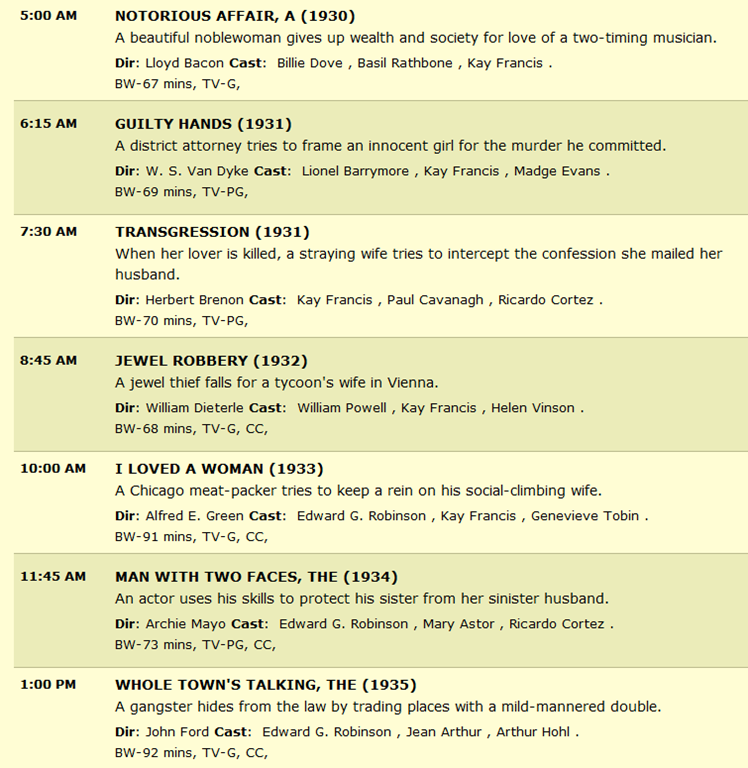
I wish TCM would offer a pay channel on my Roku, or an internet deal like Hulu Plus.  Or even offer DVDs for $15 each at their web site, but their DVDs are more expensive than that and they don’t sell the movies I want to see.  For example, here’s a great lineup of films I’d love to see that will show April 6th.  You might need to click on the image to see a larger readable version.

tcm

I’m thinking of asking my friend Janis who has cable if I can come over to her house at 5am that day.  I’d take a vacation day.  I wish I had a time machine.  Wouldn’t it be great to go back to those years and just watch those movies in the theaters?

How weird is this?  I wonder how many people are like me and love old flicks like these?

I’d go back to cable TV if they offered a base package of no channels and a set-top box with DVR for $15 a month, with an on-screen menu listing available channels and monthly prices and I could pick exactly which channels I wanted.  And no bullshit about charging extra for HD – the world is HD now, it shouldn’t be extra!  I’d really want more than 1 channel.  I’d like CBS, NBC, ABC, PBS, TCM and maybe a couple others.  Maybe not either.  I hate seeing channels I don’t want to watch.  I doubt a la carte cable TV will ever happen, but it’s what many people want.

I’ve got more TV than I can watch now with Netflix.  TV I really, really want to watch.  It’s just sometimes I’d like something Netflix doesn’t offer, especially movies before 1940.  I can buy some, but strangely the oldest movies are often way more expensive than the latest movies.  Careful shopping on the web can find me a few bargains, like double feature DVDs of pre-code Hollywood films for $15.  But all to often, like the Warner Archive DVDs, they want $25 for a single movie.  That’s nuts.  If Amazon sold digital copies of the old movies from TCM for $4.99 each, I’d buy them like crazy.

JWH – 3/31/12

Nonfiction, Fiction, History, Myth and States of Consciousness

Have you ever read a book about a real life event and then watched a documentary about the same subject?  The contrast of what we can learn from words and what we can learn from film is often jarring and sometimes shocking.  One of my favorite books from youth is The Electric Kool-Aid Acid Test by Tom Wolfe.  Wolfe made literary fame by pioneering “new journalism” which is now called creative nonfictionThe Electric Kool-Aid Acid Test was considered the book that defined the hippies and their philosophy.  I read this book back in 1969, and now 42 years later I got to watch Magic Trip, a documentary that used actual film footage of Ken Kesey and the Merry Pranksters.   Wolfe interviewed all the principal people right after the events, and he also must have seen the original 30 hours of film, and I was blown away by the difference between the two ways of telling the same story.

KoolAid_1stUSEd_front

Truth is the actual events.  How close can we ever come to reconstructing the truth?  What is the best evidence for the truth?  When Farmer Ted bets his geeky friends he’ll hook up with Samantha in Sixteen Candles and his friends demand proof, he asks them what kind, and they say in unison, “Video!”   As far as I can imagine, video comes closest to the truth as any evidence we can find – but even then it’s far from perfect.  For centuries, before the advent of video, our knowledge of past events was based on writing.

How much can we know from reading?  Before writing was invented our worldview was limited to the here and now.  We had oral storytellers that conveyed news from distant lands and remembered events and people from the past, but it was very limited.  Most of the time people’s consciousness was focused on the present and the immediate world around them.  Then reading and writing was invented and information about endless places and countless past moments could be recorded so people could conjure up in their minds things that weren’t here and now.  But how effective is reading at reproducing the past?  How accurate can reading describe distant places and events?

All my life I’ve been a bookworm, spending hours a day with my head in a book.  When young I most read fiction, and felt that time away from reality was just escapist entertainment, but over the decades I’ve shifted to reading more nonfiction, and felt I was learning stuff about other places, people and the past.  But am I?

Lately I’ve been reading nonfiction books and then seeking out documentaries and photographs to supplement my reading, and in every case I’m shocked by how different my mental image from reading is from the photograph or film.  Words are black marks on white paper, but they attempt to encode information that comes through our five senses.  How well does any word for a color convey the actual color? Does the word blue suggest any particular shade of blue?  Picture the wall of paint sample colors at your local Home Depot.  Which of the thousands of blues are the one we call blue?  Now think about the other four senses and words for sounds, textures, tastes and smells.  How close do words come to the infinite varieties of sensual details?

Last night I watched a documentary Magic Trip about Ken Kesey and his band of Merry Pranksters taking a bus from the west coast to visit New York City for the 1964 Worlds Fair.  In 1969 when I read “The Electric Kool-Aid Acid Test” by Tom Wolfe it blew me away by how exciting his non-fiction writing was at vividly conveying the story of these freaks on acid traveling across the country.  Over the years I’ve read more books and articles about this event, and the people involved.  To me this cross country trip was the legendary beginning of the hippies.  Of course I was wrong.   Kesey and his Merry Pranksters met the real hippies, like the Grateful Dead, when they got back from the trip and started promoting their acid test events.  Hippies already existed in 1964.

The documentary Magic Trip was created around the actual film the Pranksters took while on the trip and it blew my mind again.  It was absolutely nothing like I pictured from the Tom Wolfe book.  First off, Kesey and the Pranksters didn’t look like hippies – only the women had long hair.  And they all looked ordinary – I wouldn’t have named them the Merry Pranksters – that moniker seems way to grand for them.  The people in the film looked like college kids from the late 1950s or early 1960s acting really silly.  They looked more like early Beach Boys wearing stripe shirts.  Their antics looked as sophisticated as old episodes of The Monkees.

In some of the film clips Kesey and the Pranksters are on heavy doses of acid but you couldn’t tell that from what you see.  Now I know what they were feeling, I can remember that from those days.  Acid is like having a hurricane in your head, but you don’t see that from the outside.  What you see is kids being goofy and stupid.  Now in the book, Tom Wolfe tries to convey the epic psychological discoveries they were making – things going on in their heads, and the Magic Trip film tries to suggest that too, but the physical evidence of visuals from the film and sound recordings from tape just don’t back it up.  Wolfe wrote about what was going on in their heads and we can’t see that in the film.

As evidence of what actually happened I credit the film over Wolfe.  But is that fair or even accurate?  How much can we judge the truth of an event from what we can see and hear?  As counter evidence, how much do people know you from seeing you and hearing you talk?  See what I mean?  Reality and truth is deceptive.

It’s impossible to convey a psychedelic trip in words – and the clips of the trip festivals at the end of the movie don’t even come close.  What you see is kids dancing and acting weird and idiotic – no wonder the silent-majority Americans were freaked out by the freaks.  Back then the claim was drugs took you to a state of higher consciousness, but I always felt like they took me to a state of animal consciousness – a lowering.  Don’t get me wrong, it’s quite revealing, and you can learn a lot about how the mind functions, but all that talk about higher states was bullshit.  But then I value the verbal mind over the nonverbal mind.

In one part of the film, the west coast Merry Pranksters, along with their legendary bus driver Neal Cassidy, famed beat character Dean Moriarty from On the Road, meet up with his fellow real life On the Road beat characters Jack Kerouac and Allen Ginsberg.  Hippies meet their beatnik idols.  But things don’t go off well.  Jack is morose and turned off by the silly pranksters.  Then the west coast psychedelic legends go and meet the east coast prophets of LSD, Timothy Leary and Richard Alpert.  Leary is so turned off by them that he runs away and hides and leaves the future Ram Das to deal with them.  Leary and Alpert were trying to make LSD a serious tool for studying consciousness and these proto-hippies were abusing acid like teenagers breaking into their parents liquor cabinet.  In 1964 most people did not know what to make of these crazy kids.

Seeing Magic Trip was shocking to me.  Imagine how disturbing it would be to discover films of Jesus and his merry band of disciples.  Christianity has created thousands of different interpretations of the history of Jesus – so imagine if we got to see what Jesus really said and did?   Video can be so shocking to see after studying words.  We have no idea what Jesus was like or what he said.  Everything he supposedly said was recreated decades after the fact.  In The Electric Kool-Aid Acid Test, Tom Wolfe is deifying Kesey and his disciples just three years after the real event, and it’s impossible to know how much of the legend is Wolfe and how much is Kesey?

Tom Wolfe had used words to make this trip into an epic adventure, a transcendental experience of the first order.  He totally mythologized the people involved – of course the Pranksters were trying to do that themselves even while they were on the trip.  They gave each other funny names making themselves into characters on an epic adventure traveling in their legendary bus Further.

Now I don’t mean to suggest that these folks weren’t experiencing eye opening philosophical experiences.  They were exploring a new consciousness, breaking out of the rigid 1950s stereotypes, and exploring new experiences that would come to be known as the psychedelic sixties – but it wasn’t new consciousness.   Throughout history groups of people have rediscovered the Dionysian joys of intoxication and ecstasy – and wanting to escape from the rigid confines of society.  Even in the film Kesey says they were too young to be beatniks and too old to be hippies.

I remember my psychedelic days from over forty years ago, and it pretty much followed the Pranksters.  Me and my friends did a lot of silly and stupid things while exploring the doors of perception.  I had been inspired by Timothy Leary and Aldous Huxley and wanted my trips to be scientific experiments into the mind, but they weren’t.  It was just me and my friends doing many of the same exact things the Pranksters did in Magic Trip – going group swimming, driving around in funny vehicles that got a lot of attention, trying to play musical instruments when we had no ability, getting zonked out by nature, admiring the beats, upsetting the older people.  Oh, I learned a lot, but I can safely say to kids today, don’t bother, there are much better ways to explore the mind.  Read Steven Pinker, Edge.org and learn how to achieve Zen mindfulness.

But does any of this answer the question about how much truth we can attain from words?  In terms of acquiring knowledge, words can get you far higher than any amount of acid.  Truth and experience are wordless – ineffable.  I’ve experienced wordless states of consciousness through drugs and a mini-stroke, and that’s not a normal human state of consciousness.  As humans, like it or not, our consciousness minds are based on words and language – and language and words do not mirror reality perfectly.  Or even closely.  I know there are non-verbal conscious states of mind but the past and future don’t exist in those states.  The mere act of trying to recreate the past is a verbal state of consciousness.

The real question is:  How close does the nonverbal reality match our verbal reality?  I don’t think very much at all.  My proof is the fact that we all live in different verbal realities, and even when several people experience the same event they seldom recreate the shared reality with the same words.

A good lesson in understanding this is to study writing creative nonfiction.  I took two MFA writing courses with Kristen Iversen dealing with Creative Nonfiction and I learned quite a lot about “telling the truth” with words.  It’s actually very hard, if not impossible.  One of the first writing lessons she gave our class was to take a memory from when we were young and put it into words.   Even here I’m being misleading.  I can’t remember the exact assignment.  I think she might have told us to pick a memory from when we were twelve, but I’m not sure.  What immediately occurred to me to write about was a memory of me staying with my grandmother who maintained an old apartment building on Biscayne Bay in Miami, and the night she gave me an old fishing tackle box left in one of the apartments, and how I went out alone to fish off the concrete wall by the bay.  The more I thought about the memory the more details I could dredge up, but eventually I realized I couldn’t be sure of any of the exact details.  Memory is so faulty, but they’re also tricky.  It’s easy to create false memories. But my final essay was praised in class for its vivid details.

Was the essay absolutely true?  No, it wasn’t.  But I didn’t feel I was lying either.  I had recreated in words what were vague impressions and memories in my mind.  Mining those memories took work.  There’s a quality of effort in recreating memories that is very enlightening.  But still this brings us no closer to explaining the difference between nonfiction, fiction, history and myth.

I have read many nonfiction books on Wyatt Earp.  I have seen many documentaries on Wyatt Earp.  I have read many fictional stories about Wyatt Earp.  I have seen many fictional movies about Wyatt Earp.  I have heard many people discuss Wyatt Earp as a legendary mythic character of the old west.  Which of these various modes of learning about Wyatt Earp are the best for knowing who the real Wyatt Earp was like?  Is Tombstone the movie better than The Last Gunfight the nonfiction book, or Doc, a fictional novel where Wyatt is a prominent character?  Or the  PBS American Experience episode about Wyatt Earp?

Here’s what I can tell you.  It’s only based on personal feelings.  Wyatt Earp the man who lived in the nonverbal reality of the 19th century is long gone and unknowable.  That kind of reality is unknowable.  That’s why it’s called ineffable.  I can say some fictional versions of Wyatt Earp vary far from the actual reality of the nonfictional evidence, but can we say the Wyatt we create with historical evidence is actually close the to real flesh and blood Wyatt?  Yes, I think we can, even though there are many nonfictional Wyatt Earps to consider.  Every account, whether fiction or nonfiction creates a new edition of Wyatt Earp.  But I actually doubt we really get that close to the real man – some accounts are just more factual than others.

Scientists like to entertain the idea of multiple universes because there should be an infinity of these other universes allowing endless versions of our own world, many just slightly different.  That’s how verbally reconstructed Wyatt Earps exists.  There’s an infinity of them.  Some of them are close to the real world that did exist, but it’s very hard to judge which are the closest.  We can spot the absurd examples easy enough like all the Wyatt Earps in science fiction stories, but we can’t say which historical Wyatt is actually the best.

I think we’re getting closer to understand nonfiction, fiction, history and myth, but we’re not there yet.  I am reminded of a book called The Origins of Consciousness in the Breakdown of the Bicameral Mind by Julian Jaynes.  What Jaynes suggested was for early humanity they had a different state of mind than we do now, which he called the bicameral mind.  I don’t want to go into the details of his theory other than to say that in the past we shifted from one kind of consciousness to another.  I just want to suggest that as our verbal consciousness evolved, we’re now shifting into a third state of consciousness.  This new consciousness is based on sharing facts and building a consensus model of reality based on science.

We’re not that good at it yet – the proof can be seen by how Democrats and Republicans model our political reality.  And even conservatives and liberals seldom share the same ideas.  But in theory we believe through science and other forms of knowledge, that we can model our complex social reality in political and economic laws, as well as nonfiction, history and even fiction.

In other words, many of us believe given enough facts we could prove to each other the validity of a model of reality.  Science has gone the furthest by explaining the physical world.  The consensus is very strong with that – there’s very little fiction or myth in science.  All other areas of knowledge, like politics, ethics, law, economics are a long way from matching reality with any kind of common agreement.  In other words, they are mostly built on fiction and myths.

What I’m saying finally is, we all like to believe that we can separate nonfiction and history from fiction and myths.  Whether that’s true or even possible, is still open for scientific evaluation.  In other words, if you hold any beliefs other than those covered by a narrow range of scientific study, you can’t be sure if there is any difference between nonfiction, fiction, history and myth.

There is no way to know who Ken Kesey or Wyatt Earp was scientifically, but is there any emerging discipline that could use consensus like science, to measure the accuracy between nonfiction and fiction?  Is the scholarship of History rigorous enough to make that claim?  Or will all areas of knowledge outside of science always by undermined by subjectivity?

JWH – 12/30/11