Information Overload and Getting Old

By James Wallace Harris, Wednesday, February 24, 2016

I was cleaning out old magazines and stopped to read about Empress Theodora in The New York Review of Books. Evidently much of history about Theodora comes from ancient gossip, and a new book puts things right. The past is like today. Procopius, an ancient writer we use to remember Theodora, would have loved Twitter and shaming. Trying to get an accurate picture of Byzantine court life, politics and actual events is extremely difficult. Real history is information overload, and most of accepted history are Tweets.

information-overload

Here’s the thing, I’m suffering from a monstrous hangover caused by information overload. I want to know everything and can’t. I don’t know why read magazines anymore, especially ones like The New York Review of Books, where their essays are comprehensive, written by extreme experts, that make me think I’m completely uneducated. Reading one issue feels like I’ve learned more history than all I studied in K-12 schools. And it hurts. Often I can only read one essay before my head seems like a fission bomb reaching critical mass.

But if I stop trying to learn, living feels like killing time watching television while waiting to die. I can’t win either way. I’m starting to wonder if internet reading isn’t shorting out my neural pathways. Mostly I headline graze. There’s got to be some kind of happy median between Ph.D. scholar and Tweet view of every topic.

Generally when I feel this way, I return to science fiction, a cozy little artificial reality I discovered in my youth. I used to think the science fiction universe was small enough to comprehend, but in the last week, I’ve discovered inflationary events have expanded it well beyond my limits of observation. Now I understand why people dwell on highly focused specialties. Being a generalist is impossible. That also explains why the human race is too stupid to survive. Our brains are too tiny to comprehend even a vague model of larger reality. Our politicians think in sound bites because that’s the limit of their ability. We disagree with them because our 140 character capacity sees the same reality differently.

Part of my overload agony comes from growing older and sensing my brain slowing down. I hate giving up on keeping up. Yet, I also realize to survive aging I must jettison what I can’t mentally carry. I have to discover a practical diet of information consumption. I need Marie Kondo to declutter my mind. And I need to stop beating myself up because I can’t lift knowledge I once easily pressed.

Dirty Harry revealed exquisite wisdom when he said, “A man must know his limitations.”

Since I’m retired I assume I have all the time in the world, so I should be able to keep up. But it doesn’t work that way. Every new fact requires time to digest. If I don’t think about what I’m learning I forget it immediately. And even when I do contemplate new insights, it appears my brain is erasing something old to squeeze in something new. I not getting ahead anymore. Reading an essay from The New York Review of Books gives the illusion I’m learning something significant, but it’s going to be gone after I go to sleep tonight. I hate that. I truly hate that. I’m living in The Invasion of the Mind Snatchers.

Currently, I can comfortably manage one book, one audiobook and two or three documentaries a week. I just can’t make myself finish magazine articles anymore, or even read longer news reports on the web. I graze web pages. I’m not sure if internet reading is good for me. I’ve learned it’s better to spend my mental energy on fewer topics. I waste too much time chasing too many subjects. Web surfing is a very pleasant diversion, letting me think that I’m keeping up with the world, but I’m fooling myself to believe I’m actually learning anything.

JWH

Explaining Reality With More Than One Book

By James Wallace Harris, Tuesday, December 8, 2015

What are the minimum number of books you’d have to read to get a good overview of reality? Would they all be science books, or would we need philosophy, history, mathematics or even religious texts to go beyond what experimental results can’t cover?

There are billions of people on this planet who explain existence with the help of just one book. These sacred works have been around for hundreds, if not thousands of years, well before science and scholarship. It’s quite understandable to want just one manual, but is this world explainable in words? Science experiments offers an alternate explanation to ontological questions, but requires reading a library of books to understand. That might be why billions stick to their single volume guides.

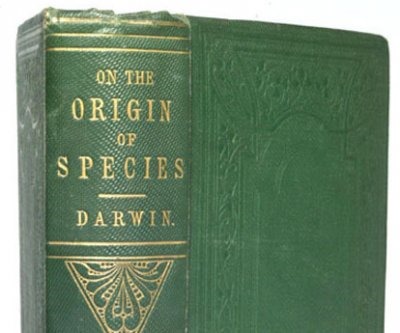
On the Origin of Species

Is there a single science book that can compete with The Bible, Quran, Tanakh, Tao Te Ching, Rig Veda, Diamond Sutra, etc.? Does science even try to give one book believers what they want? A book on cosmology or biology explains aspects of reality but without telling people how to live. People who live by just one book, read for guidance, not explanations. They want the world to be easily explained, fair and just. The trouble is science splendidly explains how reality works in tremendous detail, but offers no guidance how to live. We followers of science are left to find our own purpose, because science clearly shows everything in this reality is a product of impartial statistical events.

Do people choose one book solutions because reality is overwhelming, preferring simple myths instead?

How many science books would a person of faith have to read before they could understand the existential nature of their lives? Because believers are taught from an early age to believe in their single books, their non-scientific views are deeply ingrained in their minds, and hard to reprogram. Apparently, anything we learn as children sticks with us, and is very hard to erase. If children were taught Darwin at an early age, and their one book was On the Origin of Species, would the world be psychologically different?

Few scientists understand the actual science of things beyond their narrow specialty. If everyone had to read the original research of all the discoveries of science, we wouldn’t have much time for anything else. Most supporters of science understand reality through popular science, which is only an approximation of real science. Our knowledge about reality is collective knowledge. People who argue against evolution are really arguing against millions of books and research papers.

I once bought On the Shoulders of Giants by Stephen Hawking, which reprints the original scientific writings of Kepler, Copernicus, Galileo, Newton and Einstein, but I could not read it—at least for long. If I devoted my life to it, I could probably understand this book after a few decades of trying.

What would happen if schools showed documentaries that recreated all the great science, mathematics and engineering experiments of history, so that little kids saw how people discovered details of reality for the first time? Would seeing be better than reading?

I’ve read hundreds of nonfiction books and seen just as many documentaries, but I’d be hard press to point to a selection and claim they are the basis of my beliefs. Of course I have a confusing, muddled view of science and mathematics, and couldn’t actually teach what I know either. However, because there are endless views of The Bible or Quran, I tend to think even having just one book to master doesn’t lend itself to consistent explanations.

Despite all the books I’ve read about Einstein, and all the documentaries I’ve seen that explain his work, I still can’t comprehend relativity. Evolution makes sense to me, but I couldn’t teach it. I can understand why other people might not comprehend evolution.

Maybe we should ignore books altogether. Maybe we should strive to teach kids the basic concepts of science by having them recreate the experiments themselves. I’m getting sort of old, but I wonder if there are any experiments I could learn to do, that would allow me to see how a basic aspect of reality works. For example, I’ve been taught the sun is a big ball of hydrogen. Is there anyway I could prove that for myself?

For 2016, I plan to read On The Origin of Species. I wonder how close I can get to seeing the science behind it, and how much will remain just a story, a myth, a generalization? And after that, I want to find another science book that will take me closer to understanding real science rather than popularization. Einstein discovered relativity with thought experiments. I don’t think there will be many books I can comprehend actual science without mathematics and experimental apparatus, but there might be a few. I’m sure it’s more than one.

I ask my friends who believe in The Bible to distrust what it says, but am I not a creature of faith by my acceptance of science from popular sources? Who knows, maybe one book guides are one too many. Maybe we shouldn’t believe anything unless we can recreate the experimental proof ourselves.

JWH

Searching For Hope Thanksgiving 2015

By James Wallace Harris, Thursday, November 26, 2015

Yesterday was my 64th birthday. I had planned to publish “100 Signs of Hope for the Future” in reaction to my 63rd birthday post, “50 Reasons Why The Human Race Is Too Stupid To Survive.” That essay, the most popular one I wrote this year, still gets 20-50 hits a day. This year I felt challenged to discover twice as many signs of hope for my 64th birthday. I’ve been working for weeks, but alas I have failed. Not because I couldn’t find that many signs of hope, but because the essay just got too big to finish on time. I’ve decided to break it into several essays.

Thanksgiving 2015 

I’ve switched to searching for hope because pursuing pessimism is pointless. Even if we know we’re going to lose, we have to bet to win. Signs of despair are everywhere, so it’s too easy to find roads to apocalypses. The real existential challenge is to find  routes out of our maze of problems. Deciding what we want is the first step on the journey. I want an Earth friendly society, where everyone is equal, who follow universally accepted standards of ethics, with lifestyles that are sustainable over millions of years, that leads to opportunity for all Homo sapiens while still fairly sharing this planet with the rest of our fellow species.

When we are young we have great hope for the future, but as we age, little by little, that hope fades. I grew up with a tremendous sense of wonder for this amazing reality around us, but as I’ve grown old, I’ve become increasing pessimistic about the future of our species. Most people on this planet hide from reality in childish beliefs about God and Heaven, but as an atheist, I have to live with the scientific assessment of our existence. The future looks bleak. But I want to fight the natural tendency of becoming cynical while growing wrinkles. I desperately want to the human race to get its shit together and make the most out of this astonishing piece of ontological luck.

Finding hope for the future is a Mt. Everest size challenge. News reporting makes us all want to stick our heads in the sand. How can we overcome our sense of powerlessness? Why does being spectators on the sidelines of history feel so soul destroying? When will weathervanes stop pointing to countless hurricanes bearing down on us from all the directions of the compass? I actually believe there are ways to solve our collective problems. The trouble is we are our own worst enemies.

It would have been much easier to find a 1,000 signs of despair than 100 signs of hope. We all cope by ignoring what we don’t want to see, and rationalize things will magically get better. It’s impossible for one person to even comprehend the holographic information behind one half-hour news program. Having access to the internet overwhelms our minds with infinite data. We can’t even tell the facts from misinformation. We all maintain an ever shifting illusion about the future. The easier path is to ignore what might be, and focus on our personal needs and wants. I see hope in just defining our problems, which is what I want to do in future essays.

The other night I found an especially important sign of hope in a very strange place, the documentary Pandora’s Promise. This film is about environmentalists who were once passionately against nuclear power that have changed their minds. The hope I find, is not in the promise of cleaner energy, but in the fact that fervent true believers can admit they were wrong. To survive all the ill winds that blow our way, will require open minds with a strong willingness to study new information. We’re currently being bombarded by politicians who regurgitate the same brainwashed propaganda of their parties. This gives us little reason for hope. We need more Sauls who become Pauls, transformed by the light of reality. And before all you conservative Christians gloat with glee over my metaphor, let me tell you that you’ve still got your own Road to Damascus to travel.

For all of us to find hope for the future will require each of us to transform ourselves. Last year I was pessimistic because I doubted we could change. Recently I decided to bet on hope than spend my waning years becoming bitter about the human race, like the aging Mark Twain. What I need, and I think every else needs too, are signs of hope. I’ve spent a lifetime reading science fiction, so thinking about the future comes easy to me. If this essay seems more worried over despair that’s because it illustrates two significant points. One, finding hope is Sisyphean task. Two, recognizing that we have a problem is the beginning of transcendence.

Our problem as ordinary citizens, is we feel powerless at controlling our own fates. We think leaders should enact policies that will change the way we live. That passivity is dangerous. It is our individual decisions to change ourselves that is the solution. The key issue is sustainability. The ways we live our lives are not sustainable. For me to find 100 true signs of hope will require finding signs we are all choosing sustainable ways live.

People seldom change without being forced to change. Few people will unilaterally sacrifice what they have to help others, or even help themselves. It’s one thing to have a lot, and share some extra. It’s a whole other thing to give up what you have. This past year I’ve chosen to go on a plant-based diet for health reasons. I’m constantly tormented by what I can’t have. It’s not easy doing without. I know so many people who have far more serious health issues, yet they say they won’t change how they live to save themselves. They pray for magical solutions. Such false hope will destroy us.

I agree we won’t change without technological help. We’re more likely to survive if clever engineers invent technology that bypass our human failings. But technology can’t be our only salvation. Anyone who has been on a diet knows how hard it is to change the momentum of habits. Anyone who has succeeded at losing weight and transforming their health, knows how empowering new habits can be. No civilization of the past has survived a major disruption, so we have a perfect record of losing. On the other hand, our species has been mutating and transforming at a hyper-rate since The Enlightenment. Scientific knowledge has transformed our cognitive abilities dramatically, and with technology we’ve transformed human society, the face of the Earth, and the biosphere. So far this knowledge has allowed us to become a cancer upon the planet.

The reason why I wrote that pessimistic essay last year was because I felt people are incapable of change, but a year of reflection tells me the human race constantly changes. Recent research shows the brain is very plastic, capable of rewiring, even late in life. Another good sign of hope. However, humans tend to change because of powerful outside forces rather than by personal choice. We evolve through survival. And now it’s time to evolve like we never evolved before. Is it possible to intentionally guide our evolution? Can we choose to do what’s hard instead of what’s easy? Will the seven deadly sins always rule our habits?

There seems to be little reason to expect a political solution. A U.S. president from either party will never be bold enough to defy political self interest. In fact, their self interest thrives on our weaknesses. Does that mean we should just give up and wait for the apocalypse? I’d like to believe when the going gets tough, the tough get going, and we’re all tough enough.

Everything is interrelated. Solving any of our major problems requires solving our other major problems. Finding hope also involves recognizing the problem—we cannot solve problems we refuse to see. We cannot solve our problems without becoming different people from who we are now. Learning what we need to do will require reeducation, and that means a lot of reading and watching of documentaries. We need to learn how reality works. We need to stop pursing mindless forms of escapism. We’ve spent thousands of years praying to God, and we know that doesn’t work. Waiting for a Zoroaster, Moses, Jesus, Mohammed, Buddha, isn’t practical either.

To stop acting like lemmings rushing to the cliffs of oblivion requires thinking for ourselves.

Essay #982 – Table of Contents

When Does Nonfiction Go Stale?

By James Wallace Harris, Friday, June 19, 2015

When does a newspaper transform from news to wastepaper?  How old do the magazines at your dentist office have to be before you sneer at reading them? When does a science book become a history book? Why don’t we have classic nonfiction books like we have classic novels? What’s so important about new information as opposed to old information? If you found a two week old newspaper in your house you’d immediately throw it away, but if you found a 1832 newspaper in your attic you’d treasure it. How many bestselling novels from 1955 are still read today versus the nonfiction bestsellers from that year? When The Bible and The Iliad were written there was no distinction between fiction and nonfiction.

Sometimes it seems the books I enjoy reading the most are novels from the 19th century and the nonfiction books just published that are getting a lot of buzz. The only nonfiction book I can remember reading from the 19th century is Walden; or Life in the Woods  by Henry David Thoreau. I’ve always meant to read On the Origins of Species by Charles Darwin.

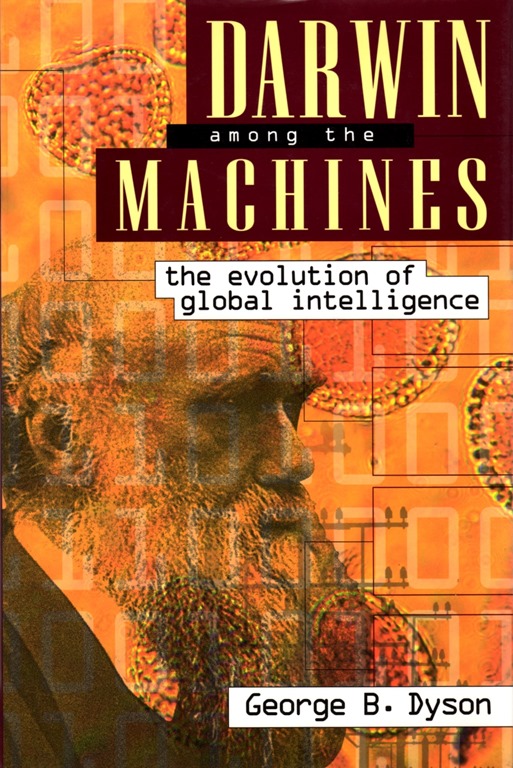
I started reading Darwin Among the Machines: The Evolution of Global Intelligence by George B. Dyson, a book I bought new back in 1997, but just now getting around to reading. Dyson is the son of Freeman Dyson, and the author of the more recent book Turing’s Cathedral (2012), which I bought and is also lying around here waiting to be read. I wonder if I’ve waited too long to read Darwin Among the Machines, because I’ve read The Information (2011) by James Gleick and The Innovators (2014) by Walter Isaacson, as well as many other books about artificial intelligence and information theory since 1997. However, Dyson has a unique approach to the history of thinking machines, starting his story with Thomas Hobbes and his book Leviathan. Dyson even ties in H. G. Wells and Olaf Stapledon. This is the kind of book I would write if I had the discipline to write books.

Darwin Among The Machines by George Dyson 1997 1st printing

Yet, I wonder about reading such an old book when there are so many newer books waiting to be read. Is there a Read By date for nonfiction books?

Dyson opens with,

“Nature (the Art whereby God hath made and governes the World) is by the Art of man, as in many other things, so in this also imitated, that it can make an Artificial Animal,” wrote Thomas Hobbes (1588–1679) on the first page of his Leviathan; or, The Matter, Forme, and Power of a Common-wealth Ecclesiasticall and Civill, published to great disturbance in 1651. “For seeing life is but a motion of Limbs, the beginning whereof is in the principall part within; why may we not say that all Automata (Engines that move themselves by springs and wheeles as doth a watch) have an artificiall life?”¹ Hobbes believed that the human commonwealth, given substance by the power of its institutions and the ingenuity of its machines, would coalesce to form that Leviathan described in the Old Testament, when the Lord, speaking to Job out of the whirlwind, had warned, “Upon earth there is not his like, who is made without fear.”

Three centuries after Hobbes, automata are multiplying with an agility that no vision formed in the seventeenth century could have foretold. Artificial intelligence flickers on the desktop and artificial life has become a respectable pursuit. But the artificial life and artificial intelligence that so animated Hobbes’s outlook on the world was not the discrete, autonomous mechanical intelligence conceived by the architects of digital processing in the twentieth century. Hobbes’s Leviathan was a diffuse, distributed, artificial organism more characteristic of the technologies and computational architectures approaching with the arrival of the twenty-first.

The trouble is Dyson wrote this sometime before 1997, and artificial intelligence has come a long way since then, beyond what Dyson could imagine eighteen years ago. Yet, what he’s really writing about are the centuries of thought before the 20th century on the subject – and that is mostly new to me. The common starting place seems to be with Babbage and Ada Lovelace, so it’s rather interesting that Dyson starts with Hobbes.

I guess it depends on what I’m enjoying learning. I seem to have two modes of interest. First is, what’s happening right now. The second is, how did we get here. Should I spend my time reading about the current state of global intelligence, or study the history of how someone imagined it would be hundreds of years ago?

I could be reading The Fourth Revolution: How the Infosphere is Reshaping Human Reality published 9/1/14 by Luciano Floridi. The Fourth Revolution is a book Hobbes would have found very interesting.

I wish I could read, digest and summarize a book in my blog in three or four hours. It takes me one or two weeks to read a book, and often longer to digest. If I really get caught up into a book I want to follow its leads and tangents. Just reading the first chapter of the Dyson book makes me want to go read about Thomas Hobbes. But do I need to spend so much time thinking about the 17th century when I live in the 21st? Tim Urban claims in “The AI Revolution” that the years 2000-2014 experienced as much progress as all the progress in the 20th century, and that the years 2015-2021 will speed even faster through that same amount of new information.

I am reminded of an old play title – Stop the World I Want To Get Off. Of course, I’m also reminded of that bestseller of the 1970s, Future Shock. Maybe it would easier on my mind to read Thomas Hobbes than Luciano Floridi. Yet, isn’t it sort of sad, that whatever nonfiction book I’ll read will be out-of-date in just a few years. If I had a good memory, I could tally up a very long list of nonfiction books that promoted some kind of far out idea as a possible understanding of how reality works yet has since been forgotten. How many people remember The Naked Ape by Desmond Morris or The Origins of Consciousness if the Breakdown of the Bicameral Mind by Julian Jaynes?

Not only do we surf the web, but we surf the current state of knowledge by reading the latest nonfiction books. New information flows into creation far faster than we can gain wisdom from processing that data. Is it practical for me to stop and read a book from 1997? Dyson was working to make sense of 1996.

Quite often new popular science books rephrase the same histories the older books covered. How many popular physics books have I read that summarized Einstein’s discovery of general relativity or  Kurt Gödel’s incompleteness theorems? Generally my knowledge of science lags far behind it’s discovery. At least I gave up on String Theory before The Big Bang  characters did.

I read for fun, so does it matter when a book is published if it’s fun to read? I’m not a scientist, so I don’t need to be up on the latest theories. I can never understand science at anything more than a popular science level, which is essentially at a philosophical level. And at a philosophical level, Darwin Among the Machines is still a fun read.

The problem that continues to nag me is whether or not I’m being the most efficient reader I can be. I only have a few more years left to live, and I want to cram in as much knowledge as possible. I know it leaks out my brain as fast as I consume it, but overall, a little residue remains and it feels like I’m progressing in my understanding of reality.

The decision to read an old nonfiction book versus a new nonfiction book must be made on how much knowledge will it add to my overall collection. That means I must choose between a writer who is carefully digesting a lot of historical information versus a writer who is reporting a lot of new information.

JWH

What Are The Limits of Individual Knowledge?

By James Wallace Harris, Tuesday, December 2, 2014

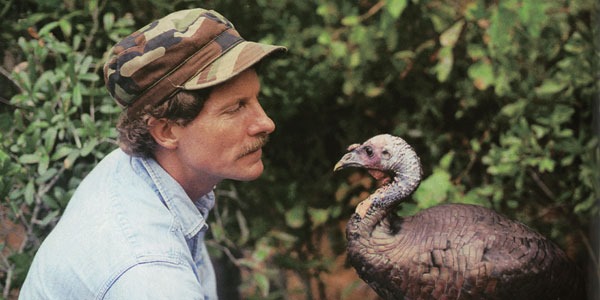
This week I watched my favorite nature documentary, My Life as a Turkey for the third and fourth time – and never gets old. Joe Hutto was given 16 wild turkey eggs which he hatched with an incubator and then let the chicks imprint on him. Hutto spent a year alone with his brood in the Flatwoods of Florida, being their mother, and becoming a turkey. The more time Hutto spent with his turkeys, the more his mind adapted to the natural world. Hutto, a naturalist, had already spent much his life in nature, but at one point he said that normally he saw three rattlesnakes a year, but when he was with the turkeys he saw that many or more a day. He eventually learn over thirty vocalizations the turkeys used to communicate with each other. While he was with the turkeys reality revealed itself to him at a level he had never known before.

joe_turkey

Now my point is not to talk turkey, but explore the capacity of the human mind. Hutto, by living with wild turkeys was able to see their minds were vaster than anyone ever imagined. He learned that animals live in the moment and see so much more of reality than we do, because our minds can’t stay focused on the present, and spend too much time dwelling on the past, or anticipating the future, places that don’t actually exist.

I am using examples from the natural world to think about thinking. The Inuit, the native people of the North American Arctic, were hunters who could traverse great expanses of frozen land and sea without maps or other navigational aids until they started using GPSes. The method of navigation by brainpower alone is called wayfinding, and the Inuit were highly skilled at it. I’m sure they also understood their prey like Joe Hutto understood his turkeys. Now that the Intuit use GPSes they have lost the capacity to live on the ice like their ancestors.

My guess is the maximum capacity of human brainpower is close to what humans experienced when living in nature and at the edge of survival. Becoming farmers, and then industrialized urban dwellers, provided us with ways to slack off. It’s only when we push ourselves to the extremes, in science, sports, mathematics, war, academia, business, do we get close to our operating maximum. Most people never push themselves in their day-to-day jobs, and watching television hardly taxes our abilities. It’s no wonder that video games are so popular, because they do push our minds to work harder.

We use machines and technology to make our lives easier, and even though we think we’re much smarter than those that have come before us, that might be an illusion. Our collective knowledge is greater, but probably not our individual knowledge. Just because I live in an era of computers and robots on Mars doesn’t mean I know how to create them, or even describe the science used in their creation.

We live in a time when everyone thinks they know everything, and the people who act with the most certainty seem to know the least. This is why I doubt the human race is smart enough to avoid extinction. I’m not being cynical about people, just trying to guess their real potential. I love computers, but I’m starting to think we’d be smarter without them. But I don’t think we should give them up either. It’s obvious the next stage of evolution is machine beings.

I think we need to invent ways to push our own brain capacity, and learn to amplify our individual knowledge by working together in new forms of social knowledge acquisition.  We see this in teams of inventors or entrepreneurs who apply their collective knowledge towards a common goal. We revere and praise the individual, but we might need to start recognizing great teams, and study how they work. Or how and why collaborative systems like open source software and Wikipedia succeed.

One example of that is climate science. Climate deniers tend to be individuals, but they are arguing against an army of scientists working together with billions of dollars worth of cybernetic minds  and scientific tools. It strange how often average citizens side with the deniers. Can any one individual ever understand enough to explain anything thoroughly about reality? We need to recognize the limitations of our minds, and how collective knowledge works.

JWH