Waiting for Linux

In the early 1990s my friend Mike bought a copy of Minix that promised to be a home version of UNIX.  At the time I was into GENIE, CompuServe, Prodigy and BBS systems.  I even ran my own 2-line bulletin board.  I liked the promise of UNIX and how it networked.  Luckily I worked at a university and also had access to USENET and FTP.  This was before the web.  I eventually found my way to a USENET group that talked about Linux, and it was free.  At the time I was hesitant to spend $69 for Minix, so Linux intrigued me.  However, the instructions for getting the code, making the install discs, and installing Linux were daunting.  I’ve forgotten all the details, but it involved a DOS program for making the floppies, and I had to make a bunch of floppies.  This might have been Slackware, but I don’t remember.  It was a long way from Ubuntu 12.04.

ubuntu

After much work with FTPed files,  I finally got Linux going on an old machine, but I was frustrated that it wouldn’t do any of the things I normally did with a computer at the time.  It was neat, but Linux wasn’t ready to be my computer OS.  After that I’d try Linux again and again, as it evolved, hoping it would become something I’d want to use as my full time computer system.  I remember I was so excited when I got Yggrasil and I could install Linux from a CD.  I could install it from the CD, but I couldn’t mount the CD afterwards.  This was before standard IDE drives and each CD device had its own drivers.  I can remember being so happy the first time I finally got Linux to mount a CD.

Then came Redhat and things got much easier.  Over the years Linux distributions got so easy to install that it was almost nothing to throw Linux on a computer, but I always took it off almost as fast.  After Windows 95 came out, and then Windows 98, using Microsoft got addictive and standard.  I got used to all the popular programs and games and it was just painful to try and switch to Linux.

And why did I want to switch?  The whole open source programming movement was so appealing.  The idea of free and DIY made so much sense.  I thought Linux would catch on and everyone would eventually make it their OS of choice.  But that never happened.  Linux has become a standard for servers and supercomputers, but for desktops it’s never been able to compete with Windows and Macs because they have so much commercial software that’s a breeze to install and use.  It’s a breeze now to install Linux, but adding other programs, especially those not prepackaged for a specific distribution, can still be a major headache.

I could switch to Ubuntu or Mint today and do most of what I like to do on a computer, but with programs that are clunky compared to the slick ones I use on my Windows 7 machine.  If I was truly tempted to switch operating systems it would be to Macintosh OS X, but even OS X is a pain to use after being addicted to Windows all these years.

I’ve been waiting for a long time for the Linux desktop to surpass Windows, and KDE and Gnome have come a long way, but desktop Linux just never catches up.  Most of the people reading my blog will not even know what I’m talking about because Linux is so esoteric.  Over the years I’ve talked a few people into trying Linux.  Linux is great for people who only use Firefox or Chrome to do everything they do on a computer.  But I still like Word, Photoshop, Audible Manager, iTunes, Rhapsody, Spotify, Webshots, and many other Windows based programs.  But even if I was totally cloud based in all my apps, I just prefer Chrome on Windows much more than Linux or the Macintosh.

I recently install Kubuntu on my home Linux box so I could play with Amarok on Linux, but I quickly grew disappointed with it.  I loved how Amarok will find lyrics to display as it plays songs, and the program is rather nice overall, but it feels years behind other programs on Windows 7 and Lion.  Spotify also does lyrics now, and they scroll as the songs plays, and the lyric being sung is highlighted.   Spotify is blazingly fast, Amarok is not.

I keep waiting for Linux, like waiting for Godot.  Linux is always on the horizon, close but far.  For awhile Windows XP was having so many problems that I thought I jump over to Linux, but then XP shot ahead and became reasonable stable.  Then Windows 7 came out, and I even prefer it over OS X.  I’m not sure about Windows 8, but I’ll probably get hooked on it too.  Ubuntu is trying hard to leap ahead, to catch up, but by the time it gets where it’s going, Windows and Mac OS X have shot ahead again.

I want Linux to be my desktop operating system because the Linux philosophy is just so much cooler than the commercial alternatives, but I’m hooked on their crack and I just can’t give it up.

It’s sad to admit, but I’m tired of waiting.  Actually, I’m tired of thinking about computer operating systems.  I started using computers in 1971, and I’ve been waiting over forty years for the future to arrive when computers would do everything, and I’d live with the perfect human/machine interface.  I’m tempted to say Windows 7 is it, and I plan to go no further.  I remember working with a guy who retired and bought a computer with latest WordStar and DOS who told me that system would have to last him the rest of his life.  I wonder if he lived long enough to eat those words?

Computers have been the most fascinating invention in my lifetime, and I have put a lot of my life into learning them, but I think I have reached a point where I don’t want to care about them anymore, not as a hobby or topic of interest.  I just want to use them.  I want computers to be invisible and all I see if my work.  I want the Wizard of Oz to stay unseen behind the curtain.  Linux still demands too much working under the hood, getting grease on my hands, and requiring a toolbox of tools to keep things running.  Windows 8 promises to be the operating system so mundane that it’s transparent.

I guess I’m ready for computers to just be magic rather than advanced technology.

The sad thing is technology changes too fast.  What I learned about the IBM 360 forty years ago is all forgotten now, and there’s a long line of other machines and operating systems that came after it that I’ve forgotten too.  I can’t remember how many programming languages and operating systems I’ve forgotten.  Computer technology has been dazzling, mesmerizing, diverting, but what was it all for?  I used to be able to use a slide rule as quick as some people could use a calculator, but that skill is gone too.  Technology knowledge isn’t like scientific knowledge, or history or mathematics.  It’s not cumulative.  Gadgets just keep changing.

I think computers have become good enough that computer literacy is no longer required.  They aren’t idiot proof yet, but they are getting there.  At one time I thought desktop Linux would be the winner, but I think the race is over and Linux never made it to the finish line for the personal desktop OS.  I also believe, sometime in the near future we’ll buy computers and we won’t even care what operating system is on them, or what version.   We probably won’t even think of them as computers.

JWH – 3/4/12

My Music DNA: The FM Years

Until I wrote My Music DNA:  The AM Era I never thought about how my life has been one long experiment with technology.  We like to think personal technology started with personal computers, or for some people, the iPod, iPhone or iPad, but now that I contemplate the topic, I realize The Gadget Age started in the 19th century with photography, then the phonograph, movie camera and radio.  Before gadgets if you wanted to hear music you had to go where the musicians were performing.  If you wanted to see Paris you had to go to France.

Gadgets bring the world to us, whether it’s voice, music, images or movies.  To a degree, books and paintings are proto-gadgets, they bring distant words and images to us created by people, but gadgets bring snapshots of reality, whether it’s images (photography), voice and music  (phonograph, radio) or movies (film and television).  A personal computer or iPad are dazzling devices because not only can they bring us voice, music, images and movies, they can process these media like a word processer processes words.

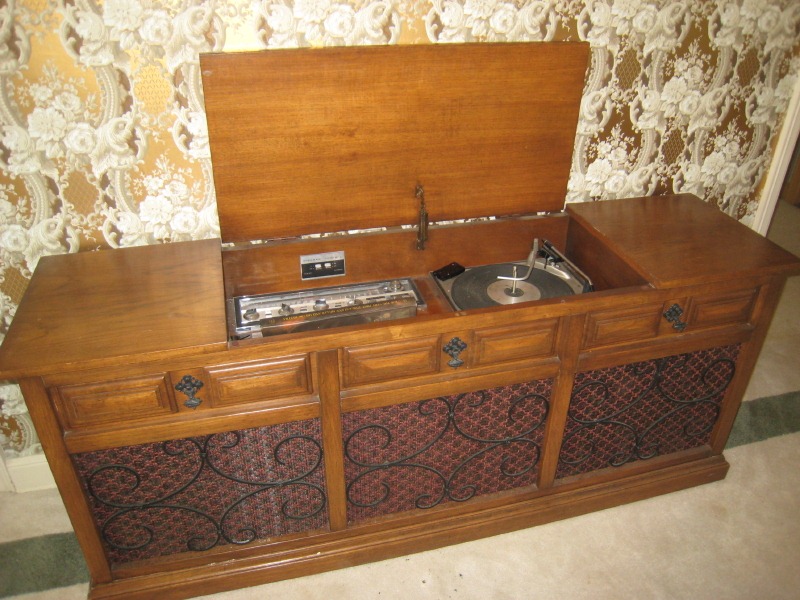
Although FM radio was patented in 1933, first broadcasts weren’t made until 1939, and stereo not added until the late 1950s, I didn’t get my first FM radio until 1968.  FM radio took a long time to catch on.  If you look at the Fidelity Potential Index Table you will see how sound recordings have evolved since the invention of the wax cylinder.  FM music has more fidelity than the 78 and 45, but not as much as the LP.  I had already started buying 45s and LPs before I got my first FM radio.  My first FM radio came in a small console stereo I bought in 1968 from the Columbia Record Club, when I was 16.  It was my first installment plan purchase.  I don’t have a photo of my first console stereo, but it looked something like this.

console-stereo2

Working as paperboy, cutting lawns, babysitting, and eventually as a bagboy didn’t not pay enough to buy all the music I wanted to hear, so my FM radio was a magical piece of technology.  AM radio was all about hit singles, whereas FM was about albums.  FM radio took me out of the teeny-bopper tunes and introduced me to a more mature level of album oriented music.

Among the albums I discovered back in 1968 on my FM radio was Truth by Jeff Beck, which I immediately bought.  I was transitioning from AM radio to FM and I discovered new groups like Cream,  Quicksilver Messenger Service, Moby Grape, Steve Miller, Grateful Dead, etc.  I also got into the albums of artists I had discovered on the AM airwaves like The Byrds, Bob Dylan, Jefferson Airplane, Buffalo Springfield, The Beatles, The Rolling Stones, The Doors, Jimi Hendrix, The Mamas and The Pappas.

I remember friends coming over in 1968 to hear the FM radio for the first time and being blown away – it was that different from AM.

My FM years didn’t last long, from 1968-1972.  It was transitional technology.  FM brought me a wide range of music from around the world, but it was a broadcast technology.  I started buying LPs in the AM era, and by 1970 I had about 300 albums, but they were never enough.  FM radio was my music news and how I discovered new music until I couldn’t handle the disc jockeys.  At first, back in the 1960s, FM was considered underground music, but FM took over the hit parade as more people got FM receivers.  At a certain point disc jockeys became so annoying I gave up FM and AM radio.

In 1969 I started getting my music news from The Rolling Stone magazine.  For a brief while in the late 70s and early 80s I returned to FM to listen to WEVL, a volunteer radio station where music fans hosted music shows rather than professional disc jockeys.  But for the most part I gave up radio listening in the 1970s.  I became a album buying addict, buying over a thousand LPs before I switched to buying CDs in the 1980s, and I went on to buy 1,500 CDs before I phased into streaming music in recent years.

AM radio showcased top hits that were played frequently.  AM hits of the 1960s provide the core music that Baby Boomers share.  On any given day you could hear about 40-60 different songs.

FM radio offered a far larger range of music and styles until it was hijacked by the Top 40 format and became zany entertainment for automobile drivers.  In the early days of FM if you tried hard enough you could hear 100-200 different songs in a day.

Buying LPs offered the choice of thousands of albums at better stores.  And LPs allowed fans to own music, another kind of enabling technology.

With Internet shopping, collectors could buy a million CDs if they could afford it – then the MP3 revolution hit, and collectors could steal those million albums if they had the time, bandwidth and lack of ethics.  Now with steaming music anyone can have easy access to over a million albums, or about 15-20 million songs for $9.99 a month.

iTunes and iPod reinvented the hit singles and almost killed the album.  Streaming music is like combining FM and owning LPs with renting music, and it promotes the album.

FM radio still exists, as does AM radio and even LPs, but they are waning technologies that have been supplanted by the Internet.  FM radio was a stepping stone technology that expanded the world of music over AM.  FM radio is now a trailing technology – it fits a niche market, and has many competitors like Sirius Radio, a paid service, or Pandora Radio, free and paid, that offers music from a very wide selection of albums, and is a far superior to broadcast technology.  Broadcast radio itself is a waning technology, even with HD Radio.

Streaming music offers the greatest selection and control – with instant access to most of the albums in print.

Strangely enough, it’s very hard for me to remember FM songs that I loved because of listening to the radio, versus songs from the same time period that I bought on LPs.  The way I’ve discovered how to tell the difference is to listen to Play Cofi Jukebox at tropicalglen.com by the years below.  The songs I loved but never bought are songs I can give thanks to FM radio technology.  What’s surprising is just how many of those songs there were.  Just click on a link and listen.  How many of the songs did you buy, and how many are part of your memories because you listened to FM radio?

19681969197019711972

It’s strange to think that young people today may never have listened to an AM or FM radio, or bought a LP or CD.  But I wonder, just what kind of technologies will supplant streaming music?  Combining streaming music with a smartphone is about as close to thinking of a song and hearing it instantly telepathically as one can get.  Will they ever invent brain transceivers that stimulate the neurons directly, and just bypass the ears?  It’s just amazing to think of all the technological change in one lifetime.

But you know what?  There’s one constant that doesn’t change.  That’s listening to music.

JWH – 2/21/12

The Future

We can’t know the future – not the specific details but we constantly try to imagine the future.  Here are some impressive videos from Microsoft that shows what the future might be like following the trends of current technology.

The first one appears to have been made in 2009.

The next one from 2011 seems very similar, as if they were actually produced at the same time.  Or we have to assume that 2019 seen from Microsoft from two years apart looks very much like.

Do these predictions please you, or scare you?  It certainly seems the Geeks have inherited the Earth.  But if you think about it, it’s a rather tame mundane view of the future.  Adults still go to work and children go to school – the difference is the physical objects around us get more intelligent.  But do we?

We like to think that people are evolving too and in some ways we are.  We’re moving toward a society where everyone is equal regardless of race, gender or sexual orientation.  However, if you think about it, we’ll all be treated equally fair, at least under the law, but will we be different?  Greed will still coexist with charity, violence will exist with peace, law and order will still fight the lawless, the rich will get richer and the poor poorer.

I think if you plotted the evolution of humans it would show one long slight incline.  If you plotted the evolution of technology we’d see the classic hockey stick graph.

These two videos show a future for rich people, nothing is implied for the poor.  Without technology and money, the poor of one era seem to live pretty much like the poor of another era.  I’d also imagine if you are politically conservative now, or liberal, you will be the same in the future.  And I’d say if you are a bookworm that loves music and movies, then you’ll probably be a bookworm that loves music and movies in the future.  Most people will even be living in the same house they are living in now.

We can’t predict the details of the future, like who will win the presidential race in 2012, or what life will be like as the Earth gets warmer, or will we find a solution to the financial crisis and the economic divide between the 1% and the 99%.  There are an infinity of factors that go into shaping the future that keeps us from calculating what the future will be.

Some of the tech predictions we see in these Microsoft videos might come close to happening, but I doubt the tech will be as slick and clean as how they predict them.  It would be interesting to find some videos from 1999 and 2001 that Microsoft created predicting 2009 and 2011.

Jim

Redesigning the Television–Will Apple Revolutionize the TV Next?

Before Steve Jobs died he told his biographer that he wanted to create a television set that was completely easy to use.  Can you imagine a TV that’s as revolutionary as the iPhone or iPad?  Well, I think it would be fun to guess its features.

World TV

Right now there are different technical broadcast systems all over the world so I would think the first area of simplification would come from jettison outdated technical standards.  Why not design one TV that will work with all 7,000,000,000 citizens of the Earth.  I can’t imagine Jobs would want to design a TV that had to work with set-top boxes from other companies selling content.  Nor could I imagine he’d want to design something that used over-the-air channel reception.  Because the Internet is universal across the world, why not just design the future TV to be an Internet TV?

Picture a TV with one power plug and built-in wireless networking.  Now that would be a simple and elegant design.  It would essentially be a computer with a 24”-62” screen using 1080p, that could work anywhere in the world with a different power cord.

The TV antenna will go the way of the buggy whip, and so will set-top boxes and DVD-Blu-ray players.

Physical Design

Now we need to imagine the design of the device itself.  Currently I have 5 remotes and a keyboard with trackpad to use with my 52” TV entertainment system I built myself.  If our new future TV used something like Siri, we could get rid of all remotes and keyboards.  The only external control that Siri couldn’t handle is a game controller, and with a Kineck type sensor even that might be eliminated.

Having to connect a receiver and surround sound speakers to HD TVs is a pain.  Our perfect TV should have a sound bar built-in with great surround sound.  And it should play music fantastically too.  No more Hi-Fi component, speakers and wires cluttering up the living room.

My new LG computer monitor has no physical buttons on it, but light sensors, even for the on/off switch.  I think our perfect TV wouldn’t have mechanical buttons either.  It should be voice activated only, but if it did require a manual power switch it should be light activated.

This TV will be more futuristic than anything on the Jetsons.
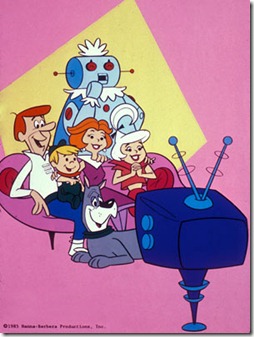
jetsons_l

Content

Now I can’t imagine Jobs thinking he could design this TV and just throw iOS 5 on it.  The TV opening screen and menu system is the hardest feature to imagine.  This is why Apple is the success it is, and why other companies copy its design.  Our prefect TV needs to show:

  • Internet broadcasts – live TV
  • Recorded shows from the past
  • Movies
  • Personal videos
  • Photographs
  • Internet
  • Games
  • Music
  • Telephone
  • Teleconferencing
  • Online courses
  • Presentations
  • Business and education software

For Internet TV to work we need TV networks to switch to streaming their content, but there’s needs to be a paradigm change first.  How many shows need to be live?  Think about that.  The news, sports, reality shows, special live concerts and performances.  We actually don’t need live TV all that much.  Most of what’s on TV is recorded.  Because of DVRs and services like Hulu, how many people even watch new TV shows that premiere each week live?  Cable/satellite services provide hundreds of channels because of their technical limitations, not because we need hundreds of live TV channels.

Content from networks like TCM, National Geography, Discover, History, etc. can be served just as well from a web page, they don’t need to be live.

Recorded TV shows and movies can come from services like Netflix, iTunes and Amazon Prime.

When I was growing up in the 1950s and 1960s we had 3 television channels.  There were no DVDs or DVRs to catch a show later.  You either watched the show when it aired, or maybe had another chance the following summer during rerun season, and that was it.  Each fall we were presented with a new line-up of shows and they would generally run a whole season – shows were seldom canceled mid-season.  Once you learned the lineup on shows in September you pretty much knew what was going to be on television until next summer.  Special shows were indeed special and rare.  That was simplicity then.

Back then watching TV was as easy as basic arithmetic.  Today with cable, satellite, iPads, smartphones and internet television channels, along with DVDs, Netflix, Amazon Prime, Blockbuster, Redbox and DVRs deciding what to watch on television is more like advanced calculus.  We now live in a TV age of painful complexity.

Watching TV fifty years ago meant three channels of choice.   Today we’re getting closer and closer to being able to watch anything that’s ever been on television at any moment.  The choices aren’t infinite, but when someone asks “What’s on TV?” it might be safe to say, “There’s a million things on TV tonight.”  And that’s painful to deal with.

Our perfect TV needs to have an operating system that allows the viewer to find what they want to watch as quickly as possible.  It needs to be as simple to use as an iPad for a two-year-old.   When the set is turned on it needs an opening screen – the top menu, and the basic functions can be simplified to these:

  • TV
  • Library
  • Telephone
  • Games
  • Music
  • Computer

This makes six tiles – is Microsoft on to something?  TV would be live TV, Library would be recorded shows, either TV, movies, personal videos, photographs, or other content.  Telephone could be two way video or conferencing.  Games and music are obvious.  Computer would be anything from online courses, business presentations, science simulations, word processing, blogging, etc.  I think we’ll be surprised what we’ll want to do from the family TV in the den.

Think what a game changer such a television would be.  It would be the Holy Grail of integration between TVs and Computers, but also phones, stereos and game units.  Is it any wonder that Steve Jobs wanted to tackle such an exciting project?  Sadly, think how many companies it will put out of business.  We won’t need Blu-ray players or discs, or Google TV or Roku, or music CDs, or movies and TV shows on DVD.

How To Get From the Complexity We Have Now To A New Simplicity?

If you have cable with hundreds of channels how do you even know what to watch?  And what great shows are you missing?

Live

The first thing we need to do is separate live content from recorded content.  We need to bring back the demand and understanding of live TV and we need to reduce the number of channels offered.  Because our system works with the world, live TV could be from anywhere on the planet.  We want our TV user to select any channel they want, but we need to simplify the TV menu system.  I like how Roku does things.  It offers hundreds of channels but you only add in the ones you regularly use to you main menu.  I’ve done the same thing with my over-the-air TV, reducing about two dozen local channels down to five.  It makes life easier.

When the user says “Live TV” to our new set they should see a small listing of favorite live channels.  They could be numbered on the screen so the user could say “Number 4” or just “PBS.”  Or they could say “Add channel” and then go into a menu of all possible live channels to add.  They might say, “Japan” and see live TV channels from Japan.  Or they could say “American football” or “British reality shows.”

This system would allow for simplicity from an unlimited offering.

Also, the Live function could connect to web cams around the world.  TV doesn’t have to be produced.

Library

The selection of recorded shows could run to the millions.  Any movie, any TV show, any documentary, any home video, etc.  We’d need a system to help people find good content.  The basic search engine could find things if user already knew the name of the show, or certain related details, but for discovering new shows they would need help.

What we need is the wisdom of crowds – hit lists of all kinds to let people find what other people are watching and rating.

The default Library screen could have pull down menus on the left and a list of shows on the right. The pull down menus will let you pick for Year, Genre (and Subgenre), Audience, Now/Then, Rating, and maybe others. The default might be Current to see the most popular shows people are watching right now. But under Time you can change it to a listing by year or decade. Under genre you’ll see a detail list of genres and from Audience you can pick age group.

This way you could put in 1950s, Science Fiction, 60-65, Now – and you’d see a list of 1950s science fiction shows and movies that people 60-65 are currently watching the most. You can also switch to Then and see what the people back in the 1950s watched the most.

So if you want your daughter to learn about astronomy you could request the most popular documentaries on astronomy that are viewed by 10-20 year old girls that are rated 8-10 stars.

We’d need supplemental features that used the techniques of Amazon customer reviews, Netflix, Wikipedia, Rotten Tomatoes, MetaCritic etc. to help people find shows.

The system could have an encyclopedia of TV shows and you could find any TV series that’s ever been made and start watching them from the first episode to the last.  Such a TV system will kill off DVDs.

Finally, our Library feature could also integrate with your local libraries, to their special collections, or to libraries around the world.  There’s more to our culture than old movies and TV shows.

Telephone

Wouldn’t it be cool for one family on Christmas to see and talk with other family members who can’t make it home that year?  The possibilities are endless. Science fiction has been predicting for the wall screen telecommunication device for decades.  It’s time to get around to making one.

Games

It’s pretty obvious games need to be integrated into this system.  Essentially our TV will be a computer, whether it runs Mac OS X or Windows 8 or Linux, it will be competing with console gaming.  It could signal the end to console games.  But won’t Angry Birds be cool on a 62” screen at 1080p?  Or future versions of World of Warcraft?

Music

Apple wants you to buy music from iTunes – that’s such ancient 20th century thinking.  I’m surprised that Steve Jobs didn’t recognize the simple beauty of streaming music libraries like Rhapsody, Rdio, MOG, Spotify, Zune and others.  Why mess with owning music and having to worry about backing it up and protecting it for the rest of your life.  Streaming music rental libraries is just too damn easy to use.

Like the “Live” TV function, the “Music” screen should allow users to add subscription services to the default screen.  Probably only one, but they should get to pick which one.  I’m sure the future TV from Apple will show iTunes, but unless iTunes starts its own streaming music service, this will keep the Apple model of future TV tied to the past.  Right now I subscribe to Rhapsody and Rdio, and use the free version of Spotify.

Computer

Lot’s of people want to predict the death of the desktop computer but you just don’t want to do everything you can do on a computer from a 4” screen, or even a 10” screen.  Online education is going to be big.  Doing business presentations is already huge and getting bigger.  Everyone will learn to create content, whether you’re an artist, teacher, musician or mathematician.  Imagine letting kids paint on a 62” canvas?  Or studying math from a library of the best teaching programs from around the world.  For many families the desktop might go away, or it might become the family TV.  Or the bedroom TV.  Pretty soon a TV will be a computer and a computer a TV.

Summary

It’s like Dylan said, you don’t need a weatherman to know which way the wind blows.  Many young people have already abandoned the family TV to get all their content from smartphones and tablets.  The shift to Internet TV has been going on for years, so it doesn’t take much imagination to predict a perfect TV.  I wished Jobs would have lived into his 90s to see everything he could have revolutionized.  Actually it would be fun to see if he ran out of things to reinvent. 

At some point things have got to settle down.  If you contemplate this TV I’ve imagined here, it integrated a lot of technologies into one simple device.  I’d expect one screen in every room.  And then everyone would have a 4” smartphone and a 10” tablet and maybe a 12-16” laptop if they needed one.  After the war of gadgets we’ve been seen in the last decade will we see a gadget peace for a time?  Reading Engadget makes that hard to believe.  But the Flip video camera was killed off because of video cameras in smartphones.  What will the iPhone 4s do to the digital still and video camera market?  What’s happening to portable DVD players and handheld game units?  Does anyone buy handheld GPSs anymore?

Just when Microsoft was getting into touch, Apple comes out with a voice interface.  Schools are giving up teaching cursive handwriting.  When will typing disappear?  Always remember, the evolution of machines is away from moving parts.  Now that consumers have access to 3 terabyte hard drives do they really need them when everything is moving to the cloud?  How much does the iMac look like the future of computers and TV?  Evolution appears to be moving toward intelligent flat screens.  The smartphone suggests that everyone will have a personal 4” screen they take everywhere.  Some people will also need 10” screens (tablets).  At what point does voice controlled touch screens invalidate the need for 12-16” laptop computers?  And when does the 24” computer monitor in the bedroom merge with the TV?  And can one OS handle all screen sizes?  Will it still be Microsoft v. Apple v. Linux?

My recommendation if you are buying a new TV now is to pick one with the most Internet features built in.  But expect Apple to come out with something in 2012.  Will it be as revolutionary as the iPhone?  I don’t know.  Too much depends on TV networks, cable channel systems and content providers.  But I can’t help believe that cable TV will go the way of the floppy disc.  Expect CDs, DVDs and Blu-ray discs to disappear quickly too.  Cable TV and Satellite companies will put up a big fight for years, but the Internet will allow content produces to do an end run around them.

How quickly will all this happen?  Well, how quickly are ebooks taking over printed books?

JWH – 10/30/11

The Information: A History, A Theory, a Flood by James Gleick

If you read only one science book in a decade The Information by James Gleick should be it.  I’m not saying The Information is the best science book in a decade, but if you don’t read much about science then this book is for you.  It’s not an easy read, but if you’ve ever felt information overload this book will help explain how and why it’s happening.

We live in accelerating times that are hard to comprehend – the flow of information is like a category 5 hurricane that has stationed itself permanently over our lives, never leaving, and only intensifying.  Unless you have a fairly good education it’s doubtful you’ll truly comprehend this book, but there’s plenty of easy to understand history for the non-scientific minded to get the gist of things. 

Here’s one anecdote from the book that might help.  When the telegraph was first developed, people would go to the telegraph office and write down a message and give it to the operator who would key it in and then act finished.  Many people expected to see their message to go off, leave the building.  They couldn’t comprehend how information could be translated from words on the paper, to electrical pulses of dots and dashes that would travel along a wire.  Now this is hard for us to comprehend because we’re used to the world wide web, but the history of our species is a history of conceptual breakthroughs dealing with information.  But more than that, our minds, bodies and reality are information.

When my mother and father were children growing up in the 1920s all they had for news was the radio and newspaper.  My mother grew up in the country and didn’t even have the radio right away.  My father grew up in Miami, so he was closer to the cutting edge of communication technology.  My mother’s mother, born in 1881, and grew up in rural Mississippi probably didn’t even see a newspaper that often.  Most of the information in her world came from the Bible, static news that has been lingering around for 2,000-3,000 years.

James Gleick hooks us into his story by starting with African talking drums.  European explorers were blown away by African tribes communicating across great distances with drums, and sending rather complex messages.  The best the Europeans could do were things like signal lights, one if by land, two if by sea, or blow the bugle for retreat.  It’s very hard for us modern people to understand how talking drums worked because we no longer live in an oral culture.  Before writing people memorized everything, and often would know very long poems or songs they would memorize and pass on.  Drum talking is based on knowing the sound patterns of common phrases, with the drums having enough pitch to “talk” or mimic the phrase.  Basically the African drummers would imitate a line of a song and the receiver would interpret the phrase.  What would you think to do if you were in a sticky situation and your buddy started humming “Born to Run?” Gleick gives this example:

Make your feet come back the way they went,

Make your legs come back the way they went,

plant your feet and your legs below,

in the village which belongs to us.

If the African drummer created a pattern that sounded like that song, people were supposed to interpret as, “Come back home.”  It’s a rather neat trick when you think about it.

When humans lived like animals, communication and information was very immediate – “I found some grapes.”  But as we organized and formed permanent tribes, information became more complex and abstract, for example, the ten commandments.  Before the invention of writing there was a limit to how much and how far humans could communicate.

Writing was a real breakthrough because it conquered space and time.  A message could be copied and sent in many directions at once, and it would last as long as the medium it was written on.  There was a time when writing was even mistrusted.  Socrates felt writing was bad for memory.  He was right, but writing became a new form of memory. 

Early writing was still limited.  It was very hard to copy, few people could write and few could read.  From Bart Ehrman’s Forged, I learned something very interesting.  In ancient times reading and writing didn’t always go together.  Some people could read but not write, others would write by not read.  It took centuries to get from writing to printing, but after Guttenberg literacy took off, changing our world.  Computers have again transformed how we process information, but it’s a quantum leap over the printing press.  Quantum leaps were also made by the telegraph, the photograph, the radio and the television.

Each time, people protested.  Not long after the invention of the printing press people started complaining there were too many books – meaning there was too much to know.  Here is a quote I love from 1621, given in the final chapter of The Information.  It reminds me how I feel watching the NBC Nightly News every evening.  It is from Robert Burton’s The Anatomy of Melancholy.

I hear new news every day, and those ordinary rumours of war, plagues, fires, inundations, thefts, murders, massacres, meteors, comets, spectrums, prodigies, apparitions, of towns taken, cities besieged in France, Germany, Turkey, Persia, Poland, &c., daily musters and preparations, and such like, which these tempestuous times afford, battles fought, so many men slain, monomachies, shipwrecks, piracies and sea-fights; peace, leagues, stratagems, and fresh alarms. A vast confusion of vows, wishes, actions, edicts, petitions, lawsuits, pleas, laws, proclamations, complaints, grievances are daily brought to our ears. New books every day, pamphlets, corantoes, stories, whole catalogues of volumes of all sorts, new paradoxes, opinions, schisms, heresies, controversies in philosophy, religion, &c. Now come tidings of weddings, maskings, mummeries, entertainments, jubilees, embassies, tilts and tournaments, trophies, triumphs, revels, sports, plays: then again, as in a new shifted scene, treasons, cheating tricks, robberies, enormous villainies in all kinds, funerals, burials, deaths of princes, new discoveries, expeditions, now comical, then tragical matters. Today we hear of new lords and officers created, tomorrow of some great men deposed, and then again of fresh honours conferred; one is let loose, another imprisoned; one purchaseth, another breaketh: he thrives, his neighbour turns bankrupt; now plenty, then again dearth and famine; one runs, another rides, wrangles, laughs, weeps, &c. This I daily hear, and such like, both private and public news, amidst the gallantry and misery of the world; jollity, pride, perplexities and cares, simplicity and villainy; subtlety, knavery, candour and integrity, mutually mixed and offering themselves; I rub on privus privatus; as I have still lived, so I now continue, statu quo prius, left to a solitary life, and mine own domestic discontents: saving that sometimes, ne quid mentiar, as Diogenes went into the city, and Democritus to the haven to see fashions, I did for my recreation now and then walk abroad, look into the world, and could not choose but make some little observation, non tam sagax observator ac simplex recitator, [45] not as they did, to scoff or laugh at all, but with a mixed passion.

I’m jumping to the end of The Information, the part about the information flood because I think that’s how most people will relate to this book.  The subtitle, “a history, a theory, a flood” is very apt.  For about half the book Gleick gives us a history of how we got here, reading, printing, computing – inventing the telegraph, radio, television, internet, etc.  Then he gets into Claude Shannon and information theory, and finally ends up with information overload.  That’s a very quick summary that does the book a disservice, but I’m trying to get you to read it, and if I started talking about Norbert Weiner and Cybernetics I’d probably scare you off.  (By the way, this book is very popular at my online book club, impressing a variety of different reading tastes.)

James Gleick covers a lot of fascinating history, like that of Charles Babbage and Ada Lovelace developing computer programming in the 19th century, or how Morse code was developed, which created a 19th century form of geek culture that inspired developments in cryptography and information compression.  Did you know that Edgar Allan Poe was obsessed with cryptography?  I find the 19th century tremendously exciting, and Gleick spends a lot of time there.  But it’s when Gleick gets to the 20th century that book becomes important.  Most people’s knowledge of 20th century science is of the flashy stuff, like Einstein’s theory of relativity, or NASA’s explorations, or the dazzling development of medical science.  Some people are familiar with Crick and Watson’s DNA and maybe even gene sequencing.  Particle physics is often written about, and all kids love dinosaurs and a bit of astronomy.  But few people want to go deeper.

Gleick gives us a geekier history of 20th century science, almost a secret history not because it was hidden, but because it’s closer to math than pure science like physics, chemistry and biology.  This scares away the average pop science reader, but don’t let it.  Gleick wants to tell us how we are information, our minds, our bodies, our society, our reality, and it requires understanding some mathematical concepts.  But we live in a digital age and really need to understand communication theory.  Why?  That’s harder to explain, but I shall try.

Remember recently when Michele Bachmann was in the news with the story about her comment on the HPV Vaccine and it causing mental retardation?  This incident demonstrated many dimensions of her ignorance which gets into all kinds of ways we communicate and process information.  First off, notice that her information came to her verbally, in person.  She proudly cited it as such.  Before the scientific era, the eye witness was the highest forms of information validation.  We now know that first person accounts are among the least valid, but back then it was considered the gold standard of proof.  If someone claimed to have seen a mermaid then they existed.  Bachmann was merely acting like a 17th century person, or even a 4th century BCE person.  Not only did she collect her facts in a poor manner, she spread them by 21st century technology, and thus became a dangerous carrier of misinformation.  She may have created a meme and become a viral vector spreading unhealthy information.  Here reaction was based on previous memes.

But it is much more complicated than that.  How do we know if the HPV Vaccine is good or bad, or even how it works?  Your answer will place you along a history of information understanding time line.  Sadly, most conservative people are going to place somewhere before the 19th century.  But even well educated liberals might only peg in at early 20th century.  The Information, and many books like it that have come out in the last few years are trying to catch people up with things we’ve learned from the 1940s on.  There is an exciting synergy going on among the sciences and it’s a tragedy that most of the people living in these early 21st century times are missing it.

It’s very hard to explain this.  Physics was the first science to explain reality.  Then chemistry.  For a long time biology and botany was divorced from pure science of physics.  But in our lifetimes biology has reached the level of chemistry and physics, moving ever closer to the quantum level of reality, and this brings us to communication theory and mathematics.  19th century evolution is being validated by 20th century discoveries in genetics and DNA, which are now being connected to the subatomic world, which leads us to the world of probability and pure information.  It’s all coming together.  The Information: a History, a Theory, a Flood by James Gleick is your introduction.

Normally, this is where I would stop my book reviewing process, but this book makes me want to write more.  I listened to The Information, but I now plan to read and study it carefully.  This book is a gold mine of learning, and I’ve just barely taken away some quick riches, but there are billions to be learned in it still.  While researching this review I discovered that several other books essentially covering the same topic, or extensions of it.  I’m going to have to buy and study them too.  Read the reviews and comments on them here:

But returning to The Information, I’d also like to outline the essential topics that Gleick covers.  I want to list them to help people decide about reading the book, and to make a handy-dandy reference for myself to the subjects I want to further study.  Wikipedia covers these topics wonderfully, probably because if you’re geeky enough to work on Wikipedia you are also probably interested in these topics.  Plus Wikipedia was an important topic in The Information.  Furthermore, many of these Wikipedia articles cover the topics in more detail than Gleick does in book.

Other Reviews


JWH – 9/24/11