Visualizing My Discontent

by James Wallace Harris, 2/28/23

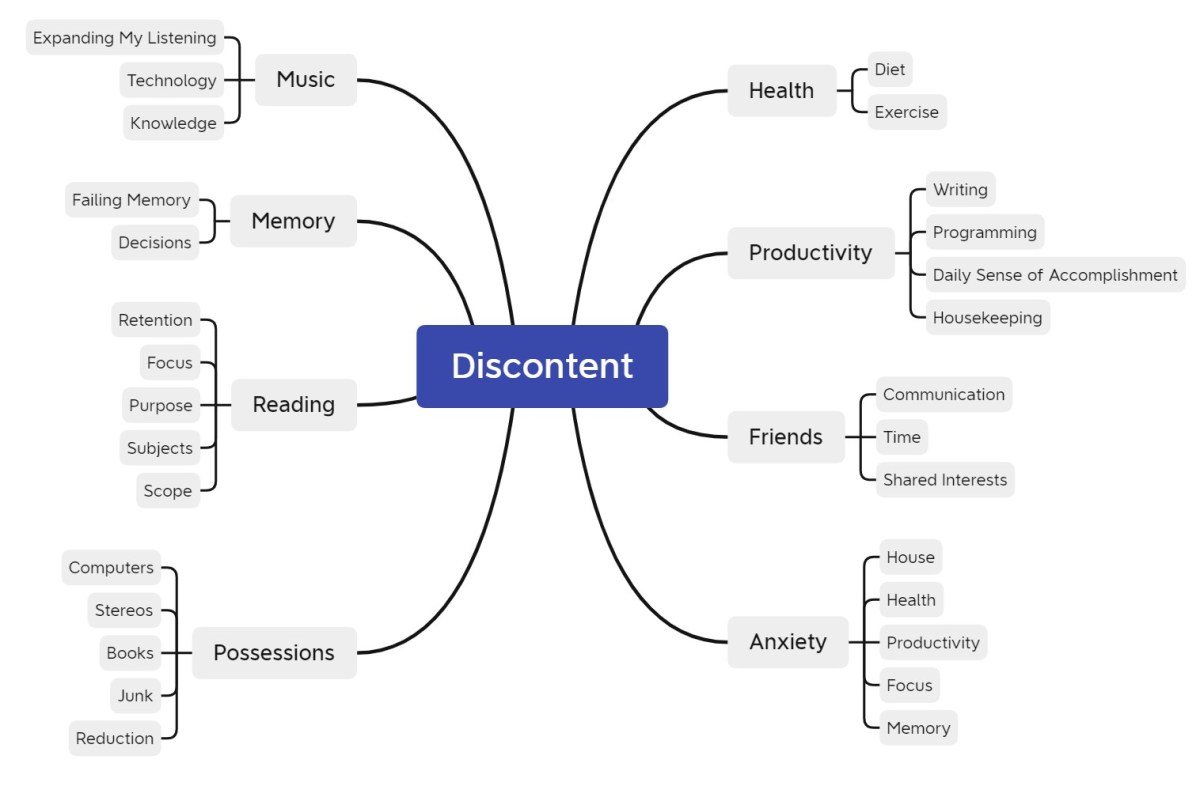
Yesterday I watched a YouTube video about writing morning pages. The idea is to get up and hand-write three pages of stream-of-conscious thoughts. So, I tried it this morning and I realized I have a number of things that make me discontent. And one of the things that make me dissatisfied with my life is not being able to see the big picture of what’s going on with myself. This brings me to this blog. I went to Xmind and created a quick mind map of my discontents hoping to see an overview of what was gnawing at me. You can see the results above.

The seed of discontent that inspired all of this comes from the way I feel each night before I go to bed — about how I spent my day. If I did something that felt productive, I feel satisfied with my day. If I didn’t I feel restless. I like when I have an ongoing project that inspires me to get up and get back to working on it. I haven’t had one of those in a while. My next level of satisfaction comes when I write a blog that I’ve put some good work into creating.

Of course, everything depends on health. Over the past few years, I’ve had to deal with a number of health issues. The walls of my life, my aquarium you might say, are the limitations of my health. When I was younger, that aquarium felt like the ocean itself, but as I grew older it shrank. As an adult, I began to realize my limitations, but the possibilities still felt huge, like I was living in the Atlanta aquarium. In my fifties, it felt more like a fancy 50-gallon deluxe home aquarium. In my sixties an ordinary 20-gallon job. Now when I feel bad it feels like I’m living in one of those bowls people keep goldfish in. When I’m feeling better, I’m back in a basic 10-gallon tank. My health goal is to do as much as I can within the boundaries set by my body. That means a lot of my daily anxiety deals with staying healthy. If I can maintain a certain level of health I feel like it minimizes my discontent. And the more I do, the less discontent I feel.

However, staying healthy juggles so many goddamn variables that it’s stressful to think about what to do to stay healthy. For instance, I watched a video, “7 Foods That Ruin Your Liver” this morning — two of which are among the top ingredients of the protein supplements I eat. Since I have a fatty liver, and sometimes have pains in my liver area, this is another worry. I also have a cyst on my liver. And I have gallstones. Eating carefully has become a very big deal for me.

Luckily, my health problems don’t cause me much discontent, or even anxiety. I’m used to dealing with them. My discontent comes from worrying over what to eat and how to exercise. I want to eat what I like and dislike making myself exercise. What would eliminate that anxiety would be finding a diet that I just stick with all the time, and finding a way to integrate just enough exercise to the minimum needed. Both really come down to discipline, but discipline is a major area of discontent for me.

I’ve been lucky lately, and have been feeling better. Last year wasn’t so good because of health problems and a hernia operation. Because I’m feeling better I feel like I should be doing more. Because I’m not doing more I’m feeling restless and discontent. That’s what came out in my morning pages.

Reducing that discontent and getting back on track will require finding a project to work on. I want something that will take me several days or weeks. Something that will make me feel like getting out of bed in the morning. The one I’ve picked to start on, but I don’t know if I’ll stick with, involves creating a new way to learn, memorize, and visualize a subject. My memory is deteriorating, but it’s never been very good for studying a subject deeply. I read nonfiction books and news articles all the time. But that information goes in and out of my brain almost instantly.

I recently read and reviewed a book about the German romantics. Supposedly, they found a lot of insights that have trickled down to us today. I want to create some kind of visual representation of their ideas and how they connected to other influential people over the last two hundred years. I figure this will kill several birds with one stone. It will touch on four branches of the mind map above: memory, reading, productivity, and anxiety. It might even touch on possessions because I will enjoy using more of my computer equipment, and it might touch on friends because it will give me something to talk about with them.

What I want to do is develop a way to visualize what I read to help me remember the information and convey what I’ve learned to other people.

All of this was inspired by scribbling out three handwritten pages this morning when I got up. Watch the video above, you might find it useful too.

By the way, the level of discontent I feel right now isn’t very high. I have a very contented personality. I find it very easy to just hang out and putter around in life. My greatest discontent has always been not being more ambitious. All I’m doing now is pushing myself to do just a little more.

JWH
In Control, Losing Control, Out of Control

James Wallace Harris, 12/10/22

[Don’t worry, everything is fine. The essay below might sound like whining, but I write to think things through. I’m aiming to sound comic but I’m afraid it might sound like bellyaching. But putting thoughts into words is very therapeutic for me.]

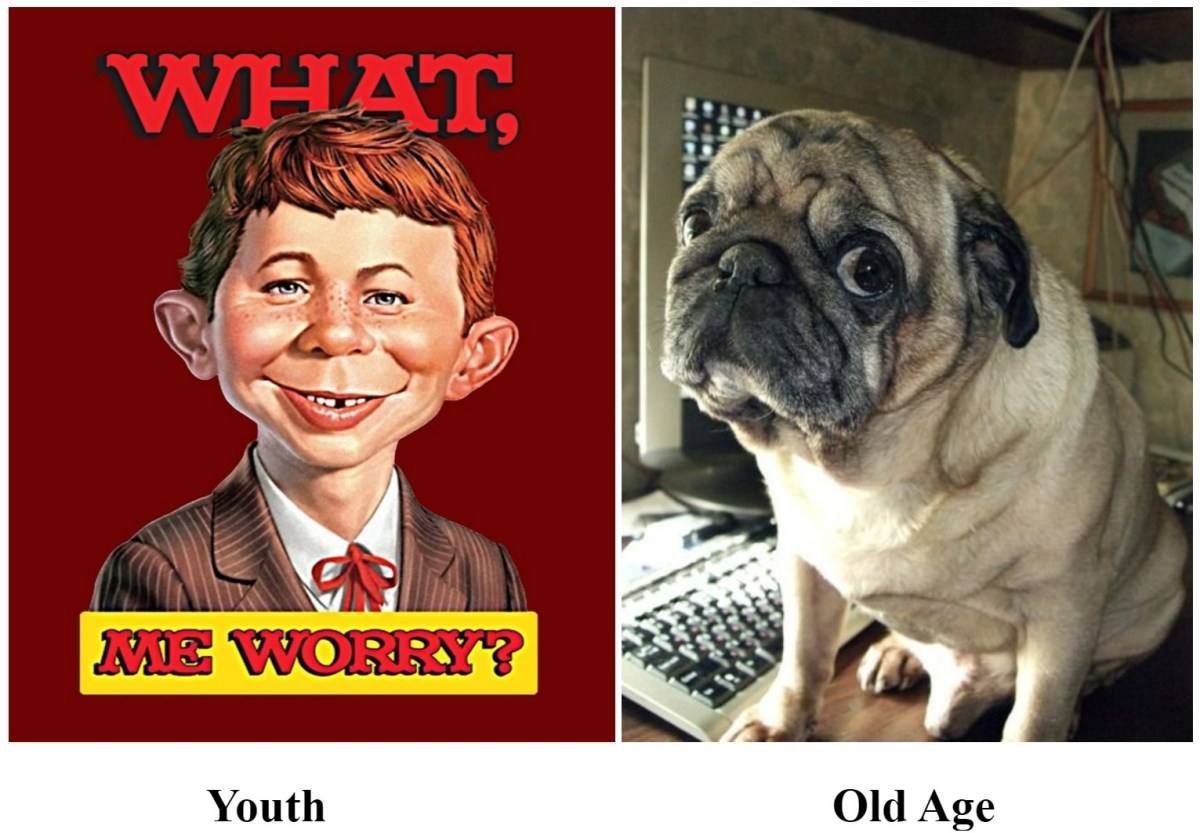
I’ve never thought of myself as an anxious person. Alfred E. Neuman was my self-help hero growing up. I had anxieties but I never thought much about being anxious — that is until I got old. Now that I’m retired and obviously aging I realize that things beyond my control might be creating new feelings to experience, and one of those new feelings might be anxiety over anxiety. Right now, that sensation is minor but I can see where it could become major.

This got me thinking about the nature of anxiety. If you’re a two-year-old and you can’t get the toy you want, throwing a tantrum is a way to communicate your anxiety. If you’re a teenager and feel like you don’t fit in socially anxiety might reveal itself in countless ways, such as a fear of where to sit in the cafeteria at lunchtime. As an adult and you feel overwhelmed at work, anxiety might manifest as a good old-fashion coronary.

I’m not sure what I’m feeling. It might be the existential angst of aging, the looming dread of civilization’s collapse, or the plain mundane fear of dying. Or maybe I just don’t have enough to do. However, I’m starting to think what I’m feeling is wimpy anxiousness over dealing with house repairs and visits to doctors. Components in my body and home keep wearing out.

I’ve always been pretty laid back, a go-with-the-flow kind of guy. I think that was because we moved around a whole lot when I was a kid, and so I just got used to things always changing and being up in the air. I never lived in any house longer than eighteen months until I was in my forties. I just solved problems as they showed up.

I also have the kind of personality where I avoid conflict and stress. I got a job in 1977 that I stuck with until 2013. And I got married in 1978 and have been married ever since. I don’t like rocking the boat. I think all of that has led to a low-anxiety life, which I was lucky to find and grateful to have.

But now I’m 71, and I realize I’ve been living in the same house for fifteen years. That has made me very comfortable and I worry more and more about losing it. And the body I’ve depended on for 71 years is becoming less dependable, and that’s freaky too.

Something is changing. Besides my body and house needing more frequent repairs, Susan is getting some health problems too. Susan and I both hope we can die in this house. I realize that I’m trying to control three big things. My health, Susan’s health, and the house.

Now, this anxiety is nothing compared to a family that’s lost their home in Hurricane Ian, or being the president and worrying over the national economy. But it is a feeling that I’m having to deal with, and I’m trying to figure out how to deal with it, and what exactly causes it.

In 2022 I had one operation, two ER visits, four ultrasounds, three CT scans, one MRI, and countless other medical tests. My doctor is talking about three additional operations I might need. Also in 2022 I had to replace the outside AC unit, replace the hot water heater after it flooded my computer room, had to have dead limbs removed in February after a falling limb speared a hole in the roof last December, and now I’m having to spend another three thousand having the trees cleared of diseased branches again after a giant limb fell across the back on the house.

I’m still a fairly la-de-da kind of guy, but I realize this slight background radiation of unease is not going away. I realize it’s because I’m trying to control things that are hard to control. I worry about Susan, but neither I nor her doctor can nag her into exercising — so I have no control over her. And there’s only so much control I have over my body even though I am willing to diet and exercise to help myself.

Although I can have the house repaired I realize I’m slowly losing control over our home (as I hear another small branch hit the roof). I can no longer do most of the repairs myself. I gave away my big ladder because I don’t think I should be getting on the roof anymore. Before I would have just gotten on the roof, sawed the big limb into pieces, and tossed them down to the ground. Now I have to wait for the tree people to clear it off. However, that turned out to be a blessing in disguise. The tree guy spotted numerous diseased branches that need to be cut out, and some of them are giant and could cause significant damage to the house. I now have falling tree limb anxiety, to add to my flooding floors anxiety.

In a fantasy of gaining control, I considered having all the trees near the house cut down, and having an addition put on the back of the house so I could move the water heater and HVAC out of the attic so there would be no water lines above us. And since we have a few days of power outages every year, I’ve also considered getting a standby natural gas generator. However, all those considerations might be overkill.

In 2023 I’ll probably have more maintenance done on my body, and I’ll replace an ancient dishwasher, and a refrigerator that leaks, and have some other plumbing problems fixed. And there will be other unforeseen things to fix too. I’m amused that my body and my house both seem to be breaking down equally as often.

I sometimes contemplate moving to a retirement complex. A friend is investigating assistant-living apartments for their parent and the assistant-living facility they described sounded super-attractive. I would no longer have to worry about controlling a house, just my body. But I think we’re too young yet for such a facility.

Still, I realize that between now and oblivion I’ll be fighting to control my health. That’s nothing I even considered when I was young. For now, I’d say I was in control, but I can foresee losing control, and even being out of control.

All kidding aside, I’ve always felt anything I was anxious about I could fix myself. One aspect of this new feeling of anxiety is a sense that I can no longer fix my problems myself. I must hire people. I’m becoming more and more dependent on doctors and repairmen.

My sister Becky once observed that we start off life in one room with people taking care of us and end up in another single room with people taking care of us. (I think she said it more graphicly, with references to butt wiping.) Maybe I didn’t feel particularly anxious most of my life because I felt I could fix my problems, and these new anxieties I’m feeling because I’m getting more and more people to take care of my problems and I’m spending more and more time in fewer rooms.

JWH

Can Fiction Educate As Well As Nonfiction?

by James Wallace Harris, 11/2/22

I turn 71 this month, and getting older is getting harder. Being old is nothing like I imagined. That’s a problem for me because I like to be prepared, and being prepared requires anticipating the possibilities.

Last year I read The Art of Dying Well: A Practical Guide to a Good End of Life by Katy Butler. It’s a useful handbook giving tips about healthcare for the elderly, plus Butler relates plenty of stories about people she met who were going through a variety of issues as they approached death. I learned a lot from her book. People tend to decide between two paths toward the end of life. Some want to take advantage of everything medicine has to offer, and others prefer to take a gentler path, choosing less aggressive medical procedures, or even refusing treatment. One of the best lessons of the book is doctors will go to extremes to keep you alive unless you learn to say no. And for me, the important part of The Art of Dying Well is learning when to say no, and how to decide what you want before you lose control of your situation.

When I read Olive Kitteridge by Elizabeth Strout this week, I was surprised by how it inadvertently taught many of the same lessons. Although it’s called a novel, it’s a collection of thirteen interrelated short stories, and often those fictional stories were like the case studies in Butler’s book. Olive is in her late sixties at the beginning of the book, and seventy-four at the end. I was particularly horrified by the final accounts of Olive’s husband, Henry.

Olive Kitteridge is a book that offers a series of intense emotional impacts. And most of them made me think about how I will deal with a particular issue if it should happen to me. Henry’s fate is the hardest to contemplate. One day he and Olive are going to the grocery store and when he steps out of the car, he falls to the ground. He’s had a sudden stroke that leaves him blind, unable to walk or talk, and probably has left him deaf. He’s put in a nursing home where he needs to be cared for like a small child. To me, that’s scarier than anything Stephen King ever imagined. And how do you prepare for something like that?

It would help to have all the proper legal paperwork ready. And it would help if others knew your wants. That’s covered in the Butler book, but it’s covered in more detail in Elderhood: Redefining Aging, Transforming Medicine, Reimagining Life by Louise Aronson. Aronson is a doctor who eventually got into geriatric medicine. Her book is heavier than The Art of Dying Well, with more clinical details. It has a tremendous wealth of information, but I found Aronson’s structure for her book somewhat disappointing. Elderhood has a clearly laid out structure but Aronson doesn’t always stick to it.

Both nonfiction books are excellent handbooks for anticipating getting older, especially for the medical and legal details. But the novel, Olive Kitteridge, was also excellent for the same purpose, but in a different way. I guess it’s a handbook for philosophically preparing for our last years. Some of its most important lessons were about communication, or more precisely, the lack of communication.

Much of the novel is about waiting until it’s too late to express our true selves. One of the strongest reasons why people want an afterlife is so they can meet up with dead loved ones. Is that because we really want to tell them something? Or that we really want to ask them something? I know that’s true for me.

I loved reading Olive Kitteridge enough that I’m going to read more Elizabeth Strout books and have already started on Olive, Again – a sequel with additional short stories about Olive Kitteridge and the people she knew. I’m also keeping The Art of Dying Well and Elderhood to reread again and again as I get older.

JWH

What Books Do You Speak?

by James Wallace Harris, 8/8/22

Most of our ideas are borrowed since few people have original thoughts. The other day I was wondering why conservatives and liberals think so differently. I decided one reason is that they read different books. Of course, not everyone reads books. Ideas are also passed around from person to person, or by newspapers, magazines, journals, advertisements, political rallies, television shows, the internet, etc. We dwell in a sea of ideas.

Ideas do originate with original thinkers, and often they are first published in books. Journalism and other forms of mass media then propagate those ideas, which in turn are spread by word of mouth. So, for now, let’s think of the basic unit for storing and spreading ideas are books.

My theory is conservatives and liberals think differently because the foundation of their beliefs comes from different books. I’m not suggesting that all conservatives and liberals read the same set of books, but the ideas for their thoughts and speech originated in a subset of books.

I was thinking along these lines because I wondered if conservatives and liberals each had a core set of twenty books, what would happen if the conservatives read the liberal’s books, and the liberals read the conservative’s books? Would our polarized political opinions begin to homogenize?

Then I wondered about fundamentalist religious people who put their faith in one book. What would happen if all the fundamentalists around the world all read each other’s holy book?

Thinking about that brought up an obvious stumbling block. Most people’s beliefs are based on what they first learned as children. If you are raised Christian and conservative you’re most likely to stay Christian and conservative. That suggests ideas acquired in youth are stickier than ideas acquired later in life. For my test, we’d have to raise children with The Bible, The Quran, The Tanakh, The Talmud, The Vedas, The Upanishads, The Tipitaka, The Tao Te Ching, The Yasna, etc.

We know minds are open and plastic at birth. If you took a child from a Christian family and gave it to a Muslim family to raise, it will grow up Muslim. But for some reason, after a certain age, minds close and lose their plasticity.

On the other hand, fads arise and spread ideas/memes all the time. Adults will embrace new ideas. Fox News, the Internet, to Tik-Tok can spread new ideas like a California forest fire. This suggests that people can acquire new ideas that they put on top of the foundational ideas that were programmed in their youth.

And ideas don’t have to come from nonfiction books. If all you read are romance novels and watch romance TV shows and movies, your ideas about relationships will be different than if you only consumed mysteries.

I’m in a book club that was reading Developmental Politics by Steve McIntosh, a book about our polarized politics. McIntosh hoped his insights would help solve that problem but most of the readers in the book club doubted it. One of our members did believe in McIntosh’s ideas and thought they could work. I felt McIntosh’s ideas were insightful but figured for them to be persuasive, would require everyone to read many other books first. McIntosh’s book was complex enough to require reading dozens of other books to fully understand it.

That’s when I realized we speak in books. When we express ourselves, we pass on fragments of books, but we don’t pass on enough information to let other people fully understand the foundation of the original ideas. Generally, we pass on tiny fragments of the original idea that are barely impressions. And we seldom communicate ideas but express ourselves emotionally.

If you want to understand a person, you have to consume the same books they did, or at least the same secondary sources. If a friend is passionate about a belief you’ll never understand your friend until you understand the foundations of their beliefs.

Few people understand the sources of their beliefs. Few people can point to a set of books and say here’s where my ideas originated. The origin of a classical education came from the study of foundational books, but that idea broke down in modern times when we were overwhelmed with significant books.

Yet, even when there was only one book for most people, The Bible, Christianity spent centuries arguing over its meaning. If you study all the people who claim to be Christian today you’d find very little commonality. The Bible is too big and too diverse. If we took The U. S. Constitution instead, which is tiny in comparison, we still get endless disagreement.

Ideas are slippery and inexact. Even if we read the same books and speak about the same ideas we don’t interpret them in the same way. Humans aren’t computers. We filter ideas through our emotions. Books might sow ideas but they don’t plant them evenly, and they grow inconsistently.

It appears that humans latch onto vague concepts and use them for ammunition to get what they emotionally want. Even if we read the same books we’ll still be a long way from finding agreements.

What we have here is a failure to communicate. What we need is a better approach to understanding each other’s wants. It might start with reading the same books, but it would only be a start. We’d also need to start studying each other’s emotions, and emotions are even harder to communicate than ideas. That’s what McIntosh was getting into with Developmental Politics, building on developmental psychology.

JWH

To Go, or Not to Go — To the Bookstore?

by James Wallace Harris, 7/21/22

Each morning before I get out of bed I plan to do something with my day. It’s never very ambitious because of health problems, lack of discipline, and laziness. And things seldom go according to plan. Today I decided to donate ten books to the library bookstore. That impulse came from getting a new toy. I feel like Jerry Pournelle in his old columns for Byte magazine called “Chaos Manor.” In those columns, Jerry would get a new computer which would cause a cascading series of problems. I got a new little tube amp, a cheap one, to set up a better stereo system in my bedroom. That single act has caused a domino-falling cascade of problems to fix.

The only place I have to put a stereo in my bedroom is on top of two bookcases. That’s okay if I don’t care about sound quality, but this new little tube amp sounds great — if the speakers are at ear level — but sounds like crap next to the ceiling. For me to solve this problem, will require moving two Ikea Billy bookcases and replacing them with a piece of furniture 72 inches wide and roughly 24-30 inches high.

“Ah-ha!” you might be thinking. “He’s finally getting to the part about going to the bookstore.”

Well, not quite. This is going to be a long story about getting old and how my aging mind and body affect my decision-making at seventy.

The quick and easy solution to my problem was to go into the dining room which we’ve converted into a gym and take the TV credenza and put it in the bedroom in front of the bookcases. That left the TV on the floor for now, but I had to give up exercising when my back went out a few weeks ago, so I can worry about it later. Since I’ve become semi-invalid the easiest solutions are the ones that work with the least effort.

If Susan and I had had the foresight to have children we could have gotten them to move the bookcases into the dining room, left the TV on the credenza, and then sent those kids to Ikea to get a cabinet for the stereo. Unfortunately, back in the early 1980s, we didn’t anticipate this need.

My back has gotten somewhat better. I can do a little lifting. I don’t want to do too much because I might screw it up again. I figured I could unload a shelf or two each day in stacks on the floor. There are two cases with six shelves each. You do the math. I could put slides under the cases and push them into the dining room, and then reverse the process of loading them back up. Ikea also offers delivery and assembly for a fee. Thus, without offspring, and if I’m patient, I can get the job done in a week or two depending if Ikea can deliver that quickly.

But is this the best long-term solution? Susan has long complained that she doesn’t want to deal with all my books after I depart this world — whenever that might be. I keep telling her she can just call Salvation Army or a book buyer, but maybe all those books are my responsibility?

This morning I decided I would start going through my books and weed out enough to empty two bookcases. I figured I could carry ten or twelve books to the library bookstore each week and eventually, I’ll donate two bookcases worth of books. So after doing my spinal stenosis physical therapy exercises I pulled the first book off the shelf I thought might be the first of ten I would part with today. It was The Long-Winded Lady by Maeve Brennan.

I opened it up to a random page and started reading. Whoops. There went my plan. Maeve wrote lovely little essays about living in New York City for The New Yorker. The first one I read was about seeing a young woman collapse on the street outside her restaurant window. The next was about an evening walk to see a farmhouse that had been moved from downtown to Greenwich Village. I bought this book after seeing a documentary, I think on HBO, about another writer who met Brennan before she died. That writer had discovered Maeve on the street after she had become homeless. I’d like to see that documentary again, but I can’t remember its title.

I’m afraid every book I pulled off the shelf had a story behind it, one that made me want to keep it. I have more books than I could read in another dozen lifetimes. It might take me years to find and decide which books I could give away that would free up two bookcases full of books.

That left me so despondent that I went to the library bookstore and bought five more books.

JWH

p.s.

The other night Janis and I were jabbering on the phone about all the hoarders we know. We felt horror at what has befallen our friends. Now I need to worry if that affliction needs to be added to my recognized list of afflictions.