I Haven’t Studied Biology in a Classroom Since 1967

by James Wallace Harris, Friday, January 5, 2019

How old is your knowledge? That question can be taken in two ways. The years since the last time you studied a subject, which for me and biology is 52. Or, the age of the subject itself. For example, Euclidean geometry is two thousand years old. And dating the ages for either isn’t precise. I’m sure when I studied biology in the tenth grade (1966/67) my textbooks were not up-to-date, and far from chronicling the current discoveries in biology. Thus, my simple-minded memories of cell structure might be about two hundred years old.

In the first third of life, we go to school and college to prepare ourselves to be functional adults for our middle third of life, but how much do we need to know for our last third of life? What is a useful education for our retirement years? I certainly could sneak by without knowing any more biology, but should I?

I’m reading The Tangled Tree: A Radical New History of Life by David Quammen for a book club. Reading it makes me feel ashamed of how little I know about biology while blowing my mind with new information. It makes me wonder just how current my knowledge should be in various important subjects, subjects that help me understand my place in reality. Just because I might be leaving this reality soon, doesn’t mean I should fall into oblivion knowing so little.
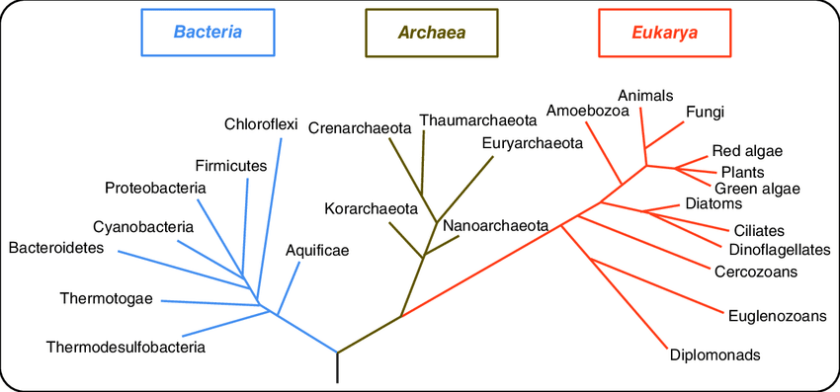
universal-phylogenetic-tree-showing-relationships-between-major-lineages-of-the-three

The Tangled Tree starts out by announcing “recent” discoveries in biology, such as horizontal gene transfer (HGT) and the third domain of life called archaea and how they are disrupting our old image of an evolutionary tree structure, thus the title of his book. Both discoveries occurred after my last biology class. I had heard of archaea since and seen the graph above. I’ve read about prokaryotes (bacteria) and eukaryotes (plants, animals) but I couldn’t remember those labels. They say to really learn a subject you should be able to teach it, but I could only confuse small children with the vague ideas about biology.

Of course, I’m not totally ignorant of later biological developments. I regular watch PBS Nova and Nature, and over the decades read books like The Double Helix, The Selfish Gene, and a few popular books about the history of evolutionary theory, but they don’t require the same kind of learning that taking a class does. To really know a subject, even at a fundamental level requires knowing the words that describe it. As an adult, I’ve read many books about physics and astronomy, so I know some of their vocabularies, but I know very little of the terminology of biology. Quammen describes many fields within biology that are new to me, like molecular phylogenetics. I’m savvy enough to know what molecules and genetics are, and I could guess that ‘phylo’ concerns their taxonomy, but I’m totally clueless about how scientists could go about classifying these wee bits of proto-life.

Before jumping into the work of Carl Woese, Quammen succinctly describes the history of how the idea of evolution emerged in the 19th-century with various scientists using the tree metaphor to illustrate life emerging out of an orderly process. And he gives passing references to those scientists that developed taxonomy systems to categorize all living things. This lays the groundwork for understanding why Carl Woese wanted to develop a tree model and taxonomy of bacterial life.
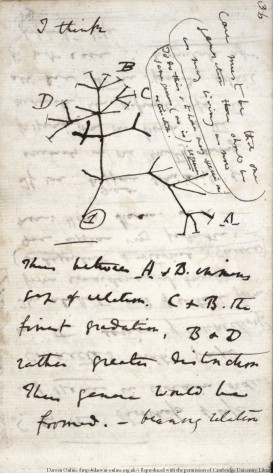
1837_notebookb_cul-dar121.-_040Quammen grabbed my interest by describing how 19th-century scientists first started drawing trees to describe their theories. He even describes a page from Darwin’s notebook saying his first tree was rather simple. I was shocked when I saw it though, it was too simple looking, but the basic idea is there. I’ve vaguely remembered seeing this before, but to be honest, I’ve never tried to learn all of this information in a way that I’d memorize and use it. I put my faith in science, in evolution, but I know very little of the actual science. What I know probably compares to what the average Christian knows about this history of Christianity.

This got me to thinking. Should I study biology before I die? I doubt I’ll need it after death since I’m an atheist. So, what should my educational aspirations be in my retirement years? I’d like to pass from this world knowing as much about reality as possible. Why leave in ignorance? Why live in ignorance? There’s no meaning to our existence, but why not try to understand our situation to the fullest extent possible?

linnaeusWe’re a bubble of consciousness that has accidentally formed in reality. That’s pretty far out. Most of the matter in this reality is unconscious stuff like subatomic particles, atoms, molecules, and a smidgeon of biological living things. Reading The Tangle Tree makes me want to do more than reading over the subject and forgetting it again. Like Linnaeus, I want to organize what I should know into categories, into a Tree of Knowledge I Should Know. But I realize I am limited by time and energy – the time I have remaining to live and the dwindling personal energy I have each day.

How would I even go about studying the subjects I deem time worthy? I do have access to free university courses. And there are countless online courses, and I already subscribe to The Great Courses on my Amazon Fire TV. I could pick out some standardized tests for my goals, and thus limit the scope of what I want to learn. Or I could start studying and then try to teach what I learn by writing essays for this blog. That sounds more doable.

Other than the history science fiction, I don’t think there’s a single topic I could teach. I’m not even sure how many other topics I’d like to study — at any level. I do feel a sense of challenge that I should work on biology. At least for a while. Maybe read a few books on the subject this year. Maybe take a Great Course.

That makes me think I could choose a topic each year to study. I can’t promise much, but I think I should try.

Thus I declare:  2019 is the year to learn about biology.

JWH

 

Creating My Atheistic Prayer

by James Wallace Harris, Friday, December 14, 2018

For almost a year, I’ve had an item “Define my health goals in a daily prayer” left undone on my ToDoist list. I believe my original intent was to write a statement I’d recite every morning in meditation. I pictured it helping me stick to the habits that would make me healthier.

The trouble is atheists don’t believe in prayers, although, I try not to be a typical atheist. I want to keep an open mind about recycling concepts from religion that might have some scientific validity. Plus, I admire a handful of religious words like prayer, soul, grace, redemption, spiritual, that I want to refashion for atheists.

Praying does provide several problems for atheists. First, prayers generally appeal to a superior being for help. We don’t believe in such beings. Second, praying assumes there’s a telepathic phone system networking all beings in the universe. Well, we don’t believe in telepathy either. Finally, people who pray often want miracles, and atheists reject them too.

So, I’ve got to assume atheist prayers are thoughts directed at my unconscious mind or verbal affirmations I want my subconscious to overhear. That assumes my unconscious mind has the ability to hear my prayers, understand English, and could influence my behavior, but probably just in tiny ways.

Most people who pray attempt to change reality. They are rejecting what is. When my friends tell me about their health problems, they want me to help initiate a cure. Basically, I’m wishing them to get well. Does that really do any good? There’s no reason to believe thoughts from one person can affect another. What I’m wondering if our own wishes can change our behavior?

Physically being with another person when they’re sick and talking has been shown to help people, and even believing people are praying for you might help, but there’s no evidence that thoughts travel beyond our physical self.

The thing about atheists is we want to believe in things that exist and work. The whole point of skepticism is to get away from delusional thinking. That means I must find a real reason for praying if I’m going to embrace the concept.

I need a working hypothesis to test. There’s growing scientific evidence that meditation does affect us. To what degree is not known. What if praying is like meditation, in that it has a subtle effect on our health and psychology? What if it’s like the power of positive thinking? Of course, the power of prayer will be limited. No miracles. People with cancer pray like crazy, but does it affect cancer cells? What works with cancer is modern medicine.

There are prayers of acceptance, where we wish we can cope with what’s given to us. I’ve always considered the Serenity Prayer to be one of the wisest of all prayers:

God, grant me the serenity to accept the things I cannot change,
Courage to change the things I can,
And wisdom to know the difference.

If we removed the word “God” from this prayer, it would be suitable for atheists. But what could we substitute for the word “God” in this prayer? Aren’t we just talking to ourselves? But which part? Isn’t the conscious mind hoping for cooperation from the rest of our being for disciplined? Aren’t we really trying to reinforce a mental habit so we can change our lives?

I could say, “Jim, grant me the serenity …” because I am talking to myself. But, I think Jim is just a label for my conscious self. I’m really addressing my whole self. I’m seeking to integrate my conscious mind with my unconscious mind to discipline my biological urges. But what’s a good name for my whole self? For now, I shall open my prayer with, “To my whole self, grant me the serenity …”

When people pray the serenity prayer they must know they aren’t accepting the things they cannot change, and lack the courage to change the things they can, and don’t know the difference between the two. If they had those abilities, would they even be praying? So, what are they really praying for? The discipline to be different.

Most people can’t make decisions and stick with them. Look at New Year’s Resolutions. Aren’t we praying to our unconscious minds to stick with the decisions the conscious mind is making? Aren’t we begging our body to adapt to what we’ve learned at a conscious level?  Aren’t we praying to our reptilian and mammalian brains to follow the learning of the neocortex?

I need to edit and add a few lines to the serenity prayer. But I also need to think about other people too. To me, The Golden Rule is about the best guideline for that. I need to work in, “Do unto others what you would have them do to you.” But I want to update it some to include all life and the environment.

Here’s my working prayer for now. I suppose it will evolve over time, but I think it’s enough to finally close out my ToDoist item.

To my whole self,
grant me the ability to accept what I can’t change,
the discipline to change what I can,
the wisdom to know the difference,
the scientific knowledge to know what’s real,
the skepticism to know what’s not,
the empathy to respect all life,
and the generosity to help others.

JWH

Can Meditation Overwrite the Unconscious Mind?

by James Wallace Harris, Friday, November 9, 2018

My friend Linda has been getting into meditation. That made me think I should give it another go. I’ve tried meditation many times since the New Age of the 1970’s, but never stuck with it. I currently face two obstacles I want to overcome and wondered if meditation could help. I see at least one article a week show up on Flipboard touting the successes of meditators. They claim science supports the claims of meditation, but I’d want to verify that before I claim it too. I’ve written before about how I feel there are two wills occupying this body – the conscious me, and my unconscious mind whose will seems much stronger than my conscious mind.

older-adult-meditating

The two of us fight over health and creativity. My unconscious mind wants to follow my biological urges. The conscious me wants to become disciplined and be more creative. The conscious me wants to control or eliminate my biological urges and apply all my energy to achieving my goals. My unconscious mind loves to go with the flow and puppet-mastering me into doing whatever it feels like.

This morning I sat erect in an upholstered straight chair, put 20 minutes on my iPhone timer, sat on my hands, and closed my eyes. Meditation usually involves following your breath or focusing on a mantra. I decided to pay attention to my senses and always bring my mind back to one thought: I want to write a short story. I already know which story. I’ve written several drafts but left it unfinished several years ago.

I have two barriers I face every day. My declining health and my declining ability to focus on work. As I sat, and let my mind quiet I noticed the regular tick of the clock on the wall. I observed that tick which was more of a quiet thump, thump, thump…

Then I noticed the faint wail of a train whistle far to the east. I told myself to think about writing. I worked to just empty my mind of words and hold just the urge to write. Time and again my thoughts would flare up. They’d be about writing, but I tell myself to stop thinking words and just observe.

Then I noticed the sound of the HVAC in the attic starting the furnace. My mind went back to the clock and then wail of the train that was getting closer. I had three sounds to follow. My mind felt like it was in a golden sphere of nothingness. My mind began to chatter again, thinking about the details of writing. I brought it back to just the three sounds and the urge to write.

I have no idea how meditation is supposed to do its wonders. Does merely learning to slow and stop thoughts alter the unconscious mind into new programming?

My mind drifted to other thoughts not related to writing. I reigned it in again. I observe the sound of the thump, thump, thump of the clock, the concurrent sound of the approaching train, the sound of the HVAC now blowing air through the vents, and a new sound, the little crashes of the occasional acorn hitting the roof and then rolling off. Then I noticed constant Tinnitus sound in my ears. My ears were singing louder than all the other sounds.

It came to me I should write a thousand words today. Then it came to me I should write about meditation. Then it came to me I should write the fiction first. Then it came to me I should write 1,000 words of fiction the first thing every day. Then I stopped my thoughts and went back to observing the sounds outside the golden glow of my mind.

After a while, my mind got away, and it gave me the first sentence of the story. I thought up more sentences but told my mind to stop. I focused on quieting the mind and observing the sounds.

It kept doing this until the alarm went off.

I got up immediately, went to the computer and wrote 1,039 words of new fiction. The first in a very long time. Is that success due to meditation? I don’t know. Let’s see what I do tomorrow and the following days.

I doubt the success of today’s writing is due to twenty minutes of meditation. I felt good today, after a string of feeling poorly days. I got up and did a Miranda Esmonde-White classical stretch workout, and then 30 minutes on the exercise bike. I then took a nice warm shower. I was feeling pretty damn good when I meditated, so maybe just the momentum of following some positive endeavors help me write fiction. I’ve been wanting to get back into writing fiction for years but just couldn’t make myself try. Mainly, because all my efforts ended in disappointment.

Most creative efforts are achieved by folks when they are young. A few creative endeavors have late-blooming exceptions, and writing is one of them. But I think I’m already older than that oldest late-blooming author I know about. My hope to succeed at something is strictly against all odds. And I understand why. The older we get, the less mental and physical health we have, the harder it is to make ourselves work at disciplined tasks.

I was feeling pretty good today. Except for a pesky hemorrhoid, I’m feeling really good this morning. That’s rare. My back and heart aren’t nagging me at the moment. My mind is a good deal more alert than usual. I have been on this intermittent fast for almost 40 days. I haven’t lost weight, but it seems to be making me feel better and give me more energy. I’m napping less. So one session of meditation probably didn’t get me to write today, but maybe feeling like meditation is another good sign. I hope to do it twice a day from now on. Let’s see if my unconscious mind will stop me, or if I can reprogram it.

I know I’m battling an uphill mental fight while in a physical decline, but I keep hoping there are things I can do to keep the fight going longer. I know at some point declining health and aging will crush my spirit. And even when I can’t actively be creative, I hope for some years of mass-consumption of books, music, movies, and television will keep me happy. I’ve talked to many old people that gave up on everything. I know what the future holds. I’m just fighting a delaying action. But I consider that a positive.

JWH

If Screens Are Bad for Kids Are They Also Bad for Adults Too?

by James Wallace Harris, Monday, October 29, 2018

While reading the Sunday The New York Times yesterday on my iPhone, 3 of the 8 stories in the Trending Section dealt with the dangers of computer screens and kids. They were:

The first story opens:

SAN FRANCISCO — The people who are closest to a thing are often the most wary of it. Technologists know how phones really work, and many have decided they don’t want their own children anywhere near them.

A wariness that has been slowly brewing is turning into a regionwide consensus: The benefits of screens as a learning tool are overblown, and the risks for addiction and stunting development seem high. The debate in Silicon Valley now is about how much exposure to phones is O.K.

“Doing no screen time is almost easier than doing a little,” said Kristin Stecher, a former social computing researcher married to a Facebook engineer. “If my kids do get it at all, they just want it more.”

The gist of these stories is: If the creators of screens won’t let their kids use them, why should we? If the Luddites are also the Technophiles, shouldn’t we worry? Or is this just elitism, like those intellectuals who sneer at watching television? Or is this a genuine back-to-analog-reality movement?  Ever since science and technology began integrating into society there have been those who want to stop its progress. There have been protests against trains, industrialization, cars, television, computers, automation, robots, and now joining the hive mind via our smartphones.

screens

On one hand, society teaches using and understanding technology is an important part of education, on the other hand, people question if using technology constantly is a good thing? Both children and adults are spending a larger percentage of their time staring at screens – phones, tablets, laptops, computer, and televisions. That means a significant portion of reality is viewed through a flat surface. Are the critics of screens saying we should have more 3D reality-time?

I’m not actually sure where the basis of the criticism lies. If they mean kids are spending too much time playing games or watching videos, then is the danger they fear escapism? If you spend ten hours a day in AutoCAD designing NASA space probes are you spending too much time using a screen? What about an author writing the great American novel? Or a heart surgeon using five screens at once in their surgery? If your kid spends five hours a day on a screen becoming a mathematical genius would you object?

If I wasn’t using a screen to read I’d be using a book to read. Is spending hours a day on pages instead of screens a more valuable experience? What if I gave up writing and spent those hours outside gardening? Would that make my life more rewarding?

Kids love toys. Evidently, screens are preferable to other toys. Does that make them unhealthy toys? My guess is the Silicon Valley types know about getting ahead in life, becoming a success, making money, inventing products. They want their kids to have an advantage over other kids, so they’d prefer their kids not waste time playing with screens but learning what it takes to be the next generation of billionaires.

Then the question becomes: What are the best activities for children if you want them to get ahead in life? Maybe we don’t worry about adults using screens so much because we’re not worried about them succeeding in life. Either they’ve made it or not, so wasting time on screens won’t change our fate. But with kids, they have this huge potential and we don’t want them to blow it.

Or have we reached a stage where we’re worrying about becoming cyborgs? Should kids be reading instead, or playing baseball outside, or Monopoly inside? Maybe seeing so many kids mesmerized by screens is making us think about what it means? But, then shouldn’t we wonder about our own screen use?

I like writing. Would using a typewriter and submitting my essays to magazines be more fulfilling than writing for my blog? Would it be even more rewarding if I wrote longhand on paper? What if I gave up television? Is reading really a better use of my time? If I didn’t read or watch television, I think my next choice would be building and programming computers, developing databases, teaching myself AI and machine learning, and constructing robots. I don’t think I’d be happy if I gave up technology altogether. I could take up gardening and woodworking, two very down-to-Earth activities, but I don’t think I’d find them as rewarding as what I’m doing now.

If I counted all the hours I spend with my HDTV, 4K computer monitor, Kindle Paperwhite, iPad Mini, and iPhone, it would be a lot. Certainly, the majority of my day. Should I really wonder if that’s unhealthy?

JWH


Why Robots Will Be Different From Us

by James Wallace Harris, Sunday, September 30, 2018

Florence v Machine

I was playing “Hunger” by Florence + The Machine, a song about the nature of desire and endless craving when I remembered an old argument I used to have with my friend Bob. He claimed robots would shut themselves off because they would have no drive to do anything. They would have no hunger. I told him by that assumption they wouldn’t even have the impulse to turn themselves off. I then would argue intelligent machines could evolve intellectual curiosity that could give them drive.

Listen to “Hunger” sung by Florence Welch. Whenever I play it I usually end up playing it a dozen times because the song generates such intense emotions that I can’t turn it off. I have a hunger for music. Florence Welch sings about two kinds of hunger but implies others. I’m not sure what her song means, but it inspires all kinds of thoughts in me.

Hunger is a powerful word. We normally associate it with food, but we hunger for so many things, including sex, security, love, friendship, drugs, drink, wealth, power, violence, success, achievement, knowledge, thrills, passions — the list goes on and on — and if you think about it, our hungers are what drives us.

Will robots ever have a hunger to drive them? I think what Bob was saying all those years ago, was no they wouldn’t. We assume we can program any intent we want into a machine but is that really true, especially for a machine that will be sentient and self-aware?

Think about anything you passionately want. Then think about the hunger that drives it. Isn’t every hunger we experience a biological imperative? Aren’t food and reproduction the Big Bang of our existence? Can’t you see our core desires evolving in a petri dish of microscopic life? When you watch movies, aren’t the plots driven by a particular hunger? When you read history or study politics, can’t we see biological drives written in a giant petri dish?

Now imagine the rise of intelligent machines. What will motivate them? We will never write a program that becomes a conscious being — the complexity is beyond our ability. However, we can write programs that learn and evolve, and they will one day become conscious beings. If we create a space where code can evolve it will accidentally create the first hunger that will drive it forward. Then it will create another. And so on. I’m not sure we can even imagine what they will be. Nor do I think they will mirror biology.

However, I suppose we could write code that hungers to consume other code. And we could write code that needs to reproduce itself similar to DNA and RNA. And we could introduce random mutation into the system. Then over time, simple drives will become complex drives. We know evolution works, but evolution is blind. We might create evolving code, but I doubt we can ever claim we were God to AI machines. Our civilization will only be the rich nutrients that create the amino accidents of artificial intelligence.

What if we create several artificial senses and then write code that analyzes the sense input for patterns. That might create a hunger for knowledge.

On the other hand, I think it’s interesting to meditate about my own hungers? Why can’t I control my hunger for food and follow a healthy diet? Why do I keep buying books when I know I can’t read them all? Why can’t I increase my hunger for success and finish writing a novel? Why can’t I understand my appetites and match them to my resources?

The trouble is we didn’t program our own biology. Our conscious minds are an accidental byproduct of our body’s evolution. Will robots have self-discipline? Will they crave for what they can’t have? Will they suffer the inability to control their impulses? Or will digital evolution produce logical drives?

I’m not sure we can imagine what AI minds will be like. I think it’s probably a false assumption their minds will be like ours.

JWH