Looking Forwards v. Looking Backwards

by James Wallace Harris, Wednesday, September 20, 2017

Do you read books about the past, or about now, or the future?

Our Nig by Harriet WilsonThis morning I started work on an essay about African-American fiction in the 19th century. It began with a question that had popped into my head: “Who was the first black novelist in our country?” This kind of fun sleuthing on the internet inspires me to write essays. I quickly came across articles about how Henry Louis Gates, Jr. had discovered a long forgotten book in the early 1980s called Our Nig; or, Sketches From the Life of a Free Black (1859) by Harriet Wilson. That made me want to research a number of other things. Have earlier novels been uncovered since? What were the second, third, fourth, fifth novels? What about short stories? Were any bestsellers in their day. Before long I realized I could spend weeks on this project.

Men-Into-SpaceI usually think of several ideas a day for researching and writing. I start work on just a fraction of these ideas, and complete work on damn few. Another idea I got yesterday was to write about Men Into Space, a one-season TV show of 38-episodes (1959-60) that worked to be very realistic about space flight. A lady in my online book club mentioned it and I was surprised I hadn’t known about it before now. It’s not available on DVD except as DVD-R sales through places like eBay (because it’s in the public domain). It is available to watch online at YouTube. However, I did find a book, Men Into Space by John C. Fredriksen that extensively writes about the series. I’d love to write a book like this – if I could focus my mind for a year or two.
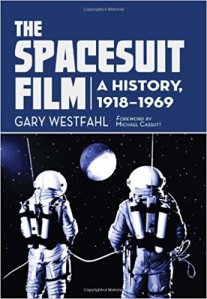
The Spacesuit Film - A History 1918-1969 by Gary WestfahlWhile researching Men Into Space I came across another book The Spacesuit Film: A History 1918-1969 by Gary Westfahl that covered Men Into Space as well as other movies and television shows that prefigured the space age. Hell, this exactly the kind of book I’d love to write too. But can you imagine the time it would take? But wouldn’t it be fun to watch all those old movies and television shows analyzing them for how they imagined the future? However, how many people read such books? I want to, but the $39.95 price for the paperback stops me. Even the $19.99 price for the Kindle edition is making me think long and hard.

This suggests another idea for researching. How many people buy and read these esoteric kinds of history books? How many people love to study tiny segments of forgotten history? I have this nagging desire to write something longer than blog essays. This month was supposed to be the month I began a book-length project. And I did start on an idea, but once again got side-tracked by too many distractions. But I’m back to focusing my mind on the project.

I have to ask myself, who is going to read what I write and why? Why spend a year, or several, writing something few people will want to read? It occurred to me this morning I could divide books into three categories: about the past, about the present, about the future. This is true for both fiction and nonfiction.

To Be A Machine by Mark O'ConnellI’ve always loved science fiction, which is future-oriented. But when I think about writing about science fiction, that’s past-oriented. Because I write for Book Riot, I can also write about contemporary publishing. I even think about writing books like To Be A Machine: Adventures Among Cyborgs, Utopians, Hackers, and the Futurists Solving the Modest Problem of Death by Mark O’Connell, which is essentially about how science fiction is affecting our world today.

I also came across this pledge drive for Farah Mendlesohn yesterday. She is writing a book about Robert A. Heinlein and is looking for backers. She’s gotten 143 supportors so far. This is also exactly the kind of book I’d love to write – but is that the rough number of people who would be interested in reading it?

I’m now worrying that I’m spending too much time thinking about the past. Is that because I’m getting older and it’s natural for aging folks to analyze yesterday? I assume that many people who like my blog do so because they are somewhat like me – they are older and thinking about when they grew up, and we all loved some of the same things.

I believe my less popular essays at Book Riot are due to writing about topics that bore their demographic readership, which tilts young and female. This makes me wonder if I should accept that I like to write about things that appeal to a subset of aging baby boomers, or if I should work to write about topics that have a wider appeal across different age groups.

My guess is writing about contemporary subjects or about the future has more universal appeal. I wonder if writing about today or tomorrow isn’t more psychologically positive for both me and readers. But I’m so fascinated by the past, especially esoteric subjects.

I’m currently reading The Man Who Loved Only Numbers by Paul Hoffman about Paul Erdős, a brilliant mathematician, and The Five Gospels, about the Jesus Seminar, a group of scholars who work to figure out what the historical Jesus actually said. Both of these books are intensely fascinating. Both of these books are about the past and have little relevance to today or tomorrow.

I have to wonder if I’ve given up on tomorrow because I don’t have much hope for the future, either for myself, or the planet, and I’m finding pleasure and meaning by exploring the past.

I’ve always loved science fiction but when I read science fiction today I’m usually very critical of works that are based on unrealistic ideas. I don’t believe in all those far out futures like I used to. As a writing challenge maybe I should work to write about positive futures that could be realistic, ones we can hope to find. Yet, my most popular essay ever is, “50 Reasons Why Humans Are Too Stupid To Survive.” Gloom and doom does sell. Hell, the TV shows my friends and I binge-watch focus on awful people and horrible events.

Writing is about focus. Writing a book is about intense focus over a great time span. I’m wondering if choosing to write about the past isn’t a way of escaping the present or future? I also wonder if writing about the future isn’t a way to give myself hope for tomorrow?

Maybe you can’t relate to this topic because it’s about writing. Think of it this way. Do you love watching old movies and television shows, or new ones? Do you listen to old music or new music? If you’re mentally young, no matter what your age is, you’ll be enjoying whatever is new.

I’m being more and more drawn into the past. 1950s movie westerns, mid-20th-century written science fiction, 1960s romantic movie comedies, 19th-century novels, 1950s jazz, 1940s film noir, 1920s modernistic literature, Victorian scientific romances, etc. Growing up, I always thought about the future…

JWH


Distractions! Distractions! Distractions!

by James Wallace Harris, Friday, August 11, 2017

I’ve always wanted to be a person who could focus intensely on a project until it’s finished. Instead, I’m easily derailed by endless distractions. Don’t get me wrong, I love my distractions – that’s my problem – I love them too much. I have too many interests, too many things to do, too many people to visit, too many art forms to consume, too many ideas to write about, too many ambitions, too many book clubs, too many hobbies, too many distractions of all kinds.

Distractions

As can be guessed from the previous sentence the solution is to have less of everything. I regularly meditate on the wisdom of minimalism but the best I can do is maintain a holding action against the thought-kipple hordes that eats up my time.

Psychologically I feel I have all the time in the world since I’m retired, but the reality is I don’t. Every morning when I wake, I spend a delicious half-hour planning my day or thinking about essays to write. I know not to be too ambitious. I’m quite aware of my limitations. Usually, I settle on three small goals, because that’s all I can remember. One task always involves writing. The other two deal with fighting the chaos that comes with everyday living.

If I ever found a genie in a bottle my first wish would be for the kind of mental focusing powers that allow complete control of going in and out of flow. Of course, as all the three-wishes stories tell us, there are dangerous side-effects to getting what we think we want. But this how I imagine focusing:

distractions2

I know what it takes to get there. I’ve always known. I’ve written about it many times before. A great analogy is a rocket with a payload and a destination. The mathematics of space travel involves cruelly cold equations. Every bit of extra mass a rocket carries costs fuel. In the 1950 science fiction film Destination Moon, the astronauts used too much fuel landing their rocket ship on Luna. The only way to return to Earth was by jettisoning everything possible to lower the take-off mass.

Destination-Moon

Knowing this wisdom doesn’t change who I am, that takes more of something I evidently don’t have. It requires I throw out all my beloved interests but one. I usually spend my days alone in solitary pursuits. I love being with people in the evenings. This gives me six to eight hours to pursue whatever I want during the day. That should be more than enough to achieve take-off to any destination.

I dream of spending all those hours on one big ambition, writing a book. However, right now I can’t muster that kind of focus. The older I get the harder it gets to spend even two hours on writing small essays like this one. The reason why I write essays for this blog and other sites is that short essays allow me to pursue many subjects, and that appeals to my scattered-brained thinking. I’m like a dog trying to chase six squirrels at once. I enjoy the hell out of the pursuit but I don’t catch any squirrels. I need to pick just one.

And if that one squirrel I pick to chase is writing a book, it means giving up essay writing, something that’s become a habit during this last decade. Up to now, I couldn’t make that commitment. But today I’m wondering if I could try it for a month?

So, the plan is to spend the rest of August finishing up some projects and commitments and spend all of September thinking and writing on one subject as an experiment. I’ve imagined writing a nonfiction book by writing fifty blog-sized related essays on one subject. 50 x 1,200 words = 60,000 words. I’ve probably written 1,500 essays since 2007, or about 30 books worth of words. The challenge will be to plan one coherent topic that’s divided into fifty chapters that locked together perfectly like a jigsaw puzzle.  I’d need to learn to constantly redirect my thoughts to that one topic. I have a topic in mind too, but I don’t want to talk about it ahead of time.

Now that I’ve thought this out I need to spend the rest of this month jettison all the extra mass I can.

JWH

Do I Have Diabetes?

Here are the symptoms from the American Diabetes Association (ADA) symptoms page:

  • Urinating often
  • Feeling very thirsty
  • Feeling very hungry – even though you are eating
  • Extreme fatigue
  • Blurry vision
  • Cuts/bruises that are slow to heal
  • Weight loss – even though you are eating more (type 1)
  • Tingling, pain, or numbness in the hands/feet (type 2)

I do pee a lot, but I thought it was because of my prostate was getting old. Now I wonder. The reason why I thought something might be wrong is I’m napping more, especially after meals. I was getting more and more tired. Then I thought maybe I wasn’t getting enough protein. I’ve been on this plant based diet for over a year, and it has little protein and fat. So, I started eating protein bars and even tuna, which is a big deal for me since I’ve been a vegetarian since 1969. That turned that problem around. But then I read protein helps with insulin processing. It’s amazing how many factors we have to consider maintaining our health.

HealthPro Easy-Touch

I figured a little science experiment was in order, one that I could make into a blog post. I bought a glucose testing kit, the kind diabetics use to test their sugar levels. I figured I’d test before and after meals for several days and keep a record. But I kept putting off starting my experiment. Then I told an old friend who has diabetes about my plans and he went after me like a drill sergeant badgering me to get on the bounce. I did. Thanks.

One reason I didn’t think I had diabetes is I get my blood work done very regularly because my doctor hounds me about my cholesterol levels. She’s always said my glucose levels were good. Here are my fasting glucose numbers from doctor’s office for the last few years: 101, 90, 83, 77, 81, 75, 87 mg/dL. The acceptable range from the lab is 79-115 mg/dL.

My home glucose meter gave me these readers for the last 7 days taken in the morning: 92, 95, 88, 84, 95, 93, 92. That suggests my meter is in the same ballpark as my lab work. However, I’ve read that home meters are only accurate to +/- 20 points. I once had what I thought was a high reading, and I retested immediately, and it dropped 18 points. This suggests I can’t trust single readings and must look at averages over time.

The ADA recommends the first-thing-in-morning reading should be in the 80-130 mg/dL range. The American Association for Clinical Endocrinologists (AACE) recommends < 110 mg/dL. So, by both associations, I’m okay for fasting numbers.

But what happens when I eat something? Both the ADA and AACE have recommendations for glucose numbers for 2-hours after eating: ADA recommends < 180 mg/dL for nonpregnant adults, and AACE recommends 140 mg/dL. My home testing had these numbers when I checked at the 2-hour mark after eating: 123, 143, 124, 125, 131, 106, 99, 98, 115, 141, 112. On average, I’m fine by both ADA and AACE. But I twice went over the AACE guideline for individual readings. In both cases after I ate my breakfast cereal which has blueberries, blackberries, and strawberries. My breakfast cereal is a health food cereal with 8g of sugar, but the almond milk has 16g.  So, if I eat a meal loaded with sugars I’m pushing the AACE limit. And those two examples might just be within the +/- 20 error. I’ll have to continue to monitor my sweeter meals to know for sure.

To test things, I ate my standard breakfast at different times, and the results were the same. However, on some days I exercised before the 2-hour mark and the scores came down. That could be the exercise, or it could be those high figures were within the error margin. I don’t know. I’ll keep testing. By the way, they emphasize handwashing before using the test strips because food on the fingers will alter the reading.

I tend to go on junk food benders. I was tempted to eat a bunch of junk food (meaning sweets for me) and see what it did to my numbers. However, I’ve been eating healthier for weeks and I don’t want to start another bender. Once I start eating sweets I can’t stop.

Overall, I think I don’t have diabetes, but that I need to watch out. By the lab work numbers, I don’t even fall into the pre-diabetes range. However, doing my own testing shows I’m okay by the ADA, but iffy by the AACE when I fill up on meals with more sugar in them. Some of my healthier meals let me get back to the morning fasting range within 2 hours, and well within the 2-hour after eating ranges.

I believe this little experiment showed me that eating right and exercising does have a physical impact on my body, at least my glucose levels. Tracking my numbers might help me lose weight. Because I’m overweight, I’ve worried about diabetes. I have friends with diabetes or pre-diabetic. It’s scary. It will be interesting to see if I do lose weight if my ability to stabilize after eating a sweet meal happens quicker. Of course, as I work hard to control my weight and cholesterol I automatically eat what diabetics should eat.

Too bad they don’t have a FitBit that constantly reads out glucose levels. Such tech might provide biofeedback to eat healthier and lose weight. This little glucose testing kit has proved to be very useful and revealing. I’m going to report my findings to my doctor and ask for an A1C test, which is supposed to be more accurate than the tests I’m doing now.

JWH

Writing and Aging

by James Wallace Harris, Monday, June 12, 2017

Most skills are best learned young. Few people find initial success late in life. I started this blog a few years before I retired and it has been an enriching educational experience. I consider blogging public piano practice for writing. I hope I’ve gotten better, but I’m not sure. Regular practice should make me better, but aging is traditionally a time of decline. I know there are programs that analyze written texts to give readability ratings, but I wonder if there are programs that rates writing ability that could measure cognitive decline?

writing-engraving

We all know our last years are ones in decline, we just don’t know what it feels like until we get there. And even then, it’s subtle. It’s like that frog in boiling water analogy.

You’d think because writing requires little physical effort I could write for hours and hours, but I can’t. The amount of time I can stay at the computer is dwindling. And I assume that’s a symptom of getting older. However, I’m considering other assumptions. I follow a plant-based diet which helps my heart, but it’s a low-protein, low-fat diet. I’ve wondered if that’s contributing to my declining writing energy. The gurus of plant-based eating argue passionately that their diet restores energy in old age. I hope they are right.

I’m also wondering if I might have something else wrong with me, like diabetes. I get lethargic after every meal and need a nap. But I get blood work done 2-3 times a year because of my cholesterol and my doctor says my sugar levels are always perfect.

I do my best writing first thing in the morning and delay breakfast until after 10 am. Unfortunately, I have to spend some of that morning time on showering and exercising. I have to exercise faithfully to keep my spinal stenosis symptoms at bay. I tend to skip my back exercises if I don’t do them in the morning. I’m wondering if it’s possible to retrain myself to follow a new rut?

In fact, I’m thinking about totally changing up my routines just to optimize my energy for writing. I get several ideas a day for writing projects, so inspiration isn’t a problem. I wish I could write eight solid hours a day. Just two or three years ago I could write 3-4 hours routinely and had occasional bursts of 5-6 hours. Now I’m lucky to have 1-2 hours of writing before my mind fogs. A side-effect of this is I start many more unfinished essays. I could plot the number of unfinished essays. That might give concrete data.

I’d really like to know if this decline is due to aging, a health problem, a mental problem, or something else. I feel like I’m trying harder than ever. I’m sticking to my healthy diet, plus I do physical therapy exercises, Bow-Flex, bike riding, and recently restarted my Miranda Esmonde-White classical stretch exercises too. All activities their proponents claim will give me more energy. But to be honest, I felt more energetic eating junk food and avoiding exercise. However, that led to a clogged arteries, a heart stent, and spinal stenosis. Because of eating well and exercise, my heart has stopped nagging me, and even though I have limited mobility because of my spinal stenosis, I don’t have to take pain meds anymore.

I am managing all my medical problems by doing all this stuff that’s supposedly good for me, which leaves me believing aging is the thief stealing my writing energy. HBO has a new documentary “If You’re Not in the Obit, Have Breakfast” about several high-energy geezers. Man do I envy their energy! The show features Carl Reiner, Mel Brooks, Norman Lear, Dick Van Dyke, Betty White, and others, extolling the excitement of 90+ living! Watching those hyperactive oldsters is inspiring. Why can’t I be like them? Is it genetics? If I’m honest, I have to admit I’ve always been on the low-energy side of the activity spectrum, so I can’t expect to suddenly be a different kind of person.

If my mental energy problem is aging, how do I cope with it? I don’t plan on giving up and becoming a TV addict. This seems to be a Destination Moon problem, a 1950 science fiction film about the first trip to the Moon featuring a problem that I often use as an analogy for many problems in life. The astronauts in this movie used too much fuel when landing on the Moon, so they don’t have enough fuel to get back to Earth. The solution is to jettison all the mass they could from their spaceship. We are often stopped from taking off for our goals because of we’re carrying too much crap that weighs us down.

I’ve come to this same conclusion over and over again. Our desires and possessions weigh us down. I want to write about too many topics. I want to read too many books. I want to watch too many movies and television shows. I want to buy too much stuff. All this saps my mental energy.

Getting old is like being a rocket that has a little less fuel every day for taking off. Exercise and diet have given my rocket a bit more efficiency to use with a dwindling fuel allotment, but I’ve about squeezed as much efficiency as I can out of the process. Now I’m down to throwing stuff out the hatch to lower the ship’s mass for the take-off.

Here’s one concrete example. Susan and I have collected hundreds of DVDs over the years. I have a growing collecting of westerns, science fiction, and classic movies that I love. My mind craves more. Should I spend my time searching out new old favorite films to add to my collection, or spend that time on watching the ones I’ve already collected, or spend that time watching new films I haven’t seen that could be just as great or greater than my old favorites, or should I give up some of that movie time to writing?

My days are divided up between active pursuits of writing and body maintenance, and mostly passive activities of socializing, reading, music, movies, television, emailing, book clubs, web surfing, news reading, crosswords, and other fun pursuits. I have to push myself for the active activities, but find it easy to pleasantly wallow in the passive pursuits. I wonder if less wallowing would translate into more active energy?

What I’ve noticed in these past few retired years is a slow mental erosion. I don’t like that. I know it’s inevitable because I keep an eye on folks older than myself. I know each decade means less energy. I’m sure high-energy dudes like Carl Reiner and Dick Van Dyke notice it too. Charles Dickens used to have so much manic energy that he’d briskly stomp miles and miles all over London when not writing, but even Dickens ran down in the end.

We all know that one day our rocket will not have enough fuel to take off. As we age, fuel management becomes critical, even an art. I believe I reached a stage in life where fuel management demands a whole new level of creativity.

JWH

p.s. – now that I’ve written this I can collapse for the rest of the day into a wallow of pleasant passive pursuits.


Letting Things Slide

by James Wallace Harris, Sunday, May 21, 2017

Recently I told a friend they were letting things slide.

“What a horrible phrase,” they replied, “it sounds like I’m in a death spiral.”

“I didn’t mean you were going down the drain,” I said. “But you do keep pushing deadlines back.”

Psychology Today defines “letting things slide” as procrastination. Dictionary definitions include, “to ignore something, to not pay attention, put aside, write off, negligently allow something to deteriorate, allow something to go without punishment, to not do anything about something or someone when you should try to change or correct that thing or person.” Evidently, it’s a widely used phrase. By the last definition, if I hadn’t said anything to my friend I would have been letting things slide by not telling them they were sliding.

now-later

Often, offering helpful criticism means getting a foot stuck in our mouth. I then pointed out that one of the side-effects of getting older is letting things slide. My friend hates any suggestion that they’re getting older. They got even more annoyed with me. My wife tells me I’m too happy to accept aging. She says if I’m not going to fight getting old, I should at least not admit it.

I started thinking about causes of sliding not related to aging. I remembered that I started letting things slide more after I retired. I assume it was because I was getting older, but what if retirement causes sliding? What if not having a 9 to 5 structure promotes procrastination and delay?

When all your time is free its very easy to reschedule obligations. It’s also easy to choose pleasant activities over annoying tasks. I’ve known this for a couple years since I’ve been retired longer than my friend, so I was trying to pass on that bit of wisdom. Maybe people have to discover it for themselves.

I even wrote an essay, “Overcoming Inertia in Retirement.” I guess my friend didn’t read it. I often study older people when I get a chance to see if I can spot trends I might be following as I get older. And I do think letting things slide is an aging issue. Older folks generally do much less than younger people. We assume that’s because of health and energy, but what if it’s mental too? Life is about making an effort to get what we want.

What if the wisdom of aging is learning that some things aren’t worth the effort? Or is that a cop out? Maybe we just get tired of making an effort. I know I dream of arranging my future life so it requires much less effort. To put a positive spin on things, maybe we just streamline living as we get older.

Unfortunately, I think it’s more insidious than that. As we age our brains shrink, and we lose neurons and neural connectivity. Exercise, especially aerobic exercise can counter that trend. We actually grow new neurons and make more connections with exercise. I do very little aerobic exercise according to my FitBit. And I do feel I’m in a cognitive decline. That’s why I do things like write essays and solve crossword puzzles to keep what little brain matter I have oiled and active.

If we chart our activity levels across our 40s, 50s and 60s, we can probably plot a line that will show our activity levels for our 70s, 80s and 90s. Research shows we can tilt the slope of that line up if we exercise physically and mentally.

If other words, slowing the slide now means we’ll let things slide less in the future.

JWH