Browsing My Bookshelves When My Favorite Used Bookstore is Closed

by James Wallace Harris, Monday, August 17, 2020

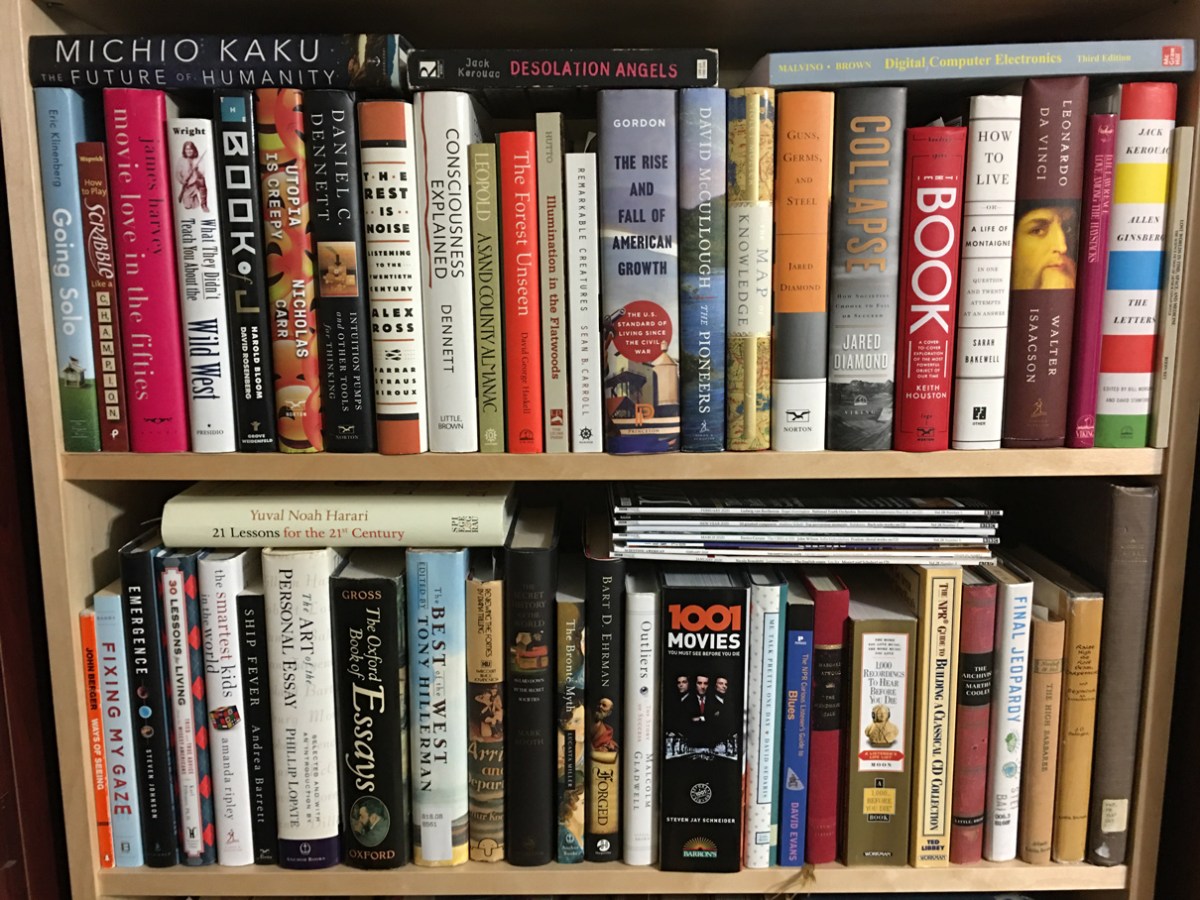
Since I can’t go book shopping, I’ve decided to browse my own bookshelves instead. I’m amazed by what interesting books I find there.

It’s been months since I’ve shopped at my favorite used bookstore, Second Editions. I use to visit it at least once a week. I certainly don’t need any more books, there are already thousands on my to be read pile. Over the years I’ve discovered that my reading habit is entirely separate from my book-buying habit. I love to read and I love to shop for books — I just don’t always read the books I buy.

The other day I browsed through my entire Audible.com library of 1426 audiobooks looking for all that contained short stories. Time and again I was amazed by what I owned that I hadn’t listened to yet (I can’t resist a good sale). Once again, I told myself I needed to stop buying new books and read or listen to what I already own. But I love going to Second Editions, the used bookstore run by our Friends of the Library.

I never know what I’ll find. Sometimes it’s an old book I’ve been hoping to find again, or it’s a book I never knew I wanted but had to buy, or it was a hardback copy of a book that just came out that I was thinking of paying full price — that’s how I got Leonardo da Vinci by Walter Isaacson for $5.

I’ve only got five six-shelf bookshelves to browse — but I’m overwhelmed by how many books I find that I want to read. Strangely, it’s 100%. Well, maybe not so strange. Because of my limited shelf space, I tend to donate books back to the Friends of the Library of those I’ve read or decided I’m not going to read. My self-imposed rule is I can’t own any more books than I have bookshelves. I’ve technically broken this rule because I’m currently allowing myself a legal loophole by shelving some books at the top of my clothes closet. Those three six-foot-wide shelves really do look like bookshelves. (But don’t tell my wife!)

Second Editions bookstore is closed for the duration of the pandemic. I know everyone is missing their favorite places to hang out, so I shouldn’t whine about missing mine. However, I do miss it. And browsing my own bookshelves looking through the books I often bought at Second Editions does help a little, but not much. It does help me empathize with young people who can’t resist gathering in public places during a pandemic.

I wonder if I pulled out a few books, and gave myself a twenty if the experience would feel more like visiting Second Editions? Maybe Susan could pretend to be the clerk at the cash register and we could chat a bit about books?

JWH

Do People Still Read Short Stories?

Yesterday I read, “43 of the Most Iconic Short Stories in the English Language” by Emily Temple over at Literary Hub. Her essay begins 

Last year, I put together this list of the most iconic poems in the English language; it’s high time to do the same for short stories. But before we go any further, you may be asking: What does “iconic” mean in this context? Can a short story really be iconic in the way of a poem, or a painting, or Elvis?

Well, who knows, but for our purposes, “iconic” means that the story has somehow wormed its way into the general cultural consciousness—a list of the best short stories in the English language would look quite different than the one below.

I was able to look up her 43 titles on the internet and found most of them available to read online. I assume that’s because those stories are taught in schools and colleges and teachers have put them online as pdf files so their students can read them for an assignment. I doubt that’s legal, but it’s convenient for me.

Are these stories iconic because a captive audience has been made to study them? Does forced cultural literary constitute a kind of fandom? I’m sure Emily Temple and I are the kind of book nerds that love these stories, but just how many other people do?

I went to Amazon looking for anthologies that might contain these stories. I assumed if they were iconic then they’d be readily available, but they weren’t. The only anthology I found that had more than a couple of these stories is an old one I already owned. It had 7 of the 43, which is pretty good. That volume, The Art of the Short Story edited by Dana Gioia and R. S. Gwynn is probably a textbook, but it seems to be out-of-print. I found a few other textbooks that had some of the 43 stories, but at most three. However, the same authors are anthologized over and over again, so there seems to be disagreement as to what their best stories might be.

This still leaves me thinking Emily Temple’s 43 iconic stories aren’t that iconic outside of hardcore bookworms. These stories definitely aren’t iconic like Classic Rock albums or the old TV shows that rerun on MeTV or TVLand which have tens of millions of fans across generations.

I added the 43 stories to a Google Sheet and put in links to where I found the stories online. I plan to read them all. I also plan to add other lists of “iconic” short stories to this spreadsheet, and read them too.

Last night I read “The Tell-Tale Heart” by Edgar Allan Poe. It was a bit of horror fluff that didn’t have much to say philosophically, nor did it reveal anything about life in 1843 America. I can’t believe we make children read it. There’s got to be better Poe to force onto younsters. 

On the other hand, rereading “The Ones Who Walk Away From Omeleas” by Ursula K. Le Guin is intensely philosophical and I imagine an excellent story to trick teens into thinking about deep concepts.

How many people still read short stories after they leave school? Probably damn few. That isn’t to say that Edgar Allan Poe or Eudora Welty don’t have their fans, but are their followers a large enough crowd to swing over the needle of a pop culture meter when mentioned on Jeopardy? Well, some Jeopardy contestants would be the kind of folks to read short stories.

More and more, I’m getting into short stories. I’m reading over three hunded of them a year. But it also feels like I’m withdrawing from reality. My friends want to talk about novels, or movies, or TV shows — and I can’t. And they aren’t interested in discussing short stories.

I imagine kids when assigned to read short stories today feel about the same way as we did when forced to do quardratic equations back in our school days. No, I don’t think the word iconic applies to Emily Temple’s list of old short stories. But what’s the right word?

I wonder if that word is in the Dictionary of Obscure Sorrows? I wish I knew Greek and Latin so I could make up a word for loving art forms going extinct. Or a word for cherishing fadding pop culture successes of the past. Anachronostalgia? 

It has been said that writers write to become immortal, but that immortality only lasts as long as people continue to read what they wrote. What’s a word for keeping old works of art alive? It’s kind of a good deed, don’t you think? Of course, not as good as helping a real person in need, but it’s still a kindly thing to do.

JWH

Can I Discipline Myself to Be More Disciplined?

by James Wallace Harris, Monday, August 3, 2020

The older I get the more undisciplined I get, but it’s an age when I need to be the most disciplined in life. As anyone who is getting older knows, the body begins to fall apart and the mind unravels. One way to counter this natural tendency is to get disciplined. But there’s a Catch-22. There’s also a growing impulse with aging to not give a fuck.

It’s taken me years to give up junk food — well, mostly. But I’m not sure if it’s being disciplined. If I indulge my body finds various ways to beat me up. So I’ve learned to mostly not do the things that cause immediate suffering. However, I can’t seem to learn to do the things that will improve my health or allow me to do more. I feel like I’m in a never ending trench war — I can’t take any new territory, and for the moment, I’m barely holding what territory I’ve have. Aging means losing territory. Discipline determines how fast.

I know defeat is the ultimate outcome. Death will eventually be the light at the end of the damn tunnel. But until then I have a finite number of days and I’m positive if I was more disciplined I could get greater use out of those days. The trouble is, when you’re old you just want to relax and take it easy, to float downstream. To get more out of life has always required paddling upstream against the current. That requires discipline.

For example I want to lose weight. I’ve been fighting the Battles of the Bulge for decades. I should just give up. I know plenty of people who have. But I have health problems and I know if I can lose weight it will counteract those health issues to a degree, or help delay them getting worse. For the past two years I’ve been doing the 16:8 intermittent fasting. Years ago I lost 30 pounds by going vegan, but I just couldn’t maintain that diet. When I went back to just being vegetarian I started gaining my weight back. When I saw that happening I switched to the 16:8 intermittent fasting, and stopped gaining weight. But I had already gained back 25 pounds. 16:8 means I eat 8 hours during the day and fast 16. If I do it without eating junk food I’ll even lose about 1 pound a month. However, I usually can’t avoid completely junk food, so I don’t lose that pound.

I’ve recently started throwing in a whole fasting day, and I’ve fought my way back down the scales by 7-8 pounds in a couple months. That’s very encouraging. If I can maintain that discipline I might be able to fight my way back down to my previous low, and even lose more weight. That could help a lot. But to go that day (actually 40 hours) without eating takes so much effort. I’m writing this today to help me get through not eating until tomorrow. (By the way, fasting actually makes me feel better in many ways — except for the not eating part.)

I’m fighting several other battles that require greater discipline. I’ve had a dream of getting a science fiction story published almost my whole life. The odds of succeeding at my age are extremely tiny, but I haven’t let the dream die yet. I know what’s required to do the work. It’s the discipline to stick to writing. Writing fiction is hard. I can write blog essays all day long with no trouble, but then I’ve put in my ten thousand hours. I’ve only logged several hundred hours writing fiction, and I need to put in several thousand more to take off. That will require developing a routine like I have with intermittent fasting.

The last thing I’ll mention, because I don’t want this essay to go on forever, is the idea of disciplined learning. I’ve written before how I’m a news junky, but I realize that’s not getting me where I want to go. A steady diet of constantly changing news items is a wasteful way of using my time. I do learn stuff, and I’m better informed than when not reading the news, but it’s like eating potato chips, not very nutritious.

I’ve been developing a new theory about news and learning. Instead of trying to cover any topic that comes along, I should pick just the topics I want to get know better. For example, I’m reading So You Want to Talk About Race by Ijeoma Oluo, a well-written, carefully thought out book about a specific subject. What’s impressive about Oluo’s book is she set out to write something useful and worked to clearly define the problem of race. Her book made me realize I should focus on specific topics, such as Black Lives Matter, but go deeper than reading daily news reports.

I need to pick the newsworthy subjects I want to embrace and focus on them, while ignoring the firehose of all the rest. Logically, I know I neither have the time or energy to study many subjects. Since I realized that I’ve been paying attention to the news items I read each day. Most are quickly forgotten. Most are not worth my time on in the first place — they are like the evil calories of junk food. But disciplining my news intake is a lot like dieting — I need to give up junk news. That’s going to be hard. I have no practice at that, and I know from dieting that it takes a lot of failures before I can develop any discipline momentum.

It would be so much easier to kick back in my La-Z-Boy, eat oatmeal chocolate chip cookies from the deli at Sprouts, and watch old episodes of Gunsmoke. It’s pleasant, it’s enjoyable, it’s fun. But what does it get me beyond that? There are still things I want out of life, and to get them I must start paddling upstream against the current again.

[This is for my wife Susan, who I think needs to get back to paddling too.]

JWH

Will Americans Ever Be United?

by James Wallace Harris, Wednesday, July 30, 2020

We might be the United States, but we’re hardly a united people. Hasn’t the melting pot of the world produced a particularly unhomogenized population?

If you pick any year in our history and study it, divisiveness is the norm. This has got me to wondering, are there topics of agreement that we mostly share?

For example, if we pass a law that means we want 100% of the people to abide by the law. Yet, a law can be passed by only a fraction of the population. Does it really make sense for 50% of the people to say how 100% of the people should act? But we’ll probably never get 100% agreement on anything. So, shouldn’t we think harder about what percentage of the vote equals a proper majority?

Would it be fair to require an 80% majority? That would still mean 20% of the population would oppose the law and would probably be unhappy. But it would also mean 80% of the population would be happy.

What we have is a happiness v. unhappiness ratio. Right now, we have a 50/50 ratio, which explains why our society is so polarized. Wouldn’t America be somewhat happier with a 60/40 ratio? And even happier with a 75/25 ratio?

We’re never going to have a 100% happy society. But shouldn’t we try to reduce the unhappy portion of the equation? My guess if we agreed to make 60% the required majority to win any vote, we’d see a shift in the contentment of the nation.

Ideally though, we’d eventually need to increase that to 75%, but right now that would be an impossibility. Just developing a 60% consensus would take a tremendous effort, mainly in learning how to make compromises.

Is It Time To Ditch News Feed Apps?

by James Wallace Harris, Saturday, July 25, 2020

The sad truth is I’m a Flipboard addict. And if I’m really jonesing for news, I’ll also check Apple News and Google News. I compulsively tap my iPhone several times a day for more new news, speed reading through dozens of digital essays and news stories every day. But Flipboard is starting to irritate me with all its ads, and more than that, my comprehension skills are deteriorating.

Although the internet is instant, smartphones are convenient, and news feed apps are comprehensive, I’m not sure they are the best conduits of news. Oh, they definitely get me more news from a greater variety of sources updated by the second, but I’m not sure its the best way to stay informed. And I’m not sure if it’s not becoming abusive to my neurons.

People often say less is more. News feed apps work on the principle of sending you news customized for your interests. Often content is barely more than blurbs with ads, and generally the same information is repeated or restated by countless news outlets, sources, and publishers. There is lots of substantial content, but lately, more than not, it’s behind a paywall.

I’m reading in a hyperactive mental state, gobbling down facts in a frantic effort stay informed. But am I? I’m starting to wonder if I read less if I’d be more informed?

Could carefully choosing my own news sources be the wiser path? Could a couple of newspapers and a handful of magazines, digital or print, offer a better news experience than a news feed service? I don’t know, but I’m thinking about trying the route. I just don’t know if I can break the news feed app habit.

I’m also tempted to go back to printed magazines and newspapers for some of that reading. The cost of printing tends to control what is printed. And I’m also wondering if reading less from a slower source might be advantageous. I really have no answers right now, but my hunch at the moment is pushing me to read less news on my iPhone. However, I’m not sure I can give up that much convenience.

It occurs to me now that I actually enjoyed TV more when there were only three networks. And music was more fun when I could only afford to buy one new album a week. Maybe there’s a downside to convenient abundance.

JWH