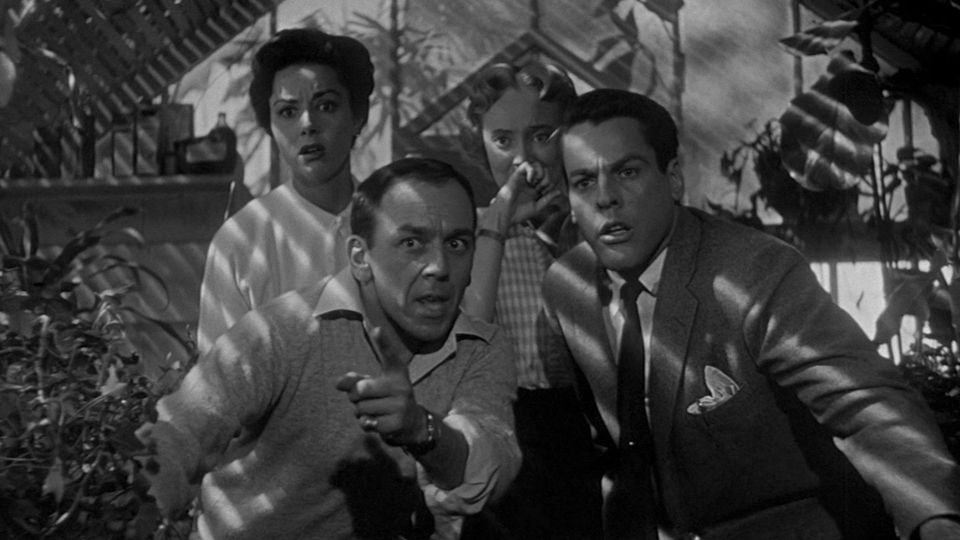
Just Who Slept With the Pods?

by James Wallace Harris, 5/14/22

In the 1956 film, The Invasion of the Body Snatchers, Dr. Miles Bennel (Kevin McCarthy) realizes his friends and neighbors are changing. One by one they all start thinking alike and that worries him. If you haven’t seen this famous film about the pod people you should. It’s based on a 1954 Collier’s serial by Jack Finney called The Body Snatchers, which was then published as a book in 1955.

The story is about an invasion of pods from outer space that transform people if they sleep in the same room with one. Back in the 1950s, the story was seen as an allegory about communism. Finney has said he didn’t target communism specifically when he wrote the book, but most readers and moviegoers did back then.

In 1951, Robert Heinlein had published a similarly themed novel called The Puppet Masters. In that story, flying saucers land with creatures that attach to our backs, and take over our bodies and minds. Heinlein was an arch anti-communist, and his story was intended to imply the evils of a commie takeover.

In 1953 Robert Sheckley’s story, “Keep Your Shape” reflected a liberal’s paranoia. It appeared in the November issue of Galaxy Science Fiction. Sheckley rewrote the story for his collection Untouched by Human Hands and gave the story a much more elegant ending and a different title, “Shape.” It’s a humorous story told from the aliens’ point of view, about how they invaded the Earth twenty-something times and always failed. The aliens come from a rigid society of shape-shifting creatures whose God dictates that everyone has to maintain a certain shape. On Earth, the aliens are corrupted by our freedom when they see that we take so many different shapes. Sheckley’s story was anti-establishment and anti-conforming.

My point in mentioning all these stories is I feel like the conservatives have been sleeping with pods or have an alien riding on their backs. I feel this because they all seem to speak the same way. It’s kind of creepy to see political ads for Republicans because they all claim to toe the party line better than any other Republican. They all claim to hold the same beliefs. And their followers all repeat the same soundbites. I’m sure conservatives feel the same way about us liberals.

A couple days ago The New York Times ran a book review called “Where Have All the Liberals Gone?” The conservatives have made the term liberal such a dirty word that liberals are now calling themselves progressives. Conservatives have aligned themselves so tightly with Donald Trump that it reminds me of the fanatics who follow Putin and everything he says.

It makes me feel like the Kevin McCarthy character wondering when I will fall asleep and wake up a pod person. I no longer think of communism when I watch Invasion of the Body Snatchers, I think of everyone following one leader, one strong man’s view. If you look at history, the dangerous horrors of the past didn’t come from ideologies, but from single men pushing their view of reality onto everyone else.

I no longer understand what conservative or liberal philosophies means, even if they ever had a consistent description of their goals. I’m now thinking it’s always been individual men pushing their own philosophy onto other people. (I use the word men because I can’t think of any women dictators in history. I hope women won’t mind me being sexist in this instance.) That’s why Trump is so popular – people resonate and relate to him. He is their political philosophy, no matter how you label it.

I want a true democracy. But I don’t think it will ever work when winning is defined as a 50% majority. I think it needs to be at least 60%, and better yet, a winning majority should be defined at 75%. I want to live in a society where we work to compromise and create laws that attempt to make 100% of the population happy. It will always fail to reach 100% agreement, but if we could work out compromises where 60-75% of the population come to some kind of agreement, then I think we could escape our never-ending political polarization.

Right now we vote for our self-interests. And we vote for candidates that come closest to those self-interests. I have to accept that Trump is a beacon shining on what a lot of people want. But as long as half the country wants something different we’re going to have a miserable society.

When 50% is the finish line for any political agenda, we’re going to be ruled by pod people. I think real democracy begins when 75% of the population hammers out good compromises. I don’t think one politician with one point of view could ever find that many followers. Maybe we should move away from politicians and have referendums on everything. If we can’t find ways to get three-fourths of us to agree, then we should do anything.

It doesn’t matter which side of the political spectrum you live on, if we have minority rule, or even 50% majority rule, half the country will always feel they are living with pod people.

JWH

Subjective Time

by James Wallace Harris, 5/11/22

I’m in a short story club where today’s discussion story is “Common Time” by James Blish from 1953. This blog will be my comment to the group, but I feel my insight is personal enough for this blog.

“Common Time” is about an astronaut in an experimental spaceship traveling at twenty-two times the speed of light. When the astronaut regains consciousness after launch he can’t move and it takes forever to open his eyes. He discovers that time is moving very slowly. He is able to count to 7,200 between each tick of the second hand on his clock. Eventually, his perspective speeds up until the hour hand is flashing around. The story is about how this astronaut reacts to the different perspectives of time.

I think time is a fascinating topic. I use the picture of a hummingbird above to illustrate subjective time. To a hummingbird, a human appears like a statue, frozen in time. I’ve often wondered how an intelligent robot will perceive time. The clock speed of computer chips is currently in the gigahertz range – that’s billions of cycles per second. Will AI minds even notice us? Of course, their bodies won’t be able to move a billion times faster than ours.

I also like to think about the concept of now. Is there a universal now everywhere? Now exists without clocks. Now can exist without even the concept of time. If we had a smartphone connection to a planet 1,000 light-years away that had an instant speed of communication we could talk to our alien friends in the now. Is that true for the whole universe? Or do different locations experience different nows? What about the multiverse? Is there one moment of now everywhere? Or many?

How long is the moment of now to a hummingbird or future robot?

Yesterday I woke up feeling better than I have in years. I noticed this when I was planning my day. I felt good enough to plan to work on a long-term project. Lately, I haven’t been feeling good, and the only things I wanted to do were those activities that focus on the moment. I was disappointed yesterday when less than two hours later after my aches and pains returned I only felt like reading, watching TV, or listening to music. I loved that feeling I had more time.

I can remember being young and feeling like I had all the time in the world to do everything I ever wanted to do. I’m writing this essay early in the morning because I feel like I have enough time to finish it. I won’t feel like that in a little while.

Jim Harris

How Do You Label Your Existence?

by James Wallace Harris, 5/3/22

Now that I’ve been retired for eight years, I realize I can no longer call myself a programmer, which is the way I identified myself during my middle years. Because Susan and I never had children, I’ve never been a parent, and thus can’t be a grandparent in my waning years, which is a label some of my retired friends proudly embrace.

My new identity is a retired person, but that’s not much of an identity and I’m not sure I like using that label, but I do. I spend most of my time reading and writing about science fiction short stories, which gives me a little bit of a purpose. I can’t call myself a scholar, but I do study that subject in depth. It’s just a tiny subject that’s not very relevant but does give my existence a purpose. I’m not sure I can justify my existence by calling myself a science fiction fan.

I guess I could call myself a blogger but don’t know how satisfying a label it would be to use. I’ve always wanted to be a scientist or philosopher but I’ve never come close to actually being either.

I look around and see people defining their existence in various smaller ways. One prominent label that is often in the news is Republican. Some of these people treat being a Republican almost like a religious identification and evidently find great identity with it. They even take great satisfaction in calling themselves a Republican or a Conservative. I’m a liberal but don’t get off on calling myself one. I think that’s one of the big differences between the two parties. Conservatives are a lot more organized, and they seem to get a lot of satisfaction out of being part of their group. I think being young and liberal is more of an identity thing. It was for me.

I observe people finding meaning in their existence in all kinds of ways. I know many people who are ardent travelers. They use the term traveler to define themselves. Many of them act like their purpose on Earth is to travel. They find self-worth by recalling the places they’ve been. I’ve noticed there are a lot of travelers with YouTube channels. I wonder if they feel like prophets of traveling?

I’m on the fringe of many subcultures. Take audiophiles for example. They find meaning in their never-ending question to achieve higher fidelity playback, I’m too cheap to go all the way with that group. I’m not a sports fan, but they are quite common around here, and they seem to find great happiness in identifying with their teams. There seems to be an overlap between sports fans, Christians, and Republicans, in that they all love their group identity and get immense satisfaction when their group wins or converts folks to the team.

I relate to many of my friends through the kinds of entertainment we share. Much of the conversations I have with my friends, deal with discussing shows and movies on television. I’m also a bookworm and find kinship with other bookworms. I’m not a foodie, but I know a lot of people who find dining out an important aspect of existence.

I believe people get more existential meaning from their pursuits when they have a strong label for themselves. The average person might love dining out, but someone who calls themselves a foodie obviously gets more meaning from it than those of us who just enjoy chowing down. And if people call themselves a gourmet, they feel even more important about themselves, like they were philosophers of the tablecloth.

That’s my trouble. I no longer have any good labels to define myself. I guess the best is Bookworm. It’s the one I’ve embraced since childhood. I’ve never been one for nice cars or clothes. I spend my money on books. I don’t travel because I prefer to read.

However, I have to wonder, when I lay dying in my La-Z-Boy, will I look back and feel my existence was well spent with all those books?

JWH

More Fun With Memory Loss

by James Wallace Harris, 5/2/22

Today I went to post my review of “The Long Iapetan Night” by Julie Nováková to my short story club that reads and reviews a short story a day. It was then I discovered the group had already read the story last year, and I had read and reviewed it before.

It was disconcerting that I had completely forgotten I had read this story, and I had even written a review before too. Usually, when I watch movies I’ve seen before, I discover it by getting to a scene that will trigger a memory. That never happened with this story.

Figuring I might have written this essay before I searched my site and found “Fun With Memory Loss,” which is what I originally called this post. So I retitled this essay, “More Fun With Memory Loss.” I did some more checking and discovered I’ve written about memory loss another time too, “Remembering When I Forget.” For those of you who read my blog with good memories, I apologize for repeating myself, but probably expect “Even More Fun With Memory Loss.”

I don’t believe I’m suffering from dementia, but I do think my memory is faltering. I find that fascinating. I’m even amused by these glitches because they reveal a tiny bit about how memory and personality work. For example, in my second review I ended by asking the group:

I enjoyed this story, but the plot seemed like something I've read before, where a second space mission is trying to figure out what happened to the first space mission. However, I can't recall any examples. Can y'all?

When I read my first review I realized this might have been the story, or it may have not. Was the vague sense of the plot all that I remembered, or is that plot used more often? In my first review, the story made me think of the film Alien, which is about a space mission that investigates a lost space mission.

In my first review, I summed the story up this way:

"The Long Iapetan Night," tells us that Earth's global civilization took two body blows in the 21st century, one from a super-volcano, and another from a massive solar flare. This sets up the plot for a second Saturn colonizing mission to wonder what happened to the first. At first, that earlier colony is just an odd mystery, then it becomes a historical tragedy like the lost colony of Roanoke, finally, the story mutates into a horror story in the present that overtakes the second mission too.

This long novelette would make a creepy space movie like ALIEN.

In my second review, I summed it up this way:

Depending on your reading reaction, "The Long Iapetan Night" by Julie Nováková might be considered a horror thriller if you thought it creepy enough, or just a mystery thriller if not. Humans arrive on Iapetus for the second time about a century after the first explorers. The mission to Saturn is split into two crewed modules on Titan and two on Iapetus.

Our point of view character is Lev, on Iapetus, but we're also introduced to another narrator in italic sections of the story. I found this confusing at first, especially since I listened to the story and there was no transition to indicate something was different. I discovered this problem by looking at the Kindle edition. I thought it was Lev's journal at first. Eventually, I realized it was the journal of an explorer from the earlier mission, and a mystery unfolds as the crew of the second mission tries to find out what happened to the first mission. This is where we have to wonder about ghosts, or unseen aliens because the old habitat begins to kill the new arrivals.

To make this story even darker, Nováková has a major volcanic eruption that disrupts the world's weather and then a solar flare that knocks out all satellites in the inner system, so the first mission to Saturn is cut off and abandoned. The second mission is after Earth goes through a long recovery.

I like my first review better because it was succinct and more vivid in summarizing the story. What’s revealing is my two reactions are nearly the same. This makes me wonder about the fixity of our personalities. It’s interesting that I read the story the first time with my eyes and listened to it the second time. I wonder if that’s why I didn’t remember it?

I ended the first review by asking the group this question:

I have one question though. Why would anyone want to live in a world that's -180C (-292F)? Now that I'm getting older and more sensitive to cold, I just can't believe people dream of going to other planets where it's so cold. Mars today is from -11F to -117F today.

In the second review I ended with:

QUESTIONS:

Would any of y'all want to explore the outer moons? It has zero appeal to me, and I can't imagine any sane human wanting to live in such an extreme environment. Is science fiction being disingenuous by suggesting people could and would?

Also, could we build a spacesuit that could handle being immersed in liquid air and still be practical to walk around and use? I know space and vacuum can be extremely hot or cold, but wouldn't it be different if there was a medium like liquid air to absorb the heat?

If I read this story again in ten years will I react the same way? My memory probably won’t remember the story, but will my personality react to it in the same way?

Is personality a kind of memory?

JWH

Mingus Ah Um

by James Wallace Harris, April 15, 2022

I’m not an experienced jazz aficionado but I do love to listen to that genre from time to time. Today, for my afternoon album I played Mingus Ah Um by Charles Mingus via Spotify. You can listen to it while you read by clicking on the YouTube video below. Unfortunately, it will play at the fidelity of your computer/phone/tablet and that won’t do justice to this legendary album. It’s best to listen to jazz in a dark room on a great stereo when you can devote your mind and soul to the experience.

My love of jazz depends on the tempo. I prefer the dreamy numbers that I imagine are heard in smoky clubs at 3 a.m., like the cuts “Self-Portrait in Three Colors,” “Goodbye Pork Pie Hat,” and “Pussy Cat Dues.” I listen to music because it triggers emotions, and slow jazz is often very emotional and moody.

I do admire, and even enjoy the medium-tempo pieces like “Better Git It in Your Soul,” and “Jelly Roll.” This is head-bopping speed and generally focuses on solos. At this speed, I can still process what each instrument is saying.

And depending on my mood, I can get into the fast pieces like “Boogie Stop Shuffle,” and “Pedal Point Blues.” The faster the jazz guys jam, the more they’re showing off. Usually, at this speed, if my mind is following along, I can dig the piece intellectually, but it’s stopped pushing my emotional buttons. This is how I often feel about listening to classical music. To truly appreciate these pieces I think it would be helpful to be young, high, and manic.

The frantic-pace performances push my limits to appreciate the form, like “Bird Calls,” which Mingus says wasn’t inspired by Charlie Parker, but bird calls. Parker is generally too speedy for my tastes. There are times when I feel Mingus is playing his bass twice as fast as the tune. The cuts on Mingus Ah Um aren’t nearly as fast as the hotter jazz from the early 1950s.

Jazz constantly mutates, so there’s no real one kind of jazz. Right now I prefer it from the late 1950s and early 1960s. 1959 was a fantastic year for jazz music. Two of the most accessible jazz albums ever came out that year: Kind of Blue by Miles Davis and Time Out by The Dave Brubeck Quartet. Those two albums are often loved by people who never listen to jazz. We could consider them suitable for freshmen students of jazz. The other great jazz album of 1959 is The Shape of Jazz to Come by Ornette Coleman. That’s graduate-level. Mingus Ah Um is more advanced than Kind of Blue and Time Out, but far from The Shape of Jazz to Come. It’s still very accessible. I’d recommend it for juniors majoring in the genre. I don’t think it should be anyone’s first jazz album. Kind of Blue and Time Out are the gateway drugs.

However, I should amend what I’ve just said. One of my all-time favorite songs regardless of genre is “Moanin'” by Charles Mingus, and it’s an assault on the senses. It makes you feel like you’re dancing with a tornado. I love it. There are many versions of this song, even many by Mingus, but this is the version I have to have.

If you go to buy this album, be careful, there are many editions, some not so good. The $7.98 CD from Amazon is a good entry-level choice.

JWH