The Joys of Technology

Today, the title of my post is in all seriousness.  I’m having a very good technology day.  Other days, the title would be sarcastic.  For years now I haven’t quite figured out how to live with MP3 music.  I don’t like listening to music on my iPod – instead I want to play MP3 music on my living room stereo.  To that end I bought a Roku Soundbridge M1001 last year.  This nifty gadget plugs into my receiver and listens to my WiFi network and watches my computers for iTunes, Windows Media Connect, Rhapsody and other UPnP AV MediaServers where I store MP3 files.

What the Roku does is display a list of songs stored on my computers in other rooms that can be played on the connected stereo system.  It displays lists by artists, albums and songs via a small LCD readout and lets me select and play them with the aid of a palm-size remote.  The trouble is I have over a thousand CDs, and flipping through their titles one LCD line at a time is a pain.  I thought at the time I first set up the SoundBridge it needed a TV output which would let me select songs through a TV interface.  There are media servers that also fetch video and photos from your computer, as well as songs, which are controlled through your TV screen.  The SoundBridge is just for songs.  By the way, the newest Roku is for Netflix online films and does work with your TV.  It’s too bad they didn’t combine the functions for a single product.

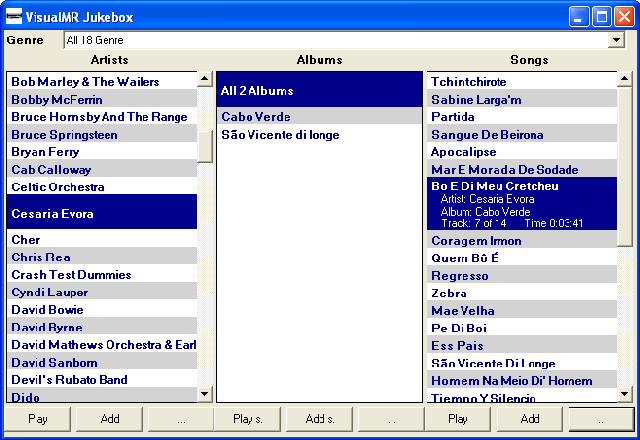
This morning I jumped on the web because I just knew there had to be an answer to my desires, and I found an excellent solution, Visual Media Remote.  Installed on my laptop, which normally sits in the living room, this program lets me to control the SoundBridge.  I know this sounds weird.  My music is stored on a machine in my library/office.  The SoundBridge is in the living room.  The laptop could be in any room but it controls the SoundBridge.  If I had SoundBridges in other rooms, it would control them too.  This screen shot taken from the VisualMR site best illustrates why the software is so useful:

visualmr_pc_jukebox

This display shows a listing of artists on the left, their albums in the middle, and the songs from the highlighted album on the right. And I can filter too, by genres. This very quickly lets me drill down into my collection and find songs and add them to the player queue. I can sit in my La-Z-Boy with my laptop on my lap and just lean back and play songs about as conveniently as I could ever imagine, other than using telepathic mind control over my computer.  VisualMR has been around a long time, but I didn’t have a laptop for the task before.  VisualMR will also work with PDAs.

Searching through Google shows a lot of people use this same setup, but I don’t think it’s a massive crowd.  My guess is most people give up on stereo systems when they get an iPod, or they buy a cradle that attaches to their receiver that lets them use their iPods as CD players.  And I thought about reducing my music world down to one handheld device, like the iPod.  I could reduce my equipment footprint if my laptop had a large enough hard drive to store all my music.  Or I could just buy some high quality headphones and listen to the music directly from the iPod.  Hell, no one seems to like to listen to music together anymore, although I got my wife singing and dancing last night while we made dinner when I was showing off my SoundBridge setup.  But I had to play the songs she liked.

I’m happy with this present setup.  I wished iTunes and Windows Media Player used the same three-pane approach to selecting songs like VisualMR.  I can pack up my CDs and store them away.  Now that music is sold as DRM-free MP3 songs, this kind of equipment might become more popular, because it’s very easy to just shuffle these tunes from machine to machine and room to room.  Microsoft has sold Windows Media Center for years hoping the idea would catch on, but it hasn’t – not big time.  Linksys, Dlink and Netgear all have media servers that work with their wireless equipment.  The tech is there, I just don’t know if they are popular solutions.

Like I said, the iPod has changed everything and I think people have just adapted to it.  It makes me wonder if sales of CD players and receivers have fallen since the success of the iPod?  Well, duh, if people aren’t buying CDs, sales of CD players must be tanking.

All of this reminds me of the fat people in the movie Wall-E – they don’t notice the world around them because everything comes through their video screen, inches in front of their faces.  Now that iPods have added cell phones, movies and television shows to the music lineup, as well as photos and audio books, there’s all the more reason to stay plugged in to your iPod 24×7.  Who knew that electronic gadgets would bring so much fun and joy to people.

Jim

Number One on the Runway

I am reminded of that great song title from Timbuk 3, “The Future’s So Bright, I Gotta Wear Shades.”  With economic chaos and skyrocketing oil prices, the future is looking a bit overcast – no need for shades now, huh, but what if that’s an illusion?  In China, the future is so bright that a billion people are putting on sunglasses.  I’ve read that there is more peace and prosperity now than anytime in the history of the world.  Global warming may only be the foot that kicks us in the ass and forces humanity to get its shit together.  A new President could clear those dark clouds on our horizon and brighten up U.S. prospects for decades to come.

We’re all on a jet that’s about to take off for the future, but who is in the cockpit, and what’s our destination?  My generation are all thinking about retirement and I’m wondering if we’re all flying down to Florida to play shuffleboard or dominos all day.  I can remember summer of 1968 like it was tomorrow.  We wanted the Vietnam war to end so we could start building a bright future.  We wanted a lot of change.  We lived on great expectations.  Many of the young felt like they were part of a movement, a movement for change.  Barack and all Democrats worked to sell the same sentiments forty years later.  Is this election the last chance for the Baby Boomers to get it right and achieve their dream?

Protestors used to chant “The Whole World is Watching” and I think our generation felt it was true, even though most of the world lived off the radar of mass communication when we were growing up.  During those mythical years of the 1960s our generation always felt we were number one on the runway taking off for the future, but now, we’re seen as being the generation number one on the runway to retire.  Is it now time for us to be quiet?  Bill Clinton and George W. Bush were both Baby Boomer Presidents.  We may get another boomer, with Barack Obama, or the Silent Generation may have its last chance to have their only President, with John McCain.

I was reminded of my Baby Boomer status when Piers Fawkes at PSFK tagged this site as 1 of 14 blogs he monitors for information about Baby Boomers.  Maybe the whole world is no longer watching us, but at least the marketing people are still keeping an eye on us.  For those who need a generational timeline, see below:

I find it tremendously hard to imagine the mindset of the generations that have come behind us.  First of all, they never demanded to be heard, and as a result of that, they never got the press the Baby Boomers did.  The Greatest Generation are famous for living in historically epic times and their generation was defined by the events they faced.  The Silent Generation made the world for the Baby Boomers and influenced them.  The Baby Boomers embraced rock and roll, but Elvis and the Beatles were from the Silent Generation – an odd nickname, huh?  And as resources such as oil become problematic, will we have a new Greatest Generation that solves those problems?

Signs are everywhere that the young are ready for the boomers to retire, for instance, read “TV Viewers’ Average Age Hits 50” over at Variety, where they whine that the damn people watching TV are too old for their precious 18-49 demographics.  What’s the matter, are the young TV execs afraid their whole industry is a Baby Boomer fad?  The whole world probably didn’t have their eyes on us, but we certainly had our eyes on TV.  Are the newer generations less mass-media oriented?  I’ve read males of certain ages have stopped watching TV altogether.

Is the Baby Boomer’s hour in the spotlight about over.  Bill Clinton and George W. Bush were both born in 1946, making them the two Baby Boomer Presidents.  Strangely, John McCain, born in 1936, a year after Elvis, is from the earlier Silent Generation, so that generation is still hanging in there, and suggests there’s time for the Baby Boomers to cling to the spotlight for another decade or two.  Barrack Obama was born in 1961, making him part of the rear end of the Baby Boomers.  We’ve now had a hippie President and jock President, so it would be great to have a minority President, and hopefully there will even be time for a female Boomer or even a gay Boomer in the White House.  Evidently, our time is not up until the overweight boomer sings.

I’m reading The Post-American World by Fareed Zakaria, a tail end boomer himself, born in 1964.  Zakaria’s wise assessment of current world affairs suggests our generation can still have influence for years to come as political pundits.  The Baby Boomers might be moving into their retirement years, but we dominant politics, journalism and opinions, and probably will for awhile.  I can not recommend The Post-American World enough, because Zakaria puts us Baby Boomer Americans in our place by letting us know what the rest of the world was seeing when we thought they were watching.  Our self-centered perspective has blinded us to what was happening with the 95% of the Baby Boomers in the rest of the world.

When you read Variety’s listing of the average age for various TV shows, and see “How I Met Your Mother,” a show about people in their twenties, has an average viewer age of 45, then you start to wonder, where the hell are the young people?  You do see them.  The news is reported by a vast array of beautiful young people.  Movies and television shows are all about the young.  You see them standing behind Obama and McCain, they fight our wars, and they direct movies, write novels, create music, and they fill jobs all around us.  But what do they want?  Where are their spokespeople?

When Generation X taxis out on the runaway where are they going to take us?  When Generation X campaigns for the Presidency, what will be their issues?  You’d think they’d make Global Warming their issue.  Maybe their generation speaks loud and clear and I don’t hear them because I’m insulated by the thickness of my generation.

If Fareed Zakaria and Thomas Friedman are right, not only do we need to hear from Generation X and the Millennials, but we need to hear from their ranks from all over the world.  That old saying, “Think globally, act locally” is more important than ever.

I hate to say this, but maybe the numbers at Variety are more damning than they are suggesting.  If the average age of TV watchers is 50, then television is a has-been media.  What mass media has an average age of 25?  Video games?  Text-messaging?  FaceBook?  I’m sorry, but tuning into Playstation 3 or Xbox 360 seems like checking out of this world in the same way that Timothy Leary advocated dropping out.  Virtual worlds don’t count, only reality.

China and Dubai are growing at speeds and magnitudes that outpace any boom in U.S. history.  The whole world should be watching them instead of “How I Met Your Mother” or whatever equivalent show or video game you’re using to escape from reality at the moment.  Where is this generation’s Bob Dylan that’s writing “Because something is happening here, But you don’t know what it is, Do you, Mr. Jones?” or Buffalo Springfield’s “For What It’s Worth?”

There’s heavy stuff going down, but where are the young protestors?  2008 is going to be an important election.  It is time for change, just like we thought back in 1968, but this time the biggest issues are more pressing than ever, and if we want a future where we need shades, we all need to be watching.  Whether our plane is taking off for retirement city, or the big city to start a new career, we’re all sailing on the same Spaceship Earth.  Whether you’re 15, 35, 55, 75 or 95 there are some shows on TV we should all be watching, but they ain’t escapist shows, but documentaries about what’s going on around the real world.

Jim

What Does the Demise of the CD and DRM Mean?

Yesterday I went to my favorite Borders bookstore and was shocked to see that they had removed their entire music shopping area.  Life is getting mighty hard for record stores and High Fidelity type dudes.  Now, it’s been awhile since I bought any CDs at Borders, so I won’t miss it, but seeing that big gapping space in the back of the store made me realize that the era of the CD is over.

If you go to Google News and search on DRM, you’ll see all the announcements about how Rhapsody Music will now sell DRM-free songs and albums.  I’m in the process of ripping my old CD collection, which is very time consuming.  From now on, whenever I buy a new song or album I’ll just get the digital edition.  The last CDs my wife and I bought were a few Beatles titles we didn’t already have.  Beatles For Sale might have been our last CD purchase.

It’s a whole new world for music fans, that’s been evolving since the advent of the MP3 player, and especially since the iPod.  But what does this paradigm shift mean?

Cover Art

When music albums shifted from LPs to CDs, cover art moved from major galleries to refrigerator art.  Going from CD to MP3 we lose the art altogether.  I think a marketing angle record companies should pursue is adding cover art to sales of digital albums.  I’d recommend setting up a free standard for desktop art gallery software, like I envisioned in Inventions Wanted #4 – The Desktop Art Gallery.  Or at least back existing desktop software like Webshots.  Then if buyers select a whole album to buy, reward them with several desktop scenes of music related pop art.

Liner Notes

Another feature to be missed is liner notes.  I loved the liner notes on the old huge 12″ record jackets, but hated the microscopic booklets that came with CDs.  It’s time to bring back good liner notes with lyrics and band/fan info in elegantly designed Acrobat Reader files that size to the computer screen.  Maybe music lovers don’t buy albums because they aren’t the art form they used to be.  I know aficionados that still buy vinyl records because they miss the whole experience that was once part of buying an album.

Shopping and Listening

Hanging out in records stores used to a great way to waste time and even a prime activity for dates.  No wonder sales are down.  Without the word-of-mouth recommendations gained from social record buying there’s not a lot of incentive to shop for music like there used to be.  See my post, “Why Has Listening to Music Become as Solitary as Masturbation?”  Record companies need to invent software for FaceBook that puts people together for song listening parties.

Also, online record stores like iTunes, Rhapsody and Amazon need to create a virtual store experience that enhances the shopping experience beyond searching a database for new music.  One feature I would like to see is accurate discographies that list which songs are in print and are for sale and which are out of print.  There’s no reason in our digital universe that all an artist’s work should not stay in print.

Peach Crates

In the old days people stored their albums in wooden crates that made it easy to flip through the LPs one by one and easily see the covers.  When you met a new friend you’d go through their LPs to see what kind of person they were.  An album collection, with their beautiful artistic covers, were as revealing as a deck of Tarot cards laid out.  Kids today can give each other their whole collections, but what good is that?  Stolen music is indiscriminate.  And long iTunes Library lists are just rows and rows of black and white words.  No personality.  Record companies should allow music fans to decorate their blogs with songs, cover art and lyrics.

Ownership

The downside of digital music is ownership.  Protecting your digital collection is going to be a hassle.  Sharing is iffy.  Selling used albums on eBay will be weird.  Handing down your fabulous collection to your children probably won’t happen.

Personally, I think MP3s are not the ultimate format for music, and even wrote my opinions in “Are MP3s at the End of Their Lifecycle?”   My prediction, people are going to discover that owning invisible intangible objects will be a pain, lacking in style and glamour.

Unless music is freely traded, it’s going to be hard for songs to become hits.  If songs are freely traded, nobody will want to buy them.  Thus, the value of subscription music.

Playlists

Playlists will be the sharing medium of the future.  Everyone will be their own DJ – creating musical mood experiences, showing off talents for discovery, and defining identity.  Send your favorite playlist creations out to your friends, and if they have a subscription to the songs, they will play.  Or build blog pages and web sites around playlists, so when surfers drop by that are subscribers, they will have instant background music.

Next

I expect music to start disappearing from Targets and Walmarts.  Not everyone has a MP3 player yet, but the tsunami is bearing down on us.  It will be interesting to see what an all digital music world will be like.  Won’t it be strange to live in a world and never to see a LP or CD?

Jim

Roping A Wayward Mind

In the excellent essay, “The Myth of Multitasking,” Christine Rosen opens up with this 1740s quote from a Lord Chesterfield to his son that I can’t stop thinking about:

There is time enough for everything in the course of the day, if you do but one thing at once, but there is not time enough in the year, if you will do two things at a time.

I wished my kindergarten teacher had started every day of class with that lesson because it’s obvious that I have never accomplished anything significant in my fifty-six years because I’ve always been trying to do two things at once.  I’m a jack of all trades, master of none kind of guy, and it annoys the hell out of me.

This morning’s activities will well illustrate my need for focus and the pitfalls of multitasking.  After my shower I started ripping CDs with my second computer, rolled out my exercise mat and started doing my yoga-like back exercises while daydreaming the opening scene of a novel I’d like to write, while another part of my mind kept reminding me to work on the short story I had been fleshing out in my imagination yesterday while exercising, and thoughts of three or four blog ideas buzzed like bees around these main ideas hoping to get more bio-CPU cycles themselves, while I was also trying to remember who I wanted to see today, where I wanted to go, and what I wanted to do with my Saturday.

If I followed Lord Chesterfield’s advice I would have had a single-minded Zen-like focus on my exercises and my back would be much better for it. (I just jumped over to put a new CD into the burner and ran to the kitchen to feed our cats.)

After my exercises I got up and checked my email and stats on this blog page and followed a link to a web site that mentions John Scalzi’s comments on fame, followed the link to Scalzi’s site and then found a link to Wil Weaton’s site where he discusses fame and then I found a link to Stephen Fry’s site, also about fame, but a very long well thought out essay.  This gave me an idea to write a blog post about how it’s more rewarding to read a famous person’s blog than to actual meet them for a few minutes.

(Next CD to rip, which requires getting up and using the computer on the opposite side of the room.)  Before I could start writing that blog, while doing a previous CD change, I got the idea I wanted to reinstall my Roku SoundBridge, so I could play MP3s on my computer through my stereo in living room, and got up and went looking for it.  While tearing through two closets trying to remember where I put the Roku, I got ideas for several projects dealing with organization.  I have boxes and boxes of wires for stereos, computers, televisions, DVD players, etc. that I really must organize one day.  I was slightly distracted by the tight squeeze of clothes hanging in the closet, making it hard to get to all the boxes and remembering my promise to my wife to throw some worn clothes out, when I finally found the Roku.

(Next CD)  I was surprised by how easy it was to put the Roku back into service but I discovered something interesting.  The Roku was listing the music from both my computers, iTunes on the main machine, Windows Media on two machines, and FireFly media server on the second machine.  This revelation inspired me to write a blog about the most efficient way to serve up MP3 files in a home network.  (Next CD)  I wondered if I booted up the laptop if it would see that machine too.  (A pause to go pet a sick cat and think about a blog about the pet healthcare crisis.)

As you can see my mind is very far from Kwai Chang Caine’s focused mind in the old Kung Fu TV series.  (I’ll stop the annoying interruptions about the CD changes and other diversions while writing, but you get the idea about how I’m constantly trying to multitask.)  If I was a Kung Fu master, I wouldn’t own a wall of CDs and be trying to convert them to my computer library because I wouldn’t be into owning things.

If I was a real writer, with a focused mind, I would get up each morning, work on my novel and not think about about a dozen blog ideas, or another dozen short story ideas, or even worry about organizing a CD collection, or care about my clothes closet or boxes of wires.  I never finished a novel because, like Lord Chesterfield says, I’m trying to do more than one thing and there’s not enough time in a lifetime to do all that.

On the other paw, I am pretty good at multitasking if I’m willing to accept that I do so many things in a half-ass way.  I have four clunky websites (not counting several I manage at work).  I read about fifty books a year, and see a hundred movies on DVD and at the theater, and watch several hundred TV shows and documentaries.  I have a big collection of computers, books, magazines, CDs, gadgets, and other crap that I maintain and help do my part to keep the economy going.  I read a zillion web pages every year, and my Karma level is excellent on Slashdot.

Task Switching

Now over at 43 Folders, Merlin Mann offers his opinion in a podcast also called The Myth of Multitasking.  Mann’s take is multitasking is impossible for humans, that people aren’t parallel processing machines like supercomputers, and the best we can do is be very good at task switching.  Furthermore, it’s his belief that some people are good at task switching and others are not.  The implication being that some people can easily bookmark their place when they switch tasks.  Mann also believes once you discover you can’t multitask, you will lose the anxiety over getting so much done and focus on getting the job at hand accomplished.

My theory is the human brain is a fantastic bio-computer that parallel processes on vast scales, but the conscious mind is just one thread that runs on top of everything else that can’t really multitask, but like Mann suggests, can task switch.  Whether this is a good feature of Human 4.0 is yet to be proved.  Maybe multitasking will be a prominent feature of Homo Superior 1.0, but for now we have to decide what’s the optimal operating expectations for who we are now.

Attention Span

Should I trade all that fun chaotic juggling to be just a guy focused on writing a novel?  Is it even possible for me to be Mr. Zen Lit Man?  This brings up the second lighthouse beacon of an article I read this week,  “Is Google Making Us Stupid?” by Nicholas Carr in The Atlantic Monthly, that only fuels the fire of my desire to seek a simpler focused life.  Mr. Carr confesses that Google and the Internet living has reduced his ability to read long works.

If we could multitask, the length of any working process could be infinite, but if we can only task switch, then the critical factor is the time segment devoted to each task.  What Mr. Carr is suggesting is the Internet is making us used to living with short task segments and we’re losing our ability to process longer tasks.  This is an interesting idea, but I have to ask:  Did people have the knack for focusing on longer tasks before the Internet?

Long before Google, magazines and newspapers were featuring shorter articles with lots of side-bars, and short attention getting blips of information.  Television, with sitcoms and more and more commercials started dividing up our attentions starting back in the 1950s.  The car radio has long had buttons to quickly switch between shows for those weak of attention.  Imagine what the television clicker has done to our minds?

I too have found that I can no longer read hours at a time on a single book or long essay.  I had a different theory as to the cause of this, and assumed I had been corrupted by audio books which allows me to listen to other people read long books.  I justified my laziness by pointing out that those people are much better readers than I am, and that I learn so much more when I can concentrate on their readings.

So now I have two theories to test.  There might be many reasons why I can no longer read books hours at a stretch.  One that comes to mind is comfort.  I get back and neck strains, and my eyes weary quickly.  Large print helps, but to be honest, I genuinely prefer audio books.  After reading Carr’s article I will strongly consider my continual effort to multitask or task switch as a cause of attention deficit.  I will admit that when I read too long on anything I get antsy for new input.  The Internet might support my addiction for keeping multiple threads of thought going.

Conversely, if I’m going to be a real writer, as opposed to a blogger, I’d need to focus on one piece of writing at a time, and keep focused on that piece, draft after draft until it’s perfect and I could sell it.  In other words, I’d be forced to do ONE thing for weeks at a time.  I don’t know if I could handle that.  Task switching might be natural, and the ability to focus on a single task may be a special talent.  My friend Mike who is also a programmer says when he programs he feels like he’s in a deep well and all distractions are far away.  I truly envy him for that gift.

I can’t take a crap without reading a magazine while thinking through a handful of ideas about what I’ll do when I pull up my pants.  What if I got up this morning and just worked on writing that short story I’ve been meaning to finish for years.  The one I come back to the most often?  And what if when I needed to consume or evacuate I’d continue to think on that one story.  It certainly would help if I lived in a studio apartment with little beyond a bed, desk, writing equipment and four white walls.  No wonder Pride and Prejudice was so great, there just wasn’t that many distractions back in Jane Austen’s time.

I guess the real question is whether or not I could do the focused thing just one hour a day?  It’s an obvious compromise of where to start.  However, I think real writers probably sacrifice a giant pile of fun diversions to get a quality book finished.  Maybe I just don’t have that kind of mental makeup.  If I found a magic lantern and the Genie granted my wish to concentrate, would I be happy trading in a year’s worth of active diversions to produce one science fiction novel?  That scares me.  It sounds boring and lonely.

Dedication to Details

Last night I saw an episode of Nova about making Japanese samurai swords, and Friday night I saw a documentary that included a piece about a Chinese guy making traditional bows and arrows.  In each case, these were complicated skills handed down from the past and required the artisan to devote his life to his work.  Both documentaries pointed out that these acts of devotion to extreme details were being destroyed by modern culture.  Few people in our society dedicate as much of their time to a single-minded objective, but there are some.  Olympic athletes, classical musicians, and other successful people in any discipline.

There is always the chance that multitasking and Googling is common in society because that’s how the brains of most people work.  If I had a brain for single minded focusing I would be a person pursuing something very focused.  We see all those enchanting martial arts fables, like Kung Fu Panda where a slob of a mind can be polished into a diamond-point jewel of focused attention.  Is that really possible?  Maybe such training is possible if we start as children, but I doubt it for middle-aged adults.  Can I and others improve our minds with incremental improvements, especially late in life, well I think there’s plenty of evidence for that.

We know that doing the crossword puzzle or the sudoku will exercise our brain, so I would imagine reading long articles from The New Yorker and The Atlantic will condition our mental focus towards longer attention spans.  I would also assume we could follow Lord Chesterfields’ advice by starting the day by making a short list of things we want to do, and then work on them one at a time.  My closet is still a mess, but if I stuck with it, focused my mind, and only worked on my closet, it would be finished with an hour’s effort.

A New Theory of Multitasking

I think some kinds of multitasking are possible and aren’t bad.  I wouldn’t want to sit and burn CDs until I had finished all 1500 of them.  I think I could safely work on cleaning out my closet, listen to an audio book and burn CDs and be a success if I finished the closet in a reasonable amount of time and did a perfect job.  Actually, this may be a form of true multitasking, because my mind would be focused on the audio book story, and my body would be working to organize the closet and rip CDs.

People can do two things at once physically, but it’s uncommon – like rubbing your abdomen in a circle with your right hand and patting your head with your left.  I can’t sort speaker wire and switch out CDs, so that would be task switching.  But is it task switching or multitasking to listen to a book and do something physical that doesn’t require much mental processing like walking, doing the dishes, sorting wire or swapping out CDs?

The Good Old Days

I think many people would like to return to the good old days of a less hectic life.  They feel that life would be better if they didn’t have so many programming events demanding time slices.  Makes me wonder what my Main() loop looks like.  The belief is we’d be happier with fewer function calls and more time where our CPU usage falls to 0%.  Personally, I’d be philosophically happier if my log files showed more completed jobs, and fulfilled if I routinely shipped some fine 1.0 products.  I have learned that achieving a zero email inbox is very satisfying.  I don’t think we need to become Amish or Tibetan to find happiness.  I do think that learning to tame the mind is a worthy goal and all these mental lessons that are a byproduct of computer usage and Jetsons-fast living is helping us evolve.

I am reminded of some odd advice.  A modern day guru, or maybe it was a comedian, suggested getting up every morning and pistol whipping yourself if you had crippling fears of being mugged.  I wonder if I got up every morning and focused my mind intently on any kind of mental exercise, if I wouldn’t build up some focusing muscles?  If my flitting attention ever settles down to allow me to pursue such an experiment, I’ll let you know the results.

Jim

The Top 10 Science Fiction Film Game

Over at Jason Sanford’s site, he tags John Scalzi’s little game of improving on the AFI’s Top 10 science fiction films.  I imagine every blogger with any opinion about science fiction at all will want to play, because I know I do.  And it’s not that I disagree terribly with AFI, which I do, I just think a person’s favorite Top 10 SF films are their own Rorschach test of personality.

Here are my favorite Top 10 SF Movies at the moment:

  • The Matrix
  • Gattaca
  • Aliens
  • A.I.
  • Fahrenheit 451
  • Things to Come
  • The Abyss
  • Starship Troopers
  • The Fifth Element
  • Eternal Sunshine of the Spotless Mind

They are somewhat in order, but actually fluctuate moment by moment because my choices are not based on intellect, but mood.  Like music, I experience movies as a mood enhancer, and I like my science fiction to turn up the sense of wonder to the max and make me feel intensely philosophical.  However, my philosophical mood changes often, and if I made the list a month from now it might be very different.

All of these films are upbeat, even if they are sometimes about people who are beaten down.  I prefer Aliens and The Fifth Element over Alien and The Twelve Monkeys because they feel so much more positive.  I also have a nagging feeling there might be dozens of better movies I should be listing but I just can’t remember them at the moment.  What was that little Australian film that showed Saturn rising up in our sky?  That was a cool film.

I quickly pulled these ten titles from Sci-Fi Lists Top 100 Sci-Fi Films.  If you hop over to Google and search on the phrase “Top Science Fiction Movies” you can find all kinds of lists, and surprisingly, there’s a tremendous overlap.  I guess hundreds of SF films were pretty ho-hum or even ha-ha silly and are quickly forgotten.  And ten or twenty years ago my list would have been very different, but many of my old favorites like Planet of the Apes, 2001, Forbidden Planet, Back to the Future, etc., I’ve watched so many times they fizzle more than they bang.  The above list are the ones that still make my neurons explode with excitement.

Jim