Remembering Oz

I have written this essay many times over.  Starting out, I merely meant to review Oz Reimagined: New Tales from the Emerald City and Beyond, edited by John Joseph Adams & Douglas Cohen.  Oz Reimagined is a new collection of short stories inspired by the Oz books by L. Frank Baum.  That led to trying to explain what the Oz books were, and finally, trying to psychologically explore what reading those stories in childhood meant to me.  Cramming a full memoir and literary study into one blog post of a few thousand words is very difficult.

Fifty-one years ago, when I was ten, I discovered the magical world of libraries, and a set of moldy old books with Oz in each title. CBS began showing the 1939 film version of The Wizard of Oz every year around Christmas since I was eight and it had a huge impact on me.  So discovering two rows of Oz books at Homestead Air Force Base Library in 1962 was a major find.  I was just discovering the world of books, and I hadn’t understood that movies were often based on books.  Nor did I know about series books – what a fantastic idea, returning to the same fantasyland again and again.  When I first started reading for fun, all I read was series books, starting with the Oz books, then Danny Dunn, Tom Swift and on to the Hardy Boys.  The Oz books had started my lifelong addiction to fiction.

OzReimagined_V1_B

The Oz books were not as dazzling as the MGM movie, but they were incredibly far out.  I can’t recommend that you run out and read the Oz books, because you need to discover them when you are young to come under their spell.  The Oz books aren’t like the Harry Potter novels where both young and old can enjoy them.  Nor do I think they are well written.  So I thought it strange that Adams and Cohen would be trying to sell Oz stories to adults.  Is there a large enough market of people who discovered Oz books as kids who might want to return to Oz as adults?

The original Oz novels were seriously whacked – beyond bizarre, but not clever like Alice in Wonderland.  Oz was not a gentle children’s world like Winnie the Pooh, but more cracked like Dr. Seuss.  They were aimed at older children who could read a three hundred page book.     If you want to get an idea of what the Oz books were like, Mari Ness over at Tor.com has been rereading all 40 books in the Oz series.  Follow the link to see the covers of the books I found in the library 51 years ago.  If you click on the title beside each cover you can read Mari’s summary with critical comments.  This is about the best introduction to the Oz books for an adult that I can find.  You can also go to Gutenberg.com and read the original books.

Rereading them now brings back memories, but not the experiences I felt when I first read them.  This is embarrassing to admit, but when I was ten I wanted to believe that Oz existed.  I knew Oz was made up, but it was so charming I wanted it to exist.  It’s a kind of meta-magic.  Oz makes you want to believe in magic.  I think all kids want to believe in magic.  But when we get old we become skeptical.  However, with all the fantasy in our culture, I get the feeling many adults wish that magic existed for them too.  But how many adults really loved the recent Oz The Great and Powerful?  Why is Oz suddenly making a pop culture comeback?  Some people are trying to elevate L. Frank Baum’s stories into American fairytales.  Oz Reimagined attempts to build the classic Oz characters into archetypes, which makes me wonder just how deeply rooted Oz is in our subconscious minds?  How many Americans know of Oz outside of one great movie and Wicked?

oz_the_great_and_powerful 

There are other embarrassing things to confess.  Reading Oz books brainwashed me.  Even though the books aren’t particularly well written, and were childish even to my childish mind, they did a number of me.  And if you read far and wide, you’ll find a lot of people who grew up between 1900 and 1970 that also imprinted on Oz.  As a child, Oz books had a far greater impact on me than the more famous brainwashing Bible and going to church.  It’s funny, but fantasy books, science fiction and religion all have common themes that prey on young minds.

I have fond memories of reading those Oz books and daydreaming about magical worlds as a kid, but when I look now at the books I have to wonder what a goob I must have been as a kid.  But then all kids were once naïve goobers who will believe anything you tell them.

Okay, after that long introduction I need to get now to reviewing Oz Reimagined.  Why go back?  Why write new stories about Oz?  And it’s strange, I’ve returned to Oz twice in the last couple of months, because Oz The Great and Powerful also came out around the time the book did.  What’s with all these people returning to Oz?   

Within weeks we had a new Oz movie and a new Oz book.  Even if you have no interest in Oz, this is still rather interesting if you are fascinated by the concepts fiction and myths.  In the year 1900, L. Frank Baum published the original Oz story, The Wizard of Oz, and since then there have been hundreds of sequels and many movies based on this imaginary place called Oz.

From time to time, a writer will create characters and a story world that readers just won’t let die.  Think of Sherlock Holmes, Tarzan, Scrooge, Superman, Kirk and Spock, Elizabeth and Mr. Darcy, Harry Potter – maybe you’re surprised by the last one, but just gander at the list of Harry Potter fan fiction stories.  There’s over 645,652 of them.  One measure of obsessive popularity with fictional worlds is fan fiction, where young people write stories set in their favorite fictional worlds.   Just check this list sorted by popularity.   Harry Potter has 645,652 entries, Twilight has 210,560, Lord of the Rings has 49,016, and  Hunger Games has 32,298.  Way down the list, with 42 entries is Oz books.  The young just aren’t interested in Oz anymore, and I doubt the new movie will create many new fan writers.

Fan fiction is an amazing pop culture barometer.  If it existed in 1920, I’m pretty sure Oz books would have topped the list.  Fan fiction shows a deep level of love by some readers for their favorite story worlds and characters.  Most of these entries are just fragments, scenes or short stories, but many are fully developed novels.  For example, Watchers & Dancers is 108,631 word novel that takes The Little Women March sisters from the 19th and puts them in the 21st.  You have to admit that such dedication reveals the power of fiction to inspire the imaginations of young people.

There’s only 42 Oz stories at fanfiction.net.  If we could collect all these Oz inspired stories that’s ever been written, I’d bet there would be thousands.  Oz Reimagined adds 15 more.  But here’s the weird thing, some of the stories in Oz Reimagined are just stories set in Oz, but many stories are about being memed by Oz stories.  I think there are two kinds of grown-ups who read Oz books as a kid.  The first want to return to Oz, and the second want to deprogram themselves from the influence of Oz as a child.  You’re either an Oz believer, or an Oz atheist.  It all depends on your attitude towards magic.

Do you believe in magic?  Did you believe when you were a child?  Do you like reading stories and watching movies even now as a grownup that features magic?   The success of Harry Potter seems to indicate that many of you will answer yes.  Does that reflect a secret longing for magic to exist in our very scientific reality?  Or does it reflect that when were children we thought magic should be real?

Obviously the history of the human race has involved a lot of magic and myths.  I am a solid believer in science, an atheist, and know absolutely that magic does not exist.  Yet, I have this hang-up about Oz. I can’t remember a time when I didn’t know about Oz.  I can’t remember when I first saw the classic MGM film, but I think it was in those twilight years before the beginning of memories and self-awareness.

If you only know of Oz through the famous 1939 movie, then you really don’t know Oz.  The Land of Oz was a powerful fairyland first created in 1900 by L. Frank Baum with his book The Wonderful Wizard of Oz.  Baum didn’t intend for it to be a series, but fans wouldn’t let go.  Baum created thirteen more books about the citizens of Oz over the next twenty years, infecting millions of children with a deeply psychological desire for magic.  I read the fourteen Baum books as a child, before switching my reading addiction to science fiction.  I guess if I couldn’t find over the rainbow on Earth, I’d go much further to find it.

Right from the start people tried to ban the Oz books.  The faithful considered them spreading ungodly ideas and undermining gender roles.  Librarians banned them because they believed Oz books gave children unrealistic ideas about reality.

The funny thing is they were right.  Oz books do undermine religion, promote feminism and give kids unrealistic expectations about life.

Is you become addicted to Oz as a child, you’ll spend you’re whole life trying to get back to Oz.  Just read The Number of the Beast – Robert A. Heinlein was a major Oz addict.  For the most part, the Oz books are slowly becoming forgotten, but not their legacy, because stories with magic for children have come to dominate our culture.  Has there been an era that’s embraced fantasy so deeply as now?  Many mainline fantasy hours a day through their television, movie and ebook screens.

However, there must be plenty of readers still discovering the Oz books, because we have this new anthology of original stories set in Oz.

Oz Reimagined, is aimed at an audience I’m be curious to know.  How many kids growing up today read  the original Oz books by L. Frank Baum?   People have been writing new stories set in Oz since 1920 when Baum last title, Glenda of Oz, came out the year after he died.  Wikipedia has a great list of Oz Books.  Writers just can’t forget Oz.  But how many kids today grow up reading the Oz books?  It can’t be many.

And we also know the long checkered history of Oz movies, including the latest, Oz the Great and Powerful, which I thought was beautiful but had too many flaws – and by the way, there’s no sex in Oz, at least not the Oz I grew up with.  The Wizard might have been a humbug, but not a horndog, but that’s my interpretation.  Who brought adulthood to Oz?  Was it Gregory Maguire and his Wicked: The Life and Times of the Wicked Witch of the West, who writes an introduction to this collection?  I don’t know, but probably not.  I haven’t read or seen Wicked, so I don’t know how much current pop culture Oz is related to Maguire’s re-visioning of Oz.

See, that’s the thing about the new anthology, Oz Reimagined, depending on how you picture Oz, will determine how much you enjoy the many types of stories.  This collection isn’t for kids, but a few of the stories are aimed at us who try to remember being kids.  Some of the other stories show a bitterness, maybe from the realization of their Oz addiction is corrupting.  And even other stories show a cynical view, having Dorothy reliving her adventures inside a mental hospital (“One Flew Over the Rainbow” by Robin Wasserman).

There is a common theme in all Oz stories, a search for transcendence from the mundane.  There is a wistful recognition that magic doesn’t exist, but if we could become innocent again it might.  

My favorite of the collection, “Off to See the Emperor” by Orson Scott Card.  It’s the deepest story emotionally, when it comes to remembering being a kid.  I can’t help but wonder if Card’s personal belief in magic – Mormonism – allows him to write such a wonderful story about magic.  Most of the writers in the anthology aren’t true believers.  Magic is just a story gimmick.  It takes powerful writing to make readers believe in magic, or want to believe in magic.  The Harry Potter books are the best example today.

I bought both the Kindle and Audible editions of Oz Reimagined, and have to say the narrators, Nick Podehl and Tanya Eby do such a fantastic job, and I highly recommend getting the audio edition if you decide to try this book.

But in terms of creating a Oz like story for kids, I’d say “The Cobbler of Oz” by Jonathan Maberry came closest to how I remember the books.

The book contains 15 stories plus a forward, “Oz and Ourselves” by Gregory Maguire and an introduction Adams and Cohen.

  1. “The Great Zeppelin Heist of Oz” by Rae Carson & C.C. Finlay
  2. “Emeralds to Emeralds, Dust to Dust” by Seanan McGuire
  3. “Lost Girls of Oz” by Theodora Goss
  4. “The Boy Detective of Oz: An Otherland Story” by Tad Williams
  5. “Dorothy Dreams” by Simon R. Green
  6. “Dead Blue” by David Farland
  7. “One Flew Over the Rainbow” by Robin Wasserman
  8. “The Veiled Shanghai” by Ken Liu
  9. “Beyond the Naked Eye” by Rachel Swirsky
  10. “A Tornado of Dorothys” by Kat Howard
  11. “Blown Away” by Jane Yolen
  12. “City So Bright” by Dale Bailey
  13. “Off to See the Emperor” by Orson Scott Card
  14. “A Meeting in Oz” by Jeffrey Ford
  15. “The Cobbler of Oz” by Jonathan Maberry

Like Tarzan, or Sherlock Holmes, or even Star Trek, we have discovered that fans of the these original story worlds love them so much they want to return time and again, even after the original author has died.  Unlike these other stories, which are character driven, Oz is really place driven.  We see many new Dorothys, Scarecrows, Tin Woodsmen, Cowardly Lions and Wizards, but the real appeal of Oz, is it’s rich magical landscape.

You can read the original books at Gutenberg, and I recommend you try them, or a portion of them, to get a feel for what they were like.  Most everyone today knows Oz from reflections and reflections of reflections.  It very important to remember these were books written for kids, and they were written around a hundred years ago when times were much simpler.

magician

Here is  The Patchwork Girl of Oz with the beautiful John R. Neill illustrations from the 1915 edition.  This is how Oz looked when I was first introduced to the books when I was ten.  The story is about a magician who has a potion, The Powder of Life, that will make inanimate objects come to life.  One of his first experiments is on a glass cat, who is also one of the main characters in “The Boy Detective of Oz: An Otherland Story” by Tad Williams, from Oz Reimagined.

The cat was made of glass, so clear and transparent that you could see through it as easily as through a window. In the top of its head, however, was a mass of delicate pink balls which looked like jewels, and it had a heart made of a blood-red ruby. The eyes were two large emeralds, but aside from these colors all the rest of the animal was clear glass, and it had a spun-glass tail that was really beautiful.

"Well, Doc Pipt, do you mean to introduce us, or not?" demanded the cat, in a tone of annoyance. "Seems to me you are forgetting your manners."

"Excuse me," returned the Magician. "This is Unc Nunkie, the descendant of the former kings of the Munchkins, before this country became a part of the Land of Oz."

"He needs a haircut," observed the cat, washing its face.

"True," replied Unc, with a low chuckle of amusement.

"But he has lived alone in the heart of the forest for many years," the Magician explained; "and, although that is a barbarous country, there are no barbers there."

"Who is the dwarf?" asked the cat.

"That is not a dwarf, but a boy," answered the Magician. "You have never seen a boy before. He is now small because he is young. With more years he will grow big and become as tall as Unc Nunkie."

"Oh. Is that magic?" the glass animal inquired.

"Yes; but it is Nature’s magic, which is more wonderful than any art known to man. For instance, my magic made you, and made you live; and it was a poor job because you are useless and a bother to me; but I can’t make you grow. You will always be the same size—and the same saucy, inconsiderate Glass Cat, with pink brains and a hard ruby heart."

"No one can regret more than I the fact that you made me," asserted the cat, crouching upon the floor and slowly swaying its spun-glass tail from side to side. "Your world is a very uninteresting place. I’ve wandered through your gardens and in the forest until I’m tired of it all, and when I come into the house the conversation of your fat wife and of yourself bores me dreadfully."

"That is because I gave you different brains from those we ourselves possess—and much too good for a cat," returned Dr. Pipt.

"Can’t you take ’em out, then, and replace ’em with pebbles, so that I won’t feel above my station in life?" asked the cat, pleadingly.

"Perhaps so. I’ll try it, after I’ve brought the Patchwork Girl to life," he said.

The cat walked up to the bench on which the Patchwork Girl reclined and looked at her attentively.

"Are you going to make that dreadful thing live?" she asked.

The Magician nodded.

"It is intended to be my wife’s servant maid," he said. "When she is alive she will do all our work and mind the house. But you are not to order her around, Bungle, as you do us. You must treat the Patchwork Girl respectfully."

"I won’t. I couldn’t respect such a bundle of scraps under any circumstances."

"If you don’t, there will be more scraps than you will like," cried Margolotte, angrily.

"Why didn’t you make her pretty to look at?" asked the cat. "You made me pretty—very pretty, indeed—and I love to watch my pink brains roll around when they’re working, and to see my precious red heart beat." She went to a long mirror, as she said this, and stood before it, looking at herself with an air of much pride. "But that poor patched thing will hate herself, when she’s once alive," continued the cat. "If I were you I’d use her for a mop, and make another servant that is prettier."

"You have a perverted taste," snapped Margolotte, much annoyed at this frank criticism. "I think the Patchwork Girl is beautiful, considering what she’s made of. Even the rainbow hasn’t as many colors, and you must admit that the rainbow is a pretty thing."

The Glass Cat yawned and stretched herself upon the floor.

"Have your own way," she said. "I’m sorry for the Patchwork Girl, that’s all."

glass-cat

As you can see, the prose is not magical, but, if you have the right frame of mind, and can imagine Oz, and things like glass cats, phonographs, saw horses and patchwork dolls coming to life with a magic powder, then you might be a Oz person.   It helps to be a kid, or childlike, or maybe stoned, to get into the spirit.  I think the 1939 film did it best, whereas other films never quite caught the magic.  I gave you this average sample from an Oz book to show you how it compares to the new stories.

Tad Williams reimagines Oz as a computer simulation where he must solve a murder.  Many of the writers in Oz Reimagined try to come up with a rational reason for Oz, and in this story Orlando Gardiner, System Ranger, is debugging the kansas simworld.  Something must be terrible wrong with the simulation if a murder happens.   Here is Williams’ introduction to the Glass Cat.

But that still didn’t answer the main question: If everything was good in Kansas, why had he been summoned?

Whatever the reason, someone seemed to be waiting for him. She would have sparkled if the sun had been on her, but since the Glass Cat was sitting in the shade grooming, Orlando didn’t see her until he was almost on top of her. She looked up at Orlando but didn’t stop until she had finished licking her glass paw and smoothing down the fur on her glass face. The Glass Cat might be a sim of a cat— and a see-through cat at that— but she was every inch a feline. The only things that kept her from looking like a cheap glass paperweight were her beautiful ruby heart, her emerald eyes, and the pink, pearl-like spheres that were her brains (and also her own favorite attribute).

“I expected you to show up,” said the Glass Cat. “But not this quickly.”

“I was in the area.” Which was both true and nonsensical, since there really was no distance for Orlando to travel. He existed only as information on the massive network and could visit any world he wanted whenever he chose. But as far as the Glass Cat and the others were concerned, there was only one world— this one. The sims didn’t even realize they were no longer connected to the Oz part of the simulation, although they remembered it as if they were. “I hear there’s a problem,” he said. “Do you know what it is?”

She rose, swirling her tail in the air as gracefully as if it had not been solid glass, and sauntered off the path, heading down toward the stream. “Am I supposed to follow you?” he asked.

She tossed him an emerald glance of reproach. “You’re so very clever, man from Oz. What do you think?”

Following a snippy, transparent cat, he thought: Just another day in my new and unfailingly weird life. Orlando’s body had died from a wasting disease as he and others had struggled against the Grail Brotherhood, the network’s creators, a cartel of rich monsters and other greedy bastards all looking for eternal life in worlds they made for themselves. But now they were all gone, and this was Orlando’s forever instead.

“I hope this is important, Cat,” he said as he followed her down the embankment, into the rustle of the birch trees. “I’ve got plenty of other things to do.” And he did. Major glitches had looped Dodge City— the simulated outlaws had been robbing the same simulated train for days— and the gravity had unexpectedly reverted to Earth-normal in one of the flying worlds, leaving bodies all over the ground. He planned to fob at least one of the problems off on Kunohara, who, like most scientists, loved fiddling with that sort of programming problem.

“There,” the Cat said, stopping so suddenly he nearly tripped over her. “What do you think of that?”

This isn’t the same Oz as Baum’s, but it has the same spirit, just modernized.  Most of the stories are like this, all quite inventive.  Another story, “The Veiled Shanghai” by Ken Liu sets Oz inside of 1919 Shanghai like the dual cities in The City & The City, the Hugo winning novel by China Miéville.  Jeffrey Ford has an old Dorothy returning to Oz in “A Meeting in Oz” that has a rather chilling reimagined meaning to “There’s no place like home.”
snow-white-red-blood

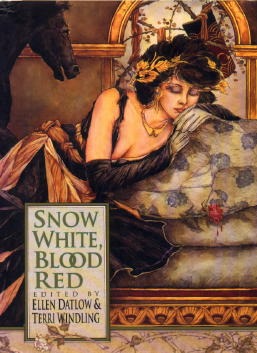
Like I keep asking, why do we keep going back to Oz?  But why do we keep going back and retelling classic Grimm tales?  Terri Windling and Ellen Datlow have  six volumes of retold fairy tales for adults.  I think it’s more than writers just wanting to modernize old folk tales.  I think it’s a kind of cultural psychoanalysis with each writer taking their turn at bat being Joseph Campbell.  Maybe they are like me, feeling they were bamboozled as kids by stories that were so much more exciting than reality.  Maybe it’s fun to dress up old fairytales in modern language.  Maybe it’s just more fan fiction.

Reading these fairy tales for adults, I wonder if they are either deprogramming tools, or remembering reprogramming tools, because we want to forget magic, or we want to return to believing in magic.  Writing stories for adults that retell children stories is a weird business.  They either try to make us think like kids again, or they make us think like kids again, but with brutal winks and nudges.

JWH – 6/11/13

Is an International Nonprofit Space Program Possible?

Ever dream of being an astronaut?  Ever fantasize about developing a new rocket system to take people to Mars?  Ever wanted to be a colonist on the Moon?  For decades only the richest of nations could afford a space program.  In the last decade several rich men have started their own space programs for rich space tourists.  But what about us poor folks, with big final frontier dreams?  Could we collective scrape up a few billion to build our own space program?  The idea was once silly, but now that ordinary people are winning lotteries approaching a billion dollars, digging up the money to finance an amateur space program doesn’t sound as impossible as it once did.

Space programs 1.0 for most of history have been huge nationalistic affairs.  Only rich governments and astronauts with the right stuff could participate, leaving most would-be final frontier explorers on the ground.  The last decade has shown the rise of private space enterprises with the focus on space for profit, space programs 2.0.   But you still have to be a billionaire to own a space company, or a multi-millionaire to be a space tourist. 

I’m asking if a 3.0 generation of space exploration isn’t possible, one based on non-profit, open source, volunteerism, where ordinary people design, build and travel into space?

What motivates people?  As Daniel H. Pink explains in his book Drive: The Surprising Truth About What Motivates Us, it isn’t the outer rewards that drive us the hardest, but the inner desires.  There’s not enough people interested in colonizing the final frontier to motivate Congress to spend more tax money on space exploration, but is there enough people interested by their own inner desires to finance a space program collectively?  We are seeing more and more projects developed around the world by volunteer effort.  Linux, the operating system that fits on everything from tiny embedded controllers to giant supercomputers, is produced by volunteer effort.  Kickstarter and Kiva show the power of individuals to financially back new ideas.  TED and Khan Academy illustrate the power of individuals with ideas to influence change.  Projects like Wikipedia show that people all over the world are willing to spend long hours working without pay to create something that almost everyone uses.

If you don’t know about the open source movement you should follow the link and read about it.  It’s about why and how programmers develop free computer programs for everyone to use.  Eric S. Raymond wrote a famous philosophical essay about open source software called The Cathedral & The Bazaar.  It’s hard to explain the open source movement in a few words, but it’s about people all over the world working on large projects, and through their own  self-starting initiative, creating something very valuable, that’s used by millions and billions of people.

The open source movement follows in the footsteps of the 19th century amateur scientist.   Now this power to the people philosophy is moving on to bigger projects, such as ARKYD: A Space Telescope for Everyone by Planetary Resources.

By using the crowd source funding site Kickstarter, Planetary Resources promises to build a space telescope for everyone to use.  You make it happen by donating money, and depending on how much you donate, you get various participation rewards.  The ARKYD is no Hubble Space Telescope, but it does show the power of people working together.

But what if we could crowd fund something bigger, like a manned lunar base?  The Bloomberg link sites one study claiming it will take $35 billion to put a four person base on the Moon.  The ARKYD project is aiming for $1 million dollars, and they are half-way funded, a Moon base would require 35,000 millions.  That’s several quantum leaps in crowd funding success.  Is such people funded projects even possible? 

What would a people’s space program cost?  Let’s imagine a private open source crowd funded space program with an annual budget of $5 billion dollars.  That’s 5,000,000,000 – lots of zeros.  It would require 50 million people donating $100 a year.  There’s probably not that many space enthusiasts in the world, because if there were, NASA would have solid public support when it comes to Congressional appropriations. 

A five billion dollar space program is also 5 million people donating a $1,000 a year.  That sounds like a lot, but that’s $83.33 a month, or about the cost of a monthly smartphone bill.  What if such a commitment would get you into a lottery to fly in space?  What if you got to help design a lunar colony?  That’s the kind of inner motivation that inspired Daniel Pink’s book, Drive

A club of 5 million people might be possible.  Especially when you think about how many volunteer type tasks would be required to start an open source space programs.  Let’s assume our open source space program doesn’t build rockets, but hires the 2.0 generation of private rocket builders, and our goal is to develop a lunar colony, it could take decades to evolve such a space program.  Let’s say for the first twenty years we devote ourselves to robotic missions to the Moon, how many people out there would love to design and build robots for the purpose, get no pay, but spend their their own money?

If we look around we can find thousands, if not millions of people already spending lots of their own money in scientific-like endeavors.  If you just include open source programmers, robot builders, amateur astronomers, amateur rocket builders, the Maker crowd, amateur AI developers, gamers who love to create complicated simulations, X-Prize enthusiasts, and get them all working on one big project, could we have an open source, non-profit space program?

In recent weeks I’ve seen quite a few internet stories that make me think such synergy is possible.

Amateur Astronomy

Amateur astronomers has always made significant contributions to real science. Timothy Ferris wrote a whole book on the topic,  Seeing in the Dark : How Amateur Astronomers Are Discovering the Wonders of the Universe.  With modest equipment, dogged determination, and disciplined  systematic effort, people without PhDs can add important information to scientific journals and research.  Take a look at the trailer for the PBS documentary that’s based on the book.  It’s available on Netflix.

Amateurs have recently discovered exoplanets by going through public data.  Amateurs often discover comets and supernovas.   Amateurs track asteroids and near Earth objects.  Amateurs monitor sunspots and double stars.  Telescopes are becoming more powerful and affordable to amateurs, and CCD astronomy lets amateurs take astronomical photographs that surpass what the Mt. Palomar telescope could take back in the 1960s.

The ARKYD space telescope is probably just the first of many amateur spaced based telescopes.  Because of the internet, there are many robot control ground based telescopes around the world that amateurs can use

Imagine amateur astronomers having a robotic lunar based telescope to share.

Make, Makers and Robots

Make Magazine has had a tremendous impact on the world of Do-It-Yourselfers.   Small cheap microcontrollers  like the Raspberry Pi and Arduino inspire people to become inventors of intelligent gadgets.  Look what Dave Ackerman did with a Raspberry Pi and a weather balloon.  Please follow the link to read a fascinating article.  These pictures look better than what the U.S. government with German scientists took with early sounding rockets back in the 1940s.

pi-view-of-Earth

Make Magazine shows the tip of the iceberg for how many would-be inventors live in our world.   Now take a look at Robot Magazine.  How many boys and girls out there dream of building a robot that does something really cool?  Why should only JPL and NASA scientists have all the fun?

Science Fairs

Eesha Khare, an 18-year-old student from Lynbrook High School, Saratoga, California, won second place in the Intel International Science and Engineering Fair this year for developing a super-capacitor that would allow cellphones and other electronic devices to be recharged in 20-30 seconds, instead of hours, and upped the recharging lifetimes from 1,000 charges to 10,000.  Ionut Budisteanu, 19, of Romania, developed AI for a self-driving car.  Henry Lin, 17, of Shreveport, Louisiana, develop a computer simulation “that simulated thousands of clusters of galaxies, providing scientist with new data that will allow them to better understand dark matter, dark energy and the balance of heating and cooling in the universe’s most massive objects.”

It’s obvious that individuals, without years of graduate school can do significant science.  Is it possible to coordinate amateurs to work on a much larger project that spans years of effort?

Open Source Space Program

What if we applied the open source programming  philosophy to amateur science to develop larger amateur projects?  The way open source software begins is when a software inventor starts a project and then Tom Sawyers other people to volunteer.  I imagine an open source space program to be an organization like Wikipedia that gives a collection of centralized tasks to thousands of volunteers.

An open source space program could start by designing itself with a virtual world version first.  That initial projects would be created in simulations, and once they are worked out, then start building real world projects.  Let’s imagine the first project is to design a lunar lander. Given the constraints of costs and the payload capacity of private launch rocket services, how big of a lander can we design?  For example, lets say we can get a 1000 pounds sent towards the Moon for $300 million.  How sophisticated can we make such a lander?

For any self-sufficient lunar colony to succeed it will require living off the land.  What elements exist on the lunar surface or in it’s scant atmosphere that can be used to build a base for human habitation?  The Moon has water, and that gives us raw material for oxygen to breathe, and oxygen and hydrogen for rocket fuel.  But can we find nitrogen on the Moon?  Trace amounts have been found in the atmosphere.  Could we build a machine that gathers significant amounts of nitrogen, so we could have a safe breathable atmosphere for when we robotically dig our underground Moon City?

The possibilities are endless.  We design a series of robots that process lunar resources into goods we don’t have to send to the Moon.  We keep sending robots to build what we need until we have a base that’s safe for humans.  Then we send people.

Now, is this possible through volunteer effort and open source techniques?

JWH – 6/5/13

Four Little Girls Buy A Jimi Hendrix LP

I was flipping through the “new arrival” bins of used LPs at Spin Street when four teenage girls, all looking about fifteen, showed up to paw through the albums too.  I heard one excitedly tell the others she found a Herman Hermits LP.  My first thought was how did a 2013 teen even know about a 1963 teenybopper group?  I was mildly annoyed at these little girls because they had gone over to the used Rock section, the place I wanted to go next.  So I went to where the used Jazz section used to be, and I discovered that Spin Street had moved the used jazz LPs or done away with them.  So I went to new Rock section, which was now was much larger than before, covering up where a third of the used rock records used to be.  LPs really must be making a comeback.

I was surprised at the flock of girls in the LP section, a room at the back of the store away from everything else.  I assumed their parents were out front, because they didn’t look old enough to drive, but I could be wrong.  I’m used to seeing old geezers like me time traveling through these dusty bins, and sometimes I even saw some hipster thirty-somethings, but never vinyl record buyers this young.

So while the girls were looking exactly where I came to shop, I contented myself to look through the new LPs.  Eventually I noticed they had disappeared, but I hadn’t finished, so I stuck with my systematic flipping of new LPs, going from Z to A.  By the time I had gotten to the I’s, two of the girls were back and jumped into the H’s right next to me, looking for Jimi Hendrix.  They pulled a couple LPs out of the bunch, and one asked the other, “Do they have ‘Purple Haze’?”  The other replied “This one does.”

ZB3276_169191_0308

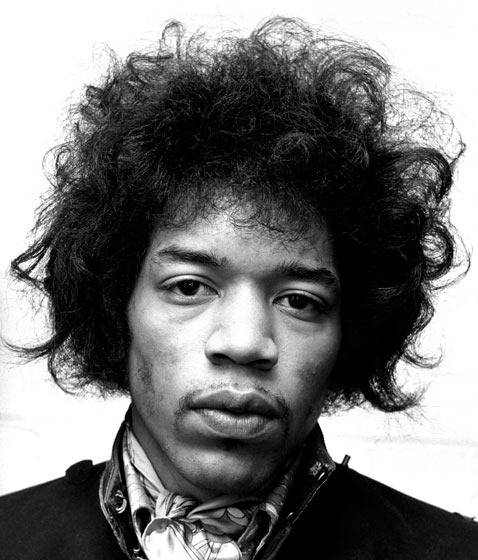
They put one of Hendrix’s posthumous albums back, and took  Are You Experience with them to the other two girls, and headed to the checkout.  I really wanted to ask them how the hell did they discover Jimi Hendrix, a guy I discovered at 15, almost fifty years ago.  I thought it very strange indeed, like if I had gone in a record store in 1964 and bought a 1924 Bix Beiderbecke record.  It took me until my forties to work back in music history forty years.

I don’t normally talk to teenagers because I worry about invading their space.  When I was that age I didn’t like old people intruding, so I’m hesitant to do it  myself, now that I’m old.  I wanted to know if they read about Jimi Hendrix in a magazine, or their parents or grandparents played him at home, or they heard him on the radio.  And do teens even listen to radio now-a-days?  Jimi Hendrix is legendary, but is he well known among the young?  I imagined it’s not hard to discover him, I was just curious how.  Is he taught in school?  And why didn’t they just steal his .mp3 songs off the net like normal kids?

These little girls, who all looked alike, skinny, brown hair, dressed in dress shorts and blouses, looking like typical Bible Belt Baptists kids that I often see around Memphis, seemed so young and innocent looking.  What the hell are they listening to Jimi Hendrix for?  I remembering tripping at 16 and listening to “Purple Haze.”  Were these little clean-cut girls doing drugs?  Did their grandfathers and grandmothers tell them about the time they dropped acid and saw Hendrix?

Jimi was the ultimate bad boy of the sixties.  Girls loved him.  So I guess it’s not strange that girls might still love him.  I just can’t imagine these little girls going home, putting Hendrix on the turntable, cranking up the amp, and then lighting up a bong.  If I was a young parent today and my kid brought home a Jimi Hendrix record, I’d wonder if they were doing drugs.  Especially when the album is entitled, “Are You Experience.”

But I really doubt these girls got high.  This is a different world than 1967.  So how do 2013 children see 1967 kids?  Can they ever fathom how we grew up?  I’m living in 2013 and can’t imagine what 2013 kids are like.  When we were young we’d say, “Don’t trust anyone over 30.”  Decades later we began to say, “Don’t trust anyone under 30.”  Soon I’ll be thinking, “Don’t trust anyone under 60.”

Or is it a matter of what goes around, comes around?

are-you-experienced

I considered long and hard about buying a new LP version of Electric Ladyland, but hell, I’ve already bought it at least three times in my life (LP, CD, remastered CD).  I ended up buying 180 gram version of Ceremonials by Florence and the Machine.  An older young women, in her early twenties, the cashier, was quite pleased with my selection, and told me it was a wonderful album.  She seemed glad that gramps was trying something new, but  I wondered it she was secretly thinking, “Why doesn’t this old fart act his age and buy a Jimi Hendrix record!”

JWH – 5/27/13

Novel Ambitions

When we were young we’d all dream of growing up to be in the movies, or rocking out on stage, or flying F-16s, or writing great novels, or rocketing to Mars – the kind of careers that look exciting when we don’t know much about how the world works.  Few kids achieve their childhood ambitions.  Most of us get regular nine-to-five jobs, and just daydream about the ways we’d really like to be spending our hours.

I always wanted to be a science fiction novelist.  Because I loved reading science fiction books I assumed I’d love writing them.  As a teen I didn’t know just how wrong that logic was.  I should have wished to grow up and become a professional reader.  Even as a teen I knew kids who compulsively wrote stories.  I didn’t, but I assumed one day I’d get an urge and start.  I should have known better – the only time I wrote was when I took a creative writing class in high school or college and deadlines forced me to write.

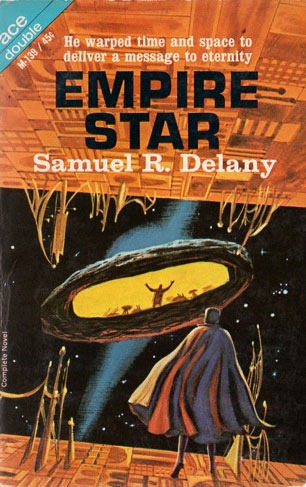
Around 1971 or 72 I went to my first science fiction convention in Kansas City, The Mid-America Con.  I was about 20 at the time and I met a lot of writers there.  But the one that impressed me the most was this kid who looked about my age who told me he had just sold his second story.  He was George R. R. Martin.  I was so impressed and jealous at this very young writer.  I felt like Comet Jo from Empire Star by Samuel R. Delaney, when he first met Ni Ti.  Comet Jo was a naïve rube with dreams that met a guy that had already done everything Comet Jo’s dreamed of doing. 

That was a revelation at that convention – writers write.  And if you want to grow up to write giant bestsellers you’ve got to start young and practice.  Delany was also a writing prodigy, and he dealt with the subject somewhat in Empire Star.

empire-star 

Those early experiences meeting writers should have convinced me to stop daydreaming about writing, but fantasy ambitions aren’t that easily destroyed.  And wanting to be a novelist is different.  Some people don’t start writing until late in life, so I figured I had plenty of time.  If I had wanted to be a football player, fire fighter or astronaut, I’d have known I was over the hill when I turned thirty.  Now that I hope to retire next year, my old fantasy ambition is returning.  I’ll finally have the time.  Probably lack of time wasn’t the real reason I never wrote, and it will be brutally revealed to me soon.  I have to be self-aware enough to recognize that wanting to write and not might be my natural state for my whole life.  But not giving up also seems to be a trait that never goes away either.

Lately, I’ve been thinking about what it means to be a novelist, the grittily specific job details.  I came across “Good Writing vs. Talented Writing” by Maria Popova over at Brain Pickings.  She quotes About Writing by Samuel R. Delany,

Either in content or in style, in subject matter or in rhetorical approach, fiction that is too much like other fiction is bad by definition. However paradoxical it sounds, good writing as a set of strictures (that is, when the writing is good and nothing more) produces most bad fiction. On one level or another, the realization of this is finally what turns most writers away from writing.

Talented writing is, however, something else. You need talent to write fiction.

Good writing is clear. Talented writing is energetic. Good writing avoids errors. Talented writing makes things happen in the reader’s mind — vividly, forcefully — that good writing, which stops with clarity and logic, doesn’t.

This is very telling. The obvious reason why I’m not a writer is the lack the talent.  But what is talent?  Is it a gene?  Is it being born with a muse?  I am reminded of a book, Talent Is Overrated: What Really Separates World-Class Performers from Everybody Else by Geoff Colvin.  Talent is mostly hard work.  If I lack talent its because I’m lazy.  But we also know that some people work very hard and never succeed, even if they put in their 10,000 hours of practice.

But even this isn’t the issue I want to explore.  What skills are really required to write a novel?  Every time I try to write fiction I hit a brick wall.  Writing fiction requires having imagination the size of Jupiter.  I don’t know if you have ever wanted to write novels, plays or movies, but have you ever thought about what goes into creating a great story?   I’ll use movies and television shows for example over books because they are more familiar to people.

Let’s think about of some of the poplar shows on TV like Breaking Bad or The Game of Thrones and dissect how they are put together, and what makes them successful.  Both stories are incredibly addictive.  I believe each has all the elements that make for great fiction.  Maybe not Shakespeare great, but great for seducing people into their story worlds.

Story World

The first aspect of great fiction is creating the story world.  This goes way beyond setting.  And I’m not talking about the world building of fantasy and science fiction, but the creating of a whole fictional reality.  Even when a story is realistic like Breaking Bad, or To Kill a Mockingbird, its creating a whole story world, time and place, with endless defining details.  As much as we’d like to believe that To Kill a Mockingbird is an accurate portrayal of the past, it isn’t.  Every written story involves two imaginations, the writer and the reader.  With movies and television shows, the director, the actors, set designers, cinematographers, costume makers, special effects wizards, also add their imaginations to creating the story world.  But with novels and short stories, the author suggests everything in words, and the readers bring their own imaginations to decode their version of the story world.  Watching The Game of Thrones, meanings most everything has been envisioned for the audience, but readers of the book all imagine something different.

The reason why the Harry Potter books are so great is because of the complete story world that J. K. Rowling created.

If you ever think about becoming a writer, do this experiment.  Each time you read a book or watch a movie, try and list everything that had to be invented by the imagination of the writer.  Most stories involves thousands of imaginative decisions, and stories like The Game of Thrones or the Harry Potter books, involve tens of thousands of mental creations, maybe even hundreds of thousands.  These novels run 100,000-200,000 words, or more.  Thinking tunic or sword are small decisions, but thinking up the details of Quidditch takes some real work.

Characters

It’s hard to say which comes first, characters or story world.  Often writers create characters that generate their story worlds.  Other writers start with the story world first and then create the characters that belong in that story world.  Either way, creating characters is very hard work.  And the best stories seem to have lots of characters.  Would The Game of Thrones or Breaking Bad stories be so compelling if they only followed a handful of main characters?  Walter White is a tremendous creation, but the depth of his character works because of his relationship with Skyler, Jesse, Hank, Walter Jr., Saul, Gus, and so on.  Think about every detail that went into creating Gustavo Fring?  Does thinking up those kinds of character details come from genes, muses or what?  Most great writers are great observers of people.

One of the hardest things to create for your characters is their dialog.  Bad writers make all their characters talk like themselves.  Great writers make all their characters sound like diverse people from all over the world.  Listen to audio books, especially the ones that have narrators who do voices for each character.  It’s not just the sound of the voice, or the accent, but how each character phrases their words.

Each character has to have their own background and history, but more important than that, each character has to have their own motivations and desires.  When we read novels generally they are driven by one or two people’s stories.  But every character that walks into a scene has their own agenda.  Bad writers create minor characters to show off the main characters, but great writers create minor characters that want to make the story their own.  Every character should be trying to steal the scene for themselves, because in reality, every person thinks they are the center of the universe.  Nobody wants to be a red shirt.

Plot

Plot is what drives the story forward.  Will Walter make enough money to leave his family secure before he dies of cancer?  Who will take the Iron Throne from Joffrey Baratheon?

Writing a plot requires imagining a beginning, middle and end.  However, modern binge worthy TV shows have no end, but are sophisticated soap operas.  Readers want a satisfying conclusion at the end of the book, even if its part of a series.  Readers love feeling the need to keep turning pages hoping to find out what happens next. 

Standalone stories, like non-series novels, and movies, have plots that lead to a satisfactory resolution of a problem revealed at the beginning of a story.  Soap opera like stories depend on a series of conflicts that get resolved from time to time.  Great stories will bring the story to a climax, and present an epiphany. 

I saw Star Trek Into Darkness yesterday.  It has the same plot every time.  Kirk and Spock play out their now famously cliché character traits while battling a almost impossible-to-beat foe, with all the minor characters also getting to reinforce their now standardize character traits.  And we love this because it reinforces the familiar and nostalgic essence of what we think of as Star Trek.  Sometimes plots involving giving the audience exactly what they want.

On the other hand, new stories must give readers and audiences something they never seen before.  Shows like Breaking Bad, Big Love, Deadwood, Shameless, Girls, etc. find ways to present new and very different plots.  Let’s face it, some of us are very old and have been consuming fiction for a very long time, and getting jaded to routine plotting is all too easy.

Conflict

Even though I greatly admire The Song of Fire and Ice for its story world, I have to nick it for stretching to the story out too long.  It’s one giant potboiler, generating a steady stream of conflicts and cliffhangers.  My favorite character is Arya Stark, who gets involved in one misadventure after the next.  She never seems to get anywhere, but she always has something life threatening to deal with.  But that’s how you keep readers and watches involved.  Characters need conflict to drive them forward in the story, and creating imaginative conflicts is another trait of a good writer.

To me, the masters of fictional conflict are the creators and writers of Breaking Bad.  Not only do they keep their characters busy, but they create original, unpredictable conflicts that we never see coming.  When I think Jesse is going to have a standard shootout with a villain, Walter shows up at the last second and runs the villain over with his car.  The cliché feeling is to want Jessie to kill the guy.  We the audience are aching for Jessie to kill the guy.  And then out of nowhere Walter runs him over.  That’s great plotting and creative conflict resolution.

Summing Up

I don’t know if creating imaginative story worlds, great characters, compelling plots and satisfying conflicts requires an innate talent.   Is it an ability that can be acquired through long study and practice?  Most books are not that creative.  Thousands of novels are published every year that don’t sell or find fans.  Many of them are competently written.  Delany might be right, that good writing is common, but bad, and talented writing is special.  Or it could be all those mundane story tellers just didn’t work hard enough to be distinctive.   Maybe creativity comes after ten rewrites, or twenty.

I feel all the stories I’ve written so far fail because I didn’t push myself hard to enough to be more creative.  I would like to know if I could push myself to work harder would I be more creative?  I have a novel I’m working on now and I feel it doesn’t even achieve 1% of what it should do.  And I have a sick feeling that even if I worked a hundred times harder it might only succeed at the 10% level.  Maybe if I had a natural talent for story telling I could achieve 90% success with far less work.  But I tend to think talented people are just people who wrote dozens of practice novels and earned their skills at faster creativity.

I have two challenges to test.  First, can I learn to write after I retire, when I have more time to work harder?  And second, is it possible for someone in their sixties to become creative late in life?  I’m not delusional, I know I’m in physical and mental decline.  I’ve already decided that writing a novel is too ambitious for this test, and that I should aim for success with short stories.

Since 2002 I’ve had a renaissance with my love of fiction because of Audible.com and audiobooks.  I have discovered that listening is the best way for me to study great writing.  Listening is like having a powerful magnifying glass for studying fiction.  And in the past year, I’ve gone back to studying fiction with eye ball reading.  What I learned from hearing lets me see words in a new way.  The more I study, the more I realize how little I knew about how fiction is put together.  I might have discovered that in my teens if I had actually tried to write fifty or a hundred stories back then.  You can’t understand fiction completely until you write it.

I don’t know if having all my time free is enough to find success at writing fiction.  Whether I succeed or not, the attempt will be a great learning experience.

JWH – 5/27/13

Buying Vinyl Records Can Be So Goddamn Annoying!!!

I wonder if the phrase “You Can’t Go Home Again” also applies to technology too?  Can we return to living with older inventions?  Why haven’t some people rejected television and returned to radio?  There’s always some Luddites.  Just last week CBS Sunday Morning had a piece about people going back to typewriters.  Really?  Who wants to go back to carbon paper and liquid paper after using a word processing?   Who would even want to return to WordPerfect or WordStar after using Microsoft Word?

Many people want to return to vinyl records.  I’ve been trying to go home again with music too, but it’s like the Thomas Wolfe novel.  I’m having trouble.

I love shopping for old records.  I love the big 12” covers.  But nostalgia is not all its cracked up to be.

I love old records, until I play them.  If they play without incident I love the heck out of them.  But if they skip, skate, crackle, pop, hiss, it shoots my blood pressure way up and pisses me off.  It makes me want to smash the record and give up LPs for good.  But I don’t.

It’s such a crapshoot to buy old records.  Come on, how much can we expect from half-century old plastic? 

I’ve bought LPs that looked mint and they’d have a constant background hiss.  I’ve bought records for one cut, and that cut, and that cut only, causes my stylus to skate.  But I’ve also bought records covered with fine scratches that sound wonderful.  It’s weird, but the heavy beat up old records from the 1950s and 1960s often play far better than the thin, nearly new looking records of the 1970s and 1980s.

Part of my problem is my “good” turntable.  It tracks so light that any imperfection causes a record to skate or skip.  My good turntable is hooked up to my good stereo.  I buy records hoping to find the wonderful warm sound of vinyl.  I play them loud.  So when a record acts up, I hear it jarringly loud, which makes it all the more annoying.  The good turntable is designed to make the records sound better, and to protect LPs from wear by lightly tracking through the grooves.  If a LP doesn’t play well on the good turntable I put it on the bad turntable in my computer room.  This older player, with its much heavier tone arm and tracking, can often play records the good turntable can’t.  But I have to listen to problem records on my computer speakers, which are Klipsch THX and sound good, but they aren’t like listening to the Infinity floor standing speakers in the den.

Maybe I should always use old technology to play old records, and new technology to play new records.

Many audiophiles claim LPs sound superior to CDs, but I disagree.  Yeah, LPs have a warm sound that’s very appealing, but it’s not why I buy records.  Modern CDs sound technically superior by far.  I buy records to travel back in time.  I want to go to a record store and shop for a new LP discovery.  I want to flip past hundreds of albums and find one I want to take a chance on.  I want to bring that album home, put it on the stereo, kick back in my recliner and listen with all my might.  And if I get lost in the experience, thrilled by discovering something wonderful, I find blissful pleasure.

All too often now I’ll be deep in reverie and BLAM! – the tone arm slams into some microscope imperfection.   Or WEEEEEERRNT! as it slides over a portion of the cut.  This is so goddamn irritating.  This seldom happened decades ago when the LPs were new.  And even now it doesn’t happen as much as you’d imagine for such ancient technology, but it happens enough to wonder why I bother with retro tech.  Digital technology is infinitely more convenient and reliable.

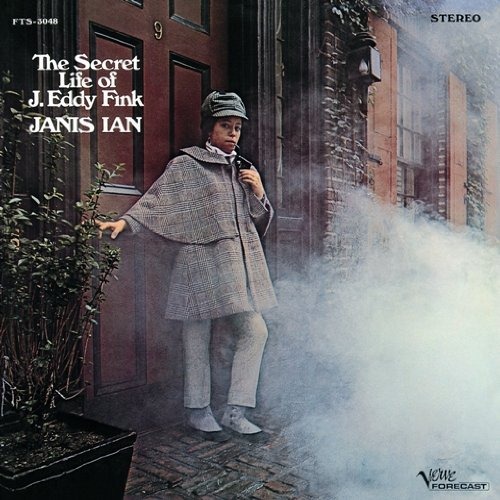
Like here’s a favorite LP I fell in love with back in 1968 that I recently rediscovered and bought on vinyl, The Secret Life of J. Eddy Fink by Janis Ian.  The copy I found even had the blue paper insert with a couple extra poems.

secret-life-of-j-eddy-fink

Coming home, I was so happy to have found this LP again.  I put it on with great expectations.  Then it didn’t play right.  I could have save myself a trip and $5.  It’s available to play online for free at Janis Ian’s website, and doesn’t skip there (although the site fades out the end of the song in a way so she’s not giving you’re the real thing).  I do have the same songs on a CD I bought years ago, Society’s Child: The Verve Recordings, or from Rdio, but it’s more fun to play from an LP that looks like the LP I owned 45 years ago.  Because it doesn’t play from the good turntable it ruins the whole experience and fun of buying the album.  It will play from the bad turntable and that’s a consolation, but it deflates the fun.

Does it really matter if a song comes from squiggles on vinyl, pits on a CD, or via electrons over the internet?  Why am I trying to go to a long ago past, when I have a bright and shiny present to explore?

I was buying a lot of old records.  I’ve bought 61 albums since the beginning of the year, but I’ve stopped.  I suppose I could switch to very expensive 180 gram new albums, which run $20-50, but I won’t.  I’ve gone back to mostly listening to Rdio.  It has about a million albums.  I’m not hurting for music to listen to.  It was just fun trying to find lost albums.  I just missed record stores and flipping through bins of records.  But I guess I can’t go home again.

I haven’t completely given up on vinyl.  I’m just more careful.  I’m learning to be a more savvy vinyl shopper.  I keep my eye out for LPs that have never been reprinted, or the CDs have long gone out of print too.  I use digital for most stuff, and vinyl for when digital lets me down.

I guess I’m an old fart when I claim that buying music online is not the same experience as shopping for records in a store.  That something has been lost by modern ways.  But I am willing to admit that the new ways, with modern technology, are far superior.  If I was forced to choose between Rdio and records that played perfectly every time, I’d pick Rdio.  If I was forced to choose between Amazon and bookstores, I’d pick Amazon.  The world wide web is better than CompuServe and GENIE.  I’m not crazy.  I do know a 2013 Ford Mustang is technically superior to its 1965 classic ancestor, even though people will pay far more for the older model.  Nostalgia sells, but modern technology is superior.

We might talk about going home, but now is better.  For instance, a couple weeks ago I got a heart stent.  In 1968 I’d have been shit out of luck.

JWH – 5/25/13