By James Wallace Harris, Sunday, September 27, 2015
I’ve been a big music love all my life, but I’ve never really liked classical music. I keep trying, thinking classical music must be an acquired taste, or I need to be educated to its ways. In recent months I’ve been trying harder, attending a few concerts. Last night I went to hear The Ceruti String Quartet perform Opus 76, No. 4 (“Sunrise”) – Franz Joseph Haydn, Opus 11 – Samuel Barber, and Opus 59, No. 3 – Ludwig van Beethoven. I was emotional moved sometimes by the Barber, mostly because some melodies seemed somewhat familiar, like I might have heard the second movement in a movie soundtrack. I liked the Haydn least, and the Beethoven kind of impressed me, but still didn’t quite work as something I’d want to regularly hear.

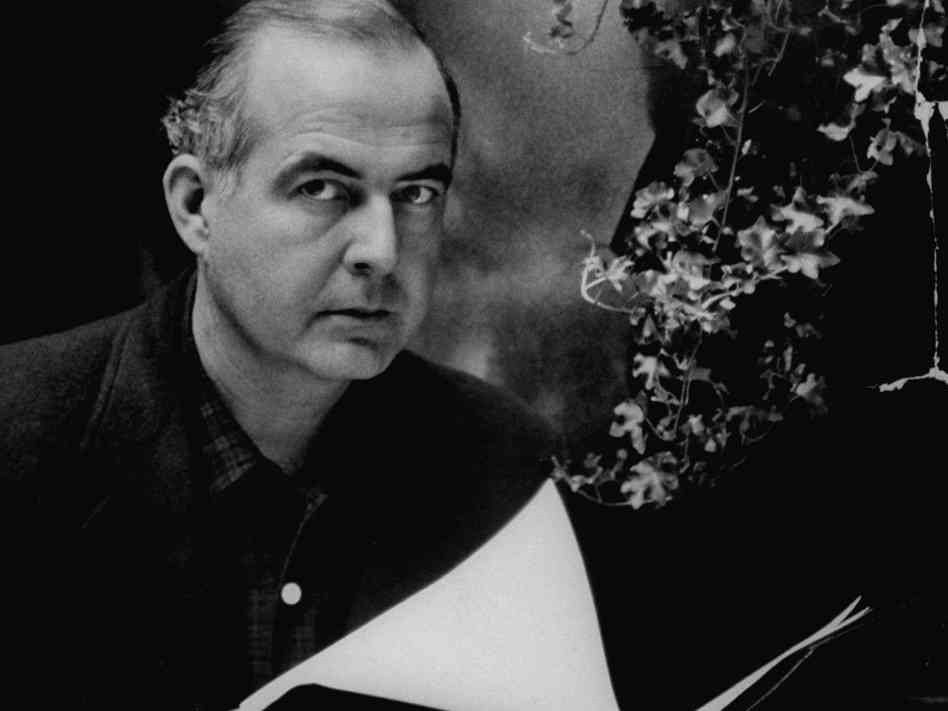
Samuel Barber
I’m fascinated by why some people find classical music so moving and powerful and others find it annoying. I’ve learned to like classical music enough, from brief measures here and there within symphonies, that I want to learn to like it more. I believe I have a conceptual barrier to understanding classical music. By understanding I mean being able to listen to it and appreciate its artistic beauty.
One hypothesis I’m working with, is I don’t have the working memory to appreciate classical music. I can’t remember the melody to any song, even popular songs I’ve heard a thousand times. I can’t hum a tune, or remember lyrics. Popular music, which I love, is based on short songs built around a relentless rhythm. Rock, folk, country and to a degree jazz songs are composed around a steady beat, usually provided by drums and bass. Other instruments weave simply melodies within the beat, but they are seldom complex, at least compared to classical music. Pop music is close to a short chant, while classical music is often much longer, far more complex, and might be compared to several long poems all read at the same time, but which still create a coherent whole. To my mind, classical music is a jumble of words and phrases I can’t comprehend, often jarring, usually without resonating with my feelings, but occasionally twinging a sense of beauty.
I came up with my working memory theory because of three recent incidents. First, my friend Janis has listened to two symphonies with me that she remembered from her high school band days. She can still hum/sing them, and remember their ever changing movements. She’d conduct with her hands as she listened, which shows she remember their overall structure.
Then I saw a video of a 3-year-old kid “conducting” the 4th movement of Beethoven’s 5th.
If you watch young Jonathan you can see that he anticipates what’s coming up. He has memorized the piece. Janis has done the same thing with the two pieces we listened to. I don’t know any classical music well enough to anticipate any part of it, even the symphonies I’ve played four or five times. I have no memory for structure. Popular music is so repetitive that you don’t have to remember. Has popular music made me lazy, or do I just have a very poor working memory?
I did play the three pieces I heard last night before the performance on Spotify–so I wasn’t absolutely new to them. I wonder how many times I would have to play them before I would learn to anticipate all the changes?
I remember taking tests where I was asked to remember a series of numbers. I’m miserable at it. Which probably explains why I can’t remember lyrics, poems and melodies. I don’t know if this is a birth defect, laziness, or lack of training. But it also relates to a third clue I discovered when I read “What Makes a Prodigy?” Scientists have discovered that most prodigies have fantastic working memories, either in the 99th percentile, or even in the 99.9th percentile. Most childhood prodigies are good at math, music and chess—all things I’m terrible at.
This probably explains why all my life I’ve wished I could play chess, music and do math—I hunger to do what I can’t. It might also explain why I can’t sing or dance. Don’t worry, I’m not feeling pity for myself, I’m good at other things. We often want what we can’t have. I’m guessing it might take a certain level of working memory ability to appreciate classical music, say 70th percentile or above, and I must be way below that.
Last night as I sat alone in the hall, (none of the three friends I asked to go with me would go). I struggled to make sense of what I was hearing. I was impressed by the performers, and by the creativity of the compositions, but except for some of the Barber, what I heard didn’t feel like what I feel when I listen to music I love. And I have a theory about that too.
If you are born into a family of Baptists it’s most likely you’ll grow up to be Baptist. If a Muslim family adopted a Baptist baby, it would grow up to be Muslim. Or maybe Hindu if it was taken to India. I was never raised with classical music, so it’s a foreign religion, a foreign culture. Because some people can move to a distant land and embrace a new culture, religion and ethics, I assume it’s possible for me to learn to like classical music. I just don’t know how hard that might be, or if my short term memory problem will be a limiting factor.
I tend to think it’s a matter of long term exposure. I used to really hate opera, but in the last year I’ve added a few arias to my Spotify playlist of favorites that I play everyday on random. This playlist are songs I can always hear and always enjoy, no matter when they come up. I’ve learned to love a few opera pieces enough to add them into the group.
Yet, I continue to struggle to conceptualize classical music. It’s funny what a newbie I am. I want to clap at the end of movements, whereas the obvious tradition is to sit quietly until the end of a piece. There’s no whistling, shouting, or stomping when a performer plays a particularly good riff. I was in a mostly empty hall with about sixty people in the audience. I think most of them were music majors, or older folk who love classical music. They all knew when each piece ended and clapped right on clue. I expected most of them were familiar enough with each of the three pieces they could have conducted. Which means they see classical music as a whole, something I can’t fathom yet.
Popular songs are played so often, and last so little time, that most people can grasp their basic structure quickly. A very long time ago I tried learning how to play the guitar and my teacher taught me the chord structure to “Like a Rolling Stone,” a song I’ve heard thousands of times since 1965. For a few weeks, decades ago, I could bang out that song, and had a feeling for its structure. I can’t even hum it now.
I listen to music in a extremely weird way, that might not be typical for most people. I don’t comprehend it’s parts. I can’t comprehend or visualize it’s structure. But holistically music pushes a button in my brain that turns on emotions. Music is a drug to me. Because pop songs are so concisely repetitious, they usually create just one emotion. Because classical music is so complexly varied, so diverse in it’s effects, that most of the time I feel nothing, but every once in a while, a measure, or even half measure of its music will find an emotion button to press. I wonder if I keep trying, I’ll learn how to like classical music so more of it’s riffs hit buttons within me that produce a response? One thing significant about classical music, and why I often compare it to movie soundtracks, is it creates a series of different emotions, sometimes even a rollercoaster ride of feelings.
Finally, I have one other hypothesis. I think I responded better to Barber than Beethoven or Haydn because he’s a 20th century composer. And that I liked Haydn least because he’s the oldest. I’m guessing the music of the 18th and 19th century was different because people’s minds were different, and I can’t tune into those periods—yet. With popular music I’ve learned to enjoy music all the way back to the 1920s, and I’ve even heard songs from the 1910s that are becoming catchy to me. For me to learn to love classical music will require learning to love music from other centuries. What’s fascinating is I started listening to chants from the Middle Ages, and I dug them. And I have a theory about why. Medieval music is more like today’s popular music, very simple. The early melodies were monophonic. Which makes me wonder if the minds of people in the 18th and 19th century were more capable of comprehending complexity than our 21st century minds?
JWH