
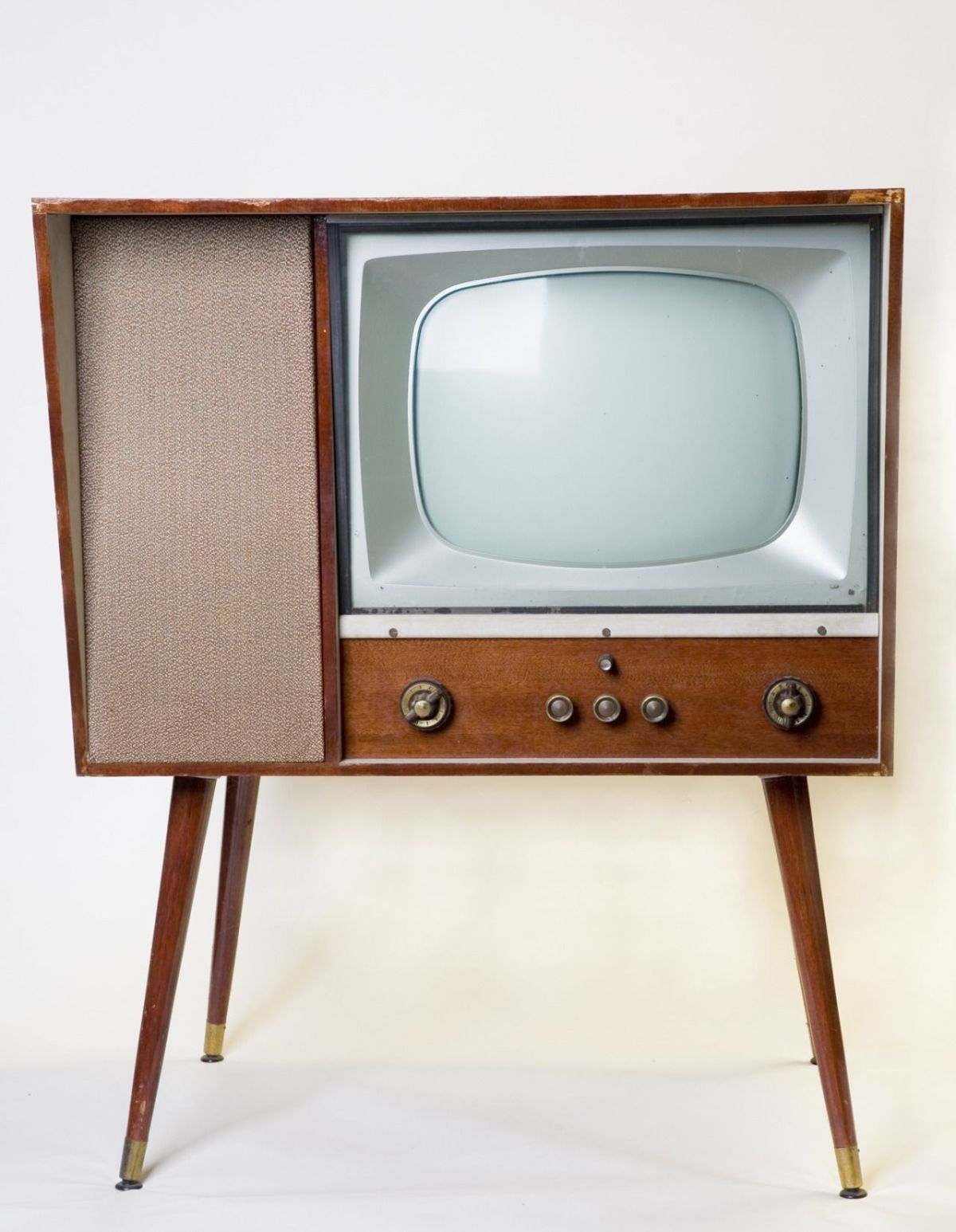
by James Wallace Harris, 1/20/26
When you think about it, staring at a screen for hours on end seems weird. We exist in an immense three-dimensional reality, yet we prefer to focus on a small two-dimensional artificial reality. Why?
There are possible explanations. We don’t view reality directly, but rather perceive what we think is reality through a recreation within our minds. And our minds love making up stories to explain everything, and usually, they have little to do with reality. At night, our unconscious minds generate dreams that feel like another reality.
Is it any wonder we’re so addicted to fiction on a screen? Make-believe is so much easier than the complexity of reality.
Before screens, there were books, plays, storytellers, tall tales, and gossip. Humans interact with reality with words and language, but those tools are so imprecise that they encourage us to make stuff up that’s not there.
So, back in 1957, when I was five, could I have rejected television? Could my little mind have said, “This is fake, I’m going out to ride my bike?”
I wish I had, but I didn’t. Guessing that I watch four hours of television a day on average, that means since January 1, 1957, I’ve spent 100,884 hours in front of the boob tube. They claim it takes 10,000 hours of practice to become great at doing anything. I could have become an expert at ten endeavors if I had said “No” to television.
A more important question is: Can I say “No” to television in 2026?
Why spend the last years of my existence glued to a television or computer screen?
Reality feels the most real when I’m outside working in the yard. I can feel the heat of a nearby star, the changing atmospheric conditions, and watch the plants, trees, birds, bugs, and animals coexist in an ecology. At night, I can see the moon, planets, stars, and even galaxies. Nature should be the most stimulating part of my existence. But it’s not.
My mind prefers to dwell on music, books, magazines, TV shows, movies, the internet, and YouTube. Why is watching old episodes of Mr. Novak from 1963 more rewarding than raking leaves or watching birds at their feeder?
I think it’s because I didn’t say “No” to television in 1957. Like people embracing religion for a lifetime at an early age, I worshipped at the television set. I wasn’t smart enough to make a choice.
Years before 1957, I remember my mother putting my sister and me in front of the TV to watch Kukla, Fran and Ollie or Romper Room as she got dressed in the morning. And after them, it was Captain Kangaroo. But I’m not blaming my mother. TV was irresistible. When my parents weren’t around, I’d turn it on. I have distinct memories of doing that by myself at age five. I remember watching Gunsmoke by myself in 1957.
I suppose if my parents had coached me in learning little activities, I might have become used to actively doing things rather than sitting in front of the TV. To be fair, in 1957, I have memories of playing with toy trucks in the scrubery, riding my bike, playing with friends, walking to school, and spending weeks pretending to be a pirate while sailing in an old wooden crate.
However, all those activities lacked much conscious effort. Becoming good at anything requires a conscious effort. I’m not sure kids do that on their own. I never had a mentor to get me started.
Watching television or doomscrolling is deliciously an unconscious effort.
I could never have said “No” to television in 1957 on my own. That would have only happened if I had the guidance of a wiser person. And they would have had to show me a better alternative.
I’ve contemplated giving up television for all my adult life. Intellectually, I know there are better ways to spend my time in reality. But I got conditioned to television at a young age, and I’ve never been able to reprogram myself.
I really should try. I only have a few more years in this reality.
If you don’t want your kids addicted to screens their entire lives, I recommend mentoring them in other activities.
JWH
 Auxiliary Memory
Well, in case I haven’t mentioned this, television was introduced in South Africa only in 1975. In 1975 we had a year of “test programs”, two hours a day, until the regular service began in 1975, which was several hours more, although most of the programs were the same as the ones which we saw during “test” transmissions. Anyway, the point is that we watched everything from start to finish. Being starved of TV for so many years virtually guaranteed addiction. For a while we didn’t have our own TV, and I remember my mother drove all the way to my aunt’s house once a week, just so she could see Rich Man, Poor Man. That’s sixteen miles there and another sixteen back. When she got home, she recounted the entire plot to us, blow by blow. The one thing we did get right in those early days is that everyone had high quality Telefunken color TV right from the start. We never crowded around a little flickering gray screen with rounded corners.
I don’t think I was ever addicted, except for that first year. And now look at me—I probably average less than an hour of TV a week. Mind you, I make up for this with screen time of different kinds.
That’s interesting, Piet. So what did kids do back then without television?
And do you have any nostalgia for old television programs? Does nostalgia only work for when you’re young?
Kids did what kids did in those old Ray Bradbury stories set in the 1920s and 1930s. Well, my high school friend and I made up our own games with cards and dice, and I kept playing those with my dad and sister after my friend started getting into student politics—and trouble.
And instead of TV, we still had great radio shows—what you in the US would have called Old Time Radio, except that brand new serials and dramas were still being made. We had No Place to Hide, The Creaking Door, Jett Jungle, Squad Cars, My Name Is Adam Kane, and a zillion others, and of course Taxi—nothing to do with the later US TV show—the main character was Red Kowalski (“If I don’t see you through the week, I’ll see you through the window!”), played by Tony Jay with a fake NYC accent, who guest starred in US TV shows when radio faded, as it inevitably had to. And if I’m not mistaken Simon McCorkindale (Adam Kane) became The Saint on TV for a while. That’s how it went. When TV finally came, the radio serials winked out, one by one, and some of the actors tried to make a go of it on TV, but no one I can think of got beyond a guest spot here and there.
So, oddly enough, I have nostalgia for those old radio shows, but not for TV. The Mary Tyler Moore Show was the first US sitcom I remember being great, and I also remember loving Happy Days and maybe Family Ties, but for me, TV nostalgia starts with the Cheers/Golden Girls era. That was the sweet spot for me.
Of course, we missed all the old American classics like I Love Lucy, The Dick Van Dyke Show, and a million others. We did see Bonanza in re-runs, and Star Trek, and (perhaps surprisingly) Roots. Dallas was absolutely colossal in South Africa. It showed on Tuesday nights and no one arranged anything for a Tuesday night. I followed it for three seasons, but when I saw how the handled the “mystery” of who shot J.R., I began to understand how TV worked (who shot J.R.? Nobody. Because if somebody important shot him, it would change the dynamic of the show), and after that I lost interest.
yr correspondent from the republic of south africa piqued my curiousity about the domestic content of his homelands television broadcasts. has anyone ever mounted a production about the voortrekkers or the boer war? were beauty contests (pardon me, ladies, SCHOLARSHIP PAGEANTS) ever carried over the airwaves? what is the ethnic makeup of the anchors and correspondents on the evening news? mayhaps one of these aprils i can make it to cape town for the autumn foliage. (do afrikaners drink cider?) it’s dis heartening how much of the world i’ve yet to encounter; in fact , there’s still a lot of north america i haven’t experienced. and, don’t let harris tell you different, all of you out there in cyberspace, chicago, not memphis , is the home of the blues.
To be honest, I prefer Chicago Blues too, Ed. But wouldn’t you say the Mississippi Delta is the true home of the Blues?
By the way, I lived in the Delta back in 1959-60, but I never met any old blues singers, but then I was only 8 and wasn’t into music yet. My family had just moved from New Jersey, and rural Marks, Mississippi was very different.
point well made,sir. i’m referring to the fact as i picked up on muddy waters, howlin wolf, and little walter (not to forget b.b. king and furry lewis as wll, credit where credit is due,eh) during the summer of 1968, which was one of those blues revival years,where we came to reluctant realization that we’d gone too far without getting anywhere. all credit to robert johnson, skip james, son house, mississippi john hurt, and johnny shines, though i doubt any of them ever worked the taverns of the south and west sides of chicago. (anybody heard different? come on, don’t all answer at once.)