Could You Give a One Hour Lecture On One of Your Favorite Subjects?

by James Wallace Harris, 2/19/25

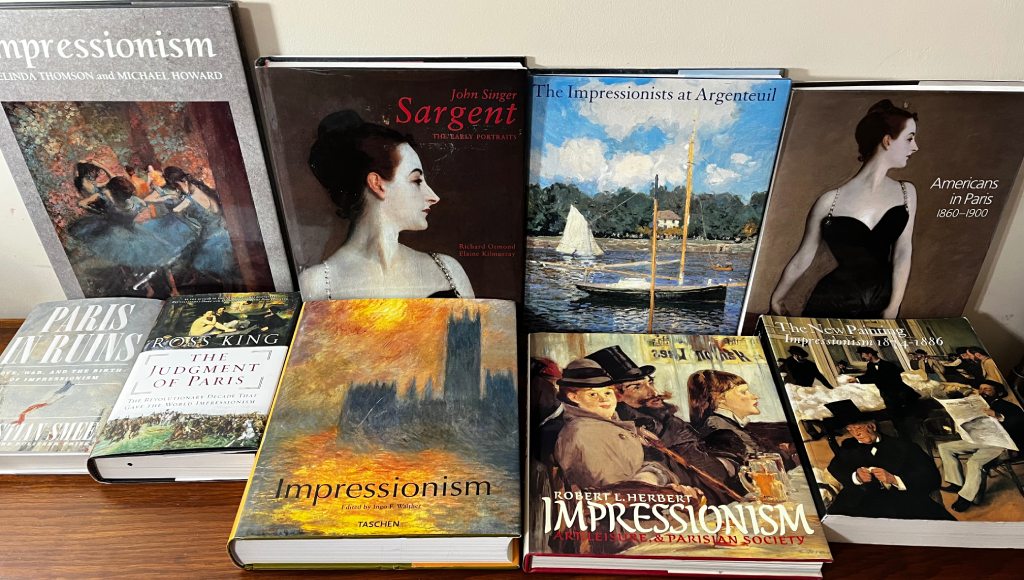
I’ve read several books on Impressionism. I’ve completed a 24-lecture series on The Great Courses on the topic. I’ve seen several exhibits of paintings by Impressionists. Yet, if someone asked me about Impressionism at a party, all I could say was “Oh, I love their paintings.” I vaguely remember their struggles to be accepted into the annual Salon in Paris in the 1860s and 1870s. I can’t tell Manet from Monat, or Gauguin from Van Gogh. If I saw pictures of water lilies I’d guess Monat, and if I saw ballet dancers I’d guess Degas. I have a stack of books on Impressionism that I want to read, but I doubt if I’ll retain much from reading them.

I’m a lifelong bookworm who loves reading nonfiction, but the information in those books seldom sticks. That’s always been disappointing to me.

I could give a pretty good lecture on the history of science fiction. I could give a decent talk on Robert A. Heinlein, the man and his work. I could get up and give a half-ass talk on Philip K. Dick. But that’s about all.

But there are so many other subjects that fascinate me. Ones I regularly read about. I worked with computers for decades and had a serious computer book/magazine addiction, but I couldn’t teach anyone anything reliable about programming anymore.

Most of us believe we know far more than we do, but isn’t that a delusion? News and information are usually how we divert ourselves. We don’t learn, we consume.

I’ve been thinking about how I could remember more. One method would be to research a subject, condense the facts, and then write and memorize a lecture. Certain people can talk at length at parties on their favorite subjects. My guess is they’ve memorized their routines like memorizing jokes. I’m not sure you could extensively grill them on the depths of their subject. I might be wrong though.

Other people are trivia buffs. They’ve memorized a lot of details. I’ve wondered if I could store enough facts about the Impressionists to have a good conversation with another fan of that art movement?

Have you ever thought about all the information they stuffed into you while attending K-12 and college? And then consider how much you’ve forgotten? A good education has always been based on exposure to a wide range of knowledge. And then we specialized in learning what’s needed to make a living.

I’ve been thinking about another kind of education. Call it the know-it-all approach to learning. Most know-it-alls are usually full of bullshit. Often they are mansplainers who annoy women. However, there is nothing wrong with loving to know a lot about little. We need an accreditation body for every subject and a way to test and rank people who want to be know-it-alls in their favorite subjects. Something like chess rankings.

I’ve wondered if I would retain more knowledge of Impressionism if I took regular tests and quizzes on the subject. Let’s imagine that scholars at universities teaching about Impressionism designed a database system that covered everything they’ve ever learned about the topic. They could create an international body that ranked knowledge of Impressionism by giving standardized tests.

I picture them putting the exams online allowing anyone to take them as often as they liked for practice. But to get an official ranking score, you’d have to take a paid supervised test. People who wanted to be ranked in this subject would attend lectures, join study groups, read books, subscribe to online study programs, etc. Learning would be any way you like to learn. That’s the problem with schools, it’s one size fits all.

I believe that the act of competing for a ranking would inspire people to remember their subject. Right now, I have no incentive to remember what I read. Of course, this is just a theory. I do know when I realized I’d forgotten all my math knowledge, studying at the Khan Academy encouraged me to keep going. Even though I had Calculus in college, I had to start over with second-grade math. I worked my way back to the 5th grade. That felt good. I’ve been meaning to keep going.

JWH
Who, What, When, Where, Why, and How of Being

by James Wallace Harris, 2/15/25

At 73 I’m starting to feel I’m running out of time. I keep having this nagging thought I should have done something, or should be doing something before time runs out. But what? I am immensely grateful for existing but was I supposed to do something while I am or was here? Would knowing who I was explain what I was? Would knowing when and where I was explain how and why I got here? And would knowing all those answers reveal my existential duties?

I just finished reading Orbital by Samatha Harvey which recently won the 2024 Booker Prize. Orbital is the kind of novel that inspires the questions above.

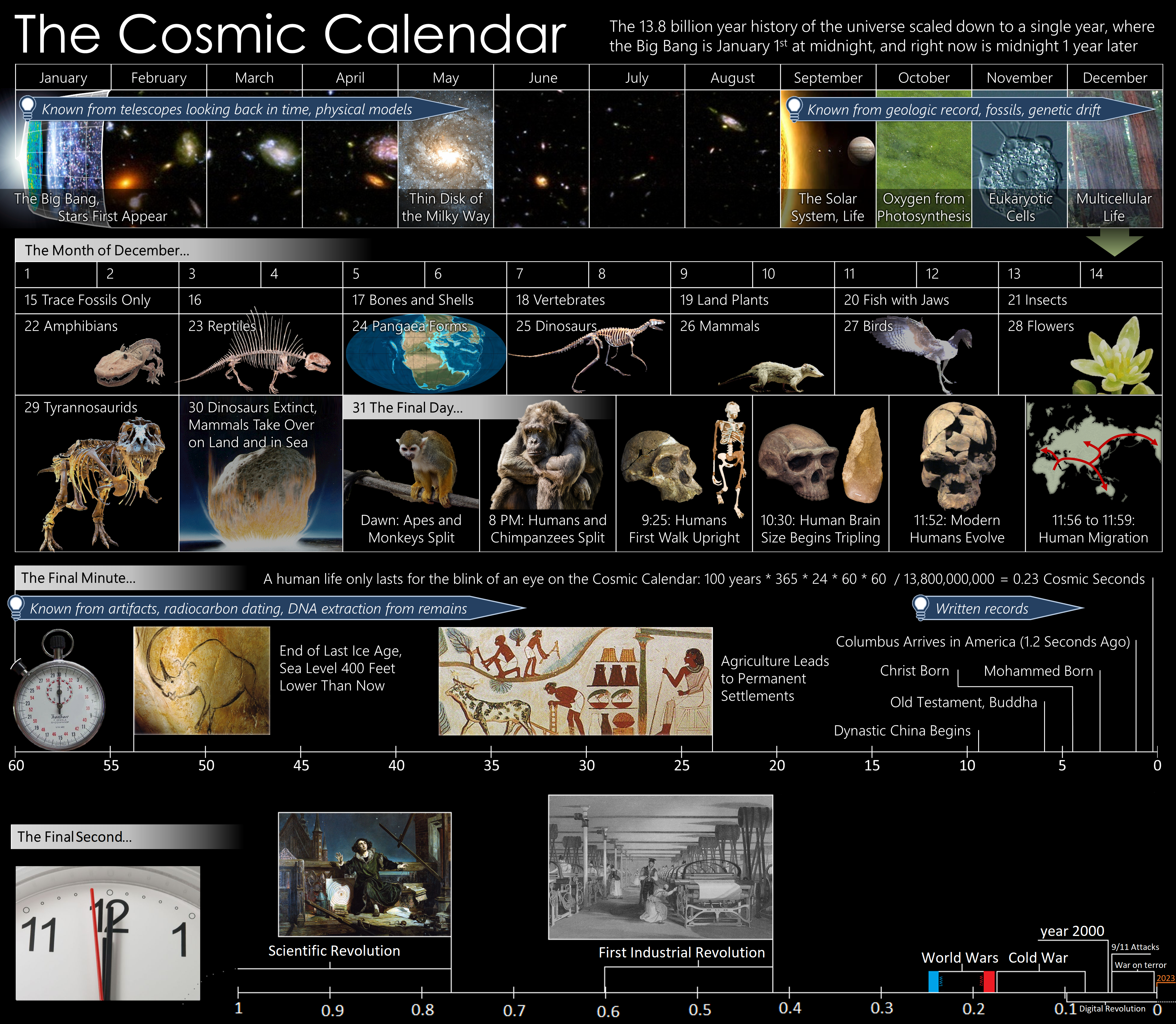
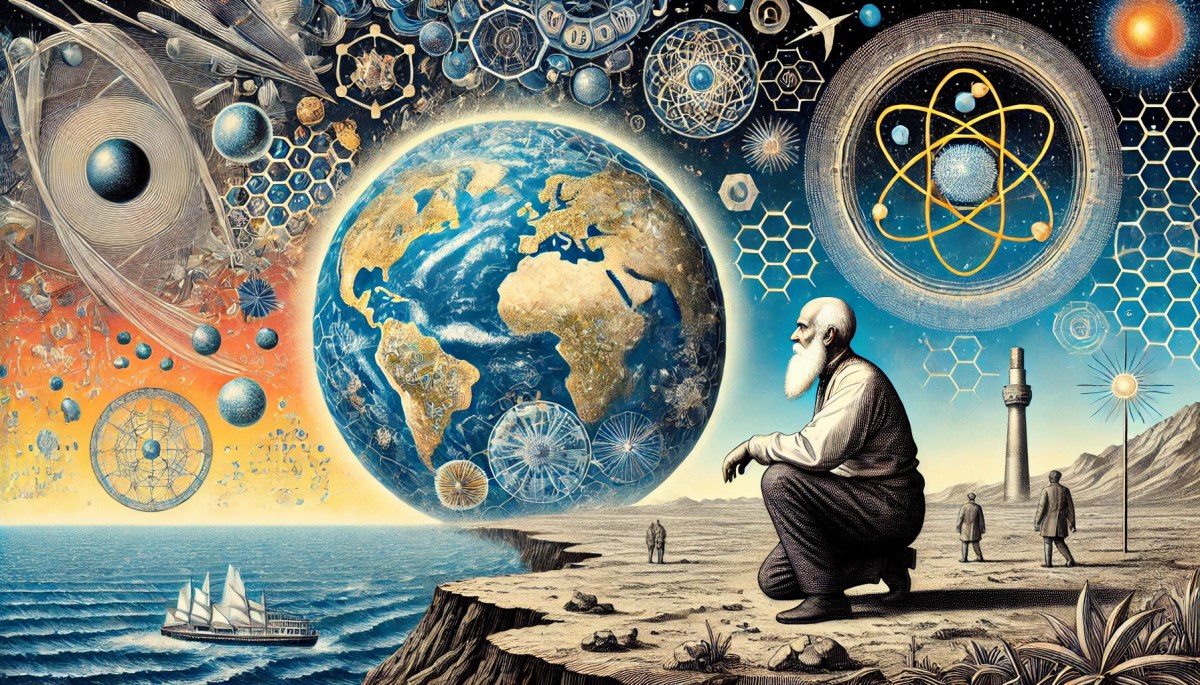
The story is set a few years hence on the International Space Station just as we’re sending astronauts to the Moon again. The book doesn’t have a plot but is a beautiful description of working in space. Harvey’s novel concludes by conveying a tremendous sense of wonder inspired by Carl Sagan’s Cosmic Calendar (large version). The Cosmic Calendar compares the timeline of the universe to one year. Everything since the Scientific Revolution would have happened in the last second of the Cosmic Calendar.

The Cosmic Calendar is a beautiful metaphor to contemplate ontology. How did we get here? There are two main theories. God implies a top-down creation. Evolution suggests a bottom-up development. Each has its paradox. Who created God? Or, how did something come from nothing? Studying cosmology makes it hard to believe in God. How could a single being create all that vastness? What if the universe is God? That’s pantheism. It makes God equal to Evolution but leaves us still with the problem of how things started.

The Cosmic Calendar answers for When.

But do we really need to know how things got started? Shouldn’t we just ask: What is our place in the universe? Scientists are now theorizing that we might exist in a multiverse. In other words, no matter how large we look into the cosmos, there’s always more. On the other hand, no matter how small we look into the subatomic, there’s always something smaller. This is beautifully illustrated by the famous Charles and Ray Eames video of The Powers of Ten from 1977.

The Powers of Ten answers for Where. More importantly, it reveals there are many domains. We might observe the cosmos or even the domain of the atom or quantum, but do they matter to who we are and what we should be doing? Shouldn’t our domain be a hundred meters?

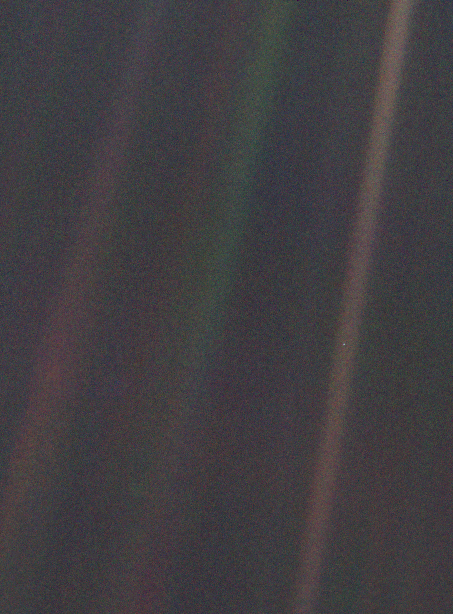
Carl Sagan wrote a book The Pale Blue Dot based on a photograph of Earth taken by Voyager 1 while it passed Saturn. If you look closely, you will see a blue dot. That’s Earth. It’s hard to think we’re significant to the universe. Then think about the Milky Way as seen from the edge of the universe. It wouldn’t be visible at all. It’s beyond conceivable to imagine how small we are compared to all of existence. How can we be significant? How can we have a purpose?

It’s important to think of ourselves relative to the domain in which we live. Many people are depressed by watching the news but isn’t the domain of the Earth too big for one person? Isn’t it ego and delusion to think our purpose could be to organize a nation, city, or even something as small as a neighborhood? I have trouble keeping my house and yard in order.

Lately, I’ve been working in the yard. After fifteen years of neglect, the backyard is overrun with tangled wild growth. Every day I spend a little time trying to conquer my tiny plot of wilderness. At 73, that effort pushes the limits of my physical abilities. I use most of the energy I have left keeping the house somewhat neat. It’s not really clean. I also must spend precious vitality on personal finances, shopping, and general living and maintenance.

Yet, I keep thinking I should be doing something more. I’m not sure what. Maybe it’s having a purpose or making my mark in a small way. This would answer the question of who. And maybe why.

I’ve been using Ancestry.com and learning about genealogy. What did my parents expect of me? What did my grandparents expect of their grandchildren? I have thirty-two ancestors if I go back five generations. Did they expect anything? At most, they expected me to keep the gene line going. Well, that’s where I’ve failed.

I recently read Parable of the Sower by Octavia E. Butler. The story is about the United States suffering an economic apocalypse. The main character felt the need to have a purpose in life, even when everything bad was happening. She decided God was change and our purpose was to affect God/change. That’s a kind of pantheism. What if existence is just trying to become everything that could possibly exist?

Under Butler’s theory, my purpose is to shape myself. To constantly change. Well, I’ve certainly been doing that my whole life.

Right now I’m working on changing myself, my relationships, my house, and my yard. Mother nature was changing the way it wanted the yard. It might seem pointless, but wrestling control from Mother Nature and changing the yard into what I want does give me existential purpose. It’s essentially meaningless in the long run. But maybe our purposes should be limited to a time and place. To a domain. Think small.

I can change myself somewhat. I can change my house and yard. Somewhat. But I can’t change other people. Or anything larger in life.

Maybe that explains how and why.

JWH