by James Wallace Harris, 7/1/24
Can I understand science if I’m not a scientist? I read popular science books, but that doesn’t mean I understand the work that went into making the scientific discoveries they report on. However, is it possible for me to intuit what popular science writers are describing?
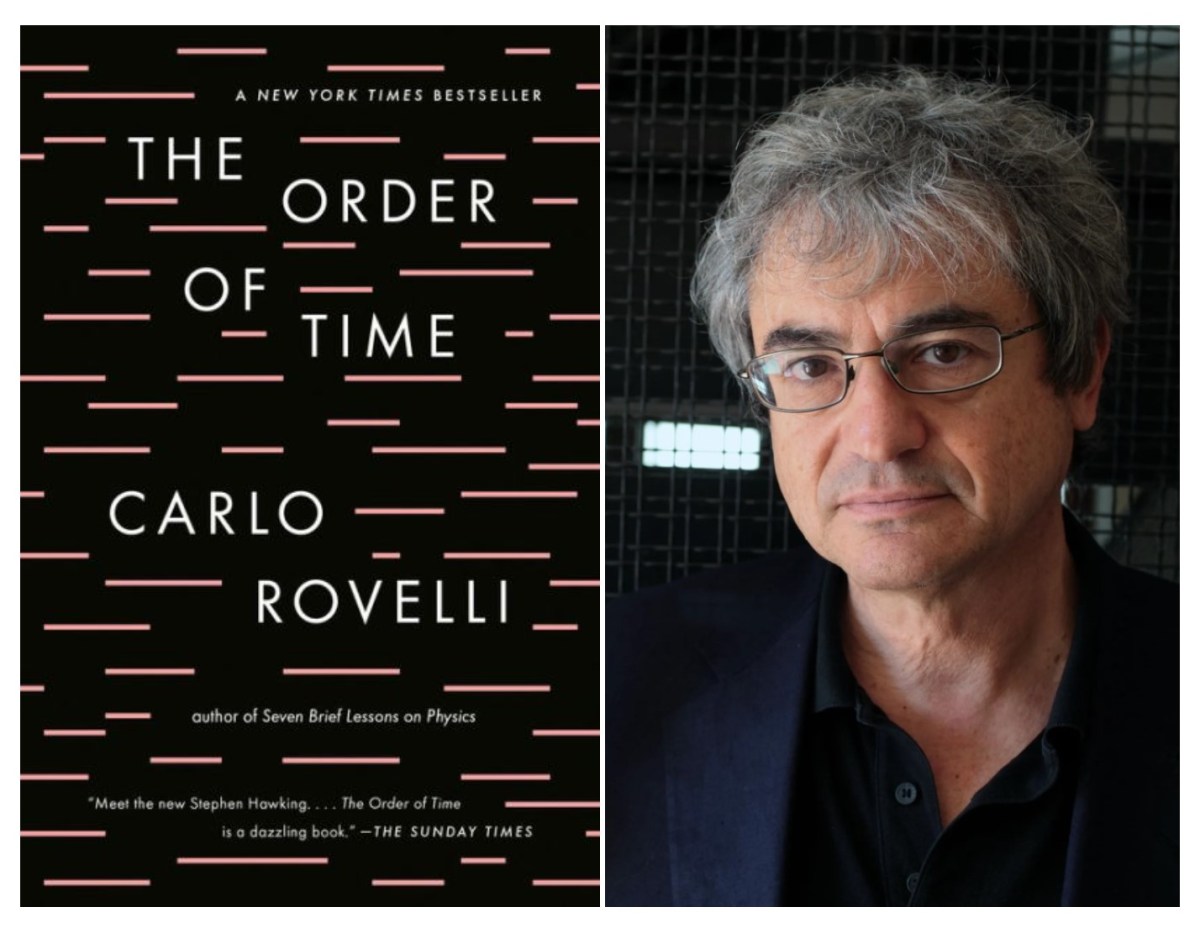
I’ve been thinking a lot about the concept of Universal Now. What is this thing we call now? How is it different from the past and future? But the most important question that’s driving me crazy is: Is it now everywhere in the universe at the same time? But then, what is time? I went looking for a book that might answer these questions and found The Order of Time by Carlo Rovelli. I discovered that book from finding the article “Now Means Nothing: How Time Works in Our Universe” online. It was taken from The Order of Time.
This passage tangles up my brain:
Now Means Nothing
What is happening now in a distant place? Imagine, for example, your sister has gone to Proxima b, the recently discovered planet that orbits a star approximately 4 light-years away from us. What is your sister doing now on Proxima b?
The only correct answer is that the question makes no sense. It’s like asking, “What is here, in Peking?” when we are in Venice. It makes no sense, because if I use the word “here” in Venice, I am referring to a place in Venice, not in Peking.
If you ask what your sister, who is in the room with you, is doing now, the answer is usually an easy one: You look at her, and you can tell. If she’s far away, you phone her and ask what she’s doing. But take care: If you look at your sister, you’re receiving light that travels from her to your eyes. That light takes time to reach you — let’s say a few nanoseconds, a tiny fraction of a second. Therefore, you’re not quite seeing what she’s doing now but what she was doing a few nanoseconds ago. If she’s in New York and you phone her from Liverpool, her voice takes a few milliseconds to reach you, so the most you can claim to know is what your sister was up to a few milliseconds ago. Not a significant difference, perhaps.
What does it mean, this “modification of the structure of time”? Precisely the slowing of time described above. A mass slows down time around itself. The Earth is a large mass and slows down time in its vicinity. It does so more in the plains and less in the mountains, because the plains are closer to it. This is why the friend who stays at sea level ages more slowly.
Therefore, if things fall, it is due to this slowing of time. Where time passes uniformly, in interplanetary space, things don’t fall — they float. Here on the surface of our planet, on the other hand, things fall downward because, down there, time is slowed by the Earth.
Hence, even though we cannot easily observe it, the slowing of time nevertheless has crucial effects: Things fall because of it, and it allows us to keep our feet firmly on the ground. If our feet adhere to the pavement, it is because our whole body inclines naturally to where time runs more slowly — and time passes more slowly for your feet than it does for your head.
Does this seem strange? It’s like when watching the sun set, disappearing slowly behind distant clouds, we suddenly remember that it’s not the sun that’s moving but the Earth that’s spinning. And we envision our entire planet — and ourselves with it — rotating backward, away from the sun.
I really dislike that answer. It goes against my sense of intuitive logic. I can understand that time is relative. I can even understand that it’s impossible for us to know what’s happening on Proxima b because of the speed limit of light at any given moment. But I refuse to believe that if Proxima b still exists, that the same now I’m experiencing isn’t occurring there too. Any sentient being will experience the moment of now at a different rate, but don’t we all exist in the same Universal Now?
To me, it feels natural to think of the universe as one giant entity that is evolving/growing. I can accept that time is variable in separate places within this entity, but I feel there is a Universal Now everywhere. Only it’s perceived at different speeds. And that’s okay. I don’t expect us to be in sync in our sentient awareness of the Universal Now.
For example, a hummingbird perceives time differently from people. We seem to be slow moving to it. A computer with a clock with operates at trillions of cycles per second will see time differently too. Just because we each perceive time differently, doesn’t mean we don’t all experience it in the same Universal Now.
I have read that the Big Bang didn’t occur in an infinite void, that space and time were created with the Big Bang. I picture the universe as one cosmic system that evolves/grows. Time evidently is the awareness of change/growth at any given point. That if stars were sentient, they’d feel time differently than we do, or if bacteria could sense change, or if humans were traveling at different speeds, every perspective would sense time differently. But that doesn’t mean it isn’t happening in one Universal Now. I just can’t grasp what Ravelli is saying.
Everything that can perceive time doesn’t perceive it in the same way, but I believe they all exist together and there is one now they are all reacting to.
If my sister Becky went to Proxima b, and we had an ansible (a science fictional communication device that can transmit and receive instantaneously from anywhere), Becky and I could have a conversation in this Universal Now that I’m talking about.
Now if Becky were on a spaceship going near the speed of light, our voices would change. I would speak so fast she couldn’t comprehend me, and she would speak so slowly I couldn’t understand her either. But if the ansible had a record feature, my message could be slowed down, and hers could be speeded up.
I’d have the same problem if I was talking with a star or a bacteria (ignoring the language barrier).
If I was on Earth, and Becky was on her way to Proxima b, and I thought, “I wonder what Becky is doing now?” Becky would being doing something.
If time is relative, and it is unfolding at different speeds, I can’t help but think, “What is it unfolding into?” To me, that’s a Universal Now, the same kind of place that spacetime unfolds into, some kind of existential nothingness. If the universe is expanding, isn’t that the same as growing? And if time is unfolding, isn’t that a kind of growing too? Maybe it’s even the same. Maybe the Now I’m talking about, and the Nothingness that spacetime is expanding into, are the same thing.
To humans, time is sensing change. It is perceived at different rates. Without an ansible, I can’t know what Becky is doing on Proxima b because it would take over four years to learn whatever it was. Where I disagree with Carlo Ravelli is Becky isn’t experiencing the same Universal Now I’m experiencing.
I can comprehend why time is relative and why different sentient beings would perceive it differently. I just can’t understand why there isn’t one Universal Now that spacetime isn’t unfolding into.
As I write this, I assume Carlo Ravelli is experiencing the same Universal Now. I can’t know what he’s doing, or what time it might be, but if he’s alive, he’s doing something, and he’s feeling time unfold at the same time I’m feeling it unfold.
And if there are multiverses. I think they all exist in the same Universal Now. I can’t understand why there isn’t nothing rather than something. But no matter how many universes or dimensions there are, I’d like to think they are all in one Universal Now. It would hurt my mind too much to imagine multiple creations.
JWH
 Auxiliary Memory
The thing is, according to the theory of Special Relativity, if your sister is traveling at near the speed of light relative to you, then your “now” is way way way in her future. Her passage of time will be so much slower that years have already passed for you, so she won’t get your message for quite some time. The same would be true if she happened to be near a black hole.
That’s true. I forgot about that. I guess her now would slowly move past mine.
Need to rethink my essay. But would she drop back into my now once she got there but I would be older.
We might be interpreting it differently, but I would say that her “now” would lag yours, but then once her relative speed matched yours again, then yes, you would be older and back in sync, like in the movie Interstellar.
This is so hard on my head. Let’s say Becky leaves for Proxima b today. I’m 72. She goes almost at light speed and gets there in 5 years. I’m 77. She would be younger, but I don’t know how much. But let’s say I called her up with an ansible when I was 75, wouldn’t I be able to hear her, even if there were vastly different rates of speaking to each other?
It sounds like traveling at near light isn’t time travel but suspended animation.
Hmm. An ansible is basically magic, so I’m not sure there is a sensible answer to that given our current understanding of physics. But, let’s say you could contact her instantaneously, then my understanding is that she would get a super sped up burst of information which she could theoretically slow down to understand your message. And by the time she responded, you would have aged even more (how much would depend on just how fast she was going) and you would receive a really slow message from her that you would have to speed up to understand it. It’s not like you would have a real time conversation – you would be waiting a long time for her responses, and she’d be getting yours one after the other rapid fire.
But if my sister had landed on a planet like Earth which is orbiting around its star at about the same speed as the Earth goes around the Sun, I’d think our voices would sound close to normal.
I believe Ursula K. Le Guin first suggested the idea of the Ansible. We can call it magical, but I like to think of it as a thought experiment. Einstein’s thought experiments could also be called magical thinking too.
Yes, you can voice your opinion because at one time science told us that the sun and planets all revolved around Earth. If there’s one thing that science teaches us, it’s that science is often wrong. Or, technology changes to prove science wrong. English economist Thomas Malthus used scientific principals to prove that population growth would eventually outstrip food production. Fortunately, Malthus was wrong. His equations were right. But they did not take future discoveries into account, such as ways to dramatically increase food production. So, I would not worry about it.
Science makes mistakes all the time, but over time, that get statistically more right about how things work. Of course, current physics is very theoretical, maybe too much so. It’s often mathematical speculation.
Did Einstein intuit relativity, or did he calculate it? I know humans have their limitations and we can’t know everything. But how much can we eventually figure out?
How much can we figure out? It depends upon how much time we are given. Given enough time, we can figure out a lot of things. There are some in the world of science who are only now just beginning to seriously believe that a very advanced society once called this planet home, and that society may have been wiped out in a previous catastrophe. Is there solid proof of this? Not yet. But time serves to level a great many mysteries. Look how far society has advanced in just the past 250 years. Try to imagine what society will look like 250 years from now.
If we are still here…
I think humans will be around for a long time, I just don’t think there will be billions of us at one time. I guess in the next century or two, humanity will face a massive population decline. Climate change and the breakdown of Capitalism will force us to manage with fewer people. I just don’t want to watch billions die, but then I’ll be among them.
As will most people alive today 😜
We have figured out a lot, and we still have a lot we can figure out. But don’t you think there are things we can never know? Aren’t there limits to our minds? Aren’t there limits to our tools to measure reality? Aren’t there even limits to science?
My view is that the universe is static – created in its entirety in less than an instant. I think of it as a vast book with pages, say, a planck distance apart. Every one of those pages is equally “now.” Our lives are a thread through those pages, and every point in our lives are also equally “now” so we are alive in each of those moment for the life of the universe. I.e. the life we lived is “forever.” (For what it’s worth.) I just happen to be writing this from a collection of points in this thread running through those static pages at this point in the “book” of the universe . The fact that memory is asymmetrical, i.e. that we can “remember” much more of or past life than our future life gives us the illusion of moving ahead through time.
So, in this view, now is always now across the entire universe. And it also everywhen as well. I like this idea because it makes everything simple. It is as it is.
Maybe the unfolding of reality is one Planck length apart. I’m not sure about forever. Was there a beginning? Is there an end? I’ve always thought my life is both finite and infinite. I never knew a beginning and I won’t realize and end, so it will feel like forever.
Say you were here on earth and one sister was out on another planet 10 light years away and the other sister was on another planet also 10 light years away. And yet they were themselves are 20 light years away from each other.
So assuming the speed of light is the limit and right now you are writing another post and you wonder what they are doing now. You had them install a camera in each of their homes, that they took with them long ago, that is recording all the time and the images are being sent back to you all the time.
So you wait 10 years and walla, you can see what they were doing in your past”now”, that occurred 10 years ago when you were curious.
On the other hand, if their cameras also send images to each other, they would each have to wait 20 years to get the same answer as you as you got in 10.
I don’t know if I believe in universal time. I think the universe somehow is too vast for that. There could be regional times , but when you get into millions and billions, it becomes nonsensical.
I also believe in the BB and space being created along with stuff, but that’s all I’ve ever learned in my non professional science interests. I follow a blogger who is a believer in the steady state and all that applies. He referenced a book. Might be a curious read. I have not read it.
I will send the link.
I love these type of discussions..
Here is the link to the blog that discusses this book.
The Static Universe—A Book Report I have started a series of posts about why I think the Big Bang Theory won’t survive. I am reading quite a number of books on the topic, but I just … https://stephenpruis.wordpress.com/2023/12/02/10091/
I need to check out THE STATIC UNIVERSE. That blog reminds me of when I was a kid, and scientists were arguing between The Big Bang theory and Fred Hoyle’s Steady State Theory. I thought the Steady State idea sounded better, but then what’s their names discovered the cosmic background radiation, and everyone settled on the Big Bang Theory.
In thinking this through..when you wondered what they were doing, you got your answer in 10 years. They also realized you wondered about them (if you have these cameras too) 10 years later, in their world, and they also knew you were just receiving your answer at the same time they saw you wondering…so it was basically simultaneous..or am I missing something? I’m sure I am. 😊
There are many kinds of time. Clock time is based on measuring a specific change, like the turn of the Earth. The kind of time I’m thinking about is the dimension in which our physical reality unfolds. If physical reality were frozen there would be no time. There would be no thoughts either. The real dimension of time is change/movement. I assume that’s why we call it spacetime because space is always in motion.
Our awareness is limited by the speed of light. If I had two sisters 20 light years apart with me in the middle, with a constant camera feed from both, I would see their lives 10 years after they had experienced it, and they would see each other 20 years later. However, if we had cameras that weren’t limited to light speed, which would instantly show me what they were doing, we could feel we were in or close to the universal now, as spacetime unfolds.
We can’t measure 3D space expanding into the fourth dimension, but we sense it because we notice some things have now passed. I’m no longer thinking about what I was thinking about. A drop of water is no longer hanging onto the faucet but is splashing in the sink. That is the perception of time. It varies greatly because the speed of our thoughts, senses, and umwelt varies. We are always reacting/noticing things that have already passed. We can never be in the moment. But that universal moment of now did exist. I believe with the magical technology I described, me and my two sisters could get remarkably close to observing the same moment of now.