Trying To Control My Insane Impulse to Buy the Past

by James Wallace Harris, Friday, January 24, 2020

Lately, I want to buy the past. For example, I’ve been craving old computers I couldn’t afford back in the 1980s. Or I’ve been compulsively buying old books and magazines on eBay I once own when I was a teen in the 1960s. And now I dream of buying a mid-century house and fixing it up to look like the 1950s Florida of my childhood. Maybe even get a 1957 Pontiac to match.

What explains those impulses? I used to have in-the-moment impulses like eating junk food or getting laid, but my decrepit stomach gets upset at one and my elderly dick has become erratically indifferent to the other. That makes me wonder if buying the past is a kind of compensation for two of nature’s most basic impulses. If it is, it doesn’t work because I’m still hungry and horny.

Life used to be more satisfying when I could get satisfied.

Buying old stuff does provide a fleeting moment of pleasure but as soon as the UPS delivery person delivers my goodies I pack them away and think about the next relic of the past to purchase. A carton of Ben & Jerry’s would keep me happy for two evenings, and getting lucky would alleviate horniness for a few moments to a few days depending on my age in life.

Television used to be a great balm for itchy urges, but nowadays watching Perry Mason shows remind me of 1962 or viewing YouTube inspires collecting and renovating antiques of my twenties. If I had never watched The 8-Bit Guy I don’t think I’d be craving an Apple IIGS right now. I can understand where the genetic programming for pizzas and pussy come from, but what explains the biology driving me to buy decaying runs of Galaxy Science Fiction?

Getting old is nothing like I expected. I thought I’d go bald and become wrinkled, yet essentially be my same old self. I never imagined a time when I couldn’t drink Dr. Pepper and eat German chocolate cake. I was warned that my dick would wear out, but I assumed so would the horniness. That really wasn’t fair. I feel like Henry Bemis when his glasses broke.

Henry Bemis

My retirement years are everything I never planned. Why didn’t they warn us? I have all this time to indulge my whims and have all the whims of my youth, but being young when you’re old isn’t very practical. I still have a future. Maybe even a future as long as my working years. Everyone asks you when you are a kid, “What are you going to be when you grow up?” But who asks, “What are you going to be when you get old?”

I think I need new cravings. I need new urges and ambitions that suit a decaying body. Something more fulfilling than the urge to guzzle Metamucil. When we are young we study to understand the world and prepare for our working decades. I think I need to study for becoming a successful old person. I don’t need a retro 8-bit computer, what I should crave is a 128-bit computer and an engaging task that will maximize its use.

I need to be buying the future.

JWH



Writing Lessons from Envy

by James Wallace Harris

Basically, my blog is where I write what I think. I polish my essays to be more readable, but I’m too lazy to be more ambitious. Blogging is piano practice for writing but seldom produces professional-level writing. Blogging improves writing skills, exercises the brain to think clearer, but is too casual to produce art. Lately, whenever I read an exceptional essay I feel both envy and regret. Envy for craft, and regret for laziness. It’s time to up my ante.

I recently wrote about rereading Brave New World fifty years after first reading it in high school. Then I read “BRAVE NEW WORLD Revisited Once Again” by the science fiction writer Thomas M. Disch in On SF. I was amazed by how much better Disch had done with the exact topic. He opens with:

Just fifty years ago, at the dawn of the new era that dates from the death of Henry Ford, a young, half-blind, upper-class Englishman published a novel destined to become—along with Orwell’s 1984—one of the two most enduring prophetic visions of the future ever to clatter from the typewriter of man. The novel was Brave New World, its author Aldous Huxley, and the vision was of the Jazz Age gone to heaven. Anything goes in A.F. (After Ford) 632, but what goes particularly well are those two pillars of the affluent society, sex and drugs. What has been eliminated from that society as being subversive and destabilizing is: family life, passionate love, social nobility, and any art but the “feelies, ” fashion design, and dance music. Here’s a sample of the song lyrics and the lifestyle of A.F. 632:

Orgy—porgy, Ford and fun,
Kiss the girls and make them One.
Boys at one with girls at peace;
Orgy—porgy gives release.

I realized this was a complete lesson in writing. Here’s my opening paragraph:

I first read Brave New World in high school back in the sixties. Rereading it again in 2020 reveals that it was entirely over my teenage head. I doubt I got even 5-10% of Aldous Huxley’s satire. Although I expect high school and college students of today have both the education and pop-culture savvy to understand it better than I did, it’s really a novel to read after acquiring a lifetime of experience. When I first read Brave New World I was already mass consuming science fiction so it was competing with shiny gosh-wow sense-of-wonder science fiction. I remember liking Brave New World in places, especially the free sex and Soma, but I thought the story somewhat boring and clunky.

My paragraph was more about me than Brave New World. I feel Disch and I are both trying to get people to reread Brave New World but his lead-in is a better salesman. His paragraph is dense with details about the book, while mine has too many details about myself. Should I even be the subject? My intent was to convince people the book deserves a second reading by my experience, but I could have done that without talking about myself.

Do visitors to this blog want to know about me or the topic of my discussion? Blogging is intended to be personal, and I have a number of followers for this blog, but the essays with the most hits are from people searching Google on a specific subject. Those readers aren’t interested in me. I could have written my first paragraph without any mention of myself and still provided the same data.

I consider this blog, Auxiliary Memory, to be my personal blog and Classics of Science Fiction to be a reference site. Maybe I should use a different style of writing for each.

Information is the key. When people read, people either want specific information or entertaining information. And web readers want quick information. I’m a wordy bastard. This essay is already longer than what the 99% want to read. But I haven’t covered my topic. I could describe a dozen insights I’ve learned from Disch’s essay and make this post 3,000 words long. Or I could put each insight into a different post.

If information is the key, then information density is the essence of great writing. I’m still impressed by how much Disch conveys about Brave New World in his first paragraph. I believe his summary says even more in fewer words.

My final quarrel with the book is one of emphasis from my first reading. I’ve always had a sneaking fondness for the world Huxley invented. I know I’m supposed to disapprove. But I would like to try soma just once, and I wouldn’t say no to a night at the Westminster Abbey Cabaret dancing to the music of Calvin Stopes and his Sixteen Sexophonists. The lyrics of the songs may be sappy, but I’ll bet they’ve got a good beat. As for the feelies, I suppose the plots are pretty simpleminded, but any more so than Raiders of the Lost Ark?

This is not to endorse all the sinister theories of Mustapha Mond, only to suggest that fun’s fun, and that some of the targets of Huxley’s satire are mean-spirited, insofar as he is making a case against pop culture, sexual candor, and the consumption of alcoholic beverages.

Relax, Huxley. You worry too much. Have a gram of Tylenol. Things could be worse. This might be 1984.

Disch’s reading reaction that Huxley’s dystopia is alluring is close to mine. Disch combines story description with story reaction into the same sentence where I separated them into different paragraphs.

My envy of Disch’s writing inspires me to work harder, but it also makes me ask myself a lot of psychological questions about why I want to write. Blogging and other social media appeal to our urge to express ourselves. On many levels, I worry that’s appealing to our ego and vanity. Of course, we also call our activities on social media sharing. But what exactly are we sharing? Ourselves, information, promotion of cool things, memories, passions — the list goes on and on. When a writer produces a work to be read, they are also asking readers to use up some of their time.

The best thing I learned from my six weeks at the Clarion West writers’ workshop was “Great writing is the accumulation of significant detail.” I believe what I learned from my recursive reflection between these two pieces is: “Great writing is the accumulation of significant detail that wastes the least time for the reader.”

That’s a single lesson at one recursive turn. With another cycle, Disch’s prose sparkles for me because I just reread Brave New World and all his allusions resonated. That wouldn’t be true for people who haven’t read the book. That insight reflects back again, and I see I admire Disch’s essay because we both reread Brave New World late in life after first reading it when young. Seeing that lets me know great writing isn’t always in the prose but in the sharing. But that reveals the limits of finding the right reader.

I could keep going, but after the 1,178th word, I believe I spent enough of your time.

JWH


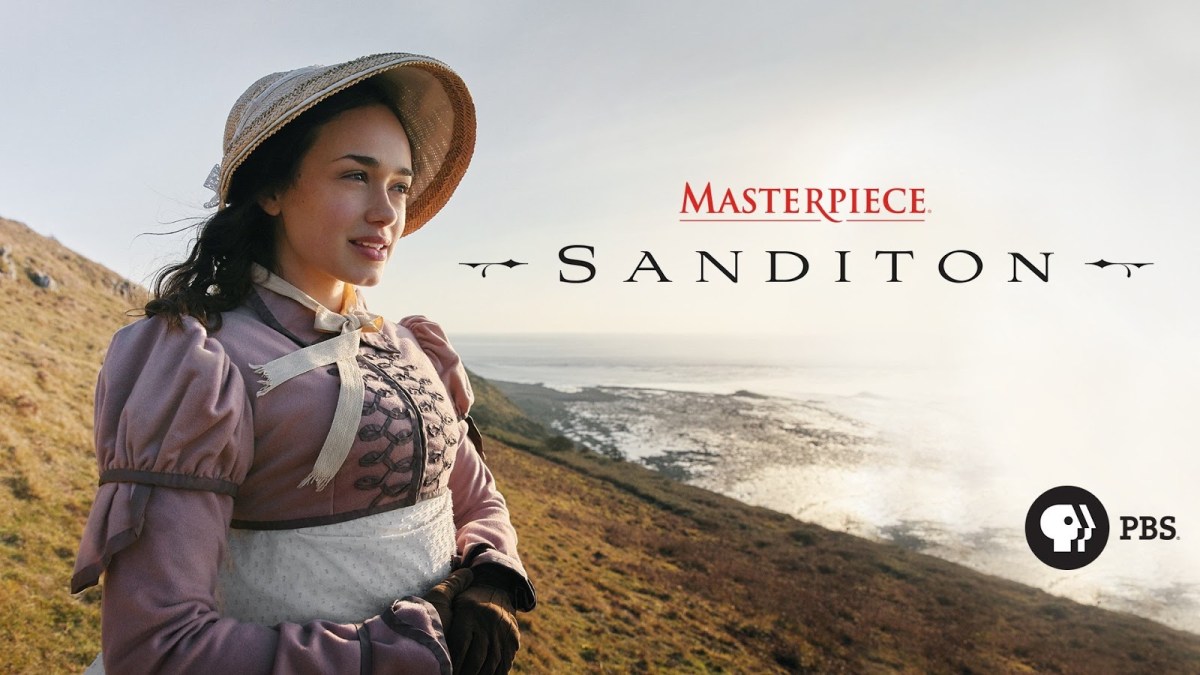
Sanditon on PBS Masterpiece

by James Wallace Harris, Tuesday, January 14, 2020

Over the past year, I’ve lost my ability to binge-watch TV. My mind just doesn’t latch on to shows like it once did. However, Sunday night I watched three episodes of Sanditon and then last night finished up the season by watching five more episodes. Only two have been broadcast, but if you donate to PBS and sign up for your Passport account, you can stream all eight episodes now.

Sanditon is based on a Jane Austen unfinished novel. She had completed about 24,000 words when she died. If you’re really interested you should read what Wikipedia said about the unfinished novel and the new TV series. The first of the eight episodes cover what Jane Austen originally wrote, so the next seven episodes are new. The show does have the feel of Jane Austen except for two glaring issues. There are a couple of sex scenes, and some British viewers claim the ending is not what Jane Austen would have written. I was thinking the ending might be setting us up for a second season, so I was withholding judgment.

I was completely delighted with the mini-series and thought it very Jane Austen-ish for the most part. Farmgirl Charlotte Heywood gets to stay with Tom and Mary Parker, a well-to-do family who live in Sanditon, a seaside village. Tom pours his fortune and others into making Sanditon a prosperous vacation destination. That reminds me of the spa town Bath from the Austen novels Persuasion and Northanger Abbey. Tom has a brother, Sidney who insults, ignores, and irritates Charlotte no end. We’ve seen that relationship before with Mr. Darcy. Charlotte also reminds me of Catherine Morland in Northanger Abbey, being a naïve visitor in a grandeur society and growing up quickly. Charlotte has a lot of Emma Woodhouse in her too by her meddling. Sanditon also has a rich old woman, Lady Denham who is a lot like Lady Catherine de Bourgh of Pride and Prejudice. The only thing missing are red-coated soldiers, but this work might be set after the Napoleonic Wars, or Jane had planned to write about them in later chapters.  One new character type for Jane was Miss Lambe, a black heiress, who was in the unfinished manuscript. If only Jane had finished this story. Would she have made the story almost a cliché of her earlier work? Or would it strike out to be distinctly different like all her six famous novels?

One of the intriguing aspects to the unfinished Sanditon that Wikipedia points out is the story has been finished before in various ways by a number of authors. Mary Gaither Marshall at the Jane Austen Society of North America (JASNA) wrote an extensive essay about the completers: “Jane Austen’s Sanditon: Inspiring Continuations, Adaptions, and Spin-offs for 200 Years.” Her essay suggests most of the continuations were off the mark in terms of actually writing something that Jane Austen would have written. At first, I wanted to try some of these completions, but after reading Marshall’s essay closer, I’m not so sure. Too many of them added silly gimmicks.

After enjoying the miniseries I read the unfinished Austen novel. It’s twelve chapters barely fleshed out the first episode. The next seven episodes don’t contradict what Jane Austen had started, but there is little evidence to suggest that’s where she was going. Tom Parker’s obsession was the likely plot in my mind. Eleanor Bley Griffiths gives a few clues to the difference between what Austen wrote and what Andrew Davies adapted for the miniseries. See “How closely is Sanditon based on Jane Austen’s original unfinished novel?” and linked essays. I feel after watching the show, that it might be the best of the continuations when it comes to finishing Jane Austen’s book.

If you don’t like Jane Austen, you probably won’t like Sanditon. Regency-era England has social norms and manners that seem silly and very politically incorrect to modern minds, although the TV writers did add some modern feminist insights. There are certain complications in the miniseries that I’m not sure Jane would have approved, but then maybe she would have. If there is a heaven I picture Jane being mobbed by fans asking her about all these adaptations. We assume Jane Austen had to censor herself for her early 19th century audiences, and if she had had more freedom probably would have explored some of the issues that modern adapters have added.

JWH


Where Are You On The Handling Complexity Scale?

by James Wallace Harris, Monday, January 6, 2020

I like to think our minds are like the mixing boards you see in recording studios, with dozens of sliders, each for a different cognitive ability. Think of the autism spectrum as one slider, and artistic ability, spatial perception, and mathematics as other sliders. I’m not sure how many mental spectrums exist, but I’ve been thinking about a possible spectrum to consider – handling complexity.

It’s obvious some people handle complexity better than others. People who can’t handle complexity want everything to be black and white. To them, everything is binary – for/against, male/female, good/evil, theism/atheism, rich/poor and so on. These people seem to have made up their minds early in life and will defend their beliefs with great tenacity. It’s easier for them to build an array of defense mechanisms than it is to deal with complexity. Successful people handle complexity and thrive. However, if you can’t handle complexity can you recognize people who can?

Ever since Donald Trump was elected I’ve been trying to understand why people like him. My current theory is neither Trump nor his follows can handle complexity. Trump’s simplex approach to problems resonates with their own simplex relationship with reality, and they find that comforting.

Republicans have taken an ostrich’s head-in-the-sand, ass-in-the-air approach to complexity. Denying complexity is their great survival mechanism. However, to solve the world’s problem involves dealing with complexity. We need leaders who place high on the handling complexity scale.

Trump is low on the scale, seeing reality in terms of black and white. People like voting for candidates like themselves. We need to vote for people who are higher on the handling complexity scale than ourselves. But how do we pick people who have cognitive skills we can’t imagine? How do we pick a person whose solutions might not make sense to us?

One way is to judge how they’ve handled complexity in the past. Trump has zero political, diplomatic, or leadership skills. His businesses have very few employees. He has no handling of complexity skills at all. Millions of people voted for him because he handles complexity in the same way they do – which is at a simple gut-level.

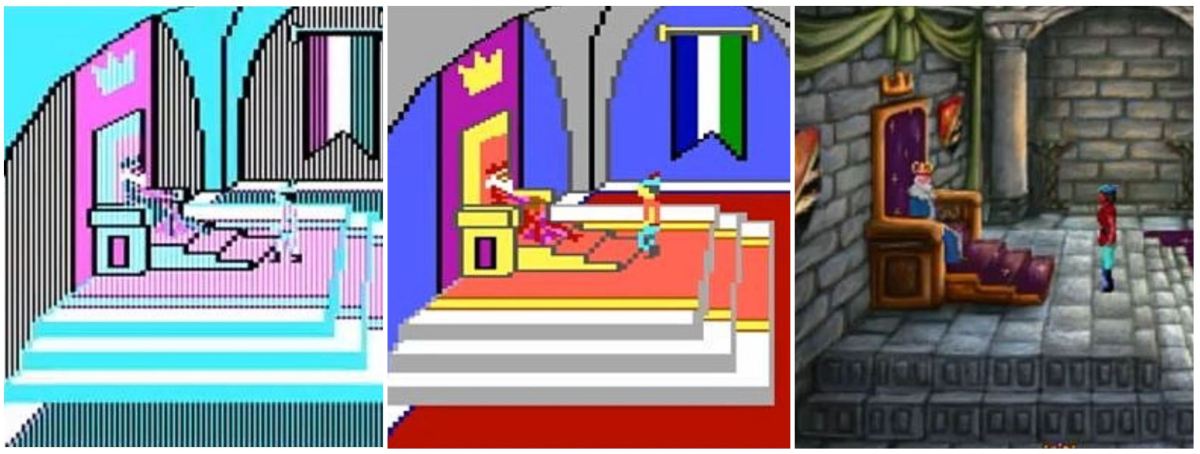
Most people see the world with a binary vision. Most voters see the political spectrum as left and right. That’s incredibly simple-minded. Just seeing the world in a grayscale of 16 adds great complexity, but it’s still extremely low on the complexity scale. Remember when computers only had 16 colors and how bad computer games looked? At the time we thought it an amazing step up from black and white (or black and green) monitors. Then when graphic cards went to 256 colors images started to look somewhat realistic. It wasn’t until graphics cards could handle millions of colors did photographs begin to look realistic. (The above graphic is CGA, EGA, and VGA.)

People have an extremely difficult time juggling 16 variables. We embrace ideas like the Myers-Briggs scale, trying to pigeonhole people into 16 types. The Myers-Briggs scale has its appeal because it vaguely works — but does it really?

Take climate change. Its complexity is immense. Even computer models that track millions of variables can only paint a rough picture of what is happening. Simplex people prefer accepting a blowhard’s opinion on climate change who has no understanding of the complexity of climate change over scientists with supercomputers and billions of dollars worth of scientific measuring devices. Why? Because binary thinkers prefer binary solutions.

We can’t solve complex problems with binary solutions. We need an army of PhDs who have armies of supercomputers working with artificial intelligence to even begin to understand climate change. Why don’t we require such expertise from our politicians? Isn’t our country’s social/economic/political structure nearly as complex as the weather? Why don’t we expect all politicians to have PhDs in political science? Why shouldn’t the highest political jobs require the greatest political experience? Shouldn’t a president at least have the experience being a governor or senator, if not a whole lot more?

How can we possibly expect a person with no experience to succeed at a job that requires the most experience? How can we expect a person who has no ability to handle complexity to succeed in a job that requires the most understanding of complexity?

Only a simplex person would vote for another simplex person.

Think of it this way. Say you’re a betting person and want to win some money on a football game. There are two teams. One team consists of professional football players, and the other team is made up of regular guys who believe they can play football. Who’re you going to put your money on? Or imagine you need brain surgery. Who will you pick? The surgeon with the most experience, or some egotistic guy who thinks anyone can do brain surgery?

JWH

Thinking About the Future Without Making Resolutions

by James Wallace Harris, Thursday, January 2, 2020

This year I didn’t even try to make New Year resolutions. I can’t make myself do things just because I think I should do them. I can’t lose weight. I can’t stop wasting time. I can’t be more productive. I can’t want to go to the gym. I can’t make myself write that science fiction novel. I can’t make myself be a better person.

I’m reading a depressing book for a book club, The Uninhabitable Earth by David Wallace-Wells. Even though Wallace-Wells claims to be optimistic we’ll deal with climate change his litany of statistics and predictions are soul-crushing. The world has clogged arteries, COPD, an A1C of 9.3, and is grossly overweight, but like me, it can’t stick to any New Year’s resolutions either. There’s no chance humanity will give up excessive eating, drinking, smoking, and start exercising.

Even though we’re on the Titanic and see the iceberg we can’t alter our course. Does that mean the future is set in stone? Is it hubris to think we can pilot our personal and collective destinies?

I spent a good bit of time last year trying to understand Republicans. We can’t make any decisions about the future if we’re polarized by two views of reality. I’ve concluded there is a total failure of communication between liberals and conservatives, and like New Year’s resolutions, I should give up trying.

Now, this might all sound like I’m depressed, but I’m not. Even though I’m an atheist, I’ve always loved the serenity prayer:

God, grant me the serenity to accept the things I cannot change,
Courage to change the things I can,
And wisdom to know the difference.

The trouble is I keep thinking I can change more than I can. I guess that’s why they say wisdom comes with old age because I’m starting to realize the difference.

What I love doing is reading. I love figuring out how things function. I will continue to do that. I can easily study how things work while giving up trying to make them work differently. I need to swim with the current rather than against it.

I can change little things in my own life, but I think I’ve finally found the wisdom to know I can’t understand, communicate, or influence Republicans, which means we can’t do anything about climate change. I give up. Climate change is theirs, they own it.

For the rest of my life, I’m going to feel like those strange visitors from the future in “Vintage Season” by C. L. Moore who came to watch a terrifying event in our present. Readers always wonder why those visitors from the future don’t alter our fate, but if you reread the story enough…

JWH