
Simplifying My Stereo

by James Wallace Harris, Monday, November 11, 2019

Does anyone ever call their music player a stereo anymore? A long time ago we’d call it a phonograph, a record player, later on, a Hi-Fi, stereo, or receiver. I guess people call them audio systems now? Actually, I don’t know what people call machines that play music in these modern times. Researching this article meant constantly changing the terms in my Google requests to find what I think I needed.

What I want is to hear my music at its maximum fidelity with the least equipment for the smallest price. I just want to own less crap. A long time ago I imagined the perfect music delivery system while I was stoned. What if we could just think of a song and then hear as if we were a character in a movie who could hear the soundtrack? Wouldn’t that be far-out! No equipment, just music, like having a stereo system integrated into our heads.

With Spotify and my iPhone, I come close to achieving that dream. However, I don’t want to always wear headphones. Basically, what I want is to tap my iPhone and hear the music fill the room.

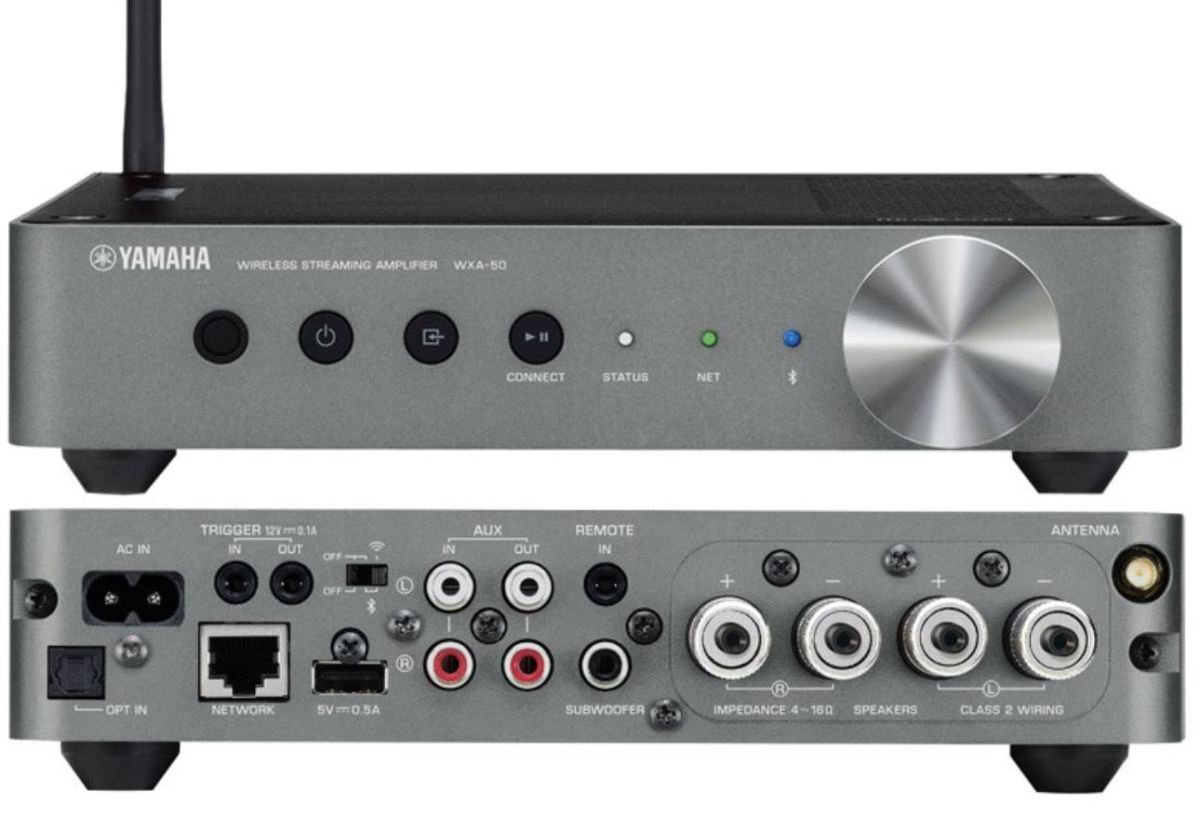
What I believe I need is called a music streamer (sometimes called a network amplifier). But neither is precise or accepted. I appear to want an amplified music streamer. There are other music streamers that connect to an existing stereo amplifier. I’m currently thinking about buying is the Yamaha WXA-50, but I’m also wondering if it’s worth spending almost three times as much to get the new Denon PMA-150H. The Yamaha came out in 2016 and the Denon was just released. (I do think the Yamaha would serve all my needs but I am worried about buying technology that came out 4 years ago.)


I guess I should explain what these gadgets do. That will require a bit of backtracking. Right now my home office stereo is a two-channel receiver connected to a pair of Bose speakers. They are connected to my computer and CD player. Music sounds pretty good, especially when I crank it up. But this system is probably 25-30 years old. I can play Spotify, CDs, or MP3 files. I have a turntable, but that’s packed away, but if I wanted, I could play LPs.

I want to be able to control all my music from my iPhone. First, this means I don’t have to worry about another remote. Second, it means if I want to hear music that’s not on Spotify it has to be ripped. I don’t want to mess with CDs or LPs anymore. It also means I don’t want to depend on my computer. Right now I can use my iPhone with Spotify Connect to play music through the computer via the receiver, but I want to eliminate the middleman, the computer. Which then means I can put the music streamer and speakers anywhere.

I’d love to do away with speaker wire too, and wireless speakers are starting to catch on, but I’m not sure they are ready for prime time just yet. Probably if I waited for another year or two that will be the big selling point to new music streamers. If you know of a great solution now, post a comment.

Speakers are a big problem with creating my dream music system. Placement is critical, and I don’t have any good places to put them in my home office. Every inch of wall spaced is currently being used. I’d like a pair of Klipsch RP 600M speakers, but they have a rear-facing port meaning they need to be set away from the wall. I might have to settle for the Elac Debut B6.2 speakers that are not as exciting but have a front-facing port. I could put them and the Yamaha WXA-50 up on top of my bookshelves. They’d barely be seen, and that would free up deskspace too.

However,  would this solve all my problems? Can I use the WXA-50 to play audio from my computer remotely? Right now all audio/music comes through my computer. If I get this new seti[, music will come from one system, and computer audio from another. I’ll need two sets of speakers. I’ll be able to remove the large Pioneer receiver and Bose speakers from my computer desk, but I might have to put back my powered computer speakers. I’d rather not.

And if I rip my CDs to FLAC I could pack away my CDs, get rid of their shelving, and put away the CD player too. I’m almost to the point of using Spotify for all my music, but unfortunately, there are a few albums they don’t have in their library.

Having two sets of speakers in one room ruins my goal of finding a simpler way to live with less. I know I’ll never have an integrated music system in my head. Going digital means eliminating a lot of physical objects and technology, but it can’t eliminate everything. I absolutely have to have a monitor, keyboard, mouse, speakers, and a box to run them. If an all-in-one computer like an iMac had perfect internal speakers I could simplify my tech needs to a monitor/keyboard/mouse.

I could also achieve music simplicity if I accepted always listening to music while wearing headphones. But the half-ass audiophile in me feels over-the-air music sounds better. Also, I believe music sounds better not coming from a computer, but from a separate DAC/amplifier. Sure, high-end audiophiles believe in a whole array of separate components to get the best sound, but luckily I’m not that driven. If I’m not playing music through the computer, I can accept a very modest level of audio quality. That means I should consider music and computers as two different systems to simplify.

A music streamer and speakers could be the lowest level of tech simplicity for listening to music, especially if they eliminate wires. I guess its possible futures designs could build the DAC/amp into a pair of speakers for even more simplification. And, all-in-one computer (monitor/mouse/keyboard) will be the lowest level of tech simplicity for a desktop computer.

JWH


Talking to Strangers by Malcolm Gladwell

by James Wallace Harris, Sunday, November 3, 2019

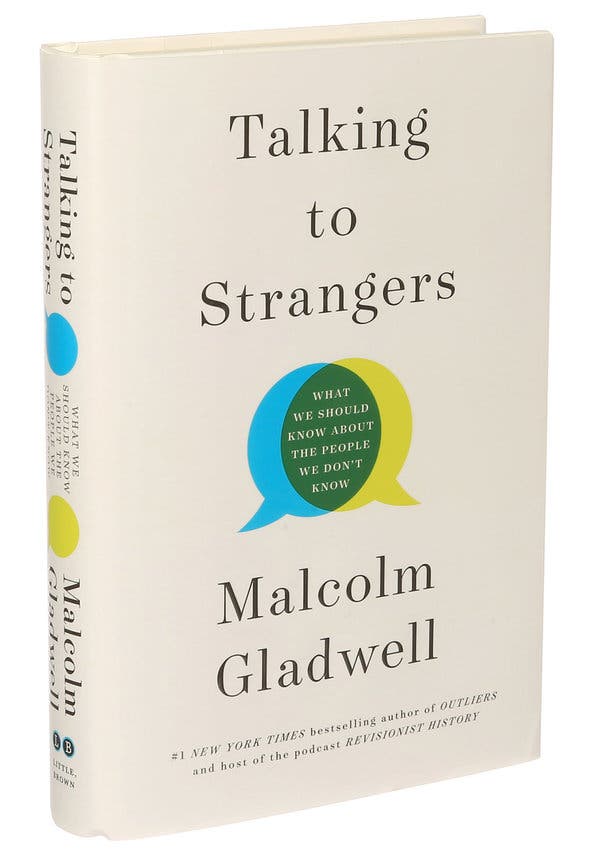
Talking to Strangers: What We Should Know About The People We Don’t Know is Malcolm Gladwell’s sixth book. I’m a big fan ever since his first book, The Tipping Point. Gladwell is an explainer, but he’s not straight forward in how he explains things. He enlightens by having the reader go step-by-step through the data he’s gathered to reach the same conclusion he has carefully discovered himself. He doesn’t just try to tell us the answer. Gladwell sees the world multidimensionally, so simple explanations won’t do.

In Talking to Strangers Gladwell wants us to understand what happened to Sandra Bland. Bland was pulled over for not using her turn signal when changing lanes, ended up being arrested, and committing suicide while in jail. The story was in all the news in the summer of 2015, and there was even an HBO documentary about the incidence. Gladwell became quite angry by the event and feels the media has failed to explain what happened and why.

It’s such a complicated story that Gladwell doesn’t even get to Bland’s story until page 313, but when he does, it all comes together perfectly.

Many people feel society is coming apart. That politics is disintegrating our culture. That everyone is on a short fuse, overly sensitive, and too easy to take offense. That there is little honesty in the world, and too many people want to carry guns. Our society is being overrun by mistrust and resentment. I am reminded of an experiment I heard about in school back in the 1960s. It involved cramming rats into a cage to simulate overpopulation. The stress of being forced to interact made them go mad and attack each other. Gladwell doesn’t mention this, but I was reminded of it constantly as I read his book.

Gladwell says we don’t know how to talk to strangers. He then goes on using various famous historical and news events to explain how miscommunication created extreme problems, often resulting in lethal consequences. His examples are quite fascinating. The first goes all the way back to Hernán Cortés meeting the Aztec ruler Montezuma, an extreme case of strangers meeting. Then he deals with Cuban spies and the CIA. This chapter is a mind-blower because Gladwell presents several historical cases where the CIA were completely fooled by double-agents. This is impressive because we assume CIA agents are highly trained at observing and understanding people.

After covering the CIA’s failure to detect traitors, Gladwell goes into detail about how Neville Chamberlain totally misread Adolph Hitler. These are fascinating cases of how we misread strangers, but they are so varied that you have to wonder what they mean to Sandra Bland’s case. Gladwell reminds us occasionally that Bland is his real goal, but he also tells us we’re not ready yet. He was right. You really want to stick close to Gladwell’s examples and explanations, because they do pay off big.

The problem is most people default to the truth, which is Gladwell’s way of saying we tend to believe other people are telling the truth. After reading his studies you feel like you should distrust everyone. Gladwell then gives cases of people who are always wary, and this is actually a worse way to live. To complicate matters, he gives several cases, such as Amanda Knox’s and Bernie Madoff’s where people act contrary to how they should act, which makes them even harder to read. I’ve seen a lot of news stories and documentaries about both of these cases and they don’t get to the details and insights that Gladwell does. I get the feeling that Gladwell wrote Talking to Strangers to show us how we’re all thinking too simplistically.

I’m not going to reiterate all of Gladwell’s arguments and cases. Besides not being able to tell when people are lying, and for many reasons, Gladwell gets to two other important insights. Coupling and location. He uses Sylvia Plath’s suicide and various studies on crime reduction methods to explain them. This is where Gladwell’s insights get more subtle. We want problems explained with one answer. Gladwell teaches us that sometimes a problem requires multiple datasets to understand what’s really going on. All too often we jump to what we think is the obvious conclusion when were missing whole areas of evidence. Evidence that sometimes appears to have no connection to the case.

Talking to Strangers is not a book you want to read casually, although it is very easy and entertaining to read. In essence, Gladwell is being a Zen master trying to explain the sound of one hand clapping. His examples bring us to the point where we have to have our own “I see!” moment. He can’t tell us. When Gladwell finally gets down to explaining what happened with Sandra Bland you should come to the conclusion that our present-day problems can’t be explained with the kind of logic we ordinary use with our friends or the kind of thinking we hear from pundits on TV. We’re too quick to lap up easy answers.

The trouble is most people will never understand what Gladwell is teaching. Most of us will continue to act on instinct using very limited instinctive thinking. Humans can’t handle the truth. This is my conclusion, not Gladwell’s. We think we know when we don’t. In fact, too many people are absolutely certain of their conclusions because their own explanations feel so right. We all live in the film Rashomon, each thinking we see the truth, but can’t understand the multiplex view we’d get from watching our lives from an outside vantage point.

Talking to Strangers, like other Gladwell books, are ones we should reread periodically. It’s so easy to fall back into simplex thinking. One of my favorite novels is Empire Star by Samuel R. Delany. It’s a science fiction novel about a farm boy from a backward planet traveling to other worlds and cultures. Before he leaves a wise person tells him that there are three kinds of thinking: simplex, complex, and multiplex. What this kid learns is most people are stuck in simplex and maybe complex thinking, and very few achieve multiplex thought. The story is about the kid evolving through the three stages of thinking.

Talking to Strangers is Gladwell’s attempt to get us to think in multiplexity.

JWH


I Believe I’ve Found a Solution to All My Reading Problems

by James Wallace Harris, Sunday, November 3, 2019

Problems:
  • I miss reading like I did when I was young
  • I try to read too many books concurrently
  • I start too many books I don’t finish
  • I buy too many books I never even get around to trying to read
  • I start too many reading projects (reading multiple books on one subject)
  • I’m attracted to too many subjects
  • I want to read every book that sounds great
Solutions:
  • Only read one book at a time
  • Only listen to one book at a time
  • Keep a list of books I want to read next
  • Keep a list of audiobooks I want to listen to next
  • I can only buy a new book/audiobook when I’m finished with my current book/audiobook and I must read it immediately.
  • I must look through my TBR lists before buying a new book.

When I was a young bookworm I only bought a new book when I finished my old book. I didn’t have much money, so deciding what to buy and read next was a huge pleasure that I’d spend a lot of time contemplating. When I first joined Audible.com, I only had two credits each month, and I was very careful about how I used them. I’d listened to everything I bought. Deciding on the next audiobook was always a delicious time of deciding.

Being able to afford all the books and audiobooks I want has been bad for me. I spend more time buying books and thinking about buying books than I do reading and listening. When I was younger, I used to read an hour or two every day, and many hours on the weekend. I barely read three hours a week now, but I do get in 5-7 hours a week of listening to books. I miss those days when I got so into books I’d finish them in a day or two.

I thought when I retired I would get more books read, but it’s been just the opposite. I have too many other distractions in my life. I won’t go into all of them, I’m sure everyone knows about all the new entertainment diversions that have popped up in the last couple of decades.

What worries me is another problem, a lack of focus. I wonder if getting older is reducing my ability to stay focused, or is it just all the distractions? Part of the problem is I have dozens of books pulled off my bookshelves in different stages of being read. I jump from one book to the next as my mental whims come and go. I have too many writing projects I want to research, and that means I don’t get anything finished. I can focus just enough to complete a blog length essay. I’d like to write something longer, but that would require focusing on one topic for days or weeks and my mind can’t seem to do that.

I’ve been wondering if my lack of writing focus is related to my lack of reading focus. Sometime after midnight last night, a solution jumped into my mind. I theorized if I only read one book at a time maybe that would help. Because reading and listening work only in their own unique settings I decided I could keep one book and one audiobook going.

From this theory, I’ve developed a plan that I believe might solve all my reading problems. I can’t start or buy new books/audiobooks while I’m working on a book/audiobook. I have to keep TBR lists for books and audiobooks with at least a hundred titles on each and I have to read through those lists before buying a new book/audiobook. I  have over a thousand unread books I could put on each list but the idea is to put just enough books I’m craving to read on each list to remind me why I shouldn’t buy another book.

To further keep me from buying new books/audiobooks, is making the rule I can only buy books after finishing books, and I must read any new purchase immediately. Any new book becomes the next read. In other words, to buy a book/audiobook I have to look at my TBR list and decide I want to read a new book more than any of the books on the list.

Right now I try to read all the books that are laying around and it doesn’t work. I need an analogous saying for “My eyes are bigger than my stomach” regarding reading. When you have countless books you’re dying to read it’s rather insane to go buy more. And boy am I crazy.

I don’t know if I will have the discipline to accomplish this plan but I’m going to try very hard. I’ve already started unsubscribing to the mailing lists advertising books on sale. I’ve got to break my restless habit of visiting used bookstores twice a week. I’ve also got to break my habit of jumping on ABEbooks and ordering any book that I think I should read.

I believe I will actually save money if I only buy books just before I read them even if I have to pay the full new price. Now, I’ve come to that conclusion before. And it slowed down my book buy a great deal, but I still bought way more than I can read. My problem is I want to read too much and I believe buying a book means I’ll eventually read it. That’s obviously not true.

The trick of this plan is to only buy a book when I’ve just finished another, whether book or audiobook. And only purchase that book if I want to read it before any of the other great books I already own and supposedly dying to read. If I can stick to that one act of discipline I believe it will have a cascading effect on solving all my reading problems.

Update 11/4/19:

I’ve decided I need a quitting factor. If I commit to reading a book I don’t want to be stuck finishing it if the book is no good. But I also want to give a book a fair shake. I figure I need to read a certain number of pages to get to know the book, but I’m not sure what that number will be. See the comments below for one suggested formula.

I also need to decide what to do with books I quit. Do I still keep them? For printed books, I’ve always donated those to the library book sales. But what about ebooks and audiobooks that clutter up my digital libraries? I’m thinking I should delete them. I believe Amazon has a provision for that, but that seems kind of drastic.

Finally, I decided on a couple loop-holes about buying books. If I buy a new book it has to be read immediately. But I can buy books I’ve already read. Quite often when I listen to a book I want a printed copy for reference. I keep an eye out for cheap used copies. Or there are books I’ve read in the past that I wished I owned a copy for reference. And sometimes I want to buy reference books that aren’t meant to be read from cover-to-cover. Finally, there are some books that I collect for various reasons — because I want a special edition, or I want to replace an old copy, or I just want an edition for its dust jacket or cover. This leaves me a little room to have fun book shopping without stockpiling books to read. However, my discipline will be sorely tested if I see a mint used edition of a book I’ve always wanted to read for $3.

I’ve already finished the first book I committed to reading and wrote a review last night. That felt good. I’m already reading on the second book I committed to, and I’m very excited about being able to stick with it. I skipped TV watching last night to read on it, and got up this morning and read some more. This early success suggests my idea of committing to reading only one book at a time works.

I guess its finally time to get down to the nitty-gritty of reading all those books I bought to read in my retirement years.

JWH