Explaining Reality With More Than One Book

By James Wallace Harris, Tuesday, December 8, 2015

What are the minimum number of books you’d have to read to get a good overview of reality? Would they all be science books, or would we need philosophy, history, mathematics or even religious texts to go beyond what experimental results can’t cover?

There are billions of people on this planet who explain existence with the help of just one book. These sacred works have been around for hundreds, if not thousands of years, well before science and scholarship. It’s quite understandable to want just one manual, but is this world explainable in words? Science experiments offers an alternate explanation to ontological questions, but requires reading a library of books to understand. That might be why billions stick to their single volume guides.
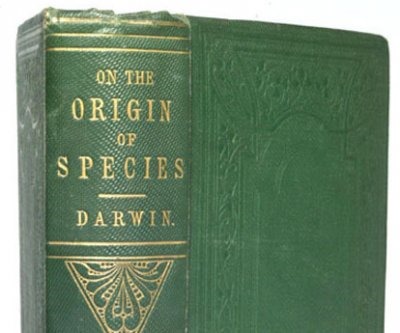
On the Origin of Species

Is there a single science book that can compete with The Bible, Quran, Tanakh, Tao Te Ching, Rig Veda, Diamond Sutra, etc.? Does science even try to give one book believers what they want? A book on cosmology or biology explains aspects of reality but without telling people how to live. People who live by just one book, read for guidance, not explanations. They want the world to be easily explained, fair and just. The trouble is science splendidly explains how reality works in tremendous detail, but offers no guidance how to live. We followers of science are left to find our own purpose, because science clearly shows everything in this reality is a product of impartial statistical events.

Do people choose one book solutions because reality is overwhelming, preferring simple myths instead?

How many science books would a person of faith have to read before they could understand the existential nature of their lives? Because believers are taught from an early age to believe in their single books, their non-scientific views are deeply ingrained in their minds, and hard to reprogram. Apparently, anything we learn as children sticks with us, and is very hard to erase. If children were taught Darwin at an early age, and their one book was On the Origin of Species, would the world be psychologically different?

Few scientists understand the actual science of things beyond their narrow specialty. If everyone had to read the original research of all the discoveries of science, we wouldn’t have much time for anything else. Most supporters of science understand reality through popular science, which is only an approximation of real science. Our knowledge about reality is collective knowledge. People who argue against evolution are really arguing against millions of books and research papers.

I once bought On the Shoulders of Giants by Stephen Hawking, which reprints the original scientific writings of Kepler, Copernicus, Galileo, Newton and Einstein, but I could not read it—at least for long. If I devoted my life to it, I could probably understand this book after a few decades of trying.

What would happen if schools showed documentaries that recreated all the great science, mathematics and engineering experiments of history, so that little kids saw how people discovered details of reality for the first time? Would seeing be better than reading?

I’ve read hundreds of nonfiction books and seen just as many documentaries, but I’d be hard press to point to a selection and claim they are the basis of my beliefs. Of course I have a confusing, muddled view of science and mathematics, and couldn’t actually teach what I know either. However, because there are endless views of The Bible or Quran, I tend to think even having just one book to master doesn’t lend itself to consistent explanations.

Despite all the books I’ve read about Einstein, and all the documentaries I’ve seen that explain his work, I still can’t comprehend relativity. Evolution makes sense to me, but I couldn’t teach it. I can understand why other people might not comprehend evolution.

Maybe we should ignore books altogether. Maybe we should strive to teach kids the basic concepts of science by having them recreate the experiments themselves. I’m getting sort of old, but I wonder if there are any experiments I could learn to do, that would allow me to see how a basic aspect of reality works. For example, I’ve been taught the sun is a big ball of hydrogen. Is there anyway I could prove that for myself?

For 2016, I plan to read On The Origin of Species. I wonder how close I can get to seeing the science behind it, and how much will remain just a story, a myth, a generalization? And after that, I want to find another science book that will take me closer to understanding real science rather than popularization. Einstein discovered relativity with thought experiments. I don’t think there will be many books I can comprehend actual science without mathematics and experimental apparatus, but there might be a few. I’m sure it’s more than one.

I ask my friends who believe in The Bible to distrust what it says, but am I not a creature of faith by my acceptance of science from popular sources? Who knows, maybe one book guides are one too many. Maybe we shouldn’t believe anything unless we can recreate the experimental proof ourselves.

JWH

The Mathematics of Persuasion

By James Wallace Harris, Sunday, December 6, 2015

I’m fascinated by the idea of society changing. This week it was announced that women will have access to all combat roles in the U. S. military. It wasn’t many years ago that would have been unthinkable. It’s less than 100 years since women got the vote in the United States, and now we could be close to having a woman President. Or think about the cultural shift of same-sex marriages. I’m already seeing charming ads by wedding planners running photos that feature a man and a woman, woman and woman and man and man couples. There’s also a lot of movement to legalize marijuana in various states. Society seems to be changing fast. But in other ways, it doesn’t. Even though we have a black President race relations are still very troubled. Sometimes I think culture can change fast, but not necessarily individuals.

chessboard growth

This makes me wonder about how an idea gets converts, and how fast a society can transform with a new idea. If one person takes up a new belief and convinces one other person, and they convince one other person, how long before it changes society? Of course, that depends on the frequency of conversion. But if one person converts two, and the two convert four, it would only take 30 doublings to covert all Americans to a new idea, or 34 for the world. See the classic rice on chessboard legend. If each doubling took a year, it would take three decades, but if it took a week, it would take less than a year.

Think about ideas that are emerging now. One that I’m interested in is the plant-based diet. My cholesterol numbers have gotten much better since I started that diet. I’ve lost weight, feel much better, and have much less inflammation. This convinced two of my friends to try it. Most people love to eat meat, but what if eating a plant-based diet turns out to be proven path to health? How long before half the country goes vegan? Most people will scoff at that idea as being downright silly. But it was only 150 years ago that this country had slavery, women couldn’t vote, cars didn’t exist, we didn’t have the income tax, and most folks died of things we consider curable today.

Things change. How long did it take abolitionists in the 19th century to enlighten enough people to change the country? How long will it take environmentalists to convince the world that climate change is something we need to stop?

I wish I knew the mathematics to answer this question: What is the difference between one person making one convert a year, or two converts a year, or three, four, five, or more? Social movements are built around people changing their minds and becoming converts. However, it’s also about old believers dying off. The growth of atheism and agnosticism is mainly due to older believers dying. That suggest that some changes takes a life-time.

I’m reading a tremendous book right now, Countdown by Alan Weisman, that is about overpopulation. Weisman reports from over twenty countries how different cultures view population growth, and their various approaches to sustaining ever growing populations with dwindling resources, in a world where the environment is collapsing. There is no question that we’re on a doomed path. The question is whether or not the mathematics of persuasion even has time to work.

I am writing a series of essays about how I’m looking for signs of hope for the future. So far, the only solution I can find is for seven billion people to change the way they live. Humans do change, but can they change fast enough to solve all the problems we face before we’re forced to live in a post-apocalyptic world? It’s no longer about surviving climate change, that’s just one of many of our problems, and I’m no longer sure it’s even our most threatening problem. Exponential growth, which the world economy depends on, is about to hit the wall. Probably before 2050, or even 2030.

Remember that old domino theory about communism? Well, communism wasn’t the problem, collapsing civilization is what we need to watch. Iraq, Syria, Afghanistan, are the early dominos. Americans pay very little attention to what’s going on in other countries, unless they host a war that concerns us. But look how a war in Syria is affecting Europe. Keep an eye on Pakistan. Start counting the countries that are collapsing, and why. What would happen if Mexico collapsed? Pay attention to all the countries that have extremely high unemployment.

We can solve our problems if we can master the mathematics of persuasion. Unfortunately, we have built economic growth on a different set of mathematics which doesn’t equate with the mathematics of a sustainable environment. It’s like the Standard Model and Gravitation, they don’t seem to be related, but should be. We need to build an economy based on using less, and sharing more. That can’t be communism, even the Chinese have learned that. But it can’t be capitalism either. Socialism only solves some of the problem capitalism fails to solve. We need a whole new model. Probably some kind of steady-state capitalism mixed with socialism and environmentalism. But to transform society will require changing how seven billion people live. Is that even possible? We have nothing yet, so convert number 1 is waiting. And even if we had an answer, how fast can we go from 1 to 7 billion?

JWH

I’m Switching From NBC Nightly News To PBS NewsHour

James Wallace Harris, Thursday, December 3, 2015

I’ve been a faithful follower of NBC Nightly News for decades now. But last night’s report, with the entire show covering the mass shooting in San Bernardino, convinced me I’m not being well informed by my news source. Mass shootings are horrible, but they can’t be the only news. Neither can storms, fires, earthquakes, floods and other natural catastrophes. Nor can crime, war and politics dominate our awareness of what’s going on around the world. The NBC Nightly News has become so obsessed by sensational stories that I feel they are the only news events happening in the world each day.

NBC Nightly News

I learned far more about the San Bernardino shootings this morning by five minutes of reading The New York Times, than the 30 minutes spent watching The NBC Nightly News. Last night’s time was wasted on speculation, or watching police carefully inspect a SUV, shown from a camera above the scene. Sometimes we get the news too fast. Watching it as it happens might be exciting, but it’s often deceptive, and full of incorrect information. Network news gives us a 20 minute summary of world events, but are those stories the best ones to spend my 20 minutes of news watching? I could cover more stories by reading.

I’ve routinely watched The NBC Nightly News because it was slickly produced and I like Lester Holt and the NBC reporters. Last night I was particularly disappointed by not hearing about the climate change summit in Paris. It should be big news if more world leaders met there than anytime ever before in history. What happened in San Bernardino was horrible, and an important news story, but the climate conference deals with the fate of the world. Does NBC assume we’re not interested, or think it’s too subtle for us to understand? Or that mass shooters scare us more than a worldwide universal threat?

For now I’ve deleted The NBC Nightly News from my TiVo and added The PBS NewsHour. In the past I’ve tried to switch to just getting my news online, but for some reason I enjoy how television conveniently packages the news. So I’ll try PBS for a while. In the long run, I might need to give up on television. I’ve always avoided local news because I find it so damn depressing, but I’m wondering if I wouldn’t be better citizen if I took more interest in my own city. Then just read about the rest of the world on the Internet.

This brings up two interesting questions. First, how much time should we spend each day on the news? We all need to be well informed citizens, so how much daily time does staying informed take? Second, which topics are the most important to follow? A surprising amount of reporting are on topics that are forgettable. For example, what do we learn about the world from film clips of forest fires? Quite often NBC spends a nightly ten minutes on forest fires, floods, tornadoes, earthquakes, and other natural disasters, but they are so common that all forest fire reports look the same. And why are all the stories about fighting fires. Why not stories about managing forests to prevent fires, or how people rebuild after fires, or where do all the wild animals go in a fire? Political reporting is becoming monotonous too, usually just telling us what stupid thing Donald Trump said today.

When I think about it, I wonder if the news is packaged to pander to a specific psychological addiction in us. It’s become entertainment, not education. I’ve watched PBS NewsHour off and on, but it takes more time to consume. Let’s see if I feel better informed.

Essay #985 – Table of Contents

Our Fantasy For Interstellar Travel is Dying

For over 50 years I’ve been reading science fiction hoping humanity will someday travel to the stars and settle other planets. Obvious other people do too, just witness the frenzy behind the new Star Wars movie, which opens on the 18th. Galactic empire stories are the new locale for big sword and sorcery epics. (Isn’t it bizarre that both are enamored with aristocracy?) What deep rooted drive makes us want to colonize distant lands? Why are we enchanted by alien landscapes, strange superior beings and their surreal cultures?

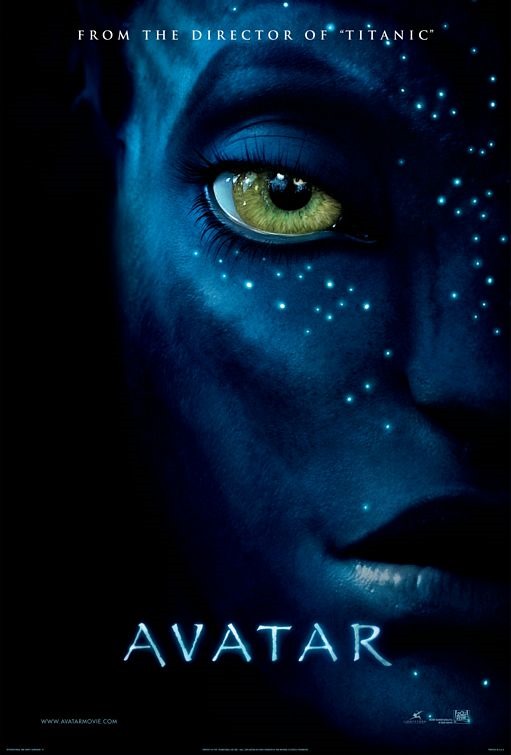
Of course, the film Avatar probably reveals our true intentions. We’d do to other worlds, what we’ve done to ours.

A Heritage of Stars - Clifford Simakavatar

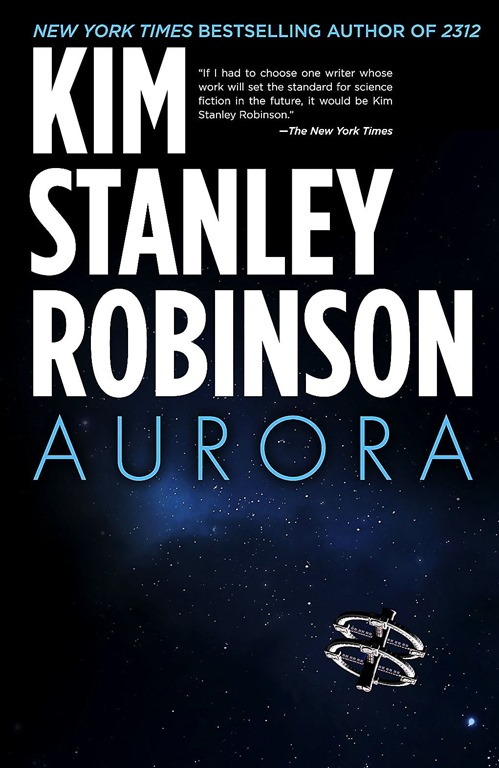
I just finished A Heritage of Stars by Clifford D. Simak, which questioned our desire for interstellar travel. It was published back in 1977. A Heritage of Stars is a quaint little book, not particularly good, unless you relish 1950s style science fiction, where Simak, in his seventies, questions many of the tropes of our genre. This same questioning was evident in Aurora, Kim Stanley Robinson’s latest novel. Both Simak and Robinson wonder at the wisdom of traveling to the stars. The distances are beyond fantastic, almost beyond comprehension. Characters in Star Wars zoom between planetary systems quicker than we travel between cities on Earth in our jet airliners. The absurdity of that strains the boundaries of absurdity. It’s only slightly less delusional than thinking we can travel to other worlds by dying.

Aurora KSMCity - Clifford Simak

Simak covers many of the most famous themes of science fiction in A Heritage of Stars. The setting is in the far future Earth, a thousand years after the collapse of a great technological civilization that went to the stars, and built intelligent robots. In some ways, it’s a variation of Simak’s classic City. America is now a post-apocalyptic landscape of roving tribes who collect the heads of robots for ceremonial voodoo. They are primitive people who can’t conceive of space travel or intelligent machines. The story is about a young man named Cushing who takes shelter in a closed-wall town, built around a former university. Cushing learns to read, discovering that humans used to be great. Cushing eventually finds mysterious references to “Place of Going to the Stars” and sets out on a quest to find it. Much like a L. Frank Baum Oz book, Cushing gathers along the way a motley assortment of strange characters to take up his quest too. A witch, a surviving robot, a horse, a man who talks to trees and a autistic like girl who can commune with the transcendental.

Along the way, Simak’s characters discover what happened to mankind, and allows Simak to philosophize about why we wanted to go to the stars. Simak also wonders if mankind is smart enough to survive his addiction to technology. Even forty year ago Simak realized that interstellar travel isn’t very practical, questioning his science fictional roots. Had Simak given up on the Final Frontier dream because he was getting old? He was in his mid-seventies at the time. I’m in a my mid-sixties and I too have given up on colonizing distant worlds. Does getting older make us realize our childhood fantasies have no foundation in reality?

Earth Abides - George R. StewartThe World Without Us - Alan Weisman

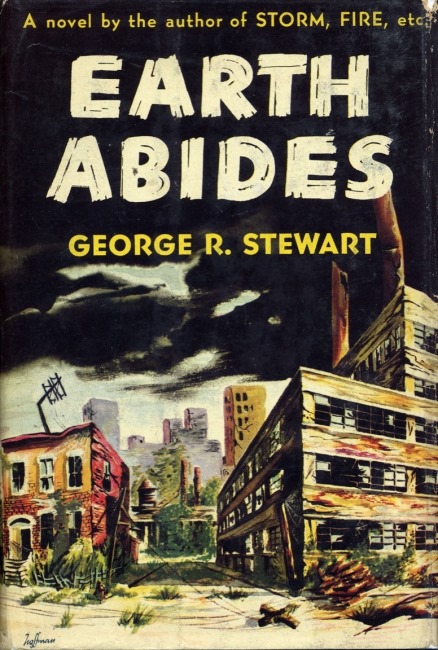
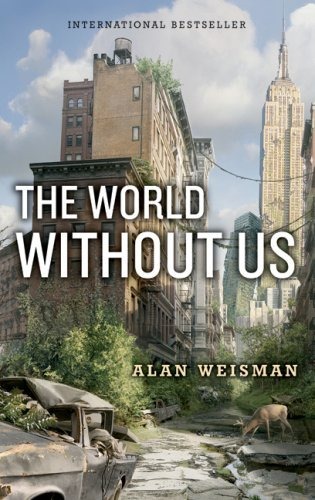
Science fiction is mostly high tech fantasy that reveals the same impulses humans have always shown. This world and life doesn’t seem to be enough for us. We want more. But the reality appears that this life and planet is all we’ll ever have. Like many other science fiction stories Simak wonders if the future of humanity will be one where we give up technology and live nomadic lives much like how Homo sapiens lived its first two hundred thousand years of existence. I can’t help but believe Simak was greatly influenced by Earth Abides by George R. Stewart. And I believe Simak would have been blown away by Alan Weisman’s The World Without Us, a philosophical thought experiment that wonders what Earth would be like if humans just disappeared.

Shouldn’t we psychoanalyze why science fictions two strongest themes are space travel and the post-apocalypse? Why are galactic empires always suffering collapse and revolutions? Isn’t it rather telling that our favorite fantasies feature feudal governments and primitive weapons? The heroes of Star Wars fight with swords made of light. Is the reason why conservatives want smaller governments is because they don’t have the genes to imagine large ones?

Childhoods End - Arthur C ClarkeMore Than Human - Theodore Sturgeon

Strangely, Simak reveals a problem that NASA wouldn’t discover until years later. Mainly, we can collect the data, even store the data, but we won’t always be able to access the data. One of the conundrums that Cushing and his crew face is humans went to the stars but what they discovered is locked up in technology that their post-apocalyptic world can’t access. I felt let down by Simak’s solution. Let’s just say that Simak’s hope for humanities failures is to discover supernatural powers. That was a common theme in 1950s science fiction, especially Arthur C. Clarke’s Childhood’s End and its 1960s retelling, 2001: A Space Odyssey. Theodore Sturgeon was never much of a technological science fiction writer, and went right for the ESP solution in More Than Human. Even the hard science Heinlein had hopes humans would discover magical powers. I guess they all grew up reading Oz books.

I feel let down by Simak, although I enjoyed A Heritage of Stars well enough. I believe he ends his story with false hope. Simak believes humanity can keep trying until it gets it right. Yet, he doesn’t attempt to describe what is getting it right might be. Not long ago I read a passage about Neanderthals that shook me up. It stated for the entire length of its long species’ lifetime, Neanderthals never showed any progress after achieving a certain level of development with their stone tools. For hundreds of thousands of years they made the same tools. We Homo sapiens feel superior because we’re quite dazzling with our technological innovation. However, I’m not sure we’re not like the Neanderthals in that we’ve continued to follow the same emotional and psychological patterns that we have for the last two hundred thousand years. We can’t get away from our Old Testament mindset, and without technology, we’d all live pretty much like North American tribal people before the advent of Western invaders, or the people who lived on the Russian Steppes and spoke the language that inspired all the Indo-European languages.

Kim Stanley Robinson has a much more sophisticated lesson about why we won’t be colonizing planets orbiting distant suns in his book Aurora. We are adapted to our biosphere. It’s extremely complex and interrelated. It’s extremely doubtful. even if we could travel the distance to another stellar system, we could integrate into another biosphere. Humans were made for this planet and biological landscape. We could probably export our biosphere to other barren planets if the conditions were right, but even that is doubtful.

Simak doesn’t give much focus to the intelligent machines of his story, but I’m guessing artificial intelligence has more potential validity than any other theme that science fiction explores. Simak points out that robots are the true species for interstellar travel. If Star Wars was realistic, galactic empires would be governed and populated by C3POs and R2D2s. Biological creatures would always stay on the planet of their origins, comfortably bound to their biospheres.

Simak wrote A Heritage of Stars near the end of his life, probably speculating about what will happen to humanity after his death, and revealing a certain level of age related pessimism about the future. I don’t know if he was aware of environmental catastrophes—he seemed to fear our mishandling of technology. Forty years later, our race doesn’t seem any wiser, but it does seem more suicidal.

More and more, I’m becoming an atheist to the religion I grew up with, science fiction. It’s not that I’m going to stop reading science fiction, but I no longer believe it. I study science fiction like many former believers still study The Bible. Both The Bible and science fiction reveal our deepest inner hopes. For some reason humans want to go to Heaven or Alpha Centauri. We need to understand why, and also need to understand why we’re turning our own biosphere into Hell.

Essay #984 – Table of Contents