“The Veldt” by Ray Bradbury

When does science fiction work even when it’s broken?  “The Veldt” is the opening short story in Ray Bradbury’s classic collection The Illustrated Man, and it’s a highly effective story that doesn’t make much sense if you try to take it apart.  “The Veldt” appears to be Bradbury’s reaction to the deployment of television in 1950.  Essentially, the tale is an allegory that says the new technology loved by the young will kill off the older generation.

“The Veldt” could be filmed today, modernizing the story, and the allegory would work with the Internet, computer games, or even iPods.  If you take the story apart looking for the science fictional technology that creates lions that dine on parents you won’t find it.  Bradbury hopes his slight of hand distraction will keep the reader from looking behind the curtain, but I think many hardcore SF readers get hung up on that and shout, “Cheat!”

Ray Bradbury is often a science fiction writer that non science fiction readers think of when they think of a science fiction writer.  Most readers don’t like science, not even the toy science of science fiction, so they readily respond to Bradbury allegories of anti-science.  If Bradbury’s goal was to fight off new technology and preserve the quaint minds of the 1940s he of course failed.

“The Veldt” is a shocking story for the time.  The children kill the parents.  And Bradbury was reacting to TV of the late 1940s, which was incredibly innocent.  Most TV at the time was local in production, featuring puppet shows for kids, gardening and cooking shows for moms, and wrestling for dads.  What television really killed was the short story, but I don’t know if Bradbury knew that at the time or even feared it.  The half-hour TV show killed the pulp magazines that filled the newsstands of the time with hundreds of titles.

Technology and change does kill off the culture of the previous generation, and I think Bradbury sensed that.  That’s why the story is so popular, getting made into a movie in 1969, and is scheduled for a remake in 2010.  This story gets the study guide treatment on many web sites that create literary summaries for kids needing to write school papers.  There are even sites that will write a paper about “The Veldt” for you.  This implies the story is studied in schools.  How many science fiction stories can claim that honor?

If the TV of the late 1940s scared Bradbury, what kind of story would he have written if we could time travel back to 1950 and spend an evening with young Ray and show him a high definition TV featuring episodes of True Blood and Dexter?  Or even show him the kind of porn children can easily get on their homework computers.  I love Dexter and True Blood, but I’ve got 50 years of television evolution to ready my mind for those shows.  Those TV programs would make Ray’s noggin explode.

Would 1950 Bradbury recognize the sophisticated art of Dexter, a show featuring an appealing serial killer, or recoil in horror at the kinky sex and violence of True Blood?  Even if we gave him kid friendly shows like Hanna Montana wouldn’t he still be shocked at the cultural changes?  I’m listening to The Green Hills of Earth by Robert A. Heinlein, a collection of short stories from the same time period.  The people in those stories don’t exist anymore.  The culture, slang, speech patterns, art, theories about life and science, and so on are long gone.

The mental and cultural life I grew up with in the 1960s is gone too.  My mind has evolved with television, but it hasn’t for popular music.  I’m still stuck back in 1965 with the Byrds, Barry McGuire, Petula Clark, and The Mamas and the Papas.  I’m sure the teenagers of today would be willing to symbolically feed my kind to the lions, just like my generation wanted to with our parents.

The children in “The Veldt” horrify the 1950 readers of Bradbury like my generation was horrified by the real-life Eric Harris and Dylan Kiebold, the Columbine shooters, when we wanted to ban violent video games.  Whether the warning is allegorical or real life, the future keeps on rolling towards us and we never even bother to step out of the street.

Science fiction can present scary stories but do we ever really listen to them?  “The Veldt” is even taught in schools.  But will a young generation ever exclaim they’ve had enough change and draw their own line in the sand?  Despite all the protests of conservatives, liberal thought keeps on evolving.  On one hand many science fiction stories are cautionary tales warning us about the future, but on the other hand, the other tales of science fiction are thrilling adventures of living in a new world.

How many kids reading “The Veldt” secretly wanted their own version of that high-tech nursery?

JWH – 2/26/9

Filming Science Fiction Short Stories

Over at BestScienceFictionStories.com Rusty Keele got an email from a film director asking him about which science fiction short stories would make great 10-15 minute films.  Go by and post your suggestions.  I suggested “The Menace From Earth” by Robert A. Heinlein, even though it would have to be cut down some to meet the time limit.

I remember the science fiction stories from the old Twilight Zone series that started back 1959.  Those short films had tremendous impact, so it is possible to tell a gripping story in 25 minutes, but I think it’s going to take a special kind of tale to work in 10-15 minutes.  Maybe it will be flash video fiction.  However, limiting the length of the film makes it much easier for an amateur film maker to produce, and with people watching videos on YouTube, Hulu, and on their iPods, making short science fiction films might be a great idea.

Since I’m always wishing for more people to discover the wonders of the science fiction short story, and support the dying science fiction magazines (F&SF, Asimov’s, Analog), I’d especially love to see short films based on recent stories from the magazines, and use those films to promote the science fiction short story market.  Even though those markets are dying, they still have 15,000-30,000 readers, so that’s a ready audience for the films.  I wonder if some kind of marketing synergy could be attained by tying several small enterprises together.

Could we see a film opening with the flashy logo graphics marketing A SFSignal Production partnered with Asimov’s Science Fiction Films of a John X Smith film …, and maybe backed by money collected from online fans from genre entrepreneurs like those great Broadway producers Max Blaylystock and Leo Bloom?

The trouble is getting people to see the short films.  Every year at the Oscars when they present the award for short film I always wonder where to do people see them.  It’s a shame theaters can’t replace those annoying trivia shows and commercials they torture their patrons with while they wait for their movies to start with good short films.  SFSignal has become a great place to catch a short video.  I wonder if short Flash based films on the SF/F magazine sites would get them more subscribers?  Macromedia Flash based films have evolved into high tech ways of watching videos online.

Most great science fiction short stories are more suitable for film length productions.  I wish movie makers would audition the genre mags every month for potential films to make.  Hollywood movie makers are obviously short on material when they have to make Terminator movies over and over and bring back Star Trek for the nth time.  I mean, when was the last time you saw a really innovative SF film?  There are way too many classic SF novels from the 1950s and 1960s that Hollywood has never filmed for them to be wasting their money on remaking The Day the Earth Stood Still.

Another good game to play, would be to list which great classic SF novels would make mind blowing films.  Here are some of my suggestions:

  • Empire Star by Samuel R. Delany
  • Mindswap by Robert Sheckley
  • The Demolished Man by Alfred Bester
  • The Moon is a Harsh Mistress by Robert A. Heinlein
  • Have Space Suit-Will Travel by Robert A. Heinlein
  • The Three Stigmata of Palmer Eldritch by Philip K. Dick
  • Women of the Iron People by Eleanor Arnason
  • Childhood’s End by Arthur C. Clarke

I could go on and on.

JWH – 2/26/9

Wikipedia and Science Fiction Reference Books

I’ve been discussing with Bob Sabella, author of Who Shaped Science Fiction?, about writing a science fiction reference book together.  We wondered if would be fun to write the book I imagine in Science Fiction: 1951.  Then I got to thinking, when is it better to write a stand-alone book compared to when it’s better to add content to Wikipedia?  Many books about science fiction are really just reference books, and Wikipedia already has a great deal of content about the history of science fiction.  Why not make Wikipedia better rather than competing?

Obviously, if I wanted to write a book like The World Beyond The Hill: Science Fiction and the Quest for Transcendence by Alexei Panshin or Heinlein’s Children by Joseph T. Major, the book format is the best way to go.  But books like The Science of Science Fiction edited by Peter Nicholls, The Encyclopedia of Science Fiction edited by John Clute and Peter Nicholls, and The New Encyclopedia of Science Fiction edited by James Gunn have the kind of content that would be perfect for Wikipedia, and Wikipedia already has similar content.   I own the latest DVD edition of The Encyclopedia Britannica, but I much prefer using Wikipedia because it’s far more extensive and has abundant hyperlinks.

For the past couple years when I search for answers on the Internet, I don’t go to Google, but Wikipedia.  Google returns so much crap now that Wikipedia is a better source of knowledge. When would an author contemplating writing a reference book or article be better off adding their research to Wikipedia.  Wikipedia has expanded beyond the traditional encyclopedia of a limited collection of short essays to one of unlimited size.  Plus its extensive use of hyperlinks makes it possible to add content in layers across many dimensions of facts.

Let’s use science fiction for example and say we want to write a book about science fiction as a general introduction to the genre.  Just by using these main Wikipedia pages as our general table of contents we can easily see the breath of research that already exists in this online encyclopedia:

These pages have hundreds of links to further articles, some of which are quit extensive, like the article on Robert A. Heinlein, which has hundreds of more branches.  How can a writer wanting to write an introductory book on any subject compete with Wikipedia?

The book I dreamed about writing in my last post would have organized events in science fiction by years and crossed referenced that listing with the evolution of themes, sort of like a pivot table.  Wikipedia already does some themes like I want:  Alternate History.  This is done quite well.  But other theme articles, like Generation Ships, still need work.  I’d love to see its list of fictional works dealing with generation ships organized by decade and year in same way alternative history stories are treated.

Wikipedia also has articles on specific years, for example, 1983, and then sub-topics for that year, like literature.  I’d like to see a sub-topic called “science fiction” where it lists the magazines and stories published that year, showing their covers, a list of major book publication, fandom events and awards, new films and television shows, plus comments about significant science fictional ideas presented that year for various themes.

Everything I want to see in my dream reference book on science fiction could be part of Wikipedia.  I don’t know if they’d like a bunch of cover art images added to the articles, but Wikipedia could expand in that direction if they wanted.  And that Table of Contents I listed above could also have section called Year.  I’d be very happy.  As long as Wikipedia doesn’t go out of print, it’s constantly being updated and refined.  The encyclopedias of science fiction in book form I mention above are several years old and very outdated.  I don’t know, but I imagine some of their editors and authors might already be working on Wikipedia entries.

At one time I wondered why fans didn’t create a separate wiki for science fiction, but what’s the point?  Why compete with Wikipedia?  If every topic had it’s own wiki there would be thousands of them to keep up with when you wanted to search on a topic.  It’s much better to have just one front end.

One you start thinking about Wikipedia this way many questions about the future of knowledge pop into mind.

JWH – 2/17/9

Science Fiction: 1951

We like to think we live in the present, interacting with the now, but how much of our conscious awareness is influenced by the past?  Much of Christian thought can be tied to the year 1611, when the first edition of the King James Bible was published.  But the stories in that book go back to the dawn of civilization.  Last year when I was listening to the Old Testament on my iPod I realized I was listening to thoughts that were thousands of years old.  Wouldn’t it be fun when recalling a thought if we also visualized its inception dates?

Every external idea in our mind originated sometime in the past, and for many big ideas we could probably date their origin, like the heliocentric hypothesis of Copernicus from 1514.  Actually, there can be two dates for each idea, the first, for when it was created and the second, for when we acquired the idea ourselves.  I didn’t hear about Copernicus’ revolutionary insight until grade school in the 1950s.

H. G. Wells invented the time machine in 1895, but when did you discover it?  Wells’ idea came to me via the classic movie in 1962.  Our minds are filled with ideas of all sizes, from tiny fleeting thoughts about reorganizing the kitchen cabinet, to magnificent giants like evolution.  They can be scientific, religious, political, philosophical, personal and so on.  And ideas are hard to transmit, often coming to us in fragments and distorted.  For those people who reject Darwin’s brilliant vision into how mother nature works, it could be because they never experienced the thousands of ideas that Darwin discovered before he formulated his hypothesis.  Nor have they experienced the millions of ideas  scientists have explored to verify that evolution is far from theoretical.

Let’s pretend I want to write the most brilliant science fiction novel for the year 2011.  This is a much smaller ambition than understanding evolution, but still quite complex, so let’s also pretend that lazy-ass me is willing to to do some major research.  I could start with the year 1818, for when Mary Shelley created Frankenstein, and try to make a list of all the great breakthrough science fictional ideas that were put forth since then.  After doing this research I’d have a good genealogy of the science fictional tree of knowledge and whatever branch I followed to place my novel, I should be in good shape for imagining the next bud.

Well, I’m not going to actually do that, I don’t have the time, but it would be a wonderfully fun project.  Instead, I’m going to test the idea out on 1951, the year I was born, and build a list of science fiction books that were published in 1951 that I consider major, and are still remembered today, and add to that list any major story that appeared in a SF magazine in 1951 that’s I’ve read or can research, and finally ice the cake with important science fiction movies from the same year.

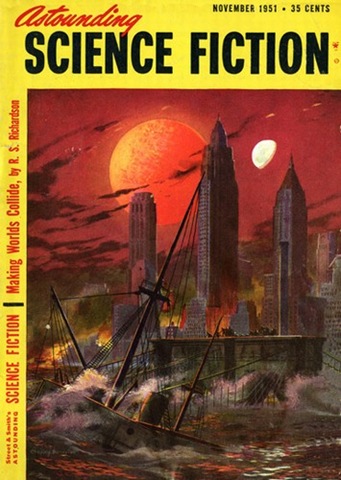
ASF-Nov51

I’m a science fiction addict, which explains why I’m intrigued with the idea of dating all the great science fictional ideas, but you could do this too with your own favorite subject area.  Hell, this idea itself popped into my mind when I noticed that the book I’m reading, The Illustrated Man by Ray Bradbury, came out in 1951, the year I was born.  This got me to thinking about the state of science fiction that year.  Bradbury is a cautionary writer, so his science fiction seems afraid of the future, but then again Heinlein’s The Puppet Master didn’t paint a rosy picture either.  Nor could you find upbeat escapism by going to the movies and watching The Day the Earth Stood Still, When Worlds Collide and The Thing From Another World.

How in the world did I grow up thinking science fiction paved the way for exciting futures?  The most famous science fiction novels of the 20th century to the world at large are Brave New World, 1984, A Clockwork Orange and Slaughterhouse Five.  When did the future become a Disney destination – well certainly not in 1951.  Or maybe all the gosh-wow sense of wonder stories of 1951 where not the big public movies, but the cherished stories that only the fans embraced.

All around the world in 1951, but mainly in the U.S. and Great Britain, science fiction writers were creating their visions of the future.  Few people took them seriously.  Some of their tales are still in print today, The Illustrated Man is set for its second movie production, and a remake of The Day the Earth Stood Still came out last year.  Why is science fiction from 1951 still being read and seen today?

I’ll work with these books:

And consider these anthologized stories from the magazines:

And use these memorable movies:

We stand 57 years into their future and know what will happen.  We can judge the hopes and fears of the people of 1951 and psychoanalyze their paranoia.  The opening story in The Illustrated Man, “The Veldt” is about a high tech nursery that is a lot like the holodeck from Star Trek: The Next Generation.  Bradbury’s story worries that technology will change the children of his times.  How do you interpret a story where the kids kill the parents with their futuristic nursery?  But wasn’t Bradbury right?  The innocent minds of 1951 don’t exist anymore.  If Ray Bradbury could have known what the Internet shows the children of today wouldn’t he have written an even scarier story?

Juveniles delinquency was one of the major problems people feared in the 1950s, so what if Bradbury could have foretold the Columbine massacre?  I include Catcher in the Rye in my list because it was probably the best literary novel of the year, and decade, but it also represented the same kind of fears about children changing that Bradbury was writing about.  Children were rejecting innocence, turning against the status quo and their parents and this scared the bejesus out of the conservatives of the times.

What we have to do is imagine what it would be like to be an average Dick or Jane in 1951 encountering these stories for the first time.  My father and mother, George and Virginia, didn’t have a clue about science fiction, but let’s imagine them going to see The Day the Earth Stood Still.  How many Americans, much less citizens of the world, really believed in aliens from other planets?  The UFO craze started in the late 1940s, so the idea was in the news for people to ponder.  Of course there had been the 1938 scare when Orson Welles broadcast H. G. Wells story of The War of the Worlds that terrified millions.  Even my parents told me about that when I was little.

By 1951, anyone in the U.S. that wasn’t too poor to have a radio or TV set had been exposed to the idea of aliens from other planets.  Another popular movie of the year was The Thing From Another World.  With two movies, three major science fictional concepts were inserted into the public mind:  interstellar flight, wise powerful beings not mentioned in the Bible, and intelligent robots.  Science fiction readers had known about these concepts for decades, but in 1951 the number of SF readers were very small.

Because of the atomic bomb in 1945, the idea of a man-made end of the world event had also been introduced to the public.  That idea was more powerful than alien visitors, because Klaatu and Gort’s real purpose was to warn us not to wipe ourselves out.  Then George Pal produces When Worlds Collide to let us know there were other ways for life on Earth to end, and John Wyndham gave readers yet another idea of how human life could be threatened.  Heinlein even combined the fear of Reds with the fear of aliens.

Many of the SF books and movies that came out after 1951 were about the end of civilization, or the end of mankind, or the end of the world.  The paranoia of the 1950s is very hard to top, but occasionally a writer will try, and Cormac McCarthy recently succeeded vividly with The Road.

Fritz Leiber’s classic a “A Pail of Air” reminds me of the film When Worlds Collide, because they each have a roaming astronomical body coming into our solar system and changing life on Earth.  In Leiber’s story, a dark star pulls Earth out past the orbit of Pluto, and in When Worlds Collide, a movie based on the 1933 book by Philip Wylie and Edwin Balmer, two planets from outside our system get captured by the Sun, and one destroys the Earth.  Ever since I’ve been reading science fiction as a kid I’ve been living with hundreds of ideas on how our world might be destroyed.  I guess that’s no big deal because before science fiction, religious people lived with the idea that God would stomp our world.  Maybe science fiction end of the world stories are just variations on biblically inspired end of the world tales.  However, to me, rogue stars and atomic wars seemed far more real than the wrath of God.

Science fiction is never very far from religion.  In “The Quest for Saint Aquin” Anthony Boucher, the legendary founding co-editor of The Magazine of Fantasy and Science Fiction, pictures a future where religion is threatened.  This story promotes the great science fictional idea of machine intelligence, and even suggests if pure AI thinking can believe in God, then why shouldn’t humans.

Now here’s an original SF idea that has not been carried forward to the present and evolved?  I guess people don’t believe that AI and robots will also believe in God?  I’ve never thought they would, but what if they did?  Here’s a potential story idea.  However, this reminds me of a famous joke from the 1950s.  Scientists wanted to know if there was a God, so they built a giant IBM machine and fed it all knowledge and typed in the question:  Is there a God?  They got back:  There is now.

1951 was a long time before most people thought that space travel could be real.  Most of the public when they thought of rocketships to the Moon and Mars pictured them from what they learned in the Sunday comics reading Buck Rogers or Flash Gordon.  They didn’t know they were just six years from the Russians orbiting a satellite and a decade before the Russians put a man into orbit.  The future was closing in far faster than anyone knew, except for Robert A. Heinlein, Arthur C. Clark and Isaac Asimov.  These men ruled 1950s science fiction as a triumvirate.

Heinlein’s 1950 classic film Destination Moon helped the public to realistically picture the first mission to the Moon.  Clarke and Heinlein wrote stories and books about early space explorers to nearby destinations.  Asimov thought huge and promoted the major SF idea of a galactic civilization, much like the Roman Empire, but spread across thousands of star systems.  Asimov’s vision wouldn’t attain wide public recognition until Stars Wars in 1977, with a good bump from Star Trek in 1966.

By 1951 Heinlein and Clarke were writing stories that realistically tried to show astronauts working on the Moon and Mars.  In the tiny world of science fiction fans, these ideas were ancient, but I think Heinlein and Clarke felt if a fictional idea was ever to give birth to reality they needed to promote space travel to millions.

How does someone born in 1966, the year of Star Trek, and 1977, the year of Star Wars, feel when they discover these ancient ideas for the first time?  1951 is Darwin voyaging on the Beagle, while 1969’s Armstrong’s giant step for mankind is science fiction’s 1859’s On the Origin of Species publication.   It’s the time between a few thinking about an idea till when the idea hits the public in a big way.

If you turn on Turner Classic Movies and eventually watch every movie from 1951 except for a handful of SF films, you will begin to get the idea of just how little that world of 1951 thought about the great ideas of science fiction.  In 2009 you can’t escape these ideas unless you live in that proverbial cave like a fundamentalist Muslim, and I bet even cave dwelling terrorists have thought about aliens from other worlds, space travel, and intelligent robots.

The question is, will in 2051, or 2151. how many of the great science fictional ideas of the 20th century will still be around?  How many will have come true and how many will be thought of as quaint fantasies of ignorant people of the past, like the Oneida Community?

And what if I continued my research, could I show how 1911, 1921, 1931, 1941 and 1961, 1971, 1981, 1991 where different from 1951 regarding the evolution of science fictional ideas?  It would take a lot of work, but I think the answer is a definite yes.  Could I write a novel to be published in 2011 that would stand out with radically new evolutionary science fictional traits?  I don’t know if I can do it, but I’m hoping someone will.

JWH – 2/14/9

Loneliness

Most people think the cure for loneliness is seeking the company of other people.  I don’t agree.  The complaint of being “lonely” is much too vague, on the same order as saying, “I don’t feel good.”  What are the symptoms of loneliness, and what are its cures?  Studying loneliness unclothes our souls.  Why is loneliness such a pervasive condition in world of seven billion?  I got onto the topic of loneliness when a couple friends mentioned joining Internet dating services and I became fascinated with how those programs worked.

Dating services sell the illusion of scientific match making.  Each service believes their method of profiling will introduce their customers to harmonious relationships.  Of course this assumes we must all be paired off like animals going into Noah’s ark.  If our goal is to produce children, then this might be logical, but high divorce rates and unhappy marriages seem to suggest that the concept of soul mates might be a failure.  I must ask, what do we want from each other?

First, is being alone bad?  Well yes, if we’re alone too much.  Is the solution a lifelong contractual relationship?  I wonder if the deeply programmed impulse to reproduce overrides all other lesser urges so we see pair bonding as the only solution to loneliness.  If we all took a contraceptive pill that removed any impulse to get naked with each other, what would be the second through nth reason for finding a friend?  In no order of importance, and with no attempt to be complete, here are some of the components of loneliness that I’ve observed lately in me and my friends.

Talking

Some of my friends love to talk.  Now I mean this different from people who love good conversation.  These people want to express themselves in words, they have an itch to gab.  They are excited about events in their lives and want to chatter away.  Some people I know like this don’t particularly like to listen, nor are they particularly interested in people’s reaction to what they have to say.  I’ve known a few rare souls that want to talk so much you have to back away from them.  I used to have a professor that I would back out of his office and heard him talking halfway down the hall.

Listening

Now, there’s another kind of person that likes to talk, but not so compulsively, because what they really want is someone to listen to them.  They want Freud for a friend.  These people value others for their empathetic ability and perceptive observations.  They are open to insightful comments and even welcome advice.

Conversation

Witty conversation is craved by some people, by not many.  They love batting words back and forth across a net.  Loneliness for these folks mean hanging out with people who spend more time chasing their words than volleying them back.

Play

Many people have the gaming gene and love to get with other people for competition.  Whether it’s bridge, bowling or baseball, they seek others to play.  I think older people crave the kind of living we had as kids where play was the common form of communication.  I’ve read that baby boomers are forming leagues to play kickball, dodge ball, four-square and tetherball, games that were great in grade school.  Kids are very physical and close when they play, like kittens and puppies, and I think many people are lonely for that kind of interaction with others.

Work

We spend most of our adult life at work, so it’s the main form of social bonding.  Having a common goal is a very satisfying way to communicate with people.  Purpose is super-glue for people.  I think many retired people miss the friendship of co-workers.  Unlike marriage, you don’t have to be intimate with the people at work to feel close to them.

Money

Now some readers are going to wonder why I list money as a kind of loneliness, but strangely enough I think some people are lonely for people to take care of them, and that involves dollars.  I think the warmth of a relationship can be expressed in the security of finances, and I think this is true of many women.  I often hear women wishing they could meet a rich man, but I never hear guys talking about wanting to meet a rich woman.  I think the biological drive deep within our old brain makes females seek out powerful providers, and that works out to be a kind of loneliness.

Nesting

Another factor connected to the biological drive to mate is the urge to build a nest within a partner.  Women, and some men, love fixing up a house and decorating, and I think there’s a kind of loneliness that make some people want to hook up with someone special to do remodeling.

Travel

There are a lot of solitary travelers out there, but most people want to go on adventures with a buddy.  Seeing the world alone is a particularly lonely pursuit.

Health

This is a complicated one to imagine, but we know scientifically that people who live together are healthier than people who live apart.  But do people really feel loneliness for health?  I don’t know if it’s a conscious thing or not, but I think there’s lots of people willing to accept anyone in their lives because they just feel better about life.

Knowledge

This is the reason I’m often lonely.  I’m interested in a lot of topics that my wife and friends find boring.  I think many people look back on their school and college years as the most exciting time of their lives because of mixing the quest for knowledge with friendship.

Art

Movies are probably the leading art form that people share.  When I was growing up music and television were major artistic expressions for connecting friendships.  However, when I was at the National Gallery in Washington, DC, I felt it to be an extremely solitary experience.  I wished I could express how I felt about the paintings I was seeing, but they were all so personal.  Reading is a lonely pursuit but we often gather in book clubs and at work to talk about books.

At the Finish Line

One my lady friends told me she was lonely for someone to be at the finish line when she runs a marathon.  I thought that was a particularly good kind of loneliness – to want someone to share your triumphs.  I know I like to tell my wife when I get a bunch of hits on my blog because an essay got promoted on StumbleUpon.  I think if you think about this one for awhile it might reveal a lot about why people are so lonely.

Be On My Side

The same friend above said she wanted a partner that would take her side, even if she was wrong.  I guess this could have also been called “Watch My Back” but that might be a slight variation.  If you go to war with words or fists you want your friends to line up behind you.

Sex

Getting genital is the eight million pound gorilla in the room of loneliness.  Horniness is what most males feel when they are miserably lonely.  I’m not sure women feel of it in the same way, but the impulse to make babies drives us crazy.  And it’s such a weird concept when you think about it.  Why would below the belt friction provide so much soothing comfort for the pain of being alone?  Stranger still, when we’re beyond age of reproduction our bodies still nag us about carry on the race.

*  *  *

Feeling lonely is such a complex symptom.  When we tell someone that we don’t feel good our friends will ask where does it hurt.  From there they can play twenty questions and drill down on some specific ailment.  They won’t do that when we complain of being lonely.  The assumption is a generic person can be the universal pill that can cure any kind of loneliness.  I spend most of my time alone, but I can’t say whether I suffer loneliness or not.  I have to force myself to socialize more, and I like the company of people, but often when I’m out with a friend I’m anxious to get home to be alone.  And even when I’m with people I still feel alone, a kind of existential loneliness.

On the other hand, I can be home alone, enjoying television or reading and it never occurs to me to complain about not having someone around.  But other times in the same situation I do feel lonely.  For the past year, my wife of thirty plus years, has had to work out of town, so I spend more time than ever alone.  But even when she’s home I can have bouts of loneliness just as easily as I can when I’m alone.

Other people just want someone else around, and maybe not even in the same room, but just around the house  The pain of their loneliness is reduced by being in a relationship.  As I get older it seems people have less and less tolerance for putting up with other people and they prefer to live alone.  Some of those people still feel lonely but find pets good company, or the hours at work to be socially fulfilling enough.  I’ve been speculating with my science fiction reading friends about how companionable a robot might be.  Other friends have pointed out that the Internet is good enough social contact for them.

What do we want from each other?  What do you want from another person that will make you happy?  I’ve asked my friends experimenting with computer dating what they are looking for in a good match.  Surprisingly, or not, they don’t know.  Usually they can specify things they don’t want.  I think their loneliness is a general sense of unease and they don’t specifically know what will make them happy, but they often know the details about other people that make them unhappy.

Last night I had a very specific desire.  I was watching this great NOVA episode on my DVR about fractal geometry and I was overwhelmed with excitement about the idea and wished I had someone to gab about it afterwards.  Seeing the gorgeous fractal images in 1080i resolution on a 56″ screen was visually stunning.  Learning about what fractal geometry teaches us about nature was inspiring.  I really wanted a friend at that moment to discuss these ideas and maybe even try to program some fractal formulas into my computer.

Now this kind of desire for companionship bores the crap out of my wife.  I get the same response from my lady friends who I spend most my social time.  Of course, they want to talk about stuff that bores the crap out of me.  I have a couple guy friends that would enjoy discussing fractal geometry, but their lives are usually busy with other stuff.  Now I could jump online and find some bloggers exploring this subject and post comments, and that might do, but it’s not exactly what I want.

So, for me, one kind of loneliness is not having someone with me to discuss science and philosophy.  I tell my wife that I ever meet a woman who has the hots for old fat bald guys that love to watch science documentaries that I’ll be dumping her.  She doesn’t seemed worried.  I don’t know if it’s because there’s zero chance of me meeting anyone that has the hots for my old body, or there’s zero chance for me to meet a woman that loves science documentaries, or the odds of finding someone with both qualities is like the odds of finding life on Mars.

Another type of loneliness I have is the desire for someone to share music.  I used to get with friends to listen and talk about music.  This started around the 6th grade and ended sometime after college.  Of course, for many of those years of sharing music also included the communal sharing of a joint.  Today people withdraw into their own private world of music with iPod earphones.  Except for live performances, most people consider music as solitary as masturbation.

For most people, the solution to loneliness is having someone to talk to.  Now some people talk to themselves, and others to cats, dogs, birds and fish, but most people need another person to carry on a conversation.  Some of my lady friends can talk a blue streak.  I just let them.  Sometimes I think they only reason they like me is because I let them.  Now I would like to talk more in these conversations, but I have learned it’s better to shovel my words out in this blog than dumping them onto people, because what I’m interested in the most seems to interest other people in the least.

When I wrote “The Implications of Sexbots” I actually thought robots would sell more for conversational companions than make-out machines.  Unless you’re a horny boy, the percentage of your day spent humping your bot would be quite small, so I figured most people would want a robot to talk to.  If Hondo made a Freud model of Asimo, it would sell more then the Accord.  If people really believe that a robot could actually listen and understand them, and help them find insights into their souls, or just patiently handle all their blather, I think robots could be a cure for the kind of loneliness where you need another person to listen.

When you start thinking about it, the word loneliness can means all kinds of things.  So when your friends complain of being lonely, ask them to be more specific.

The reproductive urge is the greatest force for bring two people together, so for many people who whine they are lonely, they are merely lamenting the desire for sex rather than companionship.  We know how powerful this urge is because people will copulate with  people they hate.  The desire for sex will make you listen to conversations that bore you, and play games you despise.

I wonder what society would be like if humans had mating periods like some animals, so we only felt the urge to rut for two days a year, and the other 363 days we felt absolutely zero degrees of romantic heat?  Would depression over loneliness be so pervasive?  I don’t think so.

Before puberty, we were very social animals.  Kids love to play, and often played in packs.  That’s why I suggested the urge to play was one important type of loneliness.  I’m wondering if it’s not the strongest after sex.  But that makes me wonder if there is any kind of loneliness stronger than the sex drive.  I think there is.  Notice how powerful television is in our culture.  Few people screw for 3.7 hours a day, but most will watch that much television.

Humanity started out as tribal groups, and even after the rise of cities, the family was multigenerational up until about the 1950s when television was invented.  Instead of living with a home full of people, we commune with thousands of people via our TV sets.  We love fictional stories about other people because deep within our genes and synaptic programming is social awareness.  Watching Lost or Desperate Housewives resonates with that social tuning fork that vibrates within our head.  Television is the methadone for our natural social addiction.

One reason I think so many of my lady friends want to talk a blue streak when they can is because they have been listening to television for hours on end and feel it’s their time to talk.  Television is the robot that talks to us, hour after hour, gossiping about all the other people in the world, real or imaginary.  Television is the modern Homer telling us stories.  Television is the box that lets us watch the popular kids, the alpha males and females.  Television is the peephole in which we vicariously watch others have sex and romance.  Television is a better cure for loneliness than books, the old standard for solitary social escapism.

Loneliness is such a vague term, which is why it’s probably so overused.  The next time the words, “I’m lonely” are about to tumble out of your mouth, hold up a minute and reevaluate.   Think specific.  What you might want to say is “Gee, wouldn’t it be great if I had enough friends for a rousing game of dodge ball.”  Or “Gosh, I sure wish I knew a patient soul that would let me blab at them for forty minutes.”  Or maybe you really want is to go dancing or horseback riding.

JWH – 2/10/9