
by James Wallace Harris, 12/5/25
While watching Wicked, I struggled to recall the excitement I felt when I first read the Oz books at age 10 back in the summer of 1962. I wanted to know whether the fantasy world Wicked created matched the one L. Frank Baum created in his fourteen Oz novels.
The barrier to making this comparison is memory. Memories are highly unreliable. Plus, we overwrite our memories every time we recall them, so am I really remembering 1962, or just the last time I thought about reading the Oz books as a kid?
Like most of my brain excavations, I have to rely on logic and deduction instead. I also look for corroborating evidence. I spent many days on this problem, and here are my results.
The Oz books were the first novels I discovered on my own. For various reasons, I concluded this was the summer between the 5th and 6th grades. My family lived on base at Homestead Air Force Base, and I found the Oz books in the children’s wing of the base library. They were old and worn.
The first novel I remember is Treasure Island by Robert Louis Stevenson, which my mother read to me in the third grade. I started using libraries in the fourth grade, but read nonfiction books about airplanes, space travel, cars, and animals.
I remember roaming up and down the fiction section at the base library and discovering the Oz books. I had no idea who L. Frank Baum was, nor did I have any idea when they were written. I didn’t know about copyright pages or genres. I saw “Oz” on the spines and connected those books to the 1939 film, The Wizard of Oz, which I had seen on television every year since the 1950s.
I did not know the word fantasy. I doubt I understood the concept of fiction. In other words, these books were an exciting discovery. To compound that excitement, they were all set in the same fictional universe. They were my Harry Potter books. L. Frank Baum had tremendous world-building skills.
Analytically, I know that at ten, I didn’t know much about the world. My vocabulary was limited. And I was unaware of most concepts and abstractions. My previous beliefs in fantasy – Santa Claus, the Easter Bunny, and the Tooth Fairy had caused me great embarrassment in first grade when a girl called me a baby for mentioning them. I was five, she was six.
In other words, I knew Oz did not exist, even though Baum created so many wonderful details to make it believable. I remember wanting Oz to exist, but I knew it didn’t. I don’t think I grasped the idea of fantasy at that time. All I knew was that the books created an artificial reality in my mind that was mesmerizing.
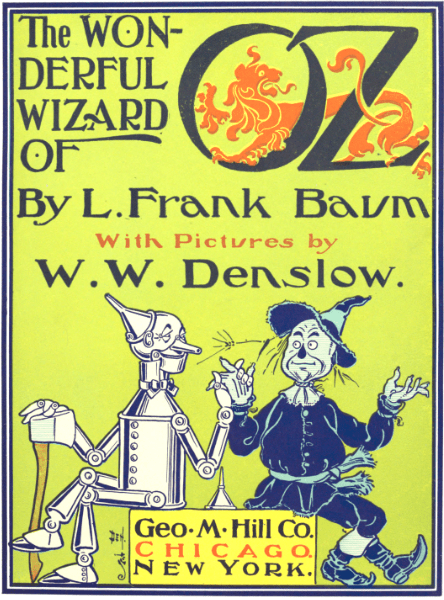
Watching Wicked and then rereading The Wonderful Wizard of Oz this week let me compare the two versions of Oz, but I couldn’t compare my initial reactions. Wicked is quite colorful, creative, and contains many elements of the original stories, but it no longer worked on me as the Oz books had in 1962. And that’s to be expected, since I’m 74, long past the age for fairytales.
My quest changed. I now wanted to know how my ten-year-old self saw the world. Rereading The Wonderful Wizard of Oz gave me very few clues.
My contemplations led me to some ideas, though. I have damn few memories of life before age five. I have zillions of memories dating from age five to twelve. I started thinking about them, and a revelation came to me.
Before age five, I theorize our minds are like LLMs (large language models). Those AIs can take in information and react to it, but they are unaware of the world. After five, but before puberty, we develop some self-awareness, but it’s very limiting. It isn’t until around twelve or thirteen that we start thinking for ourselves.
Here’s my main bit of evidence. As a child, my mother told me about God and took my sister and me to Sunday School and church. I just accepted what I was told. But when I was twelve, I started thinking about what they were telling me about religion. I didn’t buy it. I considered myself an atheist by 1964, when I was thirteen, maybe fourteen.
In my thirties, when I was working in a library, I came across an article that said that some librarians in the 1950s felt the Oz books gave children unrealistic expectations about life, and pulled the books from their shelves.
When I read that, I knew it had been true for me. The Oz books led me to science fiction, a genre that also inspired unrealistic expectations regarding the future that have proven to be unrealistic.
Here’s the thing: I was being told two fantasies at age ten. The first was from The Bible, and the second from the Oz books. Looking back, I see that my young self began to reject religion at age ten because I preferred the stories from L. Frank Baum. I wasn’t aware that I was comparing two fantasies; I just preferred one over the other.
Then I discovered science fiction. Concurrently, I was also discovering science. That gave me the illusion that science fiction was reality-based. When I consciously rejected religion, I thought I was choosing science. However, in recent decades, I’ve realized I had substituted science-fictional fantasies for religious fantasies.
I realize now that the Oz books had the power of Bible stories on me at age ten. The reason why so many people are true believers as adults is that they were programmed as children. Wicked doesn’t have that kind of power over me today. I can’t remember what that power felt like, but I do remember that for a few weeks in 1962, the ideas in the Oz books set my mind on fire. Rereading The Wonderful Wizard of Oz did not reignite that fire because I’m no longer a believer in anything.
I’ve often wondered if I hadn’t been lied to about Santa Claus, the Easter Bunny, and the Tooth Fairy, and thus had not experienced humiliation at discovering they were lies, and if I also hadn’t discovered Oz books, would I have accepted the Bible stories as truth as a kid and believed them now?
JWH
 Auxiliary Memory