Birds and Robots

The goal of AI scientists is to create an intelligent robot but many people feel that goal is impossible.  These people believe that the human mind is beyond nature and contains a soul that transcends our physical world.  If that is true, then the goal of silicon life is probably a fantasy.  However, if men and women are merely the most complex example of intelligent beings and leaves behind a trail of previous experiments by mother nature to fashion biological machines that can think, then there is a good chance we may one day give birth to our evolutionary descendants.

Folks who believe that man is different from the creatures of the Earth do so because they believe that animals lack our kind of intelligence and self-awareness.  Animals studies are showing more and more that our relatives on the tree of life often show cognitive traits that we once defined as the sole providence of human nature.  As intelligence and awareness are explored we’re starting to see that we homo sapiens are not that unique.

What we are learning from both robotics and animal studies is intelligence is a huge collection of tricks.  To be human actually means many things, including a fantastic repertoire of abilities, any one of which standing alone can be faked by machines or revealed in animals.  Robots can be programmed or designed to do one thing we can, and even do it better, like playing chess, but that doesn’t mean the robot is intelligent.  The same can be said of animals and their special traits.

Animals far exceed what any robot can do today, and they too are collections of abilities.  We’re starting to see robots that do more than one thing in a way that makes us see ourselves in their struggle to evolve.

Look at this video of Snowball, a head-banging Cockatoo and ask yourself if this bird is not enjoying himself rocking out to the music, and how is his response to music different from yours.

Snowball keeps better time than I do and I can’t match his dance moves.  Building a robot to dance to the beat probably would be easy for today’s robot engineers, but could we build a machine that enjoys a good downbeat as much?  Snowball stands above anything we’ve done with robots as people tower over ants.  Right now each artificial intelligence experiment struggles to create a single intelligent function that works in the most minimal of fashion.  Most people won’t think that Snowball perceives reality like a person, but if we make a list of all the things this bird can do and compare it with what we can do, there is a huge overlap.

Now look at this violin playing robot.  The robot is not aware of playing music, but it can do something that most humans can’t.

But can we say that Snowball is aware of music?  For all we know, the dance to the beat the bird is doing might be its way of showing pain, and we’re just anthropomorphizing that it’s getting down with the tune.  I don’t think so, though.

Now look at this news story about artificial intelligence to get some idea how complex the challenge of programming abilities into a machine.

Notice how many different projects this news story covers where the robot just does one simple thing.  Snowball and you have subsystems to do thousands if not millions of functions that could be considered an intelligent reaction to reality.  How did evolution program all those functions?

Now look at this video of Alex the talking parrot.  This bird seems to think.  Alex even asks for things it wants.  This is way beyond what robots can do, even though some of Alex’s tricks have been pursued in AI studies.  The question becomes can a robot ever think for itself?  Can a robot be created that learns from interacting with its environment like Alex the parrot?

Here’s a collection of videos that shows off robotic abilities.  None of these robots think for themselves, although some give the illusion they do.  Are we just highly evolved illusions?  There is a difference between perceiving or reacting to reality and being able to think about and understand reality.  Anyone who knows people who have suffered strokes or live with dementia know how fragile our unique abilities are, and how they can be taken away.  We also know how severely the body can be damaged and yet the mind inside can soar to brilliant levels, like Helen Keller or Stephen Hawking.  We have no idea what’s going on inside of the mind of an animal.  Dolphins could be just as aware and intelligent as humans.  How will we know when a robot becomes aware?

Robotics is the one area of science fiction prediction that is rushing ahead as fast as science can apply itself.  It’s not costly like manned space exploration and the general public anticipates more benefits of its results, especially in Japan.  Theoretically, an AI intelligence could be created by a high school kid in his bedroom.  How soon will we see an AI robot that has the intelligence of Alex the parrot?

If you’ve studied this concept at all you’ll know it’s not something that will be programmed.  Someone needs to invent an artificial brain that learns, and pattern recognition is the key.  Vision, hearing, taste, touch and smell are all sensory inputs that process patterns.  The brain appears to be general purpose enough to adapt the same kind of physical neural structures to handle each of these sensory pattern types.  Are we, that is our minds or our souls, a byproduct of pattern recognition?  What abilities do Alex the parrot have that scales up to become us?  Alex can hear questions, observe something in his field of view, and reply correct.  Do you see that trait in the robot films?

Spend some time and watch the film of Alex over and over.  Also watch the robot films carefully too.  Do you see patterns of behavior?

JWH 1/21/9
How to Introduce Physics to Your Friends?

My friends know I’m a bookworm and often greet me with, “What are you reading?”  This past week I’ve been causally replying, “A book on physics.”   To which all my friends give me a strange look that asks, “Why the f#@* would you want to do that?”  Last night, when Janis asked, and gave me the same facial response, I felt compelled to try and explain myself, but I came up short.  How do you quickly sum up the beauty of physics in a few sentences?

Later, while driving home, I wondered if there were any books to give my friends that would introduce them to physics.  Is there any physics book that the average person would be willing to try?  I flipped through some popular titles and textbooks on my bookshelves and immediately knew they wouldn’t do.  I went to the bookstore and looked at intro books like Physics for Dummies, Physics Demystified and Head First Physics.  The answer was still a big “No Way!”

Is there a way to introduce physics in a short blog essay?  Physics is a very big subject, beginning with the smallest objects in reality and ranging up to the very largest.  This made me think of the videos Powers of Ten by Charles and Ray Eames and Cosmic Voyage, the Imax movie narrated by Morgan Freeman.  If my friends could watch those videos on a big screen television and study them I think it would be a fantastic start.  They are easy to understand but have a huge sense of wonder impact.  However, I’m not sure if the crude versions found on the Internet will be that inspiring.  I did find a DVD copy Cosmic Voyage at Amazon for $8.99.

Thinking about these impressive films got me to wondering if it might be possible to introduce physics by showing DVDs that illustrate the most exciting aspects of physics.  Are any physics documentaries good enough that if I lent them to my friends they’d come back and ask if I had any more great DVDs like that one?  I’ll order Cosmic Voyage and give it a try.

How Big is the Universe?

I do believe understanding the Powers of Ten is a key starting place.  I have the original Powers of Ten book by Charles and Ray Eames and studying it really helps to grasp the scope of the world of physics.  It’s very important to teach people the size of the universe, from the very smallest to the largest and get a feel for scientific notation.  Recently The National Geographic Channel showed the documentary, “Journey to the Edge of the Universe.”  This beautiful film uses state of the art computer animation to survey the macroverse from Earth to the edge of the Universe.

The value of the visuals is diminished by not knowing the numbers behind glorious images, so that’s why I think a good understanding of the Powers of Ten video should come first.

Time

Physicists now think in terms of trillions of years.  Right now, I can’t think of any documentaries to teach about time.  I love all those analogies about the history of the universe and life on Earth, comparing time since the Big Bang to one year, and then explaining that human civilization is just the last couple of seconds of that year.  I need to track down a great documentary on time.

Motion

Classical physics is about motion.  Knowing about distance and time prepares us for studying movement.  Again I can’t think of any standout documentaries.  DVD courses like “The Great Ideas of Classical Physics” from The Teaching Company come to mind, but I don’t think I’ll get my friends to sit through its 24 lectures.

If only the series The Mechanical Universe were easily available.  If you follow the link you can register and watch small Windows Media coded versions online for free, but it costs $450 for a set of 52 thirty minute episodes on 12 DVDs.  Again, not something my friends are likely to pursue.  The great thing about The Mechanical Universe, the 1985 PBS television series, is its an introductory course to physics from California Institute of Technology.  What made the show really stand out was the mathematical animation by Jim Blinn – if only all math courses included such animation.  It’s sad that the tiny free Internet versions also have tiny impact.

Electromagnetism

You’d think I wouldn’t have to promote the teaching of electromagnetism because our society depends so much this technology that was first discovered in the 18th and 19th century and turned into tech magic in the 20th.  But how many people know that magnets are used to generate electricity?  Or that electricity can be used to turn a piece of iron into a magnet?  I think when Arthur C. Clarke said his famous phrase, “Any sufficiently advanced technology is indistinguishable from magic,” he was referring to far future technology, but for the average person, all modern technology is magical.  Does the public even understand the relationship between quantum physics and televisions?

Weak and Strong Forces

Exploring the world of the very tiny means understanding the building blocks of nature.  It also brings us closer to understanding how something came out of nothing.  And isn’t it strange that the only science that fundamentalist terrorists pursue is the one that leads to atomic bombs?  Again, I can’t think of a good film to illustrate this area of physics, although quantum physics is often covered in documentaries.  I’m hoping the Large Hadron Collider (LHC) will generate tons of news and documentaries in the coming years so maybe my physics pooh-poohing friends will even remember its name.

Gravity

Probably most people have seen documentaries about gravity.  All kids are taught about Galileo and Newton, but I doubt people know that NASA is planning a series of gravity probes like LISA and Big Bang Observer.  These deep space instruments will study colliding stars, ripples in space-time, and echoes of the early universe.  There is no way to explain the magnitude of this research.  The only analogy I can think of is if Christians built a time machine and went back to the Garden of Eden to interview God.  The more science studies the Big Bang the closer we come to understanding the Genesis of our physical reality.  How can my friends think this is boring?

How Limited is Your View of Reality?

An earlier draft of this essay pursued the idea that people who ignored physics chose to have a small view of reality.  I referenced my earlier blog post, “What Shape is the Universe?” where I was going to chide my friends for living in a small dinky universe of only a few magnitudes of dimension.  I can’t help think that many of the failings of our societies on Earth are due to only reacting to nearby reality without trying to see the big picture.  Would Israelis and Palestinians be killing each other if they all understood how big reality is and how small their feud?  Shouldn’t the whole Arab-Jew conflict resolve when they see their religions disappear in the light of science?  Israel and Gaza are probably less than two electrons in comparative size if we relate the size of our world to the Universe.

On the other hand, if humans are the crown of creation, the pinnacle of 13.7 billion years of evolution, then we are big things indeed.  But if we kill each other like viruses are we really all that evolved or intelligent?  As long as our guiding knowledge comes from speculation about reality derived three thousand years ago by nomadic people closer to cave men than to us, is there any wonder why science is ignored?  Most of my friends are well educated, with very few even concerned with religion, but people who base their knowledge on the humanities and literature are still stuck in the past.  Most of our social customs and beliefs developed during the Middle Ages.  Science is the only systematic pursuit of knowledge that consistently succeeds in explaining reality, but it’s a relatively recent development and hasn’t fully integrated into human behavior and thought.

We build our society on the handmaiden of science, technology, but we ignore the wisdom of science.  I’m intrigued by the idea of The Third Culture proposed by John Brockman.  Brockman gets his idea from C. P. Snow who wrote a book called The Two Cultures, comparing literary intellectuals and scientists, and suggests that a third culture would form when the two merged.

This makes me think of flipping through a university catalog of courses.  You can divide them into science base courses and all others, usually what we might call the humanities, or practical courses like business and law.  What Brockman seems to be saying, until the humanities and the rest of university courses are based on science, even with areas like the study of English literature, we won’t begin to see the true value of science pervade society.  Now the idea that science might infuse with all areas of knowledge could be a science fictional dream, but it is something I hope for, because until then the average person will think physics is boring.

JWH 1/11/9

Physics of the Impossible by Michio Kaku

Every science fiction fan should read Physics of the Impossible by Michio Kaku.  Kaku surveys all the famous concepts of science fiction, often referencing when he first encountered the idea in famous science fiction books, movies and television shows.  With each idea, aliens, starships, light sabers, death rays, robots, and so on, Kaku sets the stage by bringing the reader up to speed with the physics behind the idea.  He carefully explains what we know, what current experiments relate to the concept, and what future science might still discover.

I bought Physics of the Impossible on audio and liked it so much that I bought a hardback copy for reference.  This week, the Science Channel is rerunning the three episodes of Kaku’s Visions of the Future which makes a perfect visual supplement to the book, showing Kaku going around the world visiting labs working on these cutting edge breakthroughs that will lead to our science fictional future.  Many of the experiments Kaku talks about in the book can be seen in these videos.

Michio Kaku divides his book into three areas:

Class I Impossibilities – “These are technologies that are impossible today but that do not violate the known laws of physics.”

  • Force Fields
  • Invisibility
  • Phasers and Death Stars
  • Teleportation
  • Telepathy
  • Psychokinesis
  • Robots
  • Extraterrestrials and UFOs
  • Starships
  • Antimatter and Anti-universes

Class II Impossibilities – “These are technologies that sit at the very edge of our understanding of the physical world.”

  • Faster than Light
  • Time Travel
  • Parallel Universes

Class III Impossibilities – “These are technologies that violate the known laws of physics.”

  • Perpetual Motion Machines
  • Precognition

Kaku is very generous here in his categorizations.  For example telepathy.  He doesn’t try to make a case for what most people would think of as telepathy, one person reading another person’s mind.  Instead he shows how close we might get with machines that can scan minds and read vague conceptual patterns in the scan.  By chance, 60 Minutes ran a segment on Mind Reading this week. 

Follow the link to see a video that illustrates exactly what Kaku was covering, and presents even newer findings.  They show people in a MRI machine drawings of basic objects like a knife or hammer and scientists can record the brain images and analyze them with a computer.  The 60 Minutes’ producer volunteered to be scanned and was shown ten objects.  The computer program then analyzed her brain scans, correctly identifying 10 out of 10 objects.  This isn’t telepathy, but it’s pretty darn amazing.

The book does this over and over again, referencing dozens of cool contemporary science experiments.  There have been many books like this one, for example, The Physics of Star Trek back in 1995 by Lawrence M. Krauss.  The Kaku book is just the latest, so it has the most current survey of neat science tech.  I love to read such books every two or three years to catch up on the latest discoveries.  These books are sobering for the science fiction fan, and they explain why I give such bleak predictions about science fiction in my recent essay, Science Fiction in My Lifetime.

I gave far better odds on intelligent robots than Kaku.  I based my prediction on models in nature.  For example, before there were airplanes we watched birds, so we knew something could fly.  Consider faster than light travel.  We have never observed any object traveling faster than light, so I consider FTL travel an extreme long shot.  We know biological machines can be intelligence and offer a continuum of examples from the lowest animals to humans.  Airplanes are not like birds, but they fly.  I think we’ll eventually invent a pattern recognizing artificial neo-cortexes that can match and surpass our intelligence.

I highly recommend Physics of the Impossible for people who love science fiction.  It’s very well written and understandable.  You don’t even have to be particularly science minded to enjoy the book.  And if you don’t read science fiction, this book will catch you up on a lifetime of far out ideas.  Physics of the Impossible would make a fantastic eight part documentary for PBS.

JWH 1/6/9

Science Fiction’s False Assumption?

Since the earliest days of Buck Rogers and Flash Gordon the public has assumed the future of mankind included space travel.  The inherent assumption was humans would extend the range of civilization into space, across planets and moons, and then out to the stars.  I’m starting to wonder if that’s a false assumption.  From commitment to landing, the United States went to the Moon within a decade.  We spent the next four decades going nowhere.  Why?

Answering that question could take volumes.  Most people’s quick response is money, but our society waste billions upon billions with little effort.  It’s obviously not technology, we have that in spades.  Nor are we lacking in visionary scientists and dreamers.  Have we reached the limits of our frontier exploring impulses?  Could the dreams of space civilizations be built on false premises?  Science fiction presents thrilling fantasies that are endlessly entertaining, but does anyone really want to live them?

When I was a kid I wanted to be an astronaut because I loved science fiction.  Since then I’ve read dozens of books by and about astronauts and it’s quite obvious I don’t have the right stuff.  I couldn’t even be a mission specialist.  I would love to live that life, but in all honesty I never had the intelligence and drive.  Could that be a clue to science fiction’s false assumption?  Space travel is for the very elite, the very best, the most driven, the most focused, and that leaves the rest of us ordinary folk off the crew list.  Would NASA get more money if it reserved seats on their spaceships for normal people?

When it comes down to it, there is only one reason to build a space civilization, to protect the human species from extinction.  And since most of humanity wants to go to heaven rather than Mars they don’t buy that reason.  Leading normal lives of marriage and family is far more important to people than living in space.  All the astronauts had emotional conflicts between missions and marriages.  Few people would leave their families if offered the chance to colonize the Moon or Mars.

I now wonder if the premise that the future always includes men and women living in a space is just a false assumption.  That somewhere back in time we developed that premise, a false one, and we’ve all been working off that bad hunch ever since.  The reality is living in space is extremely difficult, if not impossible.  We won’t know if it’s impossible until we try. We blithely assumed it was possible, but that might another false assumption.

The other day I wrote “Is Colonizing the Moon Possible?” and I have received some interesting email comments.  Some people don’t believe we’ll ever build industries on the Moon to make a colony self-sustaining.  Others have suggested that the reason why science fiction never portrays the pioneering days of building a lunar civilization is because people don’t care about such boring details.  If you asked a 1,000 high school kids if they wanted to work  at manufacturing steel would any raise their hands?  I was hoping in my essay that if we rephrased the question by asking how many would like to design a robot to produce steel panels on the Moon a few might raise their hands.  But that might be another false assumption on my part.

Most science fiction fans love the dream and tell me it’s just a matter of waiting for the right time, that conditions will be different in the future.  Is that another false assumption?  I’ve been waiting forty years for something new to happen.  In all those forty years there have been endless books and documentaries predicting the glories of space travel that are just around the corner.

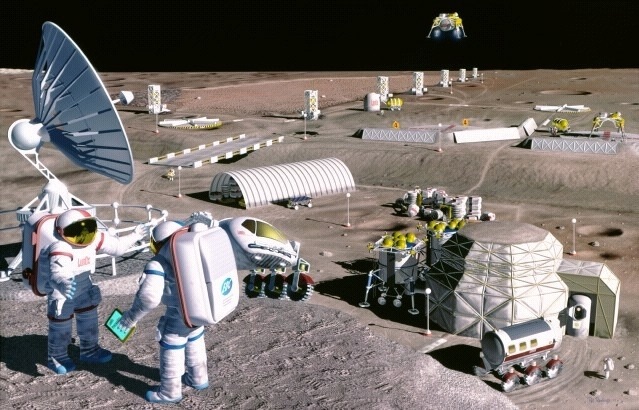
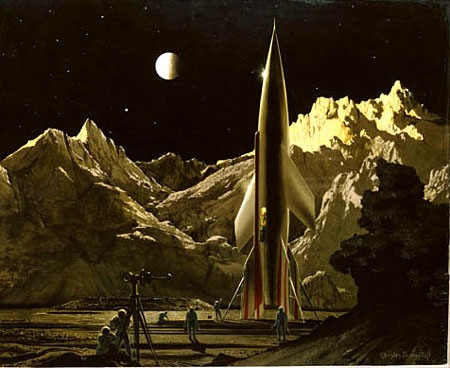
I’m constantly watching HDTV documentaries with beautiful animations of astronauts building habitats on the Moon and Mars.  They are quite awe inspiring!  I’ve been watching such futurist documentaries since the 1960s and grew up admiring paintings of the future like those of Chesley Bonestell.

bonestell_450

Are those animated plans any different than science fiction?  We know what kind of payloads the Saturn V and the planned Ares V can deliver to the Moon, and those wonderful animations show lunar outposts with equipment that would take dozens and dozens of rockets to ship to the Moon or Mars.  The United State flew thirteen monster Saturn 5s over a period of six years (1967-1973).  Budget cuts kept a two more from flying.  The public lost interest with Apollo 12.  The big space race was over, so why watch a rerun?

mooncolony

To build scientific stations on the Moon or Mars, and I’m not even talking about self-sustained colonies, but Antarctica like research habitats, like those in space documentary animations or pictured in space book illustrations, would take years of launchings, with each year blasting off the entire historical fleet of Saturn V rockets.  Will this ever really happen?  It could, and without much of a budget increase to NASA, but only if the public demands it.

President elect Obama is planning on spending several hundred billion dollars to create millions of jobs, but so far he isn’t looking to NASA as a jobs agency.  But even in flush economic times, no President has wanted to expand NASA’s budget by much.  This shows there is little public demand for space exploration.  Congressmen are often quoted as saying they see zero support for space projects.

I guess two things can happen.  One day we’ll collectively wake up and say to ourselves, “Hey, whatever happened to that vision of space travel,”  and get busy.  Or, next century people will look back on the era of manned space flight like we look back on 19th century whalers.

I’m too tied to my science fiction heritage to imagine what the average person on Earth thinks about space exploration.  Sales of hard science fiction books are quite small.  And even though science fiction movies are among the top money makers in Hollywood, few movies are made about space travel.  The public accepts the idea that space travel, but they assume it’s in the far future.

There is a vast difference between science fiction and the reality of space travel – just read the biographies of the twelve men who walked on the Moon.  Space is an extremely harsh environment.  If you think this winter is cold, imagine 250 degrees below zero in a vacuum.  Or more radiation than any nuclear plant worker sees in a lifetime.  And you know how you seldom see space suits in Star Trek and Star Wars, it’s because they are brutal to wear.  Living in the worst slums of Earth is paradise compared to the limited life in a controlled space environment.

Now all of this may sound like I’m a naysayer about space exploration, but that’s completely wrong.  I’m just saying it will be viciously hard and almost impossible but we need to do it.  Can you imagine a future where we never go to Mars or create a civilization in space?  Imagine humanity never leaving Earth but solving the problems of war, environment, hunger, disease, and we build a steady state economy where life is comfortable and secure.  Do we wait around until the race is snuffed out by an exploding Yellowstone, visiting comet or mutated virus?  Is that all there is?

Anyone who studies science knows that mass extinctions periodically visit Earth.  This weekend there were many scary stories going around the Internet about the Yellowstone super-volcano exploding and I wondered what would happen if it was true.  Do we accept the death of our species in the same way as we accept our own death?  We were born out of nothingness and we shall return to nothingness.  Do we just accept that?

Most of humanity answers yes.  There are a few extreme thinkers who say no.  To those thinkers, we are born out of nothingness and we will do whatever it takes to cling to existence.  If this world goes, we’ll find another, if our universe goes dark, we’ll wormhole our way into another.  The universe may lack meaning, but our purpose is to survive.  That’s the drive behind science fiction’s main assumption.  The question you must ask yourself:  Is that a false assumption?

It is the true dichotomy of humanity – life on Earth and life off Earth.  To most men and women, the ultimate question is:  Do you believe in God and eternal life?  To atheists, the question is:  Do you want to survive?  To future intelligent robots the question will be:  Is there a reason to keep the switch in the on position?  Developing a space civilization is asking the human species:  Do you want to avoid extinction.

JWH 1/3/9

004.jpg

Books Read 2008

2008 was a year of reading about the world and looking back at classic science fiction.  18 of the 45 books I read this year were SF.  11 were non-fiction.  12 books were ones I had read before – for some reason I listened to many SF classics that I first read back in the 1960s.  Although I enjoyed many science fiction and fantasy novels this year, the stories that moved me the most were two by Edith Wharton.  Two other novels stood out, The Road was intense and Oscar Wao was dazzling.

Science fiction books from the 1950s and 1960s are starting to show their age.  I think Childhood’s End by Arthur C. Clarke holds up the best.  I liked City and The Case of Conscience, but structurally they had problems.  City and Way Station presented wonderful sense of wonder ideas, but the writing is so dated that I worry that kids today will find them hard to read.  I still have nostalgic love for the Heinlein juveniles Red Planet, Starman Jones and Podkayne of Mars, and they hold up enough to get reprinted as audio books, but I also worry that young people will have problems reading them.  Their science is very dated, with canals on Mars, Venus being habitable, and people doing calculations for interstellar space jumps with pencil and paper.

Favorite Fiction:

  1. The Age of Innocence by Edith Wharton
  2. The House of Mirth by Edith Wharton
  3. The Road by Cormac McCarthy
  4. The Brief Wondrous Life of Oscar Wao by Junot Diaz

Favorite Non-Fiction:

  1. Hot, Flat and Crowded by Thomas L. Friedman
  2. The Outliers by Malcolm Gladwell
  3. The Post American World by Fareed Zakara
  4. Einstein by Walter Isaacson

The Whole List:

  1. Old Man’s War – John Scalzi
  2. Candy Girl – Diablo Cody
  3. The Road – Cormac McCarthy
  4. Running with Scissors – Augustine Burroughs
  5. Northanger Abbey – Jane Austen
  6. Einstein – Walter Isaacson
  7. Marsbound – Joe Haldeman
  8. The Cult of the Amateur – Andrew Keen
  9. The Book Thief – Markus Zusak
  10. The Coming Economic Collapse – Stephen Leeb
  11. Do Androids Dream of Electric Sheep? – Philip K. Dick (3rd time)
  12. The Cat Who Walks Through Walls – Robert A. Heinlein (2nd time)
  13. Ethan Frome – Edith Wharton
  14. The Maltese Falcon – Dashiell Hammett (2nd time)
  15. Death by Black Hole – Neil deGrasse Tyson
  16. Territory – Emma Bull
  17. Drop City – T. C. Boyle
  18. The Brief Wondrous Life of Oscar Wao – Junot Diaz
  19. Podkayne of Mars – Robert A. Heinlein (4th time)
  20. The Age of Innocence – Edith Wharton
  21. The Post American World – Fareed Zakara
  22. After Dark – Haruki Murakami
  23. Twilight – Stephenie Meyer
  24. City – Clifford Simak (2nd time)
  25. Proust was a Neuroscientist – Jonah Lehrer
  26. Lord of Light – Roger Zelazny (2nd time)
  27. Starman Jones – Robert A. Heinlein (4th time)
  28. The Little Book – Selden Edwards
  29. The House of Mirth – Edith Wharton
  30. Hot, Flat and Crowded – Thomas L. Friedman
  31. Way Station – Clifford Simak (2nd time)
  32. Spin – Robert Charles Wilson
  33. The Three Stigmata of Palmer Eldritch – Philip K. Dick (2nd time)
  34. The Little Guide to Your Well-Read Life – Steve Leveen
  35. Red Planet – Robert A. Heinlein (4th time)
  36. Swords and Deviltry – Fritz Leiber
  37. METAtropolis – ed. John Scalzi
  38. The Space Merchants – Pohl & Kornbluth (2nd time)
  39. Living Dead in Dallas – Charlaine Harris
  40. When You are Engulfed in Flames – David Sedaris
  41. A Case of Conscience – James Blish
  42. The Outliers – Malcolm Gladwell
  43. Childhood’s End – Arthur C. Clarke (3rd time)
  44. Like a Rolling Stone – Greil Marcus
  45. The Last Man on the Moon – Eugene Cernan & Don Davis

JWH 1/2/9