Linux Diary 0000

by James Wallace Harris, 11/17/23

You may think this diary is about technology, but deep down it’s about being old and fighting to learn new things. My life would be far easier if I weren’t pushing myself to learn Linux. I spent hours yesterday trying to get Linux Mint Debian Edition working with my scanner and printer. So far, I’ve mostly failed. Both work with my Windows and Mac OS machines, so I know both devices work and the cables work. Both took just minutes to set up on those OSes.

Failing is frustrating. But failing is how we learn. Technology is getting so easy to use that we learn less and less by using it. Technology is getting so good that the technologically challenged can fumble around and make their phones, TVs, and computers work by themselves. We used to believe every kid should study STEM courses, but recently the big tech companies laid off a quarter million computer careerists. We weren’t smart enough to foresee technology getting smarter.

Of Arthur C. Clarke’s Three Laws, the third says, “Any sufficiently advanced technology is indistinguishable from magic.” Most technology is approaching magic in use by most people today. As it does, we’ll need fewer magicians. This is becoming even more true as we rely on artificial intelligence.

At seventy-two I doubt I’ll have time to become a Linux Wizard, but I might become a wizard’s apprentice. Linux isn’t made for Dummies, although the Wizards of Linux are working hard to spread Linux to everyone. Linux is already hidden away everywhere. You use it but don’t know it. All I’m doing is trying to consciously get to know it before it turns completely magical.

I got LMDE (Linux Mint Debian Edition) running on my new Minis Forum EM680. It looked great and worked in the way I wanted — until I tried hooking up my printer and scanner. In both cases, Linux said it saw the device, even giving me their names, but said there was an error communicating with them. I started with the built-in drivers and utilities that come with LMDE. I then downloaded drivers and utilities from HP and Epson. Same results. They recognized their own hardware by name but said there were problems.

I wondered if the problem was the new AMD computer or LMDE? I got out my old NUC 5 with Linux Mint based on Ubuntu. This time the drivers that came with Mint worked with the HP Officejet. I got the printer working with a USB cable and with a Wi-Fi connection. But I wanted to use HP’s utility hoping I’d get more functionality out my all-in-one printer/scanner/copier. No matter what I did I couldn’t get any further with the HP driver and utility. I didn’t bother testing the Epson Perfection V370 and Plustek 3800L scanners. I figure I’ll work on the HP Officejet all-in-one first. Get the printer going, and then see if I can get its scanner working.

I then started Googling and found people having the same problem with HP and Mint. One Reddit thread suggested that the latest Linux Mint and the HP software had a timing problem. One guy even said if he turned everything off and on, then waited thirty minutes, the HP device manager would work with the printer one time. This is why most people don’t use Linux. This is why I should give up. But I won’t.

I also posted a message to a group of people who scan books and magazines asking if any of them used Linux. Three said they did. Two used Ubuntu Linux and one Fedora. Ubuntu and Fedora use the Gnome desktop manager, a graphical user interface. Mint uses Cinnamon for its desktop manager but is based on the Ubuntu distribution. I picked Mint because I like the way Cinnamon looks and feels. I dislike the Gnome desktop. But the Mint version I used also switched from the Ubuntu Linux distribution to the Debian Linux distribution. To make matters even more confusing and amusing, the Ubuntu distribution is based on Debian.

In other words, the Debian people build a version of Linux, and then the Ubuntu people customize it the way they like it, and then the Mint people take that and customize it again to their tastes. LMDE tried to simplify things by putting Cinnamon directly on Debian.

My problem might be a configuration problem. Maybe it’s a dependency problem. Maybe it’s caused by new hardware. Or its old drivers. Or conflicting drivers. Who knows?

I don’t know if my major problem lies with software configuration or the new hardware on my new computer. That’s why I started testing things on an old computer. The new machine has an AMD CPU while the old one has an Intel CPU. And they each have different GPUs.

This is further complicated by the fact that HP and Epson try to make drivers and utilities that work with all flavors of Linux and hardware. But the configuration combinations are endless, and that’s where problems arise. Even Vuescan that works with a wide variety of scanners didn’t work. It recognized the scanner was an Epson Perfection V370 but couldn’t talk to it.

Now this brings me to the point where I need to decide what to do. My friend Mike sent me a text this morning that said Nvidia updated its driver for Linux, and it fixed a bug that the last version caused him. The fix he made for that bug was to downgrade to an earlier edition of the driver. Waiting is sometimes a solution, so now Mike’s back to using the latest Nvidia driver. I could wait and see if Mint LMDE sends out a fix in the future. I’m in no hurry because I can print and scan from my Windows machine.

However, the goal is having a Linux machine that does everything I want to do. Luckily, I have two Linux machines. I can keep Mint on one and continue to learn to use that distribution. I can then use the second machine to test different Linux distributions.

Then what distribution will I try next? Linux has countless distributions. They vary by what graphical desktop they use. But they also vary by how often they update to the latest version of Linux itself, all its support programs, and all the various application programs, and which programs they prefer. They fall along the spectrum from old and stable to new and bleeding edge.

There’s a big advantage to sticking with the tried and true. But new CPU, GPUs, and other technologies need the latest version of Linux to recognize the new hardware, but the latest versions of applications often break things, and it takes a while for the bugs to be discovered and fixed. So, you want the latest hardware support and the shiniest new software, but not if it breaks something. It also helps to pick a distribution that is so popular that it gets supported first.

For my test machine I need to try Ubuntu, which is popular and widely supported, and Debian which is old and conservative. That tried-and-true nature is why Ubuntu starts with Debian and adds newer hardware support and mostly new applications. However, Debian changed recently to speed up hardware/software adoption yet stay reliable. It also comes with a plain version of Gnome, the desktop manager. However, Ubuntu is what two of the guys use that said they scan with Linux. And when you go to software web sites that support Linux, usually it’s Ubuntu.

I’ve just talked myself into getting a copy of the last version of Ubuntu that offered long term support and test it with my HP Officejet, Epson Perfection V370 scanner, and my Plustek 3800L scanner.

I wrote this to help me decide what to do. Hope it wasn’t too boring to read. But if you use Linux and have any tips to help me out, let me know.

JWH

The Challenge of Cross Platform Computing Life

by James Wallace Harris, 11/11/23

For the first twenty years of my life, I didn’t use computers. I started off using computers in 1971 at school, and bought my first one, an Atari 400 in 1980. Before the decade was over, I had standardized on MS-DOS computers at home, but used PCs and Macs at work. During the 1990s, Windows became the standard at work and home, although I also used a MacIntosh at work sometimes. I was a computer programmer and had to support both. I liked the Mac, but never owned one until recently when I bought a M1 Mac Air.

I bought the Mac laptop because I have back problems and can’t always sit at my desktop computer and the Air had the longest battery life. I can use the Mac Air in my La-Z-Boy when I can’t sit at my desk.

Because I use the iPhone the most daily of all my computers, and because I like to read on iPads, I should have standardized on MacOS and bought an iMac for my desktop computer. Apple is doing everything it can to make its hardware and software to synergistically work across all its devices. However, I haven’t done that. I’ve been a Windows guy for decades.

Life would be much easier if I owned a Windows computer, with a Windows tablet, a Windows smartphone, and a Windows laptop, and they all shared files from OneDrive. Windows offers the widest functionality because it supports most hardware and software. And Microsoft has done an excellent job of constantly improving Windows. However, since the early 1990s I’ve hankered after another operating system, UNIX. Back then, real computer guys used UNIX. Now real computer guys use Linux.

In the early 1990s, my friend Mike bought a copy of MINIX. It was a cheap imitation of UNIX for $89. I didn’t want to spend $89, so when I read about a free UNIX-like operating system called Linux I downloaded Slackware from USENET News messages onto several floppy disks and installed it on an extra machine. I thought it was neat, but I couldn’t run any program I was used to running. That was disappointing.

After that, I would check into Linux about once a year, always hoping it could do everything I did on my Windows machine. In recent years it’s gotten close. This week I bought a Minis Forum UM680 small form factor computer and installed LMDE (Linux Mint Debian Edition) on it. This was a complete extravagance since I don’t need any more computing power. Unfortunately, when I started seeing videos about the UM680 I just lusted after it. The thing is tiny, but super cool. It has 32GB of memory, 1TB of SSD hard disk space, 3 USB-A ports, 2 USB-C ports, and a microSD card reader. I paid $433 for it. To configure a Mac Mini or iMac like this would cost three times as much.

I decided I would finally use Linux as much as possible. I’m writing this blog on my Linux machine (see photo). I don’t hate Windows, in fact, I think it’s the best OS to use. I bought the M1 Mac Air because as a piece of hardware it was impressive and had a long battery life. However, I’m not too keen on Mac OS, and I dislike using a laptop. I love big computer screens. My Windows machine has a 34″ widescreen monitor, and the Linux box has a 27″ 4K monitor. Using the 13.3″ screen on the Air is painful to me. But I practice using it every day. During those times when my back goes out, I hate being away from my computer and figure I need a lifeboat computer, and the Mac Air will be that lifeboat.

After using the M1 Mac Air I wished I had bought a Windows laptop even though I would have had to buy a machine that had much less battery life. The Mac Air is great, and I’ve always wanted a Mac, but life would have been so much easier with one less OS to support. I should have ignored my long desires to use both Macs and Linux machines. That didn’t happen, so I’m living with three operating systems. I’ll standardize on one in the future as I get older, but for now I need to be a cross platform user.

Dealing with five operating systems (Windows, MacOS, iOS, Linux, Android) is a pain in the butt. Doing word processing is a snap on all the operating systems. So is using a spreadsheet, web browser, and email. It really doesn’t matter what OS I use for common computer activities. A cheap Chromebook would have been all I needed. However, I pursue two activities which I’m having trouble doing on the Mac and Linux.

Most of my computer use involves blogging. If I had to, I could create a blog with text, photos, and videos just from my iPhone. But it’s tedious and I can’t manipulate images the way I can in Windows. I create my photo layouts using HTML first, and then using the Windows Snipping Tool to grab the layout I want and save it to .jpg. I know that’s a silly way to avoid learning a program like Photoshop or GIMP. I’ve been using Photoshop Elements for photo manipulation for years but have never learned to use it well. Since Photoshop Elements isn’t available for Linux, I need to learn to use GIMP, the standard free photo editor that works on Windows, Mac, and Linux. Blogging on the Mac and Linux will take a little time to learn, but it shouldn’t be too hard.

Because I write about science fiction and its history, I have a large library of digital scans of science fiction magazines. In fact, I have copies of most of the science fiction magazines that were published in the 20th century. They are in the .cbr format. I can read them on devices from all five operating systems. However, I currently can only create a scan with my Windows machine. It takes several programs to create a magazine scan, and a scanner. The scanner works best under Windows. Getting it to work under MacOS or Linux is a pain. And some of the software I need to process the scan pages is only available for Windows.

For me to be truly cross platform ready, I need to get magazine scanning going on the Mac and Linux machines. That will take much longer. I will need to find drivers for my scanner, and new software on each OS that does the work of the Windows software I use now.

Like I said, I should have just stuck with Windows. Life would have been easier, cheaper, and less cluttered. But when I look into the future, I wonder if I shouldn’t become a Mac person, even though I don’t like MacOS. I love my iPhone, and doubt I’ll ever switch from it. I love the iPad far better than my Android tablet. The logical thing would be to migrate to iPhone, iPad, iMac, and Mac Air as my only computer platform.

I guess years of being a PC guy makes me shy away from becoming a Mac guy. I’ve always wanted to be a complete computer nerd and use Linux. There are Linux phones and tablets, but they are so damn clunky. Theoretically, I could go total Linux. However, I would be out of step with everyone I know.

Logic says I should pick one platform and stick to it. But I’ve never been very logical, at least with computers and technology. I’ve aways been impulsive, wanting all the different kinds of gadgets. Now that I’m getting older, that impulse is coming home to roost, and I don’t think it’s viable for the last years of life when I should be minimizing possessions.

JWH

My Problem with the Terms “Evil” and “Free Will”

by James Wallace Harris, 11/8/23

Yesterday my friend Mike and I were talking about evil women characters in old movies. We both immediately thought of the character Ellen Berent Harland (Gene Tierney) in the 1945 film, Leave Her to Heaven. I told Mike that I had just read a review of Detour, also from 1945, that featured one mean woman, Vera, played by Ann Savage. The reviewer said she was the evilest woman in all of film noir.

This got me Googling the phase “evil women in the movies” and finding several lists: 25 Of The Best Female Villains You’ll Love To Hate, The Greatest Female Villians, 10 Awesomely Sinister Women in Movie History, Most Memorable Female Villians. Not to surprising, most of the films listed were recent. What was surprising, was most modern female villians are from fantasy, horror, or animated films. Mike and I were thinking about ordinary realistic women in films.

Mike texted me:

I make a distinction between evil and insane. For example, Kathy Bates in Misery, Jessica Walter in Play Misty for Me, and Glenn Close in Fatal Attraction play characters that I consider insane, not evil. The Barbara Stanwyck character in Double Indemnity is not insane, just evil. The same goes for Gene Tierney in Leave Her to Heaven.

I texted back:

Evil is a slippery word for me. In the original religious term God was the source of all good and the Devil was the source of all evil. Being evil meant you were doing the work of the devil. It connotes that the person is a puppet of the devil. Or worshipping of the devil by doing the kind of things he wanted done. Being evil meant being devilish.

By the way, in the old days being insane meant being possessed by the devil. So judging someone evil or insane was close to the same thing.

In the modern sense of how we use those words it all relates to free will. An insane person has lost control of their free will. An evil person chooses to do evil.

But we have a problem. Recent research suggests no one has any free will. 

Now, our fun conversation has turned serious, but I think valid. If we don’t have free will, how do we judge people we think are doing wrong? I just bought the book Determined: A Science of Life Without Free Will by Robert M. Sapolsky but haven’t read it yet. However, I have been reading reviews and watching interviews with Sapolsky. What he’s saying is based on brain research that I’ve been reading about for years. We don’t have free will. The trouble is our moral and ethical structures depend on people either being sane and deciding on their own actions, or insane and out of control. What if we have no control over our actions at all?

The nightly news is full of people I’d call evil. What if we took a different approach to the problem. What if we say killing innocent children is evil no matter if you have free will or not. Does it matter if the evil person is consider sane or insane? Or has free will or not? What we’re horrified by is bad things happening to good people.

Modern films have made evil rather cartoonish by portraying the bad guy as over the top in their evilness. The films Mike and I were talking about, Leave Her to Heaven and Detour, are mundane portrayals of evil. I think the gigantic evils we see in the news, and the unrealistic portrayals of evil in modern movies, have made us forget the everyday type of evils. We no longer expect everyone to be honest and civil, and bad behavior is often claimed to be free expression and a personal right.

I don’t like what I see on the news, or in modern movies and television shows. And the behaviors I’m seeing on the freeways and while shopping is disturbing too. Maybe we don’t have free will, but we could at least act like we do. Maybe pretending to be good is all we can hope for.

I’m reminded of a science experiment I read about back in the 1960s where they put many rats in small confined cages to simulate overpopulation. The rats became violent, tearing at each other. I think that’s what’s happening to us today. Overpopulation is causing us to go mad. But that also supports the argument that there’s no free will.

Even though neuroscience is revealing there’s no free will, I wonder if free will isn’t something we could develop? Can we overcome genetics and conditioning? Is there some way we can consciously reprogram our unconscius minds. The reason why scientists say we have no free will is because they can measure brain activity happening before we’re consciousnessly aware of our choices and actions. Is there no way to condition our unconscious minds to act in the ways we consider ethical?

It’s obvious that any adult who follows the same beliefs they were taught as a child is not acting on free will. Most people believe what they are taught early in life. But if they radically change what they believe, is that a case of free will? If someone raised a Baptist grows up and spends many years trying out different religions, and ends up choosing to become a Zen Buddhist, is that free will?

When you watch movies think about whether or not the antagonist is acting on their own, or from genetics and conditioning. Do the same when you are watching the news. Does Putin have free will? The current war in the middle East is just like all the wars of history. Maybe we don’t change because we can’t.

Still, the idea of being able to change ourselves intrigues me. Science might prove we don’t have free will, but does that mean we should stop trying to change ourselves?

I’ve been paying attention to my dreams lately, so I’m getting to know my unconscious mind. I’m also working on developing good habits and breaking bad habits. And I think there are ways to reprogram how our unconscious minds function. If we could, wouldn’t that be an act of free will?

JWH

Can’t Find My Way Home Dreams

by James Wallace Harris, 10/31/23

I have a recurring dream where I can’t find my way home. These dreams take various forms, and I’ve been having them all my life. We moved around a lot when I was growing up, and those old dreams were about me trying to find my way back to our house in Lake Forest subdivision, in Hollywood, Florida. There was an obvious reason for those dreams by my younger self. That was my favorite house when I was growing up and I wanted to go back there. After I became an adult and went back to that house once, I stopped having those dreams.

In recent years, I-can’t-find-my-way-home dreams usually involve turning down a street that I don’t know and trying to get back to the part of town that I’m familiar with. But I get further and further lost. Variations on this dream involve being in a shopping mall and trying to find my way out. I can’t find the exit doors, so I start looking for back doors to the outside in the individual stores, but end up in rooms with no windows, smaller attics, and dark closets. I rush from room to room trying to find an exit, any exit. Each time I keep finding smaller and smaller rooms, and the possible exits to these rooms get harder and harder to find. Sometimes, I end up in a dark room. I usually wake up feeling frustrated.

The other night I was on a bike. I was riding down a familiar street, and I turned onto another street, and I was suddenly in an unfailiar downtown with freeways and busy streets and I didn’t know where I was at all. I tried to retrace my route but that didn’t help. I looked up at the sky to see where the sun was, to discern north and west, figuring I’d head east until I saw something I knew, however, I never found anything I knew. Then I remembered I had a smartphone with Google Maps. I got it out, but I couldn’t use it to get to the maps app.

This wasn’t the first time I tried to use a smartphone in a dream. It’s always frustrating because I can’t make it do what I want. And the screens are never clear in the dream — just blurry photos and text. In one dream I kept trying to call my wife, but I couldn’t remember the number and then thought I had her phone and calling it wouldn’t do any good.

Sometimes I can fly, and try to fly home, but I get frustrated because I can’t fly high enough to see where I am. In these dreams I’m constantly moving forward, overcoming one obstacle after another, always getting more frustrated as I feel more trapped. Often, I have to transverse water — pools, canals, and rivers. I used to be afraid of water in dreams. For many years I had a dream about trying to drive across an exceptionally long and tall bridge, but whenever I got to the middle of the bridge the water would rise and wash me away. These dreams would begin when I was far away from the bridge, but I could see it in the distance, rising in the sky, crossing an expanse of water, an ocean even, where I couldn’t see the other side. I’d always have to psyche myself up to drive across these bridges, and when I was ready to go, I’d put the peddle to the metal thinking the only way was to race across as fast as I could. I haven’t had this type of dream in years. They were common in my middle years.

Since retirement, the dreams of finding my way down unfamiliar streets, or maze of rooms or offices, or flying over houses and buildings mostly felt about being lost and not getting somewhere. I assume that means I’m frustrated about something in life. But what?

I found this website, “Lost Dream Meaning: Dreams About Not Being Able to Get Home.” Not only is this a common dream type, but there are many sub-types to this dream. Most of the explanations remind me of the kind of generic explanations you see in astrology columns. These two paragraphs do resonate, or could:

On the other hand, being lost in a dream may also reflect all the distractions in your life that have caused you to lose your direction or sense of purpose. You are going off on a digression, distracting you from seeing the entire picture. 

Do you feel as if you are just wasting your time or your life is simply going in endless circles? This may be a warning dream concerning the potential bad choices you are about to make that may lead you astray.

Since retiring from work, I do feel I lack direction, or purpose. I do feel my retirement days are going nowhere, that I’m just spinning my wheels until I die.

Here’s an explanation for getting lost while driving:

Are you driving in your dream when you get lost? This may represent the decisions or plans you have that may have been fallen victim to distractions. Perhaps you lose sight of the whole picture and gave too much of your focus on every little detail.

This also resonates. I do feel my life is one of pursing lots of fun distractions. When I first retired, I thought I would pursue specific goals and spend my time at useful work.

Here’s what they save about dreaming about getting lost in a forest, something I don’t think I do.

If in your lost dream you are lost deep inside a forest, this may symbolize feelings of being overcome with confusion. You may not know where to start addressing a problem in your waking life. Likewise, you are at loss on how you can get yourself out of a difficult circumstance. It’s as if you feel like there are no possible solutions and nobody is around to help you out. It seems like you have completely lost your way in your waking life.

Yet, it still fits. Like I said, a lot of this woo-woo stuff is so generic that it could fit anyone. I often wish I could escape our reality of war, political polarity, climate change, environmental collapse, and other problems that I can’t control. But then neither can anyone else.

Which makes me ask: Are you having dreams like mine? I would think the explanations for these dreams would apply to most people, which means most people should be having these kinds of dreams.

I wonder if on the days where I get something done, and feel satisfied with that day, I won’t have dreams about not finding my way home that night? I should pay attention to what I dream after each kind of day. Who knows, maybe I could see a pattern and decipher my own unconscious.

I notice my dreams a lot more in old age because I must get up in the night frequently to pee. I’m starting to notice that I have certain kinds of dreams. Can’t find my way home dreams are just one kind. Another kind that’s showing up more often is dreaming about people that I knew a long time ago. Of course, one of my most frequent type of dream is searching for a bathroom, but that’s logical with my pee situation.

I wonder if dreams matter. If I didn’t pee so much at night, I doubt I would even know I had them. Maybe, they aren’t meant to be consciously examined. On the other hand, they do feel like some kind of communication.

JWH

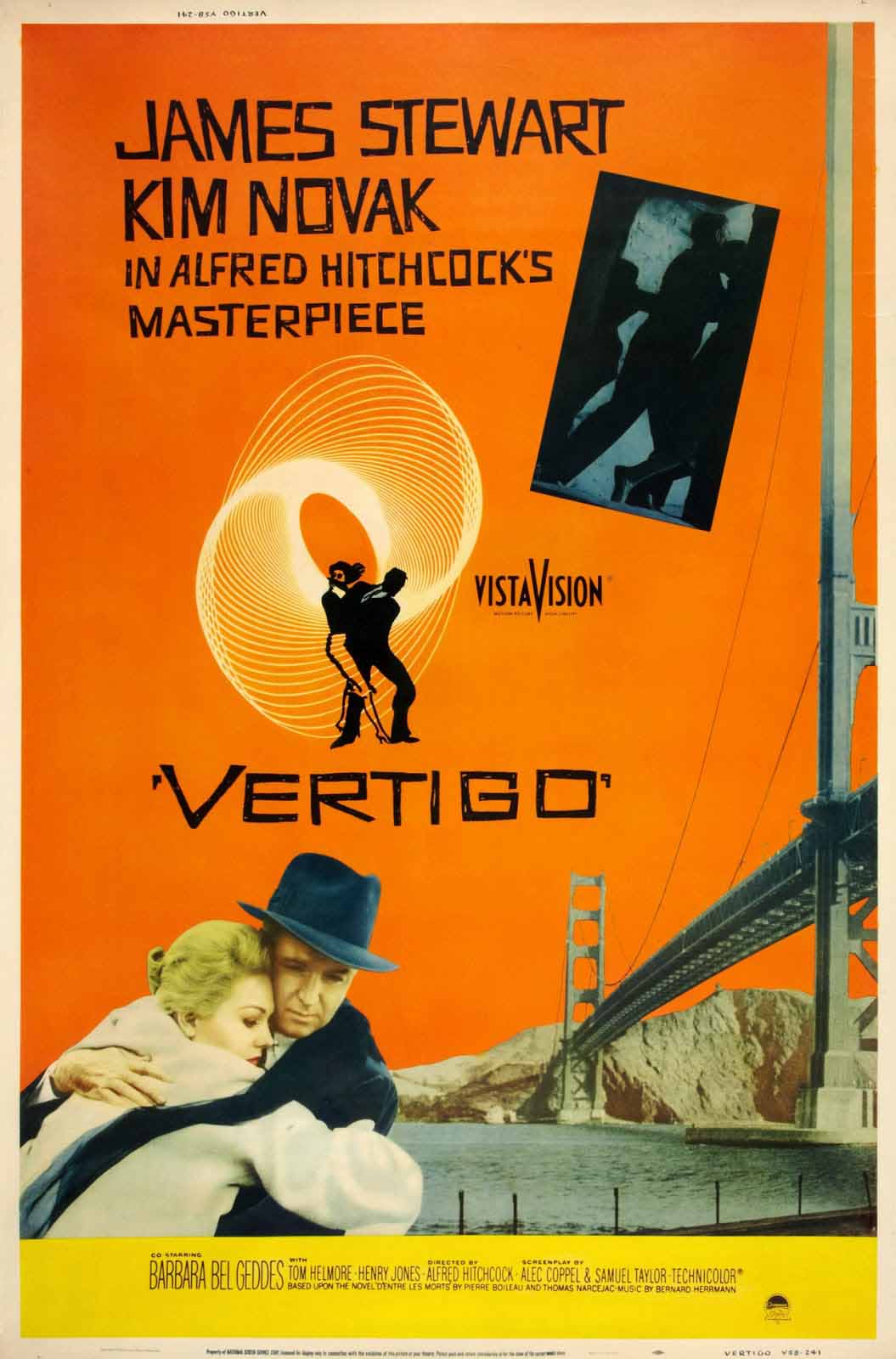
Vertigo (1958)

James Wallace Harris

Read the Wikipedia entry for a concise overview and evaluation of Hitchcock’s Vertigo — especially the sections “Reception.” When Vertigo was first released it got very mixed reviews, but over the years its reputation has risen. Some polls have even placed it as the best film ever made. Quoting this one paragraph should give you an idea of what I mean:

Over time the film has been re-evaluated by film critics and has moved higher in esteem in most critics' opinions. Every ten years since 1952, the British Film Institute's film magazine, Sight & Sound, has asked the world's leading film critics to compile a list of the 10 greatest films of all time.[83] In the 1962 and 1972 polls, Vertigo was not among the top 10 films in voting. Only in 1982 did Vertigo enter the list, and then in 7th place.[84] By 1992 it had advanced to 4th place,[85] by 2002 to 2nd, and in 2012 to 1st place in both the crime genre, and overall, ahead of Citizen Kane in 2nd place; in 2022, the Sight & Sound poll ranked Vertigo 2nd place.[86] In the 2012 Sight & Sound director's poll of the greatest films ever made Vertigo was ranked 7th.[87] In the earlier 2002 version of the list the film ranked 6th among directors.[88][89] In 2022 edition of the list the film ranked 6th in the director's poll.[90] In 1998 Time Out conducted a poll and Vertigo was voted the 5th greatest film of all time.[91] The Village Voice ranked Vertigo at No. 3 in its Top 250 "Best Films of the Century" list in 1999, based on a poll of critics.[92] Entertainment Weekly voted it the 19th Greatest film of all time in 1999.[93] In January 2002, the film was voted at No. 96 on the list of the "Top 100 Essential Films of All Time" by the National Society of Film Critics.[94][95] In 2009, the film was ranked at No. 10 on Japanese film magazine Kinema Junpo's Top 10 Non-Japanese Films of All Time list.[96] In 2022, Time Out magazine ranked the film at No.15 on their list of "The 100 best thriller films of all time".

If you haven’t seen Vertigo, you should go watch it before reading my reaction.

I’ve seen Vertigo twice in the past year, and it is a mesmerizing film. But what makes it great, or even the greatest? I love dozens of films, but I have no idea which one is best, even for me. How can critics think in terms of ranking films? By what criteria do they judge them? If you search on YouTube, you can find several documentaries and short films about Vertigo. Some people are quite passionate about this movie and what they see in it.

I know there is one thing missing from Vertigo, and maybe all Hitchcock films – and that’s an uplifting experience. His films are pure movie storytelling. There are no messages, no moralizing, no philosophy, no expressions about Art, and they aren’t studies in sociology. Some critics analyze them psychologically, but I’m not even sure they express anything consistent about psychology.

This summer, Time Magazine picked one hundred movies the editors considered the best to celebrate its one hundred years of publication. Three of Hitchcock’s films made the list, The 39 Steps, Vertigo, and Psycho. What qualities did the editors of Time and other list makers use to rank films?

I can’t answer that without months or years of study. What I can do is give my reaction to Vertigo. Is there something in my reaction or yours that points to the quality that makes films great?

On a simple level, Vertigo is a murder mystery, but the audience doesn’t know that until two-thirds way into the show. And then it doesn’t matter. The film starts with San Francisco detective John “Scottie” Ferguson (James Stewart) chasing a fugitive across rooftops. He jumps a gap, misses, and hangs by a gutter several floors above an alley. A uniform officer comes to help Scottie and falls to his death.

Next, we meet Scottie in the apartment of Marjorie “Midge” Wood (Barbara Bel Geddes). It’s a beautiful room overlooking San Francisco and the bay. Midge an artist who makes her living illustrating women’s underwear. Midge and Scottie were once briefly engaged. Stewart was 49 at the time, and Bel Geddes was 35. I found that age difference surprising. This scene is used to show how Scottie has become afraid of heights and the resultant vertigo. This is important to the plot, but I don’t think it’s important at all to the story.

Soon after that Scottie meets with his old college friend, Gavin Elster (Tom Helmore). Helmore is four years older than Stewart. He asks Scottie to tail his wife who is acting weird. Madeleine Elster is played by Kim Novak who is only 24. I also found this age difference hard to accept. I’ve even read that Hitchcock thought the age differences were a problem, but since many people consider this film about sexual obsession, and in recent years we’ve been learning about how obsessed Hitchcock felt over his female stars, it makes the age difference mean something. However, I doubt Hitchcock planned that.

Novak plays two characters, Madeleine Elster and Judy Barton, but moviegoers don’t know that until two-thirds way into the film. The first two-thirds of the movie is Scottie following Madeleine around and falling in love with her. It’s all rather mysterious.

There are two McGuffins in Vertigo. One is a murder mystery. Some critics have even called Vertigo a film noir. I think that’s bullshit. From my experience of watching the film three times, it’s all about lusting after Kim Novak’s characters. The second McGuffin is Madeleine’s obsession where she thinks she’s a reincarnated woman from the 19th century who committed suicide. The 1950s were full of weird psychological studies and stories like Bridey Murphy, The Three Faces of Eve, and Edgar Cayce. Starting in the late 1940s and through the 1950s, mental illness was a big theme in the movies. Madeleine’s obsession is colorful, but it’s another McGuffin.

That’s because Judy Barton is playing the role to help Gavin kill the real Madeleine. They are using Scottie’s fear of heights. Gavin and Judy make up this obsession to trick Scottie. It’s not real or valid.

The audience doesn’t know about this subterfuge, and that’s why I don’t think it matters. What we really enjoyed while watching the film is Jimmy Stewart chasing after Kim Novak. And we’re just as shocked as Scottie when we think we see her die. This is Hitchcock’s obsession – to surprise and shock his audience. He loves building suspense. Suspense and surprise are his core values.

Scottie goes through a year in a mental hospital helped by Midge. Of course, we wonder, why isn’t Scottie chasing after Midge? Then Scottie sees a woman who looks vaguely like Madeleine, but who claims to be a poor shopgirl named Judy Barton. Novak as Madeleine looked classy, Judy looked trashy. For the rest of the film, Scottie slowly convinces Judy to change her appearance to look like Madeleine while he woos her. Judy finds this creepy.

The audience and then Scottie learns that Judy is really the same girl who impersonated Madeleine. However, Scottie doesn’t turn her in. He’s obsessed with recreating Madeleine and recreating his experience of the murder scene. He tells Judy he wants to confront his fear of heights. Scottie becomes increasingly creepy, pushing Judy into doing things she doesn’t want to do. Personally, I felt sorry for Judy. Even though she committed a murder for money, she seems less amoral than Scottie. Yet, I’ve never seen any critic call Scottie amoral.

In the final scene, Scottie frees himself of his fear, but a nun scares Judy, and she falls from the same tower as Madeleine. Damn, in this movie, anyone that goes up several floors with Scottie falls to their death. And that’s three for three.

I love watching this film, but I don’t care about the story. I don’t care about the plot. I don’t care about who the characters are. All I love is the visuals, the cinematography, the sets, the costumes, the interiors, the street scenes, the cars. It’s all gorgeous. And I love looking at Kim Novak.

Is beautiful to look at a reason to make Vertigo one of the greatest films of all time? If I made a list of my favorite 100 films, I would include it.

But damn, I wish I could rewrite this story!

The story follows the point of view of Scottie. It should have followed the point of view of Judy. Then it would have been a true film noir murder mystery. Kim Novak would have had a deep character to play. Imagine how Judy would have gotten involved with the scheme and what it would have taken to pull it off. Think about all those details. Imagine, how afterwards Judy realized she had fallen in love with Scottie and let herself be found. Imagine how hard she would have wanted to be Judy and loved by Scottie, and how upsetting it would be to have Scottie remake her into the woman she murdered.

Hitchcock missed something big. The story was based on a novel, and the screenplay had to be rewritten several times. They should have rewritten it again.

JWH