by James Wallace Harris, Thursday, June 28, 2018
I’m reading mid-20th-century science fiction looking for stories that would stand out in 2018 and I came across “5,271,009” by Alfred Bester. At first, I thought it merely a dazzling bit of pyrotechnic wordplay. I dismissed it as all flash and no heart. Bester is most famous for two extraordinary science fictions novels of the 1950s, The Demolished Man and The Stars My Destination. Bester was commissioned to write a story for the cover of the March 1954 issue of The Magazine of Fantasy and Science Fiction.

What Bester delivered was story Bob Dylan might have written in 1965 after reading The Book of Job and The Master and Margarita, before settling down to pen “Ballad of a Thin Man.” “5,271,009” makes you wonder if Jack Kerouac had just taught Bester how to break open benzedrine inhalers or if Bester had been one of the early users of LSD in a 1950s psychological study.
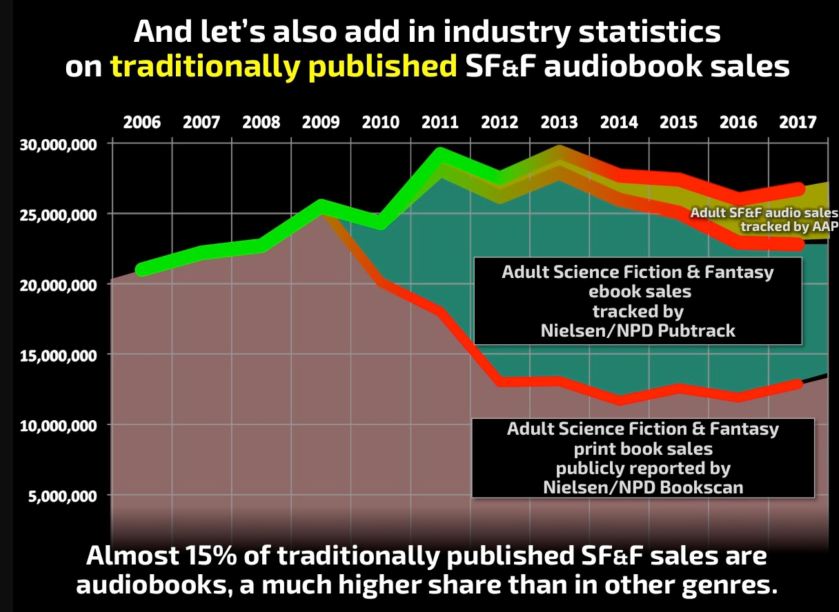
“5,271,009” is not written in ordinary prose. Oh, how I would love to hear this story read by an overly dramatic audiobook narrator. Every would-be professional book reader should use it as their portfolio story to showcase their range of character voices in a variety of wacky situations.
 Unfortunately, this story is not available to read on the web. However, a 99 cent Kindle edition is available at Amazon. Bizarrely its been retitled as “The Starcomber.” If you don’t want to plunk down 99 cents to read it, you can look at this list of places it’s been anthologized. Maybe you have a collection with it already. For a couple dollars more, you can get the $2.99 Kindle edition of Virtual Unrealities: The Short Fiction of Alfred Bester that contains 17 of Bester’s short stories along with an introduction by Robert Silverberg. That’s quite a bargain. I had to spring for this collection too because the single-story edition stopped letting me copy quotes after a slight quota. I thought that rather cheesy since I bet it’s in the public domain because there’s another publisher selling a different 99 cent edition.
I shall quote from it liberally to prove my statements about its prose are not hyperbole.
The story has a roundabout way of getting started. We’re introduced to Solon Aquila in a rather normal pulp fiction style. It is a story that would have fit perfectly in Unknown, a pulp magazine devoted to fantasy in the 1940s. The story isn’t science fiction, but it might be about science fiction.
Take two parts of Beelzebub, two of Israfel, one of Monte Cristo, one of Cyrano, mix violently, season with mystery and you have Mr. Solon Aquila. He is tall, gaunt, sprightly in manner, bitter in expression, and when he laughs his dark eyes turn into wounds. His occupation is unknown. He is wealthy without visible means of support. He is seen everywhere and understood nowhere. There is something odd about his life.
This is what’s odd about Mr. Aquila, and you can make what you will of it. When he walks he is never forced to wait on a traffic signal. When he desires to ride there is always a vacant taxi on hand. When he bustles into his hotel an elevator always happens to be waiting. When he enters a store, a salesclerk is always free to serve him. There always happens to be a table available for Mr. Aquila in restaurants. There are always last-minute ticket returns when he craves entertainment at sold-out shows.
We must assume Mr. Aquila is a metaphysical being, maybe the devil, maybe a minor god, maybe even the big guy himself. We don’t know. Then we hear him speak:
“HmimelHerrGottSeiDank! I’m crazy, man, crazy. Eclectic, by God,” he told a flabbergasted department store president. “The Weltmann type, nicht wahr? My ideal: Goethe. Tout le monde. God damn.”
He spoke a spectacular tongue of mixed metaphors and meanings. Dozens of languages and dialects came out in machine-gun bursts. Apparently he also lied ad libitum.
“Sacré bleu. Jeez!” he was heard to say once. “Aquila from the Latin. Means aquiline. O tempora O mores. Speech by Cicero. My ancestor.”
And another time: “My idol: Kipling. Took my name from him. Aquila, one of his heroes. God damn.”
WTF? This is 1954. It’s a science fiction magazine. Where did Bester get his inspiration for Mr. Aquila? He sounds like a speed-freaking Beat poet.
Like I said, the story actually starts slowly compared to its eventual pace. Mr. Aquila visits the art gallery of Jimmy Derelict looking for a particular artist. My theory is Bester was writing this story by the seat of his pants and he thought it was going to be about Aquila.
On the morning that Mr. Solon Aquila was stunned by his first disappointment, he bustled into the atelier of Lagan & Derelict, dealers in paintings, sculpture and rare objects of art. It was his intention to buy a painting. Mr. James Derelict knew Aquila as a client. Aquila had already purchased a Frederic Remington and a Winslow Homer some time ago when, by another odd coincidence, he had bounced into the Madison Avenue shop one minute after the coveted paintings went up for sale. Mr. Derelict had also seen Mr. Aquila boat a prize striper at Montauk.
“Bon soir, bel esprit, God damn, Jimmy,” Mr. Aquila said. He was on first name terms with everyone. “Here’s a cool day for color, oui! Cool. Slang. I have in me to buy a picture.”
“Good morning, Mr. Aquila,” Derelict answered. He had the seamed face of a cardsharp, but his blue eyes were honest and his smile was disarming. However at this moment his smile seemed strained, as though the volatile appearance of Aquila had unnerved him.
“I’m in the mood for your man, by Jeez,” Aquila said, rapidly opening cases, fingering ivories and tasting the porcelains. “What’s his name, my old? Artist like Bosch. Like Heinrich Kley. You handle him, parbleu, exclusive. O si sic omnia, by Zeus!”
“Jeffrey Halsyon?” Derelict asked timidly.
“Oeil de boeuf!” Aquila cried. “What a memory. Chryselephantine. Exactly the artist I want. He is my favorite. A monochrome, preferably. A small Jeffrey Halsyon for Aquila, bitte. Wrap her up.”
We don’t know it yet, but Jeffrey Halsyon is the protagonist of this tale, the man pictured on the cover of the March 1954 issue of The Magazine of Fantasy and Science Fiction.
It’s interesting that Halsyon is very close to the spelling of halcyon.
There are a number of pages about Halsyon being an insane artist who creates his art by defacing currency, and thus illegal to sell. Aquila insists he must see Halsyon and eventually frees him from confinement. This is where the story really begins.
I am reminded of stories Bob Dylan told about when he wrote “A Hard Rain’s a-Gonna Fall.” Supposedly, he wrote it during the Cuban missile crisis, trying to cram all the ideas he had for many songs into one in case WWIII began. Bester seems to cram many story ideas into “5,271,009” in the same way. Some have theorized Bester wanted to explore an array of SF ideas all using the number 5,271,009.
Again, I’m not so sure that Bester wasn’t just writing by the seat of his pants, typing whatever scenes came to mind. He spends too much time in the hospital where Halsyon is imprisoned. Then Mr. Aquila slips Halsyon a mickey:
He filled a shot glass from a decanter, added a tiny cube of purple ice from a fuming bucket, and placed the drink in Halsyon’s hand. Compelled by a gesture from Aquila, the artist drank it off. It made his brain buzz. He stared around, breathing heavily. He was in what appeared to be the luxurious waiting room of a Park Avenue physician. Queen Anne furniture. Axminster rug. Two Hogarths and a Copley on the wall in gilt frames. They were genuine, Halsyon realized with amazement. Then, with even more amazement, he realized that he was thinking with coherence, with continuity. His mind was quite clear.
He passed a heavy hand over his forehead. “What’s happened?” he asked faintly. “There’s like . . . Something like a fever behind me. Nightmares.”
“You have been sick,” Aquila replied. “I am blunt, my old. This is a temporary return to sanity. It is no feat, God damn. Any doctor can do it. Niacin plus carbon dioxide. Id genus omne. Only temporary. We must search for something more permanent.”
“What’s this place?”
Halsyon escapes but then comes to somewhere else. This part reminds me of Dylan’s “Ballad of a Thin Man” and a couple other songs I can’t remember for sure.
The president of the United Nations came to him. He was tall and gaunt, sprightly but bitter. He was wringing his hands in dismay.
“Mr. Halsyon! Mr Halsyon!” he cried. “Where you been, my cupcake? God damn. Hoc tempore. Do you know what has happened?”
“No,” Halsyon answered. “What’s happened?”
“After your escape from the looney bing. Bango! Atom bombs everywhere. The two-hour war. It is over. Hora fugit, old faithful, Virility is over.”
“What!”
“Hard radiation, Mr. Halsyon, has destroyed the virility of the world. God damn. You are the only man left capable of engendering children. No doubt on account of a mysterious mutant strain in your makeup which makes you different. Jeez.”
“No.”
Halsyon is informed that 5,271,009 virgins are clamoring for his attention, and he should pick a number from 1 to 5,000,000 and begin impregnating them.
At first, this is every teenage boy’s wet dream come true. Then Halsyon starts complaining that all the women look alike when the novelty wears off. Like any tricky Genie, Mr. Aquila grants wishes with thorns. Eventually, he is told the women resent him and consider Halsyon their rapist.
Halsyon then meets Judith Field, the old love-of-his-life. He wants to marry just her but continue with his procreation duties of being the new Adam. She wants to kill him. He learns he must escape and Mr. Aquila tries to help, but a mob of women clubs him to death.
I suppose I should worry about providing too many spoilers. You can quit reading any time you want and go read the story. Well, back to the story. The next scenario involves the story that illustrates the cover above with the spaceman chained to a very small asteroid. We’re now realizing Halsyon will not escape from his nightmare so easily. This reminds me of Confessions of an English Opium Eater by Thomas De Quincey, and Mindswap and Dimension of Miracles by Robert Sheckley. In all these stories our heroes frantically search for a way back to normal reality.
The scene changes again.
And he drifted alone in space, a martyr, misunderstood, a victim of cruel injustice.
He was still chained to what had once been the wall of Cell 5, Block 27, Tier 100, Wing 9 of the Callisto Penitentiary until that unexpected gamma explosion had torn the vast fortress dungeon—vaster than the Château d’If—apart. That explosion, he realized, had been detonated by the Grssh.
His assets were his convict clothes, a helmet, one cylinder of O2, his grim fury at the injustice that had been done him, and his knowledge of the secret of how the Grssh could be defeated in their maniacal quest for solar domination.
The Grssh, ghastly marauders from Omicron Ceti, space-degenerates, space-imperialists, cold-blooded, roachlike, depending for their food upon the psychotic horrors which they engendered in man through mental control and upon which they fed, were rapidly conquering the galaxy. They were irresistible, for they possessed the power of simul-kinesis—the ability to be in two places at the same time.
Against the vault of space, a dot of light moved slowly, like a stricken meteor. It was a rescue ship, Halsyon realized, combing space for survivors of the explosion. He wondered whether the light of Jupiter, flooding him with rusty radiation, would make him visible to the rescuers. He wondered whether he wanted to be rescued at all.
Bester is making fun of science fiction here. It even reminds me of the beginning of Bester’s own novel, The Stars My Destination. Mr. Aquila shows up in the disguise of a robot. There must be a name for this kind of story since I see it so often. Another variation of it is the 1967 film Bedazzled. Doesn’t this next bit remind you of something Douglas Adams would have written?
When he recovered consciousness he was in a plasti-cot in the cabin of a starship. The high frequency whine told him they were in overdrive. He opened his eyes. Balorsen stood before the plasti-cot, and Balorsen’s robot and High Judge Field, and his daughter Judith. Judith was weeping. The robot was in magnetic plasti-clamps and winced as General Balorsen lashed him again and again with a nuclear plasti-whip.
“Parbleu! God damn!” the robot grated. “It is true I framed Jeff Halsyon. Ouch! Flux de bouche. I was the space-pirate who space-hijacked the space-freighter. God damn. Ouch! The space-bartender in the Spaceman’s Saloon was my accomplice. When Jackson wrecked the space-cab I went to the space-garage and X-beamed the sonic before Tantial murdered O’Leary. Aux armes. Jeez. Ouch!”
“There you have the confession, Halsyon,” General Balorsen grated. He was tall, gaunt, bitter. “By God. Ars est celare artem. You are innocent.”
“I falsely condemned you, old faithful,” Judge Field grated. He was tall, gaunt, bitter. “Can you forgive this God damn fool? We apologize.”
Bester goes on to create other scenes to trick Halsyon, but I won’t quote them all. I should leave you to have some fun on your own.
This is where we need to decide if Bester is just jerking us around, or if he has something artistic to say. He’s getting paid by the word so he might be just filling up the pages. It could be every morning he got up and wrote some new way to torment Halsyon. This is a novelette of about forty pages, so it’s a rather long story. Maybe too long.
On the other hand, it might be a meta-fiction bit of philosophy. Not quite profound, but head bending enough to mesmerize science fiction readers and dope smokers.
“Stop reading the book,” he shouted. “Let me out of the pages. Can you hear me? Stop reading the book! I’d rather be in a world of my own making. Let me go!”
There was a mighty clap of thunder, as of the covers of a mighty book slamming shut. In an instant Halsyon was swept spinning into the third compartment of the seventh circle of the Inferno in the Fourteenth Canto of the Divine Comedy where they who have sinned against art are tormented by flakes of fire which are eternally showered down upon them. There he shrieked until he had provided sufficient amusement. Only then was he permitted to devise a text of his own … and he formed a new world, a romantic world, a world of his fondest dreams… .
He was the last man on earth.
He was the last man on earth and he howled.
I truly wish I could hear this story read by an amazing audiobook narrator.
Finally, we get to the kicker, or at least the kicker for me. Is Bester making fun of science fiction or fiction in general? Bester didn’t stick with the genre and left it after his wild successes with two novels and a handful of short stories.
He helped Halsyon to his feet and led him into the consultation room where he seated him in a velvet chaise longue and gave him a glass of brandy.
“Guaranteed free of drugs,” he said. “Noblesse oblige. Only the best spiritus frumenti. Now we discuss what we have done, eh? Jeez.”
He sat down behind the desk, still sprightly, still bitter, and regarded Halsyon with kindliness. “Man lives by his decisions, n’est-ce pas?” he began. “We agree, oui? A man has some five million two hundred seventy-one thousand and nine decisions to make in the course of his life. Peste! Is it a prime number? N’importe. Do you agree?”
Halsyon nodded.
“So, my coffee and doughnuts, it is the maturity of these decisions that decides whether a man is a man or a child. Nicht wahr? Malgré nous. A man cannot start making adult decisions until he has purged himself of the dreams of childhood. God damn. Such fantasies. They must go.”
“No,” Halsyon said slowly. “It’s the dreams that make my art … the dreams and fantasies that I translate into line and color… .”
“God damn! Yes. Agreed. Maître d’hôtel! But adult dreams, not baby dreams. Baby dreams. Pfui! All men have them… . To be the last man on earth and own the earth… . To be the last fertile man on earth and own the women… . To go back in time with the advantage of adult knowledge and win victories… . To escape reality with the dream that life is make-believe… . To escape responsibility with a fantasy of heroic injustice, of martyrdom with a happy ending… . And there are hundreds more, equally popular, equally empty. God bless Father Freud and his merry men. He applies the quietus to such nonsense. Sic semper tyrannis. Avaunt!”
“But if everybody has those dreams, they can’t be bad, can they?”
“God damn. Everybody in fourteenth century had lice. Did that make it good? No, my young, such dreams are for childrens. Too many adults are still childrens. It is you, the artists, who must lead them out as I have led you. I purge you; now you purge them.”
Bester is right. Those are common plots. I’ve used them in my failed attempts to write science fiction.
Is Bester telling science fiction readers to grow up and stop indulging in childish fantasies? I need to track down fanzines of that era and see if anyone fans complained.
At my online group we’re discussing mid-century science fiction short stories, and pretending we’re creating our own retrospective anthology to impress modern young readers. We’re trying to find 20th-century science fiction that resonates with 21st-century minds. At first, I wasn’t going to consider “5,271,009” for my anthology. Now I’m not so sure.
“5,271,009” is not a story that’s been often reprinted. I found it in Science Fiction of the 50’s edited by Martin H. Greenberg and Joseph Olander, a collection that was never very successful, out of print, and hard to find. I’ve been reading a lot of science fiction stories from the 1950s and I’m not sure how many will appeal to young readers new to reading science fiction in 2018. Neither Dikty or Asimov/Greenberg picked “5,271,009” for their best stories of 1954 anthologies.
I’m not sure “5,271,009” will be remembered unless it’s produced as a jazzy audiobook or made into a movie. It would be a perfect Black Mirror kind of story. Alfred Bester should have the same kind of appeal as Philip K. Dick.
JWH