
Will Internet TV Make Cable and Satellite TV Extinct?

There are two kinds of TV, live and recorded.  Internet TV sites like Hulu have already proven how well they can handle recorded TV shows.  Internet TV even does away with the need for a digital video recorder (DVR).  Think of a show, find it, watch it.  Internet TV like Hulu is even better than broadcast, cable or satellite for sponsors because viewers are required to watch the commercials.  And as long as they have such limited commercials as they do now, I don’t mind watching them.  Otherwise I’ll pay for streaming services like Netflix to be commercial free.

Where Internet TV is weak is for live broadcasts, like for sports and 24/7 news.  The infrastructure of cable and satellite systems have far more bandwidth for handling live television.  That won’t always be so, because I’m sure some kind of broadcast Internet technology will emerge to solve that problem and people will be watching live TV on their iPhones, iPads, netbooks, notebooks, desktops, HTPCs and Internet TV sets.

Digital technology ate the music industry, and is about to eat the book, newspaper, magazine and television industries.  I gave up cable TV months ago and for recorded shows I’m in hog heaven by using the Internet TV, which includes streaming Netflix.  I also supplement by viewing diet with snail-mail Netflix discs, but I see where that habit could be phased out too.  The only reason to get a disc now is for the picture quality of Bluray.  Future bandwidth will wipe out that technology too.

Owning music CDs and video DVDs seem so pointless now.  I wonder how that’s going to impact the economy and effect the entertainment business.  It also makes me wonder about my efforts of building an easy to use HTPC.  I’m struggling to get perfect Bluray playback through my HTPC computer, wondering if I should spend $80 for better software, knowing full well in the not too distance future I’ll phase out Bluray too.  The HTPC has phased out the LG BD390 Bluray player I bought just last year, and an Internet TV set could phase out my HTPC.

biggerthanlife

Last night my friend Janis had us watch Bigger Than Life on Bluray because NPR had praised this old James Mason movie so highly.  The flick wasn’t very entertaining, but it was fascinating.  The Bluray presentation of this 1956 CinemaScope production was stunning in 1080p high definition, showing intricate shadows and vivid colors.  Internet TV and streaming Netflix can’t provide that kind of resolution right now, but I imagine it will before 2015.

Technology is moving so fast that we buy devices we want to throw away in a year or two.  Growing up my folks wanted appliances and TVs that would last 15 years.  I remember Ma Bell phones lasting over twenty years.  I’ve had my 52” inch high definition TV for only three years and I’m already lusting for a new set.  Will technology ever settle down again so we can buy something that will last a generation?  I think it might.  Of course it will be terrible for the economy, but I can imagine TV technology that would satisfy me and take the ants out of my pants to have something better.

My perfect TV will still be a 1080p HDTV like we have today.  I’m pretty sure we can go decades without changing the broadcast standards again.  It will have a digital tuner to handle over-the-air broadcasts (in case the net goes down) and an Ethernet jack and WiFi for Internet TV.  It will have two removable bays.  One for a computer brain that can be upgraded, and another for a SSD hard drive.  As Internet TV is perfected the need for a local DVR will be diminished.  That will also be true for an upgradable CPU.  There will be no cable or satellite TV.  Everything will come to us by TCP/IP.  Broadcast will remain for the poor and for when the Internet fails.  Cable and satellite TV will go the way of the record store.  I also assume all Internet access will be wireless, but it will take 5-10 years to phase out wires.  Now that doesn’t mean cable and satellite companies will go under.  I expect them to buy into the Internet TV revolution.  I do get my internet access from Comcast.

Most people will think I’m crazy by predicting the extinction of cable and satellite TV.  They can’t picture living without all that choice.  That’s because of the channel switching mindset.  We have always thought of what’s on TV by flipping through the channels, even though very little TV is live.  Most of TV is recorded, and we fake immediate diversity by offering 200 concurrent channels to watch.  Eventually the only channels to watch will be live, because other technology makes it easier to find recorded shows ourselves.

Live TV will go through a renaissance.  Cable and satellite TV systems are still the best technology for live TV, and they will hang on to their audiences for another ten or twenty years as Internet broadcast TV is perfected.  However, guerrilla TV is emerging on the net, and micro audiences are evolving.  For the big networks, how many Today like morning shows will we need for live TV?  How many channels to promote sports?  How many to 24/7 talking head news and reality shows do we need?  How many live PBS networks will we need?  Will audience gather around central networks or seek out specialized Internet broadcasters catering to their personal interests?

Ultimately, how much TV really needs to be live?  Even 24/7 news shows spend a lot of time repeating themselves.  Live TV is leisurely.   The hours of the Today show are filled with just minutes of quality content, most of the time is fluff and commercials.  And if an opera is filmed live for PBS does it really need to be seen live?  Survivor and Amazing Race would be tedious if live.

When the flipping the channels metaphor dies out, and library checkout metaphor gains popularity, TV viewing will change.  People love football, war and car chases live, but will even that change too?  If you were sitting with you iPad killing some time, will you think, “Hey let’s watch the game in Miami,” or will you want to play a game or watch something recorded?   I can easily imagine sites of “WHAT’S HAPPENING NOW!” start showing up, listing thousands of events going on around the world.  TCP/IP technology will work better to provide that kind of service than cable or satellite.

Until you play with Internet TV you won’t understand what I’m saying.  You’ve got to sleep with the pods or drink the Kool-Aid to buy in.  Start with streaming Netflix and Hulu.

And if people love cell phones, Facebook and Twitter to stay in constant contact won’t they love live TV from their friends.  Instead of watching the crew of the Today show have fun, why not video link all your friends and create your own morning show?  And the emergence of spy networks will also change viewing habits.  If every daycare and classroom had web cams, wouldn’t parents spend more time watching them?  Won’t all the web cams in the world grabbing eyeballs destroy the audiences of the 200 channels of national networks?

We can’t predict the future.  Growing up in the 1960s I never imagined anything like the Internet.  All I can predict is change and more of it.  But I’m also going to predict that once the Internet and digital upheaval is over, we might settle down to a slower pace of change.  Well, until artificial intelligence arrives or we make SETI contact with distant civilizations.

Recommended Reading:

JWH – 4/10/10
Living in the Hive Mind

Our minds are created out of billions of interconnected brain cells.  And we’re billions of people living in an interconnected world of television and computer networks.  Is our world becoming the science fictional hive mind?  Personal computers have gone to parallel processing with ever growing number of CPU cores.  Is something like Wikipedia the result of thousands of human minds working in parallel?

For most of Earth’s biological history, individual life forms competed with others for survival.  Eventually organizations like social insects and herd animals developed, but what can we call the Internet in relation to biological cooperation?  Is it a hive mind?

How much of my thinking dwells on my immediate life of breathing, eating, drinking, sleeping and earning dollars to make my living, and how much is spent on data from the gigantic sensory network of the Internet?  And wasn’t books really just an earlier form of networking?  And then newspapers, radio and television more advanced forms?

I just finished reading Lady Chatterley’s Lover by D. H. Lawrence which most people think is about sex, but it’s also about the transformation of society by industrialization.  Last night I watched Bright Star, about John Keats and Fanny Brawne in England 1818-1821, about one hundred years before Lady Chatterley’s Lover.  I’m also reading Darwin’s Origin of the Species by Janet Browne, about how Charles Darwin came to write his famous book.  All three of these stories illustrate the transformation of society over the past two hundred years.  I think the romantic poets might have been canaries in the mine.

In Bright Star, people lived in houses with no electricity, and light and heat came from fire.  Their only connection with the world beyond their vision was through letters and books.  People led lives very close to other people, as nearly all work and play involved direct social involvement.  Much of our time is spent communicating with people indirectly though computers and television screens.  We spend far more of our time connected with the world beyond our vision.  Facebook is considered socializing by many people.

The gamekeeper of Lady’s Chatterley’s Lover, Oliver Mellors knows what it’s like to be an individual and understands how industrialization was destroying individuality.  One of the reasons the novel is so much about sex is because Lawrence believes the physical contact between individuals is more important than intellectual communication.  Was Lawrence right?  Is the hive mind bad?

Could we ever go back?  What if we turned off the hive mind?  It would involve shutting down the computer and television networks.  What would society be like if the fastest form of communication was books and letters?  I’d be out of a profession, since most of my life has been working with computers.  When I was young I worked in libraries, so I could go back to that.  Oliver Mellors couldn’t stop industrialization so he and Lady Chatterley had to retreat from the world to a farm.  During the 1960s the final path of hippies was back to the land too.  In fact, for thousands of years, all revolts against socialization has been back to nature movements.

Through the Internet I am in communication with people from all over the world.  Could I return to a life of working in my yard and hanging out with a few people I know physically?  For most people it’s not an either or consideration, they blend in both worlds, but if you look at the young they are spending more and more time in the hive mind.  The mobile phone will probably become the closest thing we’ll ever have to telepathy.

I spend a lot of my time being lonely for physical interaction with other people.  And even though I find great intellectual satisfaction from the Internet it never eases that physical loneliness.

Farmville, the Facebook game, has over 82 million active players, and represents over 1% of the world’s population.  What does that say?  Is it a virtual return to the land, or is it a new hive mind form of socializing, or is it a sad escape from physical loneliness?  I say that as I write this for my hive mind friends to read while my wife is out in the den tending to her virtual farm.

JWH – 3/27/10

Unique Perspectives

We love people who can think outside of the box.  We love people who can see the world from a unique perspective.  We love people who can spot the trends before anyone else.  Well two of my friends have turned me onto a couple of people that have left me stunned with admiration, so I thought I’d pass them on to you.

The first is from Professor Jesse Schell and his take on where Facebook is leading us.  It’s in three parts:


If you watch these videos and don’t have a clue to what he’s talking about, well then I think you need to worry about being out of touch with pop culture, or else accept that the future has rushed past you.  Farmville has over 80 million users worldwide, and if you can’t understand what a weird fraking fact that is, then you might want to study these videos.  I’m not sure rock and roll in its heyday had those kinds of numbers.  Evidently it’s more addictive than meth, crack and heroin combined.  I know from experience since I’m a Farmville widower.

Next up is Christian Lander and his Stuff White People Like, a blog of brilliant social commentary with over 63 million hits.  The way to start reading this site is to visit the Full List of Stuff White People Like and pick a topic dear to your heart and get ready to be undressed.  Even more fun is to get together with a bunch of other white people and read these posts aloud.  Even when Lander isn’t skewering me, I’m learning so much about the people around me that is both hilarious and incredibly insightful.  Damn, I wish I had his people watching skills.

JWH – 3/2/10

What I Want To Be When I Get Old

I’ve picked twelve areas of knowledge to pursue in the last third of life.  It’s a conscious effort to organize my thoughts and actions.  Twelve specialties sounds like too many, but I’ve selected them like building blocks to work together as a whole.  Essentially what I have done is analyze what I’ve been doing for years unconsciously and state them here publicly to make them clear to me.  The pains of aging remind me of my limited time left on Earth and inspire me to change.  What I’m really doing is deciding what I want to be when I get old.  

Areas of knowledge might sound too lofty.  I could say I have twelve self-improvement topics I want to study, or even call them twelve goals for going the distance.  We do not have the language to express ideas of self-programming.  I’ve always loved John Lily’s book title Programming and Metaprogramming in the Human Biocomputer, but sadly the book is about a great scientist going off the deep end with hallucinatory drugs and sensory deprivation.  But I digress.  Self-improvement is a vast topic for the publishing industry but has a poor connotation, but that phrase might come closest to my task.

I am a fat, lazy, late middle-aged man who has tumbled through life like big rolling weed acquiring random knowledge and wisdom through undisciplined osmosis.  Since I’m a programmer and work with computers, I think with cyber concepts, so picture an old PC that’s been running Windows XP for years.  This dusty old machine takes forever to boot up, and runs  slower and slower each day.  It’s time for a tune-up!  I want to delete all the clutter and crapware, cleanse the registry, run malware utilities, uninstall all the programs I don’t use, and decide on which programs are the most productive to keep.  I’m realistic.  I don’t expect to suddenly become a new Intel i7 machine running Windows 7, but I can make the old hardware run much more efficiently.

When we are young we have great ambitions about growing up.  We want to be somebody special and find the perfect mate.  During our middle years we expand our ambitions, seeking security, wealth and success.  But for the last third of life our goal is retirement, where we reduce our workloads and seek simple pleasures.  I say bullshit to that.  Maybe it’s because I didn’t find the success I wanted in youth and middle age that I hold out hope for an ambitious last third of life.

I’m not worried about the outward appearance of aging, the wrinkles, baldness, age spots or hobbled gait, what I’ve discovered that’s hard to see as a young person, is getting old is a state of mind that deals with wearing out mentally.  Avoiding pain, illness and injury becomes a relentless occupation.  My daily pains are minor compared to what I’ve seen in others, but the decline in health I’ve experience so far is wonderfully educational.  So for my first study goal is pretty obvious, and probably universal.

1. Maximize Health

I don’t need to become an authority or expert on this subject, but I do require major studying and practice.  Hell, I know the basics, eat right and exercise. Where I need to specialize is in the discipline of of mind over matter, or more precisely, mind over body.  I could greatly improve both the quality and quantity of my sunset years if I could lose weight.  I’ve been slowly gaining weight since my late twenties, and the only time I was actually able to lose poundage was due to illness, not a practical long term solution.  Of course, the secret to weight loss is knowledge many have sought and few have found.  I need to study books about the mind, and maybe even woo-woo subjects like yoga, meditation and will power.  This is one subject I wished I had mastered in childhood and practiced lifelong.

2. Enlightened Citizenship

I wanted to become an expert in green living, but I’ve decided that focus is too narrow.  I am deeply disturbed by partisan politics and our lack of will to make tough decisions about all our problems.  I believe in social democracy; we vote daily on countless issues with our every decision.  I am reading The Great Transformation by Karen Armstrong and I’m reminded of her description of how the ancient Chinese practiced their religion.  Instead of being concerned with invisible gods and abstract concepts of the sacred, these people sought perfection by improving the simple acts of everyday life.  In other words, how you clean your house is more spiritual than religious rituals you embrace. 

3. XHTML/CSS/PHP/JavaScript/JQuery/CodeIgniter

After thirteen years of programming in classic ASP  I need to learn a whole new suite of programming languages and tools.  This is putting me way out of my comfort zone, but it’s my chance to prove that an old dog can learn new tricks.

4. Internet Living

I’ve been living on the net since the mid-80s with BBSes, Genie, CompuServe and Prodigy.  I’ve embraced digital life.  I’m fascinated by it’s potential.  I don’t think we’ve seen anything yet, so I want to explore all the emerging possibilities and even write about what will happen in the future.

5.  Clear Writing

I want to be a much better writer.  I love blogging, but I want to go beyond dumping out my thoughts.  I’m a wordy bastard that can’t structure an essay, much less a book.  I need to remove the clutter from my sentences and learn to assemble  paragraphs into larger structures that build coherent ideas.  I’m best at 500-1,000 words, but I want to write larger essays and even a book.

6.  Techniques of Fiction

I’ve been trying to write fiction since a high school creative writing class.  Like my failure at dieting, I can’t break through the writing discipline barrier either.  I’ve taken many writing courses and workshops.  At best, I can crank out words, but except for one time in endless tries, I can’t reach the critical mass of fictional fusion.   I need to master the language of fiction in the same way I write a computer program, so the story works without major bugs.

7.  Robot Novel

I’m struggling to write the great American robot novel.  After space travel, time travel, and alien encounters, robots are about the most over-written topic in science fiction.  Yet, I believe I have a fresh idea if I can crank out 100,000 readable words of fiction.  Notice how specializations 5-10 relate?  I’m not going off in twelve different directions, but hope I’m pursuing twelve skills I can integrated into a synergy of effort.

8.  Evolution of Mind

To say anything fictional about robots will require understanding artificial intelligence, and AI has always depended on studies of the mind.  I find my library is full of books on robots, AI, mind and evolution.  I bought all those books because they were individually interesting, but now I’m going to read them as fuel for my novel.  If we are the pinnacle of intelligent life on Earth now, what will occupy that position in a million years?  Or a billion?

9.  Sense of Wonder

I’ve been a reader and scholar of science fiction my whole life.  People who adore science fiction claim its because it generates sense of wonder.  Sense of wonder has been around far longer than science fiction so it can’t claim exclusive rights, but I do believe that science provides a special kind of sense of wonder.  For too long now science fiction has been living off past glories.  It’s time to find new concepts that push our sense of wonder button.

10.  Cosmological Perspective

Our perceived position in the universe has always been very philosophical.  It is very hard to grasp our location in relationship to the rest of reality.  Even the shape of the universe is impossible to fathom.  If we are God’s supreme creation, why are we so small?  And can any religion or philosophy be valid that doesn’t fully incorporate our knowledge of cosmology?

11.  Learning in Old Age

What are the limits of acquiring new knowledge in an old brain?  Could I learn something in my last third years that I wasn’t able to learn in my first third years?  Could I go back and finish Calculus II, or learn to play the guitar?  There is a discipline barrier that I’ve never been able to crash through.  I find my wisdom grows as my body declines, but will I ever be wise enough to overcome the limitations of my body?

12.  Our Existential Relationship with Fiction

We can’t understand reality so we make up stories.  It is impossible to predict the future yet we constantly create fiction to envision what will come.  And I don’t mean science fiction.  These twelve areas of knowledge I am pursing are a fiction.  The odds are I’ll just get older, fatter, suffer more, watch even more television while waiting to die.  I invent fictions about how I will change myself and fight the inevitable.   But that’s my point about programming and metaprogramming in the human biocomputer.  Is life no more than meta-fiction?

* * *

These twelve topics of specialization are ambitious, but I don’t think impossible to achieve.  It will make me a Renaissance (old) man.  And success can be measured across a range of achievement levels.  No one gets out of here alive, so death can’t be considered a failure of life.  I am reminded of the many books I’ve read about Eastern religions where the last third of life is set aside for spiritual pursuits.  At the end of the rat race, wisdom is the only possession worth pursuing.  But I grew up with a Western world mindset.  Reality is a savage land meant to be conquered, not accepted like our friends, the Eastern gurus teach.

Christians love the concept of the eternal soul.  As an atheist I’m not sure souls exist, at least not in the past.  That doesn’t mean we don’t want to fashion our own souls.  That doesn’t mean we aren’t evolving towards creating souls.  Through discipline we program our identities.  Through metaprogramming we program our programming.

JWH – 2/27/10 

LibraryThing, Goodreads, Shelfari, Google Books, Anobii, WeRead

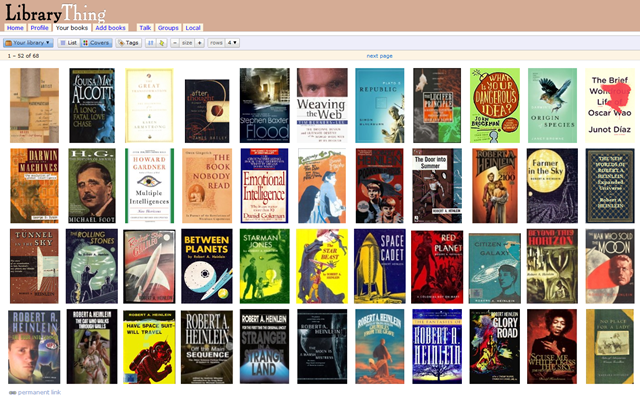
I’ve been a bookworm my whole life, and for as long as I can remember I’ve wished I had a list of all the books I own.  I’d also love to have a list of all the books I’ve read.  I think it would be impossible to create the second list, but the first list would only be a matter of typing.  And now with the Internet and the ISBN book number, it’s even less typing than before.  I could even buy a barcode reader that looks up information automatically online without typing at all.  My first consideration was to buy a standalone computer program like Book Collector from Collectorz.com, or even design my own database or spreadsheet with Access and Excel, but I decided the fun solution is to use a Web 2.0 online book cataloging site. 

The Internet has added an extra twist to this list making activity, called  social cataloging.   By entering your books into an online database it allows social network programs to compare your list to lists created by millions of other bookworms.  The synergy of doing this offers endless social networking possibilities.  The obvious one is to find other readers who have similar reading tastes to yours that will help you find great books to read that you’ve missed.  For people trying to build big personal libraries, it’s fascinating to know the size of other collector’s collections.  The largest on LibraryThing is 43,061 books.  Also on LibraryThing, the most reviewed book is Twilight (1,386 reviews), the most owned book, Harry Potter and the Philosopher’s Stone (47,598 people out of 1,035,403 members), or that my favorite science fiction writer, Robert A. Heinlein has 72,427 books in those collections, as compared to my second favorite science fiction writer Philip K. Dick who has 46,991 books in LibraryThing user’s homes.  That’s out of 48,365,418 total books catalogued.

The trouble is there are many wonderful book cataloging sites to choose from, each with their own plus and minuses.  Luckily, all are free except LibraryThing, and it’s free for your first 200 books, so you can try them all.  The sites I’ve found so far are (there may be more):

Each of the sites try to make it easy to enter books, but they all do it differently.  They each have millions of books already catalogued, so the quickest way to add a book to your list is to find it first on their list by searching on the ISBN and then hitting the add button.  This can be made even faster with a barcode reader, but I don’t have one.  I’d say it’s taken me a couple hours to enter in 58 books at LibraryThing.  This is slow because I like selecting the right cover photo to match the cover of the book I own, and I started with a shelf of old books without ISBN numbers.  That means searching by author or title, or even entering in all the book info myself.  I could probably do 60 books in 20 minutes if they were all recent and I only needed to use ISBN.  Usually when you get a book with ISBN, the cover and all the other information is already there.

LibraryThing

I’ve taken to LibraryThing, but when I finished building my list I could export my library to another site to see if I like their social networking features better.  Or I’ve thought about using one site for listing books I own, and another for books I can remember reading.  Or use another site for just my non-fiction science and history books to see if I can find readers with my exact interests.  The different cataloging sites have discussion groups for books, or linking systems to Facebook and blogging sites, so if you like to discuss and review books, these systems connect you to other people who are looking to read reviews or talk about books too.

On one blog I read a post by a woman who said her family paid for three separate $25 lifetime subscriptions to LibraryThing, for herself, her husband and her kid, so I’m assuming there’s long term rewards for doing the work of entering a book collection into the system.  I won’t know for awhile.  I’ve got 18 more shelves of books to enter, and then I’ve got to try all the different features, but I’ll get back to you with more info.

I’ve added books with all of these systems and I find it easiest to add books to LibraryThing, especially when dealing with manual adds.  LibraryThing was the only site to have any books by Lady Dorothy Mills, an author I collect.  Her books are very rare, and they only had 3 of 15 I own.  These systems are far from perfect, and the quality of the data is imperfect.  It would be great if everyone catalog the precise edition they owned, but that doesn’t happen.

Anobii, Shelfari and WeRead are probably best for people with newer books and people looking for more social interaction since they have the largest number of members.  They are slicker sites with more glitz than LibraryThing.  GoodReads is in the middle.  Google Books merely lets you tag books without any reporting features or social networking.  It is good for links to the web, and if you’re a complete Google user in general.

One of the fun things about adding books to LibraryThing is it tells me how many other members own the book when I add it to my collection.  For books by Lady Dorothy Mills, out of over a million users, I’m the only one that has any of her books.  I really like it when I find just a few people who also own the same book, like the 2 other people that own In Search of Paradise a biography of Charles Nordhoff and James Norman Hall, the guys who co-wrote Mutiny on the Bounty.  Are those two people much like me?

JWH – 2/7/10

I finished my data entry and my library can be seen here.   To me, the fun way to view is by cover art.  Open your browser to fill the screen and then click the Covers button.  I have 706 books.  I learned a lot by creating this catalog.  For one thing, I have too many books, and I plan to thin my collection when I get a chance.  The largest portion of this collection is unread by me.  My bookstore roaming eyes are far bigger than my reading stomach.  I really wish I had more time to read.

JWH 2/16/10