Collecting Science Fiction Covers for 4K Monitor

by James Wallace Harris, Saturday, July 22, 2017

[I’m going to show screenshots of my computer’s desktop to illustrate using a computer monitor as an art gallery. The image in WordPress will be small. You won’t see the wonderful details I see on a 28″ screen. If you right-click an image and save it, you should be able to see it full-size on your computer.]

My new hobby is collecting digital scans of covers from science fiction books and magazines. It’s a minor hobby that I find pleasing to my mind and memories. Back in the 1970s, I and some of my science fiction buddies enjoyed taking 35mm photographs of covers using a macro lens and then showing these cover collections as a slideshow at the science fiction club meetings. People were always blown away when they saw the art blown up.

A picture, we have always been told, can convey a thousand words. If you study cover art for magazines and books you might discover that’s conservatively true. Artists visualize details for science fiction stories I never do in my mind while reading. Often the artist will put more details for a story into his artwork than even the author imagined in words. I love that. For example, what’s going on here? I’ve never imagined such a wild colorful machine in my head.

Amazing - what's going on

With the advent of flatbed scanners, computer monitors, and even large screen TVs, it’s possible to create similar slideshows to my 1970s Kodachrome slideshows. And I’m not alone in collecting digital art. For example, there’s a company called Klio that produces handcrafted digital picture frames with 4K monitors just for showing fine digital art. There’s already tremendous interest in 4K wallpapers. It’s also fun to collect hi-rez JPLNASA, and other astronomy images. So collecting imagines of science fiction book and magazine covers isn’t that strange. There are several groups on Facebook that love SF pulp covers. One of my favorites is Space Opera Pulp.

The problem I face is getting good scans. There are many places on the internet to find a collection of covers, but often they are small images or poorly scanned images. My 4K monitor has a resolution of 3840 x 2160 pixels, or roughly 8.3 megapixels in a 16:9 aspect ratio. In the future, we might have 8K monitors (7680 x 4320 – 33.2 megapixels). 3840 x 2160 is smaller than what many digital cameras and smartphones currently snap at maximum, but it’s a good deal larger than the standard computer monitor or HDTVs, which has a 1920 x 1080 resolution. Getting larger scans dramatically improves the visual impact of displaying digital art.

Most people want to use small images on the web to improve download times, and I understand that. But for us collectors, having larger scans is better.

I find the best scans are those I do myself. I’ll scan at 300 dpi. Here’s a 1550 x 2265 scan of Beyond This Horizon by Robert A. Heinlein. It looks great on my 4K monitor. The wear on the paper is visible, yet the details of the cover are wonderful.
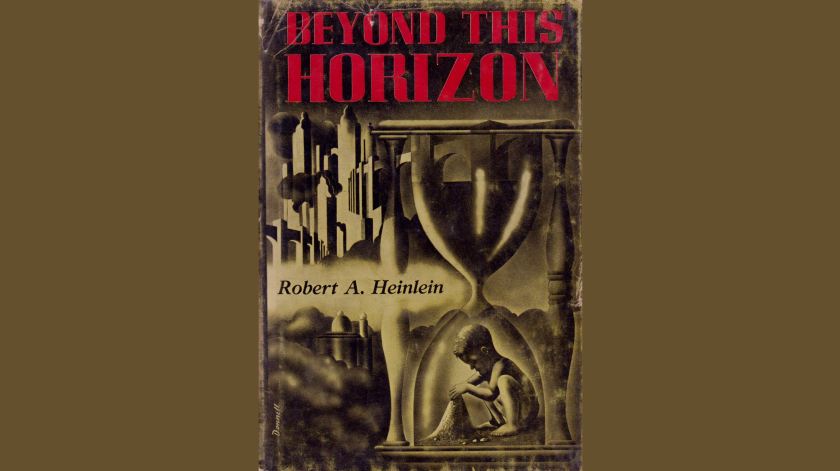
Beyond This Horizon

Here is a scan of the original Astounding magazine that first published Beyond This Horizon. It is only 400 x 550. It’s okay, but I wish it was at least 800 x 1100 or larger. By comparing the two, not only do we see how scanning resolution effects the presentation, but we also see how the condition of the book/magazine also determines what we will see. Also, isn’t it fascinating to see how two different artists captured the world Heinlein imagined?

Beyond This Horizon - Astounding cover

I must warn people who are considering buying a 4K monitor that there are drawbacks, especially for Windows 10 and Linux. Everything looks tiny when Windows is set to native display on a 4K monitor. You have to use custom scaling to get things to look right, and even then, not all apps cooperate. Usually, I scale to 150% or 225% on my 28” monitor. Some programs like Word and Chrome can also scale within their windows. Windows scaling to 225% help for getting around within Windows. 150% is much nicer for working with photographs and images.

Generally, the images I find on the web are usually much smaller than my monitor’s display resolution. I use a program called John’s Background Switcher (Win or Mac) to display my digital art collection. It had many options and setting variations for displaying digital images as your computer background. I use “Scale pictures to fit screen” which means I see the whole image without cropping, but it magnifies the image to fit the largest width or height. So portraits have color bars on the right and left, or landscapes have color bars above and below. John’s Background Switcher automatically selects the colors to use to match the image, and nearly always it’s a pleasing match.
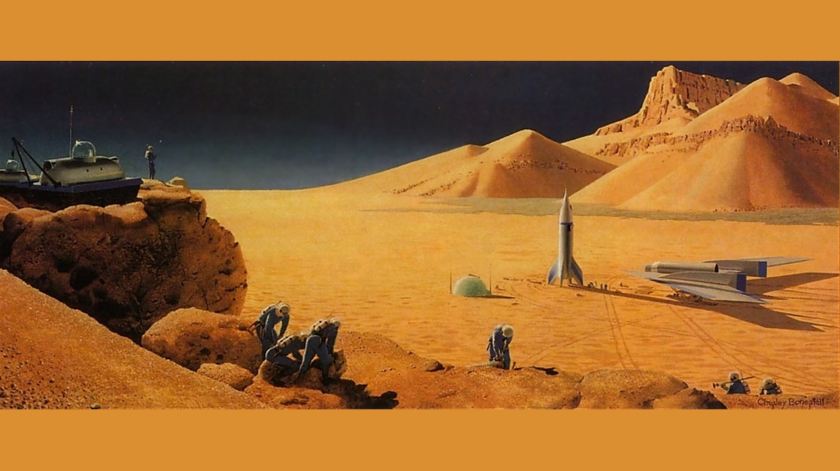
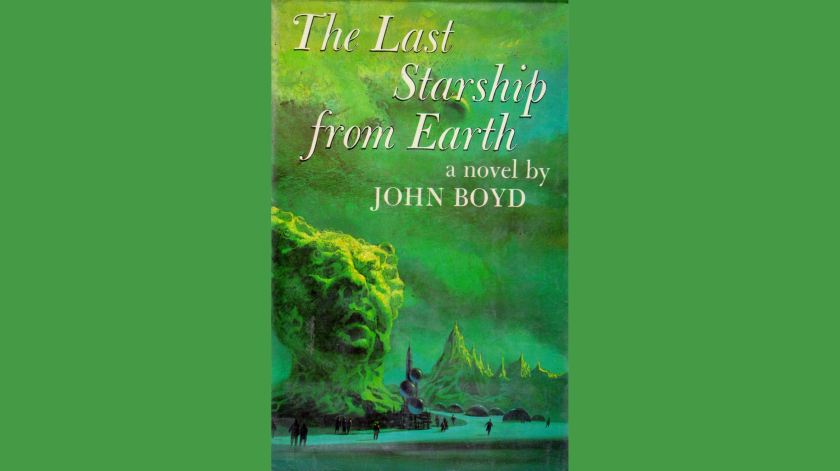
scaled to maximum width

The Last Starship From Earth

Between Windows scaling and John’s Background Switcher scaling, sharpness can take a hit. I find keeping Windows scaling down to 150% makes text barely large enough to read, but greatly improves image sharpness. However, it’s very important to get a good scan to begin with. Sometimes a 600-pixel high image can be much better than a bad 1500 pixel high scan. Here’s a 729 x 530 scan, but all the wonderful details of the artwork are fuzzy. This illustration is so wonderful that I wish I had a full 3840 x 2160 scan. Unless you see this image blown up you can’t appreciate the details the artist provides.

The Wooden Spaceships - bad scan

Sometimes I can find a scan of a cover and a copy of the original artwork that was used to make the cover. For example, I have an image Rocket to Nowhere by Lester del Rey (636 x 960) and a copy of the artwork used to make the cover (2484 x 3000). As you can imagine, the copy of the artwork is crystal clear and very dramatic on the 4K monitor. It actually has to be scaled down to fit on the screen. However, because the 636 x 960 scan is so sharp and well made it looks wonderful on the larger screen too.

Rocket to Nowhere cover

Rocket to Nowhere art

I’m not sure I can convey the impact of seeing these images on a 28″ 4K monitor via WordPress. Both large screens and high resolutions help make pictures have an impressive impact. Even black and white interior illustrations are greatly enhanced by size. Below is an illustration for one of the short stories from The Martian Chronicles by Ray Bradbury. Is it anything like how you pictured the story?

The Martian Chronicles - interior illustration

I also love collecting covers from my all-time favorite stories. Seeing them trigger memories of when I first read the stories. Here is the original magazine illustration for Have Space Suit-Will Travel by Robert A. Heinlein, and a scan of my personal copy of the hardback.

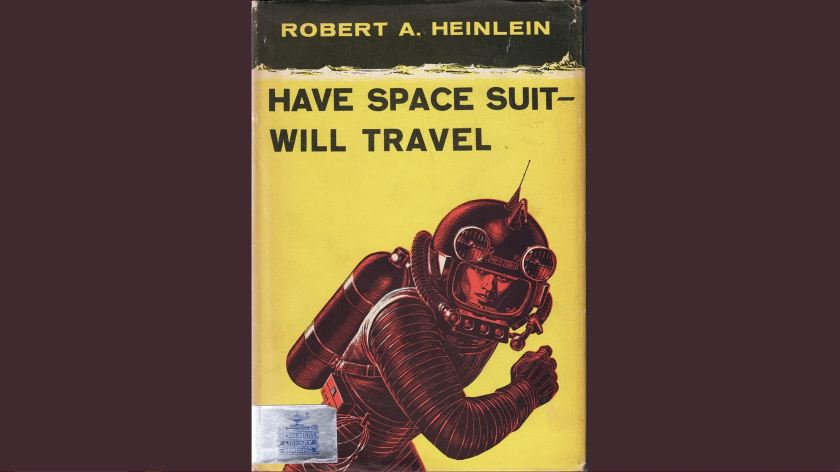
Have Space Suit-Will Trave FSF

Have Space Suit-Will Travel Scribners

Sometimes I can find scans of my favorite books, like Empire Star by Samuel R. Delany, but I’m dissatisfied with the scan. I keep it because it’s the best I’ve got. This makes me wish that people who scan covers think about the future. These books and magazines are deteriorating and fading. Whatever you scan might be the best memory we have of that book in the future. So make sure it’s in focus, the color is well balanced, and you get the most pixels possible. I wish this image was more in focus. It looks fine small, but not enlarged.

Empire Star - focus or resolution

Also, here’s a copy of the paperback edition where I first read Stranger in a Strange Land. Because the book itself is beat-up, the scan isn’t quite nice to look at. I keep it for nostalgia sake. I wish I had a better scan.

Stranger in a Strange Land

Old magazines fade. What makes a magazine collectible is its condition, and that can vary greatly. Scanners scan what they have, so I can’t complain. But I wish collectors who have better copies would scan their covers and upload them to share. Here is a bright Amazing and a faded F&SF to show the difference.
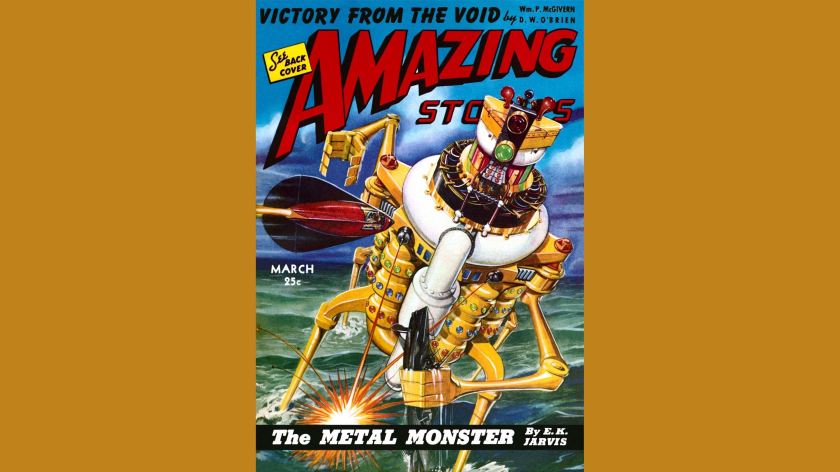
Amazing - vivid colors

FSF faded

I know 99.99% of people don’t care about what happens to old magazines. I just wrote an essay on Jane Austen for the 200th anniversary of her death. Reading about all that existed then that is now lost from 200 years ago makes me understand the importance of preserving the present for the future.

I love finding scans of original artwork used for cover illustrations, like this painting by Richard Powers. It’s a good example of how science fiction art changes styles and vogues over the years. Powers’ artwork sold a lot of science fiction in the 1950s and 1960s.

Powers original without layout

One reason I love looking at scans of old magazines and paperbacks is that I enjoy how people in the past imagined us folks in the future looking. Here are two paperbacks from the 1950s. The Door Into Summer is 1957 novel about a 1970 man taking cold sleep until the year 2000. I first read it in 1965, and we’ve already lived past the year 2000. I never wore anything that looked like that. Also, look at this cover of Nineteen Eighty-Four. It’s wonderful.

The Door Into Summer - Signet

1984

I could write about science fiction cover art forever. I’ve written about SF book covers in the past and will write about them in the future. I never get tired of them. I thought I was probably a very oddball person for liking old SF covers. But some of the groups on Facebook devoted to SF covers have thousands of members.

JWH
200 Years After Jane Austen

by James Wallace Harris, Tuesday, July 18, 2017

[To commemorate the 200th anniversary of Jane Austen’s death Book Riot devoted today to all Jane Austen essays, my contribution was “Who Jane Read, Who Read Jane.”]

Isn’t Jane Austen a writer for ladies who love romance stories? What kind of appeal can she have for a 65-year-old male with no interest in young women finding Mr. Right? This past week I watched films based on all six of Jane Austen novels with combinations of four different female friends. I thoroughly enjoyed them, but I’m not sure I enjoyed them for the same reasons my lady friends did. I have read four of her novels, and parts of several biographies.

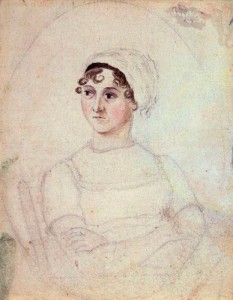
NPG 3630; Jane Austen by Cassandra AustenI wished I had read Jane Austen when I was a boy because I would have been much less clueless about girls. However, I’m not sure I could have liked her novels for the same reasons I do now. And I’m not sure I was a savvy enough teenage boy to decode their characters to understand how the opposite sex thought. I didn’t discover Jane Austen until 13 years ago when I was 52 and read Pride and Prejudice because a lady friend at work praised it so highly.

I’ve been attracted to Jane ever since. Jane died in 1817, at age 41, having never married. She is sexy to me now because of her writing skills. We know very little about Jane except for what comes through in six novels, about 160 letters that were heavily censored by her surviving sister Cassandra, and three scrapbook volumes of unpublished work now called her juvenilia. All of this has been collected in a $1.99 Kindle edition called The Complete Works of Jane Austen – a handy way to carry Jane around in your smartphone.

Jane Austen imaginedPeople still argue over what Jane Austen even looked like. The drawing above was made by her sister Cassandra, with some relatives claiming after Jane’s death that it wasn’t a particularly good likeness. The drawing on the left was found in recent years and was assumed to be an imagined version of what she looked like, but many fans hope because it’s old enough, to be a drawing of Jane while she lived.

Which brings us back to why I love to read Jane. I’m driven by the mystery of figuring out who she was. She wrote six books that after two centuries is still growing her fan base, already in tens of millions, maybe hundreds. Any writer should envy that. I say she’s tied with Charles Dickens as the most remembered English novelist of the nineteenth century. Understanding why their work survives when so many others haven’t, fascinates me.

I figure less than 100 novels from any country are still popularly read and remembered today from the nineteenth-century. That begs the question: Why? In Jane’s day, Sir Walter Scott was the Stephen King/J. K. Rowling/James Patterson best selling author. Who reads Scott today? Why do we see stories on Masterpiece by Austen and Dickens reproduced over and over again? If we knew could today’s writers apply that knowledge to write books that would be popularly loved in 2317?

The films of Jane Austen seemed aimed at Regency romance fans, but I’m not sure that’s the kind of audience Austen expected. After her death, her family worked hard to censor the memory of Aunt Jane. Some conjecture has claimed she wrote over 3,000 letters. I wished we had them because I believe we’d have the real Jane. It’s a shame WordPress didn’t exist back then. I get the feeling from some of the clues that Jane was a funny sharp-tongued woman that might have had a lot to say about her world, but was held back by family, church, and publishing propriety. Her juvenilia hints at a more zany, even vicious Jane. In some ways, she reminds me of Louisa May Alcott who loved blood and thunder stories as a girl.

What we do get in the novels is a keen observer of people and society, and Jane would have been an excellent psychologist or sociologist. My mental map of nineteenth-century England comes from novelists, not historians. And I believe the everyday history included in their novels is a major trait of Austen’s and Dickens’ success. I have no interest in reading about the Napoleonic Wars which was concurrent with Jane’s stories. Some critics shame Jane for not being interested too, but I find her peripheral view of soldiers and sailors at home more interesting.

In the past two weeks, The New York Times has run two articles on textual analysis of Jane Austen and her word usage: “Charting Literary Greatness with Jane Austen,” and “The Word Choices Explain Why Jane Austen Endures.” Austen’s six novels stood out in their graph, away from all the other novels charted. (Strangely, they left out Dickens – I wonder why?)

Because of the anniversary of her death, there’s much being written about Jane. Just look at this Google search limited to the recent week. I’m sure this Jane Austen mania is invisible to most people, but for her fans, it only validates why she’s worthy of being remembered.

When I read Jane I delight in comparing then and now. Of course, Jane’s upper middle-class characters peeking inside manor houses totally ignores how ninety-five percent of England lived back then. Dickens trounced Jane at covering the full socio-economic spectrum. However, Jane covers a preindustrial time before Dickens. Jane was born the year before America declared independence and died the year before Mary Shelley published Frankenstein, A Modern Prometheus. Her novels have almost exclusive rights to that specific period of literary history. Whereas Dickens is working the same territory as the Brontës, Thackery, Trollope, Collins, and others. There were plenty of English novelists during the Regency period, but we don’t read them today.

Anyone who is a fan of Downton Abbey should be a fan of Jane Austen because that TV show chronicles the death of a lifestyle that Austen wrote about. The reason why the Crawley family had to leave their estate to a distant cousin is the same reason why the Bennets had to leave their home to Mr. Collins. Robert Crawley, the Earl of Grantham is pretty much a Mr. Darcy a century later who had to marry a rich American woman instead of a local Elizabeth Bennet.

I’m not an Anglophile, but to enjoy reading English novels means learning English history. Austen and Dickens anchor me in nineteenth-century England in the same way Twain and Alcott put me in nineteenth-century America, or Tolstoy lets me see nineteenth-century Russia. Their novels help me understand nineteenth-century art and art history, the time of my favorite paintings. Jane’s novels help me to appreciate on a deeper level historical novels like The Signature of All Things by Elizabeth Gilbert.

Yet, there’s another reason why I love Jane Austen novels. In the 1960s I grew up reading 1950s writers and stories. Over time I realized my favorite writers had favorite writers, and those writers had writers who inspired them. Many writers today can trace their literary genealogy back to Jane Austen. Over a lifetime of reading, I’ve been slowly studying a family tree of fiction. That gives me a great deal of pleasure.

Finally, reading Jane gives me Elizabeth Bennet, Elinor and Marianne Dashwood, Fanny Price, Emma Woodhouse, Catherine Morland and Anne Elliot. Fictional females are extremely important to understanding the history of women and the evolution of feminist thought in our culture. By reading novels, we can see how free women were in their times, from Elizabeth Bennet to Caroline Meeber to Lady Brett Ashley to Janie Crawford to Esther Greenwood to Isodore Wing to Ifemelu to Offred/June.

JWH

Is Facebook a Hive Mind?

by James Wallace Harris, Sunday, July 9, 2017

Science fiction has long predicted humans meeting alien races that belong to a hive mind. The most famous example is probably the Borg from Star Trek: The Next Generation. Currently Internet Live says there are 3.7 billion users on the internet, with over 2 billion on Facebook – that’s out of 7+ billion humans. What will it mean if humanity joins a singular bio-cyber-system that allows us to interconnect?

hive-mind-1

Some people think of the hive mind in negative terms, with everyone thinking in lockstep fashion. Other people believe the hive mind could be positive, a worldwide communion of souls. I’m somewhat in the middle. Technology can produce an iPhone or an A-bomb. Also, the term hive mind is currently defined in different ways, so we need to work out a common definition.

But let’s compare Facebook to the past. The earliest forms of mass communication were the newspaper and journal, but it wasn’t until radio and television that we started talking about the impact of mass communication. 530 million people watched the moon landing. That’s a lot of people for one shared memory, especially when we were only 3+ billion. It’s not uncommon now to see a silly sentimental video on Facebook shared by tens of millions.

The difference with Facebook and older media technology is the mass audience replies. Facebook allows people to respond to what’s being broadcast to the masses. That should be good, right? We get our say. Unfortunately, what’s heard sometime is ugly.

Hive-Mind-2

Humans aren’t like ants and bees. We don’t have rigid roles within our society. We don’t work together in unison for some common purpose. Humans are often in conflict. But that conflict can be anything from disagreement over a movie to starting another world war.

I’m not sure where Facebook will take us, but I have noticed one interesting trend. When I got my first modem back in the early 1980s I connected to services like CompuServe, Prodigy, GEnie, AOL and various Bulletin Board Systems (BBS). In each case, I joined forums to discuss books. When I got on the internet I discussed books on Usenet News. After the web took hold I discussed books on Yahoo! Groups. At each technology stage, I was able to discuss books with more people around the world.

Via blogging and Twitter, I guessed there were just a few hundreds of fans of old pulp magazine still around. After I got on Facebook I discovered many thousands.

Lately, Yahoo! Groups, my favorite method for online book clubbing, has been dying. In one book club, we formed a Facebook group to support our Yahoo! Group. Then my co-moderator left the Yahoo! Group to manage the Facebook. His group currently has 3,617 members, whereas the Yahoo! Group membership has dwindled down to less than 12 active participants. The other day I joined a Facebook group for Western movie fans, it has over 25,000 members. They answered a question in minutes I’d been Googling for days to find.

Technology that allows thousands of people with a shared interest to connect is not a hive mind, but it’s something new. Mass communication has always been a misnomer because the conversation was always one-way. Facebook is creating two-way communication – true communication. Right now we share our minds over funny cat videos, get-togethers with friends, family events, pop culture tidbits, and polarize over political views. The potential of the Facebook technology is still unknown.

What if Donald Trump used Facebook instead of Twitter? Twitter can be two-way communication, but usually, it’s not. Twitter is a favorite tool of cyber bullies. Facebook can be more like virtual get-togethers. Facebook is more inclusive because it is family friendly. That is more of your entire family probably uses Facebook than Twitter.

I doubt Trump would read replies to his posts on Facebook, but wouldn’t both sides of our political divide have to reply in the same place? That would probably the largest flame war ever. A riot in cyberspace. However, what if the Like icons became an instant poll so Trump would have immediate feedback on his ideas. (We’d also need a dislike button icon added to the array.) Wouldn’t that be kind of hive mind like? A president could know rather quickly what voters thought. That’s a sharing of minds.

If Facebook became real-time Gallup Poll for global opinions wouldn’t that produce science fictional results that change our future? Whether we call it a hive mind or not doesn’t really matter. But we want to call it something. Our own individual minds work through a cooperation of many subfunctions. If we create technology that allows billions of humans minds to create gestalt functions we need to name and study them.

JWH

Writing About Science Fiction

by James Wallace Harris, Wednesday, July 5, 2017

I have a new essay up at Book Riot, “What Do We Talk About When We Talk About Science Fiction?” It’s always fun to see other sites publish something I’ve written. And it’s an essay I’m proud of and want people to read. However, I’m not sure it’s the essay I intended to write. I don’t know if you have ever written an essay but if you have, do the thoughts you want to write ever come out the in the words you type?

Book Riot

Inspiration is often a vague idea, or maybe just a feeling. When you start writing about that momentary impulse other ideas start flowing out too. Ideas you haven’t thought of before, or planned. Quite often an essay will take off in a new direction, even a better direction. When I first started writing “What Do We Talk About When We Talk About Science Fiction?” I planned to list and categorize all the main topics of science fiction. I felt there were a finite set of topics we label as science fiction. The essay covered that somewhat, but not in the way I planned. It veered off into another thought, that science fictional ideas are descended from myths, religion and fantasy stories. I ended up saying when we talk about science fiction we’re talking about ideas that we’ve been talking about ever since we shared Europe with the Neanderthals. Science fiction has redefined some of those ancient desires. The few that have any kind of scientific possibility we call science fiction, the rest we call fantasy, religion, or myths.

Since I hang out in book clubs and forums devoted to science fiction I talk and write about science fiction a lot. More often than not we end up talking about stories, storytelling, plots, characters, authors, publishing, reviewing, cover art, and all the things that go into the making of the genre of science fiction, but not the actual philosophy of science fiction. It usually comes down to whether or not the story entertained us, rather than did the story have an original speculative idea.

I actually believe science fiction is a very limited area of discourse. I believe science fiction is the act of speculating about specific unknown aspects of reality. I believe reading a story that makes us think about life on alien worlds is science fictional, but I believe that’s different from enjoying an adventure story that’s set on another world with aliens.

I often wonder if the stories we’ve inherited from myths and religions are the entertainment versions of once serious speculations about reality. That one-day science fiction from the 20th century will be like us reading about Greek mythology. Will they ask, “Did they believe these stories were true?”

When Robert A. Heinlein wrote stories about people living on the Moon in the 1950s he thought his stories were speculating about the possibility of colonizing the Moon. He wanted his stories to inspire a generation that would actually go into space and build the high frontier. Now we read those stories for entertainment or nostalgia.

I’ve always believed the science fiction magazine was where the cutting edge of science fictional ideas first appeared. But few people read those magazines anymore. I’m out of touch with most of the popular SF novels. Few of them seem to be serious science fiction speculation. People want a thrill ride, not philosophy.

I’m not sure all the serious speculative ideas of science fiction haven’t become part of our everyday culture. Forbes, a magazine devoted to business regularly covers astronomy, cosmology, theoretical physics, and space travel at its website. Artificial intelligence and robots are now part of the corporate bottom line. Miracles of biotechnology and engineering are on the news every day.

So what are we talking about when we talk about science fiction? I worry science fiction is a dying area of philosophy that’s being transformed into entertainment category. For Example, why is a sequel to Blade Runner coming out soon, and not an honest version of Do Androids Dream of Electric Sheep? PKD was a weird-ass philosopher, not a writer of action hero adventure stories. In many ways, movie and television science fiction is stuck in the era of Planet Stories and never reached what was going on in Galaxy, F&SF and IF in the 1950s, much less what came out in the 1960s and 1970s.

p.s.

I used the essay as a post of the Facebook group Space Opera Pulp and some of the people also said that movie science fiction wasn’t like what we used to read. So maybe I’m not alone in thinking science fiction is changing.

JWH

Don’t Hate Me Because I Look Like Them

by James Wallace Harris, Wednesday, May 10, 2017

I’m a liberal atheist who’s always voted Democratic – but I look like a Republican – an old white guy. That’s getting to be a problem. Women and people of color are being political disenfranchised by the current political regime. I don’t think I’m being paranoid when I think they’re starting to hate old white guys. I don’t even blame them. Not only that, I’m getting tired of old white guys coming up and immediately telling me their weird-ass political ideas assuming I’m a member of their secret fraternity. I’m totally freaked out people will think I’m a Trump supporter because of my looks.

13 white guys

It’s a good thing I don’t want to be a politician because this country doesn’t need any more old white guys wanting to run the joint. I do want to be a writer, and unfortunately, there’s a long legacy of wordy old white bastards hogging the literary canon. I write for a site that works very hard to promote diversity in reading. I feel guilty even submitting essays. Yet, I’m very thankful to be their token old white guy. I’ve always been for diversity but I’m learning even more by hanging out at Book Riot.

The trouble is there’s a large segment of our country that wishes we all looked alike. Yesterday, The Atlantic reported “It Was Cultural Anxiety That Drove White, Working-Class Voters to Trump” and not economic anxiety. These people want to return to a paternalistic white past where women and people of color don’t disturb their vision of a homogeneous America. Recently, I’ve heard second-hand personal stories and read many reports in the news about people going up to Hispanic folks and telling them they should go home. That’s incredibly shameful. Knowing the president and leaders in Congress inspires such horrendous behavior makes watching shows like The Handmaid’s Tale unnerving. I thought climate change was dooming our future, but alt-right politics is going to destroy us first.

Not only do the Republicans not see anything wrong in having all old white guy committees, they take pride in claiming they don’t play identity politics. They even jockey with each other to out-do their denials claiming nothing is wrong. But it’s very wrong! The fact they can’t see their evilness is equal to Trump’s own anosognosia. Their blind spots are so huge it’s surprising they can see at all.

What really bothers me is their claim to be Christians, a religion based on teaching compassion. If these old Republican white guys are really going to church every Sunday they should stop. If they haven’t gotten the message after all these years then they are wasting their time. I’m an atheist that quit the church when I was twelve, but I did learn this in Sunday school at age five:

Jesus loves the little children,
All the children of the world.
Red and yellow, black and white,
All are precious in His sight,
Jesus loves the little children of the world.

Obviously, they didn’t. Women are half the world, and the whole world is diverse. Why can’t they see that? I think I know why, but it’s a terrible thing to think about another human being. Women, minorities, and immigrants tend to vote Democratic. Republican’s in their single-mindedness to lower their taxes will do anything, and I mean anything, to achieve that goal. In other words, greed has driven them blind, even to the point of abandoning their faith and becoming hateful.

They have sold their souls to lower their taxes.

I just want people to know that I might look like those zombies, but I ain’t one of them.

JWH