Do Bookworms Read Too Many Books?

by James Wallace Harris, Sunday, January 27, 2019

Yesterday I reread “Vintage Season” by C. L. Moore and Henry Kuttner for the third time. I’ve read the story twice in the last ten months. This time I read “Vintage Season” by listening to an audio edition on headphones while simultaneously reading the words on my iPad. Consuming fiction via two senses is the penultimate way to get into a story. I believe the ultimate way to fully experience a work of fiction is to read it several times.

The trouble with rereading is our TBR piles are always growing. We’re driven to brain-cram as many new stories into one lifetime as possible. Reading a story once is like driving through a city and claiming you’ve been there. Rereading a story the first time is like a two-day stay. Reading a story many times is like visiting a town for weeks. Literary scholars are those folks who move into a story as a permanent residence.

There’s value to being widely traveled in books, but at some point, all the places start looking the same. It’s a shame we can’t read everything. Even if I read just the great books, this lifetime won’t be enough.

Fiction is like finding old dinosaur bones. The first reading is an amateur fossil hunter digging up the bones and getting a rough idea what the creature looked like. Rereading is a professional paleontologist carefully reconstructing every aspect of that dinosaur.

The first time I read “Vintage Season” decades ago it was just another mind-blowing science fiction story. However, it stayed with me. I don’t actually remember the title of very many short stories, but I remembered this one. When I reread the story the second time last March when The Science Fiction Hall of Fame Volume 2A came out on audio, it was like watching an old favorite movie I had first seen as a kid on a black and white TV and seeing it again on a new high definition TV and then realizing it wasn’t a black and white movie, but a Technicolor masterpiece. Reading “Vintage Season” again yesterday while listening to the audio version, felt like I was walking around inside a 3D movie.

This intense immersion with a story will not work with all stories. Every work of fiction is a creative vision by a writer encrypted and compressed into words. Fantastically rich visions can’t be decrypted and decompressed in one reading.

If our reading lives are racing through one new book after another we’re barely getting the Reader’s Digest condensed version of the story, and if we’re speed reading, it’s just an introductory abstraction.

I am now torn between chasing after all those novels and short stories I want to read before I die and rereading old favorites knowing I might reach a higher plane of bookworm existence.

JWH


Is This Cartoon Sexist?

by James Wallace Harris, Tuesday, January 1, 2019

I told my wife I was going to put this cartoon on my Facebook page and she said I shouldn’t because it might be considered sexist. It’s a cartoon by Alex Gregory whose work appears exclusively in the New Yorker. You can read an interesting bio of Gregory and a description of his work methods at A Case of Pencils, a blog devoted to New Yorker cartoonists.

I didn’t post the cartoon on Facebook because I’m now worried it could be sexist, but I wasn’t sure either. I asked a few women friends and some said it was okay and some weren’t sure. None took offense. So I went looking for definitions to “sexist” online. I was surprised by how many different definitions I found.

  • referring to women’s bodies, behavior, or feelings in a negative way
  • a person who believes that particular jobs and activities are suitable only for women and others are suitable only for men
  • suggesting that the members of one sex are less able, intelligent, etc. than the members of the other sex
  • a person who believers their gender is superior and says unfair things about the other gender, or assumes that only one gender as a certain trait
  • relating to or characterized by prejudice, stereotyping, or discrimination, typically against women, on the basis of sex
  • a person with sexist views
  • if you describe people or their behavior as sexist, you mean that they are influenced by the beliefs that the members of one sex, usually women, are less intelligent or less capable than those of the other sex and need not be treated equally
  • relating to, involving, or fostering sexism, or attitudes and behavior toward someone based on the person’s gender
  • involving sexism and the belief that men and women should be treated in a different way

By studying these definitions I might need a Supreme Court ruling to know if this cartoon is sexist or not. Part of the humor of this cartoon is it plays around with all of these issues. It assumes the stereotype that men are usually in the car and women are looking in the window. Just reversing roles is funny. If the man wore hotpants and the woman a suit, it would be a different kind of funny even without a caption. The cartoon is making generalizations about men and women behaviors, but are those generalizations negative? Is it an absolute generalization? Few people are prostitutes or hire them, so maybe it’s making no absolute assessments about either gender. However, many people, including myself, see prostitutes as victims of a sexist society.

I think the first thing we should ask: Does it offend anyone? Now I can’t answer that because I don’t know how all seven-plus billion people on Earth think. The next question: Could it offend anyone? And this is my present quandary. I don’t want to offend anyone, nor do I want to be perceived as sexist. The prudent solution: never generalize about gender. I shouldn’t be writing this essay and I shouldn’t post anything on Facebook that could ever be construed as dealing with gender differences.

I feel sorry for comedians, humorists, and cartoonists. This morning I read “These 13 Jokes From ‘Seinfeld’ Are Super Offensive Now.” I have to admit I thought them funny back in the nineties. So much of humor is observational generalizations.

But here’s the thing, almost everyone along the gender spectrum likes to occasionally generalize about others on the spectrum. This cartoon is funny to some people because it makes observations that coincide with their personal observations. We have a natural ability for organizing patterns into behavioral traits. We see certain kinds of clouds and we think it’s going to rain. We see certain prices on a menu and decide a restaurant is expensive. We see a movie preview with a superhero and we assume it’s based on a comic book. All of these can be false assumptions, so this ability creates a lot of prejudices.

What is this cartoon assuming? Even here I can’t say for sure. Everyone will see something different. My assumption is women think men don’t listen and wouldn’t it be funny if some women are so horny to be heard that they will pay for a professional male listener. However, I know men who feel women don’t listen, and a reverse of this cartoon could work for them. There are stories about prostitutes with Johns who pay just for conversational companionship.

Cartoons about prostitution generally involve men who can’t get laid paying women for sex. Should men consider such cartoons as demeaning to them? I would never use a prostitute. Should I be offended by the possible suggestion that all men would? Or will some women be offended at the suggestion that some women would be willing to pay to be heard? And will psychiatrists feel offended if they think their profession is a kind of prostitution?

I would guess that many women would say they know plenty of men who are poor listeners so the idea of paying a man to be attentive to their conservation all night long could be funny. Is that an insult to men? I know plenty of men who complain about having to listen to their wives and girlfriends, so this cartoon should be funny to them, but will it offend women in general? The reason why I even have this cartoon is one of my male friends thought it insightful because he feels his girlfriends talk too much. I thought it funny because so many women I know seem to like me because I’m willing to listen. I thought I could be that guy in the cartoon.

Maybe the humor is even simpler. Maybe its saying men want sex and women want conversation. Many married couples might agree, but does a portion of the population seeing humorous validity mean its not offensive to couples where the woman wants sex and the man conversation?

And where’s the inequality? Is it offensive to desire talk more than sex?

But you never know what words will do. For example, when I wanted a copy of this cartoon I searched on Google for “Male Prostitute” and selected the Images tab. I got copies of the cartoon but I also got mug shots of male prostitutes. It didn’t even occur to me what those words could also bring up. That’s the thing about worrying about offending, we never know the full consequences of words.

(Now I worry about what kind of ads I’ll be seeing in the next few days.)

JWH


Even If You Only Speak English You Still Know Many Languages

by James Wallace Harris, Wednesday, December 19, 2018

My obsession with memory is teaching me fascinating lessons. I realized something new today. I was trying to remember what my mental outlook was like in 1959 when I was seven. I barely remember the presidential election of 1960 and seeing Kennedy and Nixon on TV. But I have no memory of ever even noticing President Eisenhower before 1960. And I got to thinking about my essay “Counting the Components of My Consciousness” and realized how important languages are in understanding the world around us.

I see now we know many languages even when we think we only speak one.

In 1959 I had no language for politics, so politics was invisible to me. I didn’t understand words like mayor, governor, president, senator, congressman, etc. I didn’t know about local, state, and federal governments. I didn’t know about the three branches of the federal government. I didn’t know about constitutions or legal systems. The world of politics was invisible to me because I didn’t know the language of politics. At seven, I also didn’t know the language of religion, science, mathematics, or even grocery shopping.

My awareness of politics began on November 22, 1963, when President Kennedy was shot in Dallas. That’s because my family watched the news for several days straight, and that hooked me on watching the nightly news with Walter Cronkite. However, I still didn’t know the language well. In the 9th grade (1965-1966) I took a required civics class that taught me the basics, but I’ve been learning the nuances of the language of politics ever since, and still don’t speak it fluently. It has its own vocabulary and grammar.

This morning I was researching where I went to school in Aiken, South Carolina in 1964. I found a copy of an Aiken newspaper online. I was 12 at the time. All the stories about local politics and businesses were unfamiliar to me. Even the ads were unfamiliar to me. I didn’t shop for groceries or clothes at age 12, so I didn’t have the language to remember that part of Aiken, South Carolina. I realize now I could have read that paper at age 12, but didn’t. I doubt I could have understood most of it. I didn’t have the languages. And that’s why I don’t remember 99.99% of what life was like in Aiken, South Carolina in 1964.

I’ve often returned to the year 1959 over my lifetime. 1959 was an important year in jazz, but I didn’t know that until I began learning the language of jazz. And my ability to speak jazz is at a very rudimentary level. I’m much more conversant in the language of science fiction so I can comprehend 1959 in science fictional terms much more deeply.

This revelation about knowing multiple languages within English is giving me many insights this morning. It explains why so many people refuse to accept that climate change is happening to us right now. They don’t understand the language of science, so it’s invisible to them. This realization also explains our polarized politics. Conservatives only know the language of conservative politics, so they are blind to liberal politics. And liberals are blind to conservative politics because they don’t know that language.

Linda, the other member of my two-person book club, suggested we read a conservative book for our next discussion. We’re both extreme liberals and she thought it might be enlightening if we did. And it is. We picked Conscience of a Conservative by Jeff Flake. I’ve only just begun but immediately realized Flake speaks a different political language than I do. His words have different meanings. His grammar is even different. His language references points to concepts and things in reality that I normally don’t see.

Liberals and conservatives are polarized because they aren’t speaking the same language even though they use the same words. In the essay, I mentioned above, I told about two experiences where I lost my ability to use words, and how reality looked when that happened. Without words, I didn’t know what things were. I could still see and hold them, but I could tell you what they were. Abstract concepts ceased to exist. Language is everything in understanding reality.

In 1959 I didn’t have the languages to understand most of what I saw and experienced. I’ve since learned a lot of new languages and can look back and see so many things that were invisible to me then. I’m obsessed with memory at this stage in my life, and I’m learning how important languages are to memories. I’m losing my memories, words, and languages. I struggle to keep them. One way of doing that is to look back over the years and study the languages that reveal what I saw.

We can’t trust our memories. One way to understand them is to struggle to remember what we saw. But another way is to study what we couldn’t see, and learn the language to reveal it.

I realize now I must study the languages I know more deeply to understand what I see now, and what my memories might have seen in the past. Here are the languages I partial know now but want to study deeper:

  • Science Fiction
  • Literature
  • Science and Nature
  • Politics
  • Ethics and Philosophy
  • Computers and Programming
  • Music
  • Television
  • Movies
  • Myths and Religions

JWH


Bookworms Should Worship Scribd

by James Wallace Harris, Monday, November 19, 2018

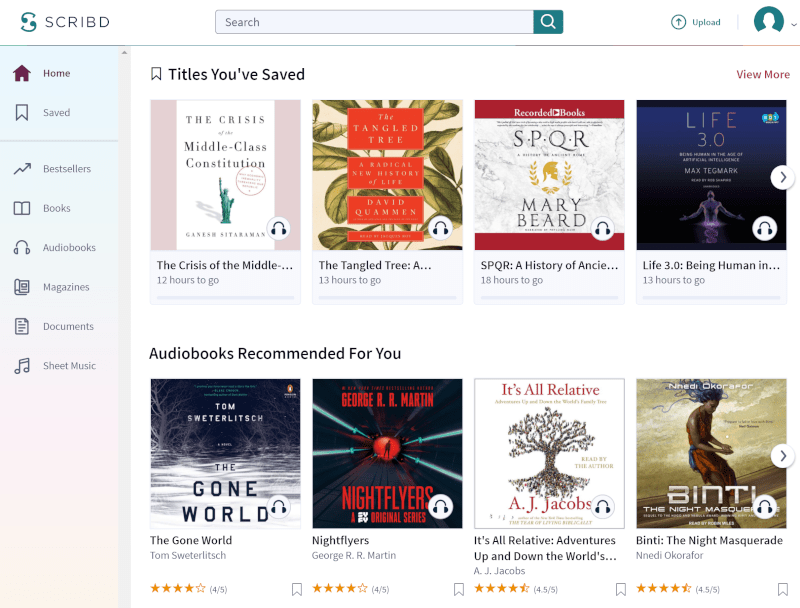
Scribd is to books and audiobooks as Netflix is to movies and television shows, and Spotify is to songs and albums. For $8.99 you get all the books and audiobooks you can read or listen to in a month. The complete variety of its offerings is somewhere between Netflix and Spotify. I consider Spotify at $9.99/month the best bargain on the planet because it provides nearly every song or album I ask from it. Scribd has about 80% of the books I read for book clubs or hear about word of mouth. It has around 25-30% of the older titles I want, but that’s better than Netflix. Plus Scribd offers magazines, sheet music, and single documents. Here’s my home screen.

Scribd 800

Every month I realize the value of my $8.99 subscription more and more. Yesterday I got a sale announcement from Audible.com for about 500 books. I love these $4.95-6.95 sales, and usually, load up. I told myself I could buy ten of them. I selected 17 to whittle down, but before I did I checked Scribd. All but one was there. This left me in a quandary. Did I spend $60 and hoped I eventually get around to listening to those books or did I take a chance they’d still be at Scribd when I wanted them?

I usually end up listening to one or two books a month from Scribd, and two or three from Audible. This might change. At $8.99 versus $20-30 (I buy the annual 24-pack of credits so my Audible books are $9.56 each, but single purchased credits are $15, which would be $30-45).

I’m in two nonfiction book clubs. Saturday night my face-to-face book club picked Sharp by Michelle Dean. The ebook version was at Scribd. White Trash, Bad Blood, and Educated, the last few selections I remembered were there too. I’m also in an online nonfiction club too. I’m listening to our current selection, American Wolf as an audiobook from Scribd. Next month’s read, The Crisis of the Middle-Class Constitution is also at Scribd, as was last month’s selection, Fascism by Madeleine Allbright. We’re now nominating books for the next three months. Here are the books at Scribd that’s among the nominations:

  • The Tangled Tree by David Quammen (audio)
  • Bad Blood by John Carreyrou (audio)
  • A Brief History of Everyone Who Ever Lived by Adam Rutherford (audio, ebook)
  • Leonardo Da Vinci by Walter Isaacson (audio, ebook)
  • The Library Book by Susan Orlean (audio)
  • My Beloved World by Sonia Sotomayor (audio)
  • Disinformation by Ronald J. Rychlak (ebook)

The nominated books that weren’t at Scribd are:

  • On Paper: The Everything of its 2000 Year History by Nicholas Basbanes
  • The Book: A Cover to Cover Exploration of the Most Powerful Object of Our Time by Keith Houston
  • Process: The Writing Lives of Great Authors by Sarah Stodola
  • Essential Essays Adrienna Rich

For months now, the books we actually select with our voting end up being on Scribd. However, this is only for nonfiction. I’m not in a general fiction book club. But for my science fiction book club, Scribd does well on new science fiction titles, but less well for older titles. The book we just picked for January, Noumenon by Marina Lostetter is available in both ebook and audiobook at Scribd.

I’ve always been a book hoarder, squirreling away books for the future. Now I need to rethink my book buying habits. I’ve practically stopped buying CDs because of Spotify. The only DVDs I buy anymore are rare titles for my western collection, everything else I stream. Is it time to rent my books too?

Every day I look at ebook sales from Amazon, BookBub, Early Bird Books, and LitFlash. At $1.99 I can’t resist a great book I think I want to read. But subscribing to Scribd is like having my own gigantic library with instant access to books and audiobooks, far more convenient that my local public library.

But owning books is so fulfilling! At $8.99 a month, even if I just used Scribd to preview the books I want to buy it’s a fantastic bargain. And if you’re a Kindle Unlimited subscriber, don’t think it compares to Scribd. Amazon doesn’t provide access to the books I want at Kindle Unlimited. Amazon seems to use up-and-coming writers and self-published books for its subscription service. And that’s a good thing for new writers, but it’s not what Scribd is doing. If you belong to a book club you really need to check out Scribd.

The reason I’m writing this essay is selfish. Scribd is just hanging on. It’s been reorganized several times. Several other book rental companies have come and gone. All are being squashed by the Amazon juggernaut. I want Scribd to survive and thrive so I will always have access to it. Give it a try if you love books.

I’m still crazy about Audible.com. I’m not going to abandon it. I’m a big fat bookworm, so I think paying for both is worth it. But for people who think Audible.com is too expensive at $15 a month, they should consider spending $8.99 a month at Scribd. It’s a much better bargain.

JWH


Kindle Tip – Saving 40%

by James Wallace Harris, Wednesday, September 4, 2018

I don’t know why, but sometimes Amazon tells me I have a promotional credit. I never know what they mean. The other day I bought a $1.99 sale ebook and was told I had a promotional credit that would last 60 days on my next Kindle purchase. I just ignored it. Then I bought a $1.99 sale book today and got another promotional credit. This time I read the email more closely.

Sense of Wonder - A Century of Science Fiction edited by Leigh Ronald GrossmanIt said I’d get 40% of my next Kindle purchase. Well, there’s a $40 Kindle book I’ve been wanting but wouldn’t buy because of the high price. It’s a textbook for teaching science fiction. Well, I checked, and it was now priced at $24, 40% less. I quickly bought it. I still think $24 is way too much of an ebook, but I’ve been wanting this book for some time now, and have almost paid the $40 for it a couple of times.

I don’t even know if this involved my promotional credit. It could just be coincidence and this book had a 40% price drop. (Tell me what price you see.)

I’ve researched these credits at Amazon and they seem rather unexplainable. I wonder if they’re just a gimmick to get us to buy more. Or Amazon’s way of justifying to publishers for offering extra discounting.

Does anyone know how these promotional credits work? They’re a mystery to me.

If you buy bargain Kindle books, keep an eye out for your promotional credit. Then go shopping for that ebook you wanted that was priced too high.

JWH