Filming Science Fiction Short Stories

Over at BestScienceFictionStories.com Rusty Keele got an email from a film director asking him about which science fiction short stories would make great 10-15 minute films.  Go by and post your suggestions.  I suggested “The Menace From Earth” by Robert A. Heinlein, even though it would have to be cut down some to meet the time limit.

I remember the science fiction stories from the old Twilight Zone series that started back 1959.  Those short films had tremendous impact, so it is possible to tell a gripping story in 25 minutes, but I think it’s going to take a special kind of tale to work in 10-15 minutes.  Maybe it will be flash video fiction.  However, limiting the length of the film makes it much easier for an amateur film maker to produce, and with people watching videos on YouTube, Hulu, and on their iPods, making short science fiction films might be a great idea.

Since I’m always wishing for more people to discover the wonders of the science fiction short story, and support the dying science fiction magazines (F&SF, Asimov’s, Analog), I’d especially love to see short films based on recent stories from the magazines, and use those films to promote the science fiction short story market.  Even though those markets are dying, they still have 15,000-30,000 readers, so that’s a ready audience for the films.  I wonder if some kind of marketing synergy could be attained by tying several small enterprises together.

Could we see a film opening with the flashy logo graphics marketing A SFSignal Production partnered with Asimov’s Science Fiction Films of a John X Smith film …, and maybe backed by money collected from online fans from genre entrepreneurs like those great Broadway producers Max Blaylystock and Leo Bloom?

The trouble is getting people to see the short films.  Every year at the Oscars when they present the award for short film I always wonder where to do people see them.  It’s a shame theaters can’t replace those annoying trivia shows and commercials they torture their patrons with while they wait for their movies to start with good short films.  SFSignal has become a great place to catch a short video.  I wonder if short Flash based films on the SF/F magazine sites would get them more subscribers?  Macromedia Flash based films have evolved into high tech ways of watching videos online.

Most great science fiction short stories are more suitable for film length productions.  I wish movie makers would audition the genre mags every month for potential films to make.  Hollywood movie makers are obviously short on material when they have to make Terminator movies over and over and bring back Star Trek for the nth time.  I mean, when was the last time you saw a really innovative SF film?  There are way too many classic SF novels from the 1950s and 1960s that Hollywood has never filmed for them to be wasting their money on remaking The Day the Earth Stood Still.

Another good game to play, would be to list which great classic SF novels would make mind blowing films.  Here are some of my suggestions:

  • Empire Star by Samuel R. Delany
  • Mindswap by Robert Sheckley
  • The Demolished Man by Alfred Bester
  • The Moon is a Harsh Mistress by Robert A. Heinlein
  • Have Space Suit-Will Travel by Robert A. Heinlein
  • The Three Stigmata of Palmer Eldritch by Philip K. Dick
  • Women of the Iron People by Eleanor Arnason
  • Childhood’s End by Arthur C. Clarke

I could go on and on.

JWH – 2/26/9

Wikipedia and Science Fiction Reference Books

I’ve been discussing with Bob Sabella, author of Who Shaped Science Fiction?, about writing a science fiction reference book together.  We wondered if would be fun to write the book I imagine in Science Fiction: 1951.  Then I got to thinking, when is it better to write a stand-alone book compared to when it’s better to add content to Wikipedia?  Many books about science fiction are really just reference books, and Wikipedia already has a great deal of content about the history of science fiction.  Why not make Wikipedia better rather than competing?

Obviously, if I wanted to write a book like The World Beyond The Hill: Science Fiction and the Quest for Transcendence by Alexei Panshin or Heinlein’s Children by Joseph T. Major, the book format is the best way to go.  But books like The Science of Science Fiction edited by Peter Nicholls, The Encyclopedia of Science Fiction edited by John Clute and Peter Nicholls, and The New Encyclopedia of Science Fiction edited by James Gunn have the kind of content that would be perfect for Wikipedia, and Wikipedia already has similar content.   I own the latest DVD edition of The Encyclopedia Britannica, but I much prefer using Wikipedia because it’s far more extensive and has abundant hyperlinks.

For the past couple years when I search for answers on the Internet, I don’t go to Google, but Wikipedia.  Google returns so much crap now that Wikipedia is a better source of knowledge. When would an author contemplating writing a reference book or article be better off adding their research to Wikipedia.  Wikipedia has expanded beyond the traditional encyclopedia of a limited collection of short essays to one of unlimited size.  Plus its extensive use of hyperlinks makes it possible to add content in layers across many dimensions of facts.

Let’s use science fiction for example and say we want to write a book about science fiction as a general introduction to the genre.  Just by using these main Wikipedia pages as our general table of contents we can easily see the breath of research that already exists in this online encyclopedia:

These pages have hundreds of links to further articles, some of which are quit extensive, like the article on Robert A. Heinlein, which has hundreds of more branches.  How can a writer wanting to write an introductory book on any subject compete with Wikipedia?

The book I dreamed about writing in my last post would have organized events in science fiction by years and crossed referenced that listing with the evolution of themes, sort of like a pivot table.  Wikipedia already does some themes like I want:  Alternate History.  This is done quite well.  But other theme articles, like Generation Ships, still need work.  I’d love to see its list of fictional works dealing with generation ships organized by decade and year in same way alternative history stories are treated.

Wikipedia also has articles on specific years, for example, 1983, and then sub-topics for that year, like literature.  I’d like to see a sub-topic called “science fiction” where it lists the magazines and stories published that year, showing their covers, a list of major book publication, fandom events and awards, new films and television shows, plus comments about significant science fictional ideas presented that year for various themes.

Everything I want to see in my dream reference book on science fiction could be part of Wikipedia.  I don’t know if they’d like a bunch of cover art images added to the articles, but Wikipedia could expand in that direction if they wanted.  And that Table of Contents I listed above could also have section called Year.  I’d be very happy.  As long as Wikipedia doesn’t go out of print, it’s constantly being updated and refined.  The encyclopedias of science fiction in book form I mention above are several years old and very outdated.  I don’t know, but I imagine some of their editors and authors might already be working on Wikipedia entries.

At one time I wondered why fans didn’t create a separate wiki for science fiction, but what’s the point?  Why compete with Wikipedia?  If every topic had it’s own wiki there would be thousands of them to keep up with when you wanted to search on a topic.  It’s much better to have just one front end.

One you start thinking about Wikipedia this way many questions about the future of knowledge pop into mind.

JWH – 2/17/9

Science Fiction: 1951

We like to think we live in the present, interacting with the now, but how much of our conscious awareness is influenced by the past?  Much of Christian thought can be tied to the year 1611, when the first edition of the King James Bible was published.  But the stories in that book go back to the dawn of civilization.  Last year when I was listening to the Old Testament on my iPod I realized I was listening to thoughts that were thousands of years old.  Wouldn’t it be fun when recalling a thought if we also visualized its inception dates?

Every external idea in our mind originated sometime in the past, and for many big ideas we could probably date their origin, like the heliocentric hypothesis of Copernicus from 1514.  Actually, there can be two dates for each idea, the first, for when it was created and the second, for when we acquired the idea ourselves.  I didn’t hear about Copernicus’ revolutionary insight until grade school in the 1950s.

H. G. Wells invented the time machine in 1895, but when did you discover it?  Wells’ idea came to me via the classic movie in 1962.  Our minds are filled with ideas of all sizes, from tiny fleeting thoughts about reorganizing the kitchen cabinet, to magnificent giants like evolution.  They can be scientific, religious, political, philosophical, personal and so on.  And ideas are hard to transmit, often coming to us in fragments and distorted.  For those people who reject Darwin’s brilliant vision into how mother nature works, it could be because they never experienced the thousands of ideas that Darwin discovered before he formulated his hypothesis.  Nor have they experienced the millions of ideas  scientists have explored to verify that evolution is far from theoretical.

Let’s pretend I want to write the most brilliant science fiction novel for the year 2011.  This is a much smaller ambition than understanding evolution, but still quite complex, so let’s also pretend that lazy-ass me is willing to to do some major research.  I could start with the year 1818, for when Mary Shelley created Frankenstein, and try to make a list of all the great breakthrough science fictional ideas that were put forth since then.  After doing this research I’d have a good genealogy of the science fictional tree of knowledge and whatever branch I followed to place my novel, I should be in good shape for imagining the next bud.

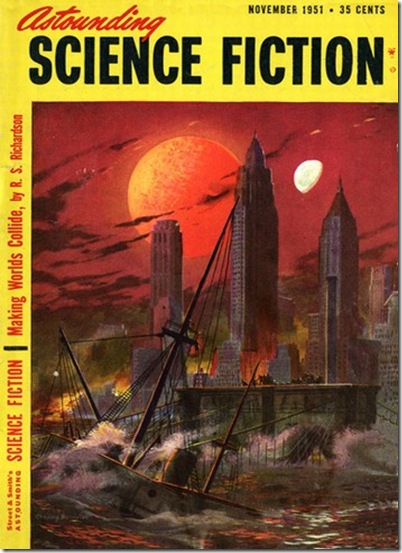
Well, I’m not going to actually do that, I don’t have the time, but it would be a wonderfully fun project.  Instead, I’m going to test the idea out on 1951, the year I was born, and build a list of science fiction books that were published in 1951 that I consider major, and are still remembered today, and add to that list any major story that appeared in a SF magazine in 1951 that’s I’ve read or can research, and finally ice the cake with important science fiction movies from the same year.
ASF-Nov51

I’m a science fiction addict, which explains why I’m intrigued with the idea of dating all the great science fictional ideas, but you could do this too with your own favorite subject area.  Hell, this idea itself popped into my mind when I noticed that the book I’m reading, The Illustrated Man by Ray Bradbury, came out in 1951, the year I was born.  This got me to thinking about the state of science fiction that year.  Bradbury is a cautionary writer, so his science fiction seems afraid of the future, but then again Heinlein’s The Puppet Master didn’t paint a rosy picture either.  Nor could you find upbeat escapism by going to the movies and watching The Day the Earth Stood Still, When Worlds Collide and The Thing From Another World.

How in the world did I grow up thinking science fiction paved the way for exciting futures?  The most famous science fiction novels of the 20th century to the world at large are Brave New World, 1984, A Clockwork Orange and Slaughterhouse Five.  When did the future become a Disney destination – well certainly not in 1951.  Or maybe all the gosh-wow sense of wonder stories of 1951 where not the big public movies, but the cherished stories that only the fans embraced.

All around the world in 1951, but mainly in the U.S. and Great Britain, science fiction writers were creating their visions of the future.  Few people took them seriously.  Some of their tales are still in print today, The Illustrated Man is set for its second movie production, and a remake of The Day the Earth Stood Still came out last year.  Why is science fiction from 1951 still being read and seen today?

I’ll work with these books:

And consider these anthologized stories from the magazines:

And use these memorable movies:

We stand 57 years into their future and know what will happen.  We can judge the hopes and fears of the people of 1951 and psychoanalyze their paranoia.  The opening story in The Illustrated Man, “The Veldt” is about a high tech nursery that is a lot like the holodeck from Star Trek: The Next Generation.  Bradbury’s story worries that technology will change the children of his times.  How do you interpret a story where the kids kill the parents with their futuristic nursery?  But wasn’t Bradbury right?  The innocent minds of 1951 don’t exist anymore.  If Ray Bradbury could have known what the Internet shows the children of today wouldn’t he have written an even scarier story?

Juveniles delinquency was one of the major problems people feared in the 1950s, so what if Bradbury could have foretold the Columbine massacre?  I include Catcher in the Rye in my list because it was probably the best literary novel of the year, and decade, but it also represented the same kind of fears about children changing that Bradbury was writing about.  Children were rejecting innocence, turning against the status quo and their parents and this scared the bejesus out of the conservatives of the times.

What we have to do is imagine what it would be like to be an average Dick or Jane in 1951 encountering these stories for the first time.  My father and mother, George and Virginia, didn’t have a clue about science fiction, but let’s imagine them going to see The Day the Earth Stood Still.  How many Americans, much less citizens of the world, really believed in aliens from other planets?  The UFO craze started in the late 1940s, so the idea was in the news for people to ponder.  Of course there had been the 1938 scare when Orson Welles broadcast H. G. Wells story of The War of the Worlds that terrified millions.  Even my parents told me about that when I was little.

By 1951, anyone in the U.S. that wasn’t too poor to have a radio or TV set had been exposed to the idea of aliens from other planets.  Another popular movie of the year was The Thing From Another World.  With two movies, three major science fictional concepts were inserted into the public mind:  interstellar flight, wise powerful beings not mentioned in the Bible, and intelligent robots.  Science fiction readers had known about these concepts for decades, but in 1951 the number of SF readers were very small.

Because of the atomic bomb in 1945, the idea of a man-made end of the world event had also been introduced to the public.  That idea was more powerful than alien visitors, because Klaatu and Gort’s real purpose was to warn us not to wipe ourselves out.  Then George Pal produces When Worlds Collide to let us know there were other ways for life on Earth to end, and John Wyndham gave readers yet another idea of how human life could be threatened.  Heinlein even combined the fear of Reds with the fear of aliens.

Many of the SF books and movies that came out after 1951 were about the end of civilization, or the end of mankind, or the end of the world.  The paranoia of the 1950s is very hard to top, but occasionally a writer will try, and Cormac McCarthy recently succeeded vividly with The Road.

Fritz Leiber’s classic a “A Pail of Air” reminds me of the film When Worlds Collide, because they each have a roaming astronomical body coming into our solar system and changing life on Earth.  In Leiber’s story, a dark star pulls Earth out past the orbit of Pluto, and in When Worlds Collide, a movie based on the 1933 book by Philip Wylie and Edwin Balmer, two planets from outside our system get captured by the Sun, and one destroys the Earth.  Ever since I’ve been reading science fiction as a kid I’ve been living with hundreds of ideas on how our world might be destroyed.  I guess that’s no big deal because before science fiction, religious people lived with the idea that God would stomp our world.  Maybe science fiction end of the world stories are just variations on biblically inspired end of the world tales.  However, to me, rogue stars and atomic wars seemed far more real than the wrath of God.

Science fiction is never very far from religion.  In “The Quest for Saint Aquin” Anthony Boucher, the legendary founding co-editor of The Magazine of Fantasy and Science Fiction, pictures a future where religion is threatened.  This story promotes the great science fictional idea of machine intelligence, and even suggests if pure AI thinking can believe in God, then why shouldn’t humans.

Now here’s an original SF idea that has not been carried forward to the present and evolved?  I guess people don’t believe that AI and robots will also believe in God?  I’ve never thought they would, but what if they did?  Here’s a potential story idea.  However, this reminds me of a famous joke from the 1950s.  Scientists wanted to know if there was a God, so they built a giant IBM machine and fed it all knowledge and typed in the question:  Is there a God?  They got back:  There is now.

1951 was a long time before most people thought that space travel could be real.  Most of the public when they thought of rocketships to the Moon and Mars pictured them from what they learned in the Sunday comics reading Buck Rogers or Flash Gordon.  They didn’t know they were just six years from the Russians orbiting a satellite and a decade before the Russians put a man into orbit.  The future was closing in far faster than anyone knew, except for Robert A. Heinlein, Arthur C. Clark and Isaac Asimov.  These men ruled 1950s science fiction as a triumvirate.

Heinlein’s 1950 classic film Destination Moon helped the public to realistically picture the first mission to the Moon.  Clarke and Heinlein wrote stories and books about early space explorers to nearby destinations.  Asimov thought huge and promoted the major SF idea of a galactic civilization, much like the Roman Empire, but spread across thousands of star systems.  Asimov’s vision wouldn’t attain wide public recognition until Stars Wars in 1977, with a good bump from Star Trek in 1966.

By 1951 Heinlein and Clarke were writing stories that realistically tried to show astronauts working on the Moon and Mars.  In the tiny world of science fiction fans, these ideas were ancient, but I think Heinlein and Clarke felt if a fictional idea was ever to give birth to reality they needed to promote space travel to millions.

How does someone born in 1966, the year of Star Trek, and 1977, the year of Star Wars, feel when they discover these ancient ideas for the first time?  1951 is Darwin voyaging on the Beagle, while 1969’s Armstrong’s giant step for mankind is science fiction’s 1859’s On the Origin of Species publication.   It’s the time between a few thinking about an idea till when the idea hits the public in a big way.

If you turn on Turner Classic Movies and eventually watch every movie from 1951 except for a handful of SF films, you will begin to get the idea of just how little that world of 1951 thought about the great ideas of science fiction.  In 2009 you can’t escape these ideas unless you live in that proverbial cave like a fundamentalist Muslim, and I bet even cave dwelling terrorists have thought about aliens from other worlds, space travel, and intelligent robots.

The question is, will in 2051, or 2151. how many of the great science fictional ideas of the 20th century will still be around?  How many will have come true and how many will be thought of as quaint fantasies of ignorant people of the past, like the Oneida Community?

And what if I continued my research, could I show how 1911, 1921, 1931, 1941 and 1961, 1971, 1981, 1991 where different from 1951 regarding the evolution of science fictional ideas?  It would take a lot of work, but I think the answer is a definite yes.  Could I write a novel to be published in 2011 that would stand out with radically new evolutionary science fictional traits?  I don’t know if I can do it, but I’m hoping someone will.

JWH – 2/14/9

Defining Science Fiction

I just started reading Fast Forward 2, an original anthology of science fiction edited by Lou Anders and I had to stop in the middle of the first story to write this.  Anders begins the book with two quotes about science fiction, this is the second:

Science fiction is the holy fool of literature. It can say what it likes and get away with an examination of truly radical and subversive ideas because no one takes it seriously. When it’s at its best, we’re generally in trouble. Science fiction flourished during the social and economic upheavals of the 1930s, during the Cold War, and during the Iron Age of the 1980s. It should be flourishing now, damn it, but too many people who used to hang out with it have wandered off into some kind of fluffy make-believe world or other. Real science fiction doesn’t make stuff up. It turns reality up to eleven. It takes stuff from contemporary weather—stuff no one else has bothered or dared to question—and uses it to make an end run on reality. It not only shows us what could happen if things carry on the way they are, but it pushes what’s going on to the extremes of absurdity. That’s not its job: that’s its nature. And what’s happened to science fiction lately, it isn’t natural. It’s pale and lank and kind of out of focus. It needs to straighten up and fly right. It needs to reconnect with the world’s weather, and get medieval on reality’s ass.Paul McAuley

Starting your collection with this quote is pretty much like Babe Ruth coming up to bat and pointing to where he’s about to hit a ball into orbit.  This makes me both excited and worried.  I want these stories to be great.  In his introduction, “The Age of Accelerating Returns” Anders goes on to classify four purposes for science fiction:

  • “It can be predictive, and it’s always fun to talk about that, but this is its least important aspect.”
  • “More important, it can be preventative, …”
  • “Third, SF’s importance lies also in its ability to actually inspire the future.”
  • “Finally, SF is the literature of the open mind — the literature that acknowledges change and encourages thinking outside the box — and that in itself is a good thing, even if the science on display is nonsense.”

But these four attributes could have described Hot, Flat and Crowded, the new non-fiction book by Thomas Friedman.  Science fiction is notoriously hard to define, but I feel great empathy for what Anders is trying to do.

To me science fiction are stories about the future, which ropes in Anders’ four purposes nicely:  predictive, preventative, inspirational and speculative, but does that list include all the aspects of great science fiction?  I think Anders left off one really important attribute:  inventiveness.  Think about the story “The Menace from Earth” by Robert A. Heinlein.  Heinlein imagines that if people colonize the Moon it will be possible to have human powered flight in the air tanks.  Now this sport might come to pass and it will fall under Anders’ third attribute of inspiring the future, but that’s not what I’m getting at.

Heinlein did some brainstorming and figured out with low gravity and the right air pressure people could fly by strapping on artificial wings.  Whether or not it ever comes true, this is very inventive.  There is little chance that time machines will ever be invented, but what a far out invention of the mind it was for H. G. Wells to conceived of time machines for fiction.

Science fiction is like a game with many different rules on how to play.  Sort of like Monopoly.  Some families have invented their own rules on how to use the board and pieces to play the game.  Personally, I think science fiction is at its best when writers limited themselves to working within the boundary of contemporary science, but that’s not everyone’s way to play the game of making up science fiction stories.  Rudy Rucker invents his ass off, but its not always scientific.  Of course, by my rules that’s easily solved, I just say he writes fantasy.  I also love fantasy stories.  By the way, I don’t see calling a story fantasy as a slight.

I just finished rereading Hyperion by Dan Simmons.  It’s not predictive, preventative, inspirational, speculative or inventive, not in the way we’ve been discussing those attributes, but it’s considered an epic science fiction novel.  Dan Simmons takes almost every known cliche science fictional idea and mixes those ingredients with a plot stolen from Chaucer and produces a wondrous story.  Is it science fiction or fantasy?  Does it matter?

By my rules, I would call Hyperion fantasy.  A fantastic, colorful, vivid, fantasy.  I don’t think most readers care to split hairs between the label of science fiction and fantasy.  If it contains rocketships, it’s science fiction, if it has magic, it’s fantasy.  The real defining attribute is great story telling.

But doesn’t that spoil the game in some way?  Without the challenge of playing within the rules, doesn’t that lessen the achievement?  Science in our society is already a slippery concept.  Shouldn’t science fiction be scientific to the best of our knowledge?  If science fiction stories are just supposed to be fun and nothing more, then it doesn’t matter.  If science fiction writers are saying something serious about the future, then shouldn’t it matter how we define science fiction?

I have a theory about this.  I think the public has never taken science fiction serious, so it doesn’t expect much from the genre, nor does it care how the form is defined.  So few writers try to say something real about the future that when one does, readers will judge that story by its own merits and not by the genre, such as The Road by Cormac McCarthy.  In other words, science fiction will get no respect in the world at large.  And that might be cool with many people, since most science fiction fans prefer their field to be wild and wooly, rather than academic and disciplined.

I now shall go off and read the stories in Anders’ collection and see if they lived up to their introduction.

JWH – 2/8/9

The Fate of SF Magazines

Over at Slashdot.org they posted a news announcement with comments, “Difficult Times for SF Magazines” that is very worth reading if you’re worried about the fate of SF magazines.  The main announcement was Realms of Fantasy will cease publication with the April issue and The Magazine of Fantasy and Science Fiction has dropped it’s schedule from monthly to bi-monthly.  The folks leaving comments make some interesting points about the state of SF, with many writers lamenting that SF isn’t what it used to be.

Here’s a comment from Moridineas that I particularly liked:

The difference between then and now–imho–is that the Asimovs, Heinleins, de Camps, etc etc etc are gone, and they haven’t really been replaced. My other opinion is that s.f. was largely a product of the zeitgeist of the what, roughly 50 years that it roughly flourished (1920-1970 or so?). We’ve got HDTVs, the Internet, Star Trek and Star Wars on TV, rovers on Mars, decoding DNA, etc etc. The sense of wonder in s.f. is largely gone because we take so much for granted that was virtually unimaginable back then.

Here’s another worthy comment to consider and was echoed by others from Steeleye Brad:

Ugh, agreeing with this. I ended my subscription to Analog around a year and a half ago, when I realized that the story quality had really gone down the shitter. I found myself starting to read a story, but then quitting 1-2 pages in because they were just so terrible. When I would get an issue and go through every story like this, I gave up. Stories with neat concepts completely ruined by confusing writing and indecipherable plots, lame tales where it was screamingly obvious the main character was an author’s self-insert, and vomit-inducing non-stories that served only to let the author express their political views (normally this is ok, except when the author’s soap-boxing completely drowns out and overwhelms the story).

Ultimately the topic degenerates into the pros and cons of publishing on the Internet and sidestepping the issue of content and whether or not the decline of the SF magazines represents a loss of interest in SF or if its an issue of declining story quality.  I brought up this topic in two online SF book clubs and the common comment is they don’t find the stories very engaging.  Second to that is many people have busy lives and let all their magazines go unread.

I started subscribing to the SF magazines back in the 1960s and kept subscribing until very recently.  I was most faithful to F&SF over the decades.  Currently I get F&SF and Asimov’s, but both are up for renewal and I’m not sure I want to renew, at least the paper edition.  I might subscribe to digital editions at Fictionwise.com.

To be honest I don’t read them.  I try every once in awhile.  I have a tremendous nostalgia that makes me want to keep reading these old friends, but when I try I seldom find stories that grab me.  And it’s not the ideas, but the characterization.  I think when I was young I loved the stories just for the ideas and I wasn’t savvy enough about story telling to know the stories were badly told.  Now, after decades of reading great stories I can’t overlook this.

Now don’t get me wrong, there are plenty of far out stories out there, it’s just a matter of finding them.  Maybe what’s needed is for the genre to get down to one magazine.  Refocus the field of science fiction.  And since the magazine publishing and distribution industry is so screwed, maybe the short story market should move to a different format.  I’d suggest a trade or mass market paperback series published quarterly to start with edited by team of editors to get the very best and diverse kind of story.  Tie the publication to a web 2.0 site where readers can discuss the stories and vote on them and interact with the writers.  Also get Audible.com to do an unabridged audio edition of the book each quarter, as well as publishing it in the Kindle, Sony and all the Fictionwise ebook editions.

I think we need a modern day Hugo Gernsback or John W. Campbell to reinvent the field of science fiction.  The number one goal should be to eliminate fantasy stories from the mix and develop real science fiction stories.  The next goal should be to find well written engaging stories that focus on good characterization.  Publish stories that grab people and make them keep reading, and not stories that you have to struggle to the end for a payoff.

Science fiction has reinvented itself many times.  I lament the passing of every genre magazine and worry about F&SF, Asimov’s and Analog, the old big three that now have circulations that are a tiny fraction of their glory days.  I can’t tell if this trend means science fiction itself is dying.  It does feel like we’re on the downward slope of the right hand side of the bell curve.

I’m a member of two online SF book clubs that focus on the classics of science fiction, and like many of the folk who left comments on Slashdot, feel SF golden age was really from 1950-1970, the Heinlein-Asimov-Clarke era.  I think there was another bulge of SF fans with a generation that grew up with writers like Vernor Vinge, Dan Simmons, Neil Stephenson, David Brin, Greg Bear, John Varley, etc.  And currently there’s a ripple bulge with writers like John Scalzi, Charles Stross, Greg Egan, Stephen Baxter, Alastair Reynolds and others.

Whether SF will ever have another golden age with over hundred thousand people subscribing to its top SF magazine is hard to predict.  Like I said, with a new Campbell or Gernsback discovering a new team of Heinlein-Asimov-Clarke level writers it could happen.

JWH – 2/1/9