What If Science Fiction Is Wrong About Space Travel?

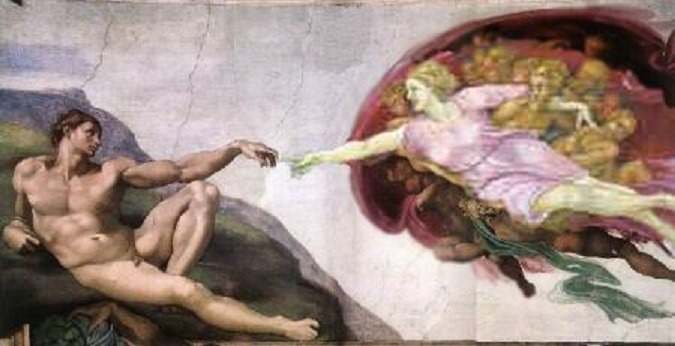
Science fiction is about speculation and the topic it has speculated on most is space travel. What if science fiction is wrong? What if it turns out that humans aren’t suited for living in space or colonizing other worlds? What if homo sapiens need to live on Earth? How will such knowledge affect your philosophy?

Decades ago I realized that science fiction was my substitute for religion. I didn’t believe in God, heaven, or an afterlife, but I did believe in humanity spreading across the galaxy. I don’t know why that brought meaning to my life, but it did. I grew up reading and watching science fiction during the Project Mercury, Gemini and Apollo year of the 1960s. As I covered in my last essay at Worlds Without End, “A Distance Too Far,” new research is showing the biological limitations of humans living in space. Space scientists hope to overcome those limitations but what if they can’t? What if humanity is condemned to living on Earth until we go extinct? What if we have to watch robots and AI machines live out our Star Trek dreams?

I assume most science fiction fans will react the same way the faithful react when they encounter an atheist. It’s really hard to give up a core value which gives our minds meaning. I have no idea how adaptable humans are to space but I’m wondering what it will mean if we can’t. If you’re a hardcore science fiction fan could you give up your faith in the final frontier?

What happens to us when we no longer believe in getting to heaven or other planets? Will we find meaning living vicariously through the eyes of our robots who leave Earth and become immortal among the stars? What kind of science fiction will be written in fifty years if we have tried to colonize Mars and failed? If we discover galactic radiation fries our brains and it requires 1-G to reproduce normally – will we give up on human space travel?

Or think about this. What if we do colonize Mars and adapt but discover everyone hates living there? There are thousands of people who would volunteer for a one-way mission to Mars. Have you ever wondered why? What motivates people to want to live on a barren rock, that’s bathed in solar and galactic radiation, that’s colder than anyplace on Earth, and its atmosphere is unbreathable? Is it a powerful fantasy implanted in childhood like theology? Is it a deep drive to spread our genes to new worlds? Or is it a psychological desire to escape an unhappy life here?

What if we discover that many of the hopes of science fiction won’t come true for us? Think a moment about our other science fiction dreams. What if we can only push our bodies so far before longevity research peters out and we realize immortality is impossible? What if we can’t download our minds into machines or clones? What happens when we discover that being homo sapiens comes with limits that can’t be surpassed? I’m sure we’re far from discovering those limits but what if someday we know those limits with certainty?

Science fiction has always given us hope for unlimited potential. Yet, reality suggests we’ll eventually bang into the glass walls of our aquarium. I wonder what science fiction will speculate on then.

JWH

A Personal God of My Own

by James Wallace Harris, Wednesday, March 1, 2017

Sometimes I wish I had a personal God for amicable chats when I have insomnia in the wee hours. Lying in the darkness, I often wish I had someone to share philosophical thoughts. I picture this personal God like a kid’s imaginary friend, or even a big pooka rabbit, like the one Jimmy Stewart conversed with in Harvey. I imagine my imaginary deity as a mashup of Mark Twain, Robert Sheckley, and Kurt Vonnegut. Maybe this God should look like Clarence the guardian angel, clueless and hapless. (Again, a Jimmy Stewart reference.) I suppose my guardian angel could look like the suave Dudley (who looked like Cary Grant), but that wouldn’t be as funny. Loretta Young would make a sexy guardian angel, and I can picture her being very insightful.

(I wonder how many people under 60 get my angelic movie references?)

female-god1

I once dreamed I had sex with God and was shocked (in the dream) to discover God was a woman. She was a stout matronly female in her sixties, with big soft bosoms, who looked somewhat like an older Sophia Loren. In this dream, I’m having very pleasurable sex with this zaftig lady, and my reaction was fucking an older woman was a lot of fun, especially one so jolly – but then I realize she was God. Seeing my shock she laughed at me with a deep throaty laugh, like the laugh my father’s mother had. I’ve always wondered what Freud would have made of that dream.

I was in my forties at the time. When I woke I was a little embarrassed to be enjoying a sex dream with a grandmotherly woman. (It didn’t bother me she was God.) I’ve had some very strange dreams over the years, and I’ve run into God before – but not as this woman.

So I suppose my personal God could be a she. I might even prefer that. When I first thought of having a personal God the name Fred popped into my mind. A good, no-nonsense name. I could have some great conversations with a God named Fred. But I sort of like God being a woman. Probably, I’ll call her Gladys or Gloria.

I’ve been an atheist since I was eleven years old. I remember my mother making me go to church as a kid, and me trying hard to believe. I even asked to be baptized thinking it would let me see what everyone claim to see. But after nothing was revealed, I took the path of unbelieving. I’ve never been the kind of atheist that advocates disbelief. I know too many people who find great comfort in theism to ever want to take it away.

And when I say I’m an atheist, I mean I have no doubts. God does not exist for me. When I talk with God, I know I’m pretending. It’s better than talking to myself, but not by much.

I believe we are all bubbles of consciousness that have accidently emerged into this infinite sea of random reality. I use the word reality because I don’t believe the universe is everything. I believe reality is quite indifferent to us and infinite in all directions and dimensions. People want a God because they want a father figure. They want their lives to mean something. When I think of my imaginary personal God, I’m really pretending I’m talking to reality. I know reality isn’t listening and doesn’t give a shit, but I like to pretend otherwise.

Many of my atheist friends would like to talk to God too, to curse the creator for all the suffering they see and experience. I’m not that way. I’d like to thank God for my existence. I used to have a lot of questions, but I’m satisfied now with what I know and don’t know. There are some things I’d like to kid ole Gladys about, though.

Like last night, I had friends over to watch A Man Called Ove, and at one point in the film, I glanced to my left and noticed my friend’s foot. It was beautiful. And I don’t mean in a sexual fetish way, but in an existential existence way. Gladys, why is one portion of reality more beautiful than another? Why are we here and not nothing? Why is the foot more aesthetically appealing than other objects in the den? You can be very weird at times. Your sense humor can be so trying – I can understand how I got old, fat, and bald – but why not shut off the sex drive as we age? Very funny, Gladys.

I accept the random nature of existence. I even accept what I fear and don’t want. So I’m content without God, but bantering with a personal God could be satisfying. It would be fun to have Gladys to chat about the beauty and absurdity of this existence.

“By the way Gladys, can you explain Donald Trump? That’s really going too damn far!”

JWH

Rejecting Some Science Fictional Ideas

By James Wallace Harris, Friday, October 14, 2016

The job of science fiction writers is to imagine things we haven’t imagine before. To speculate about the future, distant worlds, alternate histories, extrapolated trends, artificial life, machine intelligences, the future evolution of our species and so on. The territory of science fiction is quite large. As readers we are entertained by these feats of creativity, and all too often we are enchanted by the ideas that science fiction writers have given us. We want travel to distant worlds to be possible. We want to meet intelligent beings from other worlds, or build sentient machines. But I also think we should think carefully about science fictional speculation and reject ideas that aren’t rational.

ChildhoodsEnd(1stEd)ChildhoodsEnd(1stEd) (1)

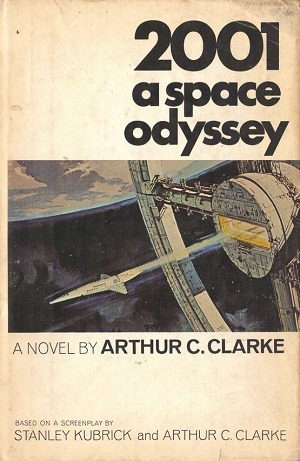
I’m currently rereading 2001: A Space Odyssey by Arthur C. Clarke. Clarke proposes several ideas in this book, some of which I don’t like, and some of which I hope are wrong. In Clarke’s two most famous works: 2001: A Space Odyssey and Childhood’s End, he theorizes that advanced aliens have or will uplifted our species. I don’t know why this idea is so appealing to him. What’s really a strange is 2001: A Space Odyssey was published in 1968, coincidentally, the same year as Chariots of the Gods? by Erich von Däniken, which proposed a rather similar idea.

I find the theory that we needed aliens to uplift us, or accelerate our evolution, or explain some of our accomplishments, to be insulting. And these ideas have a strange kinship with religion. Powerful aliens are very much like how our ancestors imagined their gods. And as much as I dislike von Däniken, he spotted the religious angle. I wonder if Clarke knew what he was doing?

Both 2001: A Space Odyssey and Childhood’s End even appear to want transcendence through alien intervention. Isn’t Clarke just wishing to be reborn into a higher form and live in heaven? Isn’t he rejecting our current existence and state of being? Which is what most religions do too, by their claims the physical world is imperfect, full of sin and suffering. I prefer science fiction that is full of hubris, and humans pull themselves up by their own bootstraps.

The second speculation Clarke pursues in 2001: A Space Odyssey is the fear of artificial intelligence. This is more logical, and maybe even practical. But it’s rather oddly religious too. Isn’t Clarke rejecting our ability to create and conceive our own evolutionary replacements? Isn’t Clarke’s warnings against HAL much like the Bible’s warnings against the Tower of Babel? Isn’t it saying God and aliens can create intelligent beings, but we can’t? Are they both saying, don’t aim too high because we don’t have the abilities.

What if we substituted crosses for monoliths in this story, and God for aliens. Wouldn’t it still work? Aren’t both of Clarke’s most famous stories about salvation by high powers? Aren’t their parallels between the beginning of 2001 and the Garden of Eden story? These two novels are very popular. Yet, isn’t that easily explainable? Even today most people seek salvation via high powers. Look at the current election. Isn’t Donald Trump actual claiming he can save us, that he knows more, that he can work magic, and people believe him. But isn’t that also a rejection of our own abilities and accomplishments?

Sometimes when we read a science fiction story we need to reject its ideas. Even though both of Clarke’s masterpieces are compelling stories, I wouldn’t want them to be true. I’d rather believe we’re here alone in the universe, and we evolved through random events. Then again, I’m an atheist.

JWH

Rethinking Star Trek: “The Cage”

By James Wallace Harris, Monday, August 22, 2016

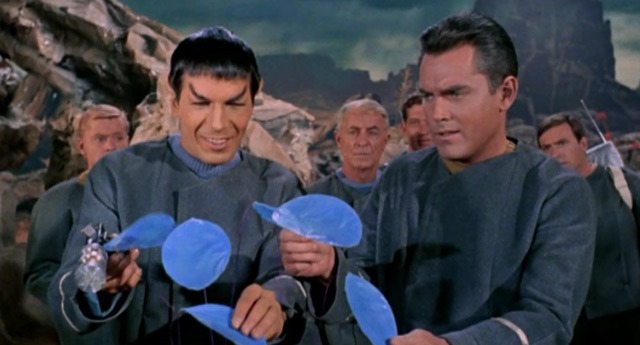
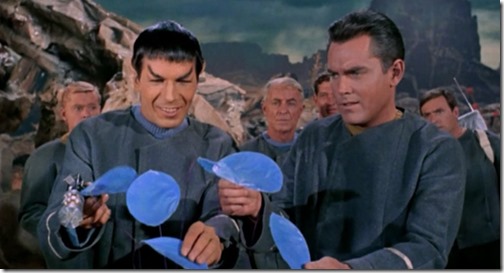
“The Cage” was the first pilot for Star Trek, made in 1964-65. Wikipedia has an excellent history and plot summary, so I won’t repeat it. I’m sure most fans remember this proto Star Trek with Mr. Spock as the only main character from the regular series. The sets, special effects, costumes, models, gadgets, were are all much more primitive than what we see in later episodes. However, the story is exactly the kind of story Star Trek was known for, and was later recycled into the two-part episode “The Menagerie.”
spock smiles the-cage

What I discovered watching “The Cage” a half-century after seeing “The Man Trap” on 9/8/66, is a different impression of Star Trek. I was never a fanatical fan, but I loved the original series, and watched all the later series as they came out. To be honest, I’ve always thought of Star Trek as Sci-Fi Lite. Quite often television and movies make science fictional ideas look silly, and all too often I criticized Star Trek for not being scientific. In recent decades I found it almost impossible to sit through the old shows because I lost the patience for 20th century television. But something in me changed recently, when I began watching the old shows as a way of understanding myself as I was fifty years ago.

For some reason, I got into a headspace where Star Trek worked again. I was able to forget the limitations of 1960s television production, my skepticism about scientific plausibility, the silliness of plotting, and enjoyed the show as its creators intended. This time around I discovered Roddenberry was less into science fiction than I remembered.

As I watch each episode with my friend Annie, I’m actually looking forward to seeing Star Trek again. We’re playing the series in order the episodes were broadcast in 1966-69 using Netflix streaming. Annie and I were both born in 1951, and we watched the show when it first came out, me in Mississippi and Florida, and she in New Mexico. This time traveling is bringing back memories of discovering science fiction, first in television and movies in the 1950s, and then in books in the early 1960s. Star Trek actually repackages all the common science fictional ideas of the times. We like to think of Star Trek as being an original television series, and it was, but sometimes it was The Beatles, but quite often it was The Monkees. Don’t get me wrong, The Monkees had some great tunes, but they were manufactured hits. What fascinates me now is how Roddenberry repacked 1950s science fiction for his 1960s philosophy.

Gene Roddenberry never had the science fiction originality of science fiction writers of the 1950s. I don’t think he was even a big fan of the genre before discovering Star Trek fans in the 1970s. Except for a few episodes written by science fiction writers, Star Trek wasn’t contemporary with 1960s written science fiction. The New Wave in science fiction hit just before the series premiered. Watching these old shows again in the 21st century lets me see them differently from how they appeared in 1966. This time around, I’m focusing on the history of science fiction, and the ideas science fiction were exploring at that time.

Watching these shows again, I realized that Star Trek was less about science fiction, and more about allegory. Roddenberry was using science fiction to express his political beliefs. For those who didn’t live through 1964-1966, these were exciting years intellectually. Science fiction is the main ingredient in Star Trek, but there’s many other ingredients as well, including 1950s television, Civil Rights, feminism, anti-war, Pop Art, the Counter Culture, and so on. Each screenwriter brought something different, and Roddenberry squeezed all of it into allegories.

The Allegorical View
cage-talosian

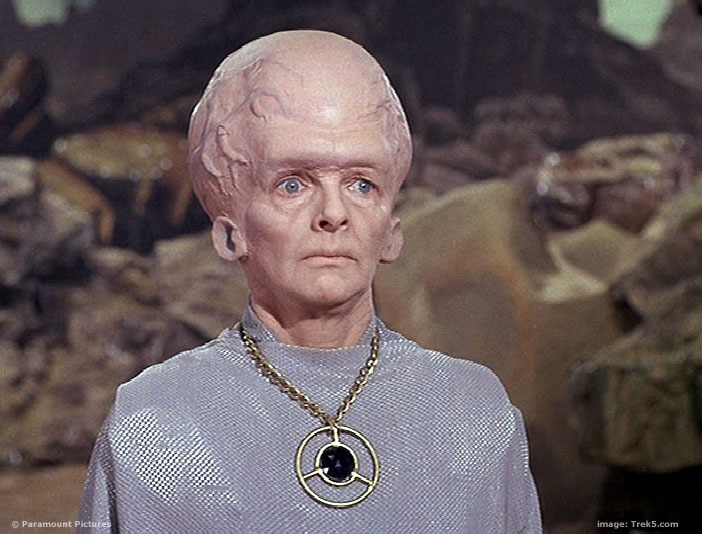
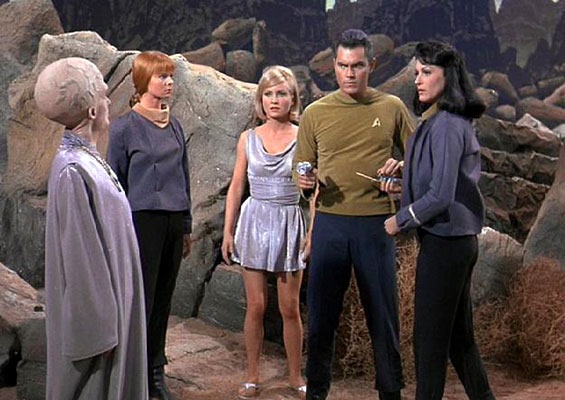
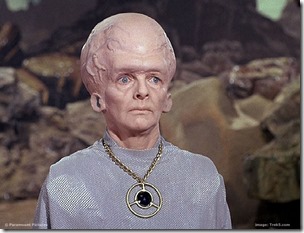
The words Talos and Talosians sound close to theology and theologians. In “The Cage” the Talosians have god-like powers. Gene Roddenberry was an atheist, and “The Cage” seems less about aliens from outer space, and more about beings from heaven. The show is about how theologians keep us imprisoned by our thoughts and the promise of heaven. Throughout the episode, the Talosians struggle to convince Captain Pike (Jeffrey Hunter) to accept their fantasies for reality, tempting him with a beautiful woman, Vina (Susan Oliver). They want Pike and Vina to play Adam and Eve, and repopulate their planet. To be their servants, their hands in the physical world. It’s very Biblical.

The symbolism of this first show is rather striking. Humans reject god, leaving a rundown Eden to escape into space. Vina stays home, trapped in god’s delusion, disfigured by god’s image of what she should be. Rewatch “The Cage” and think allegory rather than science fiction. Think about the last temptation of Christ.

The Science Fiction
Pike-holding-Phaser

The warp drive was one of Star Trek’s most famous science fictional ideas, and it evolved over time. Science fiction has come up with many ideas about traveling faster than light. Ultimately, they’re all gimmicks to further the plot. In Star Trek, interstellar travel takes about as much time to get between the stars as ocean liners traveling between the continents did in the 1960s. In Star Wars, interstellar travel is faster than jet travel between countries in the 1970s. Science fiction seldom deals with the reality that interstellar travel, which will probably take centuries, if we’re lucky.

The transporter was another “invention” of Star Trek,  even though matter transporters had existed in science fiction before 1966. The story that’s always told, is the producers of Star Trek couldn’t afford using a shuttle craft, so they came up with the transporter to save on production costs. That’s fine, but there is a huge logic hole in their design. Why does it take a machine to send people, but not another machine to receive people? If they could grab people off a planet, why didn’t Scotty just beam Kirk from the bridge to the planet? Why did they always have to go to the transporter room to beam down, but didn’t need a machine to beam up. Think of the jokes Scotty could have played on Kirk, beaming him to a different Yeoman’s bedroom every night after he had gone to sleep.

Also, how many exabytes of data are required to describe a human in transporter logic? And the transporter appears to beam people faster than light. Does that require warping space? And how are people decoded at a distance without a machine?

The aliens in Star Trek often had super-powers, or even god-like powers. The Talosians could create perfect delusions in humans. The first regular episode of Star Trek, “The Man Trap,” the creature was called a shape shifter, but obviously that was incorrect, because it appeared in one scene to several men, looking different to each. It evidently had the same power as the Talosians. But think about what such a power means. First it means faster-than-light data communication between two minds, with very massive amounts of data transferred. And with multiple humans, means multitasking at a tremendous rate.

Our minds can create very realistic, vivid hallucinations, but only when our senses are turned off. Like when we’re asleep and dreaming, or in a sensory deprivation tank, or we’ve taken some powerful drugs. Even then, the details of hallucinations are never even close to details of how we experience reality processed through our senses. Creating perfect illusions is impossible. This is only a gimmick for the allegory.

I don’t know why, but most “advanced” aliens are always given PSI-powers in science fiction. These super-powers are always very similar to the powers we attribute to gods. There’s no scientific reasons to think such powers exist in us, or aliens. Quite often in Star Trek, Kirk and crew meet aliens with such god-like powers. In each case Kirk is required to outthink such beings, and he does, although often with silly gimmicks. I get the feeling Roddenberry hated authority, religion, and any kind of mind control, and many of his science fiction stories reflect this in allegory. Often Roddenberry is much closer to The Twilight Zone than Astounding/Analog. But then again, maybe I need to revisit 1950s/1960s science fiction to see if it was more allegorical than science fiction.

To me, real science fiction was always about preparing us to go to the stars. Fans think that’s true of Star Trek. I’m not so sure, at least for the original series. My hunch is Roddenberry didn’t get the science fiction religion until after Star Trek:TOS. As I watch the shows, I’m wondering if the fans didn’t read the pro-space theology into the original series. I’ll see as we watch.

JWH
Gimme That Old Time Meditation

By James Wallace Harris, Thursday, October 29, 2015

Meditation is gaining secular and even scientific acceptance. I first heard about meditation in the mid-sixties when The Beatles ran off with that guru. I even took up meditation in the 1970s during the New Age movement. For most of the last half-century, meditation was something aging hippies in sandals pursued. Then in the last decade, meditation has been embraced by therapists, human resource departments, Christian churches and even the military. All of this is well chronicled in 10% Happier: How I Tamed The Voice In My Head, Reduced Stress Without Losing My Edge, And Found Self-Help That Actually Works – A True Story by Dan Harris. Dan Harris is a reporter and anchor for various ABC television shows. His high-stress career and obsessive personality started causing on-air panic attacks and he began searching for solutions. Harris slowly embraced Buddhism and meditation because of covering stories about them while assigned the religion beat. His book is about his struggle to discover if there is any validity to meditation and Buddhism, and how to separate provable results from spiritual woo-woo. Essentially, he demystifies Buddhism and meditation. This is a great book for anyone skeptical about ancient self-help practices.

10-percent-happier

What I really liked about this book was Harris’ skepticism. As a reporter he knew how to ask hard questions, and whenever he met a new guru he didn’t hold back. Over the course of this story, Harris meets star gurus of the self-help circuit who promises the masses various forms of enlightening and happiness. Harris eventually concludes, on average, meditation has helped him to become 10% happier. He also believes if he works at it, he might even get an even higher return, but that meditation is no magic pill for transforming anxiety and depression into bliss. In other words, there is no free lunch.

Brain_DavidEagleman

What’s really involved is learning how our brains work. Meditation was discovered long before science, but it’s essentially a systematic way of observing our own brain. We can supplement meditative experiences with modern scientific research on the brain. I highly recommend The Brain with David Eagleman, a 6-part documentary currently running on PBS that’s based on his book. Last night’s episode was about the unconscious mind and how little our conscious mind knows. We all need to become amateur brain researchers to study our own minds, and meditation is a good observing technique.

Harris first encountered Eckhart Tolle after his panic attacks and was very receptive to his message. However, Tolle troubled him with a lot of mumbo-jumbo spiritual talk. Eventually Harris met Deepak Chopra and even the Dali Lama. With each guru he kept pushing them for exactness, and felt each man had some real understanding, but was often confused or turned off by weird unscientific terminology. Harris then he found psychiatrist, Mark Epstein, who was also exploring Buddhism, meditation and mindfulness. Epstein introduced Harris to Joseph Goldstein, a master meditation teacher. Harris, who is Jewish, found practical kinship with these two Jewish meditators, and they connected him to scientists doing actual research on meditation.

This path took Harris years, and he carefully explains all his ups and downs trying to stay sane and happy while pursuing a high pressured job. Harris always felt Eastern wisdom seemed to conflict with Western ambition. At one point he even felt meditation had made him happier and kinder, but mellowness had deflated his drive to get ahead. By the end of the book, Harris is working on increased ambition combined with increased work towards Enlightenment, which is a goal I’d think most Americans would embrace. We all want success and happiness.

10% Happier shows a real difference between Eastern and Western religions. Western theologies just ask their followers to believe, whereas Buddhism asks their follows to work hard and observe. The Buddhists even have a saying, “If you meet the Buddha on the road kill him.” That’s to remind their followers that it’s very easy to get caught up in bullshit.

Table of Contents