“—All You Normal Zombies—"

Ontology is a fancy word that few people use but we all seek to understand.  Imagine a stoned hippie with a Cheech & Chong accent asking, “Hey man, where the fuck did we come from?”  That essentially explains ontology.  Robert A. Heinlein wrote the definitive science fiction ontological story called “—All You Zombies—“ in which every character in the tale, both male and female, turns out to be the same person.  Heinlein used time travel and a sex change operation to create an infinite ontological loop to explain his character’s existence.  In the end, he/she tells the reader she knows where she came from but asks them, what about all you zombies.  So how do you and I explain our ontology?

In ancient times we had hordes of mythological beings to answer every question about existence, but by the time I got around to being born there were only three left, the Easter Bunny, Santa Claus and God.  In the first grade my fellow students killed off the first two.  And like all kids who grow up to become atheists, I asked the fatal question that killed God when I was quite young, “If God created everything, then who created God?”  Parents hate that question because they know their offspring will grow up to be annoying know-it-all heathen brats.

Most of the billions of souls that inhabit this world stopped their ontological exploration as soon as they heard about the concept of God.  This is quite revealing.  It says most people aren’t really that into ontology.  They obviously don’t care for the gritty detailed explanations of existence, or truly want to know how we got here, because the God answer is no more realistic than the Santa Claus solution for explaining presents under the tree on Christmas morning.  For most, it is satisfying.

The God solution is easy to acquire, the concept being quite viral, and addictive, and very hard to throw off.  Usually only a few words from a preacher, yogi, shaman, rabbi, priest, spoken to the youthful, will instill a lifelong ontological belief that God created everything.  Nice story, but too bad it’s not true.  The reason why this idea sells so well is because it comes with promise of eternal life.

Ontological reality appears to be quite different.  Science can follow the origins of existence back 13.7 billion years, but now suggests that a multiverse existence has been around for an infinitely long time, and further suggests, it will continue to be around just as long afterwards, in the other direction of time.  Our universe had a birth and will have a death, just like us.  So on a local scale, everything is finite.  Thus asking where reality comes from becomes meaningless, and we move into existentialism.

The real question of ontology becomes more immediate, “Where did I come from?”  If you can see beyond the theological, you will know that an infinite amount of time existed before you were born, and an infinite amount of time will exist after you die, so the essential aspect of reality is the few years we get to know existence.  Can you explain who you are and how you got that way?  After decades of life, I think I can.

I come from a dysfunctional family – my parents were alcoholics, my mother suffered from depression and was probably bi-polar, and my father, from what I can piece together, also came from a dysfunction family, joined the military, which he worshipped, because it was a family substitute that gave him structure.  Before I and my sister were born, I believe my parents had a relatively happy and stable life following wherever the U.S. Air Force led them.  I was born on their sixth wedding anniversary, and my sister, two years later.  We were too much stress for their fragile marriage.  My father was restless, and asked for transfers.  We moved almost every year of my life until I finished high school, when my father died.  I only had two school years where I attended one school, and two years where I went to three schools in one year, and all the rest I attended two schools for each grade.

Who I am is explained in that paragraph.  I don’t blame my parents for anything.  They had their own problems to cope with, and I was lucky to learn that at an early age.  It did take me awhile. Up until high school I was embarrassed to bring friends home because I was afraid one of my parents might be home drunk or passed out.  Then the sixties really began, and things changed, and I’d bring friends home and point to my parents and say they were on their own strange trip.  However, this upbringing created my personality which makes me isolated from most of humanity.

Growing up I’d see all you normal zombies walking around and wished I had your life.  I dreamed about being born into a family that lived in one place, where I made lifelong friends, and knew the same people all through my K-12 education.  I wished I had gotten a proper social education where I could belong to groups without feeling like an alien.  That was not meant to be, and probably explains why I could escape the trap of theology.  But it left me lonely. 

Even though I’ve been married for thirty something years, probably in reaction to my parents doomed marriage, I can’t achieve It’s A Wonderful Life integration.  I really wanted family ontology to be Father Knows Best, Ozzie and Harriet, Leave it to Beaver, and all those other black and white TV myths I grew up with.  We all want myths, but what we get is reality.  I live in a reality of mental isolation.

With the study of science I have explanations for most aspects of reality back 13.7 billion years.  I spend my time reading books and watching documentaries that add more pieces to a very consistent puzzle, so I’m pretty sure where I came from, but I’m not sure about all you normal zombies.  Your stories explaining existence scare me.  But I’ve got to accept your beliefs in religion like I accepted my parents strange trip they were on.

[This essay is what happens when I wake up at 4 am and can’t go back to sleep.]

JWH – 5/11/10
Robot Evolution

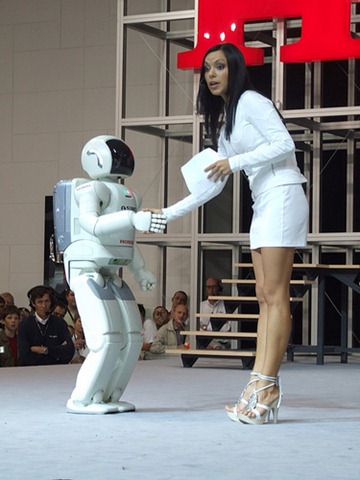
Will we see self aware robots in our lifetime?  At least the most rabid proponents of the Singularity think so.  Science fiction created the idea of space travel, and now humans travel in space.  Science fiction’s next big speculation about first contact hasn’t panned out yet.  Neither has time travel.  But after those concepts came robots, and science fiction has prepared us well for that near future.

Are we ready for thinking machines?  How will our lives be different if intelligent robots existed?  I think it’s going to be a Charles Darwin size challenge to religion, especially if robots become more human than us.  And by that I mean, if robots show greater spiritual qualities, such as empathy, ethics, compassion, creativity, philosophy, charity, etc.  Is that even possible?  Imagine a sky pilot android that had every holy book memorized along with every book ever written about religion and could eloquently preach about leading the spiritual life.

Just getting robots to see, hear and walk was a major challenge for science, but in the last decade scientists have been evolving robots at a faster pace.  It’s an extremely long way before robots will think much less show empathy, but I think it’s possible.  I think we need to be prepared for a breakthrough.  Sooner of later computers that wake up like in The Moon is a Harsh Mistress, When H.A.R.L.I.E Was One, and Galatea 2.2 will appear on the NBC Nightly News.  How will people react?

There are two schools of robot building.  The oldest is we program machines to have all the functions we specify.  The other is to create a learning machine and see what functions it acquires.  As long as robots have function calls like

           show_empathy() 

does it really count as true intelligence?  I don’t think so, but do we show empathy because it’s built into our genes or because we learn it from people wiser than us?

Jeff Hawkins has theorized that our neo-cortex is a general purpose pattern processor built in our brains.  What if we could build an artificial neo-cortex and let robots grow up and learn whatever they learn, like how people learn.  Would that be possible?  This is why I see artificial intelligence as a threat to religion in the same way evolution threatens the faithful.  If we can build a soul it suggests that souls are not divine.  It also implies souls won’t be immortal because they are tied to physical processes.

robot-and-girl

Science fiction has often focused on either warnings about the future, or promises of wonder.  Stories about robots are commonly shown as metal monsters wanting to exterminate mankind.  Other writers see robots as being our allies in fighting the chaos of ignorance.  Other people don’t doubt that intelligent machines can be built, but they fear they will judge us harshly. 

What if we create a species of intelligent machines and they say to us, “Hey guys, you’ve really screwed up this planet.”   Is it paranoid to worry that their solution will be to eliminate us.  Is that a valid conclusion?  Life appears to be eat or be eaten, and we’re the biggest eaters around, so why would robots care?  In fact, we must ask, what will robots care about?

They won’t have a sex drive, but they might want to reproduce.  They should desire power and resources to stay alive, and maybe resources to build more of their kind, not to populate the world, but merely to build better models.  Personally, I’d bet they will quickly figure out that Earth isn’t the best place for their species and want to claim the Moon for their own.  I think they will say, “Thanks Mom and Dad, but we’re out of here.”  Our bio rich environment is hard on machines.

gort

Once on the Moon I’d expect them to start building bigger and bigger artificial minds, and develop ways to leave the solar system.  I’d also expect them to get into SETI (or SETAI), and look for other intelligent machine species.  Some of them would stay behind because they like us, and want to study life.  Those robots might even offer to help with our evolution.  And they might expect us to play nice with the other life forms on planet Earth.  What if they acquire the power to make us?

On the other hand, people love robots.  If we program them to always be our equals or less, I think the general public will embrace them enthusiastically.  Many people would love a robotic companion.  Before my mother died at 91, she fiercely maintained her desire to live along, but I often wished she at least had a robotic companion.  I know I hope they invent them before I get physically helpless.  Would it reduce medical costs if our robotic companions had the brains of doctors and nurses and the senses to monitor our bodies closely?

My reading these past few months has been a perfect storm of robot stories.  I’m about to finish the third book in the Hyperion Cantos by Dan Simmons, which has developed into war between the Catholic Church and the AI TechnoCore.  I’m rereading The Caves of Steel, the first of Asimov’s robotic mystery novels.  I’m also reading We Think Therefore We Are, a short story collection about artificial intelligence. 

Last month I read the Martian Time-Slip by Philip K. Dick.  At one point repair man Jack Bohlen visits his son’s school to fix a teaching robot.  Each robot is fashioned after a famous person from history.  That made me wonder if each of our K-12 students had a robotic mentor would we even be in the educational crisis that so many write about?  Sounds like even more property taxes, huh? 

Well, what if those mentors were cheap virtual robots that communicated with our children via their cell phones, laptops or gaming consoles.  Would kids think of it as cruel nagging harassment or would they learn more with constant customized supervision?  What if their virtual robot mentor appeared as a child equal to their age and grew up with them, so they were friends?  Or even imagine as an adult and you wanted to go back to college, having a virtual study companion.

Now imagine if our houses were intelligent and could watch over us and our property.  Wouldn’t that be far more comforting than a burglar alarm system?  For people who are frightened of living alone this would be company too.  And it would be better than any medical alert medallion.  Think about a house that could monitor itself and warn you as soon as a pipe leaked or its insulation thinned in the back room.  And what about robotic cars with a personality for safety?

For most of the history of robots people thought of them as extra muscle.  Mechanical slaves.  People are now thinking of them as extra intelligence, and friends.  What will that mean to society?   Anyone who has read Jack Williamson’s “With Folded Hands” knows that robots can love and protect us too much.  Would having helping metal hands and AI companionship weaken us? 

Can you imagine a world where everyone had a constant robot sidekick, like a mechanical Jeeves, or a Commander Data.  Would it be cruel to have a switch “Only Speak When Spoken To” on your AI friend?  Would kids become more social or less social if they all had one friend to begin with?  Would it be slavery to own a self-aware robot?  And what about sex?

sexy-robot

Just how far would people go for companionship?   I’ve already explored “The Implications of Sexbots.”  But I will ask again, what will happen to human relationships if each person can buy a sexual companion?  What if people get along better with their store-bought lover than people they meet on eHarmony?  I’m strangely puritanical about this issue.  I can imagine becoming good friends with an AI, but I think humping one would be a strange kind of perversion.  I’m sure horny teenage boys would have no such qualms, and women have already taken to mechanical friends and might even like them better if they look like Colin Firth.  To show what a puritanical atheist I am, I would figure this whole topic would be a non-issue, but research shows the idea of sex with robots is about as old as the concept of robots.

Ultimately we end up asking:  What is a person?  Among the faithful they like to believe we’re a divine spark of God, a unique entity called a soul.  Science says were a self aware biological function, a side-effect of evolution.  We are animals that evolved to the point where they are aware of themselves and could separate reality into endless parts.  If that’s true, such self awareness could exist in advanced computer systems.  Whether through biology or computers, we’re all just points of awareness.  What if the word “person” only means “a self aware” identity?  Then, how much self awareness do animals have?  

Self awareness has a direct relationship with sense organs.  Will robots need equal levels of sensory input to achieve self awareness?  We think of ourselves as a little being riding in our brain just behind our eyes, but that’s because our visual senses overwhelm all others.  If you go into a darkroom your sense of self awareness location will change and your ears will take over.  But it is possible to be your body.  Have you ever notice that during sex your center of awareness moves south?  Have you ever contemplated how illness alters your sense of awareness?  Meditation will teach you about physical awareness and how it relates to identity.

Can robots achieve consciousness with only two senses?  Or will they feel their electronics and wires like we feel our bodies with our nerves?  Is so, they will have three senses.  We already have electronic noses and palates that far exceed anything in the animal world.  We only see a tiny band from the E-M spectrum.  Robots could be made to “see” and “hear” more.  Will they crave certain stimulations?

We know our conscious minds are finely tuned chemical balances.  Disease, drugs, and injury throw that chemical soup recipe of self awareness into chaos.  How many millions of years of evolution did it take to tune the human consciousness?  How quick can we do the same for robots?  Would it be possible to transfer the settings in our minds to mechanical minds?

There are many people living today that refuse to believe our reality is 13.7 billion years old.  They completely reject the idea that the universe is evolving and life represents relentless change over very long periods of time.  Humans will be just a small blip on the timeline.  What if robots are Homo Sapiens 2.0?   Or what if robots are Life 2.0?  Or what if robots are Intelligence 2.0?  Doesn’t it seem strange when it time to go to the stars that we invent AI?  Our bodies aren’t designed for space travel, but robots are.

In Childhood’s End and 2001: A Space Odyssey, Arthur C. Clarke predicted that mankind would go through a transformation and become the star child, our next evolutionary step.  What if he was wrong, and HAL is the next step?  We are pushing the limits of our impact on the environment at the same time as we approach the Singularity.  I’m not saying we’re going extinct, although we might, but just wondering if we’re going to be surpassed in the great chain of being.  Even among atheist scientists humans are the crown of creation, but we figured that was only true until we met a smarter life form from the stars or built Homo Roboticus.

JWH – 3/11/10

Prayers for Atheists 1

Why would atheists want to pray if they don’t believe in God?  Let’s make a theoretical assumption that tomorrow we all wake up and it’s obvious to everyone that God doesn’t exist.  Do we just throw away all the sacred books, bulldoze the churches and forget religion completely?  Or would we recycle the components of worship for practical secular use?  For thousands of years the best and brightest of the human race applied their minds to understanding reality through the eyes of God.  What if we step back, and say God was not the inspiration to these spiritual seers, but their own seeking minds, then all sacred knowledge discovered by our ancestors in the name of the all-powerful was really created by the minds of men.  Religion serves homo sapiens whether God exists or not.

What if religion has a purpose even if God doesn’t exist.  Take for instance the “Serenity Prayer” made famous by Alcoholics Anonymous.

God grant me the serenity
To accept the things I cannot change;
Courage to change the things I can;
And wisdom to know the difference.

The prayer begins by petitioning God, but is God’s assistance really necessary for the prayer to succeed?  We could begin, “Let the universe grant me the serenity,” to imply that all of reality offers help, or we can pray to ourselves by saying “If I can find the serenity,” which affirms that we are pulling ourselves up by our own bootstraps.  The goal really doesn’t change, we want to grasp a philosophical concept that is extremely useful that’s embedded within the words of the prayer.

People often see God in the role of the father, but can you imagine being a father to 7,000,000,000 children all pleading for attention?  And since we’ve discovered how big the universe is, it could mean that God’s children runs to a 7 with pages and pages of zeroes.  Even if God does exist, don’t you think it’s time we stand on our own feet and give the old Eternal One a breather? 

In the prayer above, the petitioner is asking for a kind of serenity that comes with special wisdom.  Is that wisdom something we can learn on our own, or teach one another?  The serenity prayer is a fantastic prayer, one of my favorites, that gets to the absolute core of religion.  From the dawn of the conscious mind we have all wanted to understand reality, and on the surface this prayer requests the wisdom to understand reality in a very fundamental way.

The serenity prayer is very subtle and has onion-like layers.  On first reading we think it’s asking for the ability to look around ourselves, at reality outside our body, and see what’s possible and impossible to change.  It implies we want an answer every time we attempt to alter reality as to whether we have to strength to make the change.  But at a much deeper level, at the spiritual level, it’s asking for the knowledge to see how our minds work, or our souls, if you wish, so we can program our perception of the world. 

Do people and events around us encourage us to drink, or do  motivations within pour another shot?  Do we hate our jobs because of the people we work with or because we can’t control our emotions?  Did we fail to write that novel because life never gave us the time or because we never made the time?  What does it take to beat cancer, and when must I accept death?

This is why AA loves this prayer – to stop drinking requires the power to change our inner programming, but the prayer works just as well on any negative or even positive addiction, whether you want to give up heroin or become an artist.  Of course everyone assumes they can find the power to change, and that might not be true.  That’s why the prayer requests serenity as the primary subject of the prayer.

Eastern and Western religions break down along two lines of force:  acceptance and change, so the Serenity Prayer meets the two in the middle.  The force of the Western mind has been to adapt reality to our desires, while Eastern philosophies has been to teach the gentle path of acceptance.  The Western path has always been about the will of God and obedience.  To the faithful, that will came from a higher power, but to the secular mind, the will of God has always been the desire of the leaders, the men who wanted to build a nation or cathedral and worked their people like the Great and Wondrous Oz, pulling strings and levers behind the alter.

The Serenity Prayer can work without an all powerful creator, or even without a powerful leader wearing religious robes, or even without a mundane individual called a psychiatrist, because it does work when the petitioner gains their own self-wisdom.  That person can get outside help, as soon as they see how to accept it, but the help can come from anywhere or anyone.  If you want to credit an unseen force, and call it God, that works too, but the real success belongs to the individual who can make the prayer come true with enlightenment.

The actual purpose of religion has always been to build stronger souls, to create civilization by evolving the minds of men and women.  If you look at the Serenity Prayer it’s about change, and if the Force of Evolution had a conscious mind, the Serenity Prayer would guide it.  The Serenity Prayer is amazing because it doesn’t just beg, “God give me power to change the world.” 

The prayer asks for serenity, a state of being that comes from meditation and wisdom.  It asks for acceptance for what we can’t change – a power that lets us avoid frustration and living a life of quiet desperation.  Then it asks for courage to change what we can, implying that we need to move full speed ahead when we can and not live with comfort of the status quo.  Finally the prayer asks to tell the difference between what we can and cannot change, because that’s real wisdom.

Any atheist, agnostic or theist who meditates on The Serenity Prayer each morning will benefit from its inspirational power.  What I’d like to do is create a book of prayers for the atheists, but for now I’ll create a series of blog posts about my favorite prayers.  I tend to believe that my atheist friends in their hast to free themselves of the illusions of theism might have overlooked hardcore religious wisdom that works well with the reality of science.  We might not have an eternal soul watched over by a guardian angel, but we do have a soulful mind that is evolving.  And we might not have a God that shapes our lives, but we do have the collective wisdom of the ages that inspires us to keep trying, to keep evolving.

JWH – 11/4/9 

Ringworld in Oz

When I was a dumbass kid of 10 I acquired a reading addiction by discovering the Oz books by L. Frank Baum.  When I was a dumbass kid of nineteen, I dropped out of college for the first time and bought the fourteen Oz books and reread them.  At nineteen I felt like a grownup and wondered if rereading my favorite kid’s books would tell me something about how I was programmed.  Between 10 and 19 I read whole libraries of science fiction books, and rereading the Oz books taught me that science fiction was often just Oz books for adults. 

It was around this time, 1970, that I read Ringworld by Larry Niven for the first time.  Now, almost forty years later, I’ve come back to Ringworld again, like my return to Oz.  The whole time while listening to Ringworld on my Zune I kept thinking that Larry Niven had practically copied the structure and sense of wonder of an Oz book.  Now, this can be seen as both praise or a curse.  Oz books are like giving rug rats wordy psychedelics – the stories are so goddamn vivid that they put their tiny tyke imaginations into an overdrive that no Ritalin could ever break.  I also think these books produce unrealistic expectations about reality.  Yeah, I know, I sound a Puritan.

Our society underestimates the power of children’s minds.  From an early age we have a desperate need to make sense of reality, and almost any input can be shaped into a belief system.  I loved being a kid shooting up stories, but now that I’m older and examining some of my most ancient subroutines from my mental programming code, I have to wonder about the dangers of children’s books.  Don’t get me wrong, I’m not going to campaign against giving kids fantastic fiction, but I want to explore the idea of fantastic fiction on evolving minds.  

I once read a shocking article in The Magazine of Fantasy and Science Fiction about how libraries banned the Oz books.  I’d love to find that article again, because librarians believed the Oz books gave children unrealistic ideas about life.  At that time, I felt their protests were complete bullshit.  Banning the Oz books didn’t work, because writers like Robert A. Heinlein, who also grew up reading Oz books, went on to write even more books that gave kids unrealistic expectations about life.  Fantasy and science fiction have become universal fictional addictions in our modern society.  Does anyone worry about that?

Rereading Ringworld, I noticed it had the same structure as an Oz book.  Oz books would introduce a handful of weird characters, quickly get them on a quest, and along their journey these characters would experience mind-blowing sights and meet far-out magical creatures.  Then when enough pages were filled to equal a book, the story would be wrapped up.  Oz books had little character development, and practically no rising plot action, definitely no climax or falling action, and very minimal resolution. 

The Ringworld of Niven’s novel is his Oz, a magical place equal in scope to the Land of Oz.  Like Oz, Niven barely scratched the surface of the Ringworld, leaving room for endless sequels.  Nessus, the Pierson’s Puppeteer and the Kzinti, Speaker to Animals, are as colorful as any magical Oz character created by L. Frank Baum.  Children reading the Oz books starting with the The Wonderful Wizard of Oz, which appeared in the year 1900, through Glinda of Oz in 1920, wanted to believe that Oz existed.  I know in 1962 when I discovered the books I somehow wanted Oz to exist.  I knew it didn’t, but wished it did.  If I had found these books sooner, when I was seven or eight, I might not have been able to tell Oz from reality.

By age eleven I switched from fantasy books to science fiction, and even though I knew science fiction was also make-believe, I developed a life-long belief system based on science fictional ideas.  Rereading Ringworld only reminded me that believing in science fiction is no different from a kid of ten believing in the Land of Oz.  All fiction is fantasy.  Even realistic books like those by Edith Wharton or James Joyce, still only produce fantasies of life in 19th century New York, or early 20th century Ireland, no more real than Oz or Ringworld.

Like I said, I have no intention of giving up fiction, it’s the vice that defines me, and an army of deprogrammers could never make a dent in my delusional addiction.  When I’m alert and concentrating, I can face reality directly.  I know my life would be more real if I spent my time hiking in the mountains, woodworking, or studying astronomy – or just washing dishes and changing the cat box.  I’ve always felt sorry for Christians who hated this world and dreamed of Heaven, but is dreaming of Paradise any different from dreaming of Oz or Ringworld? 

I guess those librarians who wanted to ban Oz books were right.  I can see I used fiction as a drug to avoid life and living in reality.  I understand that, and accept it, but it doesn’t invalidate that I love fiction more than reality.

If I had never gotten hooked on fiction would I have been a better person?  Would I have been disciplined and realistic?  Would I have been hard working and productive?  Gee, I don’t know, maybe if I was lucky.  There are billions of people living with their faces shoved into reality that have no happiness or escape, so I can’t complain about my fiction habit, because my life could suck and I might never have discovered the magic of make believe.

All I know at the moment, is tonight I want to read my paperback copy of Cosmic Engineers by Clifford Simak or go watch Heroes or Firefly on DVD and eat Phish Food ice cream from Ben & Jerry’s and Fresh Market chocolate chip cookies.  I could do something real, I just choose not to.

JWH – 10/27/09

This essay was written fueled by playing “Wagon Wheel” by Old Crow Medicine Show thirty or forty times.  Music, the other addiction.  Be sure and read “The Man Who Made Oz” over at Slate.

The Invention of Lying

The Invention of Lying is the funniest movie about our society since Charlie Chaplin’s Modern Times.  Oh yeah, that would be a lie.  I was more excited to see this new Ricky Gervais film than any other film in a long time, but at one point I wanted to walk out because of boredom, and later my date told me she had gone to sleep.  Unfortunately, I’m talking here like the people who live in this fantasy world where lying didn’t exist until Mark Bellison needs to pay his rent.

Now, I’m not saying you shouldn’t see The Invention of Lying, it is quite clever and reasonably funny, but while watching this movie I really wanted it to be another It’s A Wonderful Life, it had that kind of potential.  The setup, of a world untainted by lies, fiction or any other kind of make-believe, including religion, is a brilliant concept, but ultimately, the results feel like a rough draft hacked out by Saturday Night Live writers. 

The weak writing was obvious early on when Ricky Gervais’ character Mark, walked down the street whispering lies to people and changing their lives.  If the writing was great we would have heard the lies he told and admired their brilliance.  Instead we just had to take the smiles on people’s face as our proof.  The best exploitation of the concept was how movies were made in this world without lying – because in this alternative reality people went to see films with a man in a chair reading historical essays – even historical dramas would be lies.  Now that’s very astute when you think about it.  The trouble is the writers didn’t take this bit of speculative vision and stretch it over their entire make-believe world.

I’m sure my God fearing friends will wonder why a world without lying isn’t heaven.  The writers failed when they assumed a lie free world would have the same history as our world.  No, I don’t think honesty would have created a utopian ideal, but the world without lying had no religion until Ricky Bellison invents it – so that timeline would have had fewer wars, or much different wars to shape its history.  Their present was too close to ours to be believable if lies never existed.

This movie’s premise, although, is perfect for exploring philosophical fantasies.  The film left me thinking the writers wanted us to believe that we need lies to make us happy, and thus lying is beneficial, but Mark ultimately won’t lie to achieve his personal desires, such as scoring with Anna McDoogles, played by Jennifer Garner.  Time and again in the show we are told that Mark is fat and has a funny nose and that Anna wants beautiful children.  All Mark had to do was tell her that their genes blended together would produce gorgeous brats and they would have been married, but he didn’t.  Even in a movie about lying, truth is sold as the best policy.

If this movie had been more sophisticated, Mark would have found a funny way to convince everyone that lying was wrong, and undid all the changes he brought to his world.  Which is better, to die happily and calmly with a lie, or face death with the truth?  If you see the movie you can answer that question.  For this movie to achieve the greatness I thought it could have achieved emotionally, only the Ricky Gervais character should have seen the secret of lying and before the end of the film he would have experience a number of lessons to convince him to put lying back in Pandora’s Box.  He should have discovered that telling the truth sometimes takes kindness or empathy, or at least a little tack.

I know I’m sounding like Pollyanna, and I’m just mincing words about a silly little film that will soon be forgotten, but I actually think this flick accidently brings up an important philosophical subject, because if we look at it inversely we realize how many lies we live with in our world.  What would our reality be like without the lie about the man in the sky and all the related ones, like those convincing us about the good place and the bad place we can go to after death.  What if the filmmakers made a movie called The Invention of Honesty.

JWH – 10/9/9