How Do You Label Your Existence?

by James Wallace Harris, 5/3/22

Now that I’ve been retired for eight years, I realize I can no longer call myself a programmer, which is the way I identified myself during my middle years. Because Susan and I never had children, I’ve never been a parent, and thus can’t be a grandparent in my waning years, which is a label some of my retired friends proudly embrace.

My new identity is a retired person, but that’s not much of an identity and I’m not sure I like using that label, but I do. I spend most of my time reading and writing about science fiction short stories, which gives me a little bit of a purpose. I can’t call myself a scholar, but I do study that subject in depth. It’s just a tiny subject that’s not very relevant but does give my existence a purpose. I’m not sure I can justify my existence by calling myself a science fiction fan.

I guess I could call myself a blogger but don’t know how satisfying a label it would be to use. I’ve always wanted to be a scientist or philosopher but I’ve never come close to actually being either.

I look around and see people defining their existence in various smaller ways. One prominent label that is often in the news is Republican. Some of these people treat being a Republican almost like a religious identification and evidently find great identity with it. They even take great satisfaction in calling themselves a Republican or a Conservative. I’m a liberal but don’t get off on calling myself one. I think that’s one of the big differences between the two parties. Conservatives are a lot more organized, and they seem to get a lot of satisfaction out of being part of their group. I think being young and liberal is more of an identity thing. It was for me.

I observe people finding meaning in their existence in all kinds of ways. I know many people who are ardent travelers. They use the term traveler to define themselves. Many of them act like their purpose on Earth is to travel. They find self-worth by recalling the places they’ve been. I’ve noticed there are a lot of travelers with YouTube channels. I wonder if they feel like prophets of traveling?

I’m on the fringe of many subcultures. Take audiophiles for example. They find meaning in their never-ending question to achieve higher fidelity playback, I’m too cheap to go all the way with that group. I’m not a sports fan, but they are quite common around here, and they seem to find great happiness in identifying with their teams. There seems to be an overlap between sports fans, Christians, and Republicans, in that they all love their group identity and get immense satisfaction when their group wins or converts folks to the team.

I relate to many of my friends through the kinds of entertainment we share. Much of the conversations I have with my friends, deal with discussing shows and movies on television. I’m also a bookworm and find kinship with other bookworms. I’m not a foodie, but I know a lot of people who find dining out an important aspect of existence.

I believe people get more existential meaning from their pursuits when they have a strong label for themselves. The average person might love dining out, but someone who calls themselves a foodie obviously gets more meaning from it than those of us who just enjoy chowing down. And if people call themselves a gourmet, they feel even more important about themselves, like they were philosophers of the tablecloth.

That’s my trouble. I no longer have any good labels to define myself. I guess the best is Bookworm. It’s the one I’ve embraced since childhood. I’ve never been one for nice cars or clothes. I spend my money on books. I don’t travel because I prefer to read.

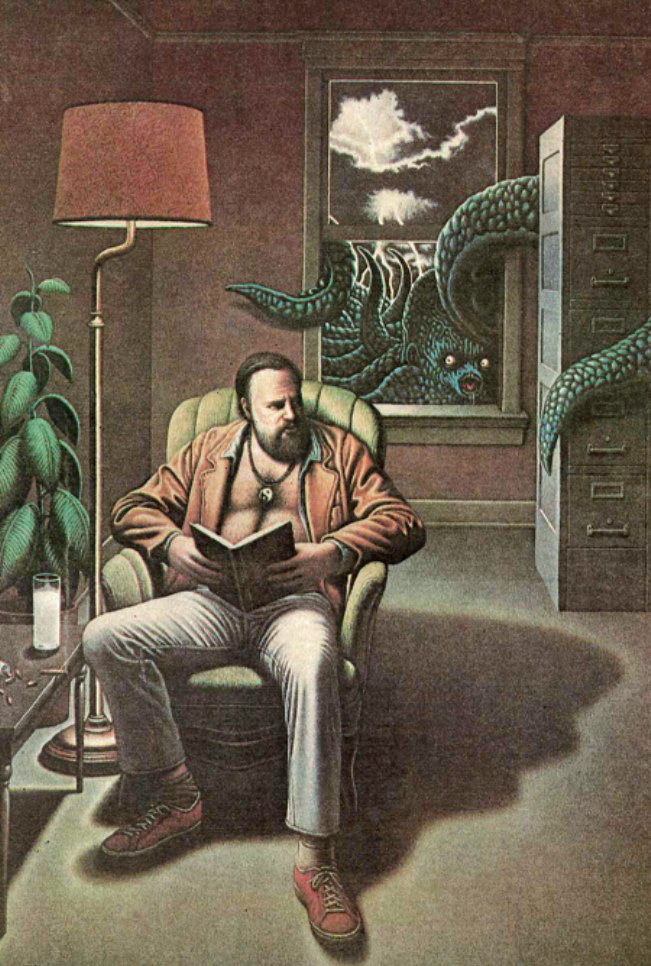
However, I have to wonder, when I lay dying in my La-Z-Boy, will I look back and feel my existence was well spent with all those books?

JWH

Schismogenesis, Cultural Appropriation, Conformity, and Identity

James Wallace Harris, 3/4/22

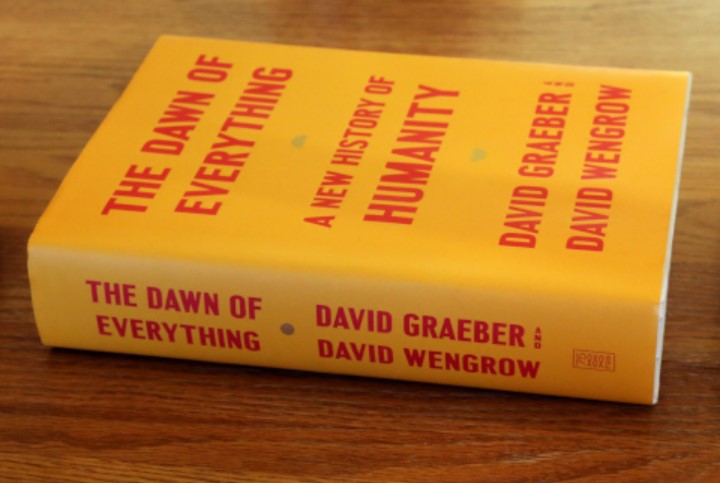
I’m reading The Dawn of Everything: A New History of Humanity by David Graeber and David Wengrow but I can’t review it as a whole because it features hundreds of interesting ideas and I have no way to assess them all in a small essay. So, I’m going to review some of its ideas in a series of blog posts. Each one will deal with a unique concept that I think is useful.

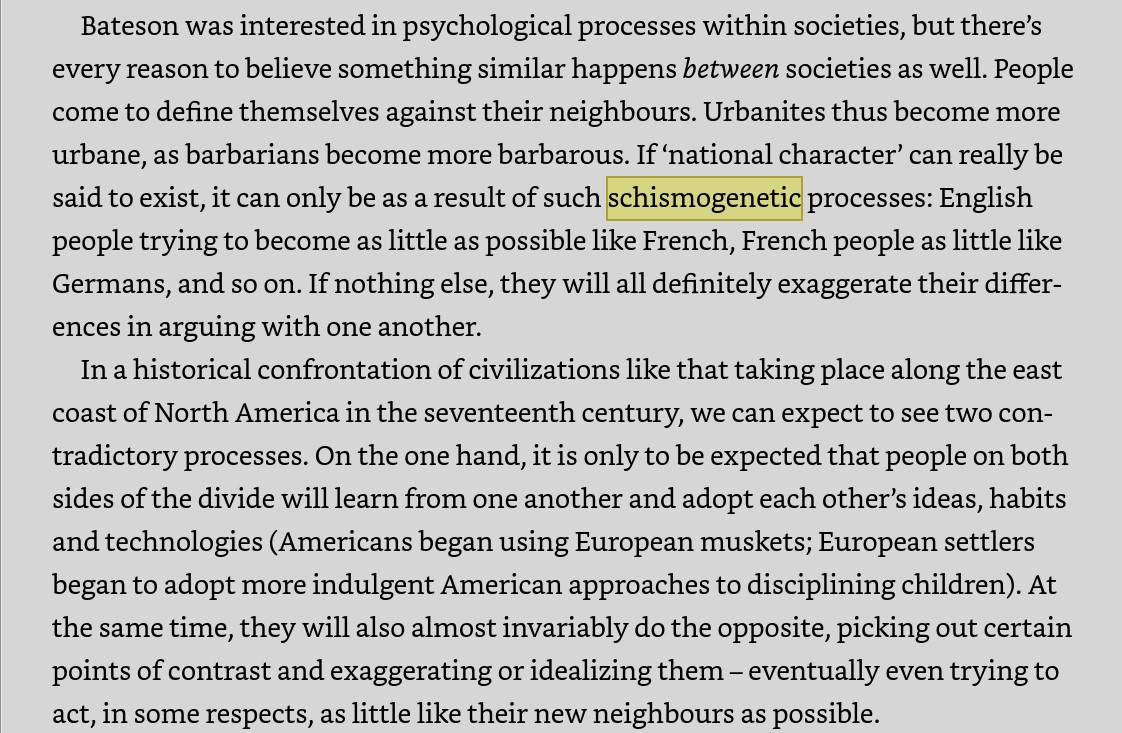
Overall, the book speculates about societies in prehistory and in three places uses the word “schismogenetic” referring to the term schismogenesis, a word coined by anthropologist Gregory Bateson. This is not a common word, but one that I had to look up, and it’s used in various ways in the social sciences that isn’t exactly how Graeber and Wengrow use it.

Graeber and Wengrow use the concept of schismogenetic to identify a human trait that is very worth recognizing — the urge to belong to a group by defining distinctive wanted traits. This explains children and adolescents who like to conform, to subcultures and hobbyists who love sharing a common interest, to ethnic, cultural, and nationalistic groups who fight cultural appropriation to preserve their unique identity, to political groups who want to maintain unity, and so on.

Schismogenesis can be seen as the cause of xenophobia, but it could also be seen as the inverse of xenophobia. Xenophobia rejects others by traits we don’t like or want, and the schismogenetic urge defines our group identity by specific traits we embrace. This is just me speculating and I’m no expert. I want to embrace this concept because I feel it’s very useful. I see examples of it everywhere. If the term became popular it might help us understand ourselves.

Take conservatives and Republicans. It seems in recent decades they are defining themselves more and more exactly. They have generated a schism by clearly defining who they want to be issue by issue. Take mask-wearing. They’re against it. They see mask wearers as a liberal trait. Ditto for vaccinations. If liberals and Democrats had been against masks and vaccinations, the people on the right would have been for them. If the left is for Critical Race Theory, then the right is against it. If the left believes in climate change, then they don’t. And the details don’t matter to most people.

I use this political example not to be political, but I think it’s obvious that the schismogenetic urge is stronger in conservatives. They really enjoy defining themselves and being part of their group, and it seems they fear being seen as not conforming. For example, being called a RINO is a terrible insult. And this has worked out well for conservatives because they are better at organizing and defining themselves than the liberals.

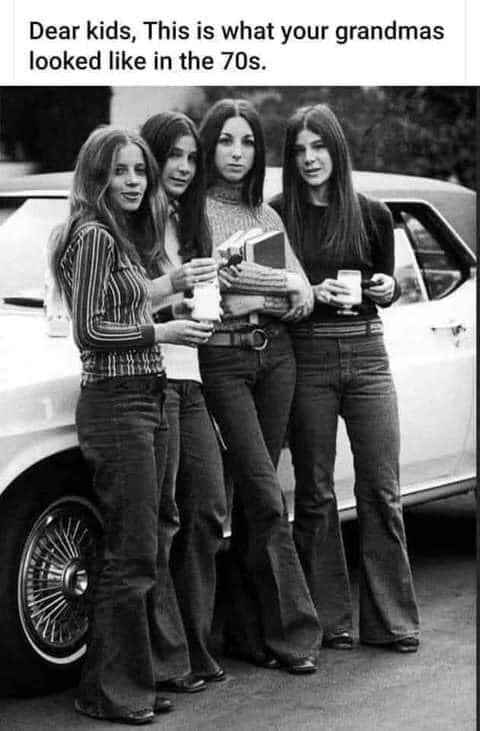
But I believe we all have schismogenetic urges. I saw this photo on Facebook and it reminded me of how back in the 1960s we all wanted to be individual free spirits, but in reality, the hippie counter-culture was very conforming.

Graeber and Wengrow used the concept of schismogenetic to explain why the hundreds of Native American tribes created very distinctive and diverse societies. I think everyone uses the trait to join the groups and subcultures they want to embrace as their identity. I believe this is why the concept of cultural appropriation has developed in recent years — subcultures want to protect their identity, their brand. And that’s cool. I’m not necessarily saying this is a bad trait, but it can lead to schisms divided by hate.

Some of the reviews that are deeply critical of The Dawn of Everything attack it because they consider Graeber and Wengrow of being historical revisionists. And I see this as a schismogenetic trait too. There are those who define themselves by the histories they embrace and they really don’t like the idea that what they’ve learned and accepted is being revised. It challenges their identity.

Science and history are constantly revising their disciplines with new data. The social sciences aren’t as exact as classical physics, so they go through more upheavals. Those upheavals cause new schisms and threaten old ones. Trying to fully grok The Dawn of Everything is difficult. Graeber and Wengrow keep bringing in politics by using studies of prehistory societies. I think this clouds what they are trying to do. At one point they say, “Since this book is mainly about freedom…” but is that true? I thought it was about prehistory. That makes me wonder if the goal of this book is to be schismogenetic.

JWH

We Can Build You by Philip K. Dick

by James Wallace Harris, 2/9/22

My intended fifth book to read for 2022 was Humankind, a hopeful reappraisal of humanity by Rutger Bregman. However, during the ice storm, I didn’t feel like reading serious nonfiction while the power was out. For some strange reason I was in the mood for Philip K. Dick (PKD) and I randomly picked We Can Build You. I listened to it on audio, and it was wonderfully narrated by Dan Jon Miller.

PKD wrote We Can Build You in 1962 calling it The First in Our Family while it was a working manuscript. It was rejected by his publisher, G. P. Putnam’s Sons, who had just put out The Man in the High Castle, and by several other publishers until Ted White bought it for Amazing Stories in 1969. White claimed the novel needed an ending, which White wrote with Dick’s permission. It was retitled A. Lincoln, Simulacrum and ran in the November 1969 and January 1970 issues. This is when I first read this novel. After that Donald Wollheim, who had rejected it for Ace Paperbacks, reconsidered the novel and published it for his new company DAW in 1972, but without the Ted White final chapter.

Before I digress, and I will digress all over the place, just let me say that Philip K. Dick is one of a handful of writers I obsess over. I’ve written about these writers before in my essay “The Ghosts That Haunt Me.” I’ve read many biographies about PKD, and even reviewed them as a group. And I’ve recently started reading his collected letters (I have 5 of the 6 volumes). I’m not the only one obsessed with PKD. Dick is known for writing science fiction, and he’s probably one of the most filmed of all science fiction authors. However, PKD was a troubled soul, and he often used his books and stories to explore his own psychological problems. We Can Build You is one such book.

Readers will find many stories to follow within We Can Build You. One is about Louis Rosen, a partner in a firm that sells organs and spinet pianos. Louis falls in love with his partner’s daughter, Pris Frauenzimmer, who is schizophrenic, and only 18. Louis is 33. Over the course of the novel, Louis also becomes schizophrenic. In 1962, PKD was around 33. At the time PKD wrote this novel he was married to his third wife, Anne. There is evidence that We Can Build You is somewhat biographical to PKD’s life in 1962 and is a reaction to a troubled marriage with Anne and his own psychological problems. Was there another woman? Or is Pris modeled on Anne?

Anne was an atypical PDK wife (he had five in all). Anne was a year older than Phil, and she was blonde. Dick had a neurotic obsession with dark-haired young women, and Pris Frauenzimmer, the love interest in We Can Build You is eighteen and dark-haired. Makes you wonder.

I’m giving all this information as a kind of warning. We Can Build You can be read without knowing anything about Philip K. Dick’s life. For some, especially readers who enjoy outre science fiction but don’t know PKD’s work, it will be a reasonably entertaining story, although one that will strike them as quite odd even for the outre. For fans of PKD who only read his fiction, it will even be one of the better novels, but far from his best. But, if you happen to be a Dickhead, this book offers all kinds of delicious mysteries about the bizarre and tragic life of Philip K. Dick.

Some Dickheads consider We Can Build You as a trial run for Do Androids Dream of Electric Sheep? It certainly focuses on two of PKD’s favorite themes: What is human? and What is Real? It’s also about insanity, a theme that runs throughout many of his stories. But it’s mainly about Dick’s obsession with young dark-haired girls, one that’s gotten its own nonfiction book. Dick was born with a twin sister who didn’t live long, and he claimed that affected him for the rest of his life.

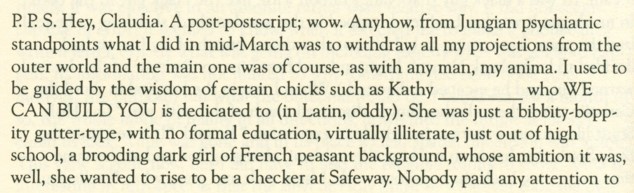
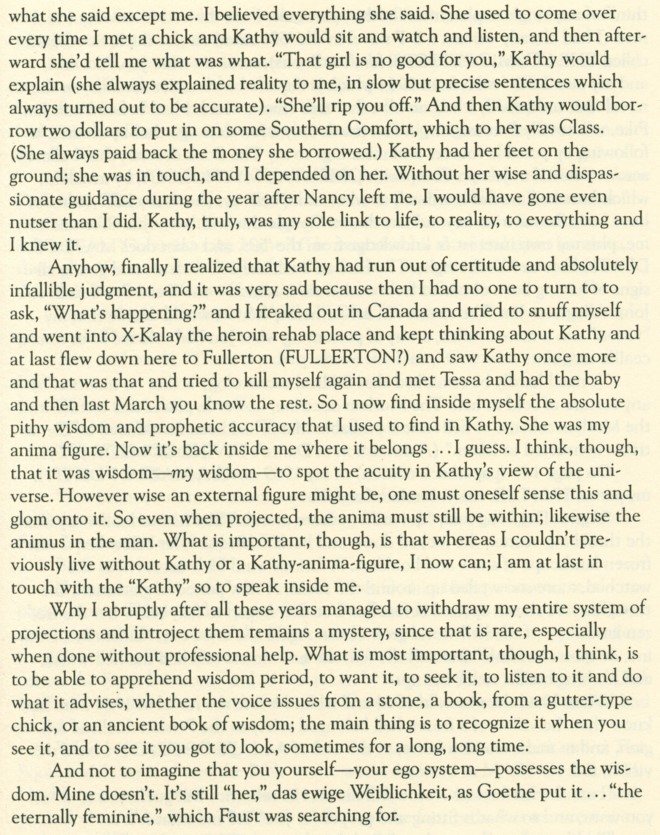
The first edition of We Can Build You in 1972 has a dedication that reads: “For Kathy Demuelle, my best friend, Mea voluptas, meae deliciae, mea vita, mea amoenitas …” Google translated that Latin for me as: “my pleasure, my darling, my life, my attractions.” This was written at the end of his marriage to his fourth wife Nancy and before he married Tessa, his fifth and final wife. These wives were barely legal for a man in his forties to marry. Dick’s published collected letters do contain letters to Kathy, and she is described in a letter to another young woman in this 1974 letter:

Kathy sounds just like Pris. But I don’t think Pris is based on Kathy. I don’t know when he met her. I need the first volume of the collected letters which I don’t have, and they are now sky high to buy used. The above letter does give us many clues as why PKD wrote We Can Build You.

However, after We Can Build You was published, Kathy evidently ghosted Phil, and he wrote Donald Wollheim asking for the dedication to be changed to Robert and Ginny Heinlein, which it is in later editions. Heinlein had out of the blue sent PKD money for medical expenses, and PKD was very moved. The early 1970s were a particularly bad time for Dick, who had suicide attempts, an escape to Canada, and had spent time in rehabs. PKD was agoraphobic but hated living alone, and often invited anyone who would, to live with him. And sometimes these were not very nice people, and sometimes they were very young dark-haired girls.

Knowing all of this should help us understand the protagonist of We Can Build You, Louis Rosen. But it’s also important to understand the major theme of mental illness and psychiatry in We Can Build You comes from a 1962 PKD, and not the 1972 PKD. Knowing the difference helps us to realize that the novel is about PKD then, but it prophesied the PKD to come.

Here’s the thing. Most readers think stories by Philip K. Dick are science fiction, but if you’re a Dickhead you realize they’re about PKD. Phil started out writing science fiction, but after he married Anne he wrote almost a dozen mainstream novels he couldn’t sell. Dick wanted to become an important writer and to support a wife that wanted that kind of success. At the beginning of the 1960s, PKD understood that wasn’t going to happen and returned his focus to writing science fiction. That’s when he published his masterpiece The Man in the High Castle in 1962. It was then PKD got the idea to blend mainstream fiction and science fiction and wrote We Can Build You.

The science-fictional elements of We Can Build You deal with building androids. The two main ones are Abraham Lincoln and his secretary of war, Edwin M. Stanton. Each android is programmed with all the biographical knowledge we have for each man. They look completely human and act like they have been reincarnated. Although they become fascinating characters integral to the story, they aren’t the important part of the story.

The novel is really a bizarre love story. Louis loves Pris, but she doesn’t love him. She is cold, cruel, and indifferent. Pris is ambitious and convives to get Sam Burrows a tech billionaire that reminded me of Elon Musk. Pris doesn’t love anyone but knows Burrows can get her what she wants. This drives Louis insane and he goes to extreme measures to take Pris from Burrows. The last third of the book is Louis undergoing therapy after having a psychotic breakdown. PKD was not the kind of man women would want, and it’s surprising he found five wives. I believe this novel conveys PKD’s frustration with his search for a woman that could make him sane and whole.

The published novel has a mainstream novel ending. Ted White wrote a science fictional ending for the magazine serialization. You can read it here, starting with the heading “nineteen.” I actually like White’s ending, but not as an ending for We Can Build You. I like it because it encapsulates how many science fiction fans think of PKD’s stories. I think they are wrong. Of course, I think I’m right in seeing PKD differently, but then I could be wrong. Reading PKD always makes you doubt everything.

Ted White’s final chapter is written knowing all of Dick’s novels from the 1960s, and White completely misses the mainstream aspects of the We Can Build You and writes a bogus PKD ending. It’s an ending that science fiction fans expect, one that falsely assumes what they think PKD is saying in the book. The ending is as different as the theatrical release of Blade Runner and Riddley’s Scott’s ending in the director’s cut. I hate Scott’s interpretation, and it’s funny that Ted White wants to use the same twist. It only goes to show you how wrong both were about Philip K. Dick.

The funny thing is I remembered White’s ending from reading it in 1970, so all the while I was listening to We Can Build You I was expecting that ending. However, I never once found any support for it.

In an April 18, 1974 letter to Claudia K. Bush, PKD tells her his favorite of his own novels are:

  • Martian Time Slip
  • We Can Build You
  • Flow My Tears
  • Doctor Bloodmoney
  • The Man in the High Castle
  • The Three Stigmata of Palmer Eldritch
  • The Simulcra
  • The Penultimate Truth

I don’t know if he intended that list to be in order, but We Can Build You came second to mind. He even mentions in the same letter that he wasn’t sure he liked Ubik. Nor does he mention any of his unpublished mainstream novels.

Additional Reading and References

Within We Can Build You Pris works on bathroom mosaic. It turns out Anne, Dick’s third wife, created such a mosaic, while he was writing the novel.

JWH
Back to Normal?

by James Wallace Harris, 2/7/22

Every time we live through an extended power outage I learn something new about myself. Our power is back on. Our electricity was restored on the fourth day after the ice storm. There are still over 61,000 people without power in Memphis on the fifth day. I feel very bad for those people because I know their misery. I know some of their thoughts and anxieties, their inner pleas, and prayers for utility restoration.

We are back to normal, but this time I’m questioning my normalcy.

We lose electricity once a year or more, sometimes for 2-3 days. Last year I wrote “Cracks in My Comfort Zone” about the 2021 ice storm. I wrote “Thrown Off the Grid Kicking and Streaming” in 2017. In 2011 I wrote “Blogging by Candlelight and Paper” and in 2008, wrote “Living Like Jane Austen.” There were many outages in between those years, but not long ones. Sometimes it’s in the heat of summer, like Hurricane Elvis, when we went 13 days without power. But more often, it’s in winter, after an ice storm, or in the spring or fall from weather fronts colliding.

Each time I learn something philosophical while living without electricity. This ice storm wasn’t as bad because we never approached zero degrees like last year. The worst was 17 degrees. In both situations, my biggest fear was bursting pipes. This year my friend Leigh Ann had a supply shelf, a color laser printer, and her studio floor ruined by two burst pipes. Last year Mike and Betsy had a flooded bathroom from one burst pipe. Laurie told me about a neighbor that once had a tree fall on her house and do $200,000 worth of damage. But then I think about those people in Kentucky hit by a tornado. We’re all lucky.

After last year’s ice storm, I made several preparations. I had the gas fireplace I was too afraid to use last year cleaned and checked for safety. I had the pipes in my crawlspace insulated. I bought a Jackery to recharge the cell phones. That was a tremendous purchase. As were two battery-powered LED lanterns Susan and I carried with us at all times. I also had our trees thinned of dead branches, but it wasn’t enough. During the ice storm, we kept hearing the crack and crash of falling limbs. It felt like it was raining limbs on our roof. One huge limb came down in front of our house and our neighbor called and said we should rush to the casinos with that luck.

Being without heat and hot food is miserable, but what we suffered mostly from was boredom. That’s a pitiful problem of privilege that I hate to admit. The only time I’m bored is in a power outage. Ditto for Susan. That shows just how pathetically addicted we are to our TVs and computers. These power outages reveal our dependency on screens. I know that’s not good, but I don’t know if I’m going to change either.

We hunkered down and endured. While some of our friends got out and still did fun things. But those friends aren’t as addicted to screens as we are. This year I tried to get up and do more things around the house, like wash dishes by hand, clean out closets, fold clothes, even vacuumed with my battery vacuum. One day I went out and filled our tires with the proper amount of air pressure. That made this outage much better than last year.

However, one thing that made last year very miserable was my prostate problems. This year I had two temporary crowns the cold annoyed but that wasn’t so bad. Obviously, health and vitality are a factor in enduring power outages. It must be torture for people with acute and chronic health problems to go without power.

Last year our phones ran down quickly. We charged them a tiny bit in the car, but it wasn’t a practical solution. This year, we charged both phones with the Jackery several times, and the Jackery still had enough juice left for several more charging. Also, we have new iPhones with 5G and we were able to play Google TV on them – that lessened our boredom. I also listened to audiobooks and read using the Kindle app on my iPhone.

The small iPhone screens gave us most of what our big TV and computer screens give us in our normal lives. That was interesting. I’m thinking an iPad with a keyboard could do everything we wanted if it had broadband access. For next year, I want to check into getting a broadband hotspot that would work with our existing tablets and Susan’s laptop.

I often read fiction and nonfiction about life in the 19th century. Those people had to live with the cold all the time and didn’t have electricity. In adapting to future power outages I need to plan for ways to follow our normal routines and be just as active.

Susan and I wore lots of layers and snuggled under three Afghans each in our recliners. That essentially solved the cold problem. The gas fireplace helped some too, but not as much as I had hoped. The temperature in the house was 50 degrees. It was 44 degrees last year and falling. It was 57 degrees in the living room near the fireplace. That made a difference. Three days living at 50 degrees wasn’t horrible, but 44 degrees was just miserable last year. Overall, we handled the cold well. I have a few tweaks to try for next year. I’m assuming that bad weather will become more common.

We were better prepared for food this year. I had bagels and cream cheese, cheese sandwiches, and protein bars. Susan had tuna fish and peanut butter and jelly. We ordered pizza one night and got Burger King one lunch. I’m a vegetarian, so I had their Beyond Burger. It was good but cold. I heated it up on the gas fireplace.

Next year I know to get a healthier supply of food that can be eaten cold. I’ll investigate camping food. Also, if I know a storm is coming I should wash all the dirty clothes and dishes ahead of time. Slowly we’re getting better at adapting to short periods of living without power.

Susan’s folks went ten days without power in this house after the 1994 ice storm. I was afraid we might have to go that long again. Some people in Shelby county might have to go that long now. Being prepared for 1-2 weeks is important.

Susan wants to get a gas stove and maybe a gas oven. Eating hot food would have helped, especially for a longer outage. I could have heated up soup on the gas fireplace but just didn’t. If the outage had lasted longer I would have.

I want to buy a generator. Last year I pondered getting a generator but decided I didn’t want to mess with a portable gasoline generator and thought a permanent fall-over natural gas generator was too expensive for outages that only happen a couple times a decade. Now that it’s two years running I’m rethinking that.

The main lesson I learned this time is I need to become more active in my retirement life and less dependent on screens. The key is to be prepared for outages, but try and live as normal as possible while the electricity is gone. We tend to just sit and wait for the power to come back, and that’s not good.

I need to work on a new normal.

JWH

2022 Book #1 – The Soul of an Octopus by Sy Montgomery

by James Wallace Harris

My old buddy Connell and I often talk about the unexpected scientific discoveries made in our lifetime. Back in the 1960s, we both grew up reading science fiction and we had certain expectations about the 21st-century. Now that we’re in our seventies living in that century we realized that science fiction missed so much, and so did our imaginations.

Because we grew up thinking the black and white astronomical photos made by the Mt. Palomar 200″ telescope were the pinnacle of astronomical awareness, we never imagined what the Hubble Space Telescope would show us in color. We never dreamed that astronomers would discover exoplanets or robots would roam the solar system. We thought people had to go to all those places.

Nor did we imagine society being transformed by computers and networks. I never pictured the computer I’m typing on now, or what I could do with my iPhone or iPad.

But one of the biggest discoveries we missed was about animal consciousness. We expected that we’d have to wait for interstellar spaceships to be developed before we’d meet another form of intelligent life. We never realized it was all around us on Earth and in the oceans.

Intelligence and sentience are on a spectrum. We grew up in a time when people believed they were the crown of creation, and all life below us was unconscious and stupid. We’re finally realizing just how stupid we were. See The Cambridge Declaration on Consciousness.

There are so many books to read to illustrate what I mean. The Soul of an Octopus is just one, but a beautiful work by a woman that has learned so much about animals by spending time with them. Sy Montgomery writes in a way that we follow her around as she makes her discoveries. You will fall in love with four beautiful creatures, Athena, Octavia, Kali, and Karma. You will cry when some of them die, but you will also get to meet intelligent alien lifeforms.

I still read a lot of science fiction, I can’t help myself, it’s a lifelong addiction that I no longer try to escape from. But I’ve learned if I really want to experience the far-out I need to read science books, books like The Soul of an Octopus.

My reading goal for 2022 is to read as many intensely great books as I can find. The Soul of an Octopus starts the year with a bang.

JWH