Getting Too Close to Helpless

by James Wallace Harris, July 14, 2022

For this essay, I’m defining helpless as being in a situation where we can’t help ourselves or get help from someone else. As I get older I worry that someday my wife Susan or I will find ourselves in a completely helpless situation. This weekend it almost happened. Our hot water heater in the attic broke and water was pooling on the sheetrock of the ceiling above my computer room. A seam then spread open and water was draining onto the floor. Susan and I had to find a solution fast and several times I wasn’t sure we would.

First, we were lucky I discovered it so soon. I have an overactive bladder so I’m frequently going back to the bathroom which is annoying. But in this one instance, it put me Johnny-on-the-spot as I went down the hall to the bathroom. The pool of water was only in the middle of the floor.

I yelled to Susan and ran into the kitchen and pulled the filled garbage bag out of the tall kitchen trash can and ran back and put that under the water flow. I saw that it would fill pretty fast so I ran back to the kitchen and got the recycle bin and dumped the contents out on the floor and took it back to the room. By then Susan was there with a pile of towels.

I then went out into the hall, pulled down the attic stairs, and rushed up into the attic. The hot water tank is right next to the stairs and I could see the overflow pan was full and not draining. Damn. I went back down the stairs and ran outside and unscrewed the hose from the outside faucet and dragged it back into the house and up the stairs and connected it to the flush drain. It didn’t have a faucet handle but a slot so I yelled for Susan to get me a large screwdriver. I tried to turn off the hot water heater but it would only let me shut it down to pilot light. For some reason, I couldn’t make the button turn to the off position. I looked at the pipes and saw a red handle so I turned it all the way to what I hoped was an off position. When I had the screwdriver I opened the flush faucet and water started spraying everywhere from a leak in the hose connection. I turned it off.

Two weeks ago my back was hurting so much, that I could barely walk, so I was thankful I was able to be going up and down the stairs. I was moving at a frantic pace but I was calm. I wondered what would have happened if I couldn’t go up the stairs. I don’t trust Susan on the attic stairs. It was then I realized I could be helpless. If I couldn’t fix this problem I had to get someone else. Help means either doing it yourself or finding someone who could. I was suddenly scared I couldn’t, and we’d be helpless. I know this is a minor emergency, but it was enlightening.

Then I went back down the stairs and called our regular plumber. I told them immediately I had an emergency of running water but they made me give me my information first before they told me they couldn’t have someone out until Monday. It was Saturday afternoon, but I thought it was Friday. So I called another plumber thinking I might catch someone still there. The same thing happened. Wanted my information before telling me the soonest would be Monday.

I got some duck tape and went back upstairs and wrapped the hose. I turned on the drain again. It didn’t shoot water. I went outside and saw that water was coming out of the hose. I then went back to the computer room and dragged the first bucket to the front door and emptied it on the front porch. I took the empty bucket and swapped it for the full and emptied it.

I felt I had a bit of breathing room. Then Susan said she still heard running water.

I went to the computer and looked up emergency plumbers. I found one that claimed 24/7 service and called them. Same thing. Can’t come until Monday. I then ran to the hall closet and got my T-wrench and went outside to the street to turn off the water to the house. However, I couldn’t get the valve to budge. I figured I had to call MLG&W to come shut off the water. I didn’t want to do that because I didn’t know how long they would take to get here, and I didn’t want to go days without water.

I went back upstairs and realized that I had shut off the gas, not the water. I started looking around. This time I looked at the top of the water tank, which almost goes to the ceiling of the attic. There I saw water spraying from around the intake pipe, but I also saw another turn-off handle. I gave it a quarter turn and the water stopped running.

That gave me a sense of release. The flow of water from the computer room ceiling slowed, and in about fifteen minutes it stopped. I called the plumber and made an appointment for Monday.

However, I kept wondering what would have happened if I hadn’t been able to shut off the water. What would we have done? What would Susan have done if I wasn’t home? She probably would have called a neighbor, her brother, or MLG&W. I pictured us taking turns swapping filled buckets all weekend, even taking sleeping shifts at night.

It’s incidents like this when I want more control. I should have been prepared. I should have known where the water shut-off to the tank was located. I thought I was prepared by buying the tool to shut off the water at the street. When the plumber came Monday I ordered a new tank and ordered an automatic shut-off device that works with a water sensor in the overflow pan. I also ordered a new overflow pan and all new drainage pipes. But is that enough? I prefer not to deal with another computer room flood. This was the second. Years ago the HVAC installers made the mistake of putting in the condensation pan at a tilt – a tilt away from the drainage outlet.

We don’t have complete control of our lives. On the news that night there were stories about flooding in the east that ruined entire homes. Our flooding was nothing, so I was thankful. However, knowing we can’t control everything doesn’t stop me from worrying about becoming helpless. One sight that always scares me when I see it on the news is when first responders have to rescue old helpless people.

I know I’m worrying about the inevitable, but that doesn’t stop me from worrying. It doesn’t stop me from thinking of ways to be prepared. If I designed houses I wouldn’t put the HVAC and hot water heater in the attic. Every house should have a little machine room on the ground floor, with a floor drain and sensors for flooding. This house has had a hot water heater in the attic since 1952 and things have been mostly good 99.9999% of the time.

Getting old has made me worry about my body breaking down or my house breaking down. I realize there are things I can do to help myself. I also realize there are things I depend on Susan to help me do. And I know there will be other things I will have to depend on friends or hired help. This flooding incident has made me think about the times I might not find any kind of help. Generally, that’s never a problem because we have each other. But it’s a thought.

JWH

Why Do We Keep Repeating History When We Know We’re Repeating History?

by James Wallace Harris, 5/16/22

I’m listening to and reading Forgotten Peoples of the Ancient World by Philip Maryazak. It’s a quick overview of 40 civilizations of early history beginning with the Akkadians and ending with the Hephthalites. To be honest, I had only heard of less than half of these civilizations, mostly because of references in the Bible or from Greek and Roman history.

I’ve never studied ancient history much but I’ve recently gotten hooked on it, especially after reading The Horse The Wheel and Language by David W. Anthony, The Dawn of Everything by David Graeber and David Wengrow, and The Writing of the Gods by Edward Dolnick. The first two were a slog to get through but I still admired them. The Writing of the Gods was sheer fun and would probably appeal to many readers. Forgotten People of the Ancient World is a breezy summary, which I’m thoroughly enjoying, but it doesn’t go too deep. Perfect for me right now, but I’ll want to know more later. Actually, the entries on Wikipedia cover more for each civilization than Matyszak’s chapters, but his book integrates a digestible narrative with inspiring photos and maps making it easier to read.

When you read/listen to one summary of a civilization after another, it’s pretty damn obvious that humankind is on repeat mode. Humanity is Phil Connors in Groundhog Day, but we never learn how to break the cycle. You’d think with all this history we’d figure it out the secret.

Some cycles are obvious, like the rise of powerful leaders. Why do we call Alexander III of Macedon the Great? Sure, he conquered a lot of territories but he also killed, destroyed, and plundered. We hate Putin today for what he’s doing in Ukraine, but how was Alexander III of Macedon any different? We really should call Alexander, Napoleon, Hitler, Putin, and every other empire builder the monsters of history.

That’s the number one cycle we keep doing over and over, which is to allow egomaniacs to become rulers. We’ve tried to avoid that by creating democracy, but as you can see from recent times that doesn’t always succeed at controlling men who want more. And even then democracies sometimes go around and destroy other countries too, just like would-be emperors. Humans have this thing about destroying their enemies and expanding their territory. Like Rodney King, I must ask, “Can’t we all just get along?”

A less obvious cycle we repeat is the reverberation between big government and small government. All the successful civilizations grew, needing central control to keep things organized. The central government of the Akkadians had to build vast irrigation systems which required taxes and governmental infrastructure. There are always people who resent that. They rebel and undermine the central government and civilization erodes and eventually collapses. Why can’t we find a balance between secure political structures and personal freedoms?

We fail to be good stewards of the Earth and overtax Mother Nature with our endless growth and consumption. Nor do we save for the future to withstand random destructive acts of nature. Humanity is no Boy Scout, it’s never prepared.

Another hit on the Top Repeat list is ignoring reality. We feed our hatreds and greed with crazy ideas and justifications. We’re always our own worst enemy.

I feel like we’re living in end-of-civilization times. Reading about history is somewhat soothing but for a strange reason. It promotes stoical thinking.

Here’s a neat video on YouTube about how chaos theory predictions patterns of disorder in ordered systems. We live with entropy, and civilization is anti-entropic. It helps to understand both chaos and complexity theory. It won’t help the world to know this, but at least it explains some things.

JWH

More Fun With Memory Loss

by James Wallace Harris, 5/2/22

Today I went to post my review of “The Long Iapetan Night” by Julie Nováková to my short story club that reads and reviews a short story a day. It was then I discovered the group had already read the story last year, and I had read and reviewed it before.

It was disconcerting that I had completely forgotten I had read this story, and I had even written a review before too. Usually, when I watch movies I’ve seen before, I discover it by getting to a scene that will trigger a memory. That never happened with this story.

Figuring I might have written this essay before I searched my site and found “Fun With Memory Loss,” which is what I originally called this post. So I retitled this essay, “More Fun With Memory Loss.” I did some more checking and discovered I’ve written about memory loss another time too, “Remembering When I Forget.” For those of you who read my blog with good memories, I apologize for repeating myself, but probably expect “Even More Fun With Memory Loss.”

I don’t believe I’m suffering from dementia, but I do think my memory is faltering. I find that fascinating. I’m even amused by these glitches because they reveal a tiny bit about how memory and personality work. For example, in my second review I ended by asking the group:

I enjoyed this story, but the plot seemed like something I've read before, where a second space mission is trying to figure out what happened to the first space mission. However, I can't recall any examples. Can y'all?

When I read my first review I realized this might have been the story, or it may have not. Was the vague sense of the plot all that I remembered, or is that plot used more often? In my first review, the story made me think of the film Alien, which is about a space mission that investigates a lost space mission.

In my first review, I summed the story up this way:

"The Long Iapetan Night," tells us that Earth's global civilization took two body blows in the 21st century, one from a super-volcano, and another from a massive solar flare. This sets up the plot for a second Saturn colonizing mission to wonder what happened to the first. At first, that earlier colony is just an odd mystery, then it becomes a historical tragedy like the lost colony of Roanoke, finally, the story mutates into a horror story in the present that overtakes the second mission too.

This long novelette would make a creepy space movie like ALIEN.

In my second review, I summed it up this way:

Depending on your reading reaction, "The Long Iapetan Night" by Julie Nováková might be considered a horror thriller if you thought it creepy enough, or just a mystery thriller if not. Humans arrive on Iapetus for the second time about a century after the first explorers. The mission to Saturn is split into two crewed modules on Titan and two on Iapetus.

Our point of view character is Lev, on Iapetus, but we're also introduced to another narrator in italic sections of the story. I found this confusing at first, especially since I listened to the story and there was no transition to indicate something was different. I discovered this problem by looking at the Kindle edition. I thought it was Lev's journal at first. Eventually, I realized it was the journal of an explorer from the earlier mission, and a mystery unfolds as the crew of the second mission tries to find out what happened to the first mission. This is where we have to wonder about ghosts, or unseen aliens because the old habitat begins to kill the new arrivals.

To make this story even darker, Nováková has a major volcanic eruption that disrupts the world's weather and then a solar flare that knocks out all satellites in the inner system, so the first mission to Saturn is cut off and abandoned. The second mission is after Earth goes through a long recovery.

I like my first review better because it was succinct and more vivid in summarizing the story. What’s revealing is my two reactions are nearly the same. This makes me wonder about the fixity of our personalities. It’s interesting that I read the story the first time with my eyes and listened to it the second time. I wonder if that’s why I didn’t remember it?

I ended the first review by asking the group this question:

I have one question though. Why would anyone want to live in a world that's -180C (-292F)? Now that I'm getting older and more sensitive to cold, I just can't believe people dream of going to other planets where it's so cold. Mars today is from -11F to -117F today.

In the second review I ended with:

QUESTIONS:

Would any of y'all want to explore the outer moons? It has zero appeal to me, and I can't imagine any sane human wanting to live in such an extreme environment. Is science fiction being disingenuous by suggesting people could and would?

Also, could we build a spacesuit that could handle being immersed in liquid air and still be practical to walk around and use? I know space and vacuum can be extremely hot or cold, but wouldn't it be different if there was a medium like liquid air to absorb the heat?

If I read this story again in ten years will I react the same way? My memory probably won’t remember the story, but will my personality react to it in the same way?

Is personality a kind of memory?

JWH

Mingus Ah Um

by James Wallace Harris, April 15, 2022

I’m not an experienced jazz aficionado but I do love to listen to that genre from time to time. Today, for my afternoon album I played Mingus Ah Um by Charles Mingus via Spotify. You can listen to it while you read by clicking on the YouTube video below. Unfortunately, it will play at the fidelity of your computer/phone/tablet and that won’t do justice to this legendary album. It’s best to listen to jazz in a dark room on a great stereo when you can devote your mind and soul to the experience.

My love of jazz depends on the tempo. I prefer the dreamy numbers that I imagine are heard in smoky clubs at 3 a.m., like the cuts “Self-Portrait in Three Colors,” “Goodbye Pork Pie Hat,” and “Pussy Cat Dues.” I listen to music because it triggers emotions, and slow jazz is often very emotional and moody.

I do admire, and even enjoy the medium-tempo pieces like “Better Git It in Your Soul,” and “Jelly Roll.” This is head-bopping speed and generally focuses on solos. At this speed, I can still process what each instrument is saying.

And depending on my mood, I can get into the fast pieces like “Boogie Stop Shuffle,” and “Pedal Point Blues.” The faster the jazz guys jam, the more they’re showing off. Usually, at this speed, if my mind is following along, I can dig the piece intellectually, but it’s stopped pushing my emotional buttons. This is how I often feel about listening to classical music. To truly appreciate these pieces I think it would be helpful to be young, high, and manic.

The frantic-pace performances push my limits to appreciate the form, like “Bird Calls,” which Mingus says wasn’t inspired by Charlie Parker, but bird calls. Parker is generally too speedy for my tastes. There are times when I feel Mingus is playing his bass twice as fast as the tune. The cuts on Mingus Ah Um aren’t nearly as fast as the hotter jazz from the early 1950s.

Jazz constantly mutates, so there’s no real one kind of jazz. Right now I prefer it from the late 1950s and early 1960s. 1959 was a fantastic year for jazz music. Two of the most accessible jazz albums ever came out that year: Kind of Blue by Miles Davis and Time Out by The Dave Brubeck Quartet. Those two albums are often loved by people who never listen to jazz. We could consider them suitable for freshmen students of jazz. The other great jazz album of 1959 is The Shape of Jazz to Come by Ornette Coleman. That’s graduate-level. Mingus Ah Um is more advanced than Kind of Blue and Time Out, but far from The Shape of Jazz to Come. It’s still very accessible. I’d recommend it for juniors majoring in the genre. I don’t think it should be anyone’s first jazz album. Kind of Blue and Time Out are the gateway drugs.

However, I should amend what I’ve just said. One of my all-time favorite songs regardless of genre is “Moanin'” by Charles Mingus, and it’s an assault on the senses. It makes you feel like you’re dancing with a tornado. I love it. There are many versions of this song, even many by Mingus, but this is the version I have to have.

If you go to buy this album, be careful, there are many editions, some not so good. The $7.98 CD from Amazon is a good entry-level choice.

JWH

Paying Closer Attention to The Beatles

by James Wallace Harris, 8/6/22

Yesterday morning while riding my stationary bike I watched a video about The Beatles. Eric Callero of Vinyl Rewind covered his least favorite Beatle song from each album. I think it’s fascinating that young people are into The Beatles and their albums that came out over fifty years ago. Can you imagine Baby Boomers excited about bands from the 1910s or 1920s when we were young.

I started listening to The Beatles in 1964 and bought all their records as they came out in the 1960s. My nostalgia finds it confusing because The Beatles albums on sale today were not the same ones we bought back in the 1960s. I bought all The Beatles standard albums again in the late 1980s when they came out on CD, and then bought them again this century when they came out on remastered CD.

The Beatles were tremendously exciting back in the 1960s but they weren’t my favorite band back then. That was The Byrds. I did play each Beatle album quite a bit as they were released, but I forgot about them in a few weeks. Then over the decades whenever Susan and I watched a documentary about the Fab Four I’d get the albums out again. When the remastered CDs came out several years ago I bought them but only listened to each album one or two times.

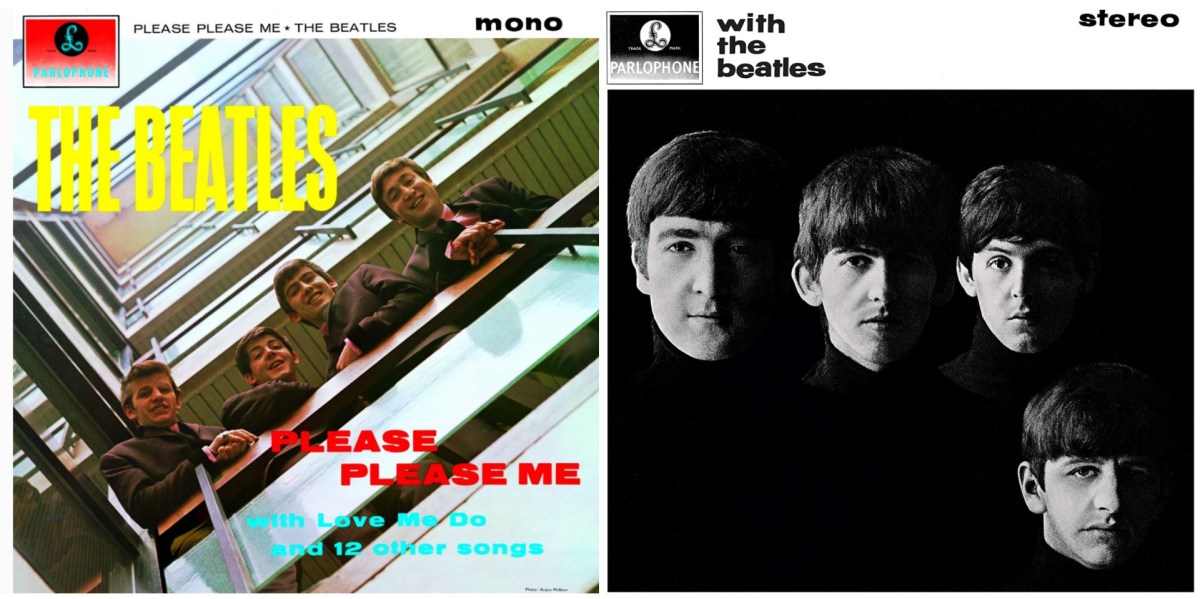
Yesterday, inspired by the Vinyl Rewind video I listened to Please Please Me and With the Beatles. Unlike Eric Callero I couldn’t pick my least favorite song from each album. I was surprised by how good all the songs sounded. I also notice something. I couldn’t distinguish between John and Paul’s voices. Sometimes I thought I could but I was never sure. I did spot the two songs sung by Ringo, but I didn’t even notice that George was the main singer of five of the songs.

This made me realize that I’ve never paid close attention to The Beatles’ songs. Susan and I love watching documentaries about The Beatles, and we’ve read a few biographies on them. Susan can sing their songs, but we’re not Beatlemaniacs.

While watching the Vinyl Rewind video I envied Eric Callero for being able to cite so many details from each song. I’ve always listened to music as a kind of drug. Music stimulates my brain, setting off emotions. I take in each song as a gestalt. To be honest, I hardly even pay attention to the lyrics.

I got out a book we had on The Beatles, tell me why by Tim Riley, that lists the main singer for each song and started trying to train my ear to discern whether John, Paul, George, or Ringo was singing. This website also gives that information.

I’m going to keep playing these albums after lunch and see just how much I can get out of each song. I remember noticing in the past I didn’t know who was singing. And I also remember noticing in the past that the songs are recorded weirdly, with what appears to be the bass, drums, and George’s guitars on the left, and the singing and John’s guitar, and sometimes other instruments, on the right. I also knew that some songs were covers, but never really paid that much attention to which were originals and which were covers.

The desire to notice more in songs comes from several motivations. For being such a major music addict I feel bad about not knowing more about the music I love. But I also feel bad that I don’t pay more attention to the details of life. I’m curious if I can become more discerning. I’m also curious if I can change myself so late in life.

At seventy, I feel my mind is slowly decaying. I know my body is, so it’s natural to assume my brain is too. I eat better and exercise to squeeze more out of my body. I wonder if paying attention to details will it help sharpen my dull mind?

JWH