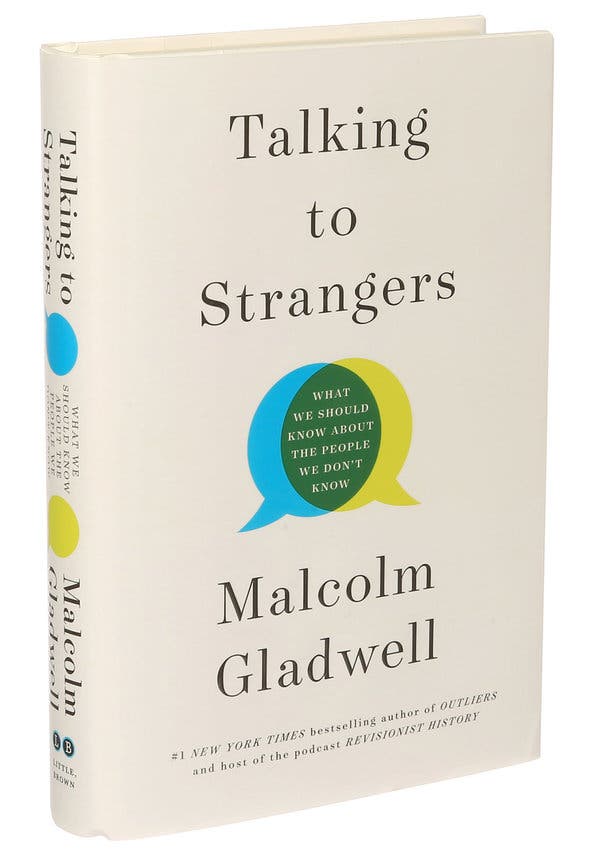
Talking to Strangers by Malcolm Gladwell

by James Wallace Harris, Sunday, November 3, 2019

Talking to Strangers: What We Should Know About The People We Don’t Know is Malcolm Gladwell’s sixth book. I’m a big fan ever since his first book, The Tipping Point. Gladwell is an explainer, but he’s not straight forward in how he explains things. He enlightens by having the reader go step-by-step through the data he’s gathered to reach the same conclusion he has carefully discovered himself. He doesn’t just try to tell us the answer. Gladwell sees the world multidimensionally, so simple explanations won’t do.

In Talking to Strangers Gladwell wants us to understand what happened to Sandra Bland. Bland was pulled over for not using her turn signal when changing lanes, ended up being arrested, and committing suicide while in jail. The story was in all the news in the summer of 2015, and there was even an HBO documentary about the incidence. Gladwell became quite angry by the event and feels the media has failed to explain what happened and why.

It’s such a complicated story that Gladwell doesn’t even get to Bland’s story until page 313, but when he does, it all comes together perfectly.

Many people feel society is coming apart. That politics is disintegrating our culture. That everyone is on a short fuse, overly sensitive, and too easy to take offense. That there is little honesty in the world, and too many people want to carry guns. Our society is being overrun by mistrust and resentment. I am reminded of an experiment I heard about in school back in the 1960s. It involved cramming rats into a cage to simulate overpopulation. The stress of being forced to interact made them go mad and attack each other. Gladwell doesn’t mention this, but I was reminded of it constantly as I read his book.

Gladwell says we don’t know how to talk to strangers. He then goes on using various famous historical and news events to explain how miscommunication created extreme problems, often resulting in lethal consequences. His examples are quite fascinating. The first goes all the way back to Hernán Cortés meeting the Aztec ruler Montezuma, an extreme case of strangers meeting. Then he deals with Cuban spies and the CIA. This chapter is a mind-blower because Gladwell presents several historical cases where the CIA were completely fooled by double-agents. This is impressive because we assume CIA agents are highly trained at observing and understanding people.

After covering the CIA’s failure to detect traitors, Gladwell goes into detail about how Neville Chamberlain totally misread Adolph Hitler. These are fascinating cases of how we misread strangers, but they are so varied that you have to wonder what they mean to Sandra Bland’s case. Gladwell reminds us occasionally that Bland is his real goal, but he also tells us we’re not ready yet. He was right. You really want to stick close to Gladwell’s examples and explanations, because they do pay off big.

The problem is most people default to the truth, which is Gladwell’s way of saying we tend to believe other people are telling the truth. After reading his studies you feel like you should distrust everyone. Gladwell then gives cases of people who are always wary, and this is actually a worse way to live. To complicate matters, he gives several cases, such as Amanda Knox’s and Bernie Madoff’s where people act contrary to how they should act, which makes them even harder to read. I’ve seen a lot of news stories and documentaries about both of these cases and they don’t get to the details and insights that Gladwell does. I get the feeling that Gladwell wrote Talking to Strangers to show us how we’re all thinking too simplistically.

I’m not going to reiterate all of Gladwell’s arguments and cases. Besides not being able to tell when people are lying, and for many reasons, Gladwell gets to two other important insights. Coupling and location. He uses Sylvia Plath’s suicide and various studies on crime reduction methods to explain them. This is where Gladwell’s insights get more subtle. We want problems explained with one answer. Gladwell teaches us that sometimes a problem requires multiple datasets to understand what’s really going on. All too often we jump to what we think is the obvious conclusion when were missing whole areas of evidence. Evidence that sometimes appears to have no connection to the case.

Talking to Strangers is not a book you want to read casually, although it is very easy and entertaining to read. In essence, Gladwell is being a Zen master trying to explain the sound of one hand clapping. His examples bring us to the point where we have to have our own “I see!” moment. He can’t tell us. When Gladwell finally gets down to explaining what happened with Sandra Bland you should come to the conclusion that our present-day problems can’t be explained with the kind of logic we ordinary use with our friends or the kind of thinking we hear from pundits on TV. We’re too quick to lap up easy answers.

The trouble is most people will never understand what Gladwell is teaching. Most of us will continue to act on instinct using very limited instinctive thinking. Humans can’t handle the truth. This is my conclusion, not Gladwell’s. We think we know when we don’t. In fact, too many people are absolutely certain of their conclusions because their own explanations feel so right. We all live in the film Rashomon, each thinking we see the truth, but can’t understand the multiplex view we’d get from watching our lives from an outside vantage point.

Talking to Strangers, like other Gladwell books, are ones we should reread periodically. It’s so easy to fall back into simplex thinking. One of my favorite novels is Empire Star by Samuel R. Delany. It’s a science fiction novel about a farm boy from a backward planet traveling to other worlds and cultures. Before he leaves a wise person tells him that there are three kinds of thinking: simplex, complex, and multiplex. What this kid learns is most people are stuck in simplex and maybe complex thinking, and very few achieve multiplex thought. The story is about the kid evolving through the three stages of thinking.

Talking to Strangers is Gladwell’s attempt to get us to think in multiplexity.

JWH

 

Why Isn’t Everything Beautiful?

by James Wallace Harris, Sunday, September 8, 2019

I’m reading The Map of Knowledge: A Thousand Year History of How Classical Ideas Were Lost and Found by Violet Moller where she describes how books were important in seven beautiful cities in the ancient world. Over and over again Moller describes how a conquerer builds a city, embraces books and libraries, and founds a new civilization. They raise magnificent buildings and evolve a culture. Then someone else comes around and sacks the city.

It occurred to me that if humanity had preserved everything great we built the world would be beautiful all over. Moller describes the founding of Baghdad and it sounded magnificent. But all I can think about is how ugly that city is when I see it on the news. How many civilizations have built countless gorgeous edifices that have disappeared in time? Which is worse, war or entropy? People and decay eventually ruin everything beautiful?

The Biggest Little Farm

Last week we watched The Biggest Little Farm on Amazon about a couple who transformed an ugly drought-brown farm into something amazingly green and beautiful. Humans have the ability to go walk out into a desert and create what you see below.

beautiful house in desert

But soon or later we do this:

Syrian city

It takes so much effort to transform chaos into order you’d think we do everything possible to protect what we create. Moller writes about all the books and libraries that have been destroyed before the invention of the printing press. I know it’s hard to build something that lasts because everything eventually wears out, decays, falls apart, or is bombed, burned, or torn to pieces. But I think we could make things last far longer if we tried. What if the hanging gardens of Babylon still existed? Or all the larger works of the Mayans and Aztecs?

Just think how beautiful the world would be if we had spent all the money we spent on wars into preserving the best of our cultures. Sure there are lots of incredibly beautiful places that exist now, but what percentage of everything are they, and how long will they last? Imagine every city an entire work of art.

Quite often on television, I see documentaries about grand buildings that existed within my parents and grandparents lifetimes. Historical societies struggle to preserve as many as they can, but all too often we bulldoze aged building to make way for new ones. Sure it is natural for us to get tired of some buildings, but do we always have to? The other day I saw a story about an entertainment complex for teenagers in the 1940s where it had a roller skating rink, an immense pool, and a pavilion for music and dancing. Photos showed something very elegant, and to my modern eye very nostalgically attractive. I wished it still existed so I could go hear big band music live. Photos taken just before it was destroyed show it dilapidated and sad looking. Why did we let it fade away? I guess not everyone wants to hang onto the past.

When I drive through most commercial districts today everything looks utilitarian and tawdry. Depending on the wealth of the locale, the designs run from crappy decaying to hip conformity to city council standards. I can drive for miles on certain big city thoroughfares and see a repeating array of chain stores and restaurants. It feels like the cycling background in the old Hanna-Barbera cartoons. Wasn’t it more beautiful in the old days where every business building was unique?

I can remember over sixty years of changes. I can’t count the number of buildings I once knew that no longer exist. You’d think we’d construct every structure to last and to be the most beautiful it could be by the current architectural fashion. There’s a magazine I love to look at, Atomic Ranch, that reveres the mid-century ranch house. That’s an era I thought was beautiful. Sure, it’s not Athens or Alexandria, but the look is very appealing to me. I wonder if a mid-century modern neighborhood could be preserved for a thousand years.

It’s odd how ideas come to us. I was reading a book and I wondered why it isn’t beautiful everywhere we looked. Our species certainly has built enough beautiful objects to cover the earth. Why haven’t we preserved them?

Mid-century modern ranch

Of course, I’m one answer. We’ve let our house rundown. Suan and I have never been into yard work, decorating or housework. We care more about our hobbies and television. It takes a lot of money and effort to maintain something beautiful. Some of my neighbors work hard to make their yards and interiors look beautiful, on the outside and inside. What’s funny is some of them only make the effort on the outside, or just the inside. I’ve always envied my friends who make their personal environment beautiful. Take this as a thank you.

You’d think with seven billion people everything on this planet would look clean and tidy, if not aesthetically elegant. Maybe it’s too easy to find beauty on our flat-screen televisions.

What’s also fascinating to contemplate is how beauty pops up in nature through random nonintelligent design. Of course, the concept of beauty is something that might only exist in our species. Does any other animal stop to admire the rose? Maybe beauty only resides in human civilizations because of anti-entropic efforts. We’re all at war with entropy, and only some of us use our limited energies to create beauty.

Rose

I’ve read that color doesn’t exist in reality, but it’s something our brains adds. I’d hate to think this is true. I wonder what the other animals and insects see.

JWH

Quantifying My Cognitive Decline

by James Wallace Harris, Thursday, September 5, 2019

I subscribe to a service called Grammarly which checks my spelling and grammar as I write. Grammarly sends me a weekly report on how I’m doing. Two years ago it would tell me I was more accurate than 65-70% of their users, referring to grammar and spelling. I doubt even when I was young it would have been much higher. In recent months that number has fallen to 35-40%. And I can feel it. I have to proof my posts countless times and I still find errors after I’ve published. I’m appalled by how bad my writing has become. If I published my first drafts readers would think they were following Charlie Gordon into his descent phase from the book Flowers for Algernon.

I consider this good quantitative data on my cognitive decline. Grammarly does give me some good news. I’m generally more productive than 98-99% of their users, and my vocabulary is larger than 98-99% of their users. The first is explained by being retired and writing for two blogs. The second reflects long term memory. I can tell it’s my short term memory that’s failing.

I still don’t see this as an early sign of dementia, but I might be deluding myself. I think it’s just an aspect of normal aging. We’re used to seeing our bodies getting old because of all the visible physical changes. We’re not used to mental changes because they are less observable to ourselves and the people around us. Unless we talk or act differently, other people don’t see the changes. And we don’t feel the changes unless we try to do something and fail.

I have been noticing the number of times people ask me why I’m not talking. I tell them I’m just listening to them. Or say I’m thinking. But I believe it’s because it takes more effort to put thoughts into words, and when I do talk I can’t remember words, or I verbally trip when saying sentences. My cognitive problems are the most obvious when writing. If I’m just playing with the cats, watching television, or listening to music I feel fine. I believe we ignore our mental aging by doing less and saying less. Of course, many people also ignore signs of physical aging — that’s why so many foolish oldsters fall off ladders.

The real question is: Can we exercise the mind like we exercise the body? It appears we can slow physical decline by being more active. Is that also true for mental activity? My first reaction when I realized I was making more spelling and grammar errors was to quit writing. But I quickly decided that was the wrong approach. I believe writing exercises the mind. Instead of quitting I should work harder. However, I might need crutches. I thought about pilots who use preflight checklists, or how surgeons now use checklists to avoid making surgical mistakes.

I already pay Grammarly to keep an eye on me, but it’s far from perfect. In fact, when I see errors after I published it means Grammarly and I both missed them. I usually proofread my posts four or five times before I hit the published button. Often the most glaring mistakes are last-minute rephrasing where I don’t proof the whole sentence, or whole paragraph again. But other mistakes come from reading too fast and assuming I’m seeing what I read.

I believe my essays give the illusion that my mind is working just fine. Y’all don’t see how many broke things I fix. I use the internet to cheat. It really is my auxiliary memory. And I have unlimited do-overs. Most importantly, I can take all the time I need to say what I want.

I’ve always been a good typist. It’s been the most useful skill I learned in high school. What I typed used to be what I thought. Thoughts came out of my fingers. That’s no longer true. Now my fingers give me sound-alike words, leave out words, type words twice, and even throw in extra words. Quite often I end up typing just the opposite of what I was thinking. While typing this paragraph I created 8-10 alternate words to what I was thinking. Just that could explain the halving of my accuracy score in Grammarly.

[When proofing the above paragraph I had a new insight. What if my typing is as accurate as ever, and I’m merely typing jumbled thoughts when I once transcribed clear ones?]

Writing isn’t the only way I’m seeing increased cognitive problems. The other day I wrote “Untying a Knotted Plot” about my difficulty of understanding a short story. I had to read it four times. Admittedly, it is a complicated story. The author even wrote a couple of comments to help me. That essay was extremely difficult to compose. I struggled with trying to comprehend the story and write about it clearly. Every time I typed the author’s name I looked at the magazine to verify the spelling. I still got it wrong three out of eight times. I proofed the hell out of that piece because errors seem to be popping like popcorn. I felt like I was playing a very desperate game of Whack-a-Mole.

There’s another reason to keep writing. I want to document my own decline. Like the researchers in Flowers for Algernon, they tell Charlie to keep a journal. I’m going to be my own researcher and subject. I think it’s useful to be aware of my diminishing abilities. Aging is natural, and I accept it. I’m willing to work to squeeze all I can from my dwindling resources. What’s vital is being aware of what’s happening. The real problem to fear is becoming unconscious to who we are. Like Dirty Harry said, “A man’s got to know his limitations.”

The reason why Flowers for Algernon was such a magnificent story is that we’re all Charlie Gordon. We all start out dumb, get smart, and then get dumb again. Charlie just did it very fast, and that felt tragic. We do it slowly and try to ignore it’s happening. That’s also tragic.

JWH


What Would Have Made Me Want To Study as a Schoolkid?

by James Wallace Harris, Friday, August 23, 2019

I considered my K-12 education a 13-year prison sentence. I did my mediocre best getting mostly Cs and Bs, with rare As and Ds. My good grades didn’t reflect my ability but showed what I was actually interested in. I had a lot of great teachers that tried hard to get me to learn, but I didn’t cooperate. I wish to apologize to all of them now, especially my 12th-grade math teacher. I just didn’t want to pay attention, study, or do homework. Life was full of fun diversions and I found no incentive to make the most of my school years.

I regret that now and it’s really pointless to worry about it now, but it is an interesting problem to think about solving. How do you get kids to want to study? A certain percentage of children respond well to traditional classroom learning, but most don’t. When I’m shopping in used bookstores I look at K-12 textbooks and I’m horrified by how much crap they want to stuff in a young person’s head.

Part of the problem is society wants kids to acquire proficiency in a specific set of subjects before they’re 18. Then they up the ante by a couple of magnitudes for higher education. Before you can start life you have to be programmed with 400,000 facts. We’re told we need that many factoids to succeed in life but I doubt many believe it. I always considered it cruel and unusual punishment. I never knew what crime I committed to deserve such torture.

And it’s not like I didn’t enjoy learning as a child. I was a bookworm from the 4th-grade on, reading several hundred books while serving my K-12 time. I just didn’t want to read the books teachers wanted me to read.

I don’t know if I was a typical child. But I’d guess most kids didn’t like the system either. I’ve often thought about what if I could have designed my own pedagogy. It’s a fun thing to fantasize about. Try it and post a comment. I have come to some conclusions for me only, not a general system.

  1. The most important thing I should have been taught as a kid is about the world of work and how I’d spend forty years doing something that I could either like or dislike. I needed to learn as early as possible if I didn’t find my right vocation I’d spend those years in quiet desperation at best and crushing resentment at worse.
  2. I needed to have been shown by experience that there are many kinds of tasks and work environments. After high school, it took me several jobs to realize I preferred working inside rather than outside. I eventually learned I rather work with machines than people, but I liked an environment with well-educated people, and tasks that produced something useful to humanity rather than the bottom line. And I didn’t need to be the boss. I’m pretty sure I could have learned all of that in grade school.
  3. I learned too late in life that I loved science and technology. Again, I can imagine ways to get kids to learn subjects they like while they are still in grade school. It might require spending some classroom time in real work environments.
  4. What I sorely missed was a real incentive to study. I was told an education led to a good job but I never knew what a good job meant. I think study incentives need to be more immediate. I think the goal of being freed from classes would have been the incentive that would have worked for me. In other words, tell me the week’s goal. If I can finish by Thursday I could have Friday off. If I could finish in four weeks of a six weeks period, I could have two weeks off. If I could finish the year in March, I could have a long summer. Or even, if I could finish at 14 I could bum around for a few years before college. That would have inspired me to study harder. (I know that K-12 schools also serve as babysitters, so being freed from classes might mean more library days, or sports, or clubs, or other school activities. Although I wanted to be out on the streets or at home.)
  5. For such a finish-early system to work we’d need to carefully define and quantify what needs to be learned. Right now schools are one-size-fits-all. Not every kid wants to learn everything every other kid learns. Society needs to decide what subjects form a basic education, and what should be electives. We should find creative ways to test everything. Educators have gone nuts with cultural literacy.
  6. Society is discovering all kinds of learning and teaching methods. They didn’t have personal computers when I was little. But I think if they did I would have learned best in the classroom and taking quizzes at night on the computer for homework. If testing had been more like computer games and trivia contests they would have been fun. Competing for high scores would have pushed me, but grades never did in the least. If every subject had a rating like in chess, that would have been fun.

I’m curious if anything could have motivated me to study as a kid. It’s too bad we don’t have time machines. It would be a fun challenge to go back in time and see if could motivate my younger self.

Uh, maybe that’s an idea for a science fiction novel.

JWH


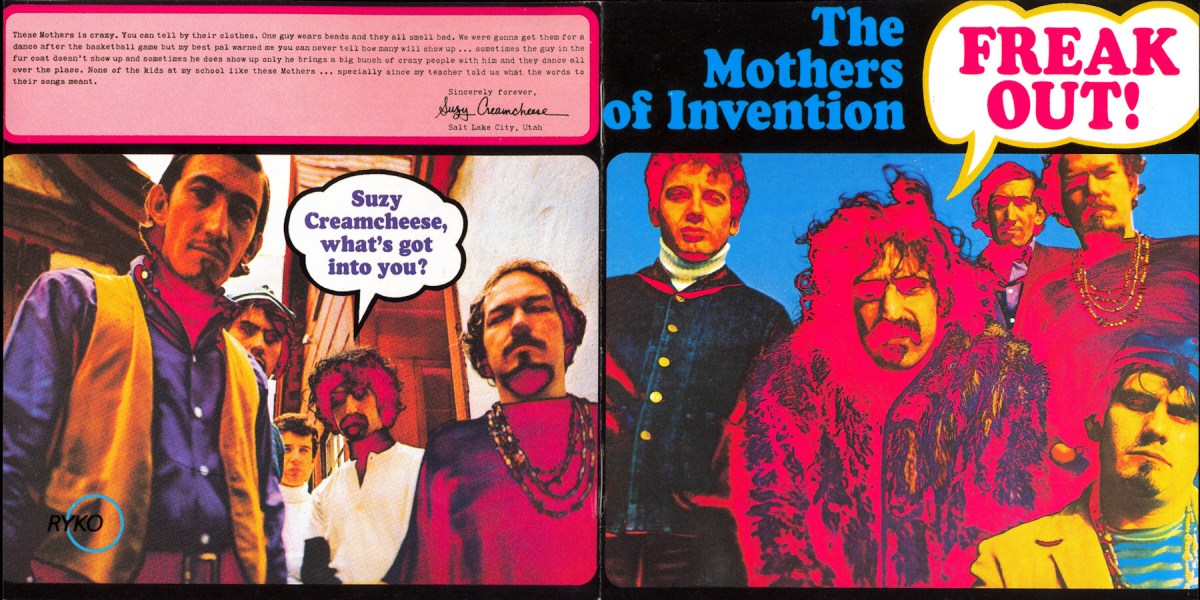
Freak Out! – 51 Years Ahead of Its Time

Is there a word that means the opposite of nostalgia? Here’s a case of remembering something I didn’t like from the past. To further compound the problem, it’s a work of art that satirized what I did love back then.

I wish I could boast that I first discovered Freak Out! from The Mothers of Invention in June of 1966 when it was first released, but I didn’t buy it until 1968. And even then when I played it on my console stereo in my 11th-grade bedroom I kept saying to myself, “WTF?” Of course, back then we didn’t talk in acronyms. I didn’t hate it, but it was too weird-as-shit to like. I eventually got rid of that LP when I sold my record collection to pay for a travel adventure after my dad died in May 1970.

In 1973 and 1974 I went to see Frank Zappa perform live, I believe for the Over-Nite Sensation and Apostrophe(‘) tours. By then I liked his music because of all the jazz influences but still thought the songs were uncomfortably weird. To be honest, I mostly went to these two concerts because my friend John Williamson was a big Zappa fan.

Over the years I’ve bought a Zappa album here and there but seldom got into them. I do love “Watermelon in Easter Hay” which is on my Spotify all-time-favorite-songs playlist.

For some strange reason, I started playing Freak Out! a couple weeks ago and haven’t stopped. I guess the album was 51 years ahead of its time — at least for me. I mentioned this to a connoisseur of 1955-1975 music I know and he reacted rather badly. I replied, at least you have to admit this music is very creative. Randy said Zappa had no talent whatsoever. That shocked me. Sure in 1968 I might have accepted that criticism, but not in 2019.

This afternoon when I played Freak Out! while eating lunch my wife pleaded with her eyes for me to stop. (She tries very hard to let me have so sonic freedom around the house, but I stopped after I realized how much I was torturing her.)

In the summer of 1966, I was transitioning from the 9th grade to the 10th, and moving from Miami to Charleston, Mississippi. There’s a good reason for not discovering Frank Zappa in the rural deep south. But by 1968 I had returned to Miami and read about this legendary album. But like I said it was too weird for me. I didn’t understand then it was making fun of everything that made me happy. I was wanting to be a hippy when Frank was skewering the whole counter-culture movement along with the clean-cut youth culture. Somehow Frank Zappa and the Mothers of Invention saw through all the crap that I admired.

I didn’t know enough to dig their combination of creative music and absurdist lyrics. I didn’t know what the avant-garde was back then. And to be confessional again, I still don’t.  I just don’t care much for satire or humor in music. However, something has changed, and the gestalt of most of the songs have begun to work on me. I actually crave to hear them.

Why at 67 has this silly nonsense become something deeply real?

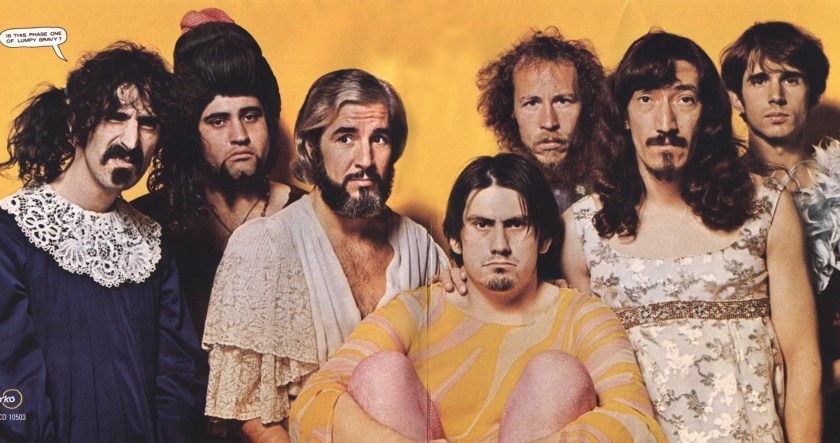
Freak Out - Inside

Like I said, it would be cool to brag that I’ve been into The Mothers of Invention since they premiered, but even though I only bought the album two years late, I’m over a half-a-century getting to like this album. The group did have an auspicious beginning, being the first group to have a double LP for their first album and to produce one of the first concept albums. Supposedly, even The Beatles paid musical tribute to it on their Sgt. Peppers album.

It’s very hard to understand how strange an album like Freak Out! was compared to the other albums of 1966. Playing it along with Revolver, Blonde on Blonde, Pet Sounds, Sounds of Silence, Fresh Cream, If You Can Believe Your Eyes and Ears, Fifth Dimension, Buffalo Springfield, Blues Breakers, Sunshine Superman, or even The Monkees,  you can feel its both a part of a larger musical transformation and a reaction to it.

Everyone remembers “For What’s It’s Worth” by the Buffalo Springfield about the Sunset Strip curfew riots, just look at how often it’s been used on a soundtrack. It was recorded on December 5, 1966. But why don’t people remember Frank Zappa’s song “Trouble Every Day” written in 1965 about the Watts riots?

“Trouble Every Day” is far angrier but also captures the soundtrack of the mid-60s like “For What It’s Worth” but it’s never been used to accent a movie that I can tell. I love “For What It’s Worth” but it was a protest song about young hippies not getting to party while “Trouble Every Day” was about a major race riot. “Trouble Every Day” criticizes far more and with more exciting music. In comparison, the new folk-rock sound of “For What It’s Worth” feels kind of wimpy today.

“Freak Out!” had all types of songs that anticipated future trends. Just listen to “Go Cry On Somebody Else’s Shoulder.” Doesn’t that sound like Sha Na Na, a group that didn’t form until 1969? Zappa was making fun of a nostalgic movement that hadn’t even begun. Listening to “Go Cry On Somebody Else’s Shoulder” in 2019 seems even more relevant. On Facebook so many people my age post photos and music clips of Do-Wop nostalgia. One of my friends even said her retirement life was recreating her high school days.

I love “How Could I Be Such A Fool?” but it makes me wonder just how honest we all were about our teenage loves. The music of this tune presses some button in me and I often put it on repeat play. Why was Frank Zappa so cynical when so young?

And isn’t “I’m Not Satisfied” a great teenage angst anthem at least as good as “I Am A Rock” by Simon and Garfunkle?

Why wasn’t it a hit single in 1966? It certainly reminds me of my 15-year-old emotional life in Charleston, Mississippi in 1966.

Zappa rerecorded several of the Freak Out! songs in 1968 as Cruising With Ruben & The Jets, to parody in even more creative musicality the 1950s rock era. I get the feeling that Zappa both loved this music, but also realized it came from a shallow culture.

So what is the word that describes anti-nostalgia? Maybe the word needs to convey both wistful fondness while recognizing what we love so much was essentially childish and unenlightened. And maybe the word should also mean demystifying nostalgia.

The 1960s was a weird time. It was both exciting and frightening. It was creative and brutal. Online I find so much nostalgia for that era, but few people remember the viciousness only the unthinking carelessness that was so fun.

JWH