To Ebook or Not To Ebook

This week Barnes & Noble lowered their price for the Nook to $199, and came out with a Wi-Fi only model for $149, and on the same day Amazon lowered the price of the Kindle to $189.  Unfortunately, the iPad remains $499.  Once again I’m thinking about buying an ebook reader, but there are so many things to consider that I’m left undecided.

For instanced, I’ve been to three local bookstores trying to find a copy of Texasville by Larry McMurtry without coming home with a book to read.  If I had an ebook reader, either Nook or Kindle, I could have started reading it immediately after realizing I wanted it.

Score 1 for ebooks.  If the book is available ebook readers win on instant gratification.

Score 1 for paper.  On the other hand, both Amazon and Barnes & Noble sell the ebook edition of Texasville for about the same price as the trade paperback edition, so I wouldn’t have saved any money towards paying back the investment of $149, $189 or $499.  Why buy an ebook when the real book is the same price?  I could read the real book and give it away or sell it, which I can’t with an ebook. 

Score 1 for paper.  I just ordered Texasville as a used hardback for 1 cent and $3.99 postage.  You can get used books but not used ebooks.

Score 1 for ebooks. If I had bought the ebook edition of Texasville, Larry McMurtry would have been paid.  Buying used cuts out the author.  If all books sold were ebooks then writers will always get their cut.

Score 1 for paper.  If everyone buys ebooks bookstores will go out of business, now that would suck, wouldn’t it?

Score 1 for ebooks. The price of The End of Biblical Studies is significantly cheaper for the ebook edition.  It’s $21.77 for paper and $9.99 for the Kindle, but it’s not available for the Nook.  Bummer, because I was thinking about getting the $149 Nook.  But that’s $11.78 I could apply towards the iPad, since it does have Kindle and Nook reader software.

Score 1 for paper.  I’m going down my Amazon Wish List to test things, and it’s score another point for paper, because The Year’s Best Science Fiction 2010 is not available for ebook readers.  Actually, paper will score many points here because many books on my Wish List aren’t available in an ebook edition.  That will change.

Score 1 for iPads.  There are books that are available for the Kindle but not the Nook, and other books like Darwin’s Armada that’s available on the Nook, but not the Kindle.  The iPad has software readers for most dedicated ebook readers.  But $149 + $189 is still cheaper than $499.

Score 1 for ebooks because they offer large print and that makes reading easier for me.

Score 1 for ebooks because they are environmental friendly.

Score 1 for paper because I can share books, give them away or sell them.

Score 1 for ebooks because they are easier to hold.

Score 1 for paper to save money.  By buying used, going to the library, getting books off the free table at work or borrowing books from friends I could significantly reduce my annual reading budget.  It’s even possible to spend no money on reading if I stuck with paper.

Score 1 for ebooks because they stimulate the economy.  Not only do you need to buy an ebook reader, but you have to pay for all your new books.  This is bad for libraries and bookstores, but great for publishers, writers and the economy.  The move to a Green Economy means creating as many environmental friendly jobs as possible.

Score 1 for iPads because they are good for magazine reading.

That’s 6 for paper and 9 for ebooks, with a leaning towards the iPad.  I’m leery of spending $499 for the iPad.  I spent $199 for the iPod touch and $399 for a Toshiba netbook and really don’t use either.  I’d hate to spend another $499 for another gadget I’d end up not using too.  But I’m wanting to read more but I can’t because small print strains my eyes.  An ebook reader promises help for this handicap.

Finally, my stand on giving up paper means I don’t read magazines like I used to, and I miss that.  I can read magazine articles online from my computer desk, but that’s not the most comfortable way to read for fun.  The iPad “appears” to offer a better solution, but I won’t know until I bet my $499.

I look at my wall of books next to my computer desk and I wonder what life would be like if all those books were inside an ebook reader.  Many of them are reference books with photos, drawings and diagrams – so I can only imagine those working on an iPad. 

I had to move my wall of books when we put down new flooring and all of those books were very heavy and hard to move.  It would be strange to hold all of them in one small device.

If I was born in a future age of ebooks, would my ebook reader at age 58 hold every book I had ever read?  That’s a weird thought.  Writing this is making me lean towards buying the iPad, and maybe even spending $599 to get the 32gb model, although I’m also tempted to hang onto paper for just a while longer until the iPad 2 comes out next year.

I keep thinking of more things to consider.  Will I take my expensive iPad into the bathroom to read?  If there are four best of the year SF anthologies to consider and only two of them are sold in ebook editions, will that force my buying decision?  Will I choose Dozois and Hartwell over Horton and Strahan because they don’t have ebook editions?

Once I buy an iPad will that make me prejudice against books that don’t have ebook editions?  It’s like my friend who took a rotary phone to show his fifth grade class and one girl asked “How do you send text messages?”  If I get used to an ebook reader and then pick up a book, will I think, “Where’s the button to change the font size?”

JWH – 6/27/10
Am I Becoming An Old Fogey?

I started taking programming classes in 1971, and in 1977 I got caught up in the microcomputer mania.  By 1981 I got swept away with the PC revolution and during the 1980s I was quite passionate about BBSes and online computer services like CompuServe and GENIE.  And I was wowed when my university got connected to the Internet years before the WWW.  I’ve always been an early adopter of any computer gadget, but somehow I’m letting the smartphone mania pass me by.  Is this a sign of aging?

At some computer news sites there are more stories about smartphones than computers,  and some digital pundits even predict smartphones replacing computers.  They sneer that the desktop is just a boring office device.  I guess I’m getting old because desktop computers are still as exciting to me as muscle cars were to me in my teens.

I’d love to have a smartphone, but I just can’t justify spending a $1,000 a year to use one.  The iPhone 4 is one seductive piece of hardware and if it was only $199 I’d get one in a snap.  I can’t stop thinking about getting an iPhone 4 or one of the new Android smartphones – but I keep remembering that I barely use my cell phone, and that I have both an iPod touch and netbook that both go weeks without being used.  And my GPS sits at the bottom of a desk drawer, and my three digital cameras seldom get snapped.

I add $50 to my T-Mobile pay-as-you-go phone and I can talk for 6-8 months.  Now I might justify paying for a smartphone if I could ditch my house phone, but cell phone service from my home is terrible, for both AT&T and T-Mobile.  My wife does have an iPhone.  She works and lives out of town and greatly benefits from her smartphone but she practically lives on the damn thing.  But Susan is a couple years younger than me and loves Farmville, Facebook and going to live rock concerts.  Her favorite band is The Foo Fighters while I enjoy people like Laura Bell Bundy who sings a tamer country rock.

I spend all day at work at my desktop, and all evening at home at my desktop, and my commute is 8 minutes.  So I don’t exactly need a powerful smartphone or laptop.  But the smartphone mania keeps gnawing at me.  They’re like a toy that every cool kid owns, and I don’t.

When I saw the video for the new iPhone 4 at the Apple site I thought the face time video calling was fantastic until I remembered Susan and I bought webcams two years ago for Valentine’s Day and only used them once.

Now I’m not trying to be the Grinch that steals Christmas but is all this smartphone mania some new kind of addiction?  I know some people who don’t have home phones, and who don’t have a computer at home, or Internet access, and the smartphone is a great, affordable solution for them.  These folks are the kind of people that a smartphone will be their computer, and the ones the pundits were talking about.

And if you’re an on-the-go person that’s already spending a pile of money for cell phone calling and texting, it’s not that much money to add a data plan.  I suppose kids and young people who stay constantly in touch with their friends via cell phones can’t imagine living any other way.  And that might be the reason why I question all of this.  Am I too old to see the necessity of such a wired lifestyle?

Will spending a $1,000 a year for smartphone use just become a necessity of life?  And what is that cost for a family with three teenagers?  On one hand, I know the smartphone mania is a great boost for the economy, so I shouldn’t complain, but on the other hand, it seems so wasteful.  But I guess I’m just an old fogey.

And now the 3D TV mania is starting.  HDTV was sexy to me, but 3D TV leaves me limp.  I wonder if I need a Viagra for my techno lust?  And did I give up cable TV and my two DVR boxes to save money, like I thought, or was it because I’m getting old and couldn’t stand all those channels, like I felt.  Now that I think of it, I did sell my Kindle, and I’m actually reading books.  Well, I’m not as bad as my friend Lee, he’s returned to listening to LPs.  I wonder if that will happen to me too?

JWH – 6/13/10 

Web Sites I Want – Best Essays from Printed Magazines

Even with the social bookmarking sites, reading from the internet is like drinking from a fire hose.  What I’d like to see is highly selective bookmarking site, and in particular, the one I’d love to have most would be Best Essays From Printed Magazines.  The top writing on the net is usually reprinted from the major print magazines, but those essays are overshadowed by the gigantic volume of web journalism.  Hey, I’m a blogger and love getting readers, and I love reading blogs, but the heaviest of the heavy duty essays are still from print magazines.  The cutthroat survival of the fittest in the print magazine industry by its very nature acquires the best writing.

That’s why I’d like a site that helps me find the best essays over 1,000 words.  Adding the length requirement is important because too many magazines have gone to filling up their pages with short web level writing.  Social bookmarking sites like delicious and StumbleUpon are great for snacking on popcorn and candy level reads, but not so yummy if you’re looking for literary steak.  Yes, they will link to long quality essays from printed magazines, but you have to wade through zillions of peanut size stories of questionable value, more akin to Television’s funniest videos in informational nutrition.

No, I want a site that’s very specific and limited.  I’d like an editorial board that selects the Top 100 magazines that publishes their content on the web, and offers a system that lets users bookmark and vote on the best essays they are reading.  Hell, I’d even pay to subscribe to such a site if they got permission to reprint articles that don’t get reprinted on the web.

The web has gotten too big and mangy, so when I want to know something I go to a specific site, mainly Wikipedia.  I’ve given up subscribing to magazines, mainly because I’m against paper for environmental reasons, but also because when I was subscribing to dozens of magazines, all too often I’d only find a good article here and there.  Most of the content was filler, like the web.  I guess I’ve gotten spoiled by the iTunes model – who wants to buy an album when it’s the hit song you want.  This is why I prefer Netflix to cable TV.  We need more ways to cut out the noise.

Here’s are examples of the kind of long essays I’d like to read:

I guess what I really want is a web version of the Best American Series to be published monthly, instead of the yearly printed volumes they have now.  And if they wanted to make extra money, reprint the monthly web site editions as ebooks for $9.99 for Kindles, Nooks, iPads, etc.

JWH – 5/12/10

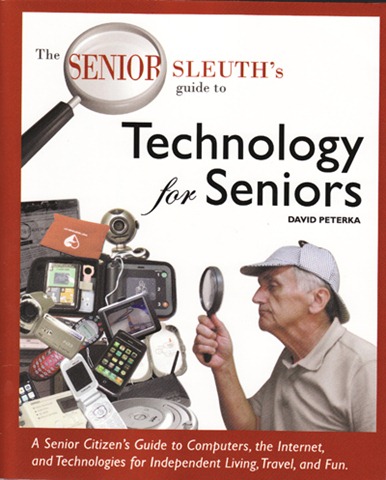
The Senior Sleuth’s Guide to Technology for Seniors by David Peterka

The common joke is if you need help with technology, find a kid.  Well, David Peterka wants us older folk to be our own tech gurus with his book The Senior Sleuth’s Guide to Technology for Seniors.  His book covers a spectrum of technology, not just computers, like robotic lawn mowers, cell phones, iPod, GPSes, remote controls, medical alert necklaces, home entertainment systems, pill reminders, medical monitoring and so on.  Peterka also covers social networking, texting and all the trendy communication systems kids embrace.  You don’t have to be a senior to find this book useful.

senior-sleuth

I help older people with their computers all the time and I know they often get stressed by technology.  Some just flatly refused to embrace it.  And that’s too bad because technology is enabling by its very nature.  This book is a quick overview for people new to gadgets and computers. 

Recently I help a woman about to retire who likes to do oral history interviews.  For years she had been relying on a cassette recorder and just typing up transcripts, but she wanted to be able to give people MP3s and CDs of edited and cleaned up copies of the original recordings.  For awhile she relied on the kindness of tech strangers to help her, but I’m the kind of person who likes to teach people to fish rather than just giving them away.

So I showed this lady how to install, configure and use Audacity.  At first she was hesitant and afraid to try stuff, but since I wasn’t offering to do the job for her, she stuck with it.  I’d come back every week to see how she was doing.  At one point she explained her interviewee cough frequently.  I showed her how to remove the coughs.  She mentioned some of the tapes had hiss.  I told her Audacity had a noise-reduction feature and sent her a link with instructions.  She figured it out.  She’s learned a lot, and now she’s confidently producing digital recordings of her interviews.

I’m in an online book club for audio books and one of the members is a guy who lives in a retirement home but he has become an Internet expert on MP3 players, helping hordes of online users to play digital audio books, collect music and old time radio, converting and watching movies, and other handy tasks for small players.  He’s in several online groups, include some for the blind.  His knowledge and willingness to help other people, many seniors, is a tremendous resource.  He proves that if you gain a skill, pass it on, and he also proves you don’t need to be a youngster to be a tech whiz.

I’m not sure how big the market is for Mr. Peterka’s book because old people are jumping online fast.  Ronni Bennett after she retired started Times Goes By, a web site for elder bloggers that is a wonderful resource for wise people wanting to share their experiences online.  I wished David Peterka had a supporting website to help his readers once they get beyond the book.  This 2009 book is still current, but technology books age fast, so Mr. Peterka will need to keep coming out with new editions until everyone is up to speed.

The advice in David Peterka book for seniors is quite broad and a good place to start if you’re nervous about gadgets and electronic doodads.  He provides a wealth of URLs to find additional knowledge, plus he teaches about how to find your own solutions online.  The print in the book is nice and large, easy to read. 

At work people are amazed I know so much about technology, but often when I meet a new tech problem, I just search on Google.  So this Senior Sleuth volume will be best for complete newbie’s who haven’t learn that trick.  It nicely distills lots of information in one handbook, and is a good volume for older children helping their aging parents.

It’s a Catch-22 situation.  If you had more knowledge, you’d use it to find the same information online.  So David Peterka book is a stepping stone.  Like I said, I wished he had an web site devoted to the same subject because having all of this information in one convenient location would make a very useful web site.

I’m hoping, as I get older there will be more and more technology solutions for aging.  In fact, I hope by the time I get frail there will be robotic caretakers.

JWH – 4/22/10

Will Internet TV Make Cable and Satellite TV Extinct?

There are two kinds of TV, live and recorded.  Internet TV sites like Hulu have already proven how well they can handle recorded TV shows.  Internet TV even does away with the need for a digital video recorder (DVR).  Think of a show, find it, watch it.  Internet TV like Hulu is even better than broadcast, cable or satellite for sponsors because viewers are required to watch the commercials.  And as long as they have such limited commercials as they do now, I don’t mind watching them.  Otherwise I’ll pay for streaming services like Netflix to be commercial free.

Where Internet TV is weak is for live broadcasts, like for sports and 24/7 news.  The infrastructure of cable and satellite systems have far more bandwidth for handling live television.  That won’t always be so, because I’m sure some kind of broadcast Internet technology will emerge to solve that problem and people will be watching live TV on their iPhones, iPads, netbooks, notebooks, desktops, HTPCs and Internet TV sets.

Digital technology ate the music industry, and is about to eat the book, newspaper, magazine and television industries.  I gave up cable TV months ago and for recorded shows I’m in hog heaven by using the Internet TV, which includes streaming Netflix.  I also supplement by viewing diet with snail-mail Netflix discs, but I see where that habit could be phased out too.  The only reason to get a disc now is for the picture quality of Bluray.  Future bandwidth will wipe out that technology too.

Owning music CDs and video DVDs seem so pointless now.  I wonder how that’s going to impact the economy and effect the entertainment business.  It also makes me wonder about my efforts of building an easy to use HTPC.  I’m struggling to get perfect Bluray playback through my HTPC computer, wondering if I should spend $80 for better software, knowing full well in the not too distance future I’ll phase out Bluray too.  The HTPC has phased out the LG BD390 Bluray player I bought just last year, and an Internet TV set could phase out my HTPC.

biggerthanlife

Last night my friend Janis had us watch Bigger Than Life on Bluray because NPR had praised this old James Mason movie so highly.  The flick wasn’t very entertaining, but it was fascinating.  The Bluray presentation of this 1956 CinemaScope production was stunning in 1080p high definition, showing intricate shadows and vivid colors.  Internet TV and streaming Netflix can’t provide that kind of resolution right now, but I imagine it will before 2015.

Technology is moving so fast that we buy devices we want to throw away in a year or two.  Growing up my folks wanted appliances and TVs that would last 15 years.  I remember Ma Bell phones lasting over twenty years.  I’ve had my 52” inch high definition TV for only three years and I’m already lusting for a new set.  Will technology ever settle down again so we can buy something that will last a generation?  I think it might.  Of course it will be terrible for the economy, but I can imagine TV technology that would satisfy me and take the ants out of my pants to have something better.

My perfect TV will still be a 1080p HDTV like we have today.  I’m pretty sure we can go decades without changing the broadcast standards again.  It will have a digital tuner to handle over-the-air broadcasts (in case the net goes down) and an Ethernet jack and WiFi for Internet TV.  It will have two removable bays.  One for a computer brain that can be upgraded, and another for a SSD hard drive.  As Internet TV is perfected the need for a local DVR will be diminished.  That will also be true for an upgradable CPU.  There will be no cable or satellite TV.  Everything will come to us by TCP/IP.  Broadcast will remain for the poor and for when the Internet fails.  Cable and satellite TV will go the way of the record store.  I also assume all Internet access will be wireless, but it will take 5-10 years to phase out wires.  Now that doesn’t mean cable and satellite companies will go under.  I expect them to buy into the Internet TV revolution.  I do get my internet access from Comcast.

Most people will think I’m crazy by predicting the extinction of cable and satellite TV.  They can’t picture living without all that choice.  That’s because of the channel switching mindset.  We have always thought of what’s on TV by flipping through the channels, even though very little TV is live.  Most of TV is recorded, and we fake immediate diversity by offering 200 concurrent channels to watch.  Eventually the only channels to watch will be live, because other technology makes it easier to find recorded shows ourselves.

Live TV will go through a renaissance.  Cable and satellite TV systems are still the best technology for live TV, and they will hang on to their audiences for another ten or twenty years as Internet broadcast TV is perfected.  However, guerrilla TV is emerging on the net, and micro audiences are evolving.  For the big networks, how many Today like morning shows will we need for live TV?  How many channels to promote sports?  How many to 24/7 talking head news and reality shows do we need?  How many live PBS networks will we need?  Will audience gather around central networks or seek out specialized Internet broadcasters catering to their personal interests?

Ultimately, how much TV really needs to be live?  Even 24/7 news shows spend a lot of time repeating themselves.  Live TV is leisurely.   The hours of the Today show are filled with just minutes of quality content, most of the time is fluff and commercials.  And if an opera is filmed live for PBS does it really need to be seen live?  Survivor and Amazing Race would be tedious if live.

When the flipping the channels metaphor dies out, and library checkout metaphor gains popularity, TV viewing will change.  People love football, war and car chases live, but will even that change too?  If you were sitting with you iPad killing some time, will you think, “Hey let’s watch the game in Miami,” or will you want to play a game or watch something recorded?   I can easily imagine sites of “WHAT’S HAPPENING NOW!” start showing up, listing thousands of events going on around the world.  TCP/IP technology will work better to provide that kind of service than cable or satellite.

Until you play with Internet TV you won’t understand what I’m saying.  You’ve got to sleep with the pods or drink the Kool-Aid to buy in.  Start with streaming Netflix and Hulu.

And if people love cell phones, Facebook and Twitter to stay in constant contact won’t they love live TV from their friends.  Instead of watching the crew of the Today show have fun, why not video link all your friends and create your own morning show?  And the emergence of spy networks will also change viewing habits.  If every daycare and classroom had web cams, wouldn’t parents spend more time watching them?  Won’t all the web cams in the world grabbing eyeballs destroy the audiences of the 200 channels of national networks?

We can’t predict the future.  Growing up in the 1960s I never imagined anything like the Internet.  All I can predict is change and more of it.  But I’m also going to predict that once the Internet and digital upheaval is over, we might settle down to a slower pace of change.  Well, until artificial intelligence arrives or we make SETI contact with distant civilizations.

Recommended Reading:

JWH – 4/10/10