
To Doze, and To Dream

by James Wallace Harris, 10/28/22

“To sleep—perchance to dream” is what Shakespeare had Hamlet say, which suggests dreaming was an iffy affair back then. That used to be for me too, but lately, I’ve been dreaming my ass off. I’m afraid I’m not as eloquent as the bard but it conveys how close I am to that cauldron of the unconscious.

It is also true, I sleep more, but I sleep in patches. My overactive bladder never lets me stray too deeply into the dream world, so I believe my need for REM sleep has adapted. I now reach the dream world much faster than when I could sleep the night away.

All this dreaming lets me consciously observe my unconscious mind closer than I have ever done before. Dreams percolate up even during a bit of drowsy dropping off. They are so close it’s like watching ripples on a pond.

What disturbs me is at night, when I get my best sleep, and my bladder kindly lets me leave this world for as long as one or two hours, then when the need to pee does bring me awake, I’m able to recall dreams with plots. Normally, surface dreams are just the bubbling up of chaotic ideas and images. Often bizarre and unconnected, these dreams are what I expect dreams to be. But in deeper sleep, there seems to be another mind at work, an author of dreams. And that often provokes a Weird Tales kind of vibe. Who is the composer of my unconscious? Or is a bit of my conscious mind deep diving into my unconsciousness? Maybe the two states are starting to blend?

Lately, some of my dreams make me think this author dwelling in my deep mind wants to be a science fiction writer. When I watched Everything Everywhere All At Once the other day, I felt that screenwriter was kin to my dreamworld writer. The unconsciousness connects to the multiverse.

I’ve always assumed when I die I’ll reach a state of absolute nothingness. Now, I worry I might be thrown into the chaos of endless dreams. My scientific thinking conscious mind doubts that, but as the conscious world becomes more chaotic itself, it’s easier to wonder about such possibilities.

I used to think humans were mainly rational beings. Recent years have taught me differently. I still believe we dwell in an objective reality that we subjectively observe. But I now doubt how well our conscious minds can map that external reality. I assume the unconscious mind is like an iceberg, with nine-tenths of it existing below the surface of awareness. I had hoped as we evolve as a species, and evolved as individuals, more of that tip would rise above the deep.

My frequent encounter with dream snippets suggests I’m seeing into my own subroutines. That makes it easier to understand why so many people around me talk about the world so weirdly.

This makes me recall a very strange book I once read: The Origins of Consciousness in the Breakdown of the Bicameral Mind by Julian Jaynes. Jaynes offered a rather logically thought-out woo-woo theory that humans didn’t always think with a singular integrated mind. I now wonder if our sharply polarized political world isn’t due to the population being divided by different states of mind. Jaynes assumed we left the bicameral mind stage thousands of years ago. Maybe we didn’t. Maybe I should reread his book. Maybe it will read less woo-woo today?

The logic of the dream world seems much different than the logic of the wide awake world. But I’m not sure everyone knows the demarcation between the two.

JWH
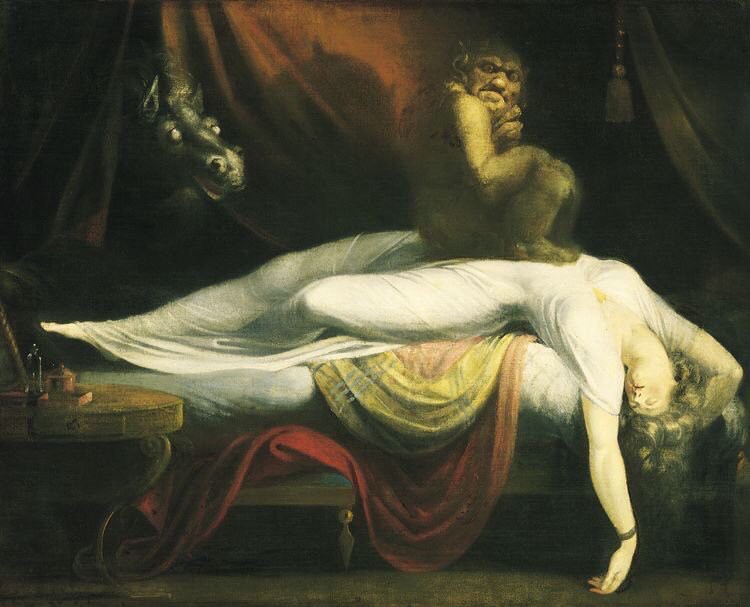
Why Did I Dream About the Dead Woman?

by James Wallace Harris, 5/15/22

A vivid emotional dream woke me. The dream was short, but it gave off an intensity. I was in a room, but I don’t think it was me. I was watching two men struggle with a dead woman trying to lay her body out straight. She wasn’t fat, but she was somewhat big, maybe tall, and around 160-170 pounds. There was a short man at her head and a taller man at her feet. I never saw their faces. The woman had died in a fetal position, tangled up in a quilt. The two men were lifting her up to stretch her out on her back. My impression was they were going to take her away, so maybe they were funeral people. I apologized to them for not helping, but I didn’t tell them I was afraid to get too close to the dead woman. I felt that strongly. I don’t know if we were related, but she was in her forties, much younger than me, but then who I was in the dream was younger too.

The woman was bald, and when they got on her back and arms folded on her chest, they stood up. The woman’s head then quickly sprouted short dark hair and she turned her head towards me and gave a beautiful smile. Shocked, I pointed exclaiming, “Look, she’s alive!” But when they looked down again, she was dead like before.

That was the end of my dream.

I’ve been reading books and watching documentaries about ancient Egypt and I wondered how ancient people would have interpreted this dream. Ancient Egyptians were obsessed with the underworld. All through history people have tried to make dreams meaningful. I wonder if this dream was supposed to be a message to me? I didn’t know the woman. And I’ve never believed in dream interpretation, yet I wondered why I dreamed this dream. Was it only my unconscious mind sorting information?

At 70, I’ve known a lot of people who are no longer with us. And since my body is obviously in decline, I don’t think I’ll be around for many more years. A dream about death seems important. When I woke up I wasn’t frightened. It wasn’t a nightmare. But I was puzzled.

Since I’m an atheist I don’t think we exist after death. But what if I’m wrong? Lately, there are been a lot of speculation about this universe being a simulation. What if I died and came to in another existence, and then realized I had been in some kind of virtual reality, wouldn’t that be weird? But then, what happens when I die in that reality?

I am amazed at my dreams for another reason. How does my brain generate images? Or construct stories? Often my dreams feel like productions equal to short movies. If I have a speech center of the brain, where is the movie studio center? What’s weird is I have that condition, aphantasia, that keeps me from visualizing imagery in my waking life. Yet, I have no trouble generating imagery in my sleep. I used to generate imagery when I was high, but that’s been half a century ago.

By the way, do we really see movies in our dreams? Sometimes I think dreams are a series of images, each one triggering an emotion, giving the illusion of movement.

I can easily understand how primitive people could believe what they did about dreams – they seem so real. The more I read about consciousness the more I believe my perceptions are very limited. And the more I read, the less I feel like I know anything.

I’m always amazed at people who are so confident in their beliefs. I’m sorry, but I assume you’re delusional. I know I am. The more I read, the more ways I’ve come across in which we fool ourselves. I guess you think I read too much.

Most of my dreams are about desperately searching for a bathroom and I wake up needing to pee. You may laugh at that, but isn’t it rather straightforward. Isn’t my unconscious mind just saying, “Wake up and go pee!” If it can be so direct about something so basic, what is my unconscious mind telling me when it shows me a smiling dead woman?

JWH

The Most Disturbing Dream I’ve Ever Had

by James Wallace Harris, 8/9/21

Last night I awoke from a dream that was so disturbing I didn’t want to go back to sleep. I was afraid I’d end up dreaming it again. I used reading Facebook on my phone so I wouldn’t fall back asleep.

The dream began when I was walking down a sidewalk. I saw people up ahead and didn’t know them. When I got up to them they asked me who I was and I couldn’t tell them. They asked where I lived and I said at the other end of the block. I told them I only walked to the end of the block and returned because I’d forget where I lived. But when I turned around to walk back home I couldn’t find it.

I kept walking through suburban streets looking for a street sign name I knew, but none of them made sense to me. Eventually, I realized I was in an urban area with traffic. I kept thinking if only I could find the main street I could walk home by following familiar streets.

As I got more disturbed people would stop me. I couldn’t tell what they wanted. I started becoming afraid of people. I thought people were hitting me and I was blacking out. Whenever I came to I was someplace else. I kept having more and more blackouts. I felt people were hurting me, even molesting me. I wanted to find home so badly.

The last scene I remembered was pushing a car door open. I was trying to run away from the people in the car. I got out of the car and ran, but everywhere was so strange. Then I woke up.

This dream was so unpleasant. I went and sat on the commode for a while thinking about it. A dream can meaning anything, but my first thought was I was suffering from dementia or Alzheimer’s in the dream.

Eventually, I went back to bed, but I got out my phone and read things off of Facebook. I remember now I wanted to see names and places I knew. Sometime after that I fell asleep. Luckily I didn’t have that dream again.

I hope I never do.

JWH

As a Kid, Where Did Science Fiction Make You Want to Go?

by James Wallace Harris, Sunday, January 20, 2019

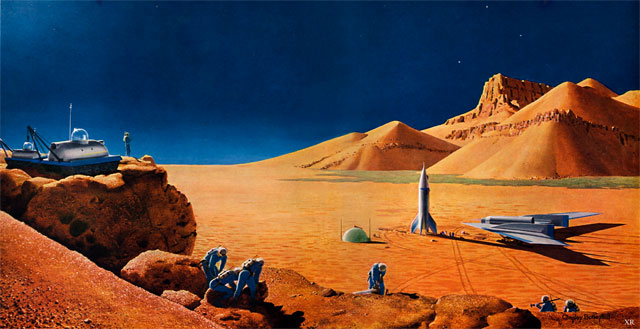
Growing up, I wanted to go to Mars. I assume the original seed of that desire came from watching science fiction movies as a little kid in the 1950s before I learned to read. When I could read, I loved reading about humans colonizing Mars. Red Planet by Robert A. Heinlein was the first SF novel I can remember reading about humans living on Mars. After that, I discovered Ray Bradbury and Edgar Rice Burroughs. But the allure of Mars came way before reading science fiction. I believe I saw a copy of The Exploration of Mars by Willy Ley, Wernher von Braun, and illustrated by Chesley Bonestell before I started reading science fiction. I began searching nonfiction books about space travel when I was in the fourth grade, right after Alan Shepard’s first ride into space.

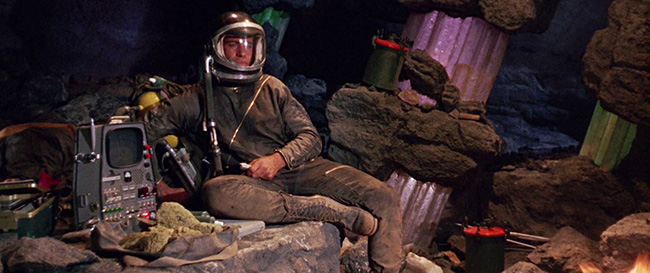
Knowing what Mars is like now, I don’t want to travel there anymore. I’m old and hate the cold, and Mars is a very frigid place. Although my agoraphobic ways would make me perfectly suitable for living in a tiny Martian habitat, and its low gravity would probably ease the pains in my back. And I love the idea of being stranded alone on Mars like the old film Robinson Crusoe on Mars or the book and film The Martian by Andy Weir.

robinson-crusoe-on-mars

The unfortunate reality is there’s not much on Mars beside radiation, rocks, and robots. I suppose visiting the landing site of Viking 1 might make a great tourist destination, but there’s not a whole lot on Mars to see unless you’re a geologist.  Of course, sometimes the appeal of getting away from this planet makes the utopian nowhere of Ares seem very attractive.

Why does science fiction make us want to leave Earth? Where did it make you want to go as a kid? Were they real places like Ganymede or Mars, or imaginary ones like Tatooine or Arrakis? Did you want to travel on interplanetary rockets or interstellar spaceships? Or maybe the past or future was your destination and you needed a time machine? Or was science fiction always just a cheap alternative to opium?

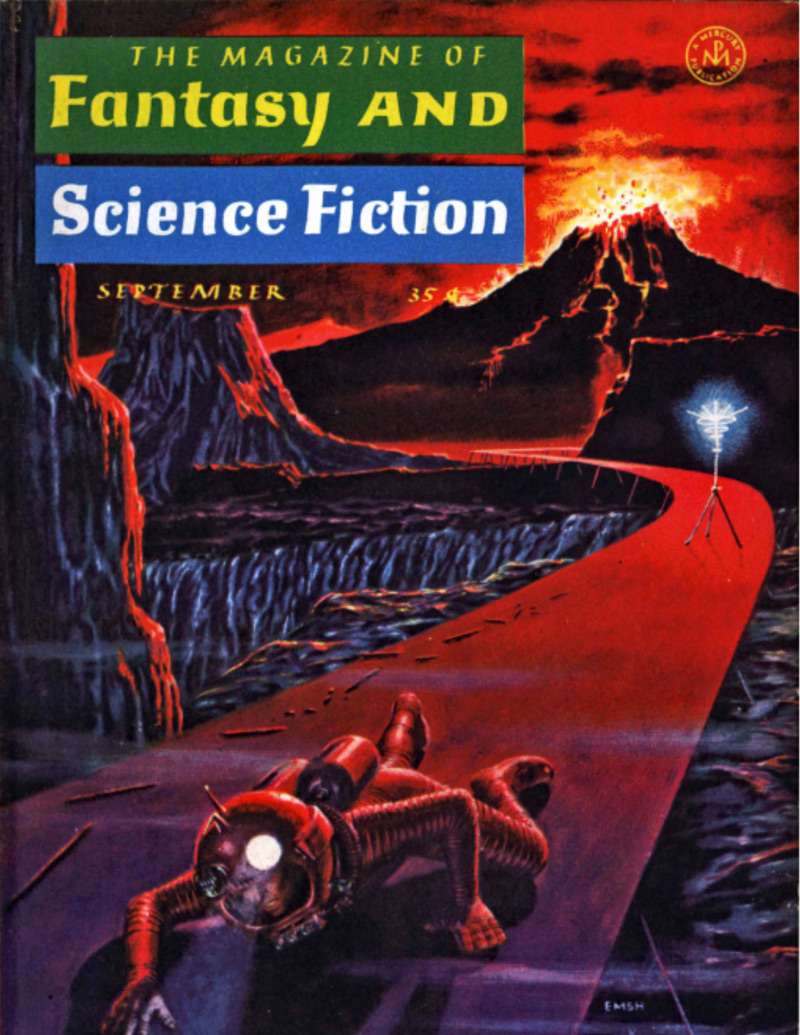
The book that describes my childhood mindset best is the 1958 Have Space Suit–Will Travel by Robert A. Heinlein. As a kid, I read it straight, but I’m sure it was a pastiche on science fiction. The story is about Clifford “Kip” Russell who is dying to go to the Moon. He hates that other people can, either because they are in the military, are top scientists, or just filthy rich. As a senior in high school, Kip determines that’s he’s going to get to the Moon one way or another. He hopes to win an all-expenses-paid trip but instead gets kidnapped by a flying saucer. Not only does Kip get to the Moon, but Pluto, a planet orbiting Vega and another planet somewhere in the lesser Magellanic cloud.

f&sf-sept-1958

I believe Heinlein wrote this book because he knew kids dreamed of leaving Earth. At the time, only a very small number of Baby Boomer had this psychological weirdo affliction. Decades later, millions do. What does that say about us? Is the desire to go into space really that different of hoping to get to heaven?

I look back over my life and see I wasted a lot of time on these fantasies. Some people really do go into space, but there’s a reality to how they live that allows that. I was never realistic enough to become an astronaut. As I got older I transferred my personal hopes to humanity in general. I thought it would be great if anybody went to Mars.

The other day I reread “The Million-Year Picnic” by Ray Bradbury. It’s the final story in The Martian Chronicles. In this lovely tale, a man and his wife, with their three sons escape to Mars as civilization collapses on Earth. They hope another family with four daughters will also make it in their rocket. The dad keeps telling his boys he will show them Martians, and in the end, he shows the kids their reflection in a Martian canal. I love this story. It was nostalgic when it was first published in Planet Stories in 1946, and it now encapsulates all my nostalgia for the science fiction I read as a kid. However, the reality is something quite different. If travelers from Earth could look into a Martian canal they would see the real Martians.

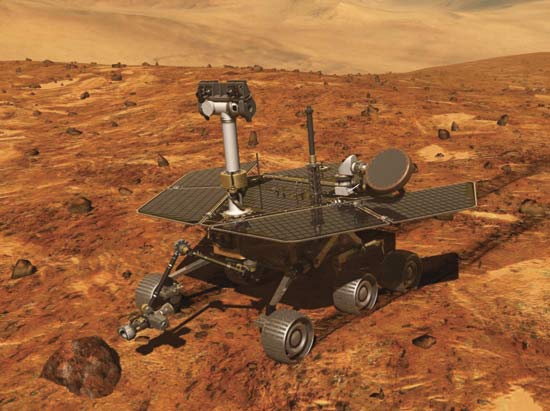
mars rover

I’m not even sure we need to send people to Mars anymore. Aren’t robots our true descendants who will colonize space?

Or do you still want to go?

JWH

The Zen of Hanging On

By James Wallace Harris, Thursday, September 24, 2015

This essay will be one of those that my friends think I’m going a little squirrelly.  But anytime I point to something that can’t be touched, I do seem a little crazy. I’m actually trying to capture a fleeting feeling—a single emotion I felt when hearing an old song.

The conventional Zen wisdom is one of letting go. We are taught to be one with the moment and learn to quiet our chattering mind. The lesson being that we miss the Now because we’re not there. Our thoughts churn out virtual never-never-lands instead of focusing on the beauty of existence. We live in our heads instead of reality. Our souls are like a drop of water floating down a stream that passes through an ever changing landscape. We hang onto memories of past sceneries or imagine future sights, ignoring the current vista.

Becoming one with Now is a lovely way to exist in reality, but I’m going to be contrary here, and explore the virtues of hanging on. All animals live in the moment. For some reason reality decided to evolve Homo sapiens who are capable of stepping out of the Eternal Now. It’s impossible to paint the Sistine Chapel or the build the Curiosity Mars rover without being able to ignore the moment. It is true we throw most of lives away in mental delusions, but it’s also true that some of those air castles we build in our heads get erected in reality. But I’m not talking about that kind of hanging on.

This morning while I was doing my morning exercises “Be My Baby” by The Ronettes came on the stereo, a song that first imprinted on me fifty-two years ago. By conventional Zen wisdom I should just listen to Ronnie Spector and enjoy the song for what it is in the moment. The powerful feelings I experienced when I was eleven years old and “Be My Baby” was chemically etched in my neural pathways don’t exist anymore. Or do they? Is it possible to exist now and then?

Living in the moment is being a one-dimensional point traveling through a four dimensional reality. The Zen of hanging on is constructing a four dimensional being. Our awareness of reality lives in the moment. Time is an illusion. The past and future don’t exist. We build the past with memories and the future with speculations. One meditation technique is to watch our thoughts, usually with the goal of quieting them. Our thoughts appear to be constant chatter that dribbles out of our brain. But if your soul can step back far enough, that chatter reveals patterns. Our diarrhea of mental babble has it’s own hard reality.

The Zen of hanging on becomes one of seeing ourselves from the fourth dimension. Living in the moment is eternal. We can’t know birth or death. But we are a finite creature with a beginning and end. We can only see that by hanging on to the residue of past moments and the most rational extrapolations of what we might become.

I don’t know if any of this will make any sense, but I felt compelled to write it before I allowed myself breakfast. It’s merely an explanation of why I believe “Be My Baby” keeps something from the past existing in this moment. To hear the song now flicks on a chemical sequence in my head that shapes my sense of the moment. From that view, the past still doesn’t exist, and the song long ago hardwired something that my present self can always experience. On the other hand, does my fourth dimensional sense of self, using all those memories I’ve hung onto, sculpts a bigger view of myself that includes the past?

Another way to ask that: Is our past a complete illusion, or something we continually reconstruct in the moment with artifacts we’ve hung onto?  Yes, one kind of past no longer exists, but don’t we create another kind, that does have a reality in the moment? Aren’t the things we hang onto the colors in which we paint our personality?

JWH