22 Dumb Fantasies I’ve Tried to Believe

by James Wallace Harris, Tuesday, October 31, 2017

Fantasyland by Kurt AndersenHave you been depressed since last November? Does the institutionalization of anti-science horrify you? Do you feel irrational politicians have hijacked our country? Does your soul ache because liberal compassions are under siege from conservative prejudices? Do you wonder if our collective mind has blown a gasket? Then you need to read Fantasyland: How America Went Haywire: A 500-Year History by Kurt Andersen. This book will not solve our problems, but it does explain how our nation has been crap-believing crazy for five centuries. Fantasyland is the most entertaining, informative, and comforting nonfiction book I’ve read in years. Fantasyland soothes my America-is-collapsing anxiety by reporting on all the dumbass fantasies Americans have embraced since Jamestown.

Because I can’t cast any first stones, reading this book makes me want to list all the stupid concepts I’ve tried to embrace in the last sixty years. We’re all suckers for fantasylands. We all hope to find saviors that will rescue us from our mundane lives. The desire to better ourselves, to create, to build an ideal world is one of the admirable qualities of our species. However, to live a life of delusion is sad.

Fantasyland proves hope for a better future depends on getting clean with reality. Recognizing we have a fantasy addiction is the first step. We need to simplify the serenity prayer, “God, grant me the serenity to accept the things I cannot change, Courage to change the things I can, And wisdom to know the difference” to “I seek wisdom to know the difference between reality and fantasy.”

As I read Fantasyland I constantly used it to condemn the conservatives for ruining our society with their delusions. However, I have my own delusions, we all do. I thought it might be fun to confess the history of my personal fantasylands. This inspired many questions as I wrote this essay we should consider.

  1. Should we lie to children, especially during their formative years, even if it’s in fun?
  2. At what age, if any, is make-believe safe?
  3. Should schools teach how to discern fantasy from reality?
  4. Does the Constitution protect us from other people’s delusions and fantasies?
  5. Do people have a right to believe anything they want?
  6. How do we teach history to convey the lessons of failed fantasies?
  7. Is fantasy in books, television, and movies a cause of our personal delusions?
  8. Aren’t most fantasies promoted by people trying to make money or at least validate their own delusions or egos?

An Abbreviated History of My Fantasies

Looking backward, I realize books often sold me on a new fantasyland. We seldom originate our own fantasies. As Kurt Andersen reports in Fantasyland, America was created by people with either a fantasy for finding gold or a fantasy for establishing a religious utopia. Evidently today, we have a greater abundance of fantasies to choose from, especially with mass media and the internet inspiring us. I wonder, without all our fantasies would this country be quiet and dull – or would it?

The Age of Magic (My Early Years)

#1 – Easter Bunny

I doubt the Easter Bunny is my first fantasy belief, but I’m listing it first because it’s the most embarrassing, even for a little kid. I can’t believe I ever believed a large rabbit went around hiding chocolate bunnies and colored hens’ eggs. Damn, I must have been a gullible toddler.

#2 – The Tooth Fairy

Okay, I was old enough to lose teeth, I should have been skeptical that any creature would pay a quarter for a rotten tooth. I can barely remember when this happened. I hope I actually didn’t believe what my parents were telling me, and that all I wanted was that change under my pillow.

#3 – Santa Claus

I was a total dumbass for the guy in the red suit. I remember being red face hot when a little girl put me down for being so stupid as to believe in Santa Claus. In my defense, I started first grade a year earlier than I should, so all the other kids were a year older than me. But still, I should have thought this through logically, there were plenty of clues.

#4 – Oz and Magic

I discovered the Oz books by L. Frank Baum when I was ten. I had been watching the annual showing of The Wizard of Oz since I was four. Oz was a fantasy world with magic that I wanted to exist. I have read there was a period when American librarians banned Oz books because they felt Oz books gave children unrealistic expectations about life. In my case, they were dead on.

#4 – Jesus/God

If parents really want kids to accept Jesus and God as the literal truth, they shouldn’t tell us about #1-3 first. It only sets us up to be skeptical about all invisible beings. My road to atheism began at age 11 when I got Baptized and I didn’t see the light. It totally confused me when Christians said one thing in church but did the opposite Monday through Saturday. I became a complete atheist by the 8th grade.

This ends my period of wanting to believe in magic. Maybe it’s something all kids want. I find it strange that the most fundamentalist of Christian believers reject the concept of magic when Bible stories are full of magic. God created the Earth with words. My rejection of magic was so strong I rejected all fantasy stories in favor of science fiction. It wasn’t until my fifties that I was able to enjoy fantasy novels like Harry Potter just for fun.

The Age of Science (Junior High)

#5 – Science Fiction

Science fiction was supposed to be the opposite of fantasy. When I was young I believe all the classics themes of science fiction were theoretically possible. Over the years I’ve slowly become a disbeliever to many of them, like faster-than-light travel, time travel, galactic empires, brain downloading, scientific immortality, etc. I still cling to intelligent robots or AI machines with conscious minds will be built someday.

#6 – Becoming an Astronaut

By the 8th grade I had exchanged religion for science fiction. This led me to an array of beliefs that would take me the rest of my life to realize were irrational. The first, the belief I would grow up and work in space took a long time to get over. Back in the 1960s, I was totally in awe of NASA and faithfully followed Projects Mercury, Gemini, and Apollo. Sputnik went up just before I started Kindergarten and Apollo 11 landed on the Moon just after I graduated the 12th grade. I had even gone to watch Apollo 8 launch Christmastime 1968, during my senior year. Sometime in my high school years, I learned astronauts had to have 20-20 vision, and I was a four-eyed geek with thick lenses. I still fantasized that science could fix my eyes, or NASA would eventually hire people with glasses. After reading Tom Wolfe’s famous book, I realized I never had the right stuff, and never would. It galled me when rich people started buying their way to space, but if I’m honest with myself, even if I was a billionaire I would never leave Earth. Space travel is just too inconvenient and uncomfortable for me.

#7 Becoming a Scientist

Probably the greatest regret of my life is not becoming a scientist. This was not an impossible dream – theoretically. However, even though I took biology, chemistry, and physics in high school, I just couldn’t devote myself to those subjects and work hard. Nor could I apply myself to math. I eventually got through calculus, but only with a half-ass effort. I even went to a tech school majoring in computer science in 1971, but I never could commit to studying hard. I wanted to have fun. I hated the classroom. One of the dumbest fantasies I had about myself involved being a disciplined scholar of science. I was always more science fiction fan than a scientist. Being successful at any pursuit requires hard work, concentration, and grit. My biggest fantasy in my life has been believing I could make myself acquire those qualities.

#8 – The Final Frontier

Instead of believing in heaven like most folks growing up in the south, I believed mankind’s was destined to travel across the solar system and out into the galaxy. That was my teenage religion. For most of my life, I believed colonizing space was our species purpose in existence. I’m now an atheist to that idea. We might travel to Mars or a few other places in the solar system, and even build colonies on the Moon and Mars, but I doubt much will come of it. Going to the stars is a fantasy for humans. I currently believe robots are destined to be interstellar travelers, but that too might be a fantasy.

The Counter Culture (High School and Early College Years)

#9 – Hippies and the Counter Culture

I remember in 1967 after reading about the march on the Pentagon standing at my school bus stop arguing with my longhair buddies about how the counter-culture was going to revolutionize America. In 1968 The Electric Kool-Aid Acid Test by Tom Wolfe and The Rolling Stone magazine started defining a new fantasyland future for me. It also introduced me to Jack Kerouac, who drew me backwards into an older fantasyland.

#10 – Expanding My Mind with Drugs

The 1960s had another impact on me. Besides science fiction and NASA, I loved rock music and drugs. So did many in my age cohort. I was influenced by Aldous Huxley, Timothy Leary and Richard Alpert and believed psychedelic drugs were the doors of perception. I sought transcendence with chemicals. I wanted them to take me as far as John Lilly claimed they took him, out into the galaxy to meet other beings – see The Programming and Metaprogramming of the Human Biocomputer. Yeah, if you mix belief in science fiction with acid it produces some far out fantasies, but really no different from mixing religion and faith.

#11 – The Beats and On the Road

I was completely romanced by Jack Kerouac and his on-the-road philosophy. I started hitchhiking around Miami when I was in high school, and continued when I went to college in Memphis. I did two short trips across states, one with my friend Connell. I learned I preferred the comforts of home. However, to this day, I still enjoy reading Kerouac. I see him as a tragic figure who followed many paths I wanted to follow but didn’t because I was either too scared or too smart. Kerouac was my father-figure substitute. My dad and Jack were horrible alcoholics that died within months of each other, both still in their forties. If I had gotten only my father’s genes that would have been my fate. I have a huge psychic connection with Kerouac.

#12 – Becoming Bob Dylan

Another absurd fantasy involved buying a guitar and harmonica and teaching myself to play and write music. This is an absurd fantasy because I can’t carry a tune, or even remember the words to favorite songs I’ve heard hundreds of times. I’m sure most kids have rockstar/sportstar/moviestar/writer/artist type fantasies. Probably every kid dreams of being famous for something. Fame is possible, certainly more possible than dying and going to heaven. Sadly, fame comes to about as many people as those winning big jackpots in Lotto.

#13 – Communes

At the end of the 1960s and beginning of the 1970s the idea of intentional communities began spreading through the counter culture. I loved the idea, and had brief stints in two communal groups. I quickly learned I loved privacy, personal possessions, and having my own way. This was a very short-lived fantasy, but it still affects me. I now dream of living in a high-rise retirement community where all my friends each have an apartment.

#14 – Back to Nature

After realizing I wasn’t suited for group living I dreamed of buying my own land and escaping the rat race. I just didn’t want to join the 9-to-5 world. My bibles were Mother Earth News, Five Acres and Independence, and The Whole Earth Catalog. Several of my buddies had this dream too, but after several failures at handy crafts, gardening, and fixing machinery, reality taught me something different. I loved Henry David Thoreau, but I only read Walden and not his biography. I should have. The back to nature fantasy hadn’t worked for him either. This fantasy still returns to me occasionally, like the other night when I watched the beautiful documentary, Off the Grid.

#15 – Carlos Castaneda

I loved these books that were supposed to be anthropological. Even though I gave up Christianity, I was still gullible to other religious ideas. I figured there might be some truth in old spiritual studies. Castaneda mixed sacred drugs and the wisdom of indigenous people, and that had the appeal of promising ancient wisdom. I learned a lot, but mostly the wisdom of what to avoid.

#16 – Hinduism and Ram Das

Be Here Now really hooked me. Ram Das (aka Richard Albert) convinced me to open my mind to Hinduism. I even read The Bhagavad Gita, took up yoga, joined some New Age groups with Hindu teachers, and read a bunch of books about the sacred literature of India. I just never could believe. I tried.

#17 – Buddhism, Zen Buddhism, Alan Watts

I had been reading Alan Watts since I started reading Jack Kerouac. Ram Das further encouraged me to accept Buddhism. I liked Zen Buddhism because it seemed the least magical/metaphysical of all religions. I still admire Zen and meditation for their anti-bullshit methods of perceiving reality, but Buddhism has its fundamental side too, that can be just as dogmatic, and miracle driven as Christianity. Theoretically, I believe a reality-based religion is possible, but so far I haven’t found one.

#18 – Spiritualism, Channeling Seth

For a brief period, I read books about communicating with other beings by mediums like Jane Roberts. My science fictional fantasies were susceptible to alien beings communicating with us through other dimensions. John Lilly promoted this idea, and he was a scientist (although zonked out on drugs) and the great science fiction philosopher of the 1930s, Olaf Stapledon, also promoted these ideas. I soon rejected astral worlds because they were too inconsistent.

#19 – New Age Psychologies

Back in the 1970s there was almost a new psychology of the month coming out of California. I wanted to go and try things like EST, Rolfing, primal screaming, etc. I might have been converted if I could have gotten to Los Angles, but I didn’t. I just read the books, joined a local New Age community and subscribed to New Age Magazine. Like spiritualism, I gave up hope on these therapies because there were too many of them that offered conflicting truths.

My Work Years

By the end of the 1970s I got into microcomputers, and spent all my time thinking about computers. For the next 36 years I was preoccupied with being married, hanging out with friends, working, computers, science fiction, music, movies, television, and other down-to-earth pursuits. I read lots of nonfiction books, and slowly began developing more mature philosophies about life. However, I eventually learned of other fantasylands I had tried to find.

#20 – Romance/Sex/Love

Over the years I realized our society is gaga over romantic love. Love stories program us for romantic fantasylands. Gender stereotypes and sexual desires cause us to see each other in very unreal ways. It’s very hard not to objectify the people we want sexual. All these desires lead us to countless fantasylands.

#21 – Political Solutions

We all have fantasyland beliefs on how to solve our political problems. I used to believe we could come to a rational agreement on how to govern society. That’s a huge fantasy. I keep hoping it’s not, but all the evidence says it is.

#22 – We Can Solve Our Big Problems

We have all the knowledge and technology we need to save the planet, but the reality is human nature won’t let us use that knowledge and technology. We all fantasize that humans have always survived so we always will. I think that’s our most dangerous fantasy. It’s a shame that two-thirds of us are deluded by childlike belief in a heavenly father. It keeps us from growing up and taking responsibility. It’s a shame that two-thirds of us believe lying to preserve personal beliefs is wiser than accepting the wisdom of science and giving up those beliefs.

Finding Reality

If we study our fantasylands, we’ll see we’re all looking for place to exist that rejects reality. We’re an adaptable species that can live in a variety of environments. We’re also clever beings that can adapt to any environment for our physical needs. Our failure comes from trying to pretend reality is something that matches our mental needs. Our superpower is the ability to delude ourselves. Our brains have countless cognitive skills to paint over reality, deny evidence, and to allow us to see our beliefs as real. It’s probably a survival mechanism, a way to cope as individuals. But it means we fail to cooperate in our shared reality by agreeing on its actual details.

JWH


Blade Runner 2049 – The Evil of Heartless Sequels

by James Wallace Harris, Wednesday, October 11, 2017

Normally I don’t write “reviews” of works I dislike. Why waste time on bad art, huh? I prefer to promote creative work I admire. However, in trying to understand why I disliked Blade Runner 2049 I asked myself, “What did I love about the original?” It came to me instantly – the voiceover. In that moment I realized Harrison’s Ford narration in the original film was the heart of the story. That insight also explained why Ridley Scott detested the voiceover. The narration must come from a human, and Scott wanted Deckard to be a replicant.

Blade Runner 2049-2

Before seeing Blade Runner 2049 I watched Blade Runner (final cut) with a friend. I explained the history of all the versions to her and offered to show her whichever one she wanted. She picked the final cut. Normally, I always rewatch the theatrical version, which is how I first saw the film back in 1982. Whenever I see one of the director’s cuts the viewing is always a letdown. They have the same sterile quality Blade Runner 2049 has.

Blade Runner 2049 is directed by Denis Villeneuve, with the story by Hampton Fancher and Michael Green. However, it feels like a Ridley Scott baby. Scott has always argued that Rick Deckard was a replicant and Blade Runner 2049 vindicates that idea to the point that I think of this film as an expression of his ideas.

Back in 2008, I wrote “Is It Time To Remake Blade Runner?” which was really a plea to film Do Androids Dream of Electric Sheep? as the story was written by Philip K. Dick. I believe the book deserves a truer conversion to film than Blade Runner. I can’t document this, but I believe Ridley Scott bragged that he hadn’t even read the novel when making the movie. Don’t get me wrong, I loved the original theatrical version of Blade Runner, but I don’t consider it very PKD.

When the screenwriters changed androids to replicants something else got changed. In the book, androids are soulless creatures who look like humans but completely lack empathy. They are self-aware but are also psychopathic sociopaths. I believe PKD intended them to be symbolic of inhuman humans. Blade Runner is about artificial creatures that were meant to be soulless slaves that have accidentally evolved empathy. We’re supposed to feel for them. And I did with the Harrison Ford voiceover.

Without the voiceover, both films are just action flicks of heartless machines killing heartless machines. Why has Riddley Scott never understood the Romeo and Juliet beauty of having a love story between lovers from two opposing houses? In Blade Runner 2049 we are taken on a meaningless thrill ride where it’s impossible to tell human from replicant – and I really didn’t give a shit either. There are a few touching scenes in Blade Runner 2049, but they are so artificial as to cause existential angst. At times we feel for K, our replicant protagonist, but the scenes are so obviously manipulating us that it’s hard to genuinely care.

In Blade Runner 2049 it becomes obvious the real problem is our lack of understanding of replicants. They are called skin jobs. That implies they are machines covered in skin. But that’s not true. In both movies, they bleed. In Blade Runner 2049 they seem to be artificially produced biological creatures that can’t reproduce on their own, and the goal of the mad scientist Niander Wallace (Jared Leto) is to create a Nexus model that is self-replicating. But what’s the fucking point of that? Humans are self-replicating, and we have plenty of them.

Wallace wants a new process to produce less costly slaves. The government obviously backs him as long as replicants don’t act like real humans. However, we also learn replicants have secretly organized into a slave rebellion. But why secret? What good is a secret mass-movement? Isn’t it obvious that replicants aren’t soulless machines?  Do any moviegoers feel the replicants aren’t equal to people? That makes the whole point of the film a straw man argument. Truly pointless. It’s funny, but Jared Leto’s character is the most inhuman character in the film and he’s supposed to be human. Or will Ridley Scott pull another juvenile joke and claim everyone in this film was a replicant.

Our world is full of robotic slaves now. They don’t have consciousness. They don’t look human. They lack any kind of consciousness. A major theme of science fiction has always been about when robots become conscious. Generally, these science fictional robots are shown as looking human. I guess SF writers assume we can’t empathize with them if they don’t look like us. By the way, the film Her did a fantastic job of overcoming this problem.

We’ve always wanted to build robots that look like us, and that’s a problem. We want them to do our work, but we worry about robots becoming self-aware as us. If they do, we can’t keep them as slaves, and we fear they may become better than us. The TV show Humans is exploring this same topic. The trouble is Blade Runner 2049 adds absolutely nothing to this topic. The film only confuses the issues in its razzle-dazzle. It lacks both a heart and a brain. Almost every character is violent and action-oriented.

Blade Runner 2049

PKD’s original novel, Do Androids Dream of Electric Sheep? isn’t about action. His androids are conscious, self-aware beings that lack empathy. Rachel is alluring and beautiful, but a cold-blooded killer. Dick’s theme wasn’t robot suffrage. PKD believed the androids in his story deserved to be destroyed because without empathy they are evil, and in doing so infers that humans without empathy are evil too. PKD’s story wasn’t about killing androids but identifying inhuman humans.

Do Androids Dream of Electric Sheep? is vastly more complicated than Blade Runner. If I could film it I would give it the look of 1959 films, because I believe PKD formative decades were the 1940s and 1950s. Its future setting would be very retro-future. It would have the Penfield mood organs and Mercerism. And the story would focus on philosophy and psychology rather than fights and shooting. The film must keep Iran, Deckard’s wife. And it needs the fake police station, having Deckard doubt himself, and eventually proving he’s human. And it needs the artificial religion of Mercerism.

Blade Runner leaves so many fascinating concepts out from the original novel. First off, Rick Deckard isn’t a tough-guy like Harrison Ford, but a married man trying to save his marriage. Their livelihood depended on the bounty from killing androids. The novel opens with their marital squabbling, and the use of mood organs. Mood organs are personal devices for controlling psychological states. People in this future use them to subtly control how they interact with other people, cope at home and work, and explore hundreds of emotional states. PKD uses this imaginary device to dissect human nature. The book is stuffed with observations about what it means to be human. Blade Runner uses none of that. PKD was obsessed with psychiatry, psychology and philosophy and his stories constantly explore those subjects. The Blade Runner movies only faintly hint at the issues PKD brought up in endless ways.

Blade Runner 2049 does not define humans or replicants. We can’t tell them apart. In fact, the evil scientist who creates the replicants acts like a heartless AI, and K, the Ryan Gossling character, who we know is a replicant, when left alone is humanly hung up on an AI girlfriend (who may be a future descendant of Alexa).

Blade Runner 2049 fails horribly if you need a human story. For moviegoers who love eye candy, violence, and a rollercoaster plot, you’ll probably be happy enough.

What’s evil is trying to make millions by making a movie that lacks heart, based on a novel that struggles to define our hearts. Seems kind of heartless, don’t you think?

Blade Runner 2049 is chock full of touchstone analogs from the original Blade Runner. That felt manipulative like Ridley Scott wanted to push our emotional buttons as if we were replicants. Did he expect us to emotionally resonate with air hoses being pulled out, yucky eyeballs, pianos, giant billboards animated with Japanese women, microscopic photo scanning machines, bicyclists riding in parallel formation, machines that measure artificial minds, old abandoned apartment buildings, drinking whiskey from squarish glasses, women dressed like 1970s hookers, giant pyramid-shaped buildings, flying cars, sentimental photographs, umbrellas and rain, and so on.

Everything in Blade Runner 2049 seems set-up for additional sequels, but like his Alien franchise, they will probably continue to abuse the original. I’ve gotten so I hate sequels to books and films. There are few exceptions, but for the most part, sequels feel like they are conning me for my money.

JWH


Looking Forwards v. Looking Backwards

by James Wallace Harris, Wednesday, September 20, 2017

Do you read books about the past, or about now, or the future?

Our Nig by Harriet WilsonThis morning I started work on an essay about African-American fiction in the 19th century. It began with a question that had popped into my head: “Who was the first black novelist in our country?” This kind of fun sleuthing on the internet inspires me to write essays. I quickly came across articles about how Henry Louis Gates, Jr. had discovered a long forgotten book in the early 1980s called Our Nig; or, Sketches From the Life of a Free Black (1859) by Harriet Wilson. That made me want to research a number of other things. Have earlier novels been uncovered since? What were the second, third, fourth, fifth novels? What about short stories? Were any bestsellers in their day. Before long I realized I could spend weeks on this project.

Men-Into-SpaceI usually think of several ideas a day for researching and writing. I start work on just a fraction of these ideas, and complete work on damn few. Another idea I got yesterday was to write about Men Into Space, a one-season TV show of 38-episodes (1959-60) that worked to be very realistic about space flight. A lady in my online book club mentioned it and I was surprised I hadn’t known about it before now. It’s not available on DVD except as DVD-R sales through places like eBay (because it’s in the public domain). It is available to watch online at YouTube. However, I did find a book, Men Into Space by John C. Fredriksen that extensively writes about the series. I’d love to write a book like this – if I could focus my mind for a year or two.

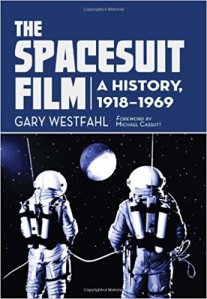
The Spacesuit Film - A History 1918-1969 by Gary WestfahlWhile researching Men Into Space I came across another book The Spacesuit Film: A History 1918-1969 by Gary Westfahl that covered Men Into Space as well as other movies and television shows that prefigured the space age. Hell, this exactly the kind of book I’d love to write too. But can you imagine the time it would take? But wouldn’t it be fun to watch all those old movies and television shows analyzing them for how they imagined the future? However, how many people read such books? I want to, but the $39.95 price for the paperback stops me. Even the $19.99 price for the Kindle edition is making me think long and hard.

This suggests another idea for researching. How many people buy and read these esoteric kinds of history books? How many people love to study tiny segments of forgotten history? I have this nagging desire to write something longer than blog essays. This month was supposed to be the month I began a book-length project. And I did start on an idea, but once again got side-tracked by too many distractions. But I’m back to focusing my mind on the project.

I have to ask myself, who is going to read what I write and why? Why spend a year, or several, writing something few people will want to read? It occurred to me this morning I could divide books into three categories: about the past, about the present, about the future. This is true for both fiction and nonfiction.

To Be A Machine by Mark O'ConnellI’ve always loved science fiction, which is future-oriented. But when I think about writing about science fiction, that’s past-oriented. Because I write for Book Riot, I can also write about contemporary publishing. I even think about writing books like To Be A Machine: Adventures Among Cyborgs, Utopians, Hackers, and the Futurists Solving the Modest Problem of Death by Mark O’Connell, which is essentially about how science fiction is affecting our world today.

I also came across this pledge drive for Farah Mendlesohn yesterday. She is writing a book about Robert A. Heinlein and is looking for backers. She’s gotten 143 supportors so far. This is also exactly the kind of book I’d love to write – but is that the rough number of people who would be interested in reading it?

I’m now worrying that I’m spending too much time thinking about the past. Is that because I’m getting older and it’s natural for aging folks to analyze yesterday? I assume that many people who like my blog do so because they are somewhat like me – they are older and thinking about when they grew up, and we all loved some of the same things.

I believe my less popular essays at Book Riot are due to writing about topics that bore their demographic readership, which tilts young and female. This makes me wonder if I should accept that I like to write about things that appeal to a subset of aging baby boomers, or if I should work to write about topics that have a wider appeal across different age groups.

My guess is writing about contemporary subjects or about the future has more universal appeal. I wonder if writing about today or tomorrow isn’t more psychologically positive for both me and readers. But I’m so fascinated by the past, especially esoteric subjects.

I’m currently reading The Man Who Loved Only Numbers by Paul Hoffman about Paul Erdős, a brilliant mathematician, and The Five Gospels, about the Jesus Seminar, a group of scholars who work to figure out what the historical Jesus actually said. Both of these books are intensely fascinating. Both of these books are about the past and have little relevance to today or tomorrow.

I have to wonder if I’ve given up on tomorrow because I don’t have much hope for the future, either for myself, or the planet, and I’m finding pleasure and meaning by exploring the past.

I’ve always loved science fiction but when I read science fiction today I’m usually very critical of works that are based on unrealistic ideas. I don’t believe in all those far out futures like I used to. As a writing challenge maybe I should work to write about positive futures that could be realistic, ones we can hope to find. Yet, my most popular essay ever is, “50 Reasons Why Humans Are Too Stupid To Survive.” Gloom and doom does sell. Hell, the TV shows my friends and I binge-watch focus on awful people and horrible events.

Writing is about focus. Writing a book is about intense focus over a great time span. I’m wondering if choosing to write about the past isn’t a way of escaping the present or future? I also wonder if writing about the future isn’t a way to give myself hope for tomorrow?

Maybe you can’t relate to this topic because it’s about writing. Think of it this way. Do you love watching old movies and television shows, or new ones? Do you listen to old music or new music? If you’re mentally young, no matter what your age is, you’ll be enjoying whatever is new.

I’m being more and more drawn into the past. 1950s movie westerns, mid-20th-century written science fiction, 1960s romantic movie comedies, 19th-century novels, 1950s jazz, 1940s film noir, 1920s modernistic literature, Victorian scientific romances, etc. Growing up, I always thought about the future…

JWH


How Much Time Do You Spend Consuming Pop Culture?

by James Wallace Harris, Saturday, June 24, 2017

In past centuries, living left little free time. Survival was all time-consuming. Twelve-hour workdays were the norm once. Few people had time for hobbies or pursuing pop culture. And if we weren’t working we were raising families or maintaining our little castles.

Times have changed. The work week keeps getting shorter. More people choose not to have kids or even marry. Some people spend as much time watching TV as working. And a lot more people are retired or unemployed. Probably, if you’re not depressed, strung out on drugs, or chasing someone to have sex with, you’re consuming popular culture with all that extra time.

Pop culture

How many hours a week do you spend reading, watching television, going to the movies, listening to music, binge-watching the internet, looking at comic books, going to museums, attending plays, or any other popular pursuit reported on by Entertainment Weekly? And what about video games? Or VR? Are they pop culture or something new?

Are the hours starting to add up? Is mass consumption of pop culture good or bad? I really don’t know. As a retired person I realize most of my time is occupied with pop culture pursuits. I’d like to think I’m consuming art, that I’m psychologically imbibing in the most creative cuisine our culture offers. Is that true? I also like to believe I’m learning about the past through consuming popular culture from other eras. For example, how well can I understand the 1920s from reading Fitzgerald, Faulkner, Wharton, Joyce, Lawrence, and Hemingway, listening to old jazz, watching silent films, look at art, and reading history books?

Would the time I spend on consuming pop culture be better spent on hobbies? TV watching and going to the movies are a big part of my social outlet. Music and reading are solitary pursuits. Hobbies are generally solitary too. I could get up every day and do something more productive than consuming art and writing about it.

Most biological beings spend most of their time looking for food, mating, rearing their young, and avoiding being prey to other biological beings. Isn’t it rather fascinating that humans excrete art and consume it? We used to say humans were the only animals that made tools – until we discovered a whole bunch of other tool using species. Then we said humans were unique because we have language. Well, we discovered that wasn’t true either. More and more we’re finding examples where animals play, have friends, and show curiosity. But do other animals create art? What about the bowerbird?

Satin-Bower-Bird-Nest

Is art tools we make to stimulate our minds? Or is art external remembrances we make for shared memories? Pop culture is art for the masses. Art used to be unique, a one of a kind piece. Pop culture depends on mass producing artwork that we like to share. Pop culture feels more nourishing to my soul than air, water, and food, although I couldn’t survive without them, and I could survive without pop culture.

Maybe I shouldn’t use the word soul. The soul doesn’t exist. It was a creative fiction of religion. (And couldn’t religion be the first pop culture creation?) Even though science cannot find any evidence for the soul, and philosophers have refuted its existence, we all feel we have one. Science shows we are not minds and bodies, but just bodies that are biologically programmed to react to our environment. So what is pop culture?

Pop culture is something we add to reality. Of course, we rearrange atoms and molecules that already exist to create art, but there is something new there. Yesterday I read “All the Animals that Love Touchscreens” and learned another way humans are not unique. Pop culture is something that even animals might perceive.

Pop culture is mass-produced art. But that also means it is art that can be saved and preserved. Pop culture artifacts remember aspects of our collective souls. There’s that word again. Religion is wrong about immortal souls. Nothing lasts forever. Neither we, our culture or our art will survive forever.

If you spend several hours a day watching television you’re consuming pop culture. Is it just a way to kill time. To distract you from life? Or do you value pop culture as an artistic achievement?

JWH

My Book Addiction is Getting Out of Control

by James Wallace Harris, Saturday, January 28, 2017

toomanybooksI wrote, “Hi, I’m a Book Addict” for Book Riot hoping the act of writing would exorcise my demon. It hasn’t. Below is a list of books I’ve bought this month. It’s about a year’s worth of reading since I read a book a week. I’m buying 10-12 books for every one I read, which I know sounds insane, but doesn’t stop me.

I’ve annotated the list with my rationalization for buying the book. I know I’m being impractical. I know I’m wasting money. It gives me pleasure to shop for books, especially to find bargains, but those are not reasonable justifications. This compulsive behavior does reveal a pathological need to “own” knowledge. Because my memory is failing, owning a book, especially an old favorite, is a way of keeping it in memory. My new memory is my iPhone, which has become my real auxiliary memory. I guess it’s an external brain, making me a tiny bit of a cyborg.

This list of books reflects what I want to know. Pathetically, not by study, but by acquisition.

Access to cheap books is the main cause of my addiction. Most of the books below cost me just a $1.99. Used books, either from my library’s used bookstore or ABEbooks.com average around $4. Here are the daily newsletters I get that announce bargain books:

I’ve hyperlinked some titles to show why the book is worth reading. If you want to maintain your place in the list, just right-click and select open in new window to read the annotation.

  1. Dimension of Miracles by Robert Sheckley – read twice, want to keep for memory
  2. Draw Lab for Mixed Media Artists by Carla Sonheim – to inspire me to draw
  3. Time is the Simplest Thing by Clifford D. Simak – collecting Simak on the cheap
  4. 10-Minute Digital Declutter by S. J. Scott – love books about minimalizing
  5. 10-Minute Declutter by S. J. Scott – love books about minimalizing
  6. Silent Spring by Rachel Carson – classic I’ve always wanted to read
  7. On the Road by Jack Kerouac – read many times wanted a copy for my iPhone
  8. A People’s History of the United States by Howard Zinn – always wanted to read
  9. The Social Organism by Oliver Luckett – about social media
  10. The Grid by Gretchen Bakke – about our aging power grid
  11. Revolution from Within by Gloria Steinem – interesting feminist take
  12. In the Darkroom Susan Faludi – one of the best books of 2016
  13. Chaos Monkeys by Antonio Garcia Martinez – start ups at Silicon Valley
  14. Never a Dull Moment by David Hepworth – rock music of 1971
  15. Kill ‘Em and Leave by James McBride – James Brown
  16. Hidden Figures by Margot Lee Shetterly – best books of 2016
  17. Schaum’s Outline of Mathematica by Eugene Don – to use with Mathematic on my Raspberry Pi
  18. Schaum’s Outline of PreCalculus by Fred Safier – I’m dreaming big
  19. Complete Book of Home Inspection by Norman Becker – should keep an eye on my  house
  20. How Will You Measure Your Life by Clayton M. Christensen – how to measure success in life
  21. College Algebra DeMYSTIFieD by Rhonda Huettenmueller – my dream of relearning math
  22. Pre-Calculus DeMYSTIFieD by Rhonda Huettenmueller – my dream of relearning math
  23. How to Diagnose and Fix Everything Electronic by Michael Geier – I want to learn about electronics
  24. Practical Electronics for Inventors by Paul Scherz – I want to learn about electronics
  25. Schaum’s Outline of Linear Algebra by Seymour Lipschutz – my dream of relearning math
  26. Schaum’s Outline of Precalculus by Fred Safier – my dream of relearning math
  27. Why We Read Fiction by Lisa Zunshine (ebook and audio) – why do we read fiction?
  28. Altamont by Joel Selvin – the evil twin of Woodstock
  29. Summary of Analysis of Hidden Figures by Worth Books – wanted to see how a book is summarized
  30. The Wizard of Menlo Park by Randall E. Stross – bio of Edison
  31. Visual Intelligence by Amy E. Herman – to improve my powers of observation
  32. Extreme Focus by Dominic Mann – want to improve my concentration
  33. Time for the Stars by Robert A. Heinlein – old favorite to keep on iPhone
  34. The Age of Wonder by Richard Holmes – great science history
  35. Wonderful Town by David Remnick – New York as viewed by the New Yorker
  36. Time and Again by Clifford D. Simak – collection Simak on the cheap
  37. Console Wars by Blake J. Harris – love tech history
  38. Island by Aldous Huxley (ebook and audio) – admire Huxley and always wanted to read it
  39. The Best American Short Stories 2016 – love this series, get them cheap once a year
  40. The Best American Essays 2016 – love this series, get them cheap once a year
  41. The Best American Science and Nature Writing 2016 – love this series, get them cheap once a year
  42. The Best American Travel Writing 2016 – love this series, get them cheap once a year
  43. The Best American Nonrequired Reading 2016 – love this series, get them cheap once a year
  44. The Origins of Totalitarianism by Hannah Arendt – books to read because of Trump
  45. A Case of Conscience by James Blish – classic of science fiction I want to keep on iPhone
  46. The Second Golden Age of Science Fiction Megapack by Mark Clifton – first Hugo winning novel for 99 cents
  47. The More of Less – by Joshua Becker – love books on minimalism, might help with this book problem
  48. The Hollywood History of the World by George MacDonald Fraser – I’m writing essay on Hollywood’s treatment of history
  49. The  New Painting by Charles Moffert – I’m fascinated by the Impressionists
  50. On Rereading by Patricia Meyer Spacks – writing article about rereading
  51. Composing Digital Music for Dummies – I’d love to learn to use digital music programs
  52. The Outliers by Malcolm Gladwell – read library copy wanted one for me
  53. Mind Tools by Rudy Rucker – my kind of book
  54. I Contain Multitudes by Ed Yong – another top 2016 book
  55. The Sound of a Wild Snail Eating by Elisabeth Tova Bailey
  56. The Big Picture by Sean Carroll

JWH