Reading Mentors

by James Wallace Harris, Wednesday, January 3, 2018

Years ago, after reading Outliers by Malcolm Gladwell I contemplated how my life had been shaped by not having a mentor growing up. Looking back now, I see I had mentor-like encounters. My reading was guided by random external influences and that worked as a kind of mentorship. We expect teachers to be mentors, but they can’t, not really, not with so many students.

This is going to be a long essay to explain how I select books today to read and why. I feel compelled to jump back and write a history of my evolution of discovering what to read. Looking back, I wish I had known right from the first that some books are significantly better than others — that I should seek out the best. I also wish I had read from a wider range of subjects — that I could have had far more favorite subjects. And I wished I had learned at an early age that some books can be like junk food — making me addictive to empty calories.

Society expects schools to pick the best books for children, but I always rebelled against their choices. How can we raise kids to be better book selectors?

Bookstore reading

Can teachers ever select books perfectly customized for the individual student? How can teachers avoid turning off students by promoting the reading of unrelatable classics? How can parents and teachers overcome the urge to make kids read the books they loved so passionately but might not be relevant to their children’s lives? If only one book is taught in any given class period what are the odds that all the students will respond to it? Is the goal to teach reading – the ability to decipher fiction and nonfiction – or to teach kids how to find the right book that will provide them cognitive maps to reality? Are kids ever taught the dangers of reading? Are they ever warned that books can become a crippling addiction? Are they ever taught that books can spread dangerous beliefs, delusions, prejudices, hate, and lies? I wished I had learned those things early on.

It has occurred to me that how I found books have always influenced what I read. And what I read has always determined the direction of my life. Thus, I need to be more careful with how I find books. If you are not a bookworm you probably won’t understand this insight. Back in 1971 when I first took a computer course they taught us this acronym: GIGO (garbage in, garbage out). Before that, I remember hippies preaching, “You are what you eat.” From this, you might assume I’m about to write an essay on “You are what you read.” However, I’m going to take one step back and write, “You are what you find to read.”

The first book I can remember is Treasure Island by Robert Louis Stevenson. My mother read it to me in the third grade (1959/60) after I had seen the film version with Wallace Beery. If my mother had chosen a different book for me I would have followed a different path as a bookworm? Both my parents were readers of tattered paperbacks. I remember mother reading Perry Mason and my father reading Mickey Spillane. Neither encouraged me and my sister to read. I guess they assumed our teachers would do that.

Evidently, at the end of the third grade, my teacher told my parents I had a reading problem and should attend summer school for reading. I vaguely remember going to a small, wedged shape room, probably a large closet rather than a classroom. The teacher told me to find a book and start reading. I went over to a twirling wire rack and found a small paperback titled Up Periscope. I started reading. It turns out I could read just fine. I don’t remember the summer school teacher ever giving lessons or even talking to him again. I was just bored by what they made us read in class. That twirling rack was an important book mentor and changed the direction of my life. The lesson I learned was I could pick my own books.

Starting in the 4th, 5th and 6th grades what I chose to read was determined by the school libraries and the physical locations where I came to browse. I was my own reading mentor. I remember always going to the beginning of the A’s of the kid’s section at Homestead Air Force Base Library in the 5th grade (1961/62). That got me reading Tom Swift (Appleton) and Oz books (Baum). Eventually, I worked up to the Hardy Boys (Dixon). I would have tried a greater variety of books if I hadn’t gotten hooked on series.

My sixth-grade (1962/63) teacher, Mrs. Saunders was the first teacher to be a book mentor. She’d read us books after lunch. I remember her starting A Wrinkle in Time by Madeleine L’Engle and me rushing to the library after school and checking out a copy to finish on my own.

When I started the 7th grade (1963/64) at another school I found When Worlds Collide (Edwin Balmer and Philip Wylie) again by browsing the beginning of a range. That simple routine was a reading mentor of sorts. By then I’d range up and down the alphabet looking for the kind of book I liked. I’d read a lot of so-so books. Books were like television or cookies, I consumed them as fast as I could. They were a commodity. I didn’t know there were great books. That’s when I could have used a reading mentor most. If only someone had only shown me how to find purpose in reading, rather than using reading for cheap thrills. If only a wise reader had shown me how to compare books to reality, or taught me about the quality of writing.

At this time I was fixated on space travel and biographies. I read for vicarious adventure. I found a numbered series that published cut-down biographies for children. I remember reading books about Ben Franklin, Aaron Burr, PT-109 and John Kennedy, and Blackjack Pershing. The numbered series acted like a mentor to me because I wanted to read them all. It also showed me that some people are more interesting than others, worthy of being written about. I wish I had had a reading mentor that that taught me that living is better than reading. On my own, I decided reading life was superior to real life.

In the 6th and 7th grade, my schools gave us order forms for Scholastic Books. I still didn’t know there was a genre called science fiction but I was drawn to science fiction books. Because of Scholastic Books, I discovered Jules Verne and H. G. Wells (too far down the alphabet to discover on my own I guess). These were the first books I bought after begging my mother to write a check. This was my first taste of owning and keeping books. I wish I had had some way of knowing what the other books were like on the Scholastic list. This was my first time I encountered a book list or publisher’s catalog. In a way, the Scholastic sales flyer was a kind of reading mentor.

Scholastic Order Form 1963

If I had found different books in the As and Bs at Homestead Air Force Base Library I could have taken a different path. I picked the Oz books because of the annual showing of The Wizard of Oz on television. Now that I am older I sometimes wish I had not started down the path of fantasy stories. I can see now that I didn’t pick what I chose to read. My tastes had already been shaped by television, which makes it another kind of mentor.

The first person to truly influence my reading was my 8th grade (1964/65) teacher. I’m sad I can’t remember her name because she was very important. She had an approved reading list. To keep the grade we earned from tests during each six week period we had to read three books, three magazine articles, and three newspaper articles — otherwise, our grade was dropped one letter. We could raise our grade each period if we read five of each. Eighth grade was the year I struggled with grammar, so I was able to turn my Cs into Bs by reading. This teacher is memorable for two reasons. She introduced me to Robert A. Heinlein and got me to read books other than science fiction. She also taught me library research and how to make bibliographic lists. This teacher couldn’t be a personalized reading mentor to all her class sections, so she worked out a method of inspiring reading and allowing us to choose our own books from an approved list.

Because I asked a librarian about Heinlein, I was shown the adult science fiction section at the Homestead Air Force Base Library. It was small, only two half-height bookcases of four shelves each. Those shelves shaped my reading for a year. Again, a limited set of books becomes a reading mentor.

In the 9th grade (1965/66) I started earning money mowing lawns and babysitting. This got me into buying albums and books. Having money and a bike let me ride to used bookstores. Because I was a science fiction fan I mainly bought books from the science fiction section. I could only afford cheap books. I mainly bought ten-cent used paperbacks that were very old. That limitation was a kind of reading mentor. I mass-consumed science fiction paperbacks from the 1950s. Even today I realize that shaped my personality more than anything else.

It’s a shame I didn’t know better. I should have read more widely. In junior high, I did branch into nonfiction reading books about science, nature, space travel, exploration, history, maps, sailing, etc., but it was still a limited focus.

In the 10th grade (1966/67) I joined the Science Fiction Book Club. This defined my reading for years. Also in the 10th grade, while going to school in Mississippi that only required 16 credits to graduate, I had two library study halls in a six-period day. Science fiction was rare in Charleston, Mississippi, so I began reading more nonfiction.

In the 11th and 12th grade I worked and went to school so I stopped watching television and got little reading done. (This also became true after I got married and worked full time.) Being a bookworm requires the luxury of time.

In the 1970s while in college, I joined the Book of the Month Club and The Quality Paperback Book Club. This broadened my reading somewhat. So these book clubs became reading mentors. Book clubs allowed me to acquire hardbacks at a discount, but the two monthly selections also became a reading mentor too.

By this time I was regularly reading the science fiction magazines, F&SF, Analog, Galaxy, If, Amazing, and Fantastic. These periodicals had book reviews, and they became another reading mentor. In the late 1960s or early 1970s, I read a review of Heinlein in Dimension by Alexei Panshin. That started me reading books about books. However, I seldom branched out of science fiction. It wasn’t until I became an English major in the later 1970s that I began studying books outside the genre. But even then I rebelled against what my professors wanted me to read. For every required classic I was forced to read to pass a test, I read ten or twenty books of my own choosing.

Unfortunately, most of the books I chose were science fiction, with a smattering of popular science and biographies. Now let’s jump ahead about thirty years. Amazon.com changed my reading habits a lot. But what really changed my reading habits was Audible.com. From listening to books read by wonderful narrators I learned I was a very poor reader myself. I also discovered my poor reading habits caused me to read too fast and love books that could be read fast. Once I started listening to books I tried all kinds of novels and nonfiction I would never have enjoyed before. Suddenly, I loved 19th-century novels. Ones that previously had turned me off by all the slow tedious descriptive bits. I also got into long rambling nonfiction books.

I have to say audiobooks have been my best reading mentor. I was reading around 12-20 books a year during the 1980s and 1990s. Mainly because of work and being married. From 1963-1973 I probably read several books a week. From 2002-2017 I read one book a week, or about 52 a year, mostly because of Audible.com. Not only did I read (listen) to more books, my range of reading topics exploded like a nova.

Then around ten years ago, I started blogging and writing about books. I began to think more about what reading meant. I read more book reviews. The internet gave me access to book commentary from all over the globe. I read blogs by other bookworms and discovered whole reading vistas I had missed. Sites devoted to books and reading maniacs showed me countless paths other bookworms had taken.

Since the 1980s I’ve been fascinated by meta-lists. I created one for science fiction, first for a fanzine, and then for the internet. Since then I’ve found others creating general fiction meta-lists, like The Greatest Books, or even collections of meta-lists like Worlds Without End. These are another kind of reading mentor.

Then there is Goodreads and Listopia where millions of readers gather to discuss books. I can even browse what books family, friends, strangers, and famous people read. That’s another kind of mentor.

Finally, in recent years I’ve been greatly influenced by Best-Books-of-the-Year lists, and especially meta-lists that collect them all together. For example, here is “The Ultimate Best Books of 2017 List,” a meta-list created by Emily Temple, where she combined 35 lists covering 520 different recommended books. These annual lists have been getting me to read 6-10 books each year I never would have tried before, and often they turn out to be the very best books I read in the year.

In conjunction with the Best-of-the-Year meta-lists is ebook bargain sales. I subscribe to a half-dozen email newsletters that tell me what books are on sale each day as ebooks. I’ve already bought three books from Temple’s 2017 list. It’s hard to resist trying a book that is on ten or more Best-Books-of-the-Year lists for only $1.99. That makes for a powerful reading mentor.

It turns out the wisdom of crowds is true. It might make the best reading mentor of all I believe. I would think if kids in school had access to meta-lists of books kids like themselves were recommending it might be an excellent mentor to aid teachers.

It would be great to have had a human reading mentor growing up. To be honest, I was never trustful of grownups as a kid. I was a know-it-all little schmuck who wanted to make my own decisions, even if they were bad. I was greatly inspired by my peers, but let’s be truthful here too, my peers were not that wise. We were all too influenced by trends. Plus, I became addicted to science fiction at an early age, which made me ignore most everything else to read.

A while back I wrote, “What 12 Books Would You Give Your 12-Year-Old Self.” Even if I had a time machine I doubt I could have been much of a mentor to my younger self. We all wish we had known what we know now back then, but we forget that most of us are hard of hearing when it comes to taking advice. Today’s kids seem more connected to their parents than kids of my generation. Maybe today parents can be mentors. Rich folks have always been great mentors to their children. I do believe Malcolm Gladwell was right in Outliers that the kids who succeed in life start early and have mentors.

We try to design education curriculums that has the wisdom of mentors, but I’m not sure if such one-size teaches all plans can ever succeed. We know the internet inspires both good and bad in children but will we ever be able to channel its chaos? I wonder if kids can find other kids on the internet who could act as their reading mentors and provide the kind of wisdom I missed growing up. Teachers might try to catalog the best young adult bloggers to show their students. And I assume the internet allows teachers to be far more in tune with their students than teachers of my era.

JWH


2017 Year in Reading

by James Wallace Harris, Saturday, December 30, 2017

This is my year of reading less. I only read 36 books in 2017, down from 55 last year. Two factors came into play causing me to read less. One is related to aging, and that was totally unexpected. I just can’t read for hours and hours like I used to when I was young. Partly, I have other things I want to do more, and partly because of a diminished ability to concentrate. I also read less because I chose to read less in 2017. I made the conscious decision to stop reading any book where I lost interest. I use to power through so I could add the title to my books read list. (See “Year in Reading” for my past summaries.)

I decided it’s silly to judge my reading by quantity. For decades I’ve loved increasing my yearly books read count like some folks love to brag about how many miles per gallon their car gets. At one point this year I got within 15 pages of finishing a 300-page book when I decided to quit reading. I realized I was pushing myself through the book just so I could add it to the year’s books read count. I returned it to the library.

Book of the Year 2017

Fantasyland by Kurt Andersen

I read some impressive books this year, both fiction and nonfiction, but Fantasyland: How America Went Haywire: A 500-Year History by Kurt Andersen stood out. Of course, 2017 was the year of Donald Trump and Fantasyland did more than anything I read to explain that insanity. Just that fact pushed Andersen’s book to the top of my list. White Trash: The 400-Year Untold History of Class in America by Nancy Isenberg also worked well to explain the nastiness of 2017.

Two other nonfiction books stood out as powerful reads, An American Sickness: How Healthcare Became Big Business and How You Can Take It Back by Elisabeth Rosenthal and In the Darkroom by Susan Faludi. I couldn’t get any of my friends interested in a book about healthcare costs, but it was fascinating. The Faludi book was a memoir about her learning her estranged father had become a woman and had moved to Budapest. On the surface, the book appears to be about transgenderism, but I found it fascinating because it was about identity in general. It also compared right-wing politics in Hungary to alt-right America, and that was very revealing for 2017.

Best Novel Read This Year

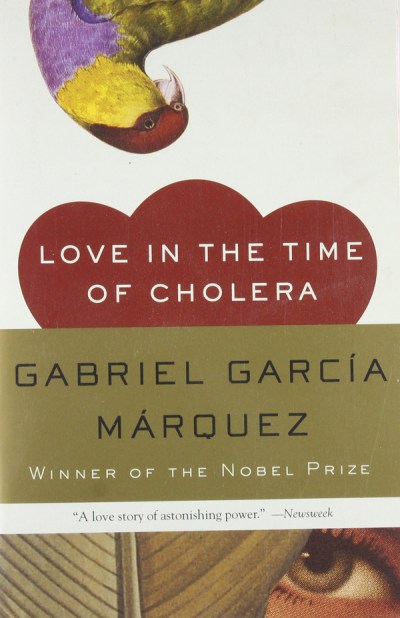
Love-in-the-Time-of-Cholera

I read Love in the Time of Cholera for a book club. I’ve owned it for years. It was one of those books I’ve always thought I should read. I’m still not sure what to make of it. It’s large and complex and I will probably need to read it a couple more times before I start to understand Gabriel García Márquez intent for his story.

My 19th-century novel this year was Looking Backward by Edward Bellamy. Even though this story was mostly philosophizing about how to turn the United States into a utopia it was a compelling read. I can understand why it was the #3 bestseller in America for the 1800s. It’s a shame that science fiction and society has given up on utopias, favoring dystopias instead. Pessimism prevails.

I only read 15 novels this year (and a few short story collections). I’m slowly switching to reading more nonfiction. My goal in recent years for fiction is to go for quality over quantity. I can’t say that most of the novels I read this year were great literary works, but they meant something to me. Anne of Green Gables was a pleasant surprise. I read it because I enjoyed Anne With An E so much on Netflix. I reread Downward to the Earth by Robert Silverberg and I’m still very impressed. I believe it’s a forgotten classic of science fiction. I read two novels by John Wyndham this year, both were entertaining. They made me realize I like cozy science fiction.

The two most well known 2017 science fiction novels I read, New York 2140 by Kim Stanley Robinson and Artemis by Andy Weir, were sharp contrasts in speculation. Both were page-turners, but I admired Robinson for his extrapolation and I was horrified by what Weir imagined for a lunar colony. I hated that Weir’s protagonist was a smuggler and saboteur. Jazz deserved to be thrown out the airlock without a spacesuit for her deeds. Basically, my reaction to Artemis was the revulsion of Republican cut-throat capitalism would be replicated on the Moon. Weir might be realistic, but I hope we can design better societies the Moon and Mars than we what have on Earth. If we’re just going to spread our cancerous ways to other planets I’d rather let robots have the final frontier.

I started the Bobiverse trilogy with great enthusiasm, but once again I learned that I just don’t like trilogies. We Are Legion (We Are Bob) by Dennis E. Taylor is a really fun science fiction story, full of recursive science fiction referencing. And even though the second and third books in the series continued to be fun, the novelty of the story wore off. I know trilogies are loved by SF fans, but I love science fiction for its ideas. Trilogies and series generally take the same idea and work it to death. (Personally, I think trilogies and series are the Big Macs and Fries of publishing.)

Best Science Fiction Read This Year

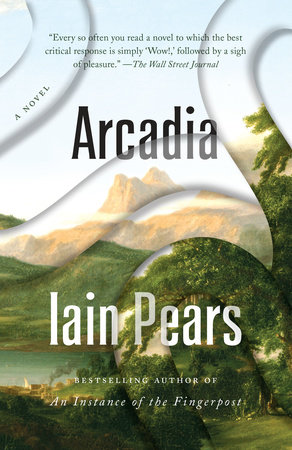
Arcadia by Iain Pears

Arcadia by Iain Pears is a 2015 novel that hasn’t gotten the attention it deserves. I don’t want to say too much about the story because I don’t want to spoil any of its cleverness. Let’s just say Pears combined fantasy, science fiction, meta-fiction, philosophy, religion, myths, and literary allusions into one complex plot. There’s even an app version which allows readers to choose their path through the plot. Arcadia would make a terrific movie. Arcadia is a very British novel about novel writing. If you loved The Golden Compass or Cloud Atlas I’d think you’ll love Arcadia. However, Arcadia is weak when it comes to psychological substance. It’s fun but not deep.

Books Read 2017

Leslie M. M. Blume Everybody Behaved Badly 2017-01-07 Audible 2016
Margot Lee Shetterly Hidden Figures 2017-01-27 Kindle ebook 2016
Nancy Isenberg White Trash 2017-01-27 Audible 2016
Mary Karr The Art of Memoir 2017-02-02 Audible 2015
Angela Duckworth Grit 2017-02-08 Library hardback 2016
Joshua Becker The More of Less 2017-02-11 Audible 2016
Bernd Heinrich One Wild Bird at a Time 2017-02-18 Audible 2016
H. Beam Piper Little Fuzzy 2017-02-19 Kindle ebook 1962
Fredrik Backman A Man Called Ove 2017-02-28 Audible 2013
Charles Wohlforth, Amanda Hendrix Beyond Earth 2017-03-07 Audible 2016
Kim Stanley Robinson New York 2140 2017-03-30 Audible 2017
Robert A. Heinlein Have Space Suit – Will Travel 2017-04-30 Audible 1958
John Wyndham The Chrysalids 2017-05-12 Audible 1955
Kathleen Tessaro The Perfume Collector 2017-05-18 Trade paper 2013
Olaf Stapledon Star Maker 2017-06-22 Audible 1937
Yuval Noah Harari Homo Deus 2017-06-30 Audible 2017
Philip K. Dick The Collected Stories of Philip K. Dick Volume 2 2017-07-17 Audible 1983
Dennis E. Taylor We Are Legion (We Are Bob) 2017-07-21 Audible 2016
Dennis E. Taylor For We Are Many 2017-07-27 Audible 2017
L. M. Montgomery Anne of Green Gables 2017-08-10 Audible 1908
Gabriel García Márquez Love in the Time of Cholera 2017-08-17 Audible 1985
Robert Silverberg Downward to the Earth 2017-08-26 Downpour 1970
Susan Faludi In the Darkroom 2017-08-30 Kindle ebook 2016
Robert Sheckley Untouched by Human Hands 2017-09-15 Downpour 1954
Mark O’Connell To Be A Machine 2017-09-22 Hardback 2017
Elisabeth Rosenthal An American Sickness 2017-10-04 Kindle ebook 2017
Allan Kaster The Year’s Top Ten Tales of Science Fiction 2017-10-04 Audible 2017
Al Franken Giant of the Senate 2017-10-11 Audible 2017
Michael Sims editor Frankenstein Dreams 2017-10-23 Audible 2017
John Wyndham Chocky 2017-10-25 Audible 1968
Robert A. Heinlein Expanded Universe 2017-10-26 Downpour 1980
Kurt Andersen Fantasyland 2017-11-08 Audible 2017
Edward Bellamy Looking Backward 2017-11-15 Audible 1888
Andy Weir Artemis 2017-11-24 Audible 2017
Dennis E. Taylor All These Worlds 2017-11-30 Audible 2017
Iain Pears Arcadia 2017-12-31 Audible 2015

Reading Goals for 2018

I really enjoy discovering relevant nonfiction books like Fantasyland or An American Sickness that explain contemporary issues, so I want to keep reading more new books as they come out during the year. I read eleven 2017 books in 2017. I think I’ll aim for one new book a month.

I also want to read more quality literary novels. I’m not sure how many I can handle though, so let’s aim for three to six next year.

Even though I feel like I read too much science fiction I still enjoy it. I like discovering both new and old SF novels. But I hope to keep my obsession in check and read only six to twelve of them in 2018. One science fiction book a month at most is enough I think.

This is what I wrote for my goal last year: “My goal for 2017 is to try and read more nonfiction, especially new books. I’m not going to worry about how many works of fiction I read, but I do want to work harder at finding the best fiction possible. I also want to stop reading mediocre books.” I think I’ve done fairly well. I probably should have quit the Taylor trilogy after the first book, and stopped reading Artemis after I realized I disliked it. I kept reading hoping Weir would redeem Jazz in some way, but he just kept making her a worse person.

My reading goals for 2018 is to read with more conscious intent and to get more out of what I read. I also hope to buy far fewer books. I have a nasty book-buying habit. I tend to buy 10-15 for every one I read. I want to stop that.

JWH


Will Fiction Work on Robots?

by James Wallace Harris, Wednesday, December 20, 2017

Have you ever thought about the nature of fiction? With books, we put ourselves into a trance and transfer our consciousness into a story. That’s pretty weird when you think about it. We’re just looking at black marks on a white background and yet we create all kinds of colorful imaginary worlds in our minds. With television and film, we have the sound and visuals to fool our minds with less work. (It’s no wonder fewer people choose books as their gateway to make-believe.) Audiobooks are somewhere in between.

Humans evidently have a mechanism in their brain for pretending that can tune out reality. It might be related to our mechanism for dreaming. But if you think about it, we embrace a lot of fiction. Religion is totally make-believe yet the faithful feel it is real. Same thing for romance, where we give the objects of our desires traits that don’t exist.

Robotreading

This morning I was so engrossed in a story that I felt like I was escaping reality. That made me wonder about how my brain works to do that. Then I wondered if robots in the future, the kind that will have artificial intelligence, will be able to read a book and find an escape from reality too.

I assume if evolution through random selection can create a biological being that is self-aware then eventually our applied efforts will produce robots that have self-awareness too. Because they won’t be biological driven by chemical and hormonal processes, they might not need sleep. One current theory about why we sleep is because we need to clean out chemical wastes in the brain so it functions properly when we’re conscious. Another theory suggests dreaming is a way to process, organize, and store memories. Robots won’t need sleep, and memory processing won’t be chemical. So they might not have that mechanism for make-believe.

Our brains have to attach meaning to everything we experience, and we usually do that with a story. However, our stories are seldom true. Our mental mechanism for storytelling is sometimes called a narrative fallacy because humans aren’t too anal about accuracy. (Example, the stories conservatives choose to believe about their new tax law.)

I believe we constantly fool ourselves because of the biology of survival. Romance and religion serve a purpose even when they are intellectually untrue. We lie to ourselves and others for a variety of survival functions, and I can’t help believe all those processes go into allowing fiction to work on us.

Robots won’t need any of that. I wonder if fiction and lying will fail on them. I can imagine an AI mind seeing us as rather delusional creatures. They certainly won’t trust us. Even our languages are full of confusing allusions when analyzed for realism. For example, if a robot hears a human saying, “I’ll be going to heaven soon” they’ll probably be smart enough to know it means “I’m going to die” but will they ever understand the will for eternal life seeded by ancient memes? In Battlestar Galactica, they had a race of robots that were monotheistic. I thought that a fun idea, but now I’m wondering if its a fiction only humans could enjoy.

I believe robots will understand our languages. It won’t take much to give them a universal language translator feature. But I’m not sure they will need language to converse with their fellow robots. AI minds will be able to record inputs from all their senses so when they need to communicate with another robot all they have to do is transmit that input. The other robot will have a perfect duplicate of the experience being conveyed.

So, in the future, will robots sit around and read books? If they read the Foundation series by Isaac Asimov will they enjoy spending hours imagining a galactic empire? I doubt it. A long string of words will probably feel like sensory deprivation to them. Even elaborate movies might feel crude compared to their hyper-view of reality.

We have 4k television cameras on our phones. What if robots had 4m or 4g eyes? We see a tiny slice of the electromagnetic spectrum. They could create to see and hear whole swaths of the spectrum. I suppose they could create equally detailed virtual worlds but would it be fiction? When we read a short story we trick our minds with a small number of suggested clues to create a fictional world in our minds. Most books today are heavy on dialog. Movies are far richer, but the actual story details in filmed fiction are still rather primitive. To robots, War and Peace would be a simple-minded Clif Notes – book or miniseries. (They could hold a whole library of Russian history in their AI mind.)

I tend to think we crave make-believe because of our limitations. We love romance or adventure stories because our lives lack romance and adventure. But I’m not sure robots will crave that. However, they might. They might even envy us. Robots will probably be 100% literal about reality. And even though the universe is extremely far out, robots will comprehend it in totality rather quickly. I don’t think they will be bored, but I don’t think they will see a lot to be done either. We can switch off reality and play in fiction. Robots might seek a similar creative outlet. Maybe it will be a super form of AI fiction we can’t even comprehend.

[Note to self: write a science fiction story about science fiction stories robots would write and read.]

JWH


Why We Need To Share

by James Wallace Harris, Thursday, December 7, 2017

This morning while I was eating my breakfast I played “Your Top Songs 2017.” This is a playlist Spotify generated for me by collecting the songs I listened to most this year. If you subscribe to Spotify you can play the songs with this embedded player immediately below. For those who don’t, I’m going to embed some YouTube videos to try.

I played this music very loud while I ate and because it’s the music I love the most. It moves me in ways I can’t describe. And while this music pushed my emotional buttons I wished I had someone here to share it with. My friend Mike was my last pal who would listen to music with me, but his hearing has gone downhill so he no longer likes to share music. Getting old is sad. I worry that my hearing is going too.

The past year, more than ever, I realized that friendships are based on what we share. I think this is why Facebook is so popular. We post something we like and then see who else likes it. It’s always fun to find a video or cartoon that many friends love too. I guess it’s a kind of validation of our tastes. But I think it also allows us to feel we’re existing close to someone.

We all live in our heads, and no matter how physically close we get to another person we don’t feel that closeness unless we psychologically resonate. The easiest way to achieve this is to do something together with another person that shares our interests. For example, it’s far more enjoyable to go to a movie and both people love it than to go and only one person love the show.

I love the Bette Midler song above. I will relate to you more if you love it too. Now “Do You Want To Dance” is an easy song to like so I should find plenty of friends to share it. And “The Other Side” by Michael Nyman easily admired by most folks because it’s so pretty. But what about “Moanin'” by Charles Mingus. Mike and I connected on this song, but I don’t think I have another friend that shares this particular love.

Probably somewhere in the middle, I can find more people who will share “I’ll Play the Blues for You (Pts. 1 & 2)” by Albert King. Bette Midler’s song was pop music, so duh, that stands for popular music. Jazz is esoteric for most music fans, but blues has a decent following. I share a love of the blues with my sister Becky. I almost can’t play this Albert King song too loud.

Susan, my wife have a lot of songs we love together, but our playlists of favorite songs are very different. When we’re in the car we have to choose who’s songs get played. When a song she’s crazy about comes on and I don’t love it back Susan’s disappointed. The same is true when one of my favorites is playing and she finds it annoying.

Susan works out of town, so in the evenings I have different friends over to watch TV in the evening. Each friendship is a Venn diagram where we find what to watch in the intersection of interests. What’s really difficult is to have 3-4 people all trying to agree on a film to watch. It’s a very satisfying feeling when the pick makes four people happy.

However, there’s a range of television shows and movies I want to see that I can’t find a friend to share. This makes me feel lonelier. Even Janis, my main TV buddy goes to sleep on a many of the shows I’m most anxious to see. Generally, I have to watch westerns, documentaries, and old black and white movies from the 1930s and 1940s by myself.

Some of my most intense feelings come from songs, books, movies, and television shows. Often these deeply aesthetic pleasures come late at night when I’m alone. Listening to these songs this morning is generating intense emotions that I wish I could describe, but can’t. And I think that’s the key to why we want to share. We can’t describe what we feel so we at least hope to find someone to experience the same thing with us. Unfortunately, we can click the Like icon but we have no way of knowing if what our friends are feeling is the same thing we’re feeling.

Do any of these songs resonate with you?

JWH

The Robert Sheckley Tontine

by James Wallace Harris, Wednesday, November 29, 2017

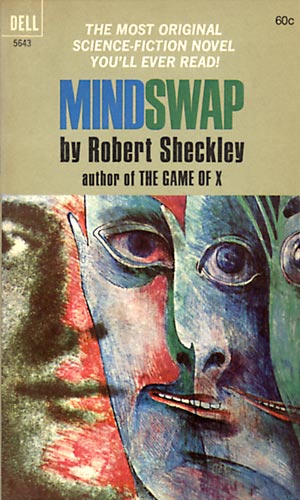
Mindswap by Robert SheckleyMonday, my buddy Mike and I were going up and down the isles of the science fiction section at Barnes & Noble looking to see if our old favorites were on the shelves. There were a few books each for Heinlein, Asimov, and Clarke, the Big Three SF writers of our childhood. But for many of the classic SF authors that we fondly remembered, none of their books were available. The last writer I looked up was Robert Sheckley. No luck. It’s sad to think modern readers won’t be discovering Mindswap or Untouched by Human Hands.
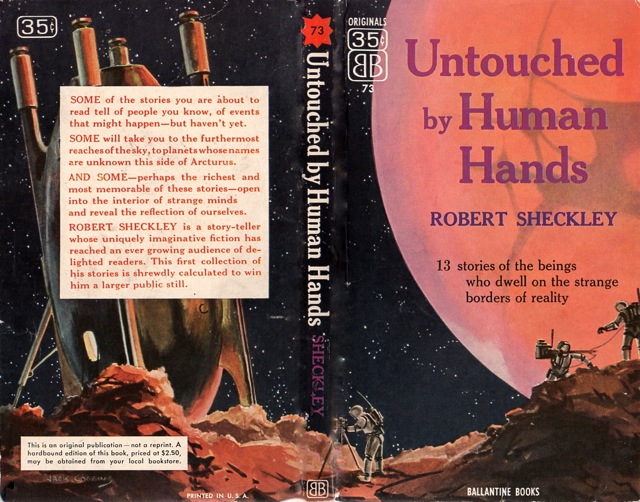
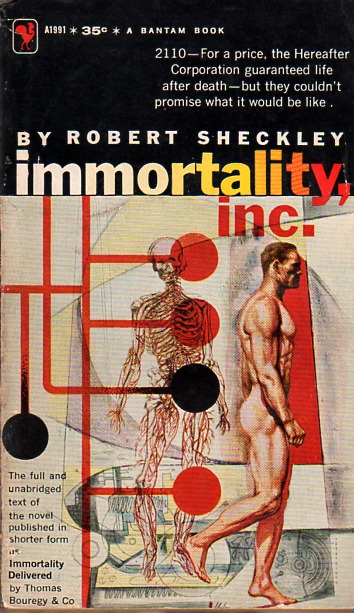
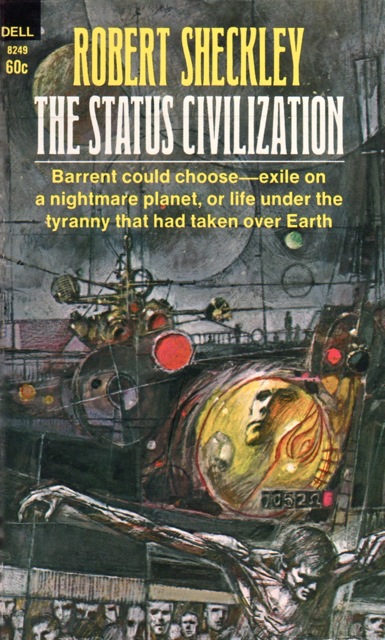
Generally, when science fiction fans today think of comedy SF they think Douglas Adams and his Hitchhiker’s Guide to the Galaxy series. But before Douglas Adams, there was Robert Sheckley. I worry that the number of Robert Sheckley fans is growing quite small.  Sure, a few new readers discover him, but that’s offset by older fans dying at a much quicker pace. The memory of his stories are like a tontine, and one day his last reader will be the only person on Earth to remember Marvin Flynn and The Theory of Searches, or any of the other wonderfully weird tales Sheckley wrote.

Much of Sheckley’s work has been reprinted in ebook editions and some of them have even gotten the audiobook treatment. Here’s the thing about books in general – most will be forgotten. Very few books are remembered over the long haul of time. I hate that. Of course, if we spent all our time cherishing old writers we’d have no time for new writers. Who are the new absurd comedy writers of SF today? Who follows in the footsteps of Robert Sheckley and Douglas Adams? I’d like to read them. I’m all for progress and time marching on, but I hate to see books I loved being forgotten. So I’ll just mention a few Sheckley titles to try.

My favorite Sheckley novels are Mindswap and Dimension of Miracles. Even though these works are still in copyright, you can hear them on YouTube. I recommend you buy them from Audible or if you prefer reading with your eyes get the Kindle editions at Amazon. But for now you can give them a test spin via YouTube:

Actually describing Sheckley is hard, so I’m glad these audiobooks are on YouTube to do that work for me.

And here’s The Dimension of Miracles with a wonderful introduction by Neil Gaiman. It’s well worth listening to his introduction – I might not convince you to read Sheckley but Gaiman might.

Sheckley was a very prolific short story writer, and reading his collections captures the essence of science fiction of the 1950s and 1960s. Sheckley explored every science fictional concept through an absurd lens of humor, often giving insights into human nature that serious science fiction failed to find. Only one of his collection, Untouched by Human Hands is available on audio. Listen to the first story, “The Monsters” on YouTube and if you like it go buy the whole collection at Audible. The story is about first-contact from an alien’s POV. There are 13 unique tales here that should tickle your funny bone and impress your intellect. Sheckley constantly reminds us we see reality with a too narrow perspective.

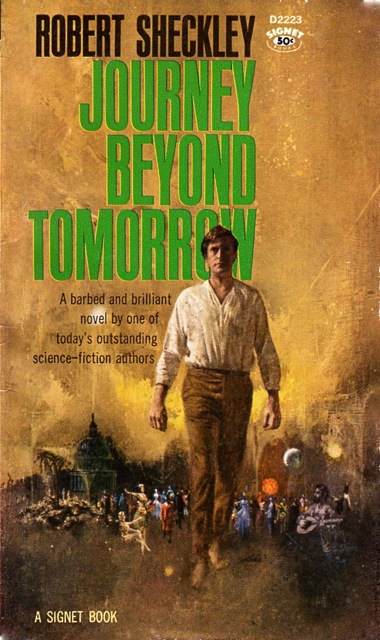
Like I said, many of Sheckley’s novels and collections are available as ebooks, and they are reasonably priced. Just for my own fun, I’m going to include covers I first saw half a century ago that make me feel nostalgic for his books today.

Untouched by Human Hands by Robert Sheckley

Immortality, Inc. by Robert Sheckley

The Status Civilization by Robert Sheckley

Journey Beyond Tomorrow by Robert Sheckley

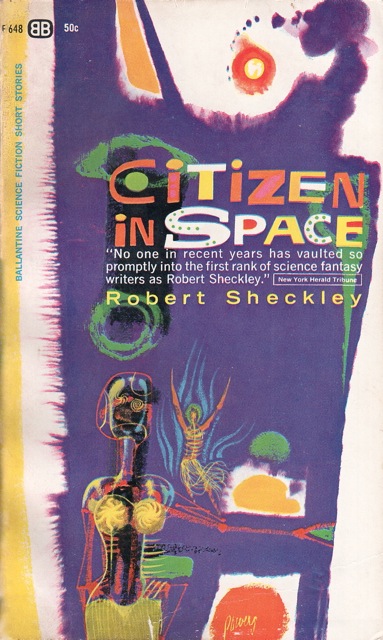
Citizen in Space by Robert Sheckley

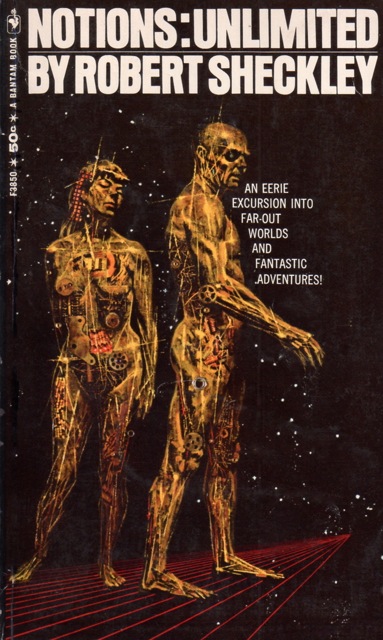
Notions Unlimited by Robert Sheckley

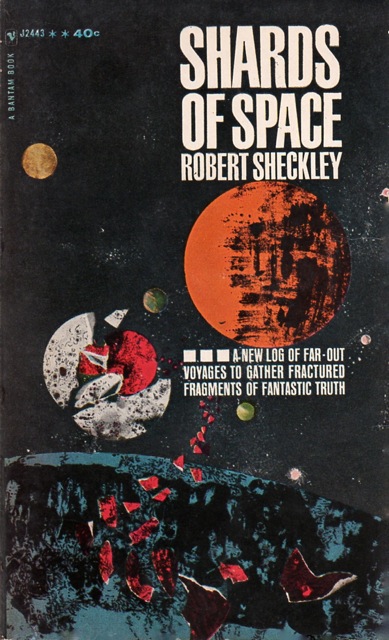
Shards of Space

Probably one old guy’s nostalgia isn’t enough to inspire new readers. I love that Philip K. Dick’s short stories are being produced as Electric Dreams, a video anthology for Amazon Prime. Sheckley’s short stories deserve that same kind of treatment, and that might resurrect his work. When Mike and I were checking the shelves at Barnes & Noble we found quite a lot of PKD titles. Back in the 1960s, I loved PKD but I never would have imagined he would be the science fiction writer of our generation to be remembered.

Young people who have discovered old reruns of The Twilight Zone or love the new anthology show Black Mirror should try reading science fiction short stories from the 1950s and 1960s. Back then science fiction stories had a lighter touch than they do today, more focused on far-out ideas and less on being literary.

Here is one example of a Sheckley story that’s always stuck with me. Sunday I tracked it down. It’s called “The Language of Love” and is in the collection Notions: Unlimited, about a young man, Jeffrey Toms, who meets a girl, Doris, and falls in love. She wants him to tell her he loves her. He wants to tell her. But he wants to express his feelings precisely, and fears using the word love is imprecise. He says people say they love pork chops, how can he use the same word for his feelings for her? So he learns about a dead race of aliens across the galaxy that had specialized in the language of love. Jeff travels to their world and finds an old scientist there, George Varis, who had studied this alien culture and Jeff spends months learning the language of love. Here’s what happens when he returns to Doris:

“Oh, Jeff,” she said, very softly. “Oh, Jeff.”

Toms simply stared, unable to say a word.

“It’s been so long, Jeff, and I kept wondering if it was all worth it. Now I know.”

“You—know?”

“Yes, my darling! I waited for you! I’d wait a hundred years, or a thousand! I love you, Jeff!”

She was in his arms.

“Now tell me, Jeff,” she said. “Tell me!”

And Toms looked at her, and felt, and sensed, searched his classifications, selected his modifiers, checked and double-checked. And after much searching, and careful selection, and absolute certainty, and allowing for his present state of mind, and not forgetting to take into account climatic conditions, phases of the Moon, wind speed and direction, Sunspots, and other phenomena which have their due effect upon love, he said:

“My dear, I am rather fond of you.”

“Jeff! Surely you can say more than that! The Language of Love—”

“The Language is damnably precise,” Toms said wretchedly. “I’m sorry, but the phrase, ‘I am rather fond of you’ expresses precisely what I feel.”

“Oh, Jeff!”

“Yes,” he mumbled.

“Oh damn you, Jeff!”

There was, of course, a painful scene and a very painful separation. Toms took to traveling.

He held jobs here and there, working as a riveter at Saturn-Lockheed, a wiper on the Helg-Vinosce Trader, a farmer for a while on a kibbutz on Israel IV. He bummed around the Inner Dalmian System for several years, living mostly on handouts. Then, at Novilocessile, he met a pleasant brown-haired girl, courted her and, in due course, married her and set up housekeeping.

Their friends say that the Tomses are tolerably happy, although their home makes most people uncomfortable. It is a pleasant enough place, but the rushing red river nearby makes people edgy. And who can get used to vermilion trees, and orange-and-blue grass, and moaning flowers, and three wrinkled moons playing tag in the alien sky?

Toms likes it, though, and Mrs. Toms is, if nothing else, a flexible young lady.

Toms wrote a letter to his philosophy professor on Earth, saying that he had solved the problem of the demise of the Tyanian race, at least to his own satisfaction. The trouble with scholarly research, he wrote, is the inhibiting effect it has upon action. The Tyanians, he was convinced, had been so preoccupied with the science of love, after a while they just didn’t get around to making any.

And eventually he sent a short postcard to George Varris. He simply said that he was married, having succeeded in finding a girl for whom he felt “quite a substantial liking.”

“Lucky devil,” Varris growled, after reading the card. “‘Vaguely enjoyable’ was the best I could ever find.”

I hope whoever will be Robert Sheckley’s last reader hasn’t been born yet. We need to keep the Robert Sheckley Tontine going.

JWH