I love reading best when I’m reading a book that I hate to stop reading and always want to get back to when I’m not reading it. Back in December, I was obsessed with reading Elizabeth Strout’s books. I read seven of her nine novels, practically one right after another. That was delightful. I was in reading heaven.
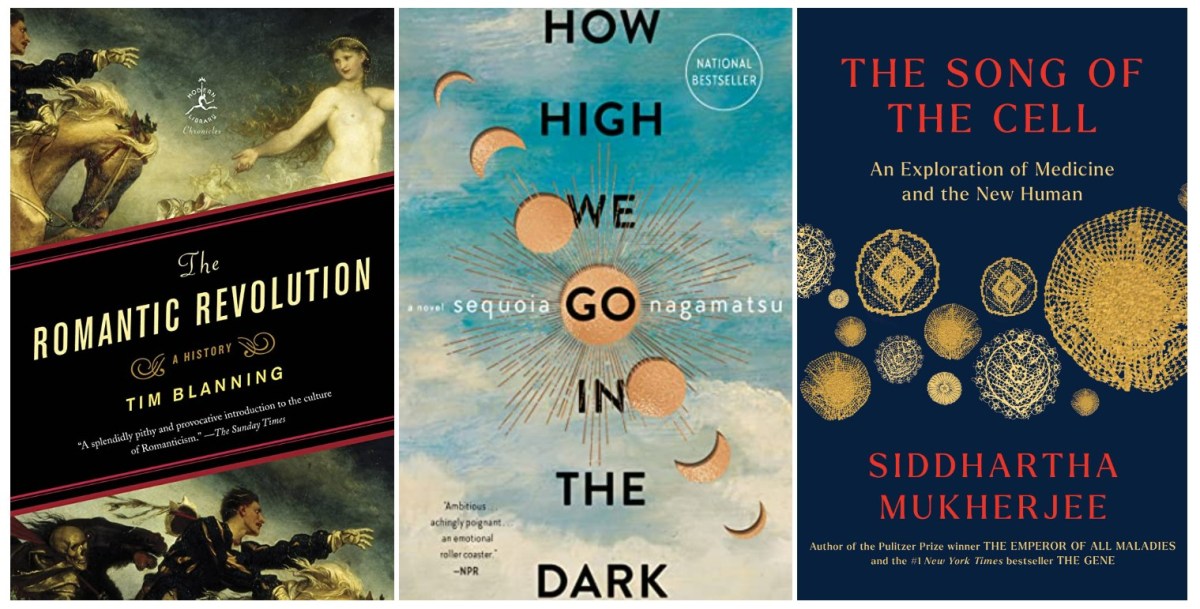
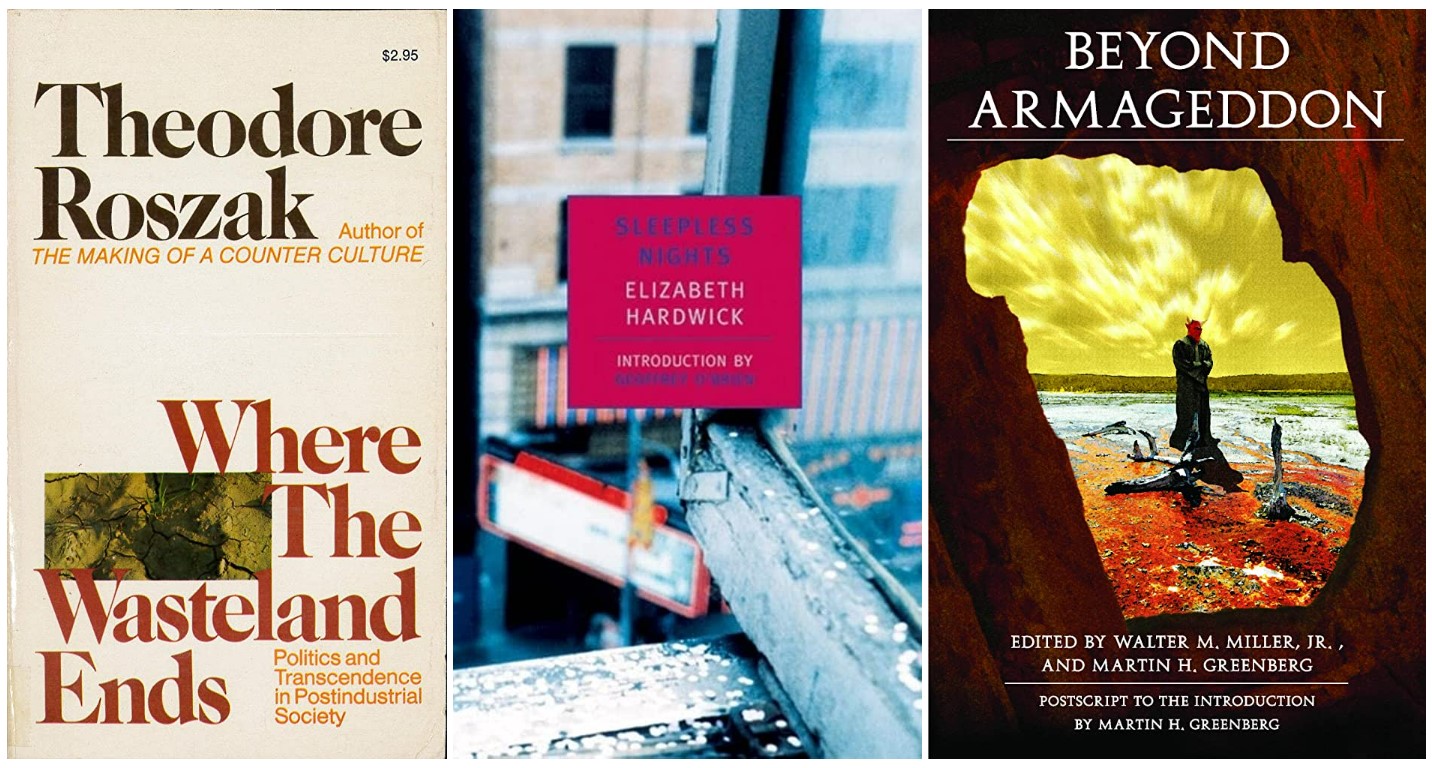
Right now my reading is terribly unfocused. I can’t stick with any book for long. Pictured on this page are all the books I’m currently reading — at least they are the ones that are currently up on my Kindle, Audible, Scribd, and Libby apps, and the books I see lying around. There’s probably more lying next to chairs, or under magazines.
Some of the books I’m reading are because I’m in an online book club for nonfiction books (Come Back in September, Song of the Cell). Or books related to what we read (Jena 1800, Sleepless Nights, The Romantic Revolution).
Others are because I’m in a Facebook group that reads anthologies (The Best of Nancy Kress, Beyond Armageddon, 21st Century Science Fiction). Others are because I’m interested in a particular subject, or they were recommended by a friend (The Good Lord Bird). (It’s great.)
I’m reading All Creatures Great and Small by James Harriot because Susan and I are watching the TV show of the same title. We finished the new series and are into the third season of the old series.
I’m reading Where The Wasteland Ends because I got interested in Romanticism in my online book club. I’m reading Miss Buncle Married because I loved Miss Buncle’s Book. I’m reading Neanderthals and The Great SF Stories 20 because I just love reading science fiction short stories.
I’m reading The Murder of the U.S.A. because I’m writing about the history of science fiction stories that deal with surviving a nuclear war, and it’s an early example of the subject. I’m reading Television’s Greatest Year: 1954 because I found it in a used bookstore and it looked interesting and is interesting. I’m reading Dangerous Visions and New Worlds because I like reading and writing about the history of science fiction. I’m reading How Hight We Go In The Dark because I try to keep up with current science fiction and it was considered one of the best SF novels last year.
I hope this illustrates how scattered my reading and thinking are at the moment. I’d much rather be focused on one subject and one book. When I was growing up and for many years of my working life, I mostly read one book at a time. I miss that simplicity, that focus.
When I joined Audible in 2002 I was on the 2 audiobooks a month plan, and I’d finish one audiobook and carefully study for days how I would use my second credit. Each book was special.
Then Audible started having sales, and now I have hundreds of audiobooks in my TBL to pile. And with all the Kindle books on sale, and all the wonderful buys I find at the Friends of the Library bookstore, I have a couple thousand books on my TBR pile. Life was simpler when I could only afford to buy one book at a time. I just can’t resist a book I think I want to read if it’s priced very low. And I subscribe to Scribd, Kindle Unlimited, and Apple News+ which provide access to hundreds of magazines and countless books and audiobooks. I have too much of a good thing. Less might be a whole lot more.
The book covers shown on this page are only the books I’m trying to read this week. It doesn’t include the books I’m buying or the books I recently gave up trying to read or finished.
I think between all the zillions of albums I can listen to on Spotify, all the zillions of movies and TV shows I can stream, and all the zillions of books, audiobooks, and magazines I could read my mind is running in seven directions at once trying to consume everything. It’s wearing me out.
I hanker for a simpler reading, listening, and watching life. One that is more focused. I think it’s time to cancel some subscriptions and give up buying bargains. I don’t know if I can ever get back to reading just one book at a time, but it should get it down too much less than 21 at a time.
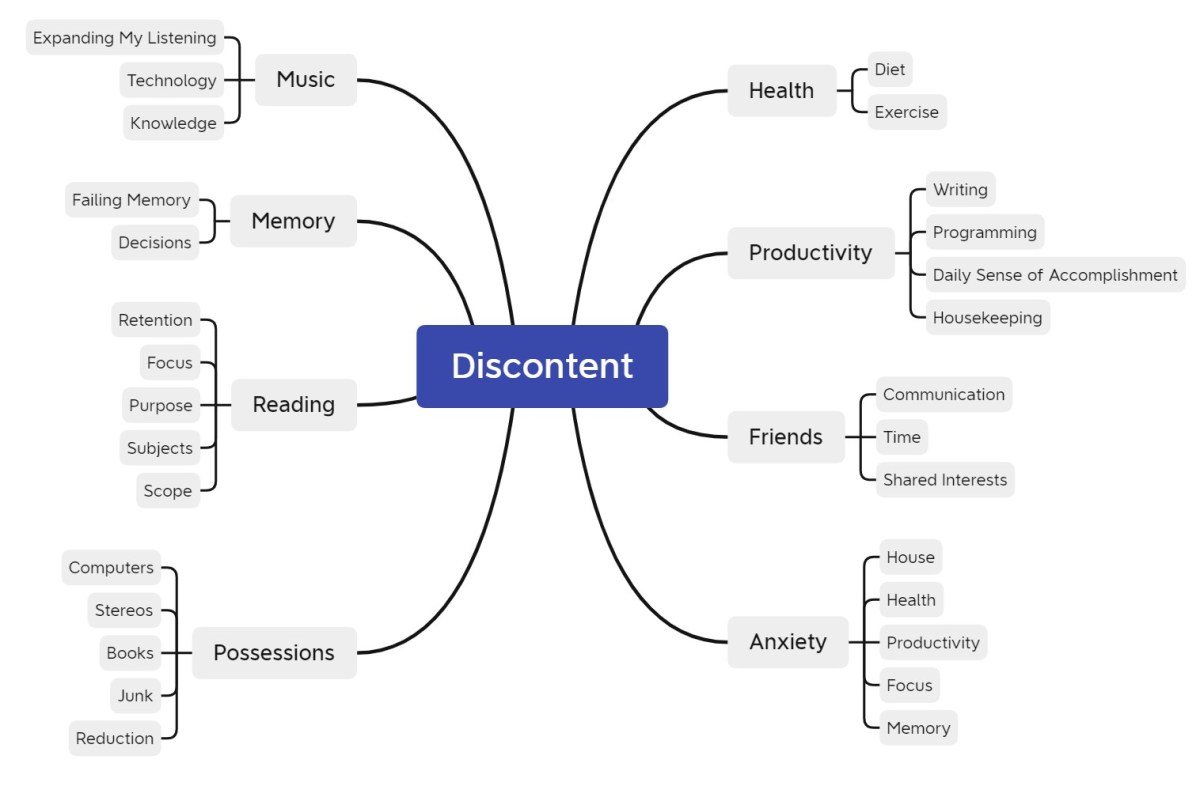
Yesterday I watched a YouTube video about writing morning pages. The idea is to get up and hand-write three pages of stream-of-conscious thoughts. So, I tried it this morning and I realized I have a number of things that make me discontent. And one of the things that make me dissatisfied with my life is not being able to see the big picture of what’s going on with myself. This brings me to this blog. I went to Xmind and created a quick mind map of my discontents hoping to see an overview of what was gnawing at me. You can see the results above.
The seed of discontent that inspired all of this comes from the way I feel each night before I go to bed — about how I spent my day. If I did something that felt productive, I feel satisfied with my day. If I didn’t I feel restless. I like when I have an ongoing project that inspires me to get up and get back to working on it. I haven’t had one of those in a while. My next level of satisfaction comes when I write a blog that I’ve put some good work into creating.
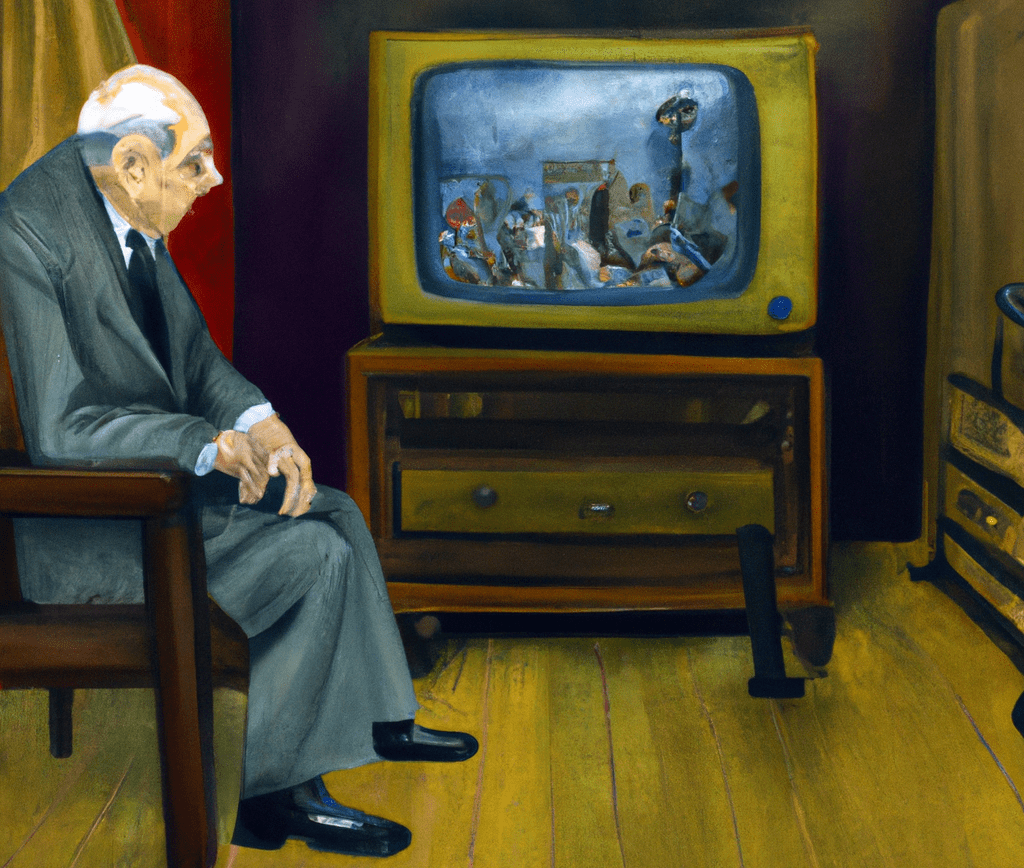
Of course, everything depends on health. Over the past few years, I’ve had to deal with a number of health issues. The walls of my life, my aquarium you might say, are the limitations of my health. When I was younger, that aquarium felt like the ocean itself, but as I grew older it shrank. As an adult, I began to realize my limitations, but the possibilities still felt huge, like I was living in the Atlanta aquarium. In my fifties, it felt more like a fancy 50-gallon deluxe home aquarium. In my sixties an ordinary 20-gallon job. Now when I feel bad it feels like I’m living in one of those bowls people keep goldfish in. When I’m feeling better, I’m back in a basic 10-gallon tank. My health goal is to do as much as I can within the boundaries set by my body. That means a lot of my daily anxiety deals with staying healthy. If I can maintain a certain level of health I feel like it minimizes my discontent. And the more I do, the less discontent I feel.
However, staying healthy juggles so many goddamn variables that it’s stressful to think about what to do to stay healthy. For instance, I watched a video, “7 Foods That Ruin Your Liver” this morning — two of which are among the top ingredients of the protein supplements I eat. Since I have a fatty liver, and sometimes have pains in my liver area, this is another worry. I also have a cyst on my liver. And I have gallstones. Eating carefully has become a very big deal for me.
Luckily, my health problems don’t cause me much discontent, or even anxiety. I’m used to dealing with them. My discontent comes from worrying over what to eat and how to exercise. I want to eat what I like and dislike making myself exercise. What would eliminate that anxiety would be finding a diet that I just stick with all the time, and finding a way to integrate just enough exercise to the minimum needed. Both really come down to discipline, but discipline is a major area of discontent for me.
I’ve been lucky lately, and have been feeling better. Last year wasn’t so good because of health problems and a hernia operation. Because I’m feeling better I feel like I should be doing more. Because I’m not doing more I’m feeling restless and discontent. That’s what came out in my morning pages.
Reducing that discontent and getting back on track will require finding a project to work on. I want something that will take me several days or weeks. Something that will make me feel like getting out of bed in the morning. The one I’ve picked to start on, but I don’t know if I’ll stick with, involves creating a new way to learn, memorize, and visualize a subject. My memory is deteriorating, but it’s never been very good for studying a subject deeply. I read nonfiction books and news articles all the time. But that information goes in and out of my brain almost instantly.
I recently read and reviewed a book about the German romantics. Supposedly, they found a lot of insights that have trickled down to us today. I want to create some kind of visual representation of their ideas and how they connected to other influential people over the last two hundred years. I figure this will kill several birds with one stone. It will touch on four branches of the mind map above: memory, reading, productivity, and anxiety. It might even touch on possessions because I will enjoy using more of my computer equipment, and it might touch on friends because it will give me something to talk about with them.
What I want to do is develop a way to visualize what I read to help me remember the information and convey what I’ve learned to other people.
All of this was inspired by scribbling out three handwritten pages this morning when I got up. Watch the video above, you might find it useful too.
By the way, the level of discontent I feel right now isn’t very high. I have a very contented personality. I find it very easy to just hang out and putter around in life. My greatest discontent has always been not being more ambitious. All I’m doing now is pushing myself to do just a little more.
In the 21st century, it now seems air, water, food, shelter, and video are the basic necessities of life. Who lives without screens in their life? Changing times and technologies keep making us adapt to new ways of consuming video.
Broadcast TV originally conditioned us to watch television on a set schedule. The price of this technology was watching commercials.
Cable TV gave us more channels but we still had to follow the schedule and watch commercials. We now had to pay a monthly bill too.
HBO and other premium channels made TV better than movies and freed us from commercials, but we had to pay even more on that monthly bill.
VCR let us time shift shows and zip through commercials, and forced us to deal with a growing collection of VHS tapes. It also allowed us to buy or rent movies and TV shows. VCRs created that wonderful subculture of video stores. This gave us more freedom regarding what to watch, but TV was now becoming a growing monthly expense.
DVD gave us better picture quality but we had to buy new equipment and replace all those videotapes.
DVD R/W+- allowed us to make our own DVDs. It saved us money over buying movies by recording them instead but we had to zip through the commercials again.
DVR made it much easier to record shows and zip through commercials. It was wonderful to give up messing with VHS tapes and R/W DVDs.
TiVo made going back to broadcast TV fun for a while but the $12.95 monthly fee to record free over-the-air TV was annoying.
Netflix discs by mail killed our addiction to Blockbuster and saved us money. I miss Blockbuster.
HDTV made TV watching great and more addicting than ever, but now we had to learn about new technology and spend a whole lot more on TVs.
Netflix streaming killed our addiction to renting discs by mail and saved us money. $7.99 a month was a tremendous bargain! Bye-bye Blockbuster.
Smartphones and tablets have become a new way of watching TV for some people. When the power was out during an ice storm Susan and I streamed TV over 5G on our iPhones.
Streaming services allowed us to cut the cord and give up cable TV. That saved us money – for a while.
Streaming TV services like YouTube TV allowed us to have cable TV without the cable box and for less money while including an unlimited digital DVR. However, they are now racking up their prices. $70 a month is like a Comcast payment from a few years ago.
When will how we watch TV stop changing? Is it evolving or just the churn of change? I thought with streaming services like Netflix, HBO Max, Hulu, AppleTV+, etc. combined with YouTubeTV we had everything we could possibly want. That is until all these services started raising their prices. The fact that we can go months without using some of those streaming services is making me worry. I see that other people are thinking about it too.
TV used to be free. It used to be simple, three channels with a fixed schedule. Now it’s $150 a month, with thousands of shows that can be watched at any time on a variety of devices. TV now has too many choices. That’s mentally wearing. Even exhausting.
Looking back I see now that I subscribed to all those various streaming services to watch another popular TV show that everyone was talking about. Even today, when I talk with my friends they will tell me about the shows they love. Wanting to give them a try often means subscribing to something new. My friend Linda has solved this problem by only subscribing to one service at a time. But she lives with a lot fewer choices. But maybe that’s good.
$150 a month is not bad for how much pleasure we get. However, I cut the cord with cable TV because cable TV forced hundreds of channels on us I didn’t want. It irked me I had to pay $7+ a month for ESPN when I didn’t even watch it. Now, with all the streaming services I’m paying for thousands of movies and TV shows, I don’t want to watch. And I just can’t tune out all those unwanted offerings. Each time I click on Netflix or HBO Max I end up scrolling and clicking and scrolling and clicking to see all my choices. By the time I finally pick something I’m worn out. My sister Becky often yells “I HATE SCROLLING.”
I discovered something very revealing when I started ripping my DVD/BDs for Plex. I have several hundred movies and TV shows I’ve bought over the last several decades. Once I converted DVDs to digital files for a couple of TV series I started watching them. I was no longer interested in streaming services. On Plex right now I have two choices (Perry Mason and Survivors), both of which I want to watch. Imagine Netflix with just two TV shows. (And wasn’t AppleTV+ much better when it had fewer choices?)
When company comes over and we then decide to watch a movie together picking a show depresses us. It makes people happier if I pick out a movie and invite people over saying we’re going to watch X. Susan and several of my TV-watching friends get annoyed if they have to decide on a show. Maybe my current problem with watching TV by myself is having too many choices.
The nightly TV program Susan and I watch together is Upstairs, Downstairs which we get from Britbox. We know what we’ll be watching at 9:30 every night – two episodes of Upstairs, Downstairs. I like that routine. Susan watches other shows by herself while she sews. If I want to watch something on my own I’m currently satisfied with either Perry Mason or Survivors. When I finish those series I’ll rip a couple more.
We did sign up for the current sale for Peacock+ ($29.99 for one year). If all the subscription services charged like that I wouldn’t mind keeping several subscriptions going. However, even though Peacoak+ has lots I think I want to watch, I just don’t feel like watching anything yet. Maybe when I finish with Perry I’ll give one of their shows a try. Maybe the key for me is to only have a couple of shows I follow (besides the one I watch with Susan).
I’ve been very happy the last few days puttering around with ripping DVDs and setting up Plex. I’m not sure Susan will like a very limited TV environment, but I do. I’m not going to try and rip all my DVDs and Bluray discs. I’m just going to rip something when I’m ready to watch it.
I would be perfectly fine just subscribing to BritBox for several months. That’s how we get Upstairs, Downstairs. I’ve already canceled HBO Max and Netflix. I want to cancel Hulu but can’t until I rip some DVDs for Susan. I’d love to cancel YouTube TV, but Susan can’t let go. I only use it for Jeopardy, NBC Nightly News, and Turner Classic Movies. But those two shows are available on YouTube for free, and we’ve got hundreds of old movies on DVD.
It feels like I’m trying to de-evolve my TV watching to back like it was when I was growing up. Just a few channels. Susan is still addicted to the cable TV level of variety. I’m trying to get her to notice that she uses YouTube TV to watch old TV shows all the time. Except for things like tennis matches and cooking shows she seldom watches anything new.
I have friends that watch a lot of television and go through many new shows each year. I used to be that way. I don’t know if it’s getting old or not, but I’m tired of the new show rat race.
[The photo above was probably taken in 1972-1973. It should do to show what I looked like in 1973. Jim Connell is on the left. I’m on the right. Connell was 6’4″ so I look tall and skinny. I’m much lower to the ground and wider today.]
How many memories can our brains hold? Is there a limit, like a hard drive? I know from experience there are limitations on accessing memories, so I assume there are storage limits. However, countless random forgotten experiences burble to the surface of my mind daily. And at night I have an apparently limitless supply of visual settings and characters to film my dreams.
I’ve always been obsessed with wanting perfect recall. Aren’t the things we obsessed over what we want and can’t have? 2023 is the 50th anniversary of 1973. I shall use that year for testing my memory in this essay.
This is not another nostalgic look back in time. In fact, I feel the golden glow of nostalgia is finally starting to wear off. 1973 is one of the least remembered years in my mind. At this moment I can’t recall anything specific I did in 1973. I know I was doing stuff, and some of my vaguer memories might have taken place that year, but for now, I just don’t remember what I was doing. I’m not even sure where I was living at the time.
Think of this essay as a cold case. I’m going to go through old drawers and paperwork looking for clues and use the internet to find out what was happening in the world at large to see if that triggers any memories of 1973.
Unfortunately, around 1975-77 I went into a Buddhist phase and gave away or threw away a lot of my possessions. I intentionally tossed most of my personal mementos because I didn’t want to be attached to them or be hung up on the past. I regret that now because I destroyed all my letters, photos, slides, 8mm films, and copies of my APAzines. When my mother died in 2007 I inherited all her photos and mementos. She kept a lot of my report cards. And over the years people have given me photos and old letters. Plus I have my college transcripts — if I can find them. Physical clues are theoretically slim, but I shall look for them.
I shall use full names in case some of my lost friends are Googling their own names. Who knows, maybe it might cause a reconnection.
Sadly, many of my close friends from the 1970s have died. My old roommate Greg Bridges has moved away and I’ve lost contact with him. 1973 was well before I met my wife in 1977. I’m still in contact with my old high school buddy Connell, and my sister Becky is still alive. Becky married in 1971 and moved to Dallas, so she won’t remember much of my 1973. Most of my relatives have also died, at least the ones I saw the most in 1973.
I did not remember a visit to Dallas in 1973 with Carol Suter and Jim Connell until after writing the first draft of this essay. The act of writing has caused memories to float to the surface. Sometimes it took hours, sometimes days to recall. I shall note these delayed experiences in italics.
I’ve written an essay like this before, in 2019, for the 50th anniversary of when I graduated high school. This time I want to go deeper into reconstructing the past. One of the best books I’ve read about being a historian is Jesus Before the Gospels by Bart D. Ehrman.
Ehrman covers all the sources of evidence a historian uses to reconstruct the past and discusses the effectiveness of each. Ehrman shows how memory is unreliable. He also shows how unreliable eyewitnesses are too. Even if I had lots of memories of 1973 I couldn’t trust them. Not everything I write here will be truly reliable. One of the most damning pieces of evidence Ehrman reviewed in his book was about a professor who had his students write down where they were and what they saw and felt the day after 9/11. Then a decade later he tracked down many of those students and asked them to write down what they remembered about 9/11. Several wrote something entirely different. But here’s the kicker. Some of those students who were shown their original essay written the day afterward claimed they didn’t believe what they had written. They believed their memory!
The first piece of evidence I found is a transcript from Memphis State University (now the University of Memphis).
I was a terrible college student. I dropped out many times. I hardly ever did homework, and it’s amazing I got grades as good as these. During 1971-1972 I attended State Technical Institute Memphis. There I majored in a two-year computer science degree. I loved computers, but the focus was on COBOL and getting a job in a bank. I decided I didn’t want that and transferred to Memphis State in 1973. This only came back to me as I studied the transcript.
Many of these courses are general requirements but the ones that weren’t, remind me of when I was searching for a major. I remember now I was considering history, sociology, English, and anthropology. Although, at some point, maybe even when I quit State Tech, I was considering getting a library degree. I needed a B.S. degree before moving to Knoxville to get an M.L.S. degree (Master of Library Science). I just can’t remember.
I remember liking Byzantine history but not the course. It required too much real work. I don’t know why I made an F in “U.S. Southern History Since 1865” since I made an A in “U. S. History Since 1865.” I have absolutely no memory of taking that course. I took “Southern Literature” in the Spring of 1974 and got an A. I also took two Library Science courses that spring, which backs up my memory theory that I was thinking about becoming a librarian.
One course I distinctly remember is “ENGL 3501 English Grammar” because it was about grammar theory and was really hard. And I have trouble with ordinary grammar. What improved my grade was writing a paper on computer translation of languages. I was really into that subject and I impressed the professor.
I lived at 140 Eastview Drive in Memphis during that year because that’s where I remember writing the paper on computer translation. I was sharing a duplex apartment with Greg Bridges who was my science fiction buddy. We went to conventions and produced a fanzine on Gestetner mimeograph which the two of us co-owned with Dennis McHaney. Another buddy John Williamson lived next door in the duplex across the driveway. We got our friend Claude Saxon to move onto this street too, just a couple doors down. We pictured ourselves creating a hippie-like commune by getting all our friends to move to Eastview. It was a rundown neighborhood in 1973, and it’s worse now in 2022. Here’s what it looks like today from Google Maps.
One of the reasons why my grades were falling off was having so much fun at the time. I was into fandom and a member of two APAs – Spectator Amateur Press (SAPS) and Southern Fandom Press Alliance (SFPA). I was also going to lots of rock concerts and smoking a lot of weed with many friends. Two that I remembered a day later were Tom and Sara. I ended up dating Sara’s sister Alice in 1975.
It was while Greg and I lived in this Eastview duplex that he worked on the Programs committee at Memphis State and he got Fred Pohl, John Brunner, and James Gunn to come and do a two-day seminar. The three writers took Greg and me to lunch and we got to listen to them talk about the old days for a couple hours before Pohl and Gunn had to go to the airport. Then we spent the afternoon taking John Brunner around Memphis. He wanted to see the Lorraine Hotel because he was the president of the Martin Luther King society in London. This was before it was renovated. Then Brunner took Greg and me out to dinner at a Mexican restaurant on Union Avenue before we took him to the airport.
I was able to document this from a fanzine article Greg Bridges wrote for Memphen 279 in 2002. The internet has become my real auxiliary memory. Pohl, Brunner, and Gunn were in Memphis on November 22 and 23 1972. That’s before 1973, and earlier than I thought. I assumed 1973 or 1974. But, can I trust Greg’s memory. I hope he had some kind of physical evidence.
I’ve always told people I never lived anyplace longer than 18 months during the 1970s. His date puts me in Eastview in 1972 and I’m pretty sure I moved out in the summer of 1975. I remember 1975 because that’s the year Born to Run by Bruce Springsteen came out. If Greg’s dates are correct I lived on Eastview for almost three years, maybe longer. That completely contradicts what I believed for years.
To me, the 10th, 11th, and 12th grades seemed like the longest years in my memory. I went to three different high schools in two states while living in four different houses. There’s got to be more to 1973. I was twenty-one for eleven months of 1973, that should have been a special time. I suppose going to college filled up the time in a way that made it seem quick and not memorable.
I found a timeline I made years ago. It gives me a few clues. Jim Connell came to visit me and he, Carol Suter, and I drove in Carol’s yellow Gremlin to Dallis to see my sister Becky and her husband Skip Suter, Carol’s brother. That was when I first met Becky’s future second husband Larry Gamer. I was very impressed with him since he was a computer programmer.
Another thing I remember is making a trip to Cape Kennedy with Carol. Her mother asked Carol and me to drive her nephew and niece back home to Titusville. They had been staying with Carol’s mother. Their father, Carol’s uncle, worked at NASA and he took Carol and me to his job site at a communication facility on base. While we were there they taped conversations with Skylab 3, which operated from July 7, 1973, to September 25, 1973. This was when we were out of school and could have made the trip. After we dropped off the kids, Carol and I drove to Gainesville to see my old friend Jim Connell. I remember sleeping on the floor in a communal house. But I’m not sure of this memory. It might have been another trip with Carol. But Gainesville would have been close to Titusville. I do remember we went by Six Flaggs in Atlanta. That’s when I saw Helen Reddy in concert.
I made that timeline decades ago to help me remember all the places I lived. It confirmed the trip to Gainesville. It said the Helen Reddy concert was on 8/31/73. It also said Carol and I went to see Edgar Winter and Dr. John the next day, 9/1/73.
So far I’ve been able to prove I took 12 college courses and visited Dallas, Atlanta, Gainesville, and Cape Kennedy in 1973. That’s something but not much.
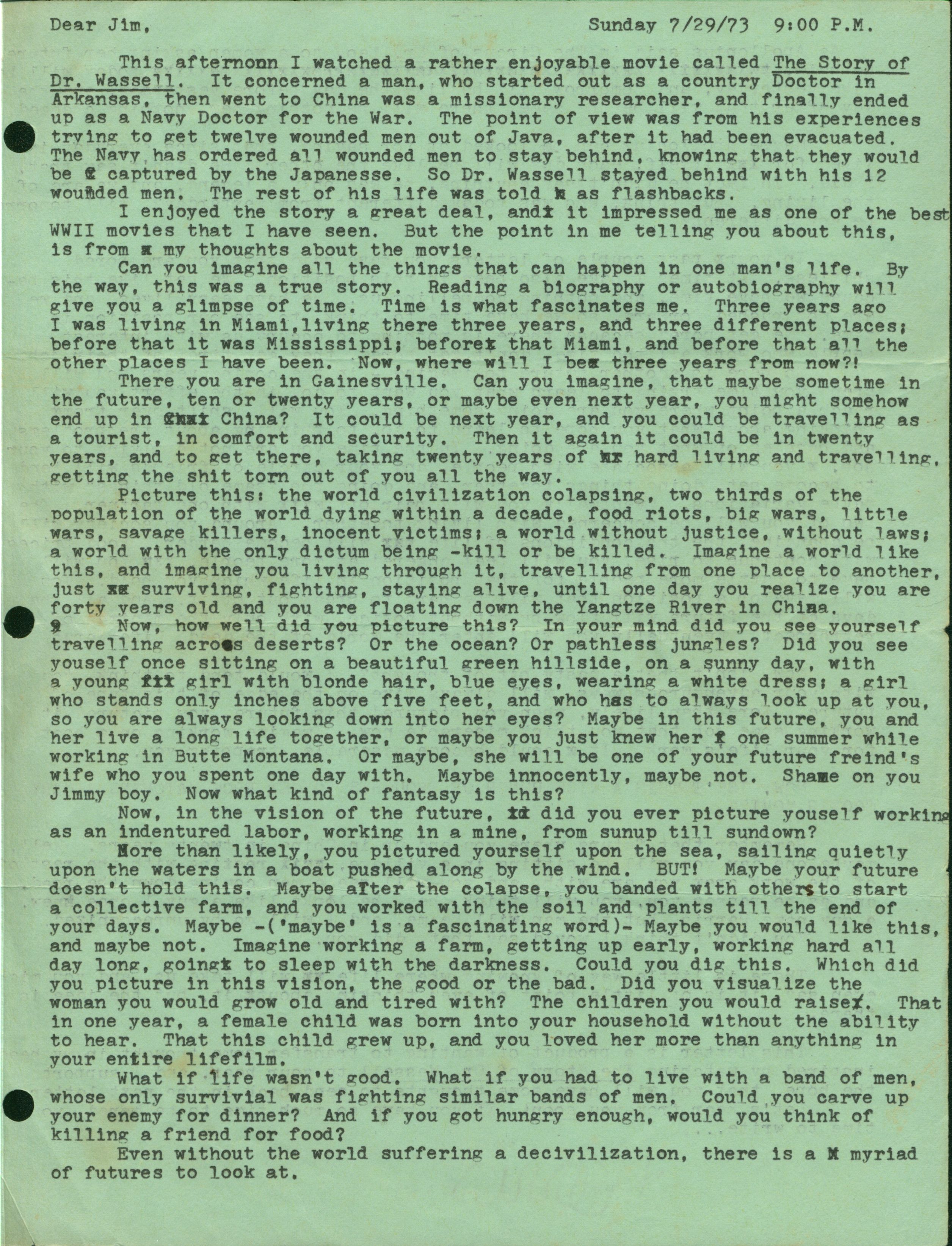
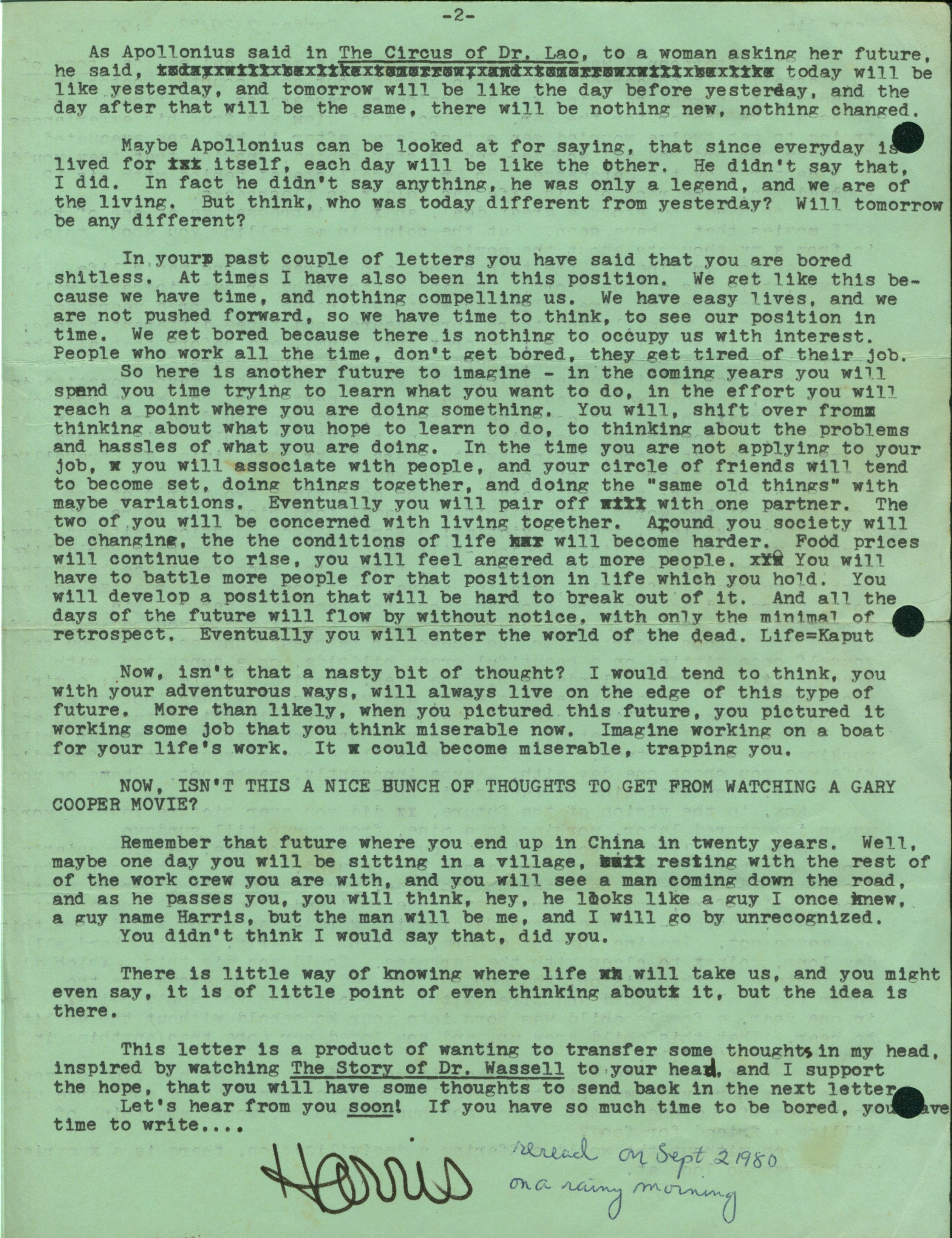
I have found one letter from 7/29/73 that I wrote Connell which he returned in 1980. I wrote Connell hundreds of pages of letters, which he kept in a box, but his mother threw out sometime in the 1970s. I’d give anything to have that box now. Here’s the letter:
There’s something woo-woo in that letter. In the third-to-the-last paragraph on page one, I asked Connell to imagine a future where he has a daughter born deaf. Connell’s stepdaughter went deaf several years ago after having to take some major antibiotics.
This letter is also weird because it sounds like me now. But then I was trying to imagine the future and now I’m trying to reconstruct the past.
I had Connell read the letter to see what he remembered. He didn’t remember the letter but he thought we thought many more thoughts per second back then than we do now because the letter impressed him with my stream of ideas.
I don’t remember taking any photographs from 1973. I don’t think I owned a camera. That really limits my recall.
A day later I remembered that not only did I own a camera, but so did Greg Bridges and John Williamson. That we had built a darkroom, in the living-room closet at the house on Eastview and considered ourselves amateur photographers. I still don’t think we took pictures of ourselves. We were all into nature photography and macro photography. I did take several rolls of film using Carol as my model. Plus we made super8mm movies. Williamson was into various creative hobbies and even made silkscreen images. He made a silkscreen cover for my SAPS apazine After the Goldrush. I through all that out in my later Buddhist phase.
I’m now out of physical evidence to prove my existence in 1973. Wikipedia’s timeline of major events of 1973 triggers little for me. Neither the 1972-73 nor 1973-74 TV schedule triggers any memories. I’m not sure we watched TV at the Eastview house or even owned a TV.
In my letter above I review a movie. I can’t remember where I watched it. I sometimes rode my bike over to my mother’s house to watch TV there. Today I had a vague memory of a black and white TV in an old wooden cabinet sitting in a tiny living room that had one ugly couch. This memory was in black and white. All my memories of that Eastview living room are in black and white. I think it must have been dark and dingy.
In this post about 50 albums from 1973, I remember many of them, but most of them I bought later. The only ones I think I bought in 1973 were Brothers and Sisters by the Allman Brothers Band, ‘Pronounced ‘Leh-‘nerd ‘Skin-‘nerd’ by Lynyrd Skynyrd, Over-Nite Sensation by Frank Zappa and the Mothers of Invention, Goodbye Yellow Brick Road by Elton John, and Piano Man by Billy Joel.
I was able to verify going to a few concerts by recalling them and verifying the dates on the internet. Carol Suter and I went to see Elton John on October 11, 1973, at the Mid-South Coliseum for the Goodbye Yellow Brick Road tour. We also saw him one other time, but I can’t remember if it was in 1972 or 1974. Carol hurt my feelings because she said she would go with me to see Billy Joel during the Piano Man when he was at Lafeyette’s for several days but then went with someone else. I now wished I had seen Billy Joel before he was famous.
I also saw Frank Zappa twice during the 1970s. He was in Memphis in March of 1973, but I can’t verify I was at that concert, but I think it was around the time of Over-Night Sensation. I and my friends went to a lot of concerts during these years. It seemed like every week some big act would perform, often two or three at a time. And the tickets were less than ten dollars back then.
If I would go to the library and look at the microfilm of the Commerical Appeal for 1973 I could verify all those concerts probably. I might even dredge up some other 1973 events I remembered or attended.
Here are the most remembered science fiction books from 1973. I don’t remember reading any of them during that year. Greg and I were both science fiction collectors. I’m pretty sure I subscribed to F&SF that year because I had collected over 200 back issues. But I probably also subscribed to Galaxy, Analog, Amazing, and Fantastic. I also remember building several large bookcases for my collection. They were the same size as a sheet of 1/4″ plywood. I used 1 x 8-inch planks for the shelves and plywood for the backing. They were huge. Greg used giant metal shelves in his room. We even had bookcases in the hall and living room.
Greg and I also published fanzines, traded fanzines, and subscribed to fanzines. Our favorite was Richard Geis’s Science Fiction Review. A few years ago I bought most of them again on eBay and scanned them for the Internet Archive. Probably if I reread the 1973 issues it would trigger many memories.
A memory that came to me on the second day of writing this essay was about my Raleigh 3-speed bicycle. I didn’t have a car that year. When I needed a car I’d ride my bike over to my mom’s house and borrow her car. I rode that bike all over Memphis. Once, and I don’t remember when I visited Connell in Miami and he told me to bring my bike on the airline. I did. And we rode it all over Coconut Grove, where I used to live. I loved that bike. I have no idea what happened to it. That saddens me.
Well, this research is running too long for a blog post, but I think you get the idea. We can remember a lot. Especially if we have triggers. I often have vivid memories of the past pop into my head unbidden. It makes me wonder if everything is recorded and if the bottleneck is the mechanism of recall.
I’m sure if I kept at this experiment I could write a whole book about memory and what I could eventually remember from 1973. I doubt many would want to read it. I’m not even sure anyone will want to read all that I’ve written here. Most people don’t seem very interested in remembering the past. I even know people who say they intentionally try to forget the past and throw away anything that makes them recall it. That horrifies me. I hate that I went through that Buddhist phase.
[Don’t worry, everything is fine. The essay below might sound like whining, but I write to think things through. I’m aiming to sound comic but I’m afraid it might sound like bellyaching. But putting thoughts into words is very therapeutic for me.]
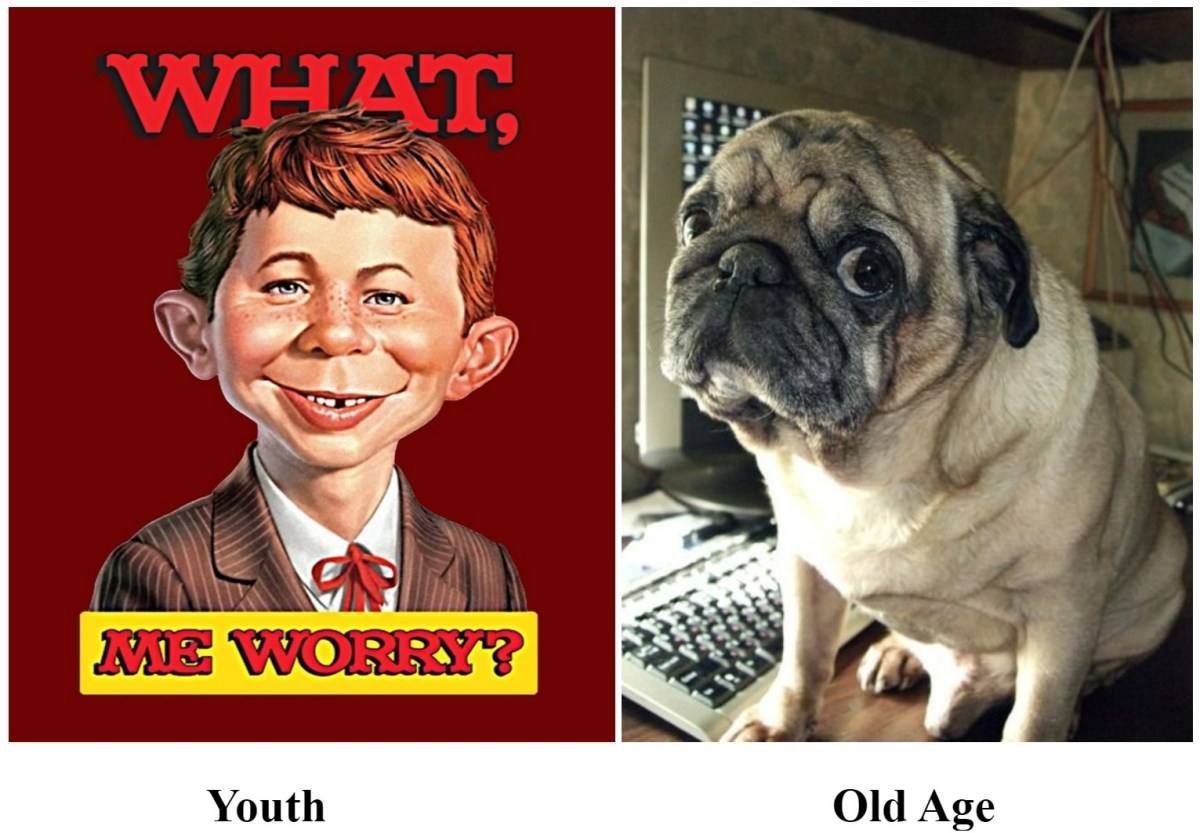
I’ve never thought of myself as an anxious person. Alfred E. Neuman was my self-help hero growing up. I had anxieties but I never thought much about being anxious — that is until I got old. Now that I’m retired and obviously aging I realize that things beyond my control might be creating new feelings to experience, and one of those new feelings might be anxiety over anxiety. Right now, that sensation is minor but I can see where it could become major.
This got me thinking about the nature of anxiety. If you’re a two-year-old and you can’t get the toy you want, throwing a tantrum is a way to communicate your anxiety. If you’re a teenager and feel like you don’t fit in socially anxiety might reveal itself in countless ways, such as a fear of where to sit in the cafeteria at lunchtime. As an adult and you feel overwhelmed at work, anxiety might manifest as a good old-fashion coronary.
I’m not sure what I’m feeling. It might be the existential angst of aging, the looming dread of civilization’s collapse, or the plain mundane fear of dying. Or maybe I just don’t have enough to do. However, I’m starting to think what I’m feeling is wimpy anxiousness over dealing with house repairs and visits to doctors. Components in my body and home keep wearing out.
I’ve always been pretty laid back, a go-with-the-flow kind of guy. I think that was because we moved around a whole lot when I was a kid, and so I just got used to things always changing and being up in the air. I never lived in any house longer than eighteen months until I was in my forties. I just solved problems as they showed up.
I also have the kind of personality where I avoid conflict and stress. I got a job in 1977 that I stuck with until 2013. And I got married in 1978 and have been married ever since. I don’t like rocking the boat. I think all of that has led to a low-anxiety life, which I was lucky to find and grateful to have.
But now I’m 71, and I realize I’ve been living in the same house for fifteen years. That has made me very comfortable and I worry more and more about losing it. And the body I’ve depended on for 71 years is becoming less dependable, and that’s freaky too.
Something is changing. Besides my body and house needing more frequent repairs, Susan is getting some health problems too. Susan and I both hope we can die in this house. I realize that I’m trying to control three big things. My health, Susan’s health, and the house.
Now, this anxiety is nothing compared to a family that’s lost their home in Hurricane Ian, or being the president and worrying over the national economy. But it is a feeling that I’m having to deal with, and I’m trying to figure out how to deal with it, and what exactly causes it.
In 2022 I had one operation, two ER visits, four ultrasounds, three CT scans, one MRI, and countless other medical tests. My doctor is talking about three additional operations I might need. Also in 2022 I had to replace the outside AC unit, replace the hot water heater after it flooded my computer room, had to have dead limbs removed in February after a falling limb speared a hole in the roof last December, and now I’m having to spend another three thousand having the trees cleared of diseased branches again after a giant limb fell across the back on the house.
I’m still a fairly la-de-da kind of guy, but I realize this slight background radiation of unease is not going away. I realize it’s because I’m trying to control things that are hard to control. I worry about Susan, but neither I nor her doctor can nag her into exercising — so I have no control over her. And there’s only so much control I have over my body even though I am willing to diet and exercise to help myself.
Although I can have the house repaired I realize I’m slowly losing control over our home (as I hear another small branch hit the roof). I can no longer do most of the repairs myself. I gave away my big ladder because I don’t think I should be getting on the roof anymore. Before I would have just gotten on the roof, sawed the big limb into pieces, and tossed them down to the ground. Now I have to wait for the tree people to clear it off. However, that turned out to be a blessing in disguise. The tree guy spotted numerous diseased branches that need to be cut out, and some of them are giant and could cause significant damage to the house. I now have falling tree limb anxiety, to add to my flooding floors anxiety.
In a fantasy of gaining control, I considered having all the trees near the house cut down, and having an addition put on the back of the house so I could move the water heater and HVAC out of the attic so there would be no water lines above us. And since we have a few days of power outages every year, I’ve also considered getting a standby natural gas generator. However, all those considerations might be overkill.
In 2023 I’ll probably have more maintenance done on my body, and I’ll replace an ancient dishwasher, and a refrigerator that leaks, and have some other plumbing problems fixed. And there will be other unforeseen things to fix too. I’m amused that my body and my house both seem to be breaking down equally as often.
I sometimes contemplate moving to a retirement complex. A friend is investigating assistant-living apartments for their parent and the assistant-living facility they described sounded super-attractive. I would no longer have to worry about controlling a house, just my body. But I think we’re too young yet for such a facility.
Still, I realize that between now and oblivion I’ll be fighting to control my health. That’s nothing I even considered when I was young. For now, I’d say I was in control, but I can foresee losing control, and even being out of control.
All kidding aside, I’ve always felt anything I was anxious about I could fix myself. One aspect of this new feeling of anxiety is a sense that I can no longer fix my problems myself. I must hire people. I’m becoming more and more dependent on doctors and repairmen.
My sister Becky once observed that we start off life in one room with people taking care of us and end up in another single room with people taking care of us. (I think she said it more graphicly, with references to butt wiping.) Maybe I didn’t feel particularly anxious most of my life because I felt I could fix my problems, and these new anxieties I’m feeling because I’m getting more and more people to take care of my problems and I’m spending more and more time in fewer rooms.







 Auxiliary Memory