The Decline of Science Fiction

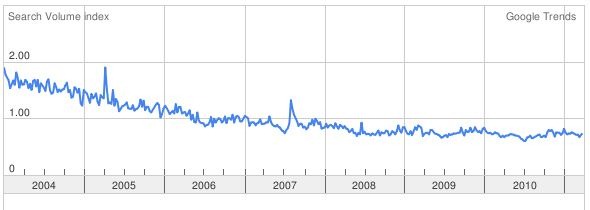
I was playing with Google Insights for Search and Google Trends and discovered that science fiction is in decline, or at least the popularity of searching on the term in Google.  I started with this Google Trends chart on science fiction:

SF-trands

I then switched to Google Insights for the rest of the comparisons.

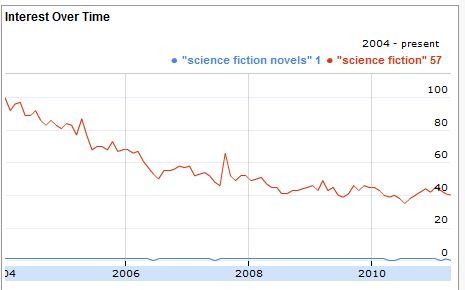
Warning, the totals given on the graphs are not always accurate – they vary with the cursor position on the time graph.  So ignore them.  Just look at the lines, or I’ll give you the averages from the Google page.

decline-of-science-fiction

Trying to understand what the numbered scale means is hard, but here is Google’s explanation,

The numbers on the graph reflect how many searches have been done for a particular term, relative to the total number of searches done on Google over time. They don’t represent absolute search volume numbers, because the data is normalized and presented on a scale from 0-100. Each point on the graph is divided by the highest point, or 100. When we don’t have enough data, 0 is shown. The numbers next to the search terms above the graph are summaries, or totals.

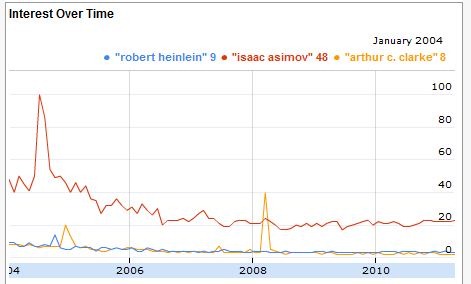
When I was growing up they talked about the big three of SF writers, Heinlein, Asimov and Clarke, so I did a graph of them.

big-three-SF-authors

Asimov is by far the more popular writer now, but all three writers show a decline in interest.  And why did Asimov have a spike in July 2004, and Clarke in March, 2008?

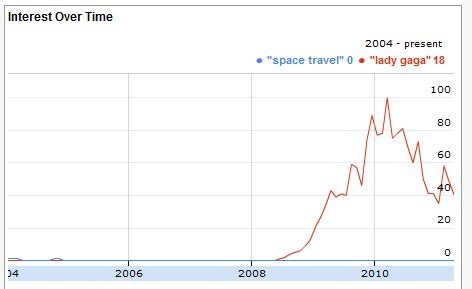
Because Google doesn’t give actual numbers it’s hard to gauge absolute interest, so I plotted “space travel” versus “Lady Gaga” and got a rather sad graph:

lady-gaga-space-travel

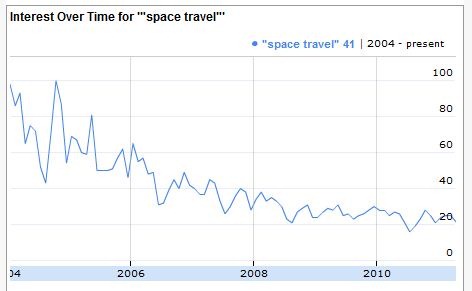
Space travel hits the 0 mark in comparison.  So I did space travel by itself and got this:

space-travel

Interest in space travel is in sharp decline.  So I wondered how science compared to science fiction and created this chart:

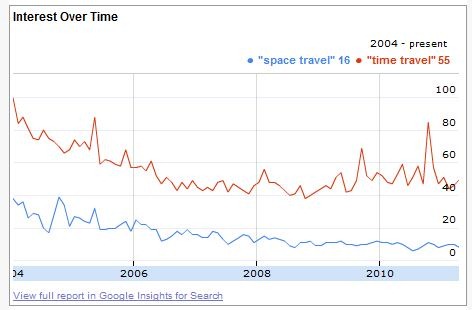
time-travel-v-space-travel

Now I’m starting to doubt my methodology.  Why is time travel so much more popular than space travel?  Or is it a matter of how the phrases are used in popular culture.  I thought I try another comparison to test things.

science-fiction-v-nasa

Science fiction is 2 compared to NASA’s 19.  But notice, interest in NASA is in decline too.

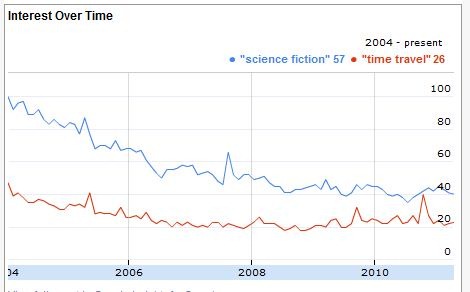
time-travel-v-sf

But science fiction is 57 compared to time travel’s 26.  Time travel is probably a common term that’s well used in popular culture outside of the field of science fiction, as is science fiction, but it’s hard to gauge phrase from genre.

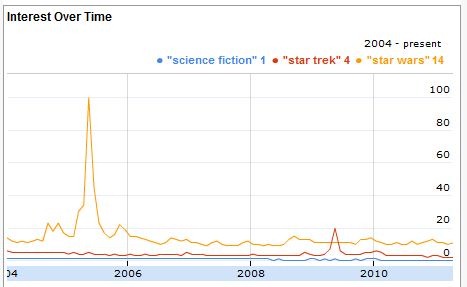
st-sw-sf

Star Wars is way more popular than Star Trek and both are more popular than science fiction.   Is that huge spike for Star Wars due to films or the discussion of the defense anti-missile program?

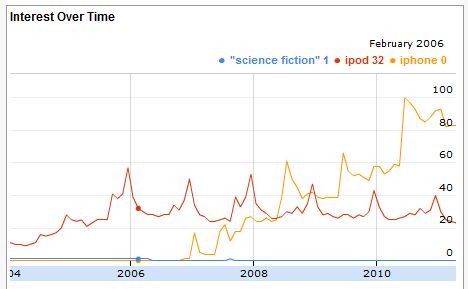
To get some real world perspective I did a comparison to iPods and iPhones.  On the Google page the totals were SF is 0 and the iPhone and iPods averaged 28 each.

sf-ipod-iphone

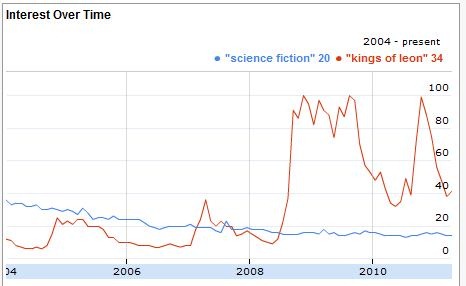
Trying to zero in on the popularity of science fiction I tried:

sf-kings-of-leon

So science fiction is about as popular as the Kings of Leon before they hit the big time – or at least on Google.

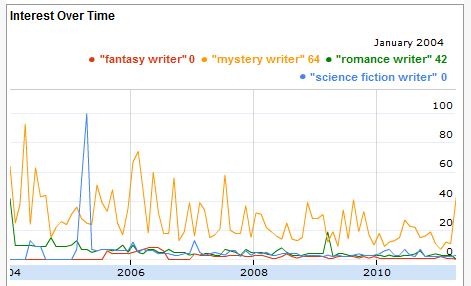
Finally, how does science fiction compare to other genres.

writers

On the web page fantasy and science fiction each get a 2, romance gets a 6, and mystery gets a 28.

Why is murder a more a interesting fictional topic than the future?  Go figure.

I don’t know if any of this means anything, but it is interesting to play with.  I linked to the two services at the top, so go test them yourself.

JWH – 4/9/11

Blogging by Candlelight and Paper

I started this blog last night while the power was out, writing with pen on paper by candlelight.  My power was out just 45 hours, but some people on my block still don’t have power.  I think after the storm Monday as many as 60,000 homes were affected.  We’ve had our power out as long as 13 days here in Memphis.  Memphis is a sea of trees if seen from the air, and when we get high speed windstorms lots of them blow over.  Down the street I saw where one tree fell and knocked another over.  My power was out because on the next block over a tree fell on the power line and pulled the pole over and the wires down.  Two houses over they had their power line pulled off their house.

The first night without power my nephew was visiting and we sat up playing rummy by candlelight, but he left first thing in the morning, to continue on his trip from Portland, Oregon to Lake Worth, Florida.  I thought my power was going to be out until Friday, so I was bucking up for two more nights of darkness and cold but MLGW fixed me.  Having these incidents are very educationally, and even though I hate when things like this happens I try to make the best of them.

I spent a lot of time last night thinking about being addicted to the grid.  I found plenty to do in the dark.  I have an iPod touch with 22 unabridged audio books on it.  I also found an old Walkman and a box of old time radio shows on cassette, so I listened to a 1950 episode of Philip Marlowe Detective.  But I spent most of the evening thinking about how we live on the power-water-gas-information grid and how ill-prepared we are for when things go wrong.

When I came home yesterday I had plan to take my frozen food to my friends house, but by then it had gone mushy.  I had to toss out most of what was in the refrigerator and all the stuff from the freezer compartment.  So I started thinking about how I would eat for three days.  I figured I could eat out, or buy food that doesn’t require refrigeration.  I didn’t want to mess with an ice chest because we had just thrown away two that had gone mildewy.   A neighbor a few doors down was running a very loud gas powered generator, and I thought about buying one of those for the future but I decided against it too.  I hate the noise.  It does protect the food but they take a lot of gas, so I figure it would be a breakeven deal.

What I wanted was more light.  I had three flashlights, two candles in glass lanterns and a giant block candle with seven wicks, but even with nine flames I didn’t have enough light to read comfortably.  I once read a wonderful book about America in the 1800s and it chronicled how people’s lives were changed by the technology evolving past candle light.  Whale oil made a huge difference.  I did some research on Amazon and found there are LED lanterns now, so I’m going to order one of them to be prepared for future blackouts.

I also wanted a radio or TV to listen to the news.  I have two Walkman cassette players with AM/FM/TV tuners, but the TV part doesn’t work anymore since they phased out analog signals.  And I couldn’t find any news on the AM/FM bands.  I didn’t have much patience though.  I plan to buy one of those emergency radios that have a crank to recharge the batteries and l want learn which radio stations are worth tuning before the next power outage.

Some of these emergency radios have hand cranks that will charge a phone or USB gadgets.  My cell phone ran out of power just after the storm.  This event taught me to keep my phone and gadgets well charged, keep the dishes washed up, and don’t let the dirty clothes pile up either. 

Luckily the house only got down to 60 degrees – just a touch cold.  I put on a hoody jacket and slept in my clothes under one patchwork quilt and was fine.  I have been in the house without power in the dead of winter and in August, so it could have been much worse.  But being addicted to a favorite temperature is a bad habit to have.

Most of all I was annoyed by having my routine disrupted.  That’s really being a pussy I know, but I’m a man who loves his rut.  If I owned an iPhone 4 instead of an iPod touch I think I would have felt connected to the net and felt less of a sense of net withdrawal.  The funny thing is I saw this PBS show last Friday about a family in England being forced to live with 1970s technology.  I never would have thought the 70s as the old days, but when I saw how different they had to live I realized how much life has changed just in my lifetime.

I tried to imagine what life was like for Jane Austen at the beginning of the 19th century, two hundred years ago.  No toilets, electricity, running water, central heat and air, safe foods, etc.  Dark was dark back then.  If I only had candles last night and none of my gadgets I would have been closer to Jane Austen times.  What the hell did they do in the evenings?

Just listening to the old time radio tapes reminded me of stories my mother and father told me about how they grew up.  Radio shows aren’t very sophisticated entertainment – and neither is television once you get used to the internet.  I think our modern minds have become addicted to complex stimulation.  Listening to the Philip Marlowe mystery was quaint but I’d hate to return to those simple story days.

Since I gave up cable last year my wife constantly searches the local channels for something to watch when she’s in town.  She likes to watch Antenna TV, a channel with old TV shows from the 1950s, 1960s and 1970s.  I loved The Monkees as a kid, but seeing it now makes me wonder if I was mentally handicapped as a teen.  I grew up back then but I wouldn’t want to return to such primitive entertainment.  I can’t imagine what young people today think of us when they see such shows.  But then I was talking to a young woman (in her thirties) and she told me how much she loved The Adams Family because it was something fun to watch with her 4 year old daughter.

Of course I did a lot of thinking about the poor people in Japan who are having their routine lives diverted for probably months if not years.  I was having no trouble adapting to life without power – it’s not life threatening, but I wouldn’t want to go all Thoreau and choose such a lifestyle.  I’m reading Edward Abbey’s Desert Solitaire and he makes living out in nature sound exciting and romantic, but reading between the lines I don’t think the desert heat comes through well in just words.

I also thought about what it would take to live with less, and wondered how much less is acceptable.  Could I live without the Internet?  Sure, but I really wouldn’t like it, but that’s weird to think about.  Why is the Internet so important?  I spend  Sunday afternoon to Friday evening living alone, so I use the Internet to socialize at night.  The computer, phone and TV make me feel in touch with the world and people.  If we fell back to Jane Austen times, work would be my only social contact and I’d probably read in the evenings.  I’m too tired after work to be socially active.  But if we didn’t have this modern world I don’t suppose my wife would be working out of town.

I wonder what our married lives should be like without our electronic addictions?  And yes, my wife has her addictions too, like Farmville and Angry Birds.  When Nicky was visiting we talked, and then we played cards.  I can see how simple games like chess, checkers and cards could be so valuable to people in the old days.

My first night back with electricity I’m typing my blog, listening to Miles Davis’ “So What” from Kind of Blue and enjoying unnatural light and heating.  I just got in the 5th season of Friday Night Lights, one of my all time favorite TV shows to watch later, and I’m back in my routine.  However, I’m not as inspired to write like I was last night.  See, being forced to do something different has it’s educational value.  Thinking about being out of my rut was stimulating in itself.  I should try to do it more often.  Yeah, right.

JWH – 4/6/11

The Good Book by David Plotz

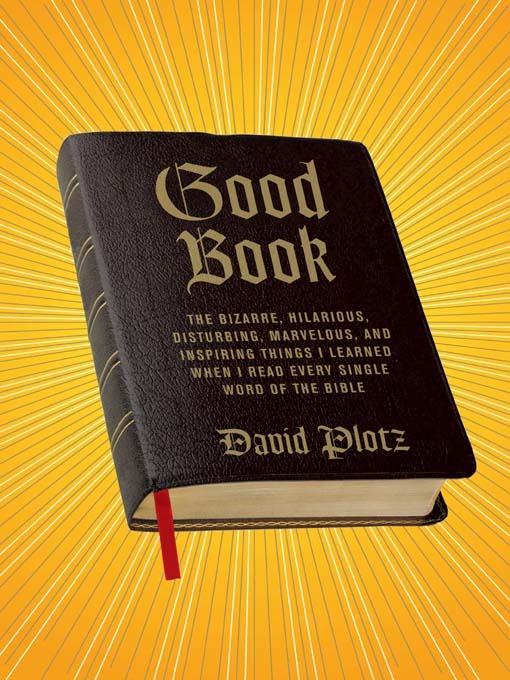
The full title of David Plotz’s 2009 book is:  Good Book: The Bizarre, Hilarious, Disturbing, Marvelous, and Inspiring Things I Learned when I Read Every Single Word of the Bible.  Now anyone who regularly reads my blog knows I’m an atheist, so you must be asking, why the hell is Jim reading a book about the Bible?  Well, for the last few years I’ve taken a little time now and then to either read the Bible or read about it, and it’s very rewarding, but just not in a religious way.  You might even say it adds to my spiritual development, and I do feel like I have a spiritual side, it’s just atheistic.

good-book-image

However, to be more down to Earth, I have to say unequivocally:  to understand western history and literature requires studying the Bible.  Not only that, to understand the psychology of the modern religious person requires a thorough knowledge of the Bible.  Moreover, I think knowledge of the Bible shines a light on contemporary politics.

The Good Book by David Plotz is a quick, informal, but skeptical overview of the Old Testament.  Plotz is Jewish, but not a religious man, but I think he still wants to believe in God, and has some religious affinities, at least far more than I do.  Plotz just wanted to read the Bible to understand his cultural heritage and ended up blogging about it over at Slate in a series called Blogging the Bible.  Read some of his posts to get a feel for his style, or even read the entire series online if you don’t feel like buying the book.  The blog isn’t the book, and I recommend the book if you’re willing to buy it.  I listened to an audio book edition read by Plotz.  Think of the Good Book as a hip Cliff Notes summary of the Bible from a Jewish guy that has a light, if not humorous touch.

Most people have never read the Bible from start to finish.  It’s long, and has lots of boring bits, and despite what fundamentalists believe, is full of inconsistencies, contradictions and surprising unspiritual stories.  Plotz gives a Reader’s Digest overview that’s surprisingly entertaining.  And like most people who try to read the Bible from cover to cover, Plotz is shocked by what he finds.  Not to give away the ending, but Plotz concludes that value of the Bible is in coming to grips with its messy parts, of which there are many.

Plotz’s Good Book is an entertaining flyover of the Bible that doesn’t take sides.  He doesn’t go very deep, but just summarizes what he’s read and gives his personal reactions.  I was hoping to learn more about Judaism but Plotz doesn’t digress too deep into that territory either.  He’s familiar enough with Christianity and the New Testament to point out passages that foreshadow things to come but he doesn’t really explore how the Bible is different for the two religions.  This is not a deep book, but a case for Bible literacy.

Everyone who reads the Bible has their own interpretations, but I like studying the Bible as history, and Bart D. Ehrman is my main guru for this approach.  Religious people like to read the Bible for messages, but I like to read it as a historical and literary puzzle.  Now that’s a black hole as big as trying to understand Shakespeare, but it’s still fun.  For example, here’s a textual problem.  There are two accounts of creation in the Book of Genesis, and they don’t match up.  Plotz points that out but doesn’t question it too deeply, but I want to know why.

Wanting to know why makes you want to read more, and that’s why I like Ehrman.  I wished that Ehrman wrote books about the Old Testament too, because his series of books on the New Testament goes deeper and deeper.  Ehrman grew up as an Evangelical and attended the Moody Bible Institute seeking more knowledge.  He kept seeking and got his Ph.D. at Princeton Theological Seminary.  He’s a guy that’s on a quest to know the truth.  What he’s ended up researching is who wrote the various books of the New Testament and why.  And reading David Plotz’s book makes me want to know the same about the Old Testament.

For example here’s my untrained guess about the two descriptions of creations in Genesis.  Long ago stories weren’t written down but memorized and spoken.  Eventually some people took up writing, and the creation tales were written down at different times by different people, and by then the stories had diverge.  For some reason when the editors of the Bible found both they included them both.  The really should have edited the two into one story though, but they probably hated throwing anything away.

The thing about the Old Testament is it’s a collection of short stories, mixed in with some history, genealogy, directions for building a temple, dietary rules and commandments from God.  It’s a real hodgepodge of ancient documents thrown together that could have used a lot of editing.  The best parts of the Bible are the stories, and as Plotz points out, they aren’t exactly political correct stories either.  There is very little in the Old Testament about being spiritually good, and often the good guys are rather bad.  So what do we make of all this?

I tend to think the Old Testament wasn’t really about God all that much, but about building the first Jewish nation, so instead of Paul Bunyan we have David and instead of Sacagawea we have Esther.  And the reason why there are so many inconsistencies in the Bible is because it was written over centuries by who knows how many different authors.  The Old Testament doesn’t promise everlasting life, salvation, or heaven.  Your soul isn’t on the line like it is in the New Testament.  God doesn’t ask much other than obedience and doesn’t promise much other than safety from being blasted by his wrath.

One thing Plotz points out time and again is how often the stories have been sanitized for retelling  to children in Bible schools.   And many of the stories have an ax to grind, like the spin Fox News puts on its stories.   Many stories are political stories trying to make a point, and often they are rather heavy handed.  If you don’t feel like reading the whole Bible, I recommend reading this book, or one like it.  The Bible is not as mysterious as it seems.  It’s less about up there and a whole lot more about down here.

JWH – 3/29/11 

12 Ways for the Kindle to Compete with iPad

The Kindle is clunky!  As a paperback book replacement, the Kindle is superior to the iPad because of size and weight.  However, as a magazine, newspaper, television and computer replacement, it fails miserable by contrasting it with the iPad.

Robert L. Mitchell, over at Computerworld writes “Why iPads will beat e-readers,” and he makes some very good points.  Basically he asks why have two devices when one will do, especially one that does so much more.  For most people this will be very true, but not all, and the not-alls can still be millions of bookworms.  Not everyone is ready to spend $500 for a reading gadget, but some people are ready to spend $139, and millions more would get into the game if the Kindle was $49.95, one tenth the price of the iPad.  The real question is:  Is the Kindle good enough in the long run?  If you could buy an iPad for $139 how many people would even think of purchasing a Kindle?

My biggest gripe with my Kindle 3 is not the e-ink display but the user interface – the Kindle is clunky at best, compared to the uber-elegant iPad.  How can Amazon fix the Kindle so its users would no longer feel iPad envy?  Can the Kindle be marketed as a single task device in such a way that it doesn’t psychologically compete with the iPad at all?

The problem is the iPad can be a universal ebook reader and that’s why people see the iPad as competition to the Kindle.  Plus the iPad can host thousands of dazzling programs on a beautiful and elegant screen.

The iPad proves that a touch screen is the perfect user interface (UI) for tablet size devices!  The Kindle 3’s buttons and UI is a major leap forward over previous models, but it’s nowhere near the quantum leap of touch screen tablets.  My biggest gripe against the iPad is it’s way too heavy to be a book.  If you’re the kind of person that reads for less than an hour a few times a week, the iPad is fine.  But if you read hours a day, seven days a week then the iPad is clunky and chunky.  This leaves room for Amazon to compete.

Amazon can go in two major directions.  First, it can continue to be just a book replacement device or second, it can go into the tablet competition arena.  And since Kindle software is already on all the major tablets, it’s doubtful that Amazon needs to market its own general purpose device unless it wants to compete with the Color Nook, which is essentially a half-ass Android tablet, and B&N’s attempt to beat E-ink technology.  But at $250, it’s too expensive for most people wanting to get into the ebook reading.

Does Amazon really need to make money in hardware sales?  Does it really matter what platform Amazon’s customers read their books on?  Now that the ebook market has exploded, and readers are accepting the idea of buying ebooks, does Amazon even need to sell Kindles?  Does it even need to sell ebooks in the Kindle format exclusively?  Amazon’s real competition is not the iPad, but Apple.  Apple now sells music, movies, audio books, ebooks, television shows – much of the same content that Amazon is pushing, and a reason to want Android tablets to succeed.  And how does Amazon compete when Apple takes in a 30% profit margin on anything Amazon sells on Apple devices.

Amazon needs to beat Apple, not the iPad, and the best way for that to happen is if Android phones and tablets outsell iPhones and iPads.  Or if Amazon has a device that its loyal customers love more than an iPad.  For the Kindle device to succeed it must be the ultimate ebook reader – and it wouldn’t hurt if it was $49.95 or less.

Here are a number of ways the Kindle could be improved.

  1. E-ink technology limits what Amazon can do with the design of the Kindle.  If Amazon could meld touch screen technology with the e-ink display it could simplify the device by jettison most of the buttons, and vastly improving the user interface.
  2. Add support for EPUB standard – that way EPUB could become the web standard for free ebooks and that would actually help the Kindle.  It would also let Kindle users get library books from Overdrive and NetLibrary, also helping sales.
  3. Make a deal with B&N to support each other’s book formats, so Kindle users could buy from B&N, and Nook users could buy from Amazon.  Hey, the competition is with Apple.
  4. Work extremely hard on the ergonomics of the device so it’s easier to hold and read than any mass market paperback, trade paper or hardback book.
  5. Make the device indestructible so people feel its safe to take their Kindle anywhere something you won’t do with an expensive iPad or Android tablet.
  6. Make the price cheap enough so people will want one for every family member, nor feel kicked in the gut if they loose one.
  7. Work out a scheme for family and friends to share books.  If I owned two Kindles so my wife and I can read the same book, we’d have to have both devices on one account name just to keep us from having to buy two copies.  Being forced to share an account means we can’t have separate libraries.  And if we’re reading the same book at the same time the auto book marking feature would get messed up.
  8. Develop a home page that’s a metaphor for a personal library system.  A Kindle can hold thousands of books theoretically, but not practically.  Amazon needs to make an app like iTunes to manage all the content on the Kindle – but it needs to be far better than iTunes.
  9. Improve the way magazines and newspapers are presented and stored on the Kindle – and aim for cheaper subscription costs than what people have to pay on the iPad.
  10. Most books, especially fiction, do not have photos and illustrations, so it’s easier for E-ink to compete with LCD displays.  It might be better to concede multimedia to the tablet competition, and make the Kindle the absolute best text to brain interface that bookworms can buy.
  11. Make it a snap to transfer text from the Internet and the computer to and from the Kindle.   Getting text to and from the iPhone/iPad/iPod touch can be annoying because of all the security and restrictions Apple uses to protect the user.  It would be fantastic to have a plugin for my browsers that would scrape a web page and put the text content into my Kindle for reading later in the comfort of my recliner.  But just getting .txt, .pdf, and .doc files to and from the Kindle is still cumbersome, and it can’t handle .epub at all.  This would be supported by #8.
  12. Find a software solution to make the Kindle a lifetime library of reading – right now I feel compelled to delete books and docs from the Kindle to keep thing clean and easy, but if the UI was better my Kindle could be a portable library of lifetime reading.  One solution is to provide a lifetime library in the cloud for your loyal users.

I use my Kindle most for reading free stuff off the Internet.  There are short stories and essays on the Internet that are too long to read sitting at the desk so I like to put on the Kindle, plus there are thousand and thousands of free novels, especially classics.  I do buy Kindle books, especially when they are cheaper than buying printed books, but the prices for ebooks have shot up which makes them less appealing.  If I see a reprint of an old science fiction book for $7.99 or $9.99 I just say no.  If it’s $4.99 I think hard about it.  If it’s $2.99 I jump.  $4.99-$7.99 competes with buying used hardbacks for collecting and sharing.  I’d rather buy a used hardback and give it to a friend than buy a Kindle book at the same price.  Sorry Amazon, but sharing books is a factor. 

If the Kindle book is cheaper than a used hardback I think, cool, I’m building an electronic library.  But even that desire is limited because the current UI makes collecting books a chore because of clutter and harder navigation.  I seldom reread books, but sometimes I’d like them for reference, so it’s a toss-up for whether or not to keep them.  I’d love to have a system for building an electronic library of everything I’ve read.  If the Kindle offered such software I’d be more likely to buy Kindle books to keep in my lifetime library.

Right now when I power up my Kindle I see a long list of books, magazines and other documents waiting to be read.  If I want I can archive stuff to an even longer list.  That’s a mess.  What’s needed is a library system for e-readers, something that’s probably only possible with a touch screen UI.

Amazon needs to get some savvy librarians to work on this task.  I can picture the opening screen having the following buttons:

  • Read [it remembers where I left off]
  • Bookmarks/Search
  • Novels
  • Nonfiction
  • Magazines
  • Short Stories
  • Poems
  • Essays
  • Newspapers
  • Documents
  • Notes

What I want is a way to organize my digital book collection and help me find stuff.  And this points to a major flaw of the iPad as an ebook reader.  If you have books in Kindle, Stanza, iBooks, Nook, and other readers on the iPad, and you subscribe to magazines and newspapers, each in their own app, and you collect documents in all kinds of apps, finding stuff will be tricky because it’s all over the place.

I wish my Kindle had a detachable handle, like a church fan handle, but with a trigger to page forward.  Even though it’s much lighter than the iPad, it gets tiring to hold.

But the biggest trouble Amazon will have when competing with tablets is whether or not people start carrying tablets around with them like cell phones.  If everyone gets that addicted to their tablet, then people won’t want a Kindle.  Thus, if Amazon wants to stay in the ebook device business they will have to come out with a tablet that competes with the iPad, or join forces with Android tablet makers.  However, I don’t think people will carry tablets everywhere.  Smartphones will be it, so having a smartphone that can connect with a lifetime library in the cloud could be another big selling point.

I think the Kindle can compete if it becomes a super-book and doesn’t try to be anything else.  A tablet is really a computer without a keyboard, it’s a general purpose device, and as long as it’s heavier and more expensive than a single purpose ebook reader, ereaders have a chance to compete.

JWH – 3/26/11 (Mine and Susan’s 33rd anniversary)
Apple’s Dangerous Storefront Paradigm

What if you bought a Sony TV and then discovered you could only watch shows that Sony okayed ahead of time?  Furthermore, what if Sony decided that anyone wanting to create a show to broadcast to your TV had to pay Sony a fee?  What if some TVs worked with some networks but not others?  How would you feel if you wanted to watch a certain show but discovered that Sony censored that TV production?

Radios, televisions, record/tape/CD/DVD players have always been sold as machines that were universal devices.  They would work with the same content everyone was providing.  You bought a RCA television and it played the same shows as a Sears set.  A GE clock radio would pick up the same stations as any other AM/FM set.

When computers came out there were many types, with different chips and operating systems, and there was no universal system.  Then came the IBM PC in 1981, followed by PC clones, and things settled down, but not quite, because in 1984 the Apple Macintosh came out with all intentions of being different.   The Mac’s market share has always hovered around 1/20th of the PCs.  It wasn’t quite disruptive, but offered an alternative.  But if you bought a Macintosh computer you could buy any Mac compatible software you wanted.

Now, with the iPhone and iPad, and the Apple App Store, Apple is creating a paradigm shift that will shake up things and change the way we do things completely on computers.  And don’t be fooled, smartphones and tablet are computers.

Apple is changing the computer from being a general purpose device that the buyer has control over into one that’s essentially a tiny Apple storefront.  Apple wants to get a cut of the action on any program, service or content that runs on their machines.  Not only that, they want to control what services, programs and content that can be used on their machines.

This is like Samsung saying “If you want to watch The Social Network on our TVs, we get a percentage of its selling price.”  Because computers never completely became universal devices like radios, TVs and DVD players, computer makers can get away with trying something different.

What Apple is saying, we don’t want to be a computer maker anymore, we want to be a retailer that sells products for computers.  They couldn’t do this before because they didn’t have the App Store.  The App Store is a choke point that Apple can control.

Under the old paradigm if you wanted a tax program for your computer you picked out a program you liked and bought it direct from its maker, or from a mail order store like Amazon or New Egg, or a retailer like Office Depot.  Now Apple can say the only way you will get a program for your iPhone, iPad, and soon maybe your iMac is through an App Store they control, and which they charge a 30% cut.  Now some people like this paradigm shift, it does have merits, but I for one find it scary too.

For instance I was going to buy the iPad 2 as soon as it came out.  I changed my mind weeks ago when Apple announced their 30% fee.  I was wanting an iPad to read magazines on, and my first magazine subscription was going to be The New Yorker.  Right now The New Yorker is $4.99 an issue on the iPad.  It’s $2.99 a month (4 issues) on the Kindle, and $39.95 for the PC version, that includes access to the complete back run of the magazine.  I don’t know what the subscription fee will be on the iPad because Apple is just now working out the deals and technology to sell subscriptions.

Now Amazon has a choke point for Kindle users too, and I’m sure Amazon is making something for selling magazines, but I doubt it’s 30%.  But see the difference?  Under the old PC model of buying content we can deal directly with the seller.  $39.95 a year is a great deal.  It’s $3 more a year than the Kindle price, but I would get all the back issues to read while I’m a subscriber, plus I’d see the full magazine page with all it’s ads and illustrations, and not just the content and cartoons as I do on the Kindle.

I was hoping The New Yorker would provide the same deal on the iPad for $39.95, but will it when Apple wants $12 for its share?  Does Apple deserve a share?  Are they really a retail store?  Google has since claimed that sellers on the Android platform will only have to kick back 10% to them.  But is being cheaper any fairer?

See the paradigm shift coming?  Computers are becoming storefronts.  Apple tells its users that programs bought from their App Store are safer than those purchased elsewhere, but isn’t that some kind of protection racket?  And isn’t this also a kind of Monopoly too?  To be legal shouldn’t iPad users have the right to visit any application store they choose?  Imagine if Ford sold you a car but enforced where you bought your gas and oil because they claimed it was safer?

Before Apple announced their shakedown plans I had imagined having an iPad with Rhapsody Music on it.  I pictured in my head what a beautiful app Rhapsody could design for listening to music while looking at appealing visuals, like large size photos of album covers.  But will Rhapsody still develop such an app?  Many content producers are saying they might have to pull their wares from the App Store, but I don’t picture that happening.  I just see them jacking up their prices.

The New York Times plans to sell the online version of their paper for PC users for $15 a month, and charge $20 a month for iPad users.  But to be fair it’s $19.99 for Kindle users now.  If they didn’t have to go through Apple or Amazon, and Kindles and iPads were just generic devices, would The New York Times just charge $15 a month to their users?

Is having the device maker controlling a choke point on sales of content for their devices really needed?  If you buy stuff from Target at their stores or online you really need Target to manage all the stuff they sale, so they deserve making money.  But do Google and Apple really do that much to run their stores?  It’s nice to have one payment system, and it’s nice to have one installation system, but is it really worth 30%.  Their fees should be more in line with what credit card companies charge retailers.  I’d say 3% tops.  And how many retail stores can get away with a 30% mark-up – most live and profit by razor thin margins.

Whether we like it or not, tablet computers are our future, and this is a good thing.  But giving Apple, Google, and Microsoft the right to control all sales on their devices is not.  Microsoft is a dark horse in the tablet race.  What if they came out with a hands off approach, and just sold their OS to tablet makers, would that change the game?  There’s a reason why PCs dominate the market share.  They may be open to attack from hackers, but they are open.

JWH – 3/20/11