Windows 8 Consumer Preview–Initial Impressions

I had no trouble getting the Windows 8 Consumer Preview on the first day.  I did an in-place upgrade that quickly installed on my i3 test machine.  Booting up into Metro was like falling into a rabbit hole, or playing a new video game, because I had to click here and there just to find all the new menus.  I’m a computer support person, and I know Metro is going to shock my users.  Metro is obviously designed for tablet users.  One of Metro’s app panes is the desktop – which is great for people wanting to escape Wonderland quickly and get back to the real world.

I stayed in Metro and was sliding through its screens and installing apps almost immediately.  Cutting the Rope was a more fun using a mouse, and reading USA Today was easier to deal with on a big screen using a mouse, which goes to show you that poking the screen with a finger might not be the ultimate human computer interface.

I often wish when using my iPad 2 that my apps were on my big monitor, especially Zite.  I use my iPad 2 because I love Zite, Words with Friends and Kindle for the iPad.  And it’s only the Kindle app that I want to use away from the desk.  And even then, my iPad 2 is so dang heavy that it’s a hassle to use.  I have to prop it up with pillows to get comfortable.

I love my iPad 2 and Kindle 3, but to be honest, I’m perfectly adapted to sitting at a desk using a computer with a mouse and 23” monitor with 1920 x 1080 resolution when interacting with programs.  Passive reading is different.  But back to Windows 8, using Metro is like using a big tablet at my desk, and that’s fun.  I wish it had Zite.

I hate that Windows, Mac OS X and Linux are all moving away from the desktop UI that I’ve grown to love so dearly.  Using Metro means living with a different UI.  People will get use to it, but it’s going to be a big move.

I hate icons on the desktop.  I consider my desktop my picture gallery.  Beautiful photographs from Webshots sooth me all day long at work and all evening long at home.  I want 100% of my screen for art and photos, and that’s possible with Windows 7.  All the new OSes for Windows, Macs and Linux want to clutter up the UI with widgets, and that annoys me.  Luckily Windows 8 lets me drop back into the old UI where I can hide all the icons and make the taskbar auto-hide.

I worry that Windows (and all computers) will evolve away from that classic desktop metaphor.  I remember the world of DOS, and the text based interface, so I know the world of computers can go through major paradigm shifts.  If feel that about to happen again, and I’m already nostalgic for the old user interface.

Windows 8 isn’t Windows 7 even when it looks like Windows 7.  I couldn’t even find the shut down menu.  The old view is there for now, but it’s been altered.

To be honest, I’m not giving Windows 8 a proper test drive because I don’t have a touch screen monitor.  Using the mouse, I have to fumble around trying to figure out what would probably be natural gestures if I was using my fingers on a multi-touch display.  It took me awhile to learn that moving the mouse to the corners brought up the “Charms” – translucent menu options.  The elegance of Windows 8 won’t truly reveal itself until I see it on a tablet or a touchscreen monitor.

Windows 8 comes with apps, like tablet and smartphone apps, and not applications, like in the old days of software programs.  Windows 8 also has an App Store, where it’s easy to find more apps to add to Metro.

Metro is a very busy user interface to me, but it works with its own logic, like iOS, but unlike iOS, apps can interact, making Metro more like a multi-tasking desktop OS.  Metro is a new look and I’m sure I’ll get used to it, but it is jarring.   I have Windows 8 Consumer Preview set up on test machine at work, so I’ll be learning it hit and miss when I get some extra time.  Whether or not I recommend we roll it out in the future is yet to be determine.  My users are very conservative.  Many found moving from XP to Windows 7 upsetting, but Windows 7 has won everyone over.  However, in the past year more professors have been wanting Macs because they have iPhones and iPads.  I’ve yet to have a user bring me a Windows Phone to set up.  Microsoft needs to get Windows 8 tablets out there as soon as possible, or the shift between Windows 7 will be to Mountain Lion instead of Windows 8.

Microsoft Office

I installed Microsoft Office 2010 but since there is no Start Menu with All Programs I couldn’t find the Office apps.  I switched back to Metro and found them as small square panes, and rather ugly ones at that.  I’m surprised Microsoft didn’t make eye candy versions of its flagship products.  When I launched Word, I saw  the desktop background for a second and then a full-screen view of the standard Word app ready for me to start typing – all very normal.  If you minimize the window, you’ll see you’re back in the desktop mode.

User Interface

Strangely, Windows seems to be moving away from windows, and dialog boxes, and other standard interface pop-ups.  Windows 8 tries to stay in full screen mode for each app.  Overall, this feels like Microsoft is trying to simplify all actions to their basic nature.  I imagined their engineers asking at every step, “Do we need this?”  And second guessing them, I think most of the time the answer was “No!”

Windows introduced the vertical and  horizontal scrolling windows.  Windows 8 is trying to simplify the desktop by doing away with overlapping windows and using sliding panes, or screen swapping techniques.  Their engineers have been paying attention to the minimal UI of smart phones and tablets.

Impressions

For the average experienced Windows user switching to Windows 8 will take a little time, but not much.  I’m sure, hidden away will be a lot of new subtle features that will take time to discover.  So far I have found no compelling feature to make me want to switch.  Windows 7 is so good that I prefer it over Mac Lion and Ubuntu machines I have at work.  I now have 4 major OSes to use in my office.  I’ll see how Windows 8 grows on me.

– – –

For more of the nitty-gritty details see this article at Computerworld.

David Pogue raves about Windows 8.

JWH – 2/29/12

How to Debate a Conservative?

My neighbor has a son I discuss politics with from time to time.  He’s conservative and I’m liberal.  He’s anxious for Obama to leave, I’m anxious for him to stay.  My friend, who is my age, is good guy and he doesn’t push his agenda and I try not to push mine.  Conservatives are mighty arguers, and debating them can be difficult because conservatives are often as passionate about their politics as they are about their faith.  One problem with debating conservatives is they often feel the solution to the issue at hand is all too obvious and the facts are all on their side.  And that’s the first quandary with debating conservatives – liberals have to argue against the status quo.  We’re fighting an uphill assault against a well entrenched position.

Today my friend claimed Obama was making a huge political mistake by not siding with the proposed Keystone XL Pipeline.  To ordinary folk, the pipeline sounds like a no-brainer.  It promises jobs for Americans and more oil for America’s long term security, and during an election year where gasoline prices are climbing daily and politicians want to get every vote they can get, it would appear insane for Obama to reject the pipeline.  Why wouldn’t liberals want more jobs?  Why wouldn’t liberals want cheaper gasoline and securer oil supplies?

Obama recent decision to reject the current claim puts the decision off, probably until after the election.  Obama claims he wants a better environmental impact report.

If you aren’t familiar with the Keystone pipeline controversy you’ll need to do some background reading because I don’t want to summarize what is already so well-written elsewhere.

Keystone-pipeline-map-KWD2

I think it’s pretty easy to restate the conservative position.  The pipeline means jobs during times of high unemployment.  The pipeline will be another source of oil that doesn’t come from the Middle East, promising more security against future oil shortages.  It offers hope for lower gasoline prices.  It could be a great economic stimulus, especially for the state of Texas.  Finally, it’s a way to help our friends the Canadians.

How can liberals argue against all of those benefits?  We already have zillions of pipelines crisscrossing the country, why not another one?

If you read the articles you’ll see there are many people fighting the pipeline.  Why?  I don’t mean their specific reasons, but why are some people for something and other people against?  Any project benefits some people and hurts others.  It’s always that way.  A hot issue like the Keystone XL Pipeline is political.  The prime motivation for any big scheme is to make some people wealthy.  There’s nothing wrong with that.  The Canadian company and its American allies are trying to put over a big project and they are doing everything they can to convince America its in their best interests to let them go ahead.  So why stop them?

Like every wish from an Aladdin’s Lamp, something unexpected comes with our wishes.  To some, Obama’s delay is merely one for letting us think harder about what we’re wishing for – to try to foresee the possible unexpected consequences.

There’s been a boom in natural gas production in America and many landowners and towns rushed to embrace drilling and pipelines in their communities only to regret it later.  That’s the first layer of protests against the proposed pipeline.  There are individuals that don’t want it in their backyards.  Eminent domain has always been controversial in our country – it’s always the little guys versus the big guys and the benefits of the many against the sacrifice of the few.  But this is not the major consideration in the Keystone Pipeline now, but it’s growing.

The next level up is the local environmental impact of the project.  President Obama and the EPA and other agencies want to take a longer look at the problem.  What’s the worst thing that could happen?  Could Keystone shell out the billions like BP if there was a major spill?  What if there was an accident that impacted millions of citizens?  I tend to think the current delay by Obama is really about this level of opposition, and sooner or later the pipeline will be built.

But there’s two more layers, that I think are the real issues.  These two issues are at the heart of liberal opposition to the Keystone Project.  The first is oil addiction and the second is global warming.  They are related, and even interconnected, but they are still two separate issues.

Oil is a finite resource that the human race is using up at an exponential rate of consumption.  Americans are oil junkies and the Canadian tar sands offer billions of barrels we greedily want to consume.  We don’t want to give up our SUV and wasteful lifestyles, and the Keystone Pipeline is another drug dealer to rely on for our addiction.  Among our citizens are people that are saying, “Hey, this is enough, we’ve got to get off this drug.”  These people know that through conservation and energy efficiency we could easily live with much less oil.  They know oil is vital to our whole economy and wasting it is huge danger to our long-term survival.  Instead of using all the oil up in the next 50 years, maybe we should make it last 300 years or longer.

To these people, some of who are environmentalists, and others just economists, they know we don’t need more sources of oil, but a lifestyle to live with less.  And they believe we need to change now.  This would be true even if global warming didn’t exist.

Of course global warming does exist, and the Canadian tar sands are a particularly nasty way to get oil.  Conservatives refuse to believe that global warming is happening, or they refuse to believe it’s man-made.  Throughout the history of mankind people have refuse to accept anything that threatened their personal wealth and wellbeing.  Accepting that the pipeline is a bad idea means accepting that our way of life is wrong, and most people can’t go there.  But what if it’s true?

Now this brings me to the title of the essay, “How to Debate a Conservative?”  How do you convince people their way of thinking is wrong?  I’m not sure we can.  That’s why conservatives don’t like liberals.  We’re asking them to make radical changes in their lives.  What gives us the right to ask so many to give up so much?  Of course we know we can substitute an energy efficient lifestyle that would give them everything they have now and more, but it would be disruptive and costly in the transformation.

We can also tell them their children and grandchildren will suffer the consequences of their wastefulness, but that’s never worked in the past.  How effective is that Bible verse about the sins of the father visiting the later generations?  If God couldn’t change the Israelites, why think the liberals can change the conservatives?

We could try and convince them to read hundreds of history and science books, but we spend billions on education and get few to read.

How long has it taken to convince white people that people of color are equal?  How long has it taken to convince men that women are also equal?  Right, the liberals are still hard at work on those issues.  Change comes slowly.  We can take some satisfaction that even the most conservative people today are flaming liberals compared to people of the past.  But is that any consolation?

And how many liberals are driving SUVs and living in 6,000 square foot houses?  I’m afraid all too many.  As long as liberals consume as much oil and live equally energy inefficient lives, we can’t argue well.

Does it come down to which side has the most lawyers, super-PACs and Congressmen in their pockets?  It certainly would help if Obama had the balls to take an environmental stand and marshal the Democrats into action.  I like Obama, and I think he’s a very eloquent guy, but he’s not a visionary leader.  We live in times that needs another Lincoln but all we got was another Kennedy, a charming man with style, beautiful wife and kids, but who is only better than average politically.

Liberals need to organize and become more successful politically.  They need to fight as hard as the conservatives do, but hopefully without the dirty tricks.  Lucky for us, the best the conservatives can find to lead them are greedy buffoons that only think about one thing:  eliminating taxes.  If liberals were as aggressive as conservatives at seeking tax breaks we’d have one healthy environment, but sadly Democrats seem to be just as corrupted by money and power, but they feel just enough guilt to help the poor.

I’m not sure how to debate a conservative.

I tend to think our addiction to oil will not be broken and the Keystone XL Pipeline will be built.

I tend to think the concerns of the little landowners, farmers and ranchers will be pushed aside when the pipeline is built.

I tend to think there will be small and large oil spills and we’ll live with the consequences.

I tend to think we will consume all the oil before we learn to live without it.

And I’m quite confident global warming will destroy our current way of life, and our generation will be cursed for centuries.

JWH – 2/26/12

A Universe From Nothing Lawrence M. Krauss

As far back as I can remember I’ve often contemplated why there is something rather than nothing.  And by nothing, I don’t mean empty space, because even that would be something.  I finally decided that nothing can’t exist.  That it’s impossible for “nothing” to exist, because if it could, we wouldn’t be here, and there would be nothing.  I concluded that reality is all the possible some-things coming into being. 

When I first saw a copy A Universe From Nothing by Lawrence M. Krauss I wondered if he had a scientific theory to explain why nothing cannot exist to support my own philosophical theory.  Sad to say, he doesn’t actual work with the same concept of nothing as I imagined it, but I think he’s getting close.  Theology has always been burdened with the question that intellectual pesky kids eventual ask, “Who created God?”  Smart kids will also ask scientists, “What created the Big Bang?”  Sooner or later the ontological question has to be:  “How did something come from nothing?”

Cosmology has always invaded the territory of theology and Krauss does not shy away from this conflict.  In fact, Christopher Hitchens had promised to write the introduction to A Universe From Nothing, but he died too soon, so Krauss got Richard Dawkins to write the afterward, which uses the science in this book to attack theology rather sharply.

It seems like every popular cosmology book I read has to reiterate all the cosmological discoveries since Edwin Hubble figured out that nebulae are galaxies existing outside of the Milky Way, and they are speeding away from us.  For a short 224 page book, Krauss gets the background covered quickly and moves on to the title topic, but it requires the reader to grasp quite a bit of recent research.  To understand nothing requires understanding a lot of some-things.

Now here is where I wish I had the writing skills of Brian Greene, my current favorite science writer.  Of course, if I had such writing skills I’d end up writing a book much like what Lawrence M. Krauss wrote – however, I’d still like to summarize what I learned from reading A Universe from Nothing.  I’ve lost count of how many books I’ve read on cosmology, or documentaries I’ve seen, but I feel the need to summarize just to get things straight in my head by listing them on paper.

And if Krauss and Dawkins are right, and cosmology deposes theology, then the average person needs to learn a lot to catch up with science.  Cosmology is science’s Book of Genesis.   But unlike the Bible myths, cosmology explains how the universe came about by studying the evidence, a lot of evidence, a whole lot of evidence.  And for some concepts, like the Big Bang, there are multiple paths that prove the theory that makes the scientific research more and more definite.  This is a lot of learn and its no wonder that most people prefer the Bible to answer their origin questions.

Here’s quick and dirty study guide to modern cosmology.  The more you know will make understanding A Universe From Nothing easier to understand and comprehend.  Also, it’s impossible to understand cosmology without understanding particle physics.

Now this is a lot to learn, and even after reading many books I only have a vague layman’s idea of what’s going on, but what’s fascinating is how everything interconnects.  Reading A Universe From Nothing just inspires me to read more, to keep putting more puzzle pieces together to get the big picture. 

Just take what we’ve learned about the cosmic microwave background radiation in my lifetime.  Reading The First Three Minutes by Steven Weinberg and The Very First Light by John C. Mather tells the long story of how the CMB was theorized, discovered, and measured to finer and finer accuracy.  The Very First Light is about building the COBE spacecraft to measure the CMB.  Then I read about the Wilkinson Microwave Anisotropy Probe that studied the CMB with even more accuracy.  Then there was Planck spacecraft that explores even deeper.  If you aren’t familiar with the cosmic microwave background radiation then I beg you to study it.  It’s a near perfect example of how science works.   Just look at the list of the major experiments studying the CMB.  This history shows how experiments are constantly refined and evolved to find more evidence, or how to look for evidence from other sources, or from other approaches.  Science is a beautiful Chinese puzzle where the pieces interlock in elegant ways.

Don’t worry about not knowing mathematics to enjoy reading about cosmology.  Most of the popular science books are about the men who invented the mathematics, and their stories are told by the experimental evidence.  Their numbers are validated by real world experiments and applied engineering.  Did you know that GPS systems in your smartphones depend on mathematics that involve relativity?  Without Einstein’s equations they wouldn’t work.

Back to the book – does Krauss explain how something comes from nothing?  No.  But he does explain the current theories on dark energy, which suggests that powerful forces come from apparently empty space.  Of course, once we understand how dark energy, and dark matter work, they won’t seem like nothing anymore – they will be some-things.

The nothing Krauss is talking about are just some-things that science can’t see right now.  The nothing I say can’t exist is pushed further back into the unknown, into the multiverse.  Like the kid who asked who created God, I’m asking what created the multiverse, but if science could tell me, there would still be another layer of unknown to explore.  It’s still turtles all the way down.

Other Reviews:

JWH – 2/24/12

My Music DNA: The FM Years

Until I wrote My Music DNA:  The AM Era I never thought about how my life has been one long experiment with technology.  We like to think personal technology started with personal computers, or for some people, the iPod, iPhone or iPad, but now that I contemplate the topic, I realize The Gadget Age started in the 19th century with photography, then the phonograph, movie camera and radio.  Before gadgets if you wanted to hear music you had to go where the musicians were performing.  If you wanted to see Paris you had to go to France.

Gadgets bring the world to us, whether it’s voice, music, images or movies.  To a degree, books and paintings are proto-gadgets, they bring distant words and images to us created by people, but gadgets bring snapshots of reality, whether it’s images (photography), voice and music  (phonograph, radio) or movies (film and television).  A personal computer or iPad are dazzling devices because not only can they bring us voice, music, images and movies, they can process these media like a word processer processes words.

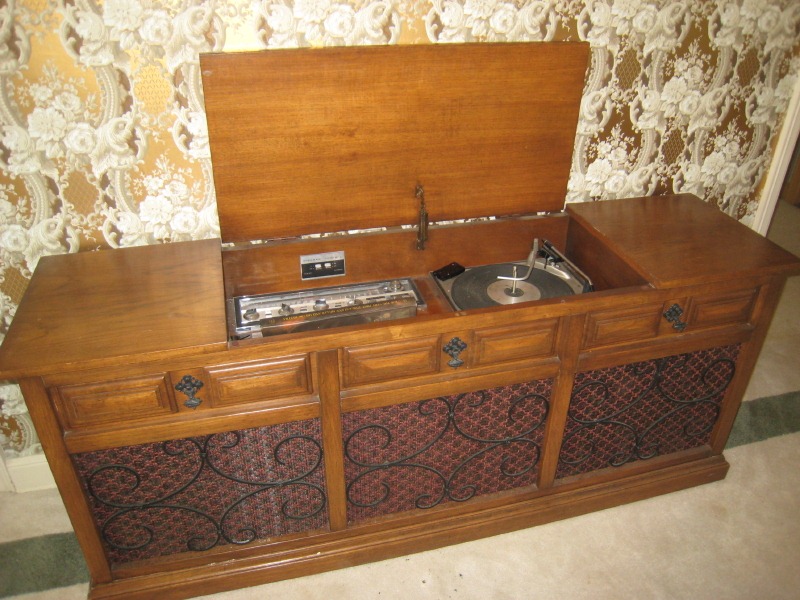
Although FM radio was patented in 1933, first broadcasts weren’t made until 1939, and stereo not added until the late 1950s, I didn’t get my first FM radio until 1968.  FM radio took a long time to catch on.  If you look at the Fidelity Potential Index Table you will see how sound recordings have evolved since the invention of the wax cylinder.  FM music has more fidelity than the 78 and 45, but not as much as the LP.  I had already started buying 45s and LPs before I got my first FM radio.  My first FM radio came in a small console stereo I bought in 1968 from the Columbia Record Club, when I was 16.  It was my first installment plan purchase.  I don’t have a photo of my first console stereo, but it looked something like this.

console-stereo2

Working as paperboy, cutting lawns, babysitting, and eventually as a bagboy didn’t not pay enough to buy all the music I wanted to hear, so my FM radio was a magical piece of technology.  AM radio was all about hit singles, whereas FM was about albums.  FM radio took me out of the teeny-bopper tunes and introduced me to a more mature level of album oriented music.

Among the albums I discovered back in 1968 on my FM radio was Truth by Jeff Beck, which I immediately bought.  I was transitioning from AM radio to FM and I discovered new groups like Cream,  Quicksilver Messenger Service, Moby Grape, Steve Miller, Grateful Dead, etc.  I also got into the albums of artists I had discovered on the AM airwaves like The Byrds, Bob Dylan, Jefferson Airplane, Buffalo Springfield, The Beatles, The Rolling Stones, The Doors, Jimi Hendrix, The Mamas and The Pappas.

I remember friends coming over in 1968 to hear the FM radio for the first time and being blown away – it was that different from AM.

My FM years didn’t last long, from 1968-1972.  It was transitional technology.  FM brought me a wide range of music from around the world, but it was a broadcast technology.  I started buying LPs in the AM era, and by 1970 I had about 300 albums, but they were never enough.  FM radio was my music news and how I discovered new music until I couldn’t handle the disc jockeys.  At first, back in the 1960s, FM was considered underground music, but FM took over the hit parade as more people got FM receivers.  At a certain point disc jockeys became so annoying I gave up FM and AM radio.

In 1969 I started getting my music news from The Rolling Stone magazine.  For a brief while in the late 70s and early 80s I returned to FM to listen to WEVL, a volunteer radio station where music fans hosted music shows rather than professional disc jockeys.  But for the most part I gave up radio listening in the 1970s.  I became a album buying addict, buying over a thousand LPs before I switched to buying CDs in the 1980s, and I went on to buy 1,500 CDs before I phased into streaming music in recent years.

AM radio showcased top hits that were played frequently.  AM hits of the 1960s provide the core music that Baby Boomers share.  On any given day you could hear about 40-60 different songs.

FM radio offered a far larger range of music and styles until it was hijacked by the Top 40 format and became zany entertainment for automobile drivers.  In the early days of FM if you tried hard enough you could hear 100-200 different songs in a day.

Buying LPs offered the choice of thousands of albums at better stores.  And LPs allowed fans to own music, another kind of enabling technology.

With Internet shopping, collectors could buy a million CDs if they could afford it – then the MP3 revolution hit, and collectors could steal those million albums if they had the time, bandwidth and lack of ethics.  Now with steaming music anyone can have easy access to over a million albums, or about 15-20 million songs for $9.99 a month.

iTunes and iPod reinvented the hit singles and almost killed the album.  Streaming music is like combining FM and owning LPs with renting music, and it promotes the album.

FM radio still exists, as does AM radio and even LPs, but they are waning technologies that have been supplanted by the Internet.  FM radio was a stepping stone technology that expanded the world of music over AM.  FM radio is now a trailing technology – it fits a niche market, and has many competitors like Sirius Radio, a paid service, or Pandora Radio, free and paid, that offers music from a very wide selection of albums, and is a far superior to broadcast technology.  Broadcast radio itself is a waning technology, even with HD Radio.

Streaming music offers the greatest selection and control – with instant access to most of the albums in print.

Strangely enough, it’s very hard for me to remember FM songs that I loved because of listening to the radio, versus songs from the same time period that I bought on LPs.  The way I’ve discovered how to tell the difference is to listen to Play Cofi Jukebox at tropicalglen.com by the years below.  The songs I loved but never bought are songs I can give thanks to FM radio technology.  What’s surprising is just how many of those songs there were.  Just click on a link and listen.  How many of the songs did you buy, and how many are part of your memories because you listened to FM radio?

19681969197019711972

It’s strange to think that young people today may never have listened to an AM or FM radio, or bought a LP or CD.  But I wonder, just what kind of technologies will supplant streaming music?  Combining streaming music with a smartphone is about as close to thinking of a song and hearing it instantly telepathically as one can get.  Will they ever invent brain transceivers that stimulate the neurons directly, and just bypass the ears?  It’s just amazing to think of all the technological change in one lifetime.

But you know what?  There’s one constant that doesn’t change.  That’s listening to music.

JWH – 2/21/12

My Music DNA: The AM Radio Era

In an age of gadget addiction I look back and realize my first AM radio was my first personal gadget that changed my life.  TV will always be the gadget that raised us baby boomers to see the world, but it was a family gadget.  For me, it was a white clock radio I got for Christmas in 1962 that was my first in a long line of personal gadgets.  Sadly, I don’t have a photo of my much loved radio, but this one will do to inspire these words.

clock-radio

How do we become the people we grow up to be?  The other night I watched Transcendent Man, a documentary on Ray Kurzweil on Netflix streaming.   Kurzweil is an inventor and visionary who hopes to live long enough for medical science to discover immortality, but he also loved his deceased father dearly, and wants to recreate his dad’s personality in a computer.  Kurzweil’s assumption is if he could program a computer with everything his father was interested in, he could create an artificial being that has his father’s personality.  I think a lot about artificial intelligence and I’ve long wondered what programs our personality.  Are we the sum of our likes, loves and dislikes and hates?

The other day I told a friend at work that the music of the 1960s defined me.  She objected to the term “defined” but I couldn’t think of a better one.  If I tried to program a robot to act like me it would require figuring out how to program a love for the same music I love.  I don’t think that’s possible, but then how did it happen in the first place, with me?  How was I programmed to love the music that I do?  What are my music genes?

Some people are very sentimental about music.  Think about weddings and funerals and how we select songs that define us.  There’s that word again.  But we don’t play our favorite TV shows at our funerals, but songs we love.  Some couples mark falling in love with songs.  And what would movies be without songs to enhance our emotions?  Baby Boomers are very different except that most of us feel tied together by the music we shared growing up in the 1960s.

One reason I’m writing this is to remember.  Figuring out the answers to these questions helps me remember.  Writing about the past involves spelunking into the deepest caverns of my mind.  My first memories of music was from the 1950s, listening to songs on my dad’s 1955 Pontiac car radio.  Right from the start my Dad hated the pop music I was unconsciously drawn to.  But it wasn’t until I got that clock radio for Christmas, when I was 11, that the songs started burning into my memory.  My AM radio, with a tiny 3” speaker, was one of the most transformative gadgets of my life.  I wished I had a photo of it sitting in all the rooms I lived in during the years I owned it.  What a shame.  That’s another article to write:  what I wished I had photographed when growing up.

From the end of 1962 until through 1967 that AM radio programmed the musical foundation of my life.  I got the radio when I was living on Maine Avenue at Homestead Air Force Base.  I was in the 6th grade at Air Base Elementary.  I started 7th grade a Redlands Jr. High in September 1963,   We then moved back to our house in Hollywood, Florida probably late October, where I attended Broward Jr. High until just after JFK was killed, when we moved to New Ellington, South Carolina, for the rest of the 7th grade and part of the 8th at John F. Kennedy Jr. High.  Then back to Leisure City near Homestead, where I spent the 8th grade going to Homestead Junior High, and then we moved to Cutler Ridge, where I went to the 9th grade at Cutler Ridge Jr. High.  I graduated Jr. High in 1966, the summer they started advertising Star Trek.  By the time the show premiered we had moved to Charleston, Mississippi for the first half of the 10th grade at East Tallahatchie High School, and then in March of 1967 we moved to Coconut Grove, Florida where I finished the 10th grade at Coral Gables High School and started the 11th.  This is was 1967 and 1968.  It was around the end of 1967 that my white AM radio died.  In 1968 I bought a small console stereo with AM/FM radio, and that began my FM years I’ll write about in the future.

Through the magic of Rdio I’ve been assembling playlists for the songs that are etched in my synapses, making groovy grooves in my gray matter.  I played my radio whenever I wasn’t in school, and I even slept with the radio playing.  Is it any wonder that I imprinted on those songs.  I can even remember the radio stations I listened to when we lived in South Florida, WQAM and WFUN.

If you wish to listen to these songs, sign up for the free membership to Rdio and play these playlists.  You can view the lists without joining, but it doesn’t take much effort to set up a free account.

196219631964196519661967

Would I have been a different person if I had played different music for those five years?  What if I had gotten into jazz or classical music?  Would different music made a different Jim Harris?  Wouldn’t it be a fascinating experiment if we could raise ourselves over and over again, traveling back in time to our birthday to be born in a different country and culture.  Then compare how much of our personality stays the same and how much is differs?  If I had been born in China and immigrated to the US in the 1990s, would I eventually discover that I loved these songs on these 6 playlists?

I don’t think I’d love the music same way if I did.  There’s something about absorbing the pop culture around you when you go through puberty – that stuff sticks to you for the rest of your life.  1962-1967 seems very clear in my memories, while the rest of my life is a blur.

To illustrate how precise my memories are from this time, is how attuned I am to the sound of the original recordings.  When building my playlists I could tell almost immediately when a song was the original, or if it was a recreation, or even if it had been re-mastered tune.  I don’t mind some sonic improvements but I hate major changes.  Remember, I first heard this music in mono.  I usually don’t mind the stereo versions, but the re-mastering that messes with the sound levels, even when it makes the instruments stand out clearer, bothers me.  And I just hate when artists re-record their hits.  I know it’s because they lost the rights to the originals, but I want to hear what I heard over my white AM radio from late 1962 to late 1967.

The soundtrack for the film Pirate Radio re-mastered many classics, compressing the sound to modernize the feel of the songs because modern songs are much louder than oldies.  I can handle this to a degree, but it makes me want a 60s AM filter to change the sound back.  It’s not quite the same, but it’s somewhat like colorizing old black and white movies.

A lot of songs are missing from these playlists – songs I’ve forgotten, songs that everyone has forgotten and gone out of print, songs out of copyright, songs from The Beatles and other butthead artists that refuse to let their music play from streaming music services.  And there’s another group of missing songs, those I learned later to love, like folk music and jazz from that era that I didn’t learn about until after I switched to FM and LPs.

Also, there’s the problem that Rdio just doesn’t have all the songs it could.  For example, “Half Heaven, Half Heartache” by Gene Pitney is available from Rhapsody but not Rdio.  This is why I pay $9.99 a month to two streaming music services.

Finally, there’s the problem of my memory.  Even with national playlists I can’t remember all the songs I used to love because many songs were local or regional hits.  For example, in Miami back in 1963, my sister and I loved a song called “The Lone Teen Ranger” that I never heard again for decades.  I later I learned on the Internet this was Paul Simon singing as Jerry Landis.  But there are so many songs like this that I haven’t heard for decades that are still lost in the darks corners of my mind.

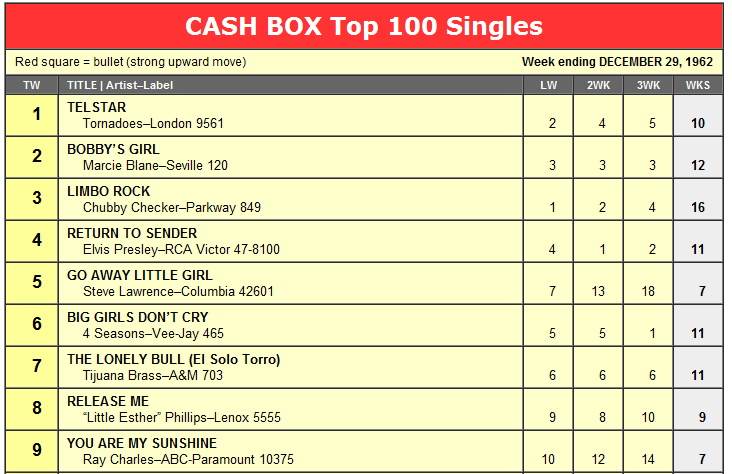
There’s a wonderful internet radio called Playa Cofi Jukebox that lets you play songs by years 1950-1989.  Nothing is required to play the music, and if you pick a year, you’ll get a link to the weekly record charts – for example here’s December 22, 1962, around the time I got my radio.  By the way, this goes to show you a flaw in my playlists.  Songs on 1963 have songs that first appeared in 1962.  If I was anal I’d remake the lists by absolute release dates.

cashbox-chart

The other night on the Grammys Maroon 5 and Foster the People sang two Beach Boys songs as a 50 Year Tribute.  Are songs from my youth still turning on young people after all these years?  I have no idea what these songs sound like without the nostalgia speakers I always hear them through.  Do they sound funny and quaint, or could they actually appeal to an eleven year old in 2012?

JWH – 2/20/12 (50th Anniversary of John Glenn’s flight into space)