The New Normal (NBC)–Now and Then

The New Normal – I love the title of this NBC show that premiered back in September, it says so much.  Makes you ask, “What was the old normal?”  Is there such a thing as normalness?  Having grown up back in the 1950s during the Leave it to Beaver and  Father Knows Best normalcy, I can remember a long parade of new television seasons where Hollywood tried to capture the new normalness of the American family every Fall for a half century.

(Some of the more famous shows about the American family from the last 50 years were My Three Sons, Andy Griffith Show, The Dick Van Dyke Show, The Brady Bunch, All in the Family, The Waltons, An American Family, Good Times, Little House on the Prairie, The Jeffersons, Eight is Enough, Family Ties, The Cosby Show, Our House, Married with Children, Full House, My Two Dads, thirtysomething, The Wonder Years, Roseanne,  Life Goes On, Family Matters, The Simpsons, Home Improvement, My So Called Life, South Park, That 70’s Show, The Sopranos, Family Guy, Freaks and Geeks, Malcolm in the Middle, Grounded for Life, Two and a Half Men, Weeds, Big Love, Jon & Kate Plus 8, Breaking Bad, The Secret Life of the American Teenager, Modern Family, Parenthood)

new-normal-2

But were Ward, June, Wally and the Beav ever a normal family?  ABC, CBS and NBC painted America as if everyone were WASPs (white Anglo-Saxon protestants)  in the 1950s, and even though my family was just as waspy, George, Virginia, Becky and Jimmy looked and acted like nothing we watched on TV.  America wasn’t lacking in people of color or various sexual orientations back in that black-and-white TV era, television just didn’t report on their normal day-to-day lives.  Some of those old gay couples getting married today were together back during the old normal.

TBDLEIT EC040

My parents were on the ass end of middle class, drank enough to be called alcoholics, fought and smashed things like Richard Burton and Elizabeth Taylor in Who’s Afraid of Virginia Woolf, and my and I sister ran wilder than any switch or belt could control.  Although television didn’t chronicle my family or anyone I knew, I think it did influence American society, and may have even shaped us.  TV showed us there was no such thing as normal.  Have you ever seen your family on TV?

Conservatives might swear to God that television news is biased to the left, and shows like The New Normal and Glee are propaganda for the liberal lifestyle, but television news reporting and fictional shows have always trailed the changes in society – they have never led the way.  Television has always been the fantasy of how we want to live.  I think America has always wanted television to chronicle the countless types of people that we are, and the accidental byproduct of all this voyeurism was that we have adapted to diversity.  Real life strangers would flair up your xenophobia, but put that same subculture or ethnic group on TV and they became endearing.

Real life and television life seems to have some kind of reverb going, with television echoing changes in society and stimulating society with its feedback.  The New Normal is about two gay men, Bryan (Andrew Rannells) and David (Justin Bartha) hiring Goldie (Georgia King) to be the surrogate mother of their baby.  This arrangement is far from new in the real world, or even on TV, but it’s taken for granted normalcy is a way to convince all those Americans who haven’t gotten the memo, that this is the new normal.

I find The New Normal just as comforting and pleasant as Leave it to Beaver, Father Knows Best or The Adventures of Ozzie and Harriet back in 1958.  These happy families, both then and now, make me feel good and wish all families were just as happy.  Like Modern Family, to which The New Normal is often compared, these and other feel-good liberal shows are designed to make us feel better about life in America in 2012, they are our Sunday School classes about how to be good people.  Our economic lives might suck, but at least we’re evolving as accepting and empathetic beings.

Sadly, this doesn’t work with everyone in our polarized society.  We’re still fighting the war between extreme religious belief and the Enlightenment.  I wonder what Descartes, Bacon,  Locke, Voltaire and Rousseau would make of our modern times, and what philosophical issues would they make out of our television shows?

father-knows-best

That’s the thing, I don’t think television initiates social change, but soothes us to accept it.  Many Americans don’t like gays or gay marriage, but as a whole, those attitudes are changing.  Last October, GLAAD released a report showing the 2012 television had the highest percentage of gay LGBT characters ever.  Not only are there more gay characters on TV, gay characters are finding more fans, and even the hateful grumpy people who protest their outrage are becoming fewer.

Television makes us comfortable with new ideas.  Television is an agent of integration, and I don’t mean that in just the racial integration sense, but in the integration of all change that’s going on in society.  Television is the spoon that stirs the American melting pot.

Television has been programming my social awareness since the 1950s, and it’s fascinating to contemplate all the changes the TV has made to America in the last fifty years.  If we had a time machine and could go back to 1962 and convince NBC to show The New Normal to America back then, how would it have been received?  Of course the show would be seen as a kind of science fictional view of the future.  There’s more new to The New Normal than two gay guys living together, and besides they did have gay people in 1962 so it wouldn’t have been a totally new concept, but they didn’t have surrogate mothers, or iPhones, video games, an African-American president, global warming, etc.  Change is relentless.

Remember, 1962 was before the sexual revolution of the 1960s.  The pill had just been released a few years earlier and it still hadn’t made it’s social impact.  If you watch The New Normal it has an whole spectrum of liberal ideals integrated into the show that would have been overwhelming to the “normal” people of 1962 to digest.  On the other hand civil rights and feminism had already begun by 1962, so maybe the viewers of 1962 would connect the dots between then and now.  And even though America was a technological giant in 1962, I just don’t think those 1962 TV viewers had any clue as what computers would do to our society.

Today we have hindsight to see how far we’ve come.  All too often we judge the citizens of the past by the morality and political correctness of today, but let’s reverse the tables.  How will people fifty years from now look back on us in 2012 and will they judge us harshly?  I’m sure in 2062 there will be a sitcom that’s the equivalent of The New Normal, and if we could see that show today, how would we react?

Liberal education marches on.  Will we ever reach an end and be perfectly enlightened?  I’m sure the seeds of future liberal standards of political correctness exist in our day-to-day life now.  Our treatment of the environment and animals will horrify our descendants.  Our polarized politics and fundamental religions will make the people of 2062 scratch their heads in amazement wondering how we could have been so irrational.  Our wasting of natural resources will be judged criminal.  But those are the easy issues.  What are the harder ethical issues we can’t discern with our quaint old-fashioned minds?

What will be the next new normal?

JWH – 12/10/12

Rejuvenation Delusions–Searching for the Fountain of Youth

This is one of those essays I occasionally write that get no hits.  Usually I don’t even publish them to the blog.  It’s a Sunday night and I’m tired.  I write this trying to capture how I feel, which is old, but how does one put that into words?  When I was young and met old people trying to recapture their youth I thought they were pathetic.   I knew they wanted young bodies and youthful vitality, but I didn’t know how it felt to have an old body or what it meant to be old.  I heartlessly felt no empathy for them, and now the chickens have come home to roost.

GBS

My two days of freedom from work are about over, and I feel depressed that I have only three hours to accomplished something but I’m too tired to do anything other than to write this.  I saw two tragic romantic movies this weekend, Anna Karenina and The Royal Affair – so I think I’ve overdosed on watching beautiful people leading passionate young lives, which makes me feel even older and more worn out than I actually am.

But you know what the weird thing is?  My mind is just as ambitious as ever.  The pain in my back and legs grows as I stand or walk, and I’m only good for about ten minutes of activity, but I daydream of hiking the Appalachian Trail.  My dick has reached those hilarious ED years but it still has an ambitious role in my idle thoughts, sort of like daydreaming what you’d do if you won the $500 million dollar lottery.  In other words, why should I think critically of people looking for the fountain of youth at the end of a plastic surgeon’s scalpel.  Nor should I think “dinosaur rock” when I see that The Rolling Stones and The Who touring again.

Like George Bernard Shaw said, “Youth is wasted on the young,” because you REALLY don’t know what the hell he meant until you get old.

That’s the vexing thing about life, we all  keep trying to be young way beyond our youth.  None of us want to just give up and die.  I’m reminded of a Vaughn Bode underground comic I read back in the 1970s, about a little cartoon creature that had been captured by an enemy who cut off his arms and legs, poked out his eyes, and left him in a dungeon.  In the final panel the little disfigured cartoon creature whispered to his fellow prisoner, “I’m going to escape when they go to sleep.”  In other words, we don’t give up no matter how pathetic and wrinkled we get.  Just pass the Viagra, Botox and amphetamines – we’re all Joe Gideon from All That Jazz until our hearts blow a gasket.

Now, is that pathetic or heroic?

You know what though?  I’m pretty sure I’ve written this all before, maybe even using the same words, quotes and similes, but my old fucking mind thinks its new.  Ha-ha.  Maybe we lose our memories so won’t just give up in frustration!

I still can’t capture in words what it means to feel old but think young, other than to say, “Tomorrow I’m going to buy an electric guitar and become another 1965 Bob Dylan,” or maybe I’ll join NASA and convince them geezers belong on Mars.  Or maybe I’ll just write a book about a 61-year-old ex-astronaut who buys an electric guitar to become a rock star.

I never did like that crazy witch Scarlett O’Hara, but she did have it right, “Tomorrow is another day.”

[Wow, I still have 90 minutes of weekend freedom to do something still.]

JWH – 12/9/12

Life of Pi–Is God the Better Story?

Director Ang Lee and screenwriter David Magee have done an excellent job of adapting Yann Martel’s 2001 novel Life of Pi to film.  When I read the book back in 2004 I thought at the time it would never be made into a film because the novel was too cerebral, too narrative heavy, plus, how could anyone get a tiger to do all that acting?

bengal-tiger

Life of Pi the film covered a surprising amount of the content of Life of Pi the book.  So far I can think of just three scenes I missed.  First, story of Pi’s family running into Pi’s three religious leaders.  Second, showing how Pi used turtles to survive, and finally, the scene where Pi is blind and hears people in another life raft.

Still, Lee and Magee beautifully succeeded with capturing the philosophical heart of the novel.  If you loved the book, go see the film, you’ll be surprised by how well it was filmed.

Is God the Better Story?

If you haven’t read the book or seen the movie, don’t read beyond this point if you plan do either, because I’m going to analyze the philosophical statement of the book and it will spoil the story.

In the main story, a boy from India, Piscine Molitor Patel,  who wants to be called Pi, is shipwreck in a lifeboat with a zebra, orangutan, hyena and a tiger named Richard Parker.  Martel tells us this story very realistically and we are expected to believe it happened. But along the way, Martel takes us through scenes that are very hard to believe, like the carnivorous island with the meerkats.

Yann Martel has crafted a Zen kōan into a novel.  Most kōans are short, “What is the sound of one hand clapping.”   Yann Martel essentially asks, “Is God the better story?”

At the beginning of the novel and movie, in a pseudo introduction, the author is told by an older Pi, that he can tell the author a story that will make him believe in God.  Yann Martel creates two stories, one very long, elaborate, fantastic, awe inspiring – and brutal, and a second that is short and brutal.  We are asked which one we prefer.  Martel is right, everyone, including realists like me, will pick the story with Richard Parker, the Bengal tiger.

So where does God come in?  How can this story make us believe in God?  Analyzing fiction for symbolism is tricky, but for me, Richard Parker represents God though analogy.  At the end of the film and novel, when Pi has told his long fabulist story to two Japanese insurance investigators they refuse to believe him.  So Pi tells a shorter, ugly version that we know is true, but hate to believe.  Then Pi asks the investigators which story they prefer.

We all want to believe in the story where Richard Parker existed because it’s a better story than the one of madness, murder and cannibalism.

So what about the prediction at the beginning, that the story will make us believe in God?  I believe Yann Martel uses the desire to believe in Richard Parker as a stand in for God, creating an analogy, that the readers and audience must make on their own.  Pi desperately wants to believe in God.  Pi asks us to believe in Richard Parker because the story of surviving in a lifeboat with a tiger is a better story than going mad and surviving alone.

The whole point of the novel is to trick the reader into the question:  Which story do you prefer.  Of course everyone prefers Richard Parker to be real.  By transference, we’re ask to accept that belief in God is the better story, just like how we want to believe that Richard Parker existed.  We’re never explicitly told that wanting to believe in Richard Parker is the same as wanting to believe in God, but I feel it’s obvious.

Yann Martel tells us people prefer religion over reality because the story of God is a better story than reality.  And I ask:  “Is this why people refuse to accept the fact of evolution because they prefer the story with Richard Parker – oh, I mean God?”

The novel is an elaborate metaphor to explain why people believe in God.  It doesn’t say that God exists.  Nor do we know what Yann Martel believes.  It just says people prefers belief in God because it’s a better story than how we see reality directly.

What the novel is tricking us into confessing is that the belief in God, no matter how unbelievable that story might be, that it’s a better story than reality.  That when we’re pushed to the ends of our physical and mental limits, we want God even if he’s cruel, vicious and indifferent.  That the belief in God is what gets us through this life.

Has Yann Martel stacked the deck?  Is God the better story?  Yes, reality does sometime involve madness, murder and cannibalism.  And even in the God story, people die, animals are cruelly killed and eaten, people suffer.  If the audience was given the Richard Parker story, and a documentary about the evolution of the universe with cosmology and the evolution of life on Earth with evolutionary biology, is God still the better story.  I don’t think so.  Richard Parker is like a magician’s diversion.  If you could watch this movie and blot out the tiger, the reality of Earth is magnificent!  Richard Parker and God divert our attention to our fantastic reality.

God is only the better story when you don’t understand reality.  Richard Parker is ferocious, terrifying, cruel, indifferent and doesn’t answer prayers.  No matter how much Pi loves Richard Parker and wants his recognition, Richard Parker ultimately refuses to acknowledge Pi’s existence.

So why is God the better story if Richard Parker just walks away from us?  I know many people who have long given up religion but haven’t given up on God.  They say that God must have created us but walked away from the universe and is no longer involved.  Personally, I’m confident there is no God and the size, age and origin of reality is beyond our understanding.  I find it far more comforting to know the rules of our local universe and not feel the need to blame a superior being for bad things or beg for good things.  If a bacteria, shark, drunk driver hurts me badly, I just accept it was the luck of the draw and not a judgmental deity deciding I had done something wrong.

Where the metaphor of Richard Parker breaks down is Pi can see Richard Parker, and we never see God.  It’s actually easier to believe in Richard Parker than it is to believe on God.  Life of Pi is a wonderful novel.  I’ve read I twice now.  And each time I want to believe the Richard Parker story, even though I know the truth is the story about cannibalism.  How many times will I have to read this book before the realistic story is the better story?

What if the novel and movie had been about a boy that survived 227 days on the ocean and had endured the incident with cannibalism and madness and survived.  No tiger, no zebra, no hyena, no orangutan, just Pi, his mom, the Frenchman and the Buddhist sailor?  It would have been brutal, but the success of Pi surviving the ordeal would have been just as magnificent.

Why do we want a better story?  Santa Claus is a better story than parents buying kids Christmas gifts from Target.  The tooth fairy is a better story than throwing milk teeth in the garbage.  Heaven is a better story than dying.  But why is God a better story than reality?  Is God a better story than evolution?  If you understood evolution and cosmology, God isn’t the better story.  God is a simpler story, and God’s story is endlessly confusing and contradictory.  It’s just God is fantastically powerful like Richard Parker.

Even though I disagree with Yann Martel’s assertion, I love his fiction.  See, that’s the real revelation in this.  Fiction is the better story, and Life of Pi is very good fiction.  Humans embraces fiction with an intense passion.  Richard Parker is a better character than a cannibalistic Frenchman.  And for many people, all the stories about God, are a better story than the brutal aspects of reality.  However, there is nothing in fiction that comes within light years of evolution.  All stories about God are just crude children stories compared to the complexity and beauty of evolution.  Evolution is just as brutal as the Old Testament God – it’s just not personal.

Here’s the final kōan:  Did Yann Martel write this story to make us atheists or make us believers in fiction?

JWH – 11/28/12

Treating Back Pain Without Drugs

Most people I meet with chronic back pain only fight the pain with drugs.  I’ve discovered some other techniques to try.  Overall, what I’ve learned is my back is trying to communicate with me and all pills do is tell it to shut up.

I am not a medical expert of any kind.  I’m only recounting my personal experience with living with back pain.  I’ve greatly benefited from going to physical therapy (PT) and the training the PT doctors gave me to do daily exercises on my own.  Although you can find all kinds of PT exercises for back pain online, I highly recommend talking to a doctor before doing any exercise if you are suffering from chronic back pain.  The point I want to make is I’ve discovered some ways to avoid back pain without depending on powerful drugs.

Years ago when my degenerative back disease began and I was in a lot of pain I took prescription pain pills and muscle relaxers, but when I learned my condition was chronic I stopped taking those pills

I have three kinds of symptoms:

  • inflammation/tension/tightness (lower back)
  • numbness/nerve sensations (foot and leg)
  • muscle pain (lower back, hip, leg)

The inflammation/tension/tightness is almost always present in my lower back but in varying degrees of discomfort.  If things get worse, my foot goes numb and the numbness works up my right leg.  When things get even worse, my left leg goes numb too.  When things get really bad I have increasing constant dull pain and infrequent sharp shooting pains in my lower back, hip and leg.

I can keep the sharp and shooting pains away if I do my PT exercises daily, do regularly rowing exercises on the Bowflex, and if I don’t walk or stand for longer than 10 minutes.

I can keep the numbness to a minimum if I take B vitamins and exercise regularly, and don’t stand straight or lie flat for any length of time.

I used to keep the inflammation/tension/tightness to a low level with anti-inflammation pills, over-the-counter pain pills and regular PT exercises.  However in recent months the anti-inflammation pills have messed up my stomach and intestines and I’ve had to stop them.*[See update below]  I’m learning how to keep this kind of pain at a minimum without those drugs by carefully babying my back and not inflaming it.  No lifting, lots of rest, more exercising.

I now ask younger people to lift stuff for me, and I even take the elevator sometimes.  I’m getting old and creaky.

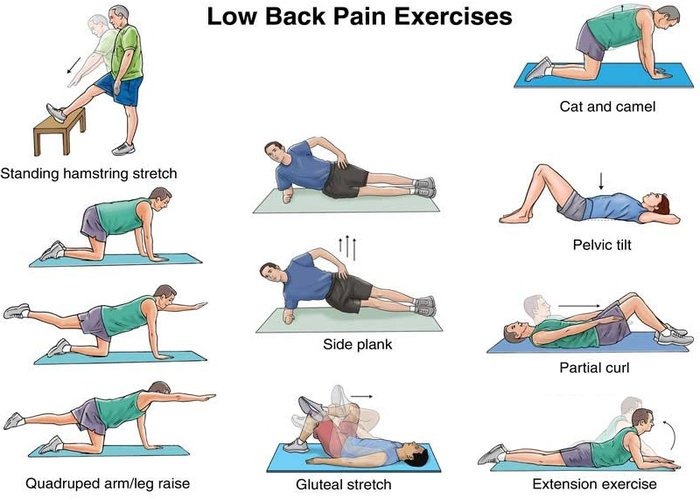
The exercises I learned from my PT classes are very simple, like these:

back-exercise

I’m writing this because I’ve had to stop taking any anti-inflammation medicine because it’s tore up my stomach and intestines, and I’ve learned that I can get about the same relief without those drugs if I’m careful.  Although my doctors have prescribed some powerful pain pills I’ve avoided taking them.  I have lived off of various anti-inflammation drugs over the last few years, but I can’t take them anymore.  Doctors keep prescribing drugs that are easier on the stomach, but evidently my stomach is on the wimpy side, or years of taking pills have beaten it up badly.

I’ve always liked the anti-inflammation drugs because they reduce the feeling of inflammation and tension in my lower back, but when I had to quit these drugs I realized that those drugs were the cause of some of that inflammation.  Taking a pill would reduce the tension, and the wearing off the pill hours later would make it spring back.   After several days of not taking the anti-inflammation pills, I had much less inflammation and tension.  I’ve started and quit several different kinds of anti-inflammation pills and I’ve noticed this affect twice now.

Lower back tightness and inflammation builds up during the workday, especially when I do a lot of walking and standing, and time and again I’ve discovered I can quiet my back by just exercising and/or resting.  That made me think some of the stuff I was feeling as inflammation was drug withdrawal or drug craving.

I’ve been dealing with my back problem for years and it’s a degenerative disease.  Walking, standing, or lying flat makes my back worse, so I’ve learned to live with limitations by altering my lifestyle.  For instance I no longer sleep in a bed.  Sleeping in a recliner significantly reduced my daily pain.  Not walking for exercise reduced my pain.  Getting a better office chair at work and home help too.

I also bought Z-Coil shoes and they have been a huge help.  Before I got Z-Coil shoes when my back was stressed I’d get weird sensations when walking.  I’d feel like I was stepping into a hole or sliding on ice with some steps.  I assumed I was compressing a nerve.  The Z-Coil shoes act like a shock absorber so I don’t compress the nerve and feel those weird sensations.  I also tried Gravity Defyers but their springs weren’t powerful enough to help me.  Z-Coil springs are very large and visible so they are very ugly shoes, but I wear them because they let me keep working, and they let me walk further than I can without them.

Z-Coil shoe
Z-Coil shoe

I’ve tried all kinds of drugs over the years, various pain pills, muscle relaxers, and anti-inflammation meds.  For my particular problem I’ve learned that physical therapy is the most effective treatment.  I do take an occasional Tylenol or aspirin, but daily PT is best.  If I don’t do my PT my back will slowly tense up, and over days I’ll get hip pain, pain down the leg, and numbness in my foot, and then a lot of lower back pain.  When the pain is very bad I have a hard time getting up or down.  Doing daily physical therapy keeps the worst pain away.

I seldom skip my daily PT, and when I do, I regret it.

I still have a certain amount of discomfort, but not the major pain.  I’ve learned I need to do  Bowflex exercises once a day to reduce a lot of tension in my lower back and fight off leg numbness.  I do a rowing exercise daily, just 130 strokes.  I’ve also learned from trial and error that taking a B-complex vitamin reduces the numbness in my foot and leg.

The last technique I’m working on to help myself is losing weight.  I’ve been overweight for decades, and at 235 pounds, just existing is like carry two sacks of cement with me at all time.  However, feeling bad makes me eat, so I’m always gaining weight.  When I get up to 240 my back gets much worse and that pain makes me diet for awhile.  As I drop back to 230 it gets better, I treat myself to junk food, and then I yo-yo back up to 240.  I’m hoping in the next year to get down to 200.

My back doctor has told me time and again to avoid surgery at all costs.  And before I consider surgery to try nerve block shots.  I’ve never liked the idea of nerve block shots and now they are in the news because of contamination, I doubt I’ll ever try them.  I did hear about a new surgical technique that’s just finished clinical trials and could come online in 2014.  The new technique involves regenerating the discs in the back, and I like that idea.  So I’m hoping exercise and losing weight will keep me going until this new technique is FDA approved and my insurance covers it.

JWH – 12/2/12

*Update 1/16/14

Last year I learned I had problems with gluten and gave it up.  I did it because of stomach and chest pains, which went away immediately.  But over the weeks of going without gluten I realized my inflammation was much improved and much of my joint pain had disappeared.  My knees seem twenty years younger.  I still have problems with the spinal stenosis, but much of my other pain has disappeared.  Over time going without gluten has made me feel much better.

I’ve told some of my friends about pain reduction through avoiding gluten, and one lady who had regular joint and arthritis pain gave up gluten and she reported she was eventually able to go without her pain pills.  If you have chronic pain of any sort, you might experiment with going gluten free and see if it helps.

Table of Contents

Is Heinlein’s Have Space Suit-Will Travel Satire?

Over at Locus Online, Gary Westfahl has proposed a new theory about Robert A. Heinlein in his essay “The Joke Is on Us:  The Two Careers of Robert A. Heinlein.”  Westfahl proposes:

Thus, I wish to argue instead that there were, in fact, only two periods in Heinlein’s career: from 1939 to 1957, Heinlein wrote science fiction, and from 1958 until his death in 1988, Heinlein wrote satires of science fiction. Or, if that language seems too strong, say that from 1939 to 1957, Heinlein took his science fiction very seriously, and after that, he no longer took his science fiction seriously.

Now Westfahl didn’t say Heinlien wrote satires, but satires on science fiction, and even makes a case that Heinlein is parodying his own earlier work.  Westfal starts his essay by claiming Heinlein is a golden age science fiction writer that still has impact:

Still, there is at least one classic writer that every science fiction reader must come to terms with; for when you visit a bookstore today, the science fiction section may have only a few books by Jules Verne and H. G. Wells, or even Isaac Asimov and Arthur C. Clarke, and there may be few signs of their influence on other writers. But the works of Robert A. Heinlein are still occupying a considerable amount of shelf space, and the evidence of his broad impact on the genre is undeniable.

I don’t agree.  Heinlein has always been my favorite SF writer, but I’ve watched his reputation’s slow decline in recent decades.  I am totally open to reevaluating Heinlein’s work like Gary Westfahl has done, but not to explain Heinlein’s continued success, but to rescue Heinlein’s work for contemporary readers.  I think we need to find and recognize Heinlein’s best work that will appeal to new readers.  In our Classics of Science Fiction Book Club we have many Heinlein fans but far from most, and his popularity is on the wane, especially with younger readers.

I don’t think repackaging Heinlein as a satirist will sell or fly.

Heinleinface

Claiming Heinlein’s later work is satire is not new, William H. Patterson Jr. was the first one I remember proposing this idea in his book The Martian Named Smith back in 2001.  But I’m sorry, I just don’t buy the satire theory of Heinlein.  To me Heinlein was always as serious as a rattlesnake, and even when he was being light hearted, as he was in Have Space Suit-Will Travel, a book for children, he was dealing with kidnapping, murder, torture, genocide and destroying planets.  Heinlein worked awful hard to make that book realistic, even though it had a silly title.

Westfahl believes Citizen of the Galaxy, the 11th juvenile was the culmination of Heinlein’s expansion of stories moving away from Earth starting with Rocket Ship Galileo.  However,  Have Space Suit-Will Travel went further than Citizen of the Galaxy, by leaving the Milky Way.  Have Space Suit-Will Travel is the logical conclusion of the series.  Starship Troopers is the first retreat.   Starship Troopers is the first of the preachy Heinlein novels.  Starship Troopers it the first of Heinlein’s books where Heinlein is flat out on his soap box arguing his philosophy and politics to the reader.  Starship Troopers is Heinlein’s first Putnam novel.

And that preaching has always been in Heinlein’s work, but I believe editors always reined Heinlein in until he went to Putnam.  Once Heinlein moved to G. P. Putnam, we finally get to see the naked Heinlein.  I don’t think he wanted to wear court jester attire, he was a nudist.  When Heinlein’s characters propose killing people for being rude I don’t think Heinlein was trying to be funny or satirical.  I think he really meant we should shoot rude people.  And this horrifies me.

Even at the end of Have Space Suit-Will Travel, when Kip is before the galactic tribunal and Earth is being judged, Kip gets mad and tells them, “All right, take away our star–  You will if you can and I guess you can.  Go ahead!  We’ll make a star!  Then, someday, we’ll come back and hunt you down—all of you!”

That wasn’t satire.  Heinlein meant it.  Heinlein has always believed that homo sapiens are the most dangerous creature in the galaxy.

The Daily Show is satire.  Saturday Night Live is satire.  Satire is something liberals do.  I don’t think deadly serious conservatives do satire.  When Heinlein was younger he had some liberal in him, but I’m pretty sure most of it was gone by 1958.

If you read Heinlein from beginning to end, over and over again, you’ll see he had certain pet ideas that were always present in his stories.  I believe Heinlein changed his writing style to fit his publisher.  In the early days those were pulp magazine editors.  Then he started writing for the slicks after the war, and finally snagged a lucrative deal at Charles Scribner’s Sons in 1947 and wrote twelve amazing juvenile novels.  Heinlein’s writing was confined by Alice Dalgliesh, his editor while at Charles Scribner’s Sons.  In the 1950s he also wrote a handful of adult books for Doubleday, and they were different from the Scribner titles.  Finally he went to Putnam, and his writing changed again.  I think Putnam let Heinlein be Heinlein.

Heinlein always claimed his number one reason for writing was money.  But after he got money, I think he wanted to express his own ideas.  As he got older, I believe Heinlein started expressing his personal fantasies.  I think all his later books are his own personal power and sex daydreams.  I don’t think Jubal Harshaw was Heinlein, but I believe Heinlein wanted to be Jubal Harshaw.

I believe Heinlein changed after Sputnik too, like Gary Westfahl suggests, but for different reasons.  Heinlein was savvy enough to realize that NASA was going to invalidate much of science fiction before the 1960s.  Heinlein knew space science was going to change science fiction and he wanted to be ahead of the curve, so he started writing social science fiction, political science fiction, sexual science fiction, fantasy science fiction, and got away from writing space travel science fiction.

Personally, I believe Heinlein’s writing got sloppy as he got old, and lost his ability to write structured novels.  He never was great at the structure of fiction, but the editors at Putnam let him run wild.  I don’t think Heinlein ever wanted to be Jonathan Swift but Patrick Henry.  Later in life Heinlein claimed his essential books were Starship Troopers, Stranger in a Strange Land and A Moon is a Harsh Mistress.  Oh, I agree some of Stranger does seem satirical, like the scenes with the angels, but I believe that was Heinlein being sentimental, more like A Wonderful Life for grownups.  Most of Heinlein’s political drama is simplistic, like out of a 1930s Frank Capra flick.

I believe all the scenes with Harshaw are Heinlein talking straight.  I believe the scenes with Mike are Heinlein’s power and sex fantasies.  The Fosterite Church scenes could be labeled satire on 1950s television preachers, but what is he satirizing?  One of Heinlein’s pet ideas was proving that the soul existed after death.  Do people attack beliefs they want to be true?  Mike, Foster and Digby become archangels in the end.  Is this satire or sentimentality?

Is Heinlein attacking “Thou art God” philosophy or proposing it?

Satirical writers have a target in mind for their writing.  They want to destroy people and ideas with humor.  Heinlein was cynical and angry, and didn’t think much of the average man, but I don’t think he was trying to kill people with humor, if Heinlein wanted to kill people he’d use a gun.  Heinlein was as funny as William F. Buckley, Jr.  Heinlein never struck me as a George Carlin, Jon Stewart, Stephen Colbert, or even a Mark Twain.

Although Heinlein is my favorite writer, I’ve always felt he went downhill after he went to Putnam.  None of the Putnam books strike me as funny or satirical.  Heinlein is attacking people, ideas, customs and society, but I don’t believe its with humor.  Humor is a funny thing in that what I might not laugh at someone else will.  Maybe I’m just missing the satire.  Heinlein always seemed to be about getting what he wanted.  He was bad about developing conflict, and generally created faceless straw men to knock over.  Satire is all about the details of the enemy, and Heinlein was always about the details of people who got ahead and took what they wanted.

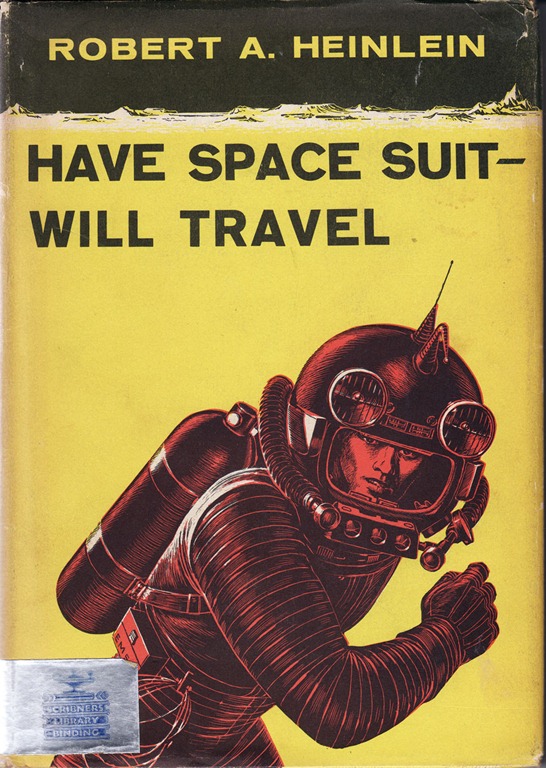
have-space-suit---will-travel

Have Space Suit-Will Travel has always been my favorite book because its about the overwhelming desire to go into space.  It’s about a boy wanting to go to the Moon, and I grew up wanting to go into space myself.  I took this novel seriously, even though it had a funny title.  Have Gun-Will Travel was a favorite show as a kid, and it wasn’t funny either.  Much of Have Space Suit-Will Travel is about space suits.  I loved those details.  Have Space Suit-Will Travel was a power fantasy for me at 13.  It was a story I wanted to live.

It never occurred to me to think Have Space Suit-Will Travel is satire.  What I worry about now is modern minds looking back on those old books and thinking them silly, and concluding the author must have written them for laughs.   And I can even see why Gary Westfahl claims Have Space Suit-Will Travel is poking fun at science fiction because in modern eyes the story might seem quaint, goofy and naïve, but back in 1964 it was my Bible, my dream, my fantasy for the future.  I would have exchanged places with Kip in a heartbeat.

I don’t consider Have Space Suit-Will Travel poking fun at science fiction, I consider it the ideal expression of science fiction.

JWH – 11/30/12