
by James Wallace Harris, 8/18/25
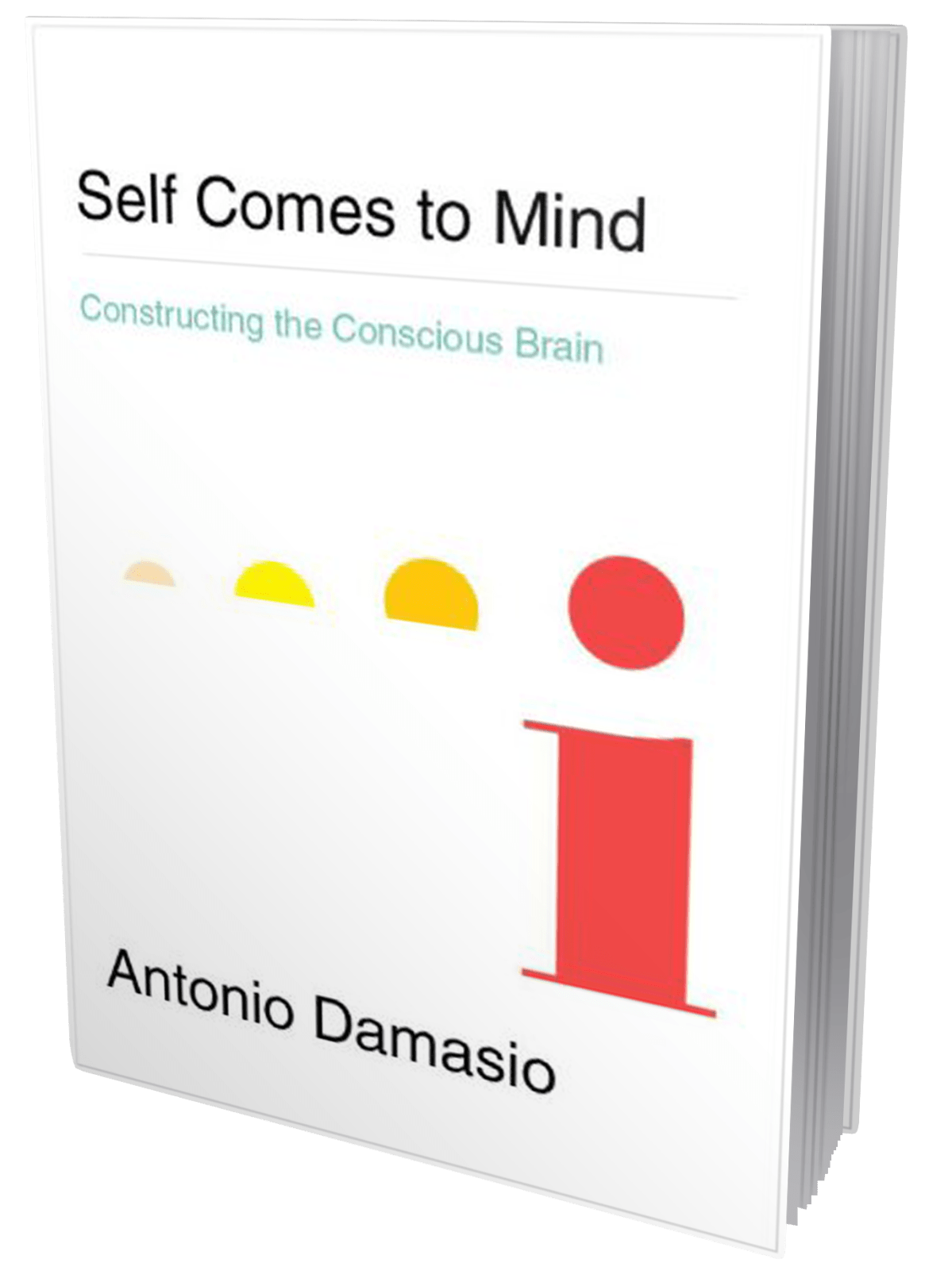
I began work on the project I described in my last post (“What Should I Major in at Old Age University“) by looking through the books in my bookcases for titles that fit the project. The first one I found was Self Comes to Mind by Antonio Damasio. After reading a few pages, I wanted to hear it. I bought the audiobook. After listening to fifteen pages, I knew this book was one I wanted to study thoroughly. I purchased the Kindle edition so I could highlight the passages I wanted to remember.
I was particularly taken with this paragraph:
We all have free access to consciousness, bubbling so easily and abundantly in our minds that without hesitation or apprehension we let it be turned off every night when we go to sleep and allow it to return every morning when the alarm clock rings, at least 365 times a year, not counting naps. And yet few things about our beings are as remarkable, foundational, and seemingly mysterious as consciousness. Without consciousness—that is, a mind endowed with subjectivity—you would have no way of knowing that you exist, let alone know who you are and what you think. Had subjectivity not begun, even if very modestly at first, in living creatures far simpler than we are, memory and reasoning are not likely to have expanded in the prodigious way they did, and the evolutionary road for language and the elaborate human version of consciousness we now possess would not have been paved. Creativity would not have flourished. There would have been no song, no painting, and no literature. Love would never have been love, just sex. Friendship would have been mere cooperative convenience. Pain would never have become suffering—not a bad thing, come to think of it—but an equivocal advantage given that pleasure would not have become bliss either. Had subjectivity not made its radical appearance, there would have been no knowing and no one to take notice, and consequently there would have been no history of what creatures did through the ages, no culture at all.
Damasio, Antonio. Self Comes to Mind: Constructing the Conscious Brain. Knopf Doubleday Publishing Group. Kindle Edition.
I want to know everything Damasio is telling us. I want to remember it. I was never a good student, never good at remembering information for tests, and at age 73, my memory is like a sieve. There are both comprehensive barriers that I can’t overcome, and limitations to the knowledge I can digest and maintain.
To maximize my reading concentration, I concurrently listen to an audiobook edition while following along with the printed page with my eyes. Although Damasio’s prose set my mind on fire, I can’t paraphrase what I just read. I can vaguely say that he describes what he thinks the mind is and makes a case that feelings are an important aspect of understanding the mind. I remember that because I wondered if AIs can ever become conscious without feelings. Feelings must be tied to biology.
If I’m ever going to learn and remember what I read, I need to go beyond the momentary exposure to ideas I get through simple reading. It seems comic, or should I say tragic, or maybe ironic, or even pointless, that I’m finally getting down to developing study habits at 73.
The only way to prove you know something is to teach it. Teaching a topic requires comprehension. I feel that when reading, I do comprehend, but that’s probably a delusion. One way to explain something is to give an analogy that makes the idea understandable. Another method is to create an infographic, chart, or diagram.
Yesterday, when I set my goal to understand how my personality developed and to explain why people are delusional, I didn’t say I wanted to teach what I learned. I did write that my final proof of accomplishment is writing a thesis on what I learned. That is a kind of teaching. It makes allowances for my quick-to-forget brain.
Reading gives the illusion of “Oh, I see,” and then you forget. I need to develop a note-taking system. And I think I need to mindmap what I read. I need to knuckle down and learn Obsidian. That’s a note-taking software program that allows for hyperlinks. And other tools will help me organize and temporarily remember information so I can summarize what I learn in prose.
But I really need to amend my goal. I don’t think I can say I learned anything unless I can teach it to someone else by conversing with them. I know mansplainers are looked down on, but I’m terrible at explaining things verbally.
I can write blogs because I have all the time I need to compose and revise. I can look things up. Explaining things in a lecture, or even a conversation, involves memory and comprehension at levels I cannot muster.
I need to go beyond reading. I need to go beyond writing. For my study project, I need to get into teaching. Since I don’t want to become a boring mansplainer, I need to learn the art of the Socratic dialogue.
JWH
 Auxiliary Memory
Damasio’s quote describes nothing albeit if flowery language. I have tried to read Damasio before and never got much from his writing. So I don’t think it is your comprehension that is the problem, but his inarticulateness.
Consciousness is a difficult concept to define, describe, measure, and utilize.
As far as teaching to learn goes, that’s a wonderful strategy and there are many ways to teach like writing your articles on your blog which I always get a lot out of. You are a very articulate article and I notice that your narrative style seems to be “subjective” because you share many of your ideas with “I” sentences. I like this style. It seems to work well for you and the reader.