My Problem with the Terms “Evil” and “Free Will”

by James Wallace Harris, 11/8/23

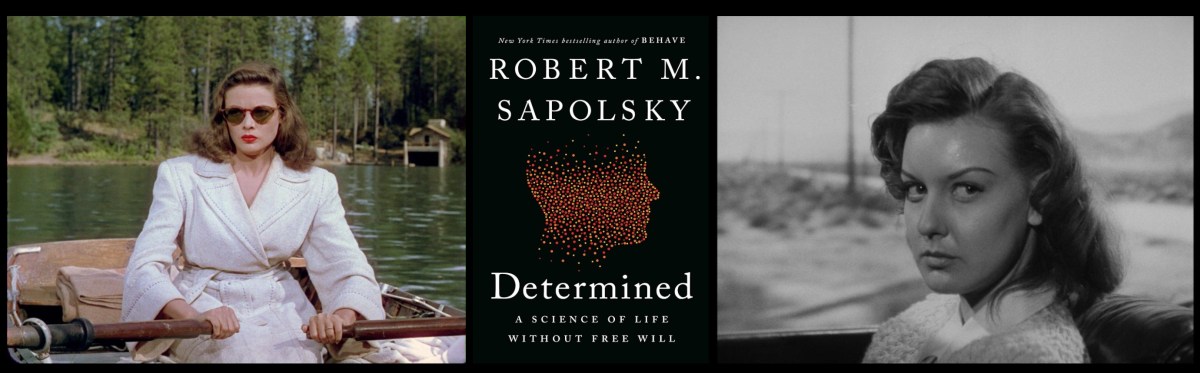
Yesterday my friend Mike and I were talking about evil women characters in old movies. We both immediately thought of the character Ellen Berent Harland (Gene Tierney) in the 1945 film, Leave Her to Heaven. I told Mike that I had just read a review of Detour, also from 1945, that featured one mean woman, Vera, played by Ann Savage. The reviewer said she was the evilest woman in all of film noir.

This got me Googling the phase “evil women in the movies” and finding several lists: 25 Of The Best Female Villains You’ll Love To Hate, The Greatest Female Villians, 10 Awesomely Sinister Women in Movie History, Most Memorable Female Villians. Not to surprising, most of the films listed were recent. What was surprising, was most modern female villians are from fantasy, horror, or animated films. Mike and I were thinking about ordinary realistic women in films.

Mike texted me:

I make a distinction between evil and insane. For example, Kathy Bates in Misery, Jessica Walter in Play Misty for Me, and Glenn Close in Fatal Attraction play characters that I consider insane, not evil. The Barbara Stanwyck character in Double Indemnity is not insane, just evil. The same goes for Gene Tierney in Leave Her to Heaven.

I texted back:

Evil is a slippery word for me. In the original religious term God was the source of all good and the Devil was the source of all evil. Being evil meant you were doing the work of the devil. It connotes that the person is a puppet of the devil. Or worshipping of the devil by doing the kind of things he wanted done. Being evil meant being devilish.

By the way, in the old days being insane meant being possessed by the devil. So judging someone evil or insane was close to the same thing.

In the modern sense of how we use those words it all relates to free will. An insane person has lost control of their free will. An evil person chooses to do evil.

But we have a problem. Recent research suggests no one has any free will. 

Now, our fun conversation has turned serious, but I think valid. If we don’t have free will, how do we judge people we think are doing wrong? I just bought the book Determined: A Science of Life Without Free Will by Robert M. Sapolsky but haven’t read it yet. However, I have been reading reviews and watching interviews with Sapolsky. What he’s saying is based on brain research that I’ve been reading about for years. We don’t have free will. The trouble is our moral and ethical structures depend on people either being sane and deciding on their own actions, or insane and out of control. What if we have no control over our actions at all?

The nightly news is full of people I’d call evil. What if we took a different approach to the problem. What if we say killing innocent children is evil no matter if you have free will or not. Does it matter if the evil person is consider sane or insane? Or has free will or not? What we’re horrified by is bad things happening to good people.

Modern films have made evil rather cartoonish by portraying the bad guy as over the top in their evilness. The films Mike and I were talking about, Leave Her to Heaven and Detour, are mundane portrayals of evil. I think the gigantic evils we see in the news, and the unrealistic portrayals of evil in modern movies, have made us forget the everyday type of evils. We no longer expect everyone to be honest and civil, and bad behavior is often claimed to be free expression and a personal right.

I don’t like what I see on the news, or in modern movies and television shows. And the behaviors I’m seeing on the freeways and while shopping is disturbing too. Maybe we don’t have free will, but we could at least act like we do. Maybe pretending to be good is all we can hope for.

I’m reminded of a science experiment I read about back in the 1960s where they put many rats in small confined cages to simulate overpopulation. The rats became violent, tearing at each other. I think that’s what’s happening to us today. Overpopulation is causing us to go mad. But that also supports the argument that there’s no free will.

Even though neuroscience is revealing there’s no free will, I wonder if free will isn’t something we could develop? Can we overcome genetics and conditioning? Is there some way we can consciously reprogram our unconscius minds. The reason why scientists say we have no free will is because they can measure brain activity happening before we’re consciousnessly aware of our choices and actions. Is there no way to condition our unconscious minds to act in the ways we consider ethical?

It’s obvious that any adult who follows the same beliefs they were taught as a child is not acting on free will. Most people believe what they are taught early in life. But if they radically change what they believe, is that a case of free will? If someone raised a Baptist grows up and spends many years trying out different religions, and ends up choosing to become a Zen Buddhist, is that free will?

When you watch movies think about whether or not the antagonist is acting on their own, or from genetics and conditioning. Do the same when you are watching the news. Does Putin have free will? The current war in the middle East is just like all the wars of history. Maybe we don’t change because we can’t.

Still, the idea of being able to change ourselves intrigues me. Science might prove we don’t have free will, but does that mean we should stop trying to change ourselves?

I’ve been paying attention to my dreams lately, so I’m getting to know my unconscious mind. I’m also working on developing good habits and breaking bad habits. And I think there are ways to reprogram how our unconscious minds function. If we could, wouldn’t that be an act of free will?

JWH

Can’t Find My Way Home Dreams

by James Wallace Harris, 10/31/23

I have a recurring dream where I can’t find my way home. These dreams take various forms, and I’ve been having them all my life. We moved around a lot when I was growing up, and those old dreams were about me trying to find my way back to our house in Lake Forest subdivision, in Hollywood, Florida. There was an obvious reason for those dreams by my younger self. That was my favorite house when I was growing up and I wanted to go back there. After I became an adult and went back to that house once, I stopped having those dreams.

In recent years, I-can’t-find-my-way-home dreams usually involve turning down a street that I don’t know and trying to get back to the part of town that I’m familiar with. But I get further and further lost. Variations on this dream involve being in a shopping mall and trying to find my way out. I can’t find the exit doors, so I start looking for back doors to the outside in the individual stores, but end up in rooms with no windows, smaller attics, and dark closets. I rush from room to room trying to find an exit, any exit. Each time I keep finding smaller and smaller rooms, and the possible exits to these rooms get harder and harder to find. Sometimes, I end up in a dark room. I usually wake up feeling frustrated.

The other night I was on a bike. I was riding down a familiar street, and I turned onto another street, and I was suddenly in an unfailiar downtown with freeways and busy streets and I didn’t know where I was at all. I tried to retrace my route but that didn’t help. I looked up at the sky to see where the sun was, to discern north and west, figuring I’d head east until I saw something I knew, however, I never found anything I knew. Then I remembered I had a smartphone with Google Maps. I got it out, but I couldn’t use it to get to the maps app.

This wasn’t the first time I tried to use a smartphone in a dream. It’s always frustrating because I can’t make it do what I want. And the screens are never clear in the dream — just blurry photos and text. In one dream I kept trying to call my wife, but I couldn’t remember the number and then thought I had her phone and calling it wouldn’t do any good.

Sometimes I can fly, and try to fly home, but I get frustrated because I can’t fly high enough to see where I am. In these dreams I’m constantly moving forward, overcoming one obstacle after another, always getting more frustrated as I feel more trapped. Often, I have to transverse water — pools, canals, and rivers. I used to be afraid of water in dreams. For many years I had a dream about trying to drive across an exceptionally long and tall bridge, but whenever I got to the middle of the bridge the water would rise and wash me away. These dreams would begin when I was far away from the bridge, but I could see it in the distance, rising in the sky, crossing an expanse of water, an ocean even, where I couldn’t see the other side. I’d always have to psyche myself up to drive across these bridges, and when I was ready to go, I’d put the peddle to the metal thinking the only way was to race across as fast as I could. I haven’t had this type of dream in years. They were common in my middle years.

Since retirement, the dreams of finding my way down unfamiliar streets, or maze of rooms or offices, or flying over houses and buildings mostly felt about being lost and not getting somewhere. I assume that means I’m frustrated about something in life. But what?

I found this website, “Lost Dream Meaning: Dreams About Not Being Able to Get Home.” Not only is this a common dream type, but there are many sub-types to this dream. Most of the explanations remind me of the kind of generic explanations you see in astrology columns. These two paragraphs do resonate, or could:

On the other hand, being lost in a dream may also reflect all the distractions in your life that have caused you to lose your direction or sense of purpose. You are going off on a digression, distracting you from seeing the entire picture. 

Do you feel as if you are just wasting your time or your life is simply going in endless circles? This may be a warning dream concerning the potential bad choices you are about to make that may lead you astray.

Since retiring from work, I do feel I lack direction, or purpose. I do feel my retirement days are going nowhere, that I’m just spinning my wheels until I die.

Here’s an explanation for getting lost while driving:

Are you driving in your dream when you get lost? This may represent the decisions or plans you have that may have been fallen victim to distractions. Perhaps you lose sight of the whole picture and gave too much of your focus on every little detail.

This also resonates. I do feel my life is one of pursing lots of fun distractions. When I first retired, I thought I would pursue specific goals and spend my time at useful work.

Here’s what they save about dreaming about getting lost in a forest, something I don’t think I do.

If in your lost dream you are lost deep inside a forest, this may symbolize feelings of being overcome with confusion. You may not know where to start addressing a problem in your waking life. Likewise, you are at loss on how you can get yourself out of a difficult circumstance. It’s as if you feel like there are no possible solutions and nobody is around to help you out. It seems like you have completely lost your way in your waking life.

Yet, it still fits. Like I said, a lot of this woo-woo stuff is so generic that it could fit anyone. I often wish I could escape our reality of war, political polarity, climate change, environmental collapse, and other problems that I can’t control. But then neither can anyone else.

Which makes me ask: Are you having dreams like mine? I would think the explanations for these dreams would apply to most people, which means most people should be having these kinds of dreams.

I wonder if on the days where I get something done, and feel satisfied with that day, I won’t have dreams about not finding my way home that night? I should pay attention to what I dream after each kind of day. Who knows, maybe I could see a pattern and decipher my own unconscious.

I notice my dreams a lot more in old age because I must get up in the night frequently to pee. I’m starting to notice that I have certain kinds of dreams. Can’t find my way home dreams are just one kind. Another kind that’s showing up more often is dreaming about people that I knew a long time ago. Of course, one of my most frequent type of dream is searching for a bathroom, but that’s logical with my pee situation.

I wonder if dreams matter. If I didn’t pee so much at night, I doubt I would even know I had them. Maybe, they aren’t meant to be consciously examined. On the other hand, they do feel like some kind of communication.

JWH