Rethinking Going Paperless

By James Wallace Harris, Friday, June 12, 2015

Back in 2008 I started a series of essays about Going Paperless. I cancelled the paper, let all my magazine subscriptions run out, worked hard to convince junk mail senders to stop sending me crap, got off mailing lists, and did whatever I could to stop the flow of paper into my house. I greatly reduced my usage. It made me happy. My paper recycle box usually takes weeks to fill.

Then about a year ago, I got a couple magazine offers so cheap I couldn’t resist. Then I got more. Who wouldn’t want The New Yorker for $25 for 52 issues? After years of reading free on the web, I kind of missed the magazine experience. Now I’ve got piled of unread magazines sitting around again. I hate that. I hate to throw them out unread. I feel an obligation now to save those magazines and read them so the sacrifice of all those trees won’t have been in vain.

goingGreen

Having this clutter again annoys me. I do love reading magazines, but I hate their clutter. I won’t renew any of my paper subscriptions or make new ones. I actually do 95% of my periodical reading off the Internet, or from Next Issue, a digital subscription library to 140 magazines for $15 a month. I was almost paper free and I had a relapse. Sorry about that.

Annoyingly, our local paper has decided to give everyone weekly special issue. I tear out the crossword puzzle and put it in the recycle box. What a waste. I feel sorry for newspapers, but how many of their pages are actually read?

In the seven years since I started this project, my bank, credit card, retirement account, health insurance, car insurance, utility all wanted me to go paperless too, and I have. But it feels strange not having any paper proof of my savings and debt. I’m having to invent new routines to handle living in a digital world.

I still have plenty of paper books, but I don’t really like buying them anymore. I buy printed books when they are cheaper than Kindle books. For example, a recent book club read was $9.70 Kindle and $4.00 for a used printed copy. I went the cheap route. I’ll read the paper copy and then give it to the library. However, if I had bought the Kindle version, I’d have it for keeps.  I would have saved some trees and the fuel it took to ship it to me. I would have opted for the ebook if it had been $5.99 or lower. I think it odd that publishers price their ebooks so close to printed editions. Why aren’t electrons cheaper than ink and paper?

For the last two decades we’ve been going through a digital revolution, and it’s affecting more than just paper. I’m phasing out CDs, LPs, DVDs, cassettes and even hard drives. I recently switched to a SSD drive (solid-state drive). When I cleaned out my closet I found six internal SATA drives and one external USB drive, all 500GB to 2TB. My new SSD is only 250GB, and so far I’ve only used about 70GB. Because of cloud drives and digital content providers like Audible, Spotify, Next Issue, Amazon, Scribd, etc., many books, songs, television shows and movies I used to horde on mechanical drives now reside in electronic libraries.

I wonder if by 2020 if I will own any content on physical media? Not only will I have gone paperless, but I will have gone disc-less too. Did anyone imagine how the smartphone would bring about a paperless society? Now that Apple is joining the Spotify revolution, how many people will keep their old CDs, or even their iTunes songs. When I set up this new computer I intentionally didn’t install iTunes, or copy my 25,000 MP3 files to my Music folder.

I’m currently reading Hellstrom’s Hive by Frank Herbert, a novel from the early seventies about a secret branch of humanity that models their society on insect societies. Is the Internet creating a hive mind? Now that we store our libraries of knowledge and art online to share, doesn’t that radically change how we live?

Where does paper still get used? Packaging. Way too much of that. And what about school work. Do kids still turn in all their work on paper? Receipts are a big source of paper for my recycle box. And I still get too much junk mail – not anything like before, but still a good bit. For some reason every charity I contribute to feel the need to send me a regular magazine. I need to write them about that.

Of course, in the future when anthropologists unearth our civilization, they will only find dead smartphones and tablets. I wonder what they will make of that?

JWH

Less Is More–The Intel NUC 5i5RYK

By James Wallace Harris, Sunday, June 7, 2015

I love technological marvels. I’ve been lusting after the new iMac, the one with the 5K 27” screen, but since I didn’t have that kind of money my new tech toy is the tiny Intel NUC 5i5RYK – a powerful desktop computer smaller than a book. Whenever I buy a new computer I have great expectations before my purchase, and all kinds of imaginative ideas how I would redesign the computer afterwards. Because I’m reading Marie Kondo’s The Life-Changing Magic of Tidying Up, I was inspired to get the NUC to significantly reduce computer clutter.

The evolution of computers in my lifetime has been towards smallness. How little can a fully functioning desktop computer get, and still offer all the usability and configurability that a traditional desktop offered? Many users have already given up on desktops, switching to laptops, tablets and smartphones, but those mobile devices have limitations that force their users to buy extra gadgets to return them to desktop functionality – like keyboards for tablets. Or they invent kludgy apps, like programs that use the camera to scan images. People write novels and edit movies on laptops, but it’s doubtful we’ll see that kind of work done on a smartphone or tablet. And even heavy-duty laptop users often add an external monitor, mouse and printer.

This experience has made me wonder what the perfect desktop computer setup would be for me. Contemplating tidying up my life reveals the essence of my tech needs.

  • Fast computer (I hate waiting)
  • 27” monitor with highest resolution possible (I love to see the digital world as sharply as possible)
  • scanner (paper input)
  • printer (paper output)
  • speakers (digital music output)
  • keyboard mouse (for me the best interface for communicating with computers)

I figure the Apple 5K iMac with its 27” screen is about ideal for reducing the size of a computer and leaving it big enough for productive work. However, it costs a fair penny. Since I’m a do-it-yourselfer and cheap, I bought an Intel NUC 5i5RYK. The NUC (Next Unit of Computing) is tiny. My NUC was $384, plus $98 for 16GB of memory, and $117 for a Samsung 250GB M2 SSD, and $20 for an Amazon Basics wireless keyboard and mouse.

NUC with wall wart

The machine the NUC is replacing is a desktop I built myself with an Intel i5 2500K CPU, 8GB of memory, a 2TB drive, housed in a spacious Antec ATX case with 600w power supply. The NUC seems about 1/30th to 1/40th the size, yet has roughly the same capabilities. Intel even claims the NUC can drive a 4K monitor – something I want to buy in my future. I threw Windows 10 Technical Preview on it and installed all my favorite software. My desk is closer to the Zen simplicity of my fantasy, and my home office is silent enough for meditation.  Since I ran my old desktop 24×7, I didn’t know how much ambient noise it made.

Both machines are fast enough for me. The old chip, a 4-core i5, ran at 3.3 Ghz, and the new 2-core i5 runs at a much slower clock speed, but is a 5th generation Broadwell chip that is much more efficient. I assume my old machine has a lot more muscle for processor intensive work, but I don’t do those kinds of jobs, nor do I play games. I’ve also learned moving to a SSD drive is blazing fast compared to the mechanical drive. I don’t ever want to go back. The boot up time is so fast I don’t mind shutting the NUC down when I’m not using it. Not only is this computer small, but it only uses 6-30 watts of electricity, as oppose to 80-200 watts of the old machine.

My fantasy before buying the NUC was to have a very clean desk. I pictured this simple box sitting on the desk, out of sight, or even attached to the back of my 27” monitor. The NUC does come with a plate to do that. However, I didn’t foresee how many wires I’d have to plug into the thing, which has turned it into a desktop octopus. It has two USB ports on the front and back, including one powered port in the front.

It terms of clutter configurability, I wished all it’s ports were on one side. What I need is two USB hubs. One to snake around to the front of the monitor for easy access for removable devices, and second hub for permanent connects I can hide in the back.

I currently have a 27” 1080p monitor without USB ports. I plan to buy a 27” 4K monitor with 4 USB 3.0 ports when the price is right.  That should solve most of those wiring problems.  You can never have too many USB ports, but how many are too little? I never had enough USB ports on my iMac at work before I retired, or my big desktop at home. I’m always swapping out cables. Engineers can design smaller computers, but we still have all the peripherals to deal with. I have these USB devices (but don’t always use them):

  1. Printer/scanner/copier all-in-one.
  2. Web cam
  3. Microphone
  4. Wireless nub for keyboard and mouse
  5. UPS backup
  6. External drives
  7. Apple iPhone/touch/Nano/iPad and other MP3 devices
  8. Kindles and a Nexus 7 
  9. Cameras
  10. Memory card readers
  11. LP turntable
  12. External Soundblaster

All-in-one computers elegantly solve the problem of reducing clutter, but if something goes wrong, they are hard to fix. Modular systems are ungainly, but it’s easy to swap out components. The goal is to get rid of wires and cables. A wireless keyboard and mouse are about perfect in their minimal footprint. All-in-one printer/copier/scanner machines are approaching an ideal minimal design. My Epson WF-3540 has SD card readers and a USB port, and it’s wireless. Sadly, the wireless only works with printing, but I can print from my iPad and iPhone. I wished the scanner would work through the Wi-Fi so I could store the Epson out of sight. I hate seeing it on my desk.

My speakers are now the ugliest thing on my desktop. Each speaker is about seven times the size of the Intel NUC, plus an ugly subwoofer under the desk, and they have a lot of tangled wiring. No all-in-one computer has great sound, but I might find high-fidelity nirvana with a sound bar, or a SONOS system. There’s no reason why the music playing from my computer must come from near my computer. On the other hand, Mackie Studio Monitor Speakers might be the way to go.

Finally, I have my ugly UPS surge protector. Since the new setup is so low powered, I will be able to get a much smaller UPS in the future. Most people don’t use a UPS backup, and I wonder if I could live without one too.

I haven’t decided if I’ll put iTunes on this system, or even use Windows Media Player. I only use iTunes to put Audible.com files on old Nano players. I only used Windows Media Player to rip CDs. I’m very close to giving up CDs and MP3s because of Spotify, and I get all my audio books through my iPhone now.

Most of my data and photo files are in the cloud. I think going from the 2TB HD to a 250GB SSD is possible.

I’m already well satisfied with the NUC. I gave one of my desktops away, and packed the other in the back of a closet. My on-the-go computer is a Toshiba Chromebook 2 with a 1080p IPS screen. It’s also tiny. Once I let go of my old desktop, I’ll be done with CD/DVD/BD drives and mechanical disk drives. Next, I wonder if I can ever give up printing and scanning?

JWH

If God Created Everything, Who Created God?

By James Wallace Harris, Wednesday, June 3, 2015

Do we still ask the same philosophical questions at 60 that we did at 6?

Many youngsters will ask their mom who created the world, and when they are told God, the smart alack kids will ask, “Who created God?” Because of this who created the creator problem I always wondered as a kid why wasn’t there nothing. I kept trying to imagine a void without time or space ever starting anything. This caused a lot of philosophical agony in my little kid self. To put my mind to rest, I concluded that nothing can’t exist, and reality is everything that can be, because if nothing could have existed, nothing would have existed. That was my best solution to that philosophical conundrum.

Science had another solution – The Big Bang – which on the surface seemed a clever explanation to the origin of everything, but we still have to ask where that original singularity came from. Now that we’re exploring the idea of a multiverse, we’re back to how was the multiverse created. Philosophically, we’re no better off than it’s turtles all the way down.

As I got older, I encountered another impossible question – “How can bad things happen to good people?” I eventually solved that one by accepting the theory of evolution. Evolution is indifferent to our suffering. We can’t take it personally. Bad things happen by chance.

There are a lot of impossible questions out there that torment little kids. With countless religions how can one be right and the rest wrong? If God is all powerful why can’t he make his message obvious? If God is all powerful why does Satan exist? One of my solutions to that last one is Satan doesn’t exist, but is the illusion created by false ideas about God. Of course, that creates another impossible question – if all gods are Satan but one, which is the real God. And if God is all power why are there so many illusions?

Is it any wonder that I became an atheist by the eighth grade? As a kid I wanted to know the answers to those impossible questions. One problem with atheism was I’d never know. I use to fantasized that dying would grant me answers. I imagined being told the answers to all my agonizing questions before being shown the door to oblivion.

Now that I’m older I feel like I’ve found all the answers, and I know the reality of reality. Of course I don’t, but like religious people, I’m just going to assume I have. It’s easier that way. In case your curious, here are my answers.

I use the word reality to describe the whole shebang. The universe has gotten too small to encompass everything. Reality has always existed, and will always exist. It’s infinite in all directions. Humans are infinitely small, but there’s an infinity of things smaller than us, and an infinity of bigger things. There’s no edge, either expanding larger, or shrinking smaller. Time had no beginning or no end. We exist on the Earth by accident of cosmological and biological evolution. Humans will exist on this planet until we go extinct or the Earth is destroyed. Reality will continue without us. As individuals we are conscious of being in reality, but that awareness expires when we die. Ideas about gods were invented by earlier humans to explain reality but now that we see more of reality those explanations no longer work. There is no intelligent designer. There is no creator. We don’t have ask who created God because there is no God. We don’t have to wonder about good and evil because there is no good or evil. We exist. There is no why.

Some people answer childhood questions by accepting religion. I don’t think I had the religious gene, so I answered them differently. But does it matter.

My bit of personal philosophy does explain why I’m so concerned with climate change. Humans exist on Earth by accident, and are aware of reality by accident, but if we want to continue to exist we need to preserve the Earth. The reality of reality is we will exist as long as we do, and then reality will continue without us. It’s not personal. It is personal to want to stay alive, and it is personal to want your species not to expire. And although reality is indifferent to our desires, it is also indifferent to us making something of ourselves. We can do whatever we want within the limits of reality.

A human can push life for about a century if they are lucky. Humanity could push existence for billions of years. It’s only a matter if we choose to do so, otherwise the odds of reality are against us. Nothing in reality has everlasting life except reality. As a being aware of reality, I dislike the idea of nonexistence but that’s part of reality. I wonder how many other beings in far flung reality are aware of its existence. It seems tragic that as a race of reality aware beings would let ourselves go extinct. If we do, that’s how reality works. If we don’t, that’s how reality works too.

I no longer suffer impossible philosophical questions. I enjoy existence and study reality. The only thing that makes me suffer is my declining health and my species insanity to each other and how we’re collectively committing species suicide. It’s a comfort to know it’s not personal. From Buddhism, I know my suffering is caused by attachment and desire. A modern Buddha would now say suffering is caused by trying to control reality.

But reality allows that too. We are aware of reality, and we can shape it to the extent of our powers, and the cost is suffering the effort and desire.

Now that I’m in my sixties, I’ve stopped asking such questions. Along the way I found some answers I can live with.

JWH

What Are The Most Useful Concepts You’ve Learned From Science Fiction?

By James Wallace Harris, Monday, June 1, 2015

Science fiction has always thrilled me with far out ideas, giving me a life-long sense of wonder. Science fiction constantly reminds me that reality is immense and my everyday life is just one limited view. For the most part, science fiction has been entertainment, yet, I often find myself solving problems in everyday life by applying a concept acquired from my reading.

I’ve been reading SF for over fifty years, and it has programmed my thinking just as much as any Bible thumper has been influenced by their good book. Science fiction has tinted my view of reality, even though I know most of its ideas are far from scientific. When I was young science fiction fueled my hopes for the future, but now that I’m old, I’m curious what useful knowledge I actually acquired from this genre I love so much. For example, when I look back on high school, I see that a six-weeks typing course helped me get more jobs than anything else I studied. Now, I wonder if I found anything in science fiction that has been equally useful.

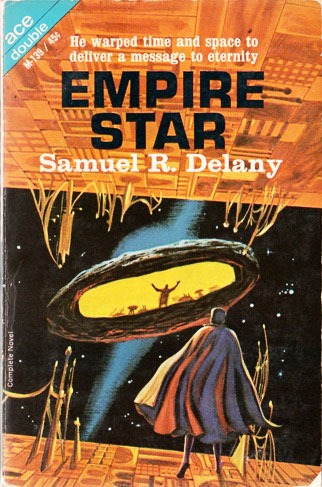
My favorite science fiction growing up was Heinlein’s twelve juvenile novels he wrote for Charles Scribner’s Sons.  Heinlein worked to teach his youthful readers to prepare for the future by studying math and science. Yet, when I look deeper, I got my best lessons about reality from two stories from Samuel R. Delany, the short novel Empire Star and the novella, “The Star Pit.”
Empire-Star---Samuel-Delany

Delany taught me three useful concepts in these two stories. I’ve expanded them with my own interpretation, as all readers do. But I credit Delany with presenting me with these three philosophical observations:

  • People think in three modes: simplex, complex and multiplex
  • No matter how original you feel you will always meet people who have already discovered everything you did
  • We all live within barriers we can’t escape, like fish in an aquarium, and we’ll always meet other people who can go beyond our barriers

In Empire Star, a boy, Comet Jo, from a backwater moon is thrust into a galaxy spanning adventure. Before he leaves home, he is warned that he has a simplex mind, and once he goes into space he will encounter complex and multiplex thinking. I was a young teen when I first read this story, so I was in a transition phase between what my parents taught me and learning to think for myself. This was the 1960s, and so it was a very complex time. We like to assume we’re all working from the same page, have equal thinking ability, and the standards by which we judge reality are the same standards by which other people see the same reality.

Simplex thinkers believe everyone should convert to their way of seeing things. Complex thinkers understand reality is very complicated, and there’s a certain amount of negotiating and compromise involved with coexisting in reality. Multiplex thinkers often let simplex and complex thinkers be themselves, and work around them. Take for instance religion. Fundamentalists are simplex, ecumenical believers are complex, and our Founding Fathers were multiplex.

Ever since reading Empire Star I always ask myself if the person I’m trying to communicate with is coming from a simplex, complex or multiplex thought process. It does no good to use complex or multiplex logic on a simplex thinker. And it’s all relative. If we ever encounter an alien civilization, no matter how much commonality we can find, our parochial humanness will make our initial approach to them simplex. We’ll have to progress through stages that involve complex and multiplex thinking.

When dealing with individuals or cultures, using this concept will help understand various social realities. People can be simplex, complex and multiplex simultaneously on different beliefs. Just watch the news. People who refuse to negotiate are coming from a simplex take on reality. Willingness to bend reflects an understanding of others. Multiplex thinkers will come up with King Solomon like solutions that can satisfy both simplex and complex thinkers.

Comet Jo begins his travels feeling everything he discovers is unique to him. He feels special. Then he meets Ni Ty Lee who has done everything Comet Jo has, and even has the ability to predict what he will experience. This shatters Comet Jo’s ego. I’ve always wondered if Delany was a child prodigy who wrote this after meeting older child prodigies.

Finally, in “The Star Pit” we meet Vyme, a man with a long tragic past who owns a starship garage out on the edge of the galaxy. In this story, humans have discovered that travel between the galaxies is impossible except for a very few people who have a special psychological makeup. They get labeled The Golden. Vyme takes in a street kid named Ratlit who hates he’s not Golden. Between the two characters we learn how each discover the limits of their aquarium, and how they learn to deal with the barriers in their life. I’ve written about his before – “The Limits of Limitations.”

The older I get, the more I realize that humanity is probably confined to living on Earth. And for the most part, we each evolve through the same stages as those who came before us, and like King Solomon observed, there’s nothing new under the sun. Finally, nearly all our conflicts are due to the failure of simplex, complex and multiplex thinkers not being able to communicate. I’ve often wondered if simplex and complex beings are two different species, and Homo Sapiens have already forked, and we’re already seeing signs of Humans 3.0.

Yet, I still have hope because of one concept I got from a science fiction movie written by Robert A. Heinlein.

Destination-Moon-Poster

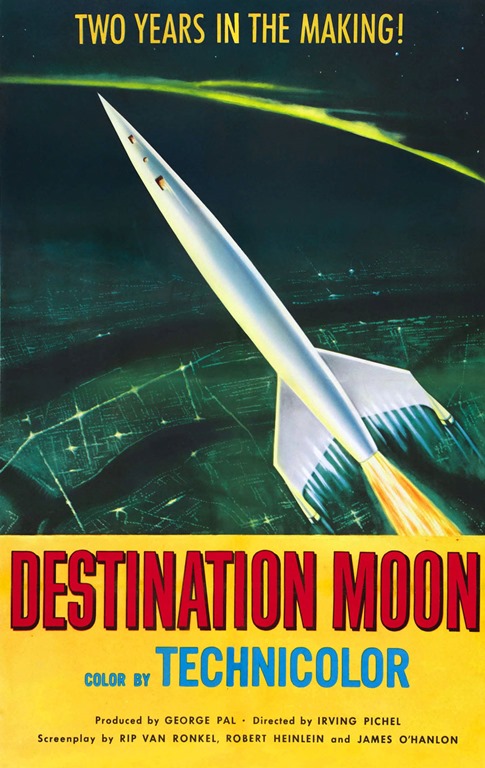
When the astronauts in Destination Moon discover they don’t have enough fuel to return to Earth after making the first Moon landing, their solution is to throw out enough mass to make their rocket light enough to match their fuel. Throughout life I’ve had moments where I couldn’t take off, and I realized that I needed to jettison the extra weight. Now that I’ve gotten older, and my body isn’t as energetic as it was, I’m learning to get further in my social security years, I need to throw out the past, all that extra mass is holding me down.

If humanity is ever to take off it will have to jettison a lot of mass from its past. To reach the next stage, whether Humanity 2.0 or 3.0, we need to give up religion and most of philosophy. Their mass keeps us from launching. Even on an individual level, I realize I have my own mental baggage that weighs me down. Much of it comes from reading science fiction.

Learning that I have limited mental fuel offers all kinds of philosophical parallels to rocket travel and Newton’s famous laws. And it’s not just energy, but cognitive ability. We all love the idea we have unlimited potential, but we don’t. Science fiction taught me that too.

Stand on Zanzibar - John Brunner

Stand on Zanzibar came out in 1968, and was about the world of 2010. I read it in 1968, and I’ve lived through 2010. We can never know the future, but some science fiction writers can make us seriously think about the possibilities. I remember being a kid reading this book and horrified at the terrorism that takes place in the story. I wasn’t savvy enough then to know that terrorism is common in all times, or that in 1970 there would be over 450 terrorist attacks in the U.S. Since 2000, there’s been less than 50 a year. What science fiction teaches us is to understand our fears, even when it’s wrong.

To value science fiction I also need to know its limitations.

Stand on Zanzibar and Harry Harrison’s Make Room! Make Room! scared me into thinking the future would be an overpopulated nightmare. What’s funny, our world is suffering horribly from overpopulation, but not how science fiction imagined. Science fiction failed to see climate change and the Internet. It also failed to see we’d never leave low Earth Orbit for 43 years. Nor did it imagine The Hubble Telescope and renaissance in astronomy.

It’s strange to credit science fiction being a success for failing to predict, but that’s also a valuable lesson.

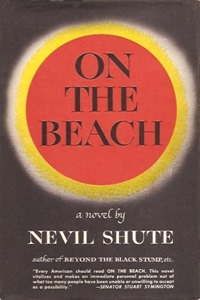
The Long Tomorrow - Leigh BrackettOn the Beach - Nevil ShuteAlas Babylong - Pat Frank

The real question we should ask: Does science fiction warn us away from following paths into bad futures? Did all those 1950s books about nuclear war keep us from blowing ourselves up? Or is it just another case of science fiction being bad at predicting the future? I’d like to think science fiction made us wiser in this case. I can’t help but believe Nineteen Eighty-Four is a great lesson in how not to govern. Yet, if you study how Republicans use rhetorical trickery to dispute science, you can’t help but wonder if Orwell’s story isn’t coming true. Dystopias are handbooks on how to avoid certain futures.

Using multiplex thinking science fiction can predict and fail to predict the future and still be a success. It’s much too simplex to assume a specific future will come to pass. It’s complex to think we should look at all the possibilities. It’s multiplex thinking to perceive how science fiction is both wrong and right at the same time.

— If you have the time, post a reply about how science fiction has been useful to you. —

JWH