The Impact of the Like Button

PBS Frontline for 2/18/14 aired the documentary Generation Like about how teens are using the Internet to be liked, and how corporations are using this mass movement to their advantage.  To be honest, the report claims teens are quite savvy about how they are being manipulated by marketing gurus and feel they are playing the system right back at them.  At best it’s a symbiotic relationship.  The funny thing is the documentary makers asked many teens to define “selling out” and they couldn’t, yet corporations have a new mantra, “your consumer is your new marketer.”  This show is about the need to be liked, the need to sell, and how society is changing when everyone is selling themselves.

facebook_like_button_big1

I found Generation Like quite amazing, especially as a 62 year old guy who knows damn little about modern teens.  The change in teens thriving on the internet is as profound as the baby boomers experienced in the psychedelic sixties.  I’m curious how representative this report on teen life is to the average teen, and luckily at the PBS Frontline page provides some statistics at “What Are Teens Doing Online?

Even though Frontline does a fantastic job of covering the topic, I was left with many questions.  Is this melding of marketing to teens wanting to be liked while they struggle to find their identities an American phenomenon, or is it worldwide?  What impact does it have for kids who don’t get hundreds of likes, and what does it mean for popular kids with hundreds of likes to know that some kids gets millions of likes?  Has popularity ever been so quantified?  Is this the start of a hive culture?  And can a hive culture work when all the individuals are promoting themselves?  Are we at the start of a cultural transformation or a fad that will go away? 

Many of the teens talked about their talent, but weren’t specific as to what that was.  Others, like the 13 year old Baby Scumbag was quite aware of what got hits, and was expecting to make money.  If Hollywood was a driving force for fame in the 20th century, the Internet in the 21st century will be many magnitudes more forceful.  And these kids want more than 15 minutes.

I remember the pressure to be liked as a teen, or even to be popular, but it was nothing like this.  I was happy to have one or two good friends, and pleased when others knew my name and said hi.  From the outside looking in, it appears these teens feel like struggling actors trying to get noticed.  How is that changing the nature of friendship?  On the other hand, many of the teens profiled, helped each other in real life to create their internet lives, so they are still socializing in the old way.   

This documentary is the tiniest tip of the iceberg at exploring the new online world.  I barely know how to use Facebook.  I have a Twitter account, but I only use it to remember what I’ve read online.  And most of the other social media sites this film explored I’m clueless as how to use and what they do.  Will adults slowly absorb this Like Culture?  I do blog, and I do get Likes, but not many.  But then I don’t crave them like the teens in this show.  The show ended with this wonderful visual.  A young girl is all animated while producing her video for YouTube, but when she turns off the camera, she sighs, deflates, looks very bored, and the film ends with the sound of her fingernails clicking distractedly on the camera.  Will being on for the Internet become a kind of social crack, and normal life a kind of lonely withdrawal?

You can watch the entire film here.  See I’m doing the same thing as the teens.  I’m marketing for PBS, and liking their show.

JWH – 2/19/14 

Faith and The Sparrow

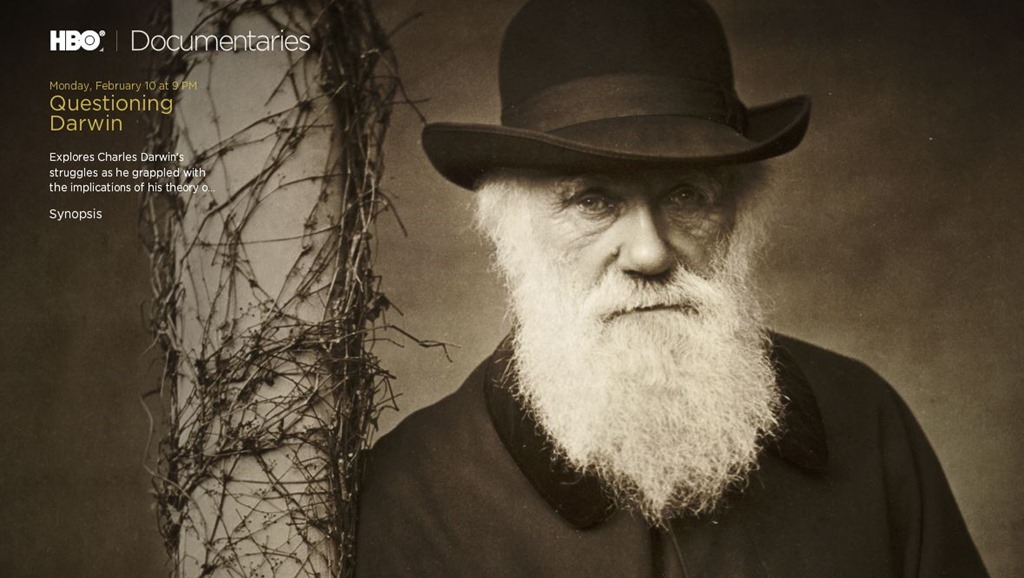
I watched the new HBO documentary Questioning Darwin twice yesterday.  This film precisely defines the conflict between the people who believe in the literal interpretation of the Bible and their objection to Darwin and evolution.  Even though I’m an atheist I’ve always believed that fundamentalists had a better intuitive understanding of evolution than the average church goer.  They know evolution is an alternative explanation for reality that absolutely contradicts their faith.  Most modern people are wishy-washy in their religious and scientific beliefs and try to hold both at the same time, believing they can keep God and embrace modern knowledge.  However, if you really understand evolution or you really understand faith in God, you know the two cannot coexist.  That’s what this documentary is about.
HBO-Darwin

People who understand science will see this documentary and wonder why the faithful cling so passionately to their ancient beliefs.  But the faithful who see this film will wonder at how the disciples of Darwin can’t see the obviousness of God.  The wishy-washy middle will wonder why we can’t have both.  It doesn’t work that way.  Often my friends ask me why I can’t just be an agnostic – why be an extremist. 

At one point in Questioning Darwin a preacher states it takes just as much faith to believe in science.  And he is right.  Both evolution and theology are systems to explain reality.  Backers of evolution firmly believe evolution is true.  Science is a process that evaluates evidences and selects the best explanations that describe the various workings of reality.  The science minded feel the evidence is overwhelming in support of evolution.  The fundamentalists insist God create reality and us.  The wishy-washy will say God created science and evolution.  But that’s a cop out.  Atheists and fundamentalists know there are two opposing explanations and you have to pick one. 

To the scientific minded, who dislike the word faith, I think they don’t understand the term as used by the faithful.  They think it means wish fulfillment.  They think when a religious person says they have faith in God they are saying they are choosing to “believe” God exists.  To the faithful, faith means they “know” God exists.  They have completely accepted God as the answer to explaining all the questions of reality.  By that definition of faith, atheists who back science have faith in science, and they “know” evolution is the explanation of how life arose on Earth.  But we’ll leave the word faith to the religious, and keep the word scientific for the science minded.

Folks in the middle will explain we can’t know anything for certain.  That’s true.  We can’t.  However, fundamentalists and atheists know there are currently only two choices, two theories, on the table, and they are exact opposites, and we feel it’s important to man up and pick one.  That’s what this documentary shows – the two conflicting options.

Even Darwin clung to God.  And many educated religious leaders want to understand and incorporate scientific knowledge into their metaphysical philosophy.  The vast majority of Christians are in the middle.  They aren’t Biblicists.  The Bible Christians, with their creationism and  Creation Museum insist the world is only six thousand years old, and use pseudo-sciences like intelligent design to attack real science to validate their beliefs.  It’s hard to say how many Americans believe this – one Gallop poll said 46% of Americans, but that’s probably not true.  The Raw Story analyzed that poll and concluded maybe 31 million Americans, or one tenth of the country.

Also, the numbers for people supporting evolution varies too, with atheists being the strongest at 87%, Buddhists (81%), Hindu (80%) and so on down to evangelical protestants at 23%, Mormons (22%) and Jehovah’s Witnesses at 8%.  Wikipedia using Pew Forum claims 48% of the U.S. population supports evolution.  Between the 46% Gallop figure and the 48% Pew figure, we can see how the country is polarized, and this topic matters.

The two choices are this.  The first theory is a supreme being is the starting point of everything, one of perfect knowledge, power and order, and reality descends from his being.  From perfect order towards chaos.  The second theory believes reality emerges out of nothingness, with no knowledge, no order, and no power, and is evolving toward something, becoming ever more complex and orderly.  From chaos to order.

Polarized Politics

One significant aspect of Questioning Darwin is to explain our polarize society.  If religious beliefs were merely personal it wouldn’t matter if some people believed in God and others in science, but the faithful want to change society so it follows their beliefs, and science automatically changes society through technological spinoffs.  I believe the rigidity of Republican party comes from the rigidity that believing in The Bible is the absolute word of God.  I also believe that anti-science philosophy is reflected in conservatives getting involved in the politics of education.  I used to believe that the small government movement merely reflected cheapness for not paying taxes, but more and more it appears to be because fundamentalist citizens hate spending their money on liberal ideas.

The documentary didn’t go into politics, but all the evidence was there to read.  Bible based believers want to redesign society so it matches their philosophy.  They feel both persecuted and empowered.  The documentary said that Bible based Christianity was the fastest growing religion in the world.  I don’t know if that’s true, but if it is, then expect an ever growing conflict between science and faith.

Accepting Science

My heart goes out to the faithful, to those people who embrace God.  When I watch this documentary I see all the reasons why they prefer God over science.  And I’m sure when they see this documentary their hearts will go out to all the non-believers.  But here’s the thing, the faithful believe us atheists live without many comforts they think they get from God, and I don’t think that’s true.  They cannot comprehend how we can live without God, and fear us.  They believe we embrace chaos.  We don’t.  We seek all the things belief in God gives the faithful.   We just find meaning and comfort by other paths.

We have a different approach to dealing with every sparrow that falls from a tree.  We can’t replace God and religion exactly, but we have many analogs.

Father Figure

One thing that comes through strongly in Questioning Darwin is the strong desire of religious people for a father figure.  People want a strong protector that is just and wise.  One that will always listen and always help, and most importantly, always care.  In Darwin’s reality, we all have to become our own father figures.  We want to grow up and leave home and stand on our own.  The faithful love the quote, “there are no atheists in foxholes.”  They believe when times are tough everyone will beg for God’s help.  That isn’t true.  True atheists understand and accept the randomness of the universe.  If there’s a shell with our name on it, then our time is up.  It’s not personal.  We don’t want to die, but death comes to us all, and usually it’s an apparently random fate.  Science and knowledge gives us understanding to how things happens.  It’s not completely random.  Sometimes its from the will or fault of another person, and we do find that evil and unjust.  We don’t expect a father figure to rescue us, and especially not one that will avenge us.

Darwin explains how we got here, but he said nothing about what it means to be a self-aware being finding itself in an unconscious reality.  Humans with scientific knowledge will be able to conquer the random chaotic indifferent universe.  There is no God that senses every sparrow that falls from a tree, but humans are now aware of sparrows and maybe it’s our responsibility to take care of all of them.

Order and Morality

Related to the father figure wish, is the desire for justice.  The faithful hate the idea that the universe is random and capricious.  The faithful want God to be the arbiter of right and wrong, and the punisher of evil doers.  The want the universe to have a referee who knows the rules that everyone must follow.  The faithful hate not having clear rules to live by.

The scientific have laws and ethics.  We do not believe the universe has morality built into it, but we do believe that intelligent beings can create their own morality.  We call that ethics.  We also believe that intelligent beings can invent their own rules to live by.  We can them laws.

We have also created the idea of human rights, and more recently, animal rights.  Even though we are Godless, we embrace ethics and morality completely.  Right and wrong is just as important to our philosophy as it is to literal Bible believers.

Yes, the universe is chaotic, seemingly ruled by random events, we see the emergence of order in everything.  If someone dies horribly from cancer we don’t see it as punishment.  We don’t blame God, or wonder if the person deserved to die a miserable death.  We study the environmental and genetic causes of cancer to understand how it happened.  Even though randomness is a major factor in everything that happens, we still find cause and effect.  It’s not a meaningless universe to us.  If a sparrow falls from a tree, we study why.

Immortality

Believers in God have one overwhelming wish they expect God to grant – everlasting life.  Science accepts death comes to us all but we work to extend life as much as possible.  Personally, living forever scares me.  It sounds like a cruel torture.  But us unbelievers do want a longer life, and we expect science to study reality and discover how to make people live longer.

Not only do we want longer lives, we want to make sure our species does not become extinct, and we want to protect all other species.

Heaven

As a nonbeliever who occasionally studies The Bible. it seems to me that two most important books are the first, Genesis, and the last, Revelation.  To believers, the first explains how we got here and the last explains where we’re going.  The Book of Revelation has the most extensive description of heaven in all of The Bible.  And if it’s the literal truth, I don’t think I want to go to heaven, especially not for all of eternity.

Those of us believe in science want to build paradise on Earth.  We want to conquer disease, live a long time, create a humane and just world, with lots of creative activities to pursue.  We want to live long enough, and then die peacefully.  We accept death, but don’t embrace it.  Not only do we want to create heaven on Earth for humans, but we want to recreate Eden for the animals.

Prayer

From watching the documentary I got the feeling that prayer was among the most cherish aspects of religion.  That being able to talk to God is the number one need.  I think we all feel lonely in this old reality.  When I saw the scenes of the happy people at the mega-church I envied them their community togetherness.  Praying together is a way of sharing hopes and fighting fears.

We unbelievers have a substitute for prayer.  Instead of asking God to change reality for us, we believe we should change reality ourselves.  We don’t plead to God to heal the sick, but spend money on medical research.  We vote for Obamacare.  We don’t pray to God to stop evil wrong doers, we pay for police and the judicial systems.  We don’t pray for world peace but build armies.  We don’t pray for rain, but build irrigation systems.  We don’t beg God to send us a husband or wife, but join Match.com.  We don’t ask for riches, but go to college or invent Candy Crush.

Also, I am constantly thankful.  I am grateful for being alive, for having a lucky life, for family and friends.  I spend a lot of time studying nature and science to appreciate the wonders of reality.  I constantly think good thoughts about other people, animals and all life on Earth, and even out into the universe.  That kind of positive thinking is our prayers.

Sin

Religious people are frightened and horrified by all the evil things that happen on Earth.  We nonbelievers are just as scared and repulsed by those events too.  In the documentary it shows a wing at the Creation Museum that depicts these horrors.  Many of the pastors and their followers interviewed talked about sin, and the origin of sin.  All pointed to the fall from grace in the Garden of Eden.  Some of the people interviewed even believed that dinosaurs existed in the Garden of Eden and that Adam and Eve and all the animals were vegetarians before sin came to us.  Believing there was no violence or suffering before sin.

The scientific minded don’t like violence either.  I’m a vegetarian.  I don’t want animals or people to suffer.  I’m a liberal and want the government to help needy people so they won’t suffer.  I give money to causes to end suffering.

Science, law, technology and ethics are all efforts to create order, to end suffering and to create justice.  We want to educate people so they won’t do evil.  So they won’t hurt other people, or protect the weak.

In a way I agree with the fundamentalists, and believe that it is humans that brought sin into this world.  I actually think the metaphor for the Tree of Knowledge of Good and Evil is a beautiful concept.  I think the writers of The Book of Genesis knew there was a time when we were like animals, and were innocent of good and bad, and that language and understanding let us know the difference between what should be and shouldn’t.  Those writers wished we still lived in the Garden of Eden, innocent and without sin.  Boy, they would have loved Jean-Jacques Rousseau.   Us disciples of Darwin see it differently.  Yes, there is sin in the world, but through knowledge we’ll learn to live ethical and good lives.  Violence is the rule of reality from The Big Bang to The Enlightenment.  It’s only been in the last few centuries have we learned that violence is wrong, and that human rights and animals rights is the way to end it.  We don’t believe Eden existed – yet.

Humans are an emergent phenomenon, sort of like the singularity we imagine for intelligent machines.  Humans woke up and saw reality and have been trying to figure it out ever since.  We reached a critical mass of brain cells that allowed us to be self-aware – aware of who we are and the reality we lived in.  We didn’t fall from grace, but emerged from the chaos of nature.  We became a new type of entity in reality – one that recognized it’s place in reality.  Reality is pretty scary.  Our job isn’t to die and go to heaven, but to conquer reality.

We left Eden not because we were exiled, but because we could no longer be unaware animals.  We wear clothes not because of shame, but because we don’t want to be animals.  We left Eden because we wanted freedom to become everything we can imagine.  Sure, we’ve fucked up the planet, but we’re still evolving.  Hopefully, we can make things right and get our shit together before we destroy everything.

Nature is not sinful, it’s just red tooth and claw.  Only humans can be sinful and evil.  We do that when we act like animals and destroy rather than create.  We achieve grace and transcend nature when we live up to our full potential and become good by our own definition of goodness.  The ten commandments were not from God, but our own creation to bring goodness into the world.

Sin defined by God is servitude and slavery.  Sin defined by humanity is escaping from nature.

The desire to return to Garden of Eden innocence is the desire to go back to sleep, to become unconscious to the nature of reality.

To the faithful, sin is not obeying God, but to the scientific, sin is not living up to our knowledge.

The evil of the red tooth and claw of nature is the hatred of chaos.  Science seeks to understand reality so that we might bring order to chaos.  Most of the evils of mankind are from when we act like animals, which reflects the programming of nature.  Currently the Earth suffers because humanity collectively acts like a cancerous growth on the planet, killing endless species and destroying the ecosystem.  It comes from being unconscious to the knowledge science has shown us.  The most evil of sin is being aware and doing evil.

Why Do Bad Things Happen to Good People?

The most disturbing of all the points they illustrate in the documentary is when they show a young girl in the hospital paralyzed from the neck down because she was in a car accident.  Her cousin said his wife prayed and prayed but wondered why it didn’t help.  The cousin wondered why an all powerful and all knowing God could let this happen.  They speculated that God had a purpose and claimed they had faith in whatever that purpose might be.

Here’s where I find atheism far more comforting than religion.  We can all be victims of random evil.  Sometimes it’s nobody’s fault, nor did we do anything to deserve punishment.  And when someone is at fault, it’s explainable, like a drunk driver, or mad gunman.   Isn’t it better to have something bad happen to you and not think God has it in for you?  Especially if you love God so much?

Being Saved

Towards the end of the documentary they interview at ex-prostitute crack user and a former heroin addict who both claim God saved them.  Religion has saved a lot of people.  Religion can bring order and stability to people.  But millions of nonbelievers have saved themselves too.  As an atheist when I meet people like these two saved people I don’t want to argue with them, or try to take away their faith.  They were lost and now they are found.  I can accept that.  But God isn’t my explanation for why they are better.

Both of these people were addicted to drugs.  Now they are addicted to a belief in God.  They switched from a negative addiction to a positive addiction.  They found a community of people to belong, and they’ve turned their life around.

Personally, I think they got a virus that changed them.  Memes are viruses of the mind.  God and religion are powerful generators of memes.  Memes replicate and spread like mental viruses.  They are like DNA in that they replicate.  Religious memes are very successful because they make people feel good.  Really good.  As good as crack or heroin.

My parents were alcoholics.  My father died of drinking when I was 18.  My mother eventually gave it up.  She was religious, but I think she gave up drinking and smoking from her own willpower.  I did a lot of drugs when I was young, but I gave them up.  I saved myself.  But I think some people need other people to save themselves.  They think it’s God, but it’s really a community of caring people.

Churches

If they had churches for atheists I think we’d have a lot more atheists.  I think a lot of people believe in God because they like going to church and being part of a community.  I’m pretty sure millions of people profess the doctrine of their church because that’s what they are told, and it’s easy to accept rather than study science books.  But what they really want is friends and community.  That professing belief in Jesus is just learning the secret password to join the club.

True believers of Darwin have their club houses too, they are called universities and research institutes.  But the average citizen who backs science usually don’t have scientific clubs to join.  Amateur astronomy is big on clubs, but we usually don’t see hangouts for physic and chemistry fans.  Birders and some other naturalists do have a lot of amateur associations.

I wonder if there would be more professed atheists in America if we had churches devoted to believers in science.  Imagine going to service on Sunday to hear lectures on cosmology and mathematics, mixed with singing and study groups for evolution and quantum mechanics.  With Sunday night dinners and Wednesday night social gatherings with kid’s activities, such as robot building contests.

Charles Darwin and Evolution

The thing believers hated most about Darwin and evolution is takes away the concept that humans are special, that we are special in God’s eyes.  Many of the preachers talked about humans being created in the image of God, and that we weren’t animals, as if being an animal was undignified, or lowly.  I thought it was strange that they’d prefer to be a servant of God to being the top dog of the animal world.  I find a kind of affinity with the line from Paradise Lost, “Better to reign in Hell, than to serve in Heaven.”

Until we meet an intelligent alien from the stars, we are the kings of the universe.  We are now responsible for what happens on this world.  We can choose to be great, or act like animals.  We can create our own immortality, our own paradise, or own morality, our own health and happiness.  We are the father and mother to what will be.  This might be hubris, but only if imaginary gods are real, and there’s never been a shred of evidence to believe they are, only wishes.

JWH – 2/12/14

Understanding Identity Theft-And the Scary Implications of Stopping It

With the recent Target hacking scare, identity theft has almost become a panic.  My goal here is to explain identity theft to myself and my readers so we can avoid it, but also to reveal a surprise side-effect of stopping identity theft.  One news commentator pointed out that Europe uses Smart Cards which are more secure against identity theft, and I wondered why we don’t use them in the U.S.?  This got me to thinking about the nature of identity theft.  To simplify, here are the basics:

  • Person
  • Proof of Identity
  • Financial institution
  • Transaction system
  • Business
  • Thief
  • Fake Identity

Because we now have electronic transfer of spending instead of money, the goal of a thief is to initiate a financial transaction with a stolen information about your identity.  When you deposit money in a bank or get a line of credit from a credit company, those institutions create an identity profile of you.  To spend money requires proving your identity at a transaction location.

identity_theft

Our old fashioned credit cards are rather simple.  The POS (point of sale) validates the card to see if it’s active.  The cashier must accept proof of identity from the person using the card.  If you are standing at the Target checkout counter, they will ask for an ID, or if you are buying from Amazon, they will ask for a password.  Both are easy to fake.  There’s a reason why many credit card thieves first go to gas stations – they don’t require any proof of identity. 

Even though the Target hackers stole over a hundred million card numbers and pins, they still have to find businesses that will process  transactions without a proof of identity, or create fake credit cards and fake identities.  Because they also stole names, addresses, and personal information, PINs, this is a scary possibility.

Proof of Identity

Every person has dozens of identities.  Your school or work has a system to identity you.  Your bank, credit card companies, insurance companies, health insurer, stock broker, library, utility company, phone company, etc., all have ways to identify you.  Even if you stood right in front of each of them, they wouldn’t know you personally.  They know you by your proof of identity.  Normally this is name, address, phone number, social security number, credit card number, library card number, customer number, etc.  Often this is in the form of ID card.  All of this information is easily stolen, and easily used by thieves.  In the old days, a fake driver’s license and stolen checks or credit cards was all it took to spend someone else’s money.  Now it’s just a name, debit card number and pin.

How To Stop Identity Theft

The current methods of protecting identity theft are far from perfect, but they are:

  • Keep your personal information as secret as possible
  • Use strong passwords and encourage the use of secondary pass phrases
  • Use credit cards from companies that have strong security monitoring
  • Monitor credit rating services
  • Hire a monitoring service

These efforts fall into two phases.  First, keep your information away from identity thieves, and second, stop thieves as quickly as possible when they do steal your identity.  What we really want is to stop thieves altogether. 

The best way to stop identity theft is absolute proof of identity.  This means creating a validation system to prove you are you in any financial transaction, whether in person or online.  I don’t believe Smart Cards are the solution.  Smart Cards are just credit cards with a computer chip – they make it harder for thieves but not impossible.  What we really want is biometric authentication.   This is technology that connects authentication to our biological selves – thumb print, voice pattern, retinal scan, face pattern, DNA, and so on.  Of course this means revamping our entire financial transactional system.  How does Amazon take your thumbprint?

There is new technology that might allow this transformation quicker than we thought – the smart phone.  But first some digression.

Let’s say a thumb print and voice pattern becomes the standard of identification.  How are they taken, and how are they validated?  There are a number of ways.  Smart Cards could store your voice and thumb print on a chip, and a POS terminal could take your prints and validate them against the card.  That would make things much more secure, but theoretically thieves could print fake Smart Cards with their prints recorded in them with your financial identity.  What we want is your credit card company to store a copy of your voice and thumb print, and the have the POS terminal authenticate your prints when you make a transaction.  Then we won’t need credit cards at all.  Identity will be bodily proof.

The trouble is our current infrastructure isn’t set up for this, so what would be the fastest way to transform our society into one secure from identity thieves?  Like I said, smart phones might be the answer.

There are many unique qualities about a smart phone.  The phone number, the IP address, the SIM card, the hardware address for the Wi-Fi card, etc.  All that’s needed is a way to tie your physical body to the smart phone.  Ultimately, in some science fictional future, I believe we’ll have a identity chip implanted in our bodies at birth and all our network connections will recognize us that way.  But until that future arrives, I believe smart phones are the answer.

Some smart phones can already do thumb prints, and voice prints can be done in software.  Newer phones could be designed to make biometric validation even easier.  Think of a smart phone as a genius level Smart Card.  To make a financial transaction you’d need your phone and your body.  That’s very hard for thieves to steal.  Not impossible.  A thief holding a gun to your head could make you buy things, give you money at ATMs.  But stress detectors might be added to smart phones to tell if a user is under duress.  We’re getting very close to foolproof.

Good Side Effects

If such a smart phone authentication system was developed it could have many positive side effects.  We’d have one of the best electronic voting systems possible.  It would allow for easy political referendums, or extensive public opinion polls.  This would change the nature of record keeping for school system, health insurance, all the way down to library cards.  Used in schools it would allow for instant testing and grading.  The spin-offs are endless.

Of course it would reduce identity theft.

Bad Side Effects

Identity theft is an easy way for thieves to steal from people without meeting them.  If we take this away, thieves will have to go back to being more personal about taking our stuff.  Switching to a smart phone authentication might increase robberies, muggings and burglaries.

However, the real scary thing about smart phone identity authentication is it creates a global identity card that’s extremely easy to track.  Americans have always been against a national ID card, and this system would be that to the nth degree.  Since we know the NSA is already tracking our phones, it’s not hard to imagine a whole host of governmental agencies, as well as businesses tracking our every move, communication and transaction.

It would make living off the grid almost impossible.  Anyone without a smart phone would have a very difficult time establishing any kind of identity with businesses, hospitals, insurers, libraries, credit agencies, etc.  If every policeman had a smart phone that could talk to your smart phone think of the Big Brother angle of that.

Other Solutions

Life on Earth is always evolving, and so does technology.  If we wanted, we could invent anonymous electronic spending.  Money is slowly disappearing, and with it privacy.  You can buy pre-paid credit cards and anonymous dumb phones to maintain your privacy, but that might not last for long.  If money disappears how do you buy pre-paid cards?  With direct deposit paychecks its now impossible to live without a bank account, and that requires a networkable identity, and thus a way to authenticate that identity.

People might not know it, but we’re on a path to no privacy.  For some people that might not matter, for others it matters a great deal.

JWH – 2/11/14

1964–Fifty Years of Reading Robert A. Heinlein

While everyone is remembering it was fifty years ago that America discovered The Beatles, I’m remembering it was fifty years ago that I discovered Robert A. Heinlein – a discovery that had far more importance to me.  1964 was the year after Project Mercury, and the year before Project Gemini.  Back then each space mission got uninterrupted coverage on CBS, NBC and ABC, and I always got to stay home from school and watch.  1964 was also the year a very futuristic World’s Fair in NYC and everyone seemed to be thinking about the decades to come. 

1964 was the year I turned 13 and I started thinking about my future. 

Now it’s 2014 and I’ll turn 63 later is year, and I think about my past.

As much as I love The Beatles and remembering 1964, 2014 is my 50th anniversary of reading Robert A. Heinlein.  I thought it might be interesting to analyze why reading the twelve Heinlein juveniles I first discovered in 1964 was so much more important than “Twist and Shout.”  Wouldn’t it be fun to read a series of blogs by baby boomers remembering all the artists that meant more to them from 1964 than The Beatles?

hein04

I read science fiction before 1964, but it wasn’t until I discovered Heinlein that I became a hardcore science fiction fan.  I turned 13 on November 25, 1964.  For some reason I started puberty by rejecting religion and God, becoming an atheist, and embracing science fiction.  I’ve always joked that science fiction was my religion, which made Heinlein my messiah.

I have my 8th grade English teacher to thank for introducing me to Heinlein, although I’m pretty sure I would have discovered him one way or another.  I wished I remembered this lady’s name, and had a photograph of her.  She had a remarkable teaching method.  For each six weeks grading period she required the class to read and report on three books.  However, if you read five, she would raise your grade one letter.  That allowed me to be a B student that year – at least for my English class.  My teacher provided us with a list of approved authors and Robert A. Heinlein was one.  In the 1940s and 1950s Heinlein had published twelve young adult novels with Charles Scribner’s Sons that had gotten a lot of recognition with librarians and teachers.

The first of the twelve juveniles I discovered was Red Planet, after that I quickly consumed the other eleven, and then went on to read the Heinlein adult novels.  Sadly I don’t remember the order in which I read them.  I do remember the night I read Have Space Suit-Will Travel, my favorite Heinlein book, and my all-time favorite science fiction novel.

HSSWT

I was babysitting for an airman my dad knew from work at Homestead Air Force Base.  I was dropped off at their house around eight, after the kids were already put to bed, and the couple didn’t return home until after three.  So I was paid fifty cents an hour to read Have Space Suit-Will Travel.  I was blown away.  When the couple came home the young dad offered to drive me home, I told him I’d walk.  It was 3:30am, and I wasn’t even sure where I was.  I had a vague idea my house was north of their house, so I started walking.  It was eerie out – completely dead, with a bit of a mist from the dew. 

I wasn’t afraid, but the long walk was surreal.  All I could think about was Kip’s adventures, going from Earth, to the Moon, to Pluto, to a planet orbiting Vega, to the Lesser Magellanic Cloud.  My brain speeded on thinking about the future and I felt very alive.

A sliver of the Moon glowed in the sky that dark night fifty years ago, and the stars looked down on me, and I up at them.  I was living the mundane life of an 8th grader, the 1960s was heating up, and all I could think about was living in the 21st century.  Now, it’s 2014, and my future is almost over, and more and more, I think about the past.

The promise and potential of space travel was why I loved Heinlein.  Elementary school had been about Project Mercury, Project Gemini was going to be my junior high years, and Project Apollo my high school years.  I started the 1st grade a couple months before Sputnik went into orbit, and graduated high school a couple months before Neal Armstrong walked on the Moon.  That, reading science fiction, and being a baby boomer growing up with the rock music revolution of the 1960s, did a number on me. 

So did the drugs.  Strangely, by 1968, science fiction had taken me far further than the chemical trips I had started taking.  Reading Stranger in a Stranger Land in 1965, I’m sure I saw it way different than Heinlein intended.

I read everything I could about NASA.  In 1964 all I could think about was the rock music on the radio, the science fiction I read, and the future of manned space flight.  I was positive I’d grow up and in my lifetime we’d build a colony on the Moon and Mars, and just maybe, I might get to go. 

Boy, was I wrong.

Heinlein made it all sound so simple, so obvious, so right.  Humans were meant to go to the stars.  His twelve young adult novels were a roadmap for all my tomorrows.

1947 Rocket Ship Galileo Moon
1948 Space Cadet Asteroids, Venus
1949 Red Planet Mars
1950 Farmer in the Sky Ganymede
1951 Between Planets Venus
1952 The Rolling Stones Moon, Mars, Asteroids
1953 Starman Jones interstellar
1954 The Star Beast Earth with interstellar visitors
1955 Tunnel in the Sky interstellar
1956 Time for the Stars interstellar
1957 Citizen of the Galaxy interstellar
1958 Have Space Suit—Will Travel Moon, Pluto, Vega 5, Lesser Magellanic Cloud

Ross, Morrie and Art, three teens in Heinlein’s first juvenile only go as far as the Moon, but in the last book, Kip and Peewee leave the galaxy.  The first half-dozen are about interplanetary travel, the second half-dozen have youngsters like me going to the stars.  These books made me a true believer in space travel in the same way Christians believe in heaven.

I’m now an atheist to my own religion, and Heinlein and his books are in my past.  They are just fun stories now, myths I lived by growing up a half-century ago.  The future was everything I never expected.  As I spend my retirement years trying to write science fiction, I imagine a much different future than I did at age thirteen.  What will the next 50 years be like? Can I conceive of a more realistic future, one that might happen, or will I only invented imaginary futures that will become fantasies like the Heinlein stories?  Do I stir up the passion of kids to believe in scientific fairy tales, or do I try to give them hope about real scientific possibilities?

Like the 1964 me, I still contemplate the future.  I have no space suit, I will not travel to the stars, but the future still holds exciting possibilities.  If I’m alive in 2051, what will I write about looking back on the next fifty years?

pug-2059d8dee5b705b4 

JWH – 2/3/14

Too Many Distractions While Running in a Thousand Different Directions

I’ve always envied people with overwhelming powers of focus. 

I wish I could just write on my novel and not think about anything else – but that’s not me. 

I’ve probably pursued twenty different tasks this Sunday morning.  Some are routine like showering, exercising, washing clothes, eating breakfast, and doing the dishes, but others are just distractions, like learning how to create CBR files of science fiction book covers, looking for neat hi-rez Ace Book covers from the 1960s, organizing my playlists on Rdio, listening to a lecture about iPython, reading Jason Sanford’s Medium collection on Sci-Fi Strange, reading a Stanislaw Lem short story, listening to Difficult Men on audio, creating a poll for the science fiction book club, promoting John’s Background Switcher in an email, playing with my desktop photo collection, talking on the phone with Janis and Susan, laying on the couch imagining a science fiction story, – or writing this blog post. 

And that’s only the distractions I remember at the moment for the last few hours.

Kay Francis The House on 56th Street

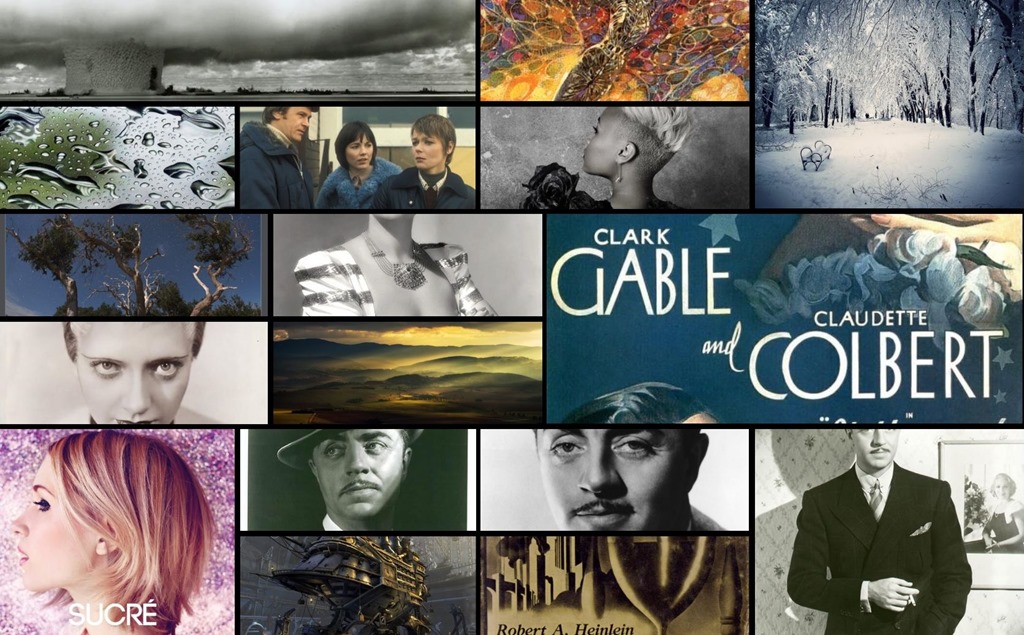
Here I am distracted by a photo from my desktop of Kay Frances with blonde hair – normally she’s always black headed.  Every minute my background switcher shows me dozens of photos.  Most are hidden under the many program windows I have open on my main monitor, but I like to have my second monitor free just to entice me with alluring visuals. 

screen1

And while my eyes are dazzled with images from nature, movies, book covers, fine art, record covers, etc., my ears are blasted with songs.  All of which explains why I don’t work on my novel.  Instead of thinking how to give up all my distractions, I keep thinking of ways to organize them so I can take in even more input at once.  I’m like the little robot. 

Am I crazy?  Or maybe I’m the most skilled procrastinator in the universe.  I guess that’s a distinction of sorts.

If I could only sit in a windowless white room containing a single desk and chair, with a pad of white paper and a single pen, and focus my mind for just one hour a day.  I could conquer the world.  Or at least write a short story.

JWH 2/2/14