Rethinking My Kindle Magazine Subscriptions–And Electronic Magazines in General

Years ago I cancelled all my magazine subscriptions to go paperless.  I was finding plenty to read on the Internet for free, and I was experimenting with services like Zinio, which offers electronic magazines.  Then I got a Kindle and iPad and subscribed to Kindle magazines at Amazon.  I liked I could subscribe by the month, and quit any time.  But like paper editions of magazines, I often didn’t keep up, and unread back issues piled up.  So I cancelled my Kindle subscription to The Rolling Stone.  I thought I’d have all my back issues to read when I got some free time, but once you cancel, you can’t download the issues, even for the ones I’ve “bought.”  If you had previously downloaded an issue it stayed on my iPad.  Unfortunately, I discovered there were many I never downloaded, even though their cover image was in my library listing.

See, I was thinking all those back issues were mine to read whenever I wanted, even if I wanted to wait years.  But that wasn’t the case.  I’m not bitching about Amazon’s licensing restrictions, I’m just reporting how things work.  It turns out that when I re-subscribed I could go back and download those previously subscribed issues.  In other words, you can get past back issues if your currently subscribing and paid for them previously, but they aren’t accessible when you aren’t paying the current monthly fee.

Reading on the iPad wasn’t bad, but I had an iPad 2, the one before the Retina Display, and reading small print was a bitch.  Using a tablet for both bookshelf and reader has it’s drawbacks.  When I upgraded to iOS 7 and v. 4 of the Kindle Reader, it zapped my collection of old magazines, telling me I needed to download them again.  I had just cancelled my Kindle subscription of The Rolling Stone, because I had started getting the paper copy again, and thus I couldn’t re-download my old issues.

Okay, I thought, the reason I subscribed to the paper copy of The Rolling Stone was to get access to the complete archive online.  Well, that didn’t work out either.  The online viewer for The Rolling Stone has one of the worst screen readers I’ve ever used.  It magnifies better than the iPad, but moving around the page and between pages is just flat out horrible.  I can’t believe many people would take the time to read old copies of RS online.

[Update 10-18-13 – the RS online reader looks great on my 24″ iMac at work.  For some reason the reader controls and the bottom of the page are removed from my Windows 7/Chrome browsing.  I also tested it on Ubuntu 13.10, with Firefox on a 1280×1024 screen.  It worked better than Windows 7/Chrome but not as nearly as good as Mac/Safari.  Unfortunately, I don’t have a Mac at home.  I need to test Windows 7/IE and iPad 2 when I get home.  Maybe there’s hope.]

What’s funny is the reader that comes with the complete archive on DVD is much better, but still clunky.  They’ve had that reader for years.  The current online reader won’t even show the bottom of the page on my 23” 1920×1080 screen.  It’s a huge step backward.

You know what? It turns out the old fashion paper magazine is the real winner here.  Damn, technology goes down in flames.

Now it is possible to create an elegant screen reader that shows old magazines, just look this December, 1959 issue of Galaxy Magazine at Archive.org.  If the folks at The Rolling Stone used this program to show it’s back issues I’d be in periodical heaven.
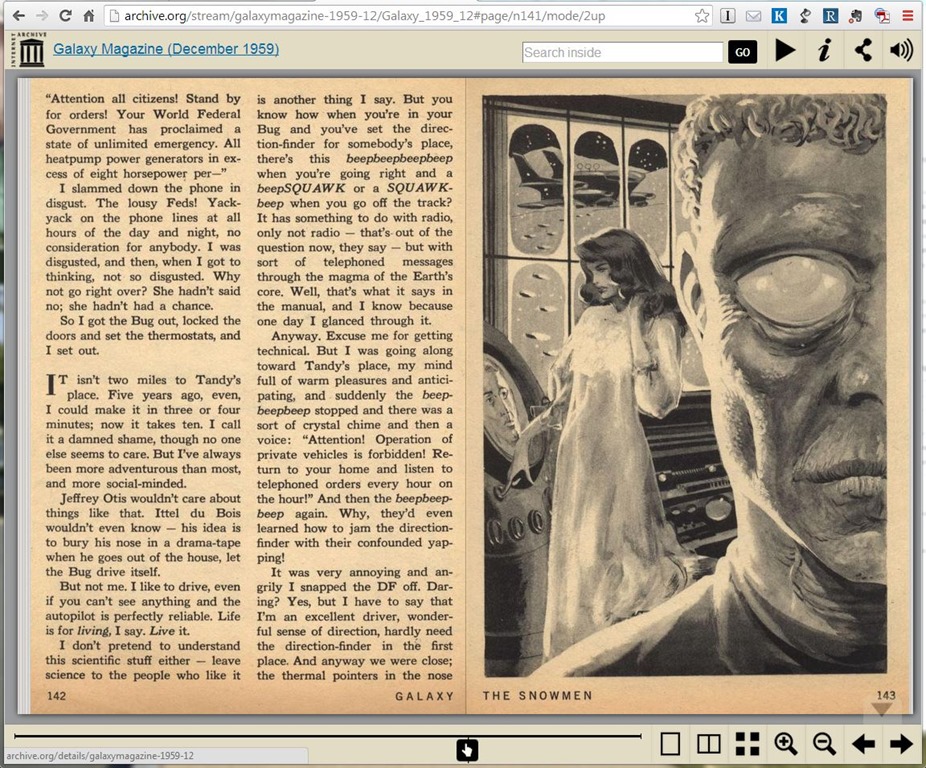
galaxy-mag

[Click to enlarge]

Now I’d love to have a complete back run of Galaxy Magazine in this format.  It would be better than owning all those shelves of moldy pulp paper copies.  And it would be great to have them on a modern tablet with 2560 x 1600 pixels screen.  The Archive.org reader works very well on my iPad, making it the most comfortable way to read this classic SF mag.

The ideal way to read magazines would be to have a large, very high resolution tablet, with the complete archive of a magazine online, and an excellent viewer app.  That way the environment benefits, and we wouldn’t be bothered by shelves and shelves of old magazines to maintain.

Right now I’m very disappointed with the electronic versions of The Rolling Stone, either tablet version or online version.  Reading the paper version is the easiest technology.  That’s a shame.  I was so looking forward to doing some serious reading of past years of The Rolling Stone.  Now that I start my retirement years next Wednesday I’ve got some real reading time.

JWH – 10/17/13
Why Don’t Politicians Have PhDs in Economics?

It seems like every politician in Washington KNOWS the absolute solution to our economic problems.  But how do they know?  The Tea Party has Washington gridlocked because they claim to know, but is their knowledge based on anything substantial?  Are their opinions backed by something other than wanting to promote Christianity and pay less taxes?  How many politicians have advanced degrees in economics, government and political science?

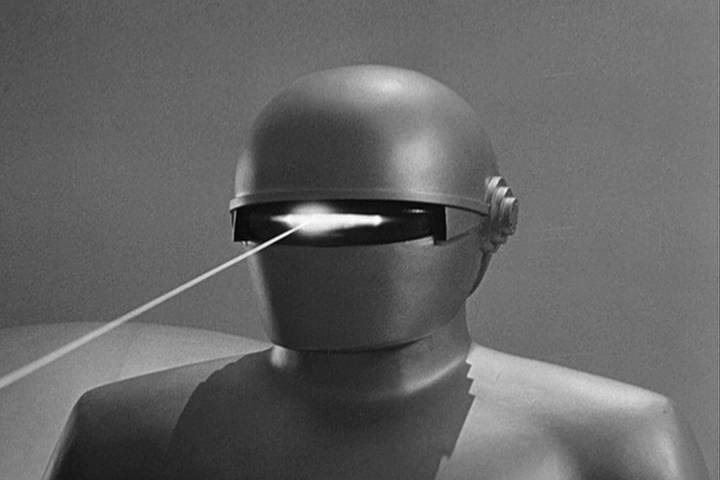
I’m sorry, but it seems to me that all politicians are out for themselves, and their positions are based on personal desires and the special interests of the people that support them.  I’d be far more impressed with the Democrats and Republicans if they each based their policies on giant economic models backed by an army of PhD researchers.  Politicians have no intellectual authority behind their opinions even though they hold them so strongly.  In fact, after recent events I’d be happy to replace all our political leaders in Congress with robots and referendums.

gort

Every major university and think tank in the United States should be developing an economic model.  All their economic and political PhD students, postdocs, and faculty should be researching and writing to support these models.  All the models should compete, like weather models and global warming models, to see which ones best reflect actual reality.  We need to get away from opinions, away from us versus them.  It’s obvious that many of our leaders don’t know shit about economics.

The makers of Sim City should create Sim Economy so we can all play and study how our economy works.

simcity4_ss1

We all need a better economic and political education.  Maybe we have saps for leaders because we’re not smart enough to elect anything better.  If we learn anything from this current political/economic crisis, it’s that we need to elect smarter politicians.  Or replace them with AI robots.

JWH – 10/15/13

How Many Pre-1950 Artifacts Do You Own?

Our book club recently read A Canticle for Leibowitz, a 1960 collection of three related stories about a future that barely remembers our 1950s civilization.  A Canticle for Leibowitz is set 600 years in the future after our civilization destroys itself in a nuclear war.  The stories are about the Albertian Order of Leibowitz, where a future Catholic monastery works to preserve the relics of a Jewish electrical engineer named Isaac Edward Leibowitz.  They do not know what the relics mean, and even illuminate one of Leibowitz’s engineering blueprints.

A_Canticle_for_Leibowitz

This got me to thinking about how many things I own might be preserved in the future.  And how many things from the past I own.  Making the cutoff date 1950, I quickly realized I have damn few relics from the past.  All I can come up with are photographs, and a few knickknacks Susan and I have inherited from our parents.  If I move the date up to 1960 I can add an old wooden radio cabinet, more photographs, some LPs, a handful of books, and our house, which was built in 1957.  If I jump to 1970, we add many more photographs, a few more LPs, and a fair amount of household items.

None of my older possessions are particular durable.  None will become antiques worth collecting.  The items I find the most meaningful are photographs and twelve hardback Heinlein juveniles I bought in 1968 with my first paycheck when I was 16.  I assume when I die my wife will give the books away to Goodwill and the photographs to my sister or her sons.

Our throw-away society doesn’t lend itself well to being remembered.   However, the sense of wonder generated in A Canticle for Leibowitz is because civilization collapses so thoroughly that most everything is destroyed, and what’s left is cherished.

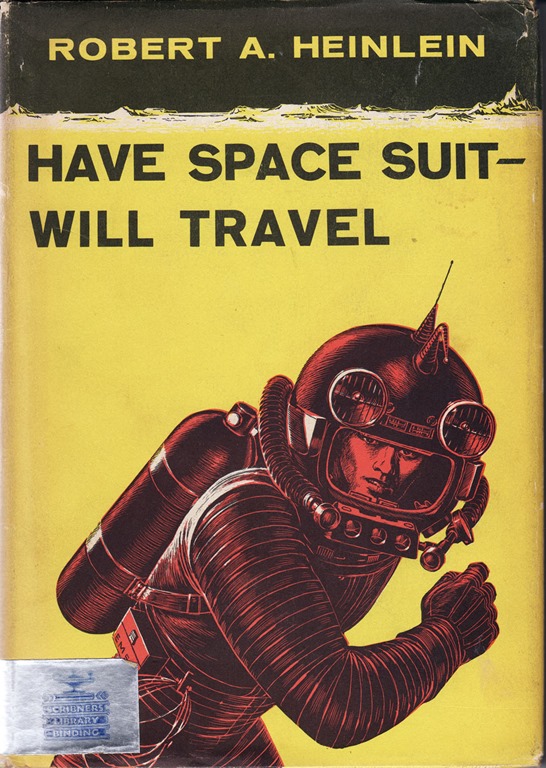
I don’t think I own a single thing that would be worth preserving 600 years, but if I did, what one thing do I own that I would like to represent me and the 20th century to future people?  I would have to pick my hard back copy of Have Space Suit – Will Travel by Robert A. Heinlein.  I used to own a very nice slide rule from the 1950s, and if I still had that, I might have chosen it.  But the Heinlein book really does represent me well.  But what would people a millennia from now think of such a story?  Would their daily language even allow them to read it?

have-space-suit---will-travel

And if I’m honest, I know future people won’t give a  damn about our junk.  They won’t give a damn about what we think or believed.  Some of our crap might make it to museums of the future, and a few eccentrics might collect 20th century doodads, but really, how many people in the year 3013 will even think about us?  Just how much daily life from 1013 do we know about now?  The Al-Hakim Mosque was finished about a 1,000 years ago.

Mosquee_al-akim_le_caire_1

Things that really last are usually buildings, artwork, monuments – works that people create to last.  I’ve often wondered what the world would be like if we all built our houses with the intention they will last a very long time – so every home becomes a museum.  Would that stifle innovation, or stimulate creativity?  Most of the stuff we own ends up in landfill, so psychologically, doesn’t that mean we’re living with garbage and not art?

Imagine a world where the smallest house lot is one acre, and each house owner builds a home intended to last centuries, if not thousands of years.  That everyone lives in the equivalent of an English mini-manor house.  Picture manicured gardens outside, and beautiful art collections on the inside.  How would society change?  Would we still want cars and roads cluttering up the countryside?  Or visible power lines, phone cables, satellite dishes?  Would we design houses to withstand tornadoes and hurricanes?  Could we design roofs that could go 500 years without maintenance?

Homo sapiens have been around for tens of thousands of years.  History, not so long, say five thousand years.  Unless we destroy ourselves, homo sapiens, and their descendants,   AI robots, could be around for millions of years.  How long will we continue to process the resources of the Earth into landfill?  At some point we need to make things that will last, and yet, leave room for new art to evolve and be added.

If I was young I’d buy a plot of land and design a house to last.  I’d furnish it with antique scientific equipment, beautiful electronics from the 20th century, and as much art as I could afford.  I’d want it solar powered.  I’d want enough land to make an interesting landscape. 

It’s a shame I didn’t think of this sooner.

JWH – 10/14/13

What’s the Resolution and Frame Rate of Dreams?

Last night I woke up with a bout of insomnia.  I was in a strange state of going in and out of consciousness and I had some very vivid dreams.  What was fascinating was I was just conscious enough to realize how my dreams were working.  An image would pop into my mind, and then very quickly my mind would provide a story for the image.  I didn’t hear words though.  It was like a telepathic storyteller was narrating my dreams and I just thought the explanations of each image as it appeared.  And those explanations animated the images into a sequence of events – so the dream felt like a movie, a story.

boots

The first image was looking down at my legs and seeing one boot on and one foot just in a white sock – I assumed I was jogging.

I saw an image of my friend Laurie – and assumed we were jogging together.

The next image was me running down a street alone – and then telling myself I’m on a strange street and I need to turn back to find one I know.

The then I saw a series of strange streets – some urban, some suburban – and I assumed I was completely lost.

The next image was being in a movie theater – I thought I came in to ask directions

Then I saw strange people – I was asking them what street was this movie theater on but they didn’t know.

One guy looked like he had Down’s syndrome – so I thought the group was of special needs people.

The next image was of a black woman – she said something about the rules and I thought I had been committed and was on a day trip to see a movie together.

The next image was running in a corridor, and I thought I was escaping.

The next image was me running with boots on both feet – and I thought how much I loved Frye boots

There was more – but I forgot

The point was my dream was a series of images, and a narrative was added to them to make a story, which made the dream flow.  I think because the images came close together, the narrative, or narrator, tied them together, but the images really weren’t related.

Over the years as I’ve been working on writing fiction I’ve often thought my dreams came up with good story ideas.  Now I’m thinking that the dreaming mechanism in my brain is a fiction machine.  The brain generates random images while I sleep and the storytelling portion of my brain ties them together with some kind of meaningful narrative.

Some dreams are more vivid than others.  I wonder just how many pixels a dream image has?  And what is the frame rate of my mind for generating new images.  There are times when I think I am seeing a movie segment, but I think my brain is often lazy and just puts up a few images.  I’ve had some very powerful dreams, ones where I thought I was awake and everything looked and felt absolutely normal, but I was still asleep.  That suggests the brain is capable of producing HD Dreams.  However, it still might have been single images and not a movie, and the narrative was HD powerful.

Today I was listening to music with headphones and almost dozing off, and I realize the song was inspiring a video like sequence on my mind’s theater screen.  It was rather strange and small, but it was an animation of a crowd of people running, and then they all got on horses, and continued to chase something.  It was a fleeting vision.  It looked like a very low resolution YouTube video.

All of this makes me think of how often we fictionalize random images and thoughts.  If you’re laying in bed at night reading and hear the bushes rustle outside your window most people imagine all kinds of scenarios.  It’s a burglar, it’s a raccoon, it’s the neighbor’s cat – we seldom get up and look.  We just make up stuff in our head to explain the input.

Think about how often you make stuff up to explain a random stimulus.  Think how often everything we believe is just made up stuff.

JWH – 10/14/13

Gravity–Riveting Story Set In Space

[Don’t read this review if you haven’t seen Gravity.  But when you have, because you should, come back here and let’s talk.]

Television watchers are experiencing a renaissance in storytelling.  Shows like Breaking Bad, Downton Abbey, Shameless, Friday Night Lights, Dexter, The Newsroom, have taken the art of storytelling to new heights.  By carefully focusing on character, writers have developed new techniques to create highly addictive forms of fiction.  This has revolutionized television.  Character driven storytelling has always been preeminent in novels, and prominent in movies, but television was always seen as a vast wasteland of lowbrow entertainment.  Now I like television better than movies, or even books.

So what is television doing that movies aren’t?  Movies often seem like a vast wasteland of teenage schlock.  CGI unreality, over the top action, Three Stooges type violence, and silly premises that should insult grade school kids.   But most of all, the characters are unbelievable.  Movies aren’t about things I could actually experience.  I don’t relate to their stories.  Maybe kids can love superhero characters because they haven’t yet learned there aren’t any superheroes.

A week ago when watching the final episode of Breaking Bad I wondered what I would have to watch next Sunday.  I remember mentally wishing I could find something that surpassed Breaking Bad in storytelling intensity.  Well, I got my wish, because on Sunday night I saw Gravity, the new film starring Sandra Bullock and George Clooney, and directed by Alfonso Cuarón.   The previews brought me to the theater with great expectations, but I wasn’t prepared by how blown away I would be by the film.  While the credits were rolling I thought how Gravity set a new standard for science fiction movies.

This space story seem real.  The characters felt like they could be real people.  The special effects were wonderful, but not the story.  This movie had the attributes of what make the current great television so much better than the movies.  But what are those attributes? For one thing, there’s not a superhero in sight.  Nobody is saving the world.  Even though the characters are involved with extraordinary situations, they are ordinary people.  Maybe we aren’t rooting for the little guy, but we are resonating with characters that are closer to ourselves.

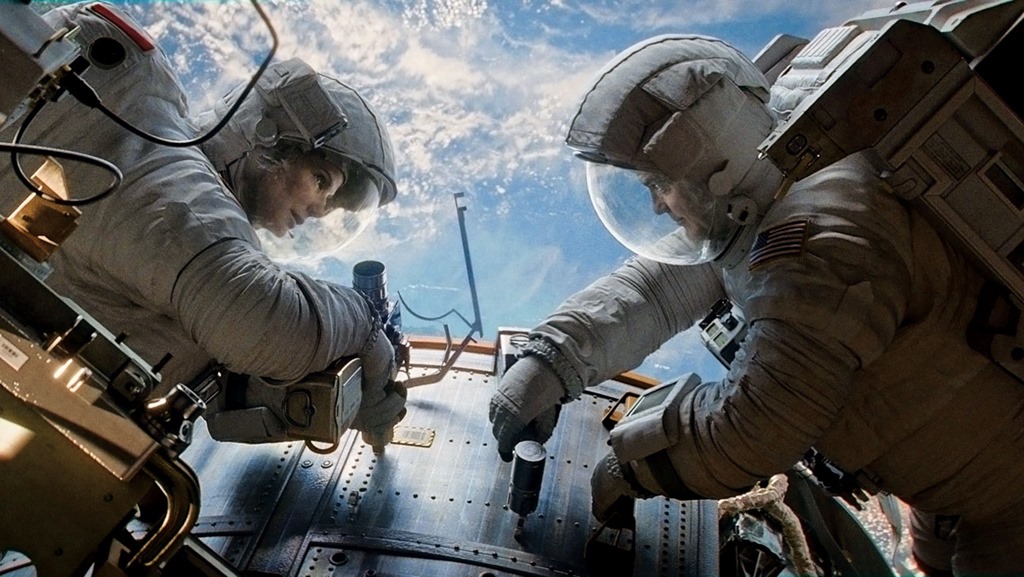
GRAVITY

Don’t get me wrong, Gravity isn’t literary or deep.  And although Bullock and Clooney give amazing performances, their characters were almost clichés.  How Gravity amazes is through simply gripping storytelling.  It is a story of survival, beating tremendous odds in a harsh environment.  And although Gravity wasn’t very scientific, Gravity felt very realistic.  Gravity was brilliantly science fiction in the same way Gattaca had been years ago, it was about a individual overcoming tremendous adversity in a science related setting.

Although in the last couple of decades we have had more and more female action heroes, I felt while watching Sandra Bullock that Gravity represented a paradigm shift, transforming story hero from male to female.  It didn’t feel like a gimmick that Ryan was a woman.

For the first hundred years of of filmmaking Ryan Stone would have been played by a male actor.  Ripley set the precedent, but when Ryan pulls herself out of the muck and stands, with the camera angle from the ground looking up at her towering figure, it felt that women had finally surpassed men at their own game.    It was much like Vincent beating the genetically enhanced humans when he took off into space at the end of Gattaca.

George Clooney plays the ultra-cocky space jock to a tee.  Matt Kowalski is perfectly at home in a vacuum.  Kowalski has the science down cold.  But more than that, he is mature way beyond his boyish antics.  He is an alpha male passing the baton to a female saying with total confidence, you can do this.  I know most viewers won’t see this film as a feminist statement.  Most girls won’t think twice about Sandra Bullock being the lead character.  But in real life and in movie life, things have changed a lot in my lifetime, but not nearly enough.

The message is clear, women can fly the fighters, drive the tanks, pilot the spacecraft, command the ships, shoot the M-16s, control the telescopes, construct the skyscrapers, etc., but it’s sad that so many women have MTV ambitions, like Miley Cyrus, to wear skimpy outfits and twerk.  Movies and television, the most heavy-duty of pop cultural social programming, sends the message that women can now do anything.  But will they?  And will we accept it?

If you think I’m making a pointless issue, then think about this.  What if our two actors were cast against type.  Would you have liked Sandra Bullock as the veteran space jock, and George Clooney as the mission specialist rookie?  We’re still brainwashed to think George Clooney should have played Matt.

Yes, we have made women into action heroes that can shoot and kill, but action heroes aren’t believable characters, they are cartoon characters.  How often are complex male roles given to female actors?  Would you have believed Sandra Bullock as Matt Kowalski?

Let’s put it another way.  I work at a university and the majority of the engineering and computer science students are male, and the majority of the teacher education and nursing students are female.

The role of Ryan Stone calls for a rookie, and most rookie astronauts are still male.  Picking a female to play Ryan is an intentional decision to make the character to appear more helpless because we’re still conditioned to think of women as helpless, or of needing help.  Gravity shows us we’re wrong. But being helpless is good in this movie, because good storytelling is about getting the audience to identify with the main character, and we’d all be essentially helpless in space.

Picking the name Ryan is an intentional choice too – Sandra Bullock is to stand in for a man.  I think that was a perfect choice by the writers of Gravity.  We’re cheering the stand-in for everyman who also happens to be everywoman.  Not only that, we’re all identifying with her, guys and gals.  While watching the movie I totally identified with Ryan Stone and not Matt Kowalski.  I never had the Right Stuff, but I might could have been Ryan Stone.

Maybe next time when they make a film like Gravity, the veteran space jock will be a woman, and it will be as natural as our need for air, but for now Sandra Bullock was perfect in this role.  Whatever is the magic formula for modern storytelling, Breaking Bad and Gravity have it down as well as Walter White cooks meth.

– – –

By the way, many people are nitpicking Gravity for scientific issues.  That’s cool.  But don’t let it keep you from seeing and enjoying an amazing film.  I was really disappointed with Neil DeGrasse Tyson because his complaints were rather lame compared to the problem of orbital mechanics.  Here are some things to read, but don’t get too hung up about them.  Gravity is a triumph of storytelling.  Like preconceived gender roles, we still want fiction with far more excitement than actual reality.  It’s hard to embrace perfect realism.

I expect gender roles to continue to evolve, and I expect incorporating realism into popular fiction to evolve too.  Breaking Bad was far more realistic than such a show would have been ten years ago, but in ten years, writers who will surpass the talents of the Breaking Bad team, will create a series about cooking meth that is far more realistic.  Gravity could have been just as exciting if it had been 100% scientifically accurate.  And I’m not dinging it for its scientific faults.  I’m just pointing out that we’re moving towards a kind of absolute realism in fiction, and that includes gender roles too.

Fact Checking Gravity

JWH  – 10/11/13