Before Steve Jobs died he told his biographer that he wanted to create a television set that was completely easy to use. Can you imagine a TV that’s as revolutionary as the iPhone or iPad? Well, I think it would be fun to guess its features.
World TV
Right now there are different technical broadcast systems all over the world so I would think the first area of simplification would come from jettison outdated technical standards. Why not design one TV that will work with all 7,000,000,000 citizens of the Earth. I can’t imagine Jobs would want to design a TV that had to work with set-top boxes from other companies selling content. Nor could I imagine he’d want to design something that used over-the-air channel reception. Because the Internet is universal across the world, why not just design the future TV to be an Internet TV?
Picture a TV with one power plug and built-in wireless networking. Now that would be a simple and elegant design. It would essentially be a computer with a 24”-62” screen using 1080p, that could work anywhere in the world with a different power cord.
The TV antenna will go the way of the buggy whip, and so will set-top boxes and DVD-Blu-ray players.
Physical Design
Now we need to imagine the design of the device itself. Currently I have 5 remotes and a keyboard with trackpad to use with my 52” TV entertainment system I built myself. If our new future TV used something like Siri, we could get rid of all remotes and keyboards. The only external control that Siri couldn’t handle is a game controller, and with a Kineck type sensor even that might be eliminated.
Having to connect a receiver and surround sound speakers to HD TVs is a pain. Our perfect TV should have a sound bar built-in with great surround sound. And it should play music fantastically too. No more Hi-Fi component, speakers and wires cluttering up the living room.
My new LG computer monitor has no physical buttons on it, but light sensors, even for the on/off switch. I think our perfect TV wouldn’t have mechanical buttons either. It should be voice activated only, but if it did require a manual power switch it should be light activated.
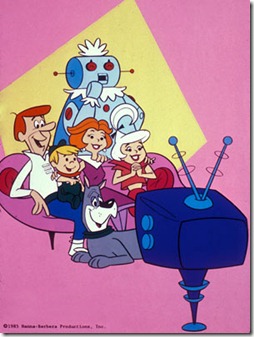
This TV will be more futuristic than anything on the Jetsons.
Content
Now I can’t imagine Jobs thinking he could design this TV and just throw iOS 5 on it. The TV opening screen and menu system is the hardest feature to imagine. This is why Apple is the success it is, and why other companies copy its design. Our prefect TV needs to show:
- Internet broadcasts – live TV
- Recorded shows from the past
- Movies
- Personal videos
- Photographs
- Internet
- Games
- Music
- Telephone
- Teleconferencing
- Online courses
- Presentations
- Business and education software
For Internet TV to work we need TV networks to switch to streaming their content, but there’s needs to be a paradigm change first. How many shows need to be live? Think about that. The news, sports, reality shows, special live concerts and performances. We actually don’t need live TV all that much. Most of what’s on TV is recorded. Because of DVRs and services like Hulu, how many people even watch new TV shows that premiere each week live? Cable/satellite services provide hundreds of channels because of their technical limitations, not because we need hundreds of live TV channels.
Content from networks like TCM, National Geography, Discover, History, etc. can be served just as well from a web page, they don’t need to be live.
Recorded TV shows and movies can come from services like Netflix, iTunes and Amazon Prime.
When I was growing up in the 1950s and 1960s we had 3 television channels. There were no DVDs or DVRs to catch a show later. You either watched the show when it aired, or maybe had another chance the following summer during rerun season, and that was it. Each fall we were presented with a new line-up of shows and they would generally run a whole season – shows were seldom canceled mid-season. Once you learned the lineup on shows in September you pretty much knew what was going to be on television until next summer. Special shows were indeed special and rare. That was simplicity then.
Back then watching TV was as easy as basic arithmetic. Today with cable, satellite, iPads, smartphones and internet television channels, along with DVDs, Netflix, Amazon Prime, Blockbuster, Redbox and DVRs deciding what to watch on television is more like advanced calculus. We now live in a TV age of painful complexity.
Watching TV fifty years ago meant three channels of choice. Today we’re getting closer and closer to being able to watch anything that’s ever been on television at any moment. The choices aren’t infinite, but when someone asks “What’s on TV?” it might be safe to say, “There’s a million things on TV tonight.” And that’s painful to deal with.
Our perfect TV needs to have an operating system that allows the viewer to find what they want to watch as quickly as possible. It needs to be as simple to use as an iPad for a two-year-old. When the set is turned on it needs an opening screen – the top menu, and the basic functions can be simplified to these:
- TV
- Library
- Telephone
- Games
- Music
- Computer
This makes six tiles – is Microsoft on to something? TV would be live TV, Library would be recorded shows, either TV, movies, personal videos, photographs, or other content. Telephone could be two way video or conferencing. Games and music are obvious. Computer would be anything from online courses, business presentations, science simulations, word processing, blogging, etc. I think we’ll be surprised what we’ll want to do from the family TV in the den.
Think what a game changer such a television would be. It would be the Holy Grail of integration between TVs and Computers, but also phones, stereos and game units. Is it any wonder that Steve Jobs wanted to tackle such an exciting project? Sadly, think how many companies it will put out of business. We won’t need Blu-ray players or discs, or Google TV or Roku, or music CDs, or movies and TV shows on DVD.
How To Get From the Complexity We Have Now To A New Simplicity?
If you have cable with hundreds of channels how do you even know what to watch? And what great shows are you missing?
Live
The first thing we need to do is separate live content from recorded content. We need to bring back the demand and understanding of live TV and we need to reduce the number of channels offered. Because our system works with the world, live TV could be from anywhere on the planet. We want our TV user to select any channel they want, but we need to simplify the TV menu system. I like how Roku does things. It offers hundreds of channels but you only add in the ones you regularly use to you main menu. I’ve done the same thing with my over-the-air TV, reducing about two dozen local channels down to five. It makes life easier.
When the user says “Live TV” to our new set they should see a small listing of favorite live channels. They could be numbered on the screen so the user could say “Number 4” or just “PBS.” Or they could say “Add channel” and then go into a menu of all possible live channels to add. They might say, “Japan” and see live TV channels from Japan. Or they could say “American football” or “British reality shows.”
This system would allow for simplicity from an unlimited offering.
Also, the Live function could connect to web cams around the world. TV doesn’t have to be produced.
Library
The selection of recorded shows could run to the millions. Any movie, any TV show, any documentary, any home video, etc. We’d need a system to help people find good content. The basic search engine could find things if user already knew the name of the show, or certain related details, but for discovering new shows they would need help.
What we need is the wisdom of crowds – hit lists of all kinds to let people find what other people are watching and rating.
The default Library screen could have pull down menus on the left and a list of shows on the right. The pull down menus will let you pick for Year, Genre (and Subgenre), Audience, Now/Then, Rating, and maybe others. The default might be Current to see the most popular shows people are watching right now. But under Time you can change it to a listing by year or decade. Under genre you’ll see a detail list of genres and from Audience you can pick age group.
This way you could put in 1950s, Science Fiction, 60-65, Now – and you’d see a list of 1950s science fiction shows and movies that people 60-65 are currently watching the most. You can also switch to Then and see what the people back in the 1950s watched the most.
So if you want your daughter to learn about astronomy you could request the most popular documentaries on astronomy that are viewed by 10-20 year old girls that are rated 8-10 stars.
We’d need supplemental features that used the techniques of Amazon customer reviews, Netflix, Wikipedia, Rotten Tomatoes, MetaCritic etc. to help people find shows.
The system could have an encyclopedia of TV shows and you could find any TV series that’s ever been made and start watching them from the first episode to the last. Such a TV system will kill off DVDs.
Finally, our Library feature could also integrate with your local libraries, to their special collections, or to libraries around the world. There’s more to our culture than old movies and TV shows.
Telephone
Wouldn’t it be cool for one family on Christmas to see and talk with other family members who can’t make it home that year? The possibilities are endless. Science fiction has been predicting for the wall screen telecommunication device for decades. It’s time to get around to making one.
Games
It’s pretty obvious games need to be integrated into this system. Essentially our TV will be a computer, whether it runs Mac OS X or Windows 8 or Linux, it will be competing with console gaming. It could signal the end to console games. But won’t Angry Birds be cool on a 62” screen at 1080p? Or future versions of World of Warcraft?
Music
Apple wants you to buy music from iTunes – that’s such ancient 20th century thinking. I’m surprised that Steve Jobs didn’t recognize the simple beauty of streaming music libraries like Rhapsody, Rdio, MOG, Spotify, Zune and others. Why mess with owning music and having to worry about backing it up and protecting it for the rest of your life. Streaming music rental libraries is just too damn easy to use.
Like the “Live” TV function, the “Music” screen should allow users to add subscription services to the default screen. Probably only one, but they should get to pick which one. I’m sure the future TV from Apple will show iTunes, but unless iTunes starts its own streaming music service, this will keep the Apple model of future TV tied to the past. Right now I subscribe to Rhapsody and Rdio, and use the free version of Spotify.
Computer
Lot’s of people want to predict the death of the desktop computer but you just don’t want to do everything you can do on a computer from a 4” screen, or even a 10” screen. Online education is going to be big. Doing business presentations is already huge and getting bigger. Everyone will learn to create content, whether you’re an artist, teacher, musician or mathematician. Imagine letting kids paint on a 62” canvas? Or studying math from a library of the best teaching programs from around the world. For many families the desktop might go away, or it might become the family TV. Or the bedroom TV. Pretty soon a TV will be a computer and a computer a TV.
Summary
It’s like Dylan said, you don’t need a weatherman to know which way the wind blows. Many young people have already abandoned the family TV to get all their content from smartphones and tablets. The shift to Internet TV has been going on for years, so it doesn’t take much imagination to predict a perfect TV. I wished Jobs would have lived into his 90s to see everything he could have revolutionized. Actually it would be fun to see if he ran out of things to reinvent.
At some point things have got to settle down. If you contemplate this TV I’ve imagined here, it integrated a lot of technologies into one simple device. I’d expect one screen in every room. And then everyone would have a 4” smartphone and a 10” tablet and maybe a 12-16” laptop if they needed one. After the war of gadgets we’ve been seen in the last decade will we see a gadget peace for a time? Reading Engadget makes that hard to believe. But the Flip video camera was killed off because of video cameras in smartphones. What will the iPhone 4s do to the digital still and video camera market? What’s happening to portable DVD players and handheld game units? Does anyone buy handheld GPSs anymore?
Just when Microsoft was getting into touch, Apple comes out with a voice interface. Schools are giving up teaching cursive handwriting. When will typing disappear? Always remember, the evolution of machines is away from moving parts. Now that consumers have access to 3 terabyte hard drives do they really need them when everything is moving to the cloud? How much does the iMac look like the future of computers and TV? Evolution appears to be moving toward intelligent flat screens. The smartphone suggests that everyone will have a personal 4” screen they take everywhere. Some people will also need 10” screens (tablets). At what point does voice controlled touch screens invalidate the need for 12-16” laptop computers? And when does the 24” computer monitor in the bedroom merge with the TV? And can one OS handle all screen sizes? Will it still be Microsoft v. Apple v. Linux?
My recommendation if you are buying a new TV now is to pick one with the most Internet features built in. But expect Apple to come out with something in 2012. Will it be as revolutionary as the iPhone? I don’t know. Too much depends on TV networks, cable channel systems and content providers. But I can’t help believe that cable TV will go the way of the floppy disc. Expect CDs, DVDs and Blu-ray discs to disappear quickly too. Cable TV and Satellite companies will put up a big fight for years, but the Internet will allow content produces to do an end run around them.
How quickly will all this happen? Well, how quickly are ebooks taking over printed books?
JWH – 10/30/11


 Auxiliary Memory