The Economics of Inefficiency

During bad economic times people seek ways to get more for their money – in other words they try to become efficient spenders.  The trouble with that thinking, it’s bad for the economy.  What we want is a thriving economy where there’s a chicken in every pot and the future is rosy.  Woefully, a thriving economy is highly inefficient.

Take saving money.  All money advisors advise people get out of debt, save a portion of their salary and only buy what they’ve saved up for – good Puritan ideals.  If everyone followed this advice we’d fall into a world-wide depression.  The economic success of all depends on everyone spending as much money as they can.  If we had a world where the only credit card spending was paid off at the end of the month, people wouldn’t buy nine-tenths of the crap that they do.  That’s a lot of people out of jobs.  And when those folks lose their jobs, even more bad things happen, and a recession becomes a growing snowball rolling down hill.

There’s always a silver economic lining, even to bad things.  If everyone was honest we wouldn’t need jails, police, lawyers, judges, counselors, bail bondsmen, mystery writers, cop show producers, and so on, as I’m sure you get the idea.  I hate the idea of crime.  Crime is the true terrorism in America.  But ending crime would be like one of those stories about a person finding a Genie in a bottle and getting a wish that turns out disturbingly screwed up.  If someone did get to make that wish and tomorrow all illegal activity stopped we’d have a whole lot of honest people out of work, and a lot of criminals previously not working, would be looking for jobs too.  Could the world’s economies handle the impact of so much ethical behavior?  I’d much prefer a crime-free efficient economy and the main way to reduce crime is for the economy to produce a lot of good jobs.  It’s a Catch-22.

The same reverse philosophy could be applied to the advice about eating right and pursuing healthy lifestyles.  If everyone ate healthy, how many people would be out of work when all the fast food restaurants went belly up?  Add in the junk food makers, their related industries, vending machines, packaging, salesmen, suppliers, warehouses, etc.  And then think about all the health care workers that clean up after we lead lives of poor healthy choices.  Sure, we’d produce a lot more sport fitness jobs, but would they make up for all the lost careers selling evil calories?

What if everyone bought the store brands instead of the big name brands?  What if everyone jettison their designer clothes and shopped at Target and Penney’s?  What if everyone wore sensible shoes and drove practical cars?  What if people gave up vanity, putting the make-up makers and cosmetic surgeons out of business?  What if everyone stole their MP3 songs and DVD movies?

Certain things in life are vital:  air, water, food, shelter and jobs.  And maybe jobs should be listed third because getting food and shelter without a job is very difficult.  Right now America is in a panic over an economic downturn and we see everything about the future through the spectacles of fear.  It doesn’t seem to matter that there’s more peace and prosperity now than at any time during all of history.

Everyone is wailing and gnashing their teeth that gasoline costs $4 a gallon.  Forecasters have been predicting that for forty damn years – so why all the tantrums?  Nor do people seem to notice that the high price of gasoline comes just at the perfect time when we need to wean ourselves off of fossil fuels because of war and global warming.  It’s a good thing.  It’s our second warning before economic hell comes to town.  We knew back in the 1970s that living off of cheap oil was like borrowing from the Mafia.  Is it so surprising they’re breaking our legs right now?  And we really haven’t had a true oil crisis, because no one is going without yet.  Wait until there are oil shortages.  That’s when they chain cement blocks to us and throw us in the ocean.  Are you ready for the day when there will be no gasoline for sale at the pumps?  Gas lines are just one terrorist act or hurricane away.

Cheap fossil fuels made for wonderful sensible things like wooden toys made on one side of the planet, practical to sell to people on the other side of the globe.  See where the economics of inefficiency come in?  We use cheap fossil fuels to move our fat asses, which desperately need exercise, around in 6000 pound vehicles, instead of vehicles, if they were efficiently designed, weighing in at 500-1000 pounds, and use renewable energy instead of molecules sequestered by the Earth millions of years ago to get carbon out of the atmosphere and allow life to blossom.

We may be the smartest creatures in creation, but heck, we ain’t smart enough not to poison our only habitat.  When you live in the basket with all your eggs, eating omelettes every day is dangerous.

To pull ourselves out of this economic mess we need to learn to consume more while using less, a Zen koan if there ever was one.  Moving music to MP3 files is a perfect example.  Distributing MP3 music requires an infinitely small fraction of the resources it took to make and sell CDs.  The demise of the CD puts a lot businesses and people out of work, but if the music industry worked it right they could eventually create a lot more jobs.  This economic theory fails if you steal the MP3s.

If everyone had solar panels on their roofs it would require the creation of whole new industries and millions of jobs.  To feed and educate all the needy people in the world would create more millions of jobs.  To build houses that withstand hurricanes, tornadoes, floods, fires and severe weather of the changing climate will create more millions of jobs.  There is no end of jobs to be create because of need.  There is plenty of economic activity, both efficient and inefficient if you have the vision to see it.

I know a lot of Americans are suffering because of the current economic crisis, but I have to agree with Phil Gramm that part of our economic recession is a “mental recession” and we’re doing too much whining.  Hell, we’re not living in Afghanistan.  What happened to that American spirit of when the going gets tough, the tough get going?  I’m voting for Obama, but I didn’t like his quip about not needing another Dr. Phil.  We need all the positive thinkers we can get.  There’s lot about McCain that I like, and if he wins I won’t be too unhappy, but his spin-control pandered to voters rather than exploring the point I think Gramm was trying to make.

During election times all voters become beggars looking for handouts demanding that their politicians promise and promise and promise.  Politicians get nowhere if they aren’t leaders.  Of course sometimes they lead us off the cliff into places like Iraq, but didn’t George Bush take us there because he was playing off the country’s fear?  We’re living in the current economic chaos because of greed and the refusal to think and pay attention.  Do we really need brilliant hindsight to know that making house loans to people who can’t afford them is silly or owning SUVs are a bad idea when oil was predicted to run out forty years ago?

Our crazy economy reminds me of the classic science fiction story, “The Midas Plague” by Frederik Pohl, where consumerism drives the economy so much that the poor are forced to change clothes several times a day to keep up with production – because to make less would hurt the economy.  In this bizarro world, the rich get the freedom to live without being consumers, but the poor must consume like hamsters on a wheel to keep the economy going.

Who’s fault is it if we take the most powerful and prosperous country in the world and run into the economic ground because we all like to make bad choices?  For decades we have built an economy on inefficiency.  What happens to China when we stop buying all that crap we don’t need?  What happens to the U.S. if China suffers an economic chill?  It’s like “The Midas Plague,” we could stimulate the economy by forcing the poor to go into debt and buy a new HD TV every month.

Right now everyone is panicking and cutting back on their spending, but if you wanted to help the economy, you should be doing just the opposite.  Now, here’s the crucial part – your economic decision has impact.  You can make an efficient choice, or a wasteful choice.  If you buy a new HVAC that uses 1/3 the energy as your old one, then you have stimulated the economy and reduced the demand on fossil fuels, plus saved yourself some bucks.  If you fly to Paris for a vacation, you have helped the airlines, but hurt the rest of us by increasing the demand for oil.  You can’t win for losing sometimes.  But if you had the choice between flying on a plane fueled by green technology or old technology, your choice could build a new industry.

We need to cowboy up and channel our ancestor’s pioneering spirit.  We need to take responsibility for our actions.  Like the old Pogo cartoon said, “We have met the enemy and he is us.”  Whether gasoline is $2 or $4 or $7 a gallon, the choice is made by us, we set the price.  If you want gasoline to go to $7 a gallon, keep burning oil like there’s no end of it, live like the oil companies will always find new resources, use it like we’ve been doing for the last thirty years.  Keep panicking over the economy and oil prices will rise.  Keep advocating going to war with Iran and oil prices will rise.

We need to get our heads together, overcome fear like FDR taught us, become frugal like our Puritan forefathers, develop green technologies, and oil prices will come down.  If gasoline went to $10 a gallon, but we had cars that got ten times the mileage, it would be like getting $1 a gallon gas.  When gasoline was $2 a gallon we could have been driving cars that made it equal to 50 cents a gallon, but we didn’t.  We collective decided to drive cars that would force gasoline to become $4 a gallon.  Our choice – so why bitch and moan now?

The other lesson of this current economic crisis is the world changes.  We built our current economy psychology, retirement system, investment system, and all our financial expectations around the idea that the world won’t change and growth would be predictable. How stupid is that?  Our current state of economic fear is because we’re having to deal with change.  Change is as constant as time.  People hate change, but we’re the dominant species on this planet because we’re adaptable.  Humans can handle habitat change that puts all other species into extinction, but that’s at the species level.  Cultures go in and out of existence like TV series.  Because the U.S. is a very diverse culture, we can take quite a beating and still keep on ticking.  Go study your Douglas Adams and Adam Smith, and don’t panic.

Jim

Beyond the iPod

Because the iPod and iTunes has had such a fantastic impact on the music industry, I have to wonder if another industry shaking revolution like it is possible?  I’m reading The Post-American World by Fareed Zakaria, where he praises the U.S. for economic innovation, so I assume for us to stay ahead of the pack we’ll have to keep inventing new tech to market.  We’ve seen a lot of technological change in the last 50 years, but does that mean we’ll see constant growth in the next 50 years?

And will other emerging capitalistic markets start beating us at our own game?  Zakaria claims that America is not declining but the rest of the world is rising.  That means both new markets and new competitors.  But will anyone anywhere create another product like the MP3 player to change the marketing of music again?

I remember the days before video recorders – where few people saw the advent of the VHS revolution coming, but once it was underway it was very easy to accept a steady stream of new tech acronyms like CD, PC and DVD.   The MP3 was even more revolutionary and economically disturbing because music moved from physical objects to bits, bytes and electrons.  There was no need for any of these inventions other than convenience, which shoots down that old theory about necessity being the mother of invention.  We’re now into the HD and Blu-Ray upheavals.

I originally started collecting music by buying 45s and LPs.  Then I had to start over with CDs.  And for a short while a few years ago I had started moving to SACDs.  I’m hesitant to make another move, but I’ve finally committed to the MP3 format.  The question is, will I have buy my favorite songs all over again in another format in the future?

But back to my questions about iPods.  Assuming that the iPhone is really an iPod merged with two other revolutionary technologies, a cell phone and a computer, is there theoretically room for a new paradigm shifting music device?  If Steve Jobs sanctioned subscription music there would be a slight bump in the iPod road, but not much.  People would still be listening to music with white plastic buds in their ears.  Once you get rid of the physical media where is there room to invent?   Sure, we could talk science fiction and imagine ESP delivered music, but we have to stay somewhat realistic.

Maybe I’m not imaginative enough, but no matter how much I rack my brains I can’t imagine a new gadget for music.  I can imagine variations on the current iPod, lots of them in fact, but they’re all just improvements:  larger hard drive, larger flash memory, better sounding headphones, tiny built-in Hi-Fi speakers, SACD quality files, better filing systems, but nothing that offers drastic change.  I feel the same about personal computers and televisions.  Once you go beyond the physical medium of DVDs like DVRs, improvements are more of a matter of storage space and video quality.

Gadget junkies are going to need to look elsewhere for big society-changing technology.  Before long I think the geekiest of geeks will be buying home solar power generators.  If you can generate a significant portion of your own power, getting into a plug-in hybrid cars is the next gizmo that’s going to change society.  Now those two technologies are going to be huge game changers.  It will be like the iPod – you won’t need to buy that much gas to run your car – or at least not much compared to how things are now, and the secondary fuel may not even be gasoline.  See the trend – away from the physical.  Think 1950s movie science fiction where all the aliens did everything with glowing balls.

Mechanical evolution is moving towards fewer moving parts (hard drive to flash drive) and away from the physical (CD to MP3).   Electric cars have a lot fewer moving parts, and fewer parts in general.  Solar energy panels, LCD TVs, iPhones don’ have any moving parts.  If computers move to flash memory storage and became completely net oriented, they could even jettison the optical drive, and the only moving parts would be in the keyboard.

There’s a chance that Blu-Ray won’t even catch on because we’ve already gone beyond the physical with online movies and DVRs.  I would buy a Blu-Ray player now if it was $99.95 and get discs from Netflix, but if they don’t bring down the price soon they will have competing products that distribute HD video over the web, or cable companies will figure out a way to distribute HD programs on demand.  Cable companies are already teamed up with Rhapsody and other subscription music services to provide songs on demand.

My guess is the end is near for revolutionary gadgets for music, movies, television, audio books, e-books and other media that can be digitized.  What we will see is refinement in software.  Putting a cell phone, GPS, camera, computer into an iPod styled package isn’t revolutionary, just evolutionary.  What makes the new iPhone 3G so exciting is the software.  Now that the iPhone is opened up to developers it becomes very promising for endless speculation of what it could be, but it’s still the same old gadget.  That’s why Google saw the Android phone as such a big deal – open development – build it and they will come.

If a person could ask his iPod to play the ten most played songs on iPods in America during the last 24 hours, that would effect the music industry.  If she could ask for the top iPod songs from Russia, India or Dubai, that could have a new kind of impact too.  Or if you’re on a road trip and could ask your iPod to play the most popular songs of the towns you are passing, that would be another interesting variation.  The Zune song sharing feature is very cool and Apple and others should copy it.

All those features effect the distribution of music, making music more global and making it more social.  Sheet music was the technology for spreading music in the early days.  The first gadget to change the world of music was the phonograph.  Then came the radio, creating the mass audience.  To understand the impact of radio watch Ken Burn’s Empire of the Air: The Men Who Made Radio, which you can buy from Amazon or rent from Netflix, but if you want even more details, track down the out-of-print book by the same title written by Tom Lewis.   The phonograph went through many refinements including the CD, but ultimately, the ethereal MP3 player replaced it.

At first the MP3 file technology, combined with technology to play the file set music free.  Bad for the industry.  The goal of the music industry is to sell music as widely as possible.  Illegally free MP3 music has a wide distribution, but it’s not necessarily the best way to promote music.  Kid’s pretty much stole what they already liked.  Radio has always been the best medium to educate people about new music, and it’s always been free too, because it came with programming and promotion.

What will be the next big revolution in the music industry won’t be a gadget but software.  The networked computer part of the iPhone and iPod Touch has the ability to promote music in ways never possible before.  Whether you buy songs 99 cents at a time, or subscribe to them at $15 a month, getting you to commit ear time to a song is the dream of all musical artists.  People have complained about the stale rotation of Top 40 music for decades, but with a world of hundreds of countries and thousands of cultures, and all their musical history, there’s a lot of music to discover and play.

Let’s say you want to get into music history, wouldn’t it be fun to tell your iPod to start with 1950 and begin playing the Top 100 Hits of that year and move forward in time, and then use your click wheel to rate the songs.  Or buy a future edition of “How to Listen to and Understand Great Music” from the Teaching Company and have it play full pieces while it instructs you about the history of music?  Or buy a special edition of Richie Unterberger‘s history of folk rock and whenever you hear the narrative mention a song, it pauses to play the song.

Just remember, it’s not about the iPod stupid, it’s about music.  What we want is great music.  What we want is for as many composers, performers, producers and publishers to become wealthy or at least make a good living as possible.  We want music to stimulate the economy.  We want it to be a driving force in culture and art.  Every decade needs their own Beatles, Springsteen, Madonna and Prince.  Modern pop music is produced like candy and not art.  It needs more new waves like Rap and Hip-Hop before they got tired like rock, jazz and country.

I’m willing to call it quits with the development of MP3 music technology.  I don’t need any more convenience.  What I miss is the excitement I got from music back in the 1960s when I was growing up.  What I love is discovering a new song that I’ll play over and over again for two weeks.  It’s been a long time since I’ve found such a song.  Susie and I are watching The Beatles Anthology, an eight part DVD documentary and it’s riveting.  I don’t need or want a new generation of iPods, what I want is the new Beatles.

Jim

Science Fiction in the Last 25 Years

Entertainment Weekly recently published their list of The New Classics: The 100 Best Reads from 1983-2008.  Guess what?  Only one science fiction genre book, Neuromancer (1984) by William Gibson made their list, coming in at #26.  There was some fantasy titles like Harry Potter and the Goblet of Fire (2000) by J. K. Rowling at #2 and His Dark Materials (1995-2000) by Philip Pullman at #40, and even a graphic novel, Sandman (1988-1996) by Neil Gaiman at #46, to represent some other genres that are close to science fiction fan’s hearts, but only one real SF title.

Now squeezing in the best literary, non-fiction, YA, genre books and even graphic novels from the last twenty-five years down to a hundred titles doesn’t leave much room for many titles in each category, but to only have one science fiction title seems harsh at first glance.  But I’m not being too critical, it’s a good list, but I think they should have included one other science fiction novel:  Ender’s Game (1985) by Orson Scott Card.  I say this because so many of my non-science fiction reading bookworm friends loved this story, and even consider it one of their all-time favorite books.  In fact, if EW were to insist on including only one SF title, I’d pick Ender’s Game.

Entertainment Weekly isn’t alone in proclaiming Neuromancer as the only quality SF novel of the last twenty-five years, so did The Daily Telegraph.  Both periodicals also picked Cloud Atlas (2004) by David Mitchell, a literary novel with some story settings in the future.  And the Telegraph also picked The Time-Traveler’s Wife (2003) by Audrey Niffenegger, an excellent science fiction story told in a literary narrative.  Personally, I liked both of these titles better than Neuromancer

Of course The New York Times did their What Is the Best Work of American Fiction of the Last 25 Years? and they didn’t even throw in any token genre books at all.  I’ve only read two of their titles, White Noise (1985) by Don DeLillo and A Confederacy of Dunces (1980) by John Kennedy Toole, and I prefer Ender’s Game, Cloud Atlas and The Time-Traveler’s Wife over both of them, and Neuromancer just a little less.

Does this mean that for the most part science fiction is ignored by the reading world at large, or is it sadly that science fiction books just don’t measure up?  Many of the books listed do have fantastic elements, so I think science fiction and fantasy have made an impact on the modern literary world.  The current Pulitzer Prize winner, The Brief Wondrous Life of Oscar Wao (2007) by Junot Díaz is on the list and the title character is a Sci-Fi fan and extreme geek.  I wonder if that’s how the literary world at large sees SF fans? 

Junot Díaz weaves in so many Sci-Fi references, totally off-the-cuff and unexplained, that I assume he thinks they are universally part of our culture.  But I have to wonder if most of them don’t just fly right over the average reader’s head.  Just how many outside of our genre know who Dejah Thoris is, and if you are a younger science fiction reader, I’m not sure if even you know.  The literary world often sneers at science fiction and claims science fiction fans are immature social misfits – and Junot only reinforces this idea, but I think he’s really with us and not against us.

I’ve read a lot of science fiction and a lot of books from these lists and in these book Olympics I’ve got to say that most genre books do not have the times to get on the team, but there’s a gimmick that’s not be addressed.  These top culture best-of-lists aim to find the most memorable titles for the most people.  Genre writers crank out gazillions of titles that are very entertaining in the moment but aren’t very memorable in the long scheme of things.  Also, science fiction books aren’t widely read, so how can the be widely remembered?

I think The Time-Traveler’s Wife straddles both the genre and literary world even though it’s widely loved, few of it’s fans want to think it’s a science fiction novel.  I think Gibson’s Neuromancer is on the list because it’s not about traditional science fiction themes, but about computers, and we know how important computers are in our society.  The Time-Traveler’s Wife is about love, and we know how important romance is to our society.  Science fiction books are often about weird things that most people don’t think about, so that’s why SF books get little attention.  Ender’s Game is about children and childhood first, and most people can identify with that.

If science fiction writers want to get their books listed on these pop culture memory lists, they need to write more books with universal appeal that are memorable.  Another exciting military action thriller can be a great reading experience, but they tend to all blend in together.  The reason why Stranger in a Strange Land is so well remembered outside of the genre is because it’s so unique.  It’s one of the few SF titles that the general public remembers from the last 50 years, and even then I doubt 1 person in 300 would list it if Jay Leno asked them to name a famous science fiction book from the last century in one of his Jaywalking segments.

On the other hand, if Jay Leno was asking a long line of people to name a single title from Entertainment Weekly’s list and give them ten chances, how many on average could succeed?  I have no idea, but I’d guess damn few.  If you gave people ten chances to guess one of the movies off their EW’s 100 Best Films from 1983 to 2008, I’d say 95% would succeed.  Books just aren’t mass media like movies and television, or even music.  I’d say it was damn nice of EW to remember Neuromancer at all, and to make that Top 100 list is a very excellent distinction.  William Gibson and his family should be very proud.  And we science fiction fans should be very pleased too.

Jim

The Age of Innocence by Edith Wharton

Edith Wharton’s 1920 Pulitzer Prize winning novel, The Age of Innocence, is a story about how people never communicate their real feelings.  Wharton suggests at the end of her book, set twenty-five years after the start, that the next generation is more open, but I’m not sure even a hundred years later, in our own times, if this is true.  The love triangle of Newland Archer, his fiancée May Welland, and her older cousin, Ellen Olenska is shown through the viewpoint of Newland’s mind.  Edith Wharton does an excellent job of taking on a male point-of-view, considering the cultural restrictions of her time, and her consideration for the minds of people from the 1870s.

AgeOfInnocence

The Age of Innocence is a story of culture and manners and their impact on people.  Newland Archer knows what he’s suppose to do, and how other people are suppose to act, but within his own mind he wants to be different, and imagines that maybe other people do too, but his life is frustrated by the few clues he gets to verify his theories.  He thinks he has the perfect young woman lined up to be his wife and then he meets a woman who has run away from her husband, a Count no less, abandoning wealth and position, to flaunt traditional behavior.

Countess Ellen Olenska is described as looking old at thirty, and no where near as beautiful as her younger cousin May, at twenty-two.  Yet, Newland Archer finds himself more attracted to Ellen.  Plenty of other men do too, and readers are never sure how many men are chasing Ellen, or how many are catching her.  Many men want to make her their mistress, but we’re never told the details of the relationships because we only get to know what Archer knows.  He gets conflicting information from Ellen and the people who know her.  Archer is never sure what May is thinking, or Ellen.  He often plays games, telling himself if this happens, he’ll do this, and it means that, but they never work out like he plans.

Archer wants to tell May, sorry old sport, but you’re as dull as your society, and then run away with Ellen.  We know that even in Wharton’s time, 1920, men were doing that, and readers today probably have a very hard time understanding why Newland didn’t just chuck it all for love, but then I guess that’s why Edith called her novel the age of innocence about the 1870s.  In our times, we act on our impulses but do we communicate why?

People today still don’t say what they’re thinking but instead communicate with a strategy like the old Battleship game, where players try to guess the location of hidden ships on a grid.  Readers following along behind Newland Archer and watch his strategic plans and waits with him to see if his remarks hit anything in the minds of May and Ellen, and then ponders along with Archer about May and Ellen’s commands back and if they offer any clues to what they are thinking.  Even to the end, what May knows about Archer’s feelings for Ellen is ambiguous to the reader, but Wharton lets us know that May is no dummy and is playing her own game with as much passion as Newland’s.

We know even less about what Countess Olenska is thinking.  Is Archer someone special to her, or is he just one of many men that she plays along.  And does Archer really want to know?  Edith Wharton has written a beautiful masterpiece about the battle between the sexes.  The ending is perfect.  Reading this novel makes me, and I assume other readers, wonder why people don’t just say what they are thinking.  My guess is we’re afraid of shattering our fantasies.  Our expectations of other people are all built on fantasy, speculation and desires.  If men knew what women were thinking it would be crushing blows to our egos and sexual fantasies.  If women knew what men were thinking it would be the end of romance.

I think Wharton knew this.  I’m guessing Countess Olenska knew this, and from the last scene I think Newland Archer knew this, and we’re given hints that even May eventually learned this truth.  But we never know anything for sure, because Wharton knew that, too.

Jim

The Joys of Technology

Today, the title of my post is in all seriousness.  I’m having a very good technology day.  Other days, the title would be sarcastic.  For years now I haven’t quite figured out how to live with MP3 music.  I don’t like listening to music on my iPod – instead I want to play MP3 music on my living room stereo.  To that end I bought a Roku Soundbridge M1001 last year.  This nifty gadget plugs into my receiver and listens to my WiFi network and watches my computers for iTunes, Windows Media Connect, Rhapsody and other UPnP AV MediaServers where I store MP3 files.

What the Roku does is display a list of songs stored on my computers in other rooms that can be played on the connected stereo system.  It displays lists by artists, albums and songs via a small LCD readout and lets me select and play them with the aid of a palm-size remote.  The trouble is I have over a thousand CDs, and flipping through their titles one LCD line at a time is a pain.  I thought at the time I first set up the SoundBridge it needed a TV output which would let me select songs through a TV interface.  There are media servers that also fetch video and photos from your computer, as well as songs, which are controlled through your TV screen.  The SoundBridge is just for songs.  By the way, the newest Roku is for Netflix online films and does work with your TV.  It’s too bad they didn’t combine the functions for a single product.

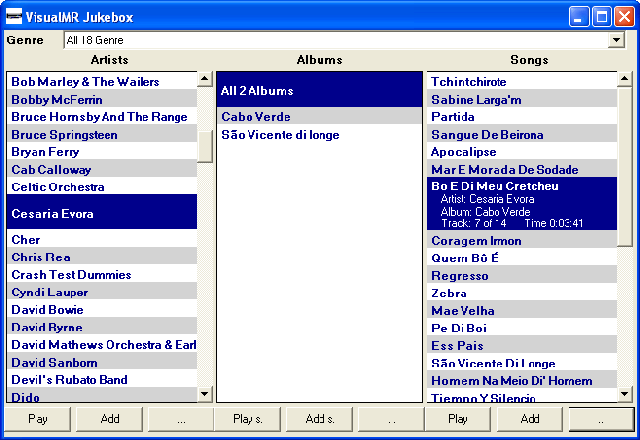
This morning I jumped on the web because I just knew there had to be an answer to my desires, and I found an excellent solution, Visual Media Remote.  Installed on my laptop, which normally sits in the living room, this program lets me to control the SoundBridge.  I know this sounds weird.  My music is stored on a machine in my library/office.  The SoundBridge is in the living room.  The laptop could be in any room but it controls the SoundBridge.  If I had SoundBridges in other rooms, it would control them too.  This screen shot taken from the VisualMR site best illustrates why the software is so useful:

visualmr_pc_jukebox

This display shows a listing of artists on the left, their albums in the middle, and the songs from the highlighted album on the right. And I can filter too, by genres. This very quickly lets me drill down into my collection and find songs and add them to the player queue. I can sit in my La-Z-Boy with my laptop on my lap and just lean back and play songs about as conveniently as I could ever imagine, other than using telepathic mind control over my computer.  VisualMR has been around a long time, but I didn’t have a laptop for the task before.  VisualMR will also work with PDAs.

Searching through Google shows a lot of people use this same setup, but I don’t think it’s a massive crowd.  My guess is most people give up on stereo systems when they get an iPod, or they buy a cradle that attaches to their receiver that lets them use their iPods as CD players.  And I thought about reducing my music world down to one handheld device, like the iPod.  I could reduce my equipment footprint if my laptop had a large enough hard drive to store all my music.  Or I could just buy some high quality headphones and listen to the music directly from the iPod.  Hell, no one seems to like to listen to music together anymore, although I got my wife singing and dancing last night while we made dinner when I was showing off my SoundBridge setup.  But I had to play the songs she liked.

I’m happy with this present setup.  I wished iTunes and Windows Media Player used the same three-pane approach to selecting songs like VisualMR.  I can pack up my CDs and store them away.  Now that music is sold as DRM-free MP3 songs, this kind of equipment might become more popular, because it’s very easy to just shuffle these tunes from machine to machine and room to room.  Microsoft has sold Windows Media Center for years hoping the idea would catch on, but it hasn’t – not big time.  Linksys, Dlink and Netgear all have media servers that work with their wireless equipment.  The tech is there, I just don’t know if they are popular solutions.

Like I said, the iPod has changed everything and I think people have just adapted to it.  It makes me wonder if sales of CD players and receivers have fallen since the success of the iPod?  Well, duh, if people aren’t buying CDs, sales of CD players must be tanking.

All of this reminds me of the fat people in the movie Wall-E – they don’t notice the world around them because everything comes through their video screen, inches in front of their faces.  Now that iPods have added cell phones, movies and television shows to the music lineup, as well as photos and audio books, there’s all the more reason to stay plugged in to your iPod 24×7.  Who knew that electronic gadgets would bring so much fun and joy to people.

Jim