
by James Wallace Harris, 4/17/26
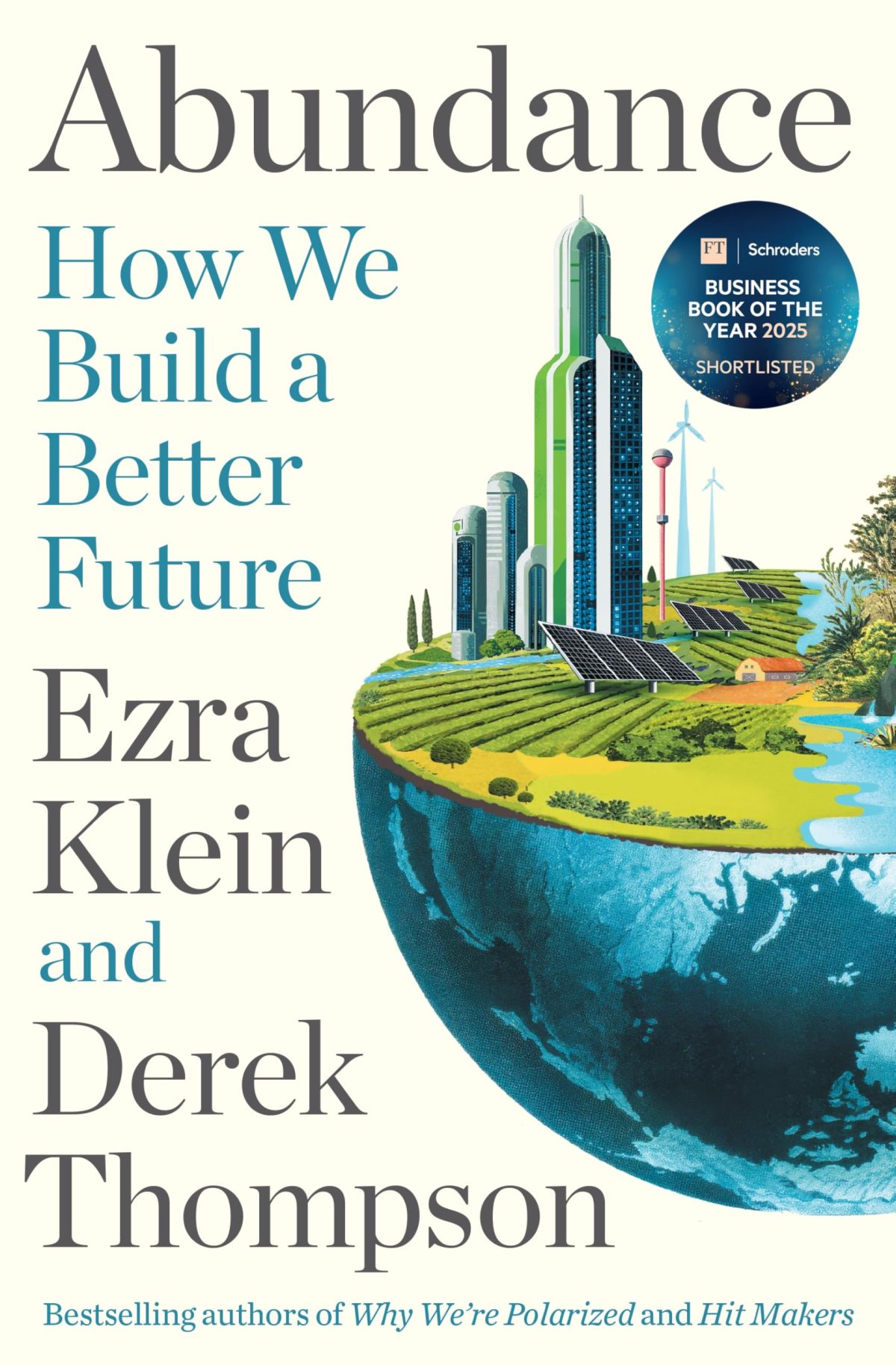
When I bought Abundance by Ezra Klein and Derek Thompson, I assumed it would be about creating a post-scarcity society. Instead, it’s about the supply-side progressivism. A post-scarcity society was a concept created by futurists and embraced by science fiction writers. It’s based on the idea that technology could produce such a surplus of everything that it would invalidate capitalism. It turns out supply-side progressivism (or the abundance movement) is somewhat related, but a smaller subset of post-scarcity.
The book Abundance originated with an essay by Klein in The New York Times and an essay by Thompson in The Atlantic. Before buying the book, I suggest reading those two essays and the Wikipedia entry. If you still feel a need to deep dive into this subject, the book is where to go. 40% of my Kindle edition is references and index. Klein and Thompson have done a massive amount of research.
Basically, Klein and Thompson are liberals attacking the government for too much regulation, and telling liberals that some of those laws designed to help people for liberal reasons are now hurting people that liberals also want to help.
The two cases Klein and Thompson focus on are finding homes for the homeless and for people who can’t afford one, and making healthcare more affordable. They go into great detail about how zoning laws are keeping us from solving the housing problem. The second focus is on how the federal government is now stifling innovation.
I agree that zoning laws keep us from solving housing problems, but I don’t think undoing those laws is possible or the full solution. I thought San Francisco was the wrong city to analyze, and considered Houston an unfair counter-example. San Francisco’s growth is limited by geography, and Houston has endless sprawl, so zoning may not be the defining factor.
I believe wealth and greed control zoning laws, and that’s not going to change. The American tech oligarchs have no trouble quickly building giant data centers, even when they face significant protests. I don’t think asking average Americans who are NIMBYs to become YIMBYs is a fair request. Or one that will bring about change.
I found their story of Katalin Karikó far more fascinating. I especially recommend chapters 4 and 5 on Invent and Deploy.
Karikó spent years submitting research proposals to study mRNA, which were routinely rejected because those who decided who received research grants didn’t think mRNA was worth studying. Yet, years later, her research led governments and pharmaceutical companies to develop Covid vaccines within one year, even though it normally takes years to develop a new vaccine.
Klein and Thompson praise the quick development of the mRNA vaccine under the Trump administration and wonder why Trump never took credit for it. They guess that Trump didn’t want to promote a huge success for big government, and a success for vaccines to his anti-government, anti-vax followers. They do recommend the book Warp Speed: Inside the Operation That Beat COVID, the Critics, and the Odds by Paul Mango. It proves how successful governments can create abundance when the need arises.
Klein and Thompson show how the federal government wastes huge amounts of money on scientific research through its current procedures and often backs the wrong research. They give a history of how the federal government was successful in the past but is now confined by policies and regulations.
Modern liberal politics is made possible by invention. Almost every product or service that liberals seek to make universal today depends on technology that did not exist three lifetimes ago—or, in some cases, half a lifetime ago. Medicare and Medicaid guarantee the elderly and poor access to modern hospitals, where many essential technologies—such as plastic IV bags, MRI and CT scan machines, and pulse oximeters—are inventions of the last sixty years. It is tempting to say that, with these essentials already in existence, it is time for society to focus at last only on the fair distribution of existing resources rather than the creation of new ideas. But this would be worse than a failure of imagination; it would be a kind of generational theft. When we claim the world cannot improve, we are stealing from the future something invaluable, which is the possibility of progress. Without that possibility, progressive politics is dead. Politics itself becomes a mere smash-and-grab war over scarce goods, where one man’s win implies another man’s loss.
The world is filled with problems we cannot solve without more invention. In the fight against climate change, the clean energy revolution will require building out the renewable energy that we have already developed. But decarbonization will also require technology that doesn’t exist yet at scale: clean jet fuel, less carbon-intensive ways to manufacture cement, and machines to remove millions of tons of carbon from the atmosphere.
In health care, the last few centuries of invention have turned a death planet—where disease ran rampant and, before 1850, one in two babies perished before their sixteenth birthday—into a world where people can look forward to generation-over-generation increases in life expectancy. But there are still so many mysteries that require fresh breakthroughs. We’ve made disappointingly little progress with many cancers. Complex diseases like Alzheimer’s and schizophrenia elude treatment or even basic comprehension. The cellular process of aging is a deep mystery. We still don’t have effective vaccines for adult tuberculosis or hepatitis C, or vaccine platforms that we can immediately scale up in the event of a new pandemic. Decades from now, our children may gawk in horror that people with chronic pain or lingering illness in the early twenty-first century couldn’t take a simple all-purpose saliva or blood test to answer the basic question Why do I feel sick? If disease is a universe of mysteries, we have scarcely explored one minor solar system of its cosmos.
Inventions that may seem outlandish today may soon feel essential to our lives. Streets filled with electric self-driving cars that give us mobility without emissions and free us from the vast number of deaths caused by faulty human reflexes or judgment. Gigantic desalination facilities that transform our oceans into drinkable tap water. An economy with robots that build our houses and machines that take on our most dangerous and soul-draining work. Wearable devices to scan our bodies for diseases. Vaccines that we can rub on our skin rather than inject at the end of a needle. As unrealistic, or even ludicrous, as some of these ideas might seem, they are not much more ludicrous than a rejected, ignored, and unfunded mRNA theory that came out of nowhere to save millions of lives in a pandemic. To make these things possible and useful in our lifetime requires a political movement that takes invention more seriously.16
So, where is that movement? Invention rarely plays a central role in American politics. In health care, for example, Democrats have spent decades fighting for universal insurance, while Republicans have consistently fought its expansion. But while the dominant fight in Washington is typically about how we buy health care, we rarely talk about the health care that exists to be bought. After all, in the future, progressives don’t just want everyone to have an insurance card; they want that card to provide access to a world of treatments that liberates patients from unnecessary disease and debilitating pain. Technology expands the value of universalist policies.
If progressives underrate the centrality of invention in their politics, conservatives often underrate the necessity of government policy in invention. “The government has outlawed technology,” the investor and entrepreneur Peter Thiel said in a debate with Google CEO Eric Schmidt in 2014, echoing a popular view among techno-optimists and libertarians that government laws mostly block innovation. But many of Silicon Valley’s most important achievements have relied on government largesse. Elon Musk is now a vociferous critic of progressive policy. But he has also been a beneficiary of it. In 2010, when Tesla needed cash to launch its first family-friendly sedan, the Model S, the company received a $465 million loan from the Obama administration Department of Energy.17 His rocket-launching company, SpaceX, has received billions of dollars from NASA under Democratic and Republican administrations. Musk has become a lightning rod in debates over whether technological progress comes from public policy or private ingenuity. But he is a walking advertisement for what public will and private genius can unlock when they work together.
Beyond merely regulating technology, the state is often a key actor in its creation. An American who microwaves food for breakfast before using a smartphone to order a car to take them to the airport is engaging with a sequence of technologies and systems—the microwave, the smartphone, the highway, the modern jetliner—in which government policies played a starring role in their invention or development. Federal science spending is so fundamental to the overall economy that a 2023 study found that government-funded research and development have been responsible for 25 percent of productivity growth in the US since the end of World War II.18 “There is widespread agreement that scientific research and invention are the key driver of economic growth and improvements in human well-being,” the Dartmouth economist Heidi Williams said. “But I think researchers do a poor job of communicating its importance to lawmakers, and lawmakers do a poor job of making science policy a major focus.”19
The pandemic proved the necessity of invention yet again. The mRNA COVID vaccines saved millions of lives and spared the US more than $1 trillion in medical costs.20 But they might have never existed if it weren’t for Karikó’s force of will—and the cosmic luck of an extremely well-placed Xerox machine.
Klein, Ezra; Thompson, Derek. Abundance (pp. 134-137). Avid Reader Press / Simon & Schuster. Kindle Edition.
Ultimately, Abundance brings little hope. I think the book showed too many examples of how we can’t create abundance and why. It thoroughly convinced me that our current political evolution is in the wrong direction.
Yes, Katalin Karikó and mRNA are shining examples of what’s possible, but one great example does not prove that change will happen. All the other examples Klein and Thompson used were from history, suggesting that Americans will step up to the plate when they face a great challenge, but not in ordinary times.
AI and data centers are a major challenge, and we aren’t stepping up. Please read “How the American Oligarchy Went Hyperscale” by Tim Murphy. Greed drives us. Klein and Thompson even use examples of how monetary prizes can be used to solve problems.
The Tech Bro Oligarchy promises a post-scarcity society with AI, which is the kind I was expecting the book Abundance to be about. But I don’t believe in that kind either. At 74, I doubt the pie-in-sky dreams science fiction promises. Just because we live in science-fictional times doesn’t mean they’ll lead to science-fictional futures.
AI-generated abundance will ruin us. Old-fashioned human-generated abundance is possible, but greed will always keep the wealthy from sharing it.
p.s.
This essay was not written with any help from AI. All the ideas are my own. But are they? My ideas come from reading books and magazines. I train my mind on information just like AIs are trained. I’ve cancelled my AI subscriptions. I’m putting that money into buying more books and magazines. Reading Abundance did me more good for my mind than reading what AI has to say about it. Gemini produced excellent summaries, but they didn’t stick in my mind.
Grinding through the book word by word will not help me remember everything, but I do think it helps me remember more than reading AI summaries. But in the long run, what’s important to remember is that we could live in a saner, more compassionate society.
JWH

