I Wish I Had a Time Machine to Rescue My Dad

by James Wallace Harris

One of my favorite idle fantasies is to imagine how I would relive my life if my current mind could reincarnate into my younger self. Variations of this fantasy have included using a time machine to jump back in time to warn my younger self about the future, although I doubt young Jimmy would have taken older Jim’s advice. This week I’ve been struggling to remember everything I could from 50 years ago, and a new fantasy has occurred to me.

What if I had a time machine so I could go back and rescue my dad instead of me?

I know such fantasies are impossible, so why waste my time on them? But the science fiction reader in me loves the idea of creating my own alternate histories by playing “What if?” The challenge to these fantasies is to find the right point in time to divert the time stream. It occurred to me this morning that the moment to rescue my father was in the summer of 1967, but first I guess I should explain why my father needed help.

My father died in 1970 at age 49 when I was 18. My mother and father were alcoholics. My father was a steady drinker, but my mother would only hit the bottle in times of stress from her bipolar swings. My father loved being in the Air Force but was forced to retire after 22 years when he had a heart attack in 1964. Sitting at home without work made him drink more. Dad recovered, went back to work and had another heart attack. Dad recovered again, went back to work, and had a stroke. He even recovered from the stroke before he died of his final heart attack.

My father also had emphysema in his last years, requiring oxygen. But he continued to chain smoke Camels, eat meat and potatoes, and drink Seagram 7 all day long. His death certificate reported that his liver, lungs, appendix, and stomach were shot to hell. I’ve always figured his heart was very strong to survive all that. It made me wonder if he had ever tried to get healthy if he could have survived into old age. Or at least long enough for the two of us to get to know each other.

But my dad was not a happy man. When I was a kid I used to ask myself, “Was my father a drunk because my mother bitched all the time, or did my mother bitch all the time because my father was a drunk?” I’ve never blamed my parents about my upbringing. I survived by being totally selfish, and I figured it was every family member for themselves. Now that I’m older I feel guilty for being so selfish. I know as a kid I didn’t know enough to help them, or even how to be a better person myself. I just survived the best I could. I really don’t blame my parents, but I don’t think they were suited to have children.

Over the last few decades, I’ve come to believe that I and my sister were the main sources of my parents’ unhappiness. We just weren’t what they expected, and any effort to shape us into what they wanted only caused them endless suffering. Of course, it wasn’t easy on me and Becky either, but our youth gave us a vitality to survive. My father just couldn’t handle the emotional conflicts. My mom got better after my father died, especially with 1970s anti-depressants, but she suffered endless unhappiness for the rest of her life, mostly from trying to make Becky and I do what she wanted.

The photo above is my only proof that my parents were ever happy. It was taken in 1949 before they had me and Becky.

Over the decades I’ve tried to reconstruct who my dad was from memories of the people who knew him, but I’ve had little luck. I’m not sure I’ve ever gotten to talk with anyone who really knew him, and that includes my mother, who died in 2007. My father wasn’t much of a talker. He might have been before I knew him, but I now believe my mother, sister, and I drowned him out.

I have just 23 photographs of my father. All but three were taken before I was born, and two of those were with me as a toddler. I have no photographs of my father with my sister.
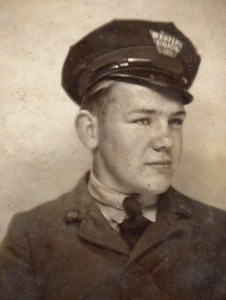
1936---George-Harris-photoshoppedMy father was born in Nebraska, in 1920, but moved when he was a little kid to Miami by 1923. He attended Miami Edison High School, but I’m not sure if he graduated there. I have a photo of him dressed for graduation that was taken in Homestead, Florida. Dad graduated in 1938 and I have his class photo, but I’m not sure if he graduated from Edison. I know he attended Edison for a while because I have a newspaper clipping about his class project. I know he worked as a Western Union delivery boy in high school because I have a photo of him in uniform from 1936. I have photos of my father in the service in 1942, but I’m not sure what he did between graduating in 1938 and joining the Army Air Corp in 1942. My father stayed in the Air Force after the war and married my mother in 1945.

My parents were first stationed in Washington, DC, and then Puerto Rico. I have several photographs of my mother and father living on the island and looking very happy. And when I was young they often talked fondly of life in Puerto Rico. I was born on the 6th wedding anniversary on November 25, 1951. There are two photographs of me with my father when I was a toddler, probably in 1952. The next and last photograph I have of my father was from Thanksgiving 1969. It’s blurry and everyone is almost unrecognizable. He died six months later.

I remembered something this morning that made me think the perfect time to rescue my dad would have been in the summer of 1967. 1964-1966 were bad years for my parents, and they separated from September 1966 to March 1967. My mother took me and my sister to live in Charleston, Mississippi to be near her family. We returned to Miami in March 1967 to live on West Trade Avenue, in Coconut Grove, Florida. I guess my father was trying to get his act together. He also started computer classes. I remember him coming home from class and telling me about how punch card codes worked. However, it wasn’t long before my mother and father were fighting again. And my mother and father were both on my sister case, and she was having none of it. I remember a lot of family fights. I tried to stay as far away from my family as possible. I slept on the screened-in back porch with the clothes washer. I had my radio, record player and science fiction books.

This would have been a perfect time to have tried to get to know my father. I don’t know if I could have convinced him to eat right, give up smoking and drinking, and maybe even exercise, but maybe he would have considered it on his own if someone had shown any interest in his life. I think he drank because he was lonely.

Taking computer classes in 1967 was a great time to break into the field. I started computer classes in 1971. If I had studied with him I would have had a great headstart too. We could have gotten to know each other. Maybe he would have tried harder.

Generally, when I have my time travel fantasies I’m thinking of time periods to change my life. Over the years I’ve decided the best time for me was the fall of 1963. If I could have talked my parents into letting me live with my grandmother instead of moving with them to South Carolina I believe my life would have been significantly different. In the fall of 1963, I went to three different 7th grade schools. I’ve always wondered what my life would have been like if I had lived in one place from 7th grade through the 12th. But now I see the pivotal moment in time for my dad was the summer of 1967.

I know we only get one life to live. There are no do-overs. I’m not religious, and I don’t believe in heaven. But I’ve long thought the idea of reincarnation was a wonderful concept, but not how the Hindus imagine it. I’ve always thought we should reincarnate in our own lives and have another chance of getting it right.

My father always worked two and three jobs. I hope he had great friends in the service. I know he loved bartending at NCO clubs and VFW clubs. He loved running bars, and I got to visit in some in those bars. I hope he had friends. I often wonder if he and his buddies consoled each other about wives and kids that didn’t understand them. But I’m not sure. Sometimes I imagine my father always being tight-lipped. Just holding it in.

I can only remember a handful of conversations I had with my dad. One time we were watching The Today Show before he took me to school and he went to work. This was also in that summer of 1967. They mentioned The Hobbit and my father said he knew about Bilbo Baggins. I didn’t know who Bilbo was at that time but remembered my dad saying that name, Bilbo Baggins, later when I finally read The Hobbit. It made me wonder what books my father read, what dreams he had about the future. He grew up in the heyday of the pulp magazines and old time radio. I wonder what stories and heroes he loved.

My father loved the military, and in 1967 I was very anti-war. I remember once my dad calling me a commie-pinko-faggot in anger. His dream for me was to join the ROTC and become an officer. I was having none of that. I ruined his fantasy for me. I later thought he should have been mature enough to understand me because I was too immature to understand him. But that was all part of the great generation gap. If my dad had lived he would have been a Fox News kind of guy. I don’t think we would have ever bridged the generation gap.

However, if I ever get hold of a time machine, I would try.

1969---Last-photo-of-Dad

JWH


How Accurately Can I Remember 50 Years Ago?

by James Wallace Harris, Saturday, February 16, 2019

2019 is the 50th anniversary of my graduating high school in 1969. I attended three different high schools in two states from 1966 to 1969. I’ve been looking at their yearbooks which has triggered a flood of memories. That is inspiring me to write a series of essays in lieu of attending my high school reunion. The process of struggling to remember and validating my memories with evidence has unleashed emotions and revelations that reflect a new honesty about myself. This is my third attempt to write about this experience. I keep bombing out when the essays got too long and complicated. So I’ve decided to cut them up into thematic chunks. I’ve toyed with writing “50 Lessons From 50 Years Ago” because I’ve remembered at least fifty scenes from the past that are worth an essay each, with more burbling out of my unconscious every hour. I’ve either stumbled upon a psychological fountain of wisdom, or a wriggling can of worms.

As my current ability to remember becomes iffier, and access times get longer, the whole topic of memory has become a siren call of fascination, even obsession. This week as I’ve worked to remember 50 years ago, I had many revelations about myself, some unpleasant and unflattering. An essential insight is I might be different from most other people. Because my family moved so much as a kid, I have always been hung up on recalling the past because I was always remembering friends, homes, and schools I just left. I envy people who never moved. My friend Linda, who is working with her 50th-anniversary reunion group is also in charge of the 1st-grade reunion. She told me recently she’s in contact with 9 of her 15 classmates from her first grade. That blows my mind. I can’t remember a single classmate from grades 1 through 3. And I can’t remember now if I went to four or five schools in those first three grades. I do remember living in 7 houses during those years.

This first essay will be about the limits of memory and evidence. To put it bluntly, our memories are flawed and unreliable. Whole books have been written about that. My favorite is Jesus Before the Gospels by Bart D. Ehrman. Don’t be scared off because it’s about Jesus, Ehrman takes a historical approach and spends most of the book talking about how we remember. Describing someone from 2,000 years ago tests the limit of memory and evidence. I’m just trying to remember who I was 50 years ago and a few friends. Supposedly I should have been the best eye witness. I probably wasn’t. After reading through the yearbooks I went searching for more physical evidence. I found very little.

The photo above is from my 10th-grade yearbook, The Warrior when I attended East Tallahatchie High School in Charleston, Mississippi from September 1966 through the beginning of March 1967. I’m the guy in the striped sweater. Except for the teacher I can’t recall any of those other science club members. So far I’ve only found three photos of myself from 1966-1969. That’s scant evidence. I thought I had a few old report cards my mother saved, but I can’t find them. I have no diaries, journals, or other physical evidence. I had more physical evidence, but in the 1970s, went through a Buddhist phase and got rid of all my possessions that triggered memories. God, I wish I had that stuff now, what a jackass. At the time I wanted to free myself from thinking about the past.

The Yardsticks of Memory

There are two primary ways to reconstruct the past. The first is memories. The second is physical evidence. But I needed a standard unit of measurement, a yardstick to lay against both memory and evidence. Or I needed anchors in the past to work out from. I’m slowly developing several:

  • How many people did I know and how often did I talk to them? This involved recalling names and finding photographs and giving myself the third-degree about how deeply I interacted with these people.
  • What was I required to do every day? What were my routines?
  • What did I want to do with my free time?
  • What did I hope to do? What were my plans for the future?
  • What events can I document on Google that I remember attending?
  • Where and what did I eat at my three meals?
  • What TV shows did I watch?
  • What books did I read?
  • What movies and concerts did I go to?
  • How did I commute to work and school?

I’ve decided not to attend my reunion because digging through the yearbooks convinced me I knew too few classmates. I realized while contemplating this whole high school reunion thing, that I can measure my high school years by how much I talked to the different people. Today I can name damn few people I got to really know back in high school. I wasn’t particularly shy. I’m fairly confident that I learned all the names of my classmates in every class. I paid that much attention. People would talk to me and I’d talk to them, but it was all casual chit-chat that’s been forgotten. I remember several girls in each class that triggered sex fantasies to alleviate the boredom of lectures. Some of them actually like talking to me. However, I only actually dated only one girl for a couple of months, and I can’t remember one distinctive thing she said to me. I found damn few kids in my memories that liked to talk about what I liked to talk about, which was science, science fiction, the future, and NASA’s efforts at space travel. I did gab daily with folks about cars, television, movies, and rock music because those were the lowest common denominators of pop culture back then. I didn’t like talking about sports or school activities or gossiping about the other kids.

I still chat on the phone several times a week to my oldest friend, Jim Connell. We met at Coral Gables High School, my second high school, in 1967. So he wasn’t part of my graduating class, but Connell was the person I spent the most time with back then. We were also pals with George Kirschner. George is probably the second person I spent the most time talking to during my high school years. We three loved science fiction, and we had each had rejected our Protestant, Catholic, and Jewish upbringing. I was into the counter culture, George was the know-it-all with a more sophisticated upbringing, and Connel was adventurous but shy and loved the ocean. We all loved science.

My family moved from Coconut Grove, Florida to South Miami when I was in the 11th grade, and I finished out high school at Miami-Killian Senior High. However, I kept my job in Coconut Grove until the last week of November 1968. That kept me tied to some of my friends that still went to Coral Gables High School, but it meant a long daily commute to work. Remembering this made me realize I had friends at two high schools and a job so that meant a lot more names and conversations to recall.

It also made me realize that I did a lot of traveling every day and I didn’t own a car. Just trying to remember how I got from place to place is unearthing all kinds of memories. Google Maps tells me from home to Kwik Check was 16.1 miles via Old Cutler Road, and would take 37 minutes. Here’s a memory puzzle. I think my mother and father each had a car, but I didn’t. They both worked. I remember a 1967 Pontiac Tempest and vaguely remember a much older Mercury. I think sometimes I’d go to school on the bus, or catch a ride with Tim Green. Miami-Killian was between home and work. And then I’d hitch-hike into the Grove, but I don’t think I did that often. I only vaguely remember driving to school a few times, but what I really remember was loving the drive home after work. I’d be hot and sweaty after working six hours. My end-of-the-night tasks were sweeping and mopping the floors, cleaning the bathrooms, and incinerating the out-of-date food. I’d buy two 16-ounce Cokes after work and drive home via the Old Cutler Road, which was dark and lined with ancient looking trees. I’d have the windows down and play the radio very loud. I love the time I had to myself driving home. It was the only time I wasn’t rushing. So my assumption is my parents would lend me their cars. But I have no memory of discussing who’d take the car each day, or how they got to their jobs.

Nor do I remember much about my sister Becky’s life back then. She was two years younger than me. When I started the 12th at Miami-Killian she started the 10th, but I have no memory of which junior high schools she attended in Gables or South Miami Heights.

And this makes me remember something else. To many, high school is 9th through 12th, but in Miami, junior high was 7th through 9th and high school 10th through 12th. So if I’m recalling the details of my high school years, do I think of four schools or three, or four homes or three? Because recalling the 9th grade is a whole other memory era for me, and a different group of friends.

This quicksand trap is teaching me about memory. Every time I find a piece of evidence, remember a name, think of an activity or recall an event, I trigger memories around them. It feels like it’s all there, I just need to find the hook, or thread of the web and follow it. It boggles my mind to think that chemical etchings in my brain stores all these memories.

Now that I’m working out the framework for finding memories, I want to pick an individual memory and reconstruct it in depth. I know there was the reality to my life fifty years ago, but it was all perceptual. There was the person I wanted to be, the person I thought I was, the person other people saw, and they were all different. And my parents and teachers wanted me to be different people with different futures, and I wanted to be something I could never be.

One of the hardest things to remember is my realistic expectations about the future. I remember countless unrealistic expectations, but how often did I make realistic decisions and plans? Stay tuned for part 2.

JWH


Archiving the Past for the Future

Are you throwing away history? How you perceive yourself is determined by what you remember. How society remembers itself is through histories. Histories are written based on the evidence the past leaves for the future.

If our eyes and ears were a video camera, each day we take in several terabytes of information, yet we remember very little. Our brains decide to throw away most of our sensory input. How many commutes to work or school can you remember? There are many theories as to how we select what to save, but I don’t science has found a consensus yet. We can’t recall the past with TiVo-like utility. Our memories are vague impressions squirreled away inside our heads. Most people don’t have photographic memories, much less video-graphic. This is also true of historians, they only have tiny incomplete fragments of the past.

Now that we’re entering into the Marie Kondo phase of our lives, many of us are throwing away the physical evidence of what we’ve done at the same time many of us have become interested genealogy. If you’ve ever watched Finding Your Roots you know how important physical records are for reconstructing the past. What’s true for individuals is even truer for society.

My father died when I was 18, and I’ve often wished I had more evidence of his life to figure out who he was. I don’t have that evidence, but I wonder if it exists elsewhere. I’ve also wanted more evidence of my own life to remember who I was. I’ve spent a good deal of time reading about world history, trying to put together a consistent memory of our past. Too much of history is opinion because we don’t have enough hard evidence.

The current decluttering mania teaches us to categorize our discards into three piles: Keep, Give Away or Sell, or Throw Away. I believe we should keep an eye out for a fourth category – Save for History. When we hold an object and ask ourselves, “Does it bring me joy?” we should also ask, “Could future historians use this?” The trouble is, what is of historical value, and who do we give it to?

Any document that connects people to events might be valuable. Of course, ticket stubs to a Bob Dylan concert might only help you remember where you were on a night in 1978. But what about a schedule of speeches for a conference? Or an old menu saved for sentimental reasons? Or a video of a family reunion? Or a catalog from an art exhibit? Anything that might help other people remember might be worthy to save.

We need to think about how we remember who we are as a society and what artifacts to save? I’m currently reading Leonardo Da Vinci by Walter Isaacson and I’m amazed by how much information we have about people who lived over five hundred years ago. Few of us have that kind of information even if we wanted to write our own autobiographies. Evidently, people who get into genealogy learn what’s important to identify people connections. And anyone who has written up an event or documented a house for sale knows about the importance of supporting facts.

What evidence should we save today about our past to help people in the future understand us? I’ve acquired a new hobby of scanning old magazines and fanzines. There are hundreds, maybe even thousands of people digitizing popular culture and uploading it into libraries, and sites on the internet like Internet Archive. However, like our own minds, we have to decide what tiny bit is worth saving, and what massive amount of junk is not. We’re actually Marie Kondoising our culture every day.

The next time you have a box of junk to throw out, don’t just ask if each item gives you joy, but would it give a future historian joy too.

One kind of evidence I ache to have for my own personal history are photographs. I wish I had pictures of all my schools and classmates since kindergarten. I also wish I had photos of all the houses I’ve lived in, their yards, and of each room. My father was in the Air Force and we moved around so much that I can’t remember all the houses I lived in or the schools I attended. I wish I had evidence to recreate that knowledge. In other words, I wish I had documentation to support my memory. There’s a chance that other people photographed what I wanted. It’s a shame we don’t have a photograph database, especially one controlled by artificial intelligence with machine learning.

PBS - Finding Your Roots with Henry Louis Gates, Jr.Most of us do not have evidence that will matter to historians, but you never know. And even if we did, how do we pass it on? If you’re a famous person you can donate your papers to a library. One thing us ordinary folks can do is to share photographs with relatives, or anyone who is pictured in the photographs. I have some old school yearbooks that I’m going to scan and upload to the Internet Archive. Yearbooks are starting to show up there. I keep hoping yearbooks from schools I went to that I don’t have will show up. Classmates.com has yearbooks for a fee, and I use it, but I think this information should be public. Eventually, items in the Internet Archive, which hopes to save everything digitally, will be churned through by AI and data miners, and there’s no telling what kind of results will turn up. I highly recommend watching the PBS show Finding Your Roots to see how sleuthing personal histories work.

I’m also scanning and uploading old fanzines to Internet Archive. It’s a skill that takes a little work to acquire, but I like rescuing these old documents. I worked in a library while going to college, and one of my jobs was finding missing issues to make whole volumes to bind. I’d send snail mail requests around the world to track down lost/stolen issues. Now, I get on eBay to look for missing issues to scan.

I haven’t gotten into genealogy yet, but I’ve thought about getting into that hobby just learn what kinds of things people save. I’m just getting into this idea of what to save for history. I know I don’t have items for big history, but I wonder if I have little clues that other people want for their small histories.

JWH

CBS All Access – A Failed New TV Paradigm

by James Wallace Harris, Saturday, February 9, 2019

Watching TV shows has gone through a number of paradigm shifts.

  1. Broadcast – watch a limited set of shows by a schedule – free
  2. Cable – watch expanded lists of shows by a schedule – costly
  3. VCR – watch shows by your schedule – the clutter of tapes
  4. DVR – watch shows by your schedule – no clutter
  5. Streaming – watch shows on demand without a schedule
  6. DVD – collect and own shows
  7. Library – watch shows without owning media. This is where CBS All Access fails.

Recently I decided to watch every episode of Perry Mason from start to finish. Here’s how it would have worked under each paradigm.

Broadcast: Back in the 1950s if I wanted to watch every episode of Perry Mason I needed to be at my TV set each week and it would have taken nine years to finish. Eventually, it was syndicated and I could have caught all the shows if I was diligent.

Cable: Starting in the 1970s, cable brought back many old shows, sometimes airing them multiple times a day. It became easier to eventually catch every episode of a TV series, but it still took months.

VCR: With a videotape machine it was possible to let the machine do the watching on the schedule, and then binge watch when in the mood. A big step forward, but the video quality of videotape was never very good, and managing all those tapes was a pain in the ass.

DVR: Recording to a hard drive was much nicer than messing with tapes. However, DVRs limited the number of shows you could keep on hand. I was watching Perry Mason on my TiVo last year recording the shows off of MeTV. But I could only keep so many without filling up my drive. This was a hybrid of broadcast/DVR that wasn’t really satisfactory because I don’t get good reception, and I couldn’t keep the shows.

Streaming:  I don’t remember Perry Mason ever being on Hulu or Netflix, but it could have been. Watching old TV shows via streaming depends on which service has the rights to stream at the moment. Shows don’t stay permanently on any single streaming service but jump around.

DVD: I could have bought the entire Perry Mason series on DVDs. But I’ve gotten so I hate owning crap, so I figured I’d give CBS All Access a try.

Library: When I first heard about CBS All Access it seemed to promise access to every TV show CBS ever broadcast. I assumed if there were enough CBS shows I wanted to watch like Perry Mason it might be worth paying them $10 a month for life so I wouldn’t have to buy DVD sets of everything. They are starting to pile up, and I really don’t want to be a DVD librarian. CBS All Access appealed to me as a permanent streaming library of shows I could depend on.

But CBS All Access has failed me. It doesn’t offer anything like all the shows it broadcast, and its Perry Mason collection is only partial. I thought it had the first 5 seasons. I subscribed thinking maybe by the time I watched those five seasons it will have added seasons 6-9. Then I discovered in season 2 they were skipping episodes. I know this is terribly anal of me, but that bummed me out. My goal was to watch every episode in order and yesterday I came to a roadblock at Season 2 Episode 18. Damn!

CBS apparently wants to compete with the Netflix model. But there’s only so many streaming services that I can afford. CBS All Access doesn’t have the massive catalog that Netflix has, nor does it have anywhere near the number of original programming shows. It can’t be Netflix. But I thought it might be a new paradigm. A large library of complete TV shows that never changed. Instead of buying several DVD sets of complete series, I was hoping that CBS Access would have enough shows to keep me busy for years and let me feel I had a permanent library of shows to access at will.

I often read about an episode of a TV show and want to watch it. I thought CBS All Access would be a new paradigm of TV, a permanent library of TV shows I could reference at ease.

CBS All Access fails at this potential new paradigm. Here are some of the CBS shows I expected to see in its permanent library – the ones I remember from growing up:

As I get older I feel a nostalgic need to watch old shows now and then. My TV watching fell off after 1970. There were many later CBS shows I’d love to see again, like Northern Exposure, but I don’t feel like going through 1971-2019 TV seasons on Wikipedia to find them. But this gives an adequate sample list of what I expected from CBS All Access.

It should have been called CBS Partial Access. Here’s what I wished CBS had offered:

CBS Television and Library – $9.99/month

  • Live Broadcast mode – with commercials
  • Binge Watching mode – complete series without commercials
  • Time Travel mode – Pick and date and time and watch shows from that date with original commercials, including news programs.

JWH


Creating v. Consuming

by James Wallace Harris, Saturday, February 2, 2019

Back in the 1970s when I used to visit New Age seminars I met a woman who claimed there were two types of people in this world: those that create and those who consume. I thought that was an interesting distinction, but probably bullshit. But every now and then I think about it. Most people read books, few write them. Most people listen to music, few play it. Yet, even a brilliant writer is a consumer when it comes to music, television, music, and even books too. And being creative doesn’t mean being an artist. Anyone with a job creates.

Since retiring I’ve thought about this insight differently. Without our 9-to-5, we spend a whole lot more time consuming and less creating, unless we have a hobby, volunteer, or pursue some other creative outlet. Cleaning house is creative – you’re making order out of chaos, but do you feel that when you do your chores?

I realize much of my happiness comes from waking up and thinking of something to do each day. Yesterday I wrote “Fantastic Universe (1953-1960)” which involved making almost 200 links to the web and the gathering of many facts. In the big scheme of things, this tiny bit of creative effort isn’t very important, but it gave me something creative to do. Creative not in the sense of Picasso, but in the sense of not consuming.

It made me happy. I know retired people who are restless, and even unhappy. They don’t know what to do with themselves. Even knowing what I’m saying here, it’s very hard to just pick something to do. Creativity, no matter how mundane, requires a drive. Having a drive to blog makes me lucky. I can’t tell my restless friends to start blogging. It won’t work if they don’t have the drive.

The morning, The New York Times presented “The Queen of Change” by Penelope Green about Julia Cameron and her classic book The Artist’s Way. Most people who read this book do so because they want to pursue a traditionally creative endeavor. But, could her approach work for finding mundane creative endeavors in retirement? Most people seeking to be creative want to be successful artistically. But is that really important? Isn’t merely being creative at anything worthy in itself? Maybe my restless friends should read it.

I am still a big consumer. I actually love consuming movies, TV shows, music, books, essays, and short stories. It’s just unfulfilling to do it all the time. I think we need a certain amount of time when we’re creating, but I don’t know if it has to ambitious creativity. Piddling at something you love can be all the difference between happiness and unhappiness.

I’ve come to realize that I’m a happy person because when I wake up in the morning I start thinking about things I want to do. I worry about my friends who aren’t lucky that way. I’m afraid if I try to judge the worthiness of my piddling activities my happiness will break. I wonder if my unhappy friends kill their drive to do something because they deem it unworthy before they even try?

JWH